
What Is Concrete Made Of? Ingredients, Proportions and the Science of Hardening
Quick Answer
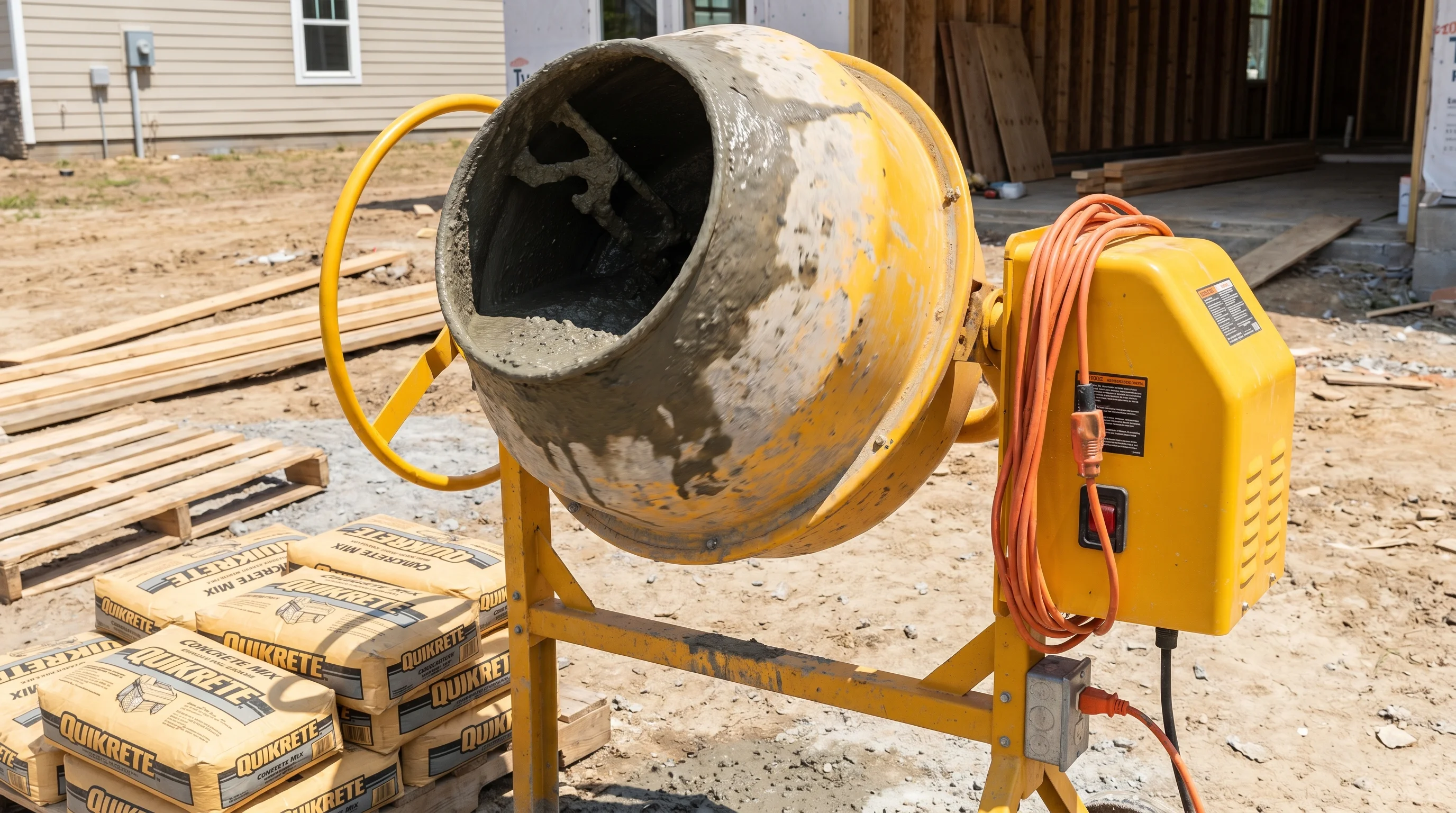
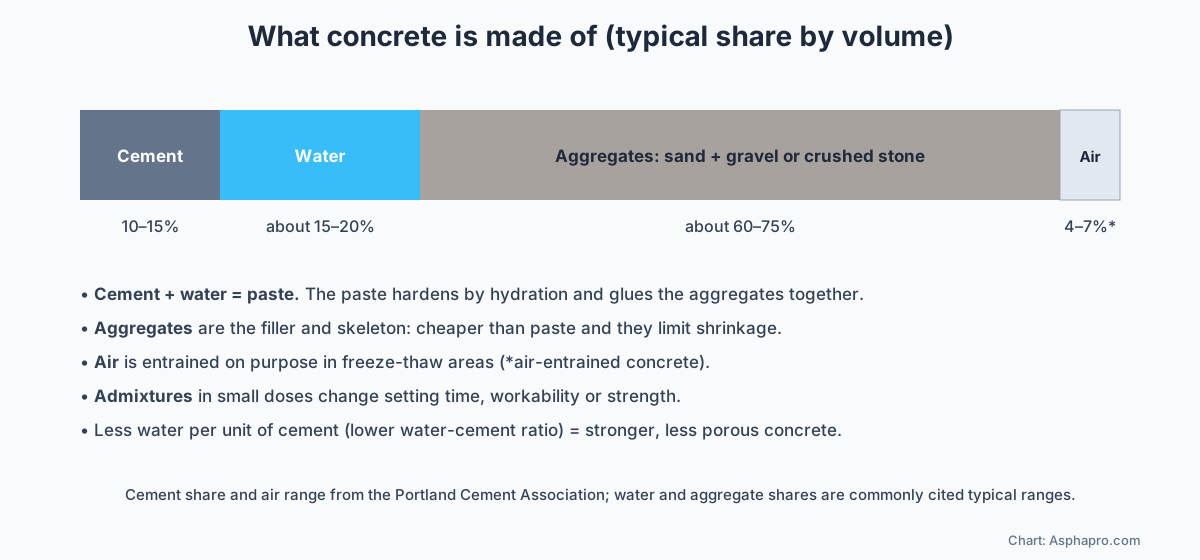
Concrete is made of portland cement, water, and aggregates (sand plus gravel or crushed stone), often with a little entrained air and chemical admixtures. Cement typically makes up 10 to 15% of the mix by volume (Portland Cement Association), aggregates make up most of the rest, commonly cited as about 60 to 75%, and water about 15 to 20%. Air-entrained concrete has about 4 to 7% air. Cement and water form a paste that hardens through a chemical reaction called hydration, gluing the aggregates into a rock-like mass. Cement and concrete are not the same thing: cement is one ingredient of concrete, like flour in bread.
Concrete is the most widely used building material in the world. It is in sidewalks, driveways, foundations, bridges, dams and skyscrapers. Yet many people use the words "cement" and "concrete" as if they mean the same thing, and few know what actually goes into a truckload of concrete or why it gets hard.
This guide explains what concrete is made of, what each ingredient does, typical mix proportions, how cement is made, whether concrete and cement are the same thing, what the gravel in concrete is for, whether concrete is porous, what slump value means, and whether concrete is a pure substance or a mixture.
The Ingredients of Concrete
What is concrete made out of at its simplest? Rock, sand, cement and water. The cement and water form a paste that coats the rock and sand and hardens into one solid mass.
1. Portland cement
Portland cement is a fine gray powder and the "glue" in concrete. On its own it does nothing; when mixed with water, it reacts chemically and hardens. The Portland Cement Association (PCA) notes that cement typically makes up 10 to 15% of the concrete mix by volume. Even though it is a small share, it is the most expensive and most energy-intensive ingredient. Other cementitious materials, such as fly ash, slag cement and silica fume, are often used to replace part of the portland cement.
2. Water
Water starts the chemical reaction with cement and makes the mix workable enough to place and finish. Only part of the water is needed for the reaction; the rest is there to make the concrete flow. Extra water makes concrete easier to pour but weaker and more porous when it hardens. Water should be clean and drinkable-quality, without oils, acids or high salt content.
3. Fine aggregate (sand)
Sand fills the spaces between larger stones and, together with the cement paste, forms the mortar part of concrete. Concrete sand is clean, coarse and well graded, meaning it contains a range of particle sizes. Fine beach sand and play sand are generally not suitable without testing, because of salt, rounded shapes or uniform size.
4. Coarse aggregate (gravel or crushed stone)
Gravel or crushed stone, usually from about ⅜ inch up to 1 or 1½ inches in residential concrete, forms the skeleton of the concrete. It takes up most of the volume, carries load, and reduces how much expensive cement paste is needed.
5. Air
All concrete contains some trapped air. In climates with freezing and thawing, producers add an air-entraining admixture that creates billions of tiny, evenly spaced bubbles. PCA notes entrained air is usually between 4 and 7% of the volume. These bubbles give water in the concrete room to expand when it freezes, which greatly improves resistance to freeze-thaw damage and deicing salts. See does salt damage concrete.
6. Admixtures
Admixtures are chemicals added in small amounts to change concrete's behavior:
- Water reducers and superplasticizers: make concrete flow with less water, so it is stronger.
- Accelerators: speed up setting and early strength, useful in cold weather.
- Retarders: slow setting in hot weather or for long hauls.
- Air-entraining agents: create freeze-thaw protection.
- Fibers: synthetic or steel fibers help control plastic shrinkage cracking.
- Color pigments: iron oxide pigments for colored concrete.
Typical Concrete Mix Proportions
| Ingredient | Typical share by volume | Role |
|---|---|---|
| Portland cement (and other cementitious materials) | 10–15% (PCA) | Binder; reacts with water |
| Water | about 15–20% | Reaction and workability |
| Sand | part of the 60–75% aggregate share | Fills gaps; forms mortar |
| Gravel / crushed stone | part of the 60–75% aggregate share | Skeleton; strength; economy |
| Entrained air | 4–7% in air-entrained concrete (PCA) | Freeze-thaw protection |
| Admixtures | very small doses | Adjust setting, flow, strength |
For small DIY batches, a classic rule-of-thumb mix by volume is about 1 part cement, 2 parts sand and 3 parts gravel, with enough water to make a workable mix. Ready-mix plants design mixes by weight to hit a specified strength, such as 3,000 to 4,000 psi for many residential slabs and driveways. See concrete price per yard and how much a yard of concrete weighs.
How Concrete Is Made: From Cement Kiln to Mixer
How is concrete made, start to finish? First, cement is made in a kiln at a cement plant. Then a ready-mix plant or a contractor weighs out cement, sand, stone, water and admixtures and mixes them, either in a central mixer or in the drum of the truck on the way to the job.
According to the PCA, portland cement is made by combining crushed limestone and other materials, such as clay, shale, sand and iron ore, which supply calcium, silicon, aluminum and iron. Lime and silica make up about 85% of the ingredients. The raw mix is heated in a rotating kiln to about 2,700°F, where it partially melts and forms new compounds called clinker: gray balls about the size of marbles. The clinker is cooled and ground with gypsum, which controls setting time, into the fine powder sold as cement.
Heating limestone releases carbon dioxide, and the kiln burns a lot of fuel. That is why cement production is a significant source of global CO₂ emissions, and why the industry is using more supplementary materials like fly ash and slag, and blended cements such as portland-limestone cement.
Are Concrete and Cement the Same Thing?
No. This is the most common mix-up. Cement is an ingredient; concrete is the finished material. PCA puts it simply: portland cement is the basic ingredient of concrete, and concrete forms when cement makes a paste with water that binds sand and rock together.
- Cement: fine powder, sold in bags, never used alone for structures.
- Concrete: cement + water + sand + gravel. Used for slabs, foundations, driveways, walls.
- Mortar: cement + sand + water (plus lime), no gravel. Used to bond bricks and blocks; see mortar vs concrete.
- Grout: a fluid cement mix used to fill gaps and cores.
So a "cement sidewalk" or "cement truck" is really a concrete sidewalk and a concrete mixer truck.
How Concrete Hardens: Hydration
Concrete does not harden by drying out. It hardens through hydration, a chemical reaction between cement and water. The main compounds in cement react with water to form calcium silicate hydrate (often written C-S-H), a gel that grows into a dense network of tiny crystals binding everything together, plus calcium hydroxide. The reaction gives off heat and continues for weeks, months and even years as long as moisture is present.
That is why concrete must be kept moist while curing. If it dries out too early, hydration stops and the concrete never reaches its full strength. Concrete is commonly specified by its strength at 28 days. See how long concrete takes to cure.
What Is the Gravel (Wet Rock) For in Concrete?
The gravel or crushed stone in concrete is not just filler. It does several important jobs:
- Strength and stiffness: rock is stronger and stiffer than cement paste and carries much of the load.
- Less shrinkage: cement paste shrinks as it cures. Aggregates do not, so they restrain shrinkage and reduce cracking.
- Lower cost: aggregate is far cheaper than cement, so filling most of the volume with rock makes concrete affordable.
- Lower heat: less cement means less heat from hydration, which matters in thick pours.
- Durability: good, hard aggregate resists wear.
The "wet rock" question also relates to moisture in aggregate. Stockpiled gravel and sand hold water. Mix designers adjust for it: if aggregates are dry, they absorb mix water and the concrete stiffens; if wet, they add extra water. Ideally aggregate is in a saturated surface-dry condition, holding water inside but with no free water on the surface. Ready-mix plants measure aggregate moisture and adjust the water so the water-cement ratio stays on target.
Is Concrete Porous?
Yes. Concrete is porous, though dense, well-made concrete has small, poorly connected pores. Pores form because more water is used than hydration needs; the extra water leaves behind capillary pores as it evaporates. Air voids and tiny gaps around aggregates add more.
- Higher water-cement ratio: more and larger pores, more permeable concrete.
- Lower water-cement ratio and good curing: fewer, smaller, disconnected pores.
- Supplementary materials like fly ash, slag and silica fume: refine the pore structure over time.
Porosity is why concrete absorbs oil, water and salts, why it can stain, and why sealers help. PCA notes that a low water-to-cement ratio and suitable aggregates decrease concrete permeability. See how to seal concrete and how to remove oil stains from concrete. Pervious concrete is a special mix made with little or no sand, intentionally full of connected voids so rainwater drains straight through.
What Is Slump Value in Concrete?
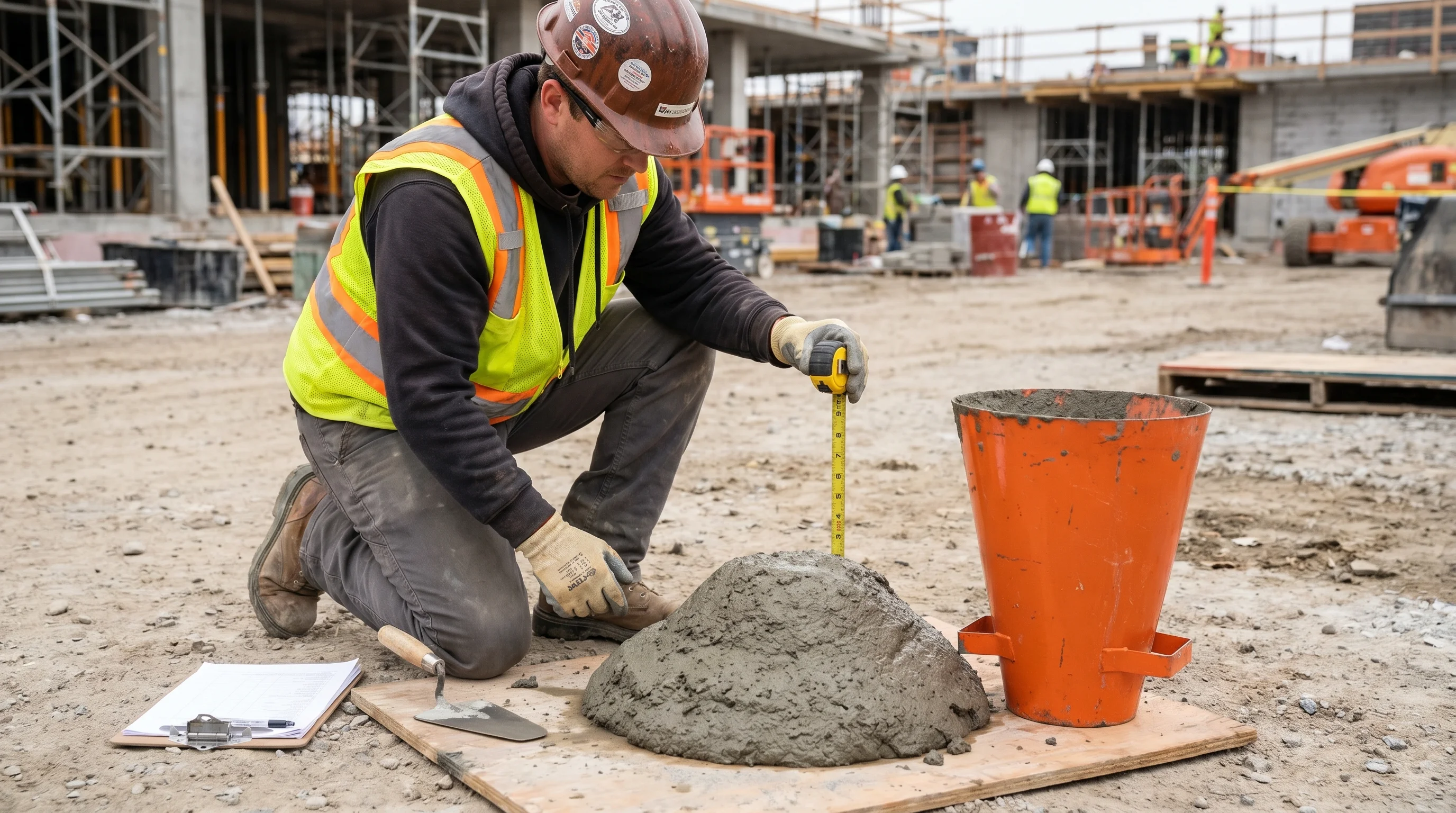
Slump is a simple measure of how stiff or fluid fresh concrete is, called its consistency or workability. The slump test (ASTM C143) works like this:
- Fill a 12-inch-tall metal cone, open at both ends, with fresh concrete in three layers, rodding each layer 25 times.
- Strike off the top and lift the cone straight up.
- Measure how far the concrete sags below the original 12-inch height. That drop, in inches, is the slump.
A stiff mix might slump 1 to 2 inches; a typical residential slab or driveway mix often slumps around 4 to 5 inches; a very fluid mix more. Higher slump from adding water weakens concrete, but higher slump from a superplasticizer does not. That is why drivers and contractors are cautious about adding water on site.
Is Concrete a Pure Substance or a Mixture?
Concrete is a mixture, specifically a heterogeneous mixture. A pure substance has a fixed chemical composition throughout, like water or table salt. Concrete is a combination of many different materials, cement compounds, hydration products, sand grains, rock pieces, water and air, that are not uniform from point to point. You can see separate stones in a broken piece of concrete. Its proportions vary from batch to batch.
Even portland cement itself is a mixture of several compounds, mainly calcium silicates, calcium aluminate and calcium aluminoferrite, plus gypsum. Once hardened, concrete is often described as a composite material: a matrix of cement paste with aggregate particles embedded in it.
Types of Portland Cement
Not all portland cement is the same. In the U.S., ASTM C150 defines several types, and ASTM C595 covers blended cements. The common ones in a concrete mix are:
| Type | Name | Used for |
|---|---|---|
| Type I | Normal | General construction |
| Type II | Moderate sulfate resistance | General use, soils with some sulfates; many cements are sold as Type I/II |
| Type III | High early strength | Fast form removal, cold weather, precast |
| Type IV | Low heat of hydration | Massive pours like dams (rare today) |
| Type V | High sulfate resistance | Soils or water high in sulfates |
| Type IL | Portland-limestone cement (blended) | General use with lower carbon footprint; increasingly common |
White portland cement is made from raw materials low in iron and manganese, so it is white instead of gray. It is used for architectural and decorative concrete; see how to make white concrete.
Supplementary Cementitious Materials
Many concrete mixes replace part of the portland cement with other powders that also contribute to strength. They are often industrial byproducts:
- Fly ash: fine ash from coal power plants. Improves workability and long-term strength, lowers heat and cost, and reduces permeability. Concrete with fly ash gains strength more slowly at first.
- Slag cement: ground granulated blast-furnace slag from iron production. Improves durability and gives lighter-colored concrete.
- Silica fume: extremely fine particles from silicon production. Used for very high-strength, low-permeability concrete.
- Natural pozzolans and calcined clays: volcanic materials and heated clays that react with the calcium hydroxide from cement hydration.
These materials react with calcium hydroxide, a byproduct of cement hydration, to form more of the strength-giving C-S-H gel. They also cut the carbon footprint of concrete because less portland cement is needed.
The Water-Cement Ratio
The water-cement ratio (w/c) is the weight of water divided by the weight of cement in a concrete mix. It is the single most important factor controlling strength and durability. PCA notes that, everything else being equal, lower water content results in stronger concrete.
- Many structural and exterior mixes use a w/c around 0.40 to 0.50.
- Higher ratios, such as 0.60 or more, make weaker, more porous concrete that is easy to place.
- Lower ratios, below about 0.40, usually need water reducers or superplasticizers to stay workable.
- Building codes and ACI 318 set maximum w/c ratios for concrete exposed to freezing, deicing salts and sulfates.
Adding water on site to make concrete easier to pour raises the w/c ratio and lowers strength. A contractor who keeps the specified slump with admixtures instead of water is protecting your slab.
Bagged Concrete vs Ready-Mix
Both are made of the same concrete ingredients, but they are delivered differently:
- Bagged concrete mix: cement, sand and gravel pre-blended dry in a bag. You add water. Good for small jobs like posts, steps and repairs. Variations include fast-setting mix, high-strength mix, sand mix (no gravel) and crack-resistant mix with fibers. See how much a bag of concrete costs and how many bags are in a yard.
- Ready-mix concrete: batched at a plant to a specified design by weight, with controlled water, admixtures and air, and delivered in a mixer truck. Best for slabs, driveways and foundations. See how many yards of concrete are in a truck.
- Volumetric (mobile mix) trucks: carry dry ingredients separately and mix on site, so you pay only for what is used.
Reinforcement Is Not an Ingredient
Rebar, welded wire mesh and steel or synthetic fibers are often placed in concrete, but steel bars and mesh are not part of the concrete mix itself. Concrete is very strong in compression but weak in tension, roughly a tenth as strong pulling as pushing. Steel reinforcement carries tension, which is why the combination is called reinforced concrete. Fibers are mixed in and mainly help control early shrinkage cracking. See concrete slab thickness for where reinforcement goes in slabs.
A Short History of Concrete
People have made concrete-like materials for thousands of years. The ancient Romans built harbors, aqueducts and the Pantheon dome with a concrete made of lime, volcanic ash and rock, some of which still stands today. Modern portland cement dates to 1824, when English bricklayer Joseph Aspdin patented a cement he named after the stone quarried on the Isle of Portland, which hardened concrete resembled. Reinforced concrete followed later in the 1800s, and today concrete is used more than any other building material.
Concrete and the Environment
Because cement making releases carbon dioxide from limestone and from kiln fuel, concrete has a large overall carbon footprint, even though each cubic yard has relatively low embodied energy compared with many materials. Ways the industry is reducing it include portland-limestone cement (Type IL), more fly ash and slag, recycled concrete aggregate, carbon-capturing additives, and designing mixes for the strength actually needed. Old concrete can be crushed and reused as base material or aggregate; see concrete removal cost.
How a Concrete Mix Is Designed
For a ready-mix order, the concrete mix is engineered rather than guessed. A typical mix design follows these steps, based on ACI guidance:
- Set the required strength: for example, 4,000 psi at 28 days for a driveway in a cold climate.
- Pick the water-cement ratio: low enough for that strength and for exposure to freezing, salts or sulfates.
- Choose the aggregate size: the largest stone that fits the section and reinforcement spacing, often ¾ inch to 1 inch for slabs.
- Pick the slump: enough workability to place and finish, often around 4 inches for flatwork.
- Set the air content: for freeze-thaw exposure, using an air-entraining admixture.
- Calculate water and cement: water from the slump and aggregate size, cement from the water-cement ratio.
- Fill the rest with aggregate: balance sand and stone so the concrete is dense and workable.
- Adjust for moisture: correct the batch water for the moisture already in the sand and stone.
- Trial batch and test: check slump, air and strength cylinders before using the design widely.
When you order concrete, the supplier will usually ask for the strength (psi), slump, aggregate size, and whether you need air entrainment or fibers. Knowing what concrete is made of helps you answer those questions and compare quotes. See concrete price per yard.
Common Myths About Concrete Ingredients
- "More cement always makes it stronger." Strength depends mostly on the water-cement ratio. Extra cement with extra water does not help, and too much cement increases shrinkage and cracking.
- "Concrete dries out to harden." It hardens by hydration and needs moisture to keep gaining strength.
- "Any sand will do." Beach sand can contain salt that corrodes rebar, and fine, uniform sand makes weaker, thirstier concrete.
- "Adding water on site is harmless." It raises the water-cement ratio and lowers strength and durability.
- "Concrete lasts forever without care." Good concrete lasts decades, but salts, freeze-thaw and poor drainage shorten its life; see how long concrete lasts.
What Is Concrete Made Of in Different Products?
The basic concrete ingredients stay the same, but the recipe changes with the job:
- Driveway and patio concrete mix: portland cement, sand, ¾-inch stone, water and entrained air in cold climates, often 3,000 to 4,000 psi.
- Foundation concrete mix: similar ingredients, sometimes with fly ash or slag and larger stone.
- Concrete blocks: a very dry concrete mix of portland cement, sand and fine gravel or lightweight aggregate, compacted in molds. See concrete blocks.
- Precast products: often Type III portland cement for quick form stripping.
- High-strength concrete: low water-cement ratio, superplasticizers and silica fume.
- Lightweight concrete: expanded shale, clay or slate aggregate instead of normal stone.
- Countertop mixes: fine aggregate, polymers and fibers for thin, smooth pieces; see concrete countertops.
For more on how these differ, see types of concrete. In every case, the answer to what is concrete made of comes back to the same core: portland cement and water forming a paste that binds aggregates together.
Quick Reference
- What is concrete made of? Portland cement, water, sand, gravel or crushed stone, air and admixtures.
- Concrete ingredients by volume: cement 10–15%, water about 15–20%, aggregates about 60–75%, entrained air 4–7% where used.
- Are concrete and cement the same thing? No; cement is an ingredient of concrete.
- Is concrete porous? Yes; lower water-cement ratio makes it less porous.
- Slump value: sag of fresh concrete in a 12-inch cone, in inches.
- Is concrete a pure substance or mixture? A heterogeneous mixture.
Whether you are pouring a single post footing from a bag or ordering several trucks for a driveway, the same rules apply. Good concrete ingredients, the right amount of water, proper placement and patient curing are what turn a simple concrete mix of cement, sand, stone and water into a surface that lasts for decades.
Frequently Asked Questions
What is concrete made of?
Portland cement, water, sand, and gravel or crushed stone, often with entrained air and admixtures.
Are concrete and cement the same thing?
No. Cement is the powdered binder; concrete is the mix of cement, water and aggregates.
What is the gravel in concrete for?
It adds strength and stiffness, reduces shrinkage and cracking, and lowers cost by reducing how much cement is needed.
Is concrete porous?
Yes. It has capillary pores and air voids. A lower water-cement ratio and good curing make it less porous.
What is slump value in concrete?
How much fresh concrete sags in the slump test cone, measured in inches. It indicates workability.
Is concrete a pure substance or a mixture?
A heterogeneous mixture, also described as a composite material.
What is the ratio for a concrete mix?
A common DIY rule of thumb is 1 part cement, 2 parts sand and 3 parts gravel by volume. Ready-mix is designed by weight for a target strength.
Why is concrete so strong?
Hydration forms a dense crystal network that locks aggregates together. It is very strong in compression; steel reinforcement adds tensile strength.
Is concrete waterproof?
No. Concrete is porous and lets water and vapor pass slowly. Dense mixes, sealers and membranes reduce this.
What is portland cement made of?
Mainly limestone with clay, shale, sand and iron ore, heated in a kiln to about 2,700°F to form clinker, then ground with gypsum.
Is concrete a mixture or pure substance?
Concrete is a mixture. It is made of cement, water, sand, stone and often admixtures, and you can see the different parts in a broken piece. Even cement itself is a mix of several compounds.
Sources
- Portland Cement Association, Cement and Concrete FAQ (cement 10–15% by volume; water-cement ratio). cement.org
- Portland Cement Association, How Cement Is Made (kiln about 2,700°F, clinker, gypsum). cement.org
- Portland Cement Association, Working With Concrete (entrained air 4–7%). cement.org
- ASTM C143, Standard Test Method for Slump of Hydraulic-Cement Concrete. astm.org
- Image credits: images and chart by Asphapro.com.
Checked November 2026.
Related Guides
- Types of concrete — high performance, precast and gunite
- Mortar vs concrete — differences and which to use
- Can you pour concrete in the winter? — cold weather rules and protection
- Can concrete burn? — fire resistance and heat damage