
High Strength Concrete Mix: PSI, Ingredients, Uses, Testing and Cost
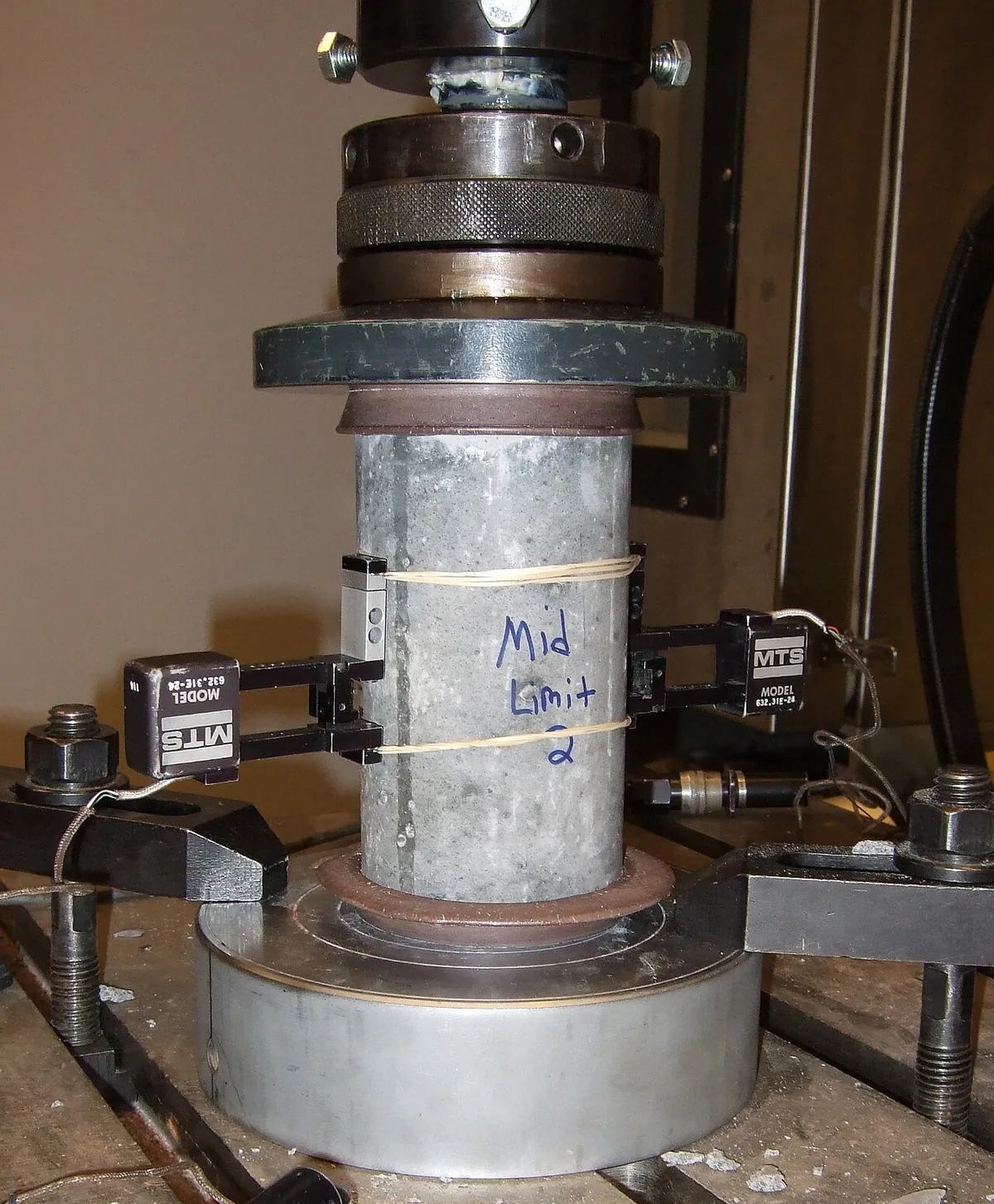
Photo: Xb-70, Wikimedia Commons, public domain.
Quick Answer
A high strength concrete mix is concrete designed to reach a compressive strength well above ordinary concrete. Most home and street concrete is 2,500 to 5,000 psi. Bagged "high strength" mixes sold at home centers are typically rated about 5,000 psi. In engineering, the American Concrete Institute treats 8,000 psi (55 MPa) and above as high strength concrete, and mixes of 10,000 to 15,000 psi are common in high-rise columns. These mixes use a low water-cement ratio (about 0.25 to 0.40), more cementitious material, silica fume or fly ash, superplasticizers and strong aggregate, and they need careful curing. Ready-mix prices rise with each strength step.
Concrete strength is the number that appears on every set of plans and every ready-mix order: 3,000 psi for a patio, 4,000 for a driveway, 5,000 for a parking garage, and sometimes far higher. A high strength concrete mix lets engineers build thinner columns, longer bridge spans and more durable structures, and it lets homeowners get tougher steps, garage floors and repairs from a bag. But "high strength" means very different things at the hardware store and on a skyscraper site, and stronger concrete comes with trade-offs.
This guide explains what counts as high strength concrete, how strength is measured, what goes into a high strength concrete mix, where it is used, how to use bagged high-strength mixes at home, the pros and cons, and what it costs.
What Counts as High Strength Concrete?
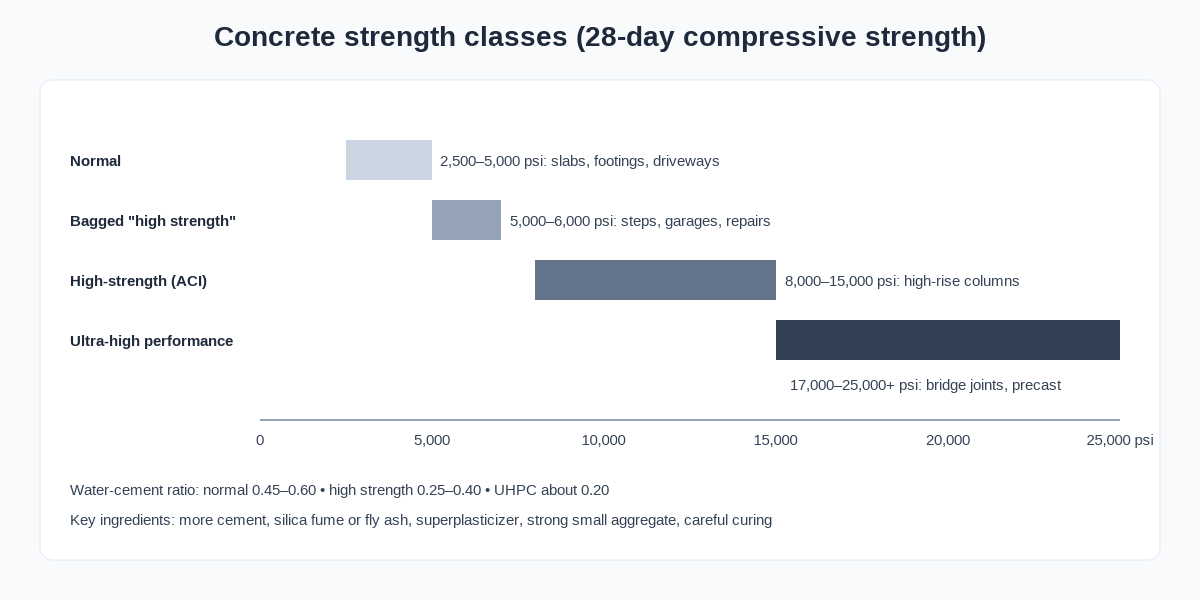
There is no single cutoff that everyone uses. In practice:
- Normal concrete: about 2,500 to 5,000 psi (17 to 35 MPa). Most slabs, footings, sidewalks and driveways.
- Bagged "high strength" or "5000" mixes: about 5,000 to 6,000 psi at 28 days, sold for steps, garage floors, structural repairs and setting posts.
- High strength concrete (engineering definition): ACI committee guidance on high-strength concrete covers mixes of about 8,000 psi (55 MPa) and higher; older references used 6,000 psi as the threshold.
- Ultra-high performance concrete (UHPC): about 17,000 to 25,000 psi or more, with fine powders, steel fibers and very low water content, used for bridge joints and thin precast pieces.
When a contractor or plant offers "high strength," ask for the actual psi at 28 days. A 5,000 psi driveway mix and a 12,000 psi column mix are both called high strength in casual speech, but they are very different products.
How Concrete Strength Is Measured
Concrete strength means compressive strength: the load a sample can carry before it crushes. Technicians fill cylindrical molds, usually 4 × 8 inches or 6 × 12 inches, with fresh concrete from the truck, cure them under standard conditions, and crush them in a hydraulic press at 7, 28 and sometimes 56 days, following ASTM C39. The strength is the failure load divided by the cylinder's area. For high strength concrete, 56- or 90-day strength is often specified, because mixes with fly ash and slag keep gaining strength well after 28 days.
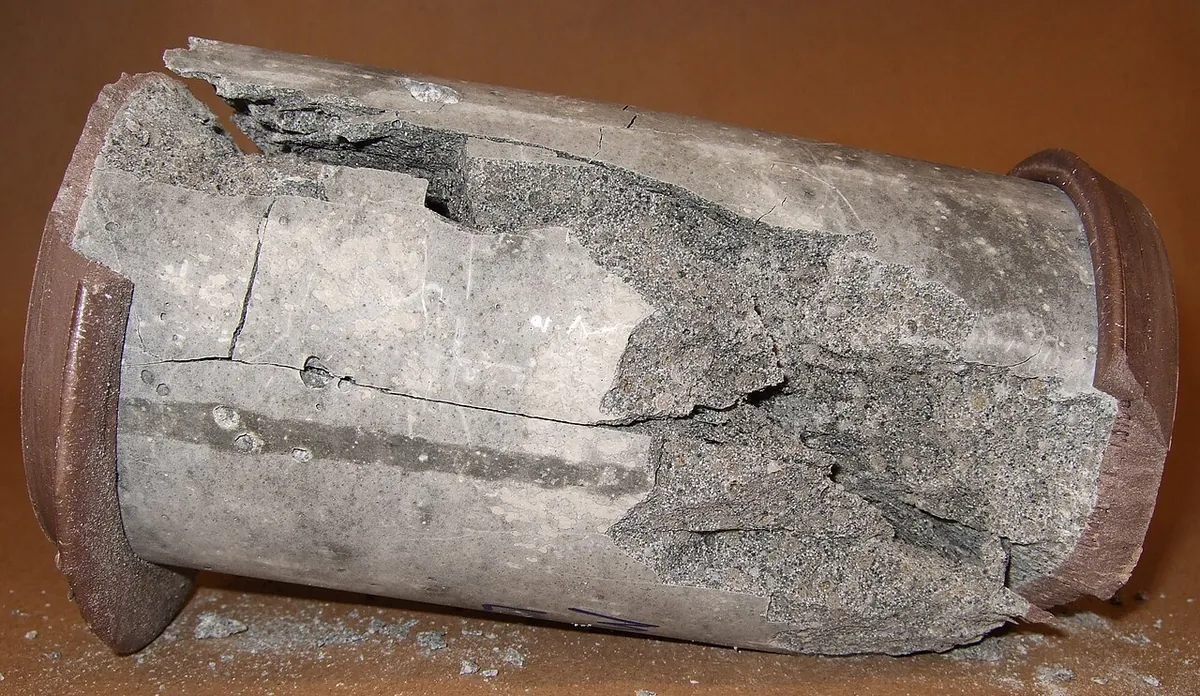
Photo: Xb-70, Wikimedia Commons, public domain.
The cylinder in the photos above is a low-strength lightweight sample, but the method is the same for every mix. The high strength of concrete made with low water and strong ingredients shows up in these tests as much higher loads before the cylinder cracks and crumbles.
What Goes Into a High Strength Concrete Mix?
Strength comes mostly from a dense, low-porosity cement paste and a strong bond between paste and aggregate. A high strength concrete mix gets there with several changes from ordinary concrete:
- Low water-cement ratio: often 0.25 to 0.40, compared with 0.45 to 0.60 for normal concrete. Less water means fewer pores.
- More cementitious material: often 700 to 1,000 pounds per cubic yard, a mix of portland cement and supplementary materials.
- Silica fume: an ultra-fine powder, a byproduct of silicon production, that fills the spaces between cement grains and reacts to form extra binder. Typically 5 to 10 percent of the cementitious material.
- Fly ash or slag: improve workability, reduce heat and keep gaining strength over months.
- High-range water reducers (superplasticizers): make the very low-water mix flowable enough to place and consolidate.
- Strong, clean aggregate: hard crushed stone such as granite, trap rock or strong limestone, often with a smaller maximum size of 3/8 to 1/2 inch, since smaller stones bond better at very high strengths. See concrete aggregate.
- Strict quality control: precise batching, mixing and testing.
Mix design for high strength concrete is more trial-based than for normal mixes. Plants run trial batches with their local materials and adjust until they consistently exceed the target strength with a safety margin. For basic proportions, see concrete mixing ratio.
Where High Strength Concrete Is Used
- High-rise buildings: columns and walls in the lower floors of towers, where high strength allows smaller columns and more usable floor space.
- Bridges: girders, decks and piers that need long spans, low weight and long service lives.
- Precast and prestressed concrete: beams, planks and piles that need high early strength to release strands quickly. See precast concrete walls and post tension concrete slab.
- Parking garages and marine structures: low permeability resists chloride and corrosion.
- Industrial floors: resistance to wear and impact.
- Home projects: bagged 5,000 psi mixes for steps, garage floors, curbs, setting heavy posts and structural patching.
Using Bagged High Strength Concrete Mix at Home
Home centers sell a high strength concrete mix in 80-pound bags, usually rated about 5,000 psi at 28 days and around 2,500 psi at 3 days, compared with 4,000 psi for many standard bags. It is a good choice for steps, landings, thin slabs over 2 inches, garage floor patches, heavy post footings and anywhere you want extra toughness. Mix it like any concrete: about 3 to 3.5 quarts of water per bag, added gradually, to a stiff, workable consistency. The strength on the bag only happens if you keep the water down and cure the concrete properly for at least five to seven days. Adding extra water to make it easier to work can turn a 5,000 psi mix into a 3,000 psi one. See how to make concrete.
Pros and Cons of High Strength Concrete
Pros
- Carries more load in smaller sections: thinner columns, longer spans.
- Lower permeability, so better resistance to water, chlorides and freeze-thaw damage.
- Higher stiffness and abrasion resistance.
- Faster early strength for precast and quicker formwork stripping.
Cons
- Higher cost per cubic yard.
- Sticky, harder-to-finish mixes; flatwork crews need experience.
- More early shrinkage and cracking risk if not cured well, including autogenous shrinkage from the low water content.
- More heat of hydration in thick sections.
- More brittle failure, which designers account for with confining steel.
- Dense paste can spall explosively in fires; polypropylene fibers are added in some buildings to reduce it.
Curing High Strength Concrete
Curing is even more important for high strength concrete than for ordinary mixes. With so little water in the mix, the surface can dry out and stop gaining strength within hours, and early shrinkage can cause cracks. Start curing immediately after finishing: wet burlap, fogging, curing compounds or plastic sheeting, kept in place for at least seven days. On large projects, contractors monitor concrete temperature in thick members to keep the core and surface from differing too much as the mix heats up.
High Strength vs High Performance Concrete
You will also hear the term high performance concrete. High strength is one kind of performance, but not the only one. High performance concrete is designed for a specific demanding need, which might be high strength, very low permeability, high early strength for a fast-track repair, resistance to severe freeze-thaw or chemical attack, low shrinkage, or self-consolidation in congested reinforcement. A bridge deck mix might be only 5,000 psi but designed for extremely low chloride penetration and very little cracking, and that is high performance. A column mix at 12,000 psi is both high strength and high performance. For most buyers, the useful question is not "is it high strength?" but "what does this concrete need to do, and what mix properties deliver that?" Plants can usually meet a durability target with a moderate-strength mix rather than paying for strength you do not need.
Ordering a High Strength Concrete Mix From a Plant
When a project calls for a high strength concrete mix, the order involves more than just a psi number. Specify the required compressive strength and the age at which it must be reached (28, 56 or 90 days), the maximum aggregate size, the slump or flow, air content if the concrete is exposed to freezing, any limits on water-cement ratio, and whether supplementary materials like silica fume, fly ash or slag are allowed or required. Ask the plant for a submittal showing the mix design and its test history, so you know it has been produced and tested before. Plan delivery so the concrete is placed quickly, since high-range water reducers can lose their effect over time, and arrange testing by an independent lab for structural work. For small home projects, a standard 4,000 to 5,000 psi mix ordered by strength is usually all that is needed.
Placing and Finishing High Strength Concrete
Crews notice the difference the moment a truck of high strength concrete arrives. With very little water and a lot of fine powder, the mix can feel sticky and stiff even when it flows under its own weight, and it bleeds little or no water to the surface. That lack of bleed water makes finishing flatwork tricky: the surface can dry and crust while the concrete below is still plastic, leading to plastic shrinkage cracks and a surface that tears under the trowel. Experienced crews use evaporation retarders, fog misting and windbreaks, finish in stages and start curing immediately. In walls and columns, high strength mixes are often self-consolidating, so they flow around dense reinforcement with little or no vibration. Because heat builds up quickly in thick high strength members, contractors may use chilled water or ice in the mix, schedule pours for cooler times, and monitor internal temperatures.
Strength Gain Over Time
All concrete gains strength over weeks and months, but the curve differs by mix. Ordinary portland cement concrete typically reaches about 65 to 70 percent of its 28-day strength in seven days. Mixes with high cement content and accelerating admixtures gain strength very fast and may reach design strength in a few days, which is useful for precast plants and fast repairs. Mixes with fly ash or slag start slower but keep gaining for months and often end up stronger and more durable, which is why high strength concrete specifications often use 56- or 90-day strength. For a homeowner, the practical lesson is that concrete keeps getting stronger as long as it stays moist and above freezing, so a week of good curing pays off for years. See how long concrete takes to cure.
A Short History of High Strength Concrete
For much of the 20th century, 3,000 to 5,000 psi concrete was the norm. Starting in the 1960s and 1970s, engineers in Chicago and other cities began using stronger mixes in the columns of tall buildings to save space; Water Tower Place, completed in 1975, used concrete of about 9,000 psi in its lower columns. The development of high-range water reducers and the use of silica fume in the 1980s made 10,000 to 14,000 psi concrete practical, and some towers and bridges have since used even higher strengths. Ultra-high performance concrete, with strengths above 20,000 psi, moved from research into bridge construction in the 2000s. Today, a high strength concrete mix is a routine choice for tall buildings, long-span bridges and precast plants around the world.
High Strength Concrete for Home Projects
Homeowners rarely need concrete above 5,000 psi, but a bagged high strength concrete mix earns its price in a few places. Front steps and landings take concentrated foot traffic, salt and freeze-thaw, and the denser paste resists scaling. Garage floor patches and thin slabs carry car tires and dropped tools. Footings for heavy posts, pergolas and basketball hoops benefit from the extra strength at the base. Concrete countertops and cast pieces use rich, low-water mixes for strength in thin sections, often with fibers. Structural repairs, such as rebuilding a broken step edge or a spalled column, benefit from a strong repair material that matches or exceeds the original. For ordinary patios, walks and fence posts, standard mix is fine and costs less. See pouring concrete steps and concrete countertops.
Common Mistakes With High Strength Mixes
The most common mistake, on job sites and in backyards alike, is adding water. A truck of high strength concrete that seems too stiff should be adjusted with the plant's admixture, not with a hose, and a bag of 5,000 psi mix needs only the water on the label. The second mistake is poor curing: high strength concrete that dries out early loses much of its strength and cracks. Others include using weak or dirty aggregate in a homemade "strong" mix, adding extra cement to a bagged mix in the belief that more is better, ignoring heat in thick pours, and paying for high strength where durability or good placement was the real need. A well-made, well-cured 4,000 psi mix often outperforms a badly handled 6,000 psi one.
How Strong Is High Strength Concrete?
Numbers like 10,000 psi are easier to picture with a comparison. A 6-inch cylinder of 10,000 psi high strength concrete can carry about 280,000 pounds, the weight of roughly 70 cars, before it crushes. Ordinary 3,000 psi concrete in the same cylinder fails at about 85,000 pounds. Natural granite is often in the range of 15,000 to 30,000 psi, so the best high strength concrete approaches the strength of good building stone. Structural steel is still far stronger, and unlike steel, concrete is weak in tension, roughly a tenth of its compressive strength, which is why even a high strength concrete mix is reinforced with steel bars or strands in beams and columns. See concrete rebar.
Testing a High Strength Concrete Mix on Your Project
On commercial and structural jobs, a testing lab samples the high strength concrete as it is placed, measures slump or flow, air content and temperature, and casts cylinders for strength tests at several ages. If results come in low, engineers may take cores from the structure to check its actual strength. Homeowners rarely test concrete, but for a large or critical job, such as a foundation for an addition or a structural slab, you can hire a local testing lab to sample the delivered concrete for a modest fee. That gives you a record that the concrete you paid for is the concrete you received, which is especially useful when you have paid extra for a high strength concrete mix.
High Strength Concrete and Durability
One of the biggest benefits of a high strength concrete mix is not the strength itself but the dense, low-permeability paste that comes with it. Water, chlorides from road salt and seawater, sulfates from soil and carbon dioxide from the air all move through concrete's pores, and they cause most long-term damage: rusting rebar, spalling and scaling. A low water-cement ratio and silica fume or fly ash make those pores smaller and fewer, slowing that movement dramatically. That is why parking decks, bridge decks and marine structures often use high strength or high performance concrete even when the loads do not demand it. For home concrete, the same principle applies: a lower water-cement ratio and good curing give a more durable surface. See concrete spalling and does salt damage concrete.
Should You Pay for a High Strength Concrete Mix?
For most homeowners, the honest answer is: only where it solves a real problem. A standard 4,000 psi air-entrained mix placed with the right amount of water, jointed correctly and cured well will make a driveway or patio that lasts decades. Paying for a 5,000 psi mix makes sense for steps, thin sections, high-traffic garage floors, structural repairs and heavy post footings, where the extra strength and density help. Engineered high strength concrete above 8,000 psi is a tool for structural engineers working on columns, bridges and precast members, and is not something you need to choose for a house. If you are unsure, tell the ready-mix plant what you are building and what it will face; they will recommend a mix that meets the need without paying for strength you will never use.
High Strength Concrete and Sustainability
At first glance, a high strength concrete mix looks worse for the environment, since it uses more cementitious material per cubic yard, and cement is the main source of concrete's carbon footprint. But the picture is more complicated. Stronger concrete lets engineers use smaller columns, thinner slabs and fewer cubic yards overall, which can reduce the total concrete and steel in a building. High strength mixes often replace a large share of portland cement with fly ash, slag or silica fume, industrial byproducts that lower the carbon per cubic yard. And dense, durable concrete lasts longer with fewer repairs, spreading its footprint over a longer life. Designers now compare options using whole-building carbon calculations rather than strength alone, and many projects find that a well-designed high strength concrete mix is part of the lower-carbon solution.
Fibers and Reinforcement in Strong Mixes
Because high strength concrete is more brittle than normal concrete, it is often paired with extra confinement steel in columns, closely spaced ties that keep the concrete from bursting outward under load. In ultra-high performance concrete, short steel fibers make up a few percent of the volume and give the material its toughness. Synthetic microfibers are sometimes added to high strength mixes to reduce early plastic shrinkage cracking and to limit explosive spalling in fires. For home projects, a fiber-reinforced high strength bagged mix is a good choice for steps and thin slabs. See fiber concrete.
Reading a Bag of High Strength Mix
Bag labels can be confusing. Look for the rated compressive strength and the age, for example "5,000 psi at 28 days"; some bags also list strengths at 3 and 7 days. Next, check the yield, usually about 0.6 cubic feet for an 80-pound bag, the recommended water range and the minimum thickness, since many high strength concrete mix products are meant for sections at least 2 inches thick. Also look for the ASTM C387 reference, the standard for packaged dry concrete mixes. Fast-setting high strength products may have short working times, so mix only what you can place quickly. Store unopened bags off the floor in a dry place, and use them within the shelf life printed on the bag.
How Much Does High Strength Concrete Cost?
- Bagged 5,000 psi mix: about $6 to $10 per 80-pound bag, roughly $1 to $3 more than standard mix.
- Ready-mix by strength: each step up of about 500 psi often adds a few dollars per cubic yard in normal ranges; a 5,000 psi mix might cost $10 to $30 more per yard than 3,000 psi.
- High-strength structural mixes (8,000+ psi): can cost significantly more because of silica fume, admixtures, extra cement and testing.
- UHPC: many times the price of normal concrete, used only where its performance pays off.
For general pricing, see concrete price per yard and how much a bag of concrete costs.
Frequently Asked Questions
What is a high strength concrete mix?
Concrete designed for compressive strength well above normal, from about 5,000 psi for bagged mixes to 8,000 psi and higher for engineered high strength concrete.
Is 5,000 psi concrete high strength?
For home use and bagged mixes, yes. In engineering, high strength concrete usually starts around 8,000 psi.
How do you make high strength concrete?
Use a low water-cement ratio, more cementitious material with silica fume or fly ash, a superplasticizer, strong clean aggregate, thorough mixing and careful curing.
Do I need high strength concrete for a driveway?
Not usually. 4,000 to 4,500 psi air-entrained concrete with a low water-cement ratio is standard for driveways.
Sources
- American Concrete Institute: ACI 363R report on high-strength concrete
- ASTM C39: Compressive Strength of Cylindrical Concrete Specimens
- Portland Cement Association: high-strength and high-performance concrete
- Federal Highway Administration: ultra-high performance concrete
Related Guides
- How to make concrete — mixing in a bucket, wheelbarrow or mixer
- Light concrete guide — lightweight aggregate, AAC and foam concrete
- Concrete admixture guide — air entrained concrete, water reducers and more
- Concrete slump test — what slump means and how to test it
- Concrete cylinder tests — strength testing and cylinder calculator
- Concrete curing compound — curing compounds vs water curing
- Shotcrete vs gunite — sprayed concrete for pools and walls
- Concrete vibrator — consolidating walls, footings and columns
- Concrete core drilling — coring holes, bits, scanning and cost
- Concrete barriers — jersey barriers, bollards and interlocking blocks
- Concrete storm shelters — storm cellars and tornado shelters
- Concrete pool — construction, gunite and costs
- Concrete burial vault — vaults, grave liners and cost
- Concrete tub — concrete bathtubs and bathrooms
- Density of concrete — unit weight and modulus of elasticity
- Concrete lintel — precast lintels over openings
- Concrete column — columns, rebar, forms and poles
- Concrete sink — vessel, integral and kitchen sinks
- Concrete beam — beams, rebar and concrete details
- Roller compacted concrete — RCC pavements and dams
- Metal decking for concrete — composite steel deck floors
- Concrete railroad ties — prestressed ties and reuse in landscaping
- Sakrete concrete mix — High Strength, 5000 Plus and Fast Setting compared
- Temperature to pour concrete — ideal range, minimums and hot or cold precautions
- Commercial concrete — specs, tilt-up, parking decks, testing, costs and contractors
- Green concrete — low-carbon mixes with fly ash, slag and Type IL, plus fresh green concrete
- Concrete canoe — how a concrete boat floats and the ASCE competition