
Convert Pool to Salt Cost: What a Salt Water Conversion Costs
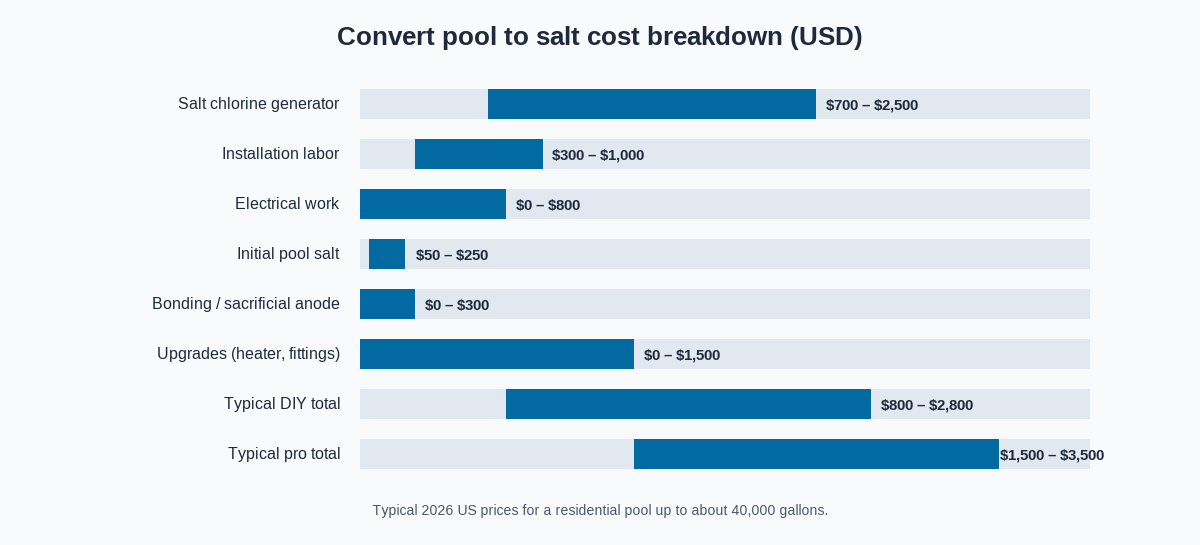
Chart: Asphapro.com
Quick Answer
The typical convert pool to salt cost is $1,500 to $3,500 with professional installation, or $800 to $2,800 if you install the system yourself. Most of the money goes on the salt chlorine generator ($700 to $2,500), with $300 to $1,000 for labor, up to $800 for electrical work, and $50 to $250 for the first load of pool salt. You do not need to drain the pool. After the switch, a salt pool often costs less per year in chemicals than a chlorine pool, but you need to budget $500 to $1,100 for a replacement salt cell every 3 to 7 years.
A salt water pool is still a chlorine pool. The difference is where the chlorine comes from. Instead of buying and adding chlorine tablets or liquid, you dissolve pool salt in the water and a salt chlorine generator turns it into chlorine as water flows through a cell. Owners like the softer feel of the water, steadier chlorine levels and fewer trips to the pool store. The question most people ask first is the cost of converting to salt water pool equipment, and whether it pays for itself.
This guide covers the full convert pool to salt cost, from the system itself to labor, salt and electrical work, plus running costs, payback and hidden extras. For a side-by-side comparison of the two systems, see our guide on salt pool versus chlorine.
Convert to Salt Water Pool Cost at a Glance
- Salt chlorine generator (control box and cell): $700 to $2,500.
- Professional installation labor: $300 to $1,000.
- Electrical work, if needed: $0 to $800.
- Initial pool salt: $50 to $250.
- Bonding or a sacrificial zinc anode: $0 to $300.
- Optional upgrades (heater, metal fittings, stone protection): $0 to $1,500.
- Typical total with a pro: $1,500 to $3,500.
- Typical DIY total: $800 to $2,800.
The convert to salt water pool cost for a small above ground pool sits at the low end, while a large inground pool with automation, a heater upgrade and stone coping sealing can reach the top end or beyond.
Salt Chlorine Generator Cost
The salt chlorine generator, also called a salt system or salt chlorinator, is the biggest part of the convert pool to salt cost. It has two main parts: a control box that powers the system and sets the chlorine output, and a cell, a tube with coated titanium plates that sits in the return line after the filter and heater.
Above ground pool systems cost about $250 to $700. Many plug into a standard GFCI outlet and fit on the return hose.
Inground pool systems cost about $700 to $2,500. Prices rise with the pool size the system is rated for, the quality of the cell, and features such as automatic salt and temperature readings, a self-cleaning reverse-polarity cell, Wi-Fi control and integration with pool automation.
A common rule of thumb is to choose a system rated for 1.5 to 2 times your pool volume. A system that is too small has to run at 100% output all the time, which wears the cell out faster. A larger system runs at a lower output and lasts longer, which lowers the long-term cost of converting to salt water pool systems even though it costs more at the start.
Installation Labor Cost
Professional installation of a salt system costs about $300 to $1,000. The installer cuts the return pipe after the filter and heater, glues in the cell and unions, mounts the control box on a wall or post, connects it to power, wires the flow switch and any sensors, bonds the cell, and starts the system. On a simple equipment pad, the job takes two to four hours. Tight pads, rerouted plumbing or older equipment take longer and cost more.
Many pool companies quote a package price for the system and installation together. Ask whether the quote includes salt, electrical work and a water test, so you can compare the full convert pool to salt cost from different installers.
Electrical Work
Some salt systems plug into a GFCI outlet, while most inground systems are hard-wired to the pump timer or a dedicated circuit. If your equipment pad already has a suitable circuit and space in the subpanel, electrical work may be included in installation labor. If you need a new breaker, a new circuit or a GFCI upgrade, expect $150 to $800. All wiring must meet local code, and the cell and control box must be bonded to the pool's bonding grid.
Initial Pool Salt Cost
Most salt systems need about 3,000 to 3,500 parts per million (ppm) of salt. A 40-pound bag of pool salt costs $8 to $15. Starting from zero, a 10,000-gallon pool needs about 250 pounds of salt, a 20,000-gallon pool about 500 pounds, and a 30,000-gallon pool about 750 pounds. That makes the first load cost $50 to $250 for most pools. Use pure pool salt (at least 99% sodium chloride), not rock salt or salt with anti-caking agents. See our guide on how to add salt to pool water.
Convert Pool to Salt Cost: Inground vs Above Ground
For an above ground pool, the convert pool to salt cost is usually $350 to $1,000 in total. Systems are cheaper, installation is simple, and the pool needs less salt. Check that the pool's metal walls, frame and parts are rated for salt water. Some pool makers say that salt can shorten the life of steel walls or void the warranty, while resin pools handle salt better.
For an inground pool, the convert to salt water pool cost is usually $1,500 to $3,500. Larger pools need larger systems and more salt. Concrete, vinyl and fiberglass pools can all be converted, though each has points to watch, covered below.
Photo: Vic Brincat, Wikimedia Commons, CC BY 2.0
How to Convert a Pool to Salt Water
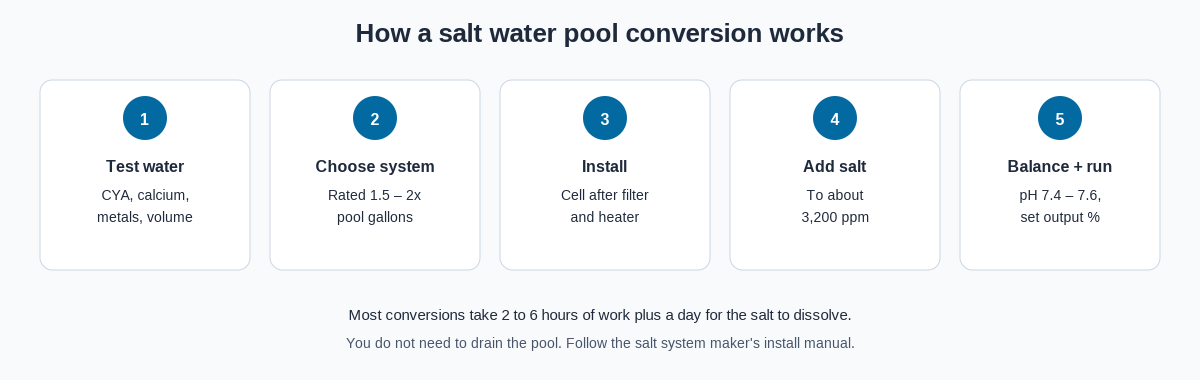
Diagram: Asphapro.com
Step 1: Test the water. Test chlorine, pH, alkalinity, calcium hardness, cyanuric acid (stabilizer) and metals. Find your pool volume. If stabilizer is very high from years of tablets, you may need to partly drain the pool first. See how to reduce cyanuric acid in pool water.
Step 2: Choose the system. Pick a salt system rated for 1.5 to 2 times your pool volume that works with your pump and any automation.
Step 3: Install. Mount the control box, install the cell in the return line after the filter and heater, connect power and bond the cell. Remove any tablet chlorinator or bypass it.
Step 4: Add salt. With the pump running, pour salt into the shallow end and brush it toward the main drain. Run the pump for 24 hours with the cell off so the salt dissolves.
Step 5: Balance and start. Bring pH to 7.4 to 7.6, alkalinity to 60 to 90 ppm and stabilizer to 60 to 80 ppm. Turn the cell on and set the output so free chlorine holds at 2 to 4 ppm. Adjust over the first week.
DIY vs Professional Conversion Cost
Doing the conversion yourself saves $300 to $1,000 in labor, which makes the DIY convert pool to salt cost $800 to $2,800 for most inground pools. A DIY install is a good fit if you are comfortable cutting and gluing PVC pipe and the system plugs in or connects to an existing circuit. Hire a licensed electrician for any new wiring or panel work, since salt systems run near water and must be bonded correctly. Some makers only honor warranties if a professional installs the system, so read the warranty terms before you decide.
Yearly Running Cost: Salt vs Chlorine
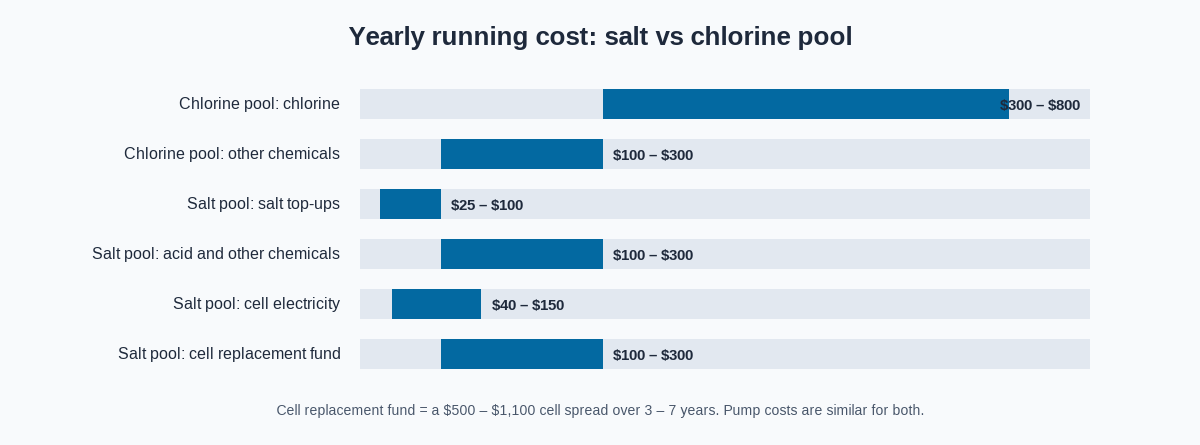
Chart: Asphapro.com
The upfront cost of converting to salt water pool equipment is only part of the story. A typical 20,000-gallon chlorine pool uses $300 to $800 a year in chlorine tablets, liquid chlorine or shock, plus $100 to $300 for other chemicals. A salt pool of the same size uses $25 to $100 a year in salt top-ups (salt only leaves with splash-out, backwashing and rain overflow), $100 to $300 for acid and other chemicals, $40 to $150 in electricity for the cell, and $100 to $300 a year set aside for the next cell.
In total, a salt pool often runs $250 to $500 a year cheaper than a chlorine pool, though this varies a lot with pool size, climate and chlorine prices. Salt pools tend to drift up in pH, so most owners use more muriatic acid than before. For more on day-to-day care, see how to maintain a saltwater pool.
Salt Cell Replacement Cost
The salt cell is a wear part. Its coated plates slowly lose their coating as they make chlorine. Most cells last 3 to 7 years, or about 10,000 hours of run time, depending on how hard they work, water balance and how often they are cleaned. A replacement cell costs $500 to $1,100 for most inground systems and $150 to $400 for above ground systems. Running a larger system at lower output, keeping calcium and pH in range, and cleaning scale gently with a weak acid solution when needed all help a cell last longer.
Does Converting to Salt Pay for Itself?
Payback depends on your chlorine use. If you save $300 to $500 a year on chemicals and spend $2,500 on the convert to salt water pool cost, the system pays for itself in about five to eight years, which is close to the life of the first cell. If you have a large pool in a hot climate and use a lot of chlorine, payback can be faster. If you have a small pool, low chlorine use or cheap liquid chlorine nearby, it may never fully pay back on cost alone.
For many owners, the reasons to switch are not only about money. Salt pools keep chlorine steadier, need less handling and storing of chlorine, and many people find the water gentler on skin and eyes. If those benefits matter to you, a longer payback period may be fine.
Hidden Costs of Converting to Salt Water Pool Systems
Natural stone damage. Salt water can damage soft natural stone coping and decks, such as limestone, sandstone and some travertine, through salt crystallization. Sealing stone costs $1 to $3 per square foot and needs to be redone every few years. Concrete decks also benefit from sealing; see our guide on does salt damage concrete.
Metal parts. Salt speeds corrosion of some metals. Heaters with copper heat exchangers, older ladders and rails, light rings, and steel above ground pool walls can suffer. A heater upgrade to a cupronickel or titanium exchanger costs $500 to $1,500. A sacrificial zinc anode costs $50 to $300 and helps protect metal parts.
Draining for high stabilizer. Pools that used chlorine tablets for years may have very high stabilizer. Partly draining and refilling to lower it costs $100 to $500 in water and chemicals, or more for trucked water.
Vinyl liner and fiberglass checks. Vinyl and fiberglass pools handle salt well. Check that any metal wall panels on vinyl pools are rated for salt, and look at the warranty.
Cost of Converting to Salt Water Pool by Pool Size
Small pool (up to 15,000 gallons): $1,200 to $2,500 installed, with a system rated for 25,000 to 30,000 gallons.
Medium pool (15,000 to 25,000 gallons): $1,500 to $3,000 installed, with a system rated for 40,000 gallons.
Large pool (25,000 to 40,000 gallons): $2,000 to $3,500 installed, with a system rated for 60,000 gallons or more.
Above ground pool (up to 15,000 gallons): $350 to $1,000 installed.
Each of these assumes the existing pump and filter are in good condition. If the pump is old or very inefficient, many owners replace it with a variable-speed pump at the same time, which adds $1,000 to $2,500 to the job but cuts electricity costs.
Worked Examples
Example 1: medium inground pool, pro install. A 20,000-gallon vinyl pool owner buys a salt system rated for 40,000 gallons for $1,600. Installation costs $550, a new GFCI breaker $250 and 500 pounds of salt $125. Total convert pool to salt cost: about $2,525. The owner saves about $400 a year on chlorine, so the system pays back in about six years.
Example 2: above ground pool, DIY. An owner with a 12,000-gallon resin above ground pool buys a plug-in salt system for $400 and 300 pounds of salt for $75, and installs it on the return hose in an afternoon. Total convert to salt water pool cost: about $475.
Example 3: large concrete pool with extras. A 35,000-gallon plaster pool with limestone coping needs a system rated for 60,000 gallons ($2,200), installation ($800), 900 pounds of salt ($225), a zinc anode ($150), stone sealing ($900) and a partial drain to lower stabilizer ($300). Total cost of converting to salt water pool: about $4,575.
Ways to Lower the Cost
To keep the convert pool to salt cost down, buy the system during off-season sales in fall or winter, install it yourself if the wiring is simple, and buy salt in bulk from a pool or farm supply store. Use up existing chlorine supplies before the switch, and let stabilizer drop naturally if you have time. Choose a system with a good cell warranty and keep water balanced so the cell lasts as long as possible, since the long-term convert to salt water pool cost depends a lot on cell life.
Is Converting to a Salt Water Pool Worth It?
Converting is worth it for most owners who use a lot of chlorine, want steady sanitizer levels, or dislike handling chlorine. It makes less sense if you have soft natural stone you cannot seal, an old heater with a copper exchanger, or a steel-walled above ground pool not rated for salt. Weigh the full convert pool to salt cost, including any hidden extras, against your yearly chlorine spending and how long you plan to stay in your home.
Convert Pool to Salt Cost by Pool Type
Concrete and plaster pools. Concrete pools convert well, and the convert pool to salt cost for them is usually in the middle of the range. The main risk is to the surroundings rather than the pool shell. Plaster can be affected by poorly balanced water in any pool, so keep calcium and pH in range. Salt can build up in porous coping and decks, so sealing the deck and coping is a good idea. If the pool has an older heater with a copper exchanger, budget for a heater check or upgrade.
Vinyl liner pools. Vinyl itself is not harmed by salt. The questions are the wall panels and fittings. Polymer walls are fine. Steel walls on older vinyl pools can corrode if water gets behind the liner, so ask the pool maker whether salt is approved. The convert to salt water pool cost for a vinyl pool is usually average, with no special extras beyond the system and salt.
Fiberglass pools. Fiberglass is one of the best surfaces for salt water. The gelcoat resists salt and the pool has few metal parts. Most fiberglass pool owners pay at the low end of the cost of converting to salt water pool systems, since there are rarely hidden extras.
Above ground pools. The cheapest to convert, but check the walls. Resin and hybrid pools handle salt well. Steel-walled pools may rust faster, and some makers void the warranty if salt is used. A plug-in system and a few bags of salt keep the convert pool to salt cost very low.
Salt System Features and How They Affect Price
Salt systems at the low end of the price range do one job: they make chlorine at a set percentage. As the price goes up, you get features that make day-to-day care easier and can help the cell last longer. A digital salt reading tells you when to add salt. A water temperature sensor shuts the cell off in cold water, which protects it. Reverse polarity flips the current through the plates every few hours to shed scale, so you clean the cell less often. A flow switch or sensor stops the cell when water is not moving, which is an important safety feature. Higher-end systems add Wi-Fi apps, links to pool automation, boost or super-chlorinate modes, and sensors that read chlorine or ORP and adjust output on their own.
Paying more for these features raises the upfront convert to salt water pool cost by a few hundred dollars, but they can save time, protect the cell and make it easier to keep water balanced. For most owners, a mid-range system with a salt display, reverse polarity and a flow sensor is the best value.
What Changes After You Switch
After the conversion, daily care changes in a few ways. You no longer add chlorine tablets or pour liquid chlorine every few days; the cell makes chlorine whenever the pump runs. Instead, you adjust the output percentage and the pump run time to keep free chlorine in range. You test salt every month or so and add a bag when it drops. You check pH more often, because salt pools tend to drift up, and add acid as needed. You inspect the cell every few months and clean it if you see white scale. You still shock the pool after heavy use or storms, either with the system's boost mode or with liquid chlorine.
Many owners find this routine easier and more predictable than adding chlorine by hand. Water often feels softer because salt pools usually run with less combined chlorine (chloramine), which causes the "chlorine smell" and eye irritation. The water is far less salty than the sea, about one tenth as salty, so it does not taste strongly of salt.
When Converting Is Not a Good Idea
There are cases where the cost of converting to salt water pool systems is hard to justify. If your pool is small and you use little chlorine, the savings may be too small to pay back the system. If you have a lot of soft natural stone that cannot be sealed, or a steel-walled pool that the maker says should not use salt, the risks may outweigh the benefits. If your area has strict rules on discharging salt water when you drain or backwash, check local rules first. And if you plan to sell your home soon, you may not stay long enough to recover the convert pool to salt cost through lower chemical spending.
Getting Quotes for the Conversion
When you ask pool companies for prices, give each one the same details: your pool volume, pool type, the age and make of your pump, filter and heater, and whether there is a spare circuit at the equipment pad. Ask each installer to list the system model and its rated size, labor, electrical work, salt, bonding and any extras separately. Ask about the cell warranty, since some cover the full cost for only one to three years and a prorated amount after that. Comparing quotes line by line is the best way to see the real convert pool to salt cost and spot quotes that leave out salt or wiring only to add them later.
Convert Pool to Salt Cost: Key Points
- Conversion costs $1,500 to $3,500 with a pro, or $800 to $2,800 DIY, for most inground pools.
- The salt chlorine generator is the biggest cost, at $700 to $2,500.
- Salt pools often cost $250 to $500 less per year to run than chlorine pools.
- Budget $500 to $1,100 every 3 to 7 years for a replacement cell, and check stone and metal parts.
Frequently Asked Questions
How much does it cost to convert a pool to salt water?
About $1,500 to $3,500 with professional installation, or $800 to $2,800 if you install the system yourself.
Do I need to drain my pool to convert to salt?
No. You add salt to the existing water. Partial draining is only needed if stabilizer or other levels are very high.
How long does a salt cell last?
Most cells last 3 to 7 years. A replacement cell costs $500 to $1,100 for inground systems.
Is a salt water pool cheaper to maintain?
Usually yes. Chemical costs drop, but you need to budget for cell replacement and more acid.
Can any pool be converted to salt water?
Most can. Check that metal parts, heaters, stone coping and above ground pool walls are suitable for salt.
How much salt do I need to start?
About 250 pounds per 10,000 gallons to reach roughly 3,200 ppm from zero.
Sources
- CDC: Pool chemistry and testing
- Pool and Hot Tub Alliance
- Trouble Free Pool: Pool water chemistry
- NFPA 70: National Electrical Code