
How to Add Salt to Pool Water: Salt Levels, Amounts and Saltwater Pool Care
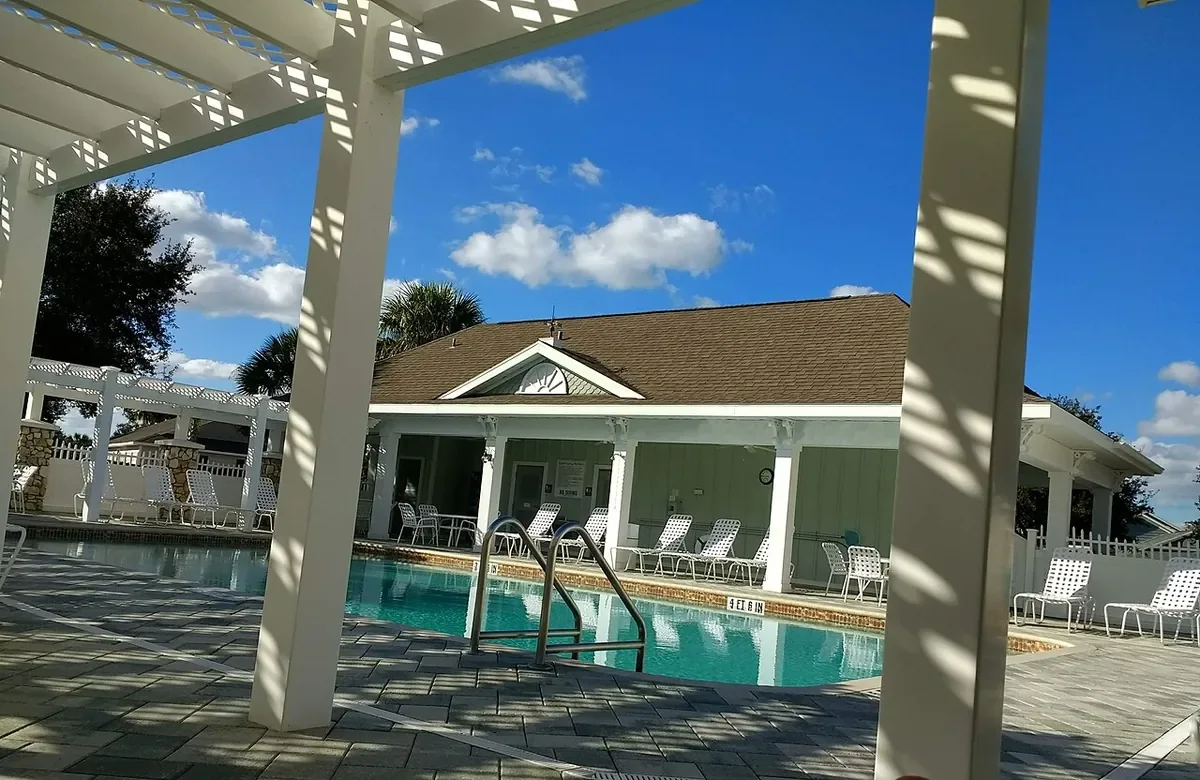
Photo: Whoisjohngalt, Wikimedia Commons, CC BY-SA 4.0
Quick Answer
How to add salt to pool water: (1) test the current salt level with test strips or a digital salt tester; (2) look up your salt cell's target, usually about 3,000 to 3,400 ppm (many cells aim for 3,200 ppm); (3) calculate the pounds needed: gallons × ppm increase × 8.34 ÷ 1,000,000, which works out to roughly 27 pounds per 1,000 gallons to go from zero to 3,200 ppm; (4) with the pump running and the salt chlorine generator off, pour pool-grade salt (99% or purer sodium chloride) around the shallow end and perimeter, not into the skimmer; (5) brush the floor so the salt dissolves; (6) circulate for 24 hours, retest, and then turn the salt cell back on. A 15,000 gallon pool starting from fresh water needs about 400 pounds, or ten 40-pound bags.
A salt water pool is not a chlorine-free pool. It is a chlorine pool that makes its own chlorine. A salt chlorine generator, often called a salt cell or salt system, passes a low electrical current through mildly salty water, which converts dissolved salt into chlorine. The chlorine sanitizes the water, then turns back into salt, so the salt level stays fairly steady. Salt only leaves the pool through splash-out, backwashing, draining and rain dilution.
That is why adding salt to a pool is not a weekly job. You add a large amount when you first convert or refill the pool, then smaller top-ups a few times a season. This guide explains how to add salt to pool water correctly, how much salt you need, the right salt to buy, how a saltwater pool system works, its benefits and costs, and how to care for a saltwater pool.
What Salt Level Should a Pool Be?
Every salt chlorine generator has a recommended salt range, printed in its manual and often on a label on the control box. Typical ranges:
| Salt level | What it means |
|---|---|
| Below 2,500 ppm | Too low: most cells produce little or no chlorine and may show a low-salt warning |
| 2,700 – 3,400 ppm | Normal operating range for most residential cells |
| About 3,200 ppm | Common ideal target |
| Above 4,000 – 4,500 ppm | Too high: high-salt warnings, possible corrosion of metal parts |
| Ocean water | About 35,000 ppm, roughly ten times saltier than a salt pool |
A salt pool at 3,200 ppm tastes only faintly salty, much less than seawater and less than human tears. Always use your cell's manual as the final word, because some models run at higher or lower levels.
How Much Salt to Add to Pool Water
The pool salt calculator formula is simple:
Pounds of salt = pool gallons × (target ppm − current ppm) × 8.34 ÷ 1,000,000
The 8.34 is the weight of a gallon of water in pounds. In practice, that means about 8.3 pounds of salt per 1,000 gallons for every 1,000 ppm increase. If you do not know your pool volume, see how many gallons is my pool.
Pool salt chart
| Pool size | From 0 to 3,200 ppm | From 2,500 to 3,200 ppm | From 2,800 to 3,200 ppm |
|---|---|---|---|
| 5,000 gallons | about 133 lb | about 29 lb | about 17 lb |
| 10,000 gallons | about 267 lb | about 58 lb | about 33 lb |
| 15,000 gallons | about 400 lb | about 88 lb | about 50 lb |
| 20,000 gallons | about 534 lb | about 117 lb | about 67 lb |
| 25,000 gallons | about 667 lb | about 146 lb | about 83 lb |
| 30,000 gallons | about 801 lb | about 175 lb | about 100 lb |
Pool salt bags usually weigh 40 pounds, so a 20,000 gallon pool starting from fresh water needs about 13 to 14 bags. It is better to add about 80% to 90% of the calculated amount, let it dissolve, retest, and then top up. Salt is easy to add and hard to remove: the only way to lower salt is to drain part of the water and refill with fresh water.
Worked example
A 16 x 32 ft pool averaging 5 ft deep holds about 19,200 gallons. The test reads 2,400 ppm and the target is 3,200 ppm, an increase of 800 ppm. Pounds of salt = 19,200 × 800 × 8.34 ÷ 1,000,000 = about 128 pounds, or a little over three 40-pound bags. Add three bags, circulate overnight, retest, and add more if needed.
What Kind of Salt to Use
- Use pool salt: at least 99% pure sodium chloride, sold in 40-pound bags as pool salt or solar salt for pools.
- Avoid salt with additives: iodized salt, rock salt with dirt, and some water softener salts with anti-caking agents or rust removers can stain the pool or cloud the water.
- Fine grain dissolves faster. Coarse pellets can sit on the floor and, on plaster, cause spots if left too long.
- Magnesium blends are sold for some systems; follow your cell maker's guidance.
Pool salt is cheap, usually under $15 a bag, so the initial salt cost for most pools is $50 to $200. Store unused bags off the ground in a dry place, because damp salt clumps and is harder to pour.
How to Add Salt to Pool Water Step by Step
- Test first. Use salt test strips or a digital pool salt tester. Many cells display a salt reading, but confirm it with an independent test, because cell readings drift.
- Balance the water. Bring pH to 7.2 to 7.6 and alkalinity into range before adding salt.
- Turn the salt cell off but keep the pump running. Running the cell while salt is undissolved can give false readings and stress the cell.
- Pour the salt slowly into the shallow end and around the edges of the pool. On a plaster pool, pour near a return so the flow helps dissolve it. Do not dump salt into the skimmer.
- Brush the salt toward the main drain so it dissolves faster and does not sit in piles.
- Circulate for 24 hours. Run the pump on high, ideally on a full cycle.
- Retest the salt level. Add more if needed in small amounts.
- Turn the salt cell back on and set the output percentage, then check free chlorine the next day and adjust.
How do you add salt to a pool with new plaster? Most plasterers ask you to wait about 28 to 30 days before adding salt, because the curing plaster is sensitive. Check your contractor's start-up guide. For vinyl and fiberglass pools, salt can usually be added right away.
How a Salt Water Pool System Works
A salt water pool system has three main parts:
- The salt cell, a tube with coated titanium plates, installed in the return line after the filter (and heater).
- The control box, which powers the cell and lets you set chlorine output, shows salt readings and warnings, and reverses polarity to reduce scale.
- A flow switch or sensor that stops the cell when water is not moving.
As water flows through the cell, electrolysis converts chloride in the salt into hypochlorous acid, the same active chlorine you get from liquid chlorine or tablets. The salt cell, sometimes called a pool salt generator or salt chlorinator, produces chlorine only while the pump runs, so pump run time and the output setting control how much chlorine the pool gets.
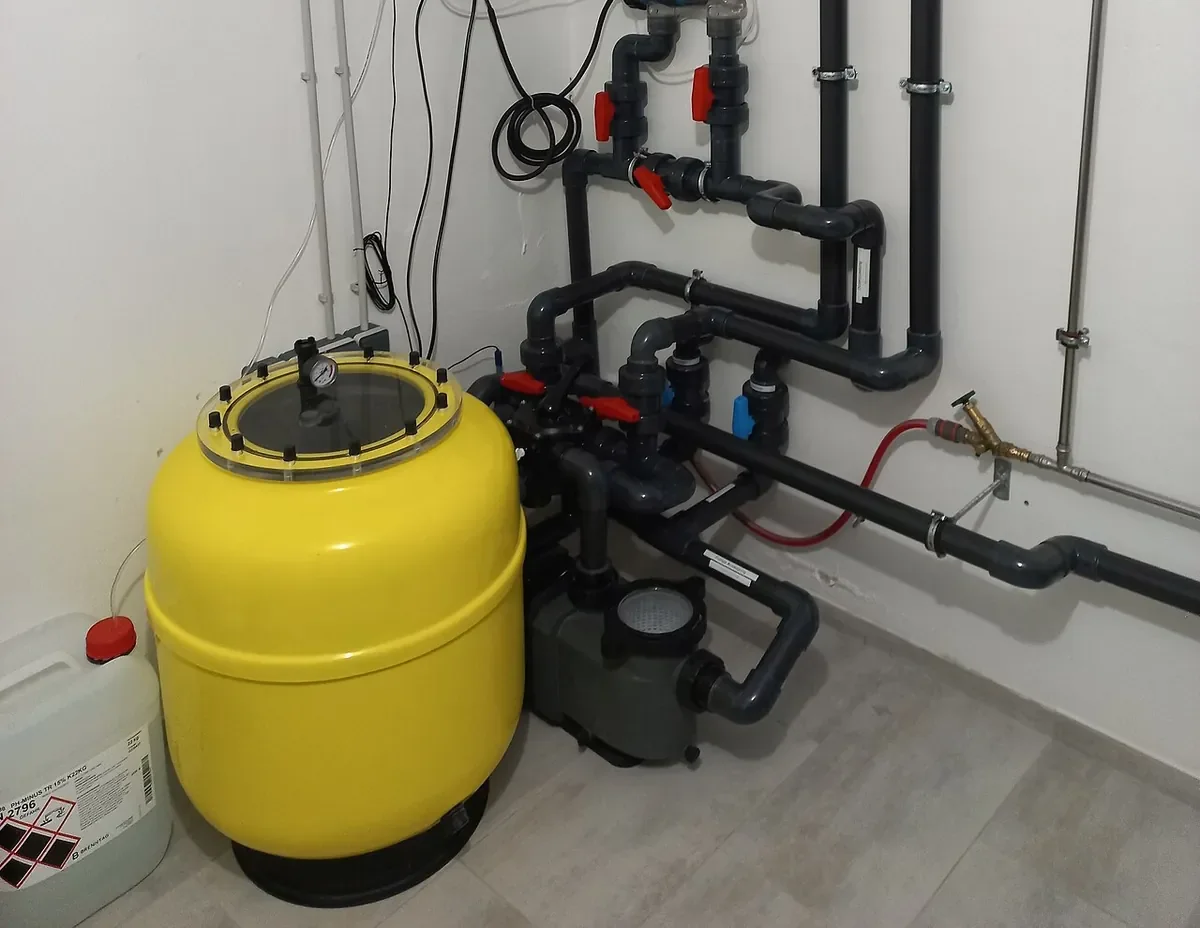
Photo: Asurnipal, Wikimedia Commons, CC BY-SA 4.0 (cropped)
Benefits of a Salt Water Pool
- Softer-feeling water. Many swimmers find salt water gentler on skin and eyes.
- Steady chlorine. The cell makes chlorine every day, avoiding the highs and lows of manual dosing.
- Fewer chloramines and less of the "chlorine smell" when the system is set correctly.
- Less handling of chlorine. No buying, storing and carrying jugs or tablets for daily sanitizing.
- Lower ongoing chemical cost in many pools, offset partly by cell replacement every few years.
The advantages of a salt water pool are real, but it still needs testing, pH control and cleaning. Salt pools tend to drift up in pH because the electrolysis process raises it, so most owners add acid regularly. For a full comparison, see salt pool versus chlorine.
Downsides of Saltwater Pools
- Up-front cost. A salt system costs about $1,500 to $3,000 installed.
- Cell replacement. Cells usually last about 3 to 7 years and cost several hundred to over $1,000 to replace.
- Corrosion risk. Salt can speed corrosion of some metals, natural stone and older equipment, especially with poor water balance or splash-out drying on surfaces.
- Rising pH. Needs regular acid additions.
- Scaling. Cells and waterline tile can build calcium scale.
Salt Water Pool Cost
| Item | Typical cost |
|---|---|
| Salt chlorine generator installed | $1,500 – $3,000 |
| Initial salt for a typical pool | $50 – $200 |
| Replacement salt cell | $500 – $1,100+ |
| Yearly salt top-ups | $20 – $80 |
| Acid for pH control | $50 – $200 a year |
| Electricity for the cell | Usually modest; varies with output and run time |
For a full conversion budget, see convert pool to salt cost, and for the steps, how to convert a pool to salt water.
Caring for a Saltwater Swimming Pool
Saltwater pool care is mostly the same as any pool, with a few extra checks:
- Test free chlorine and pH two or three times a week and adjust the cell output and acid as needed.
- Test salt monthly and after heavy rain, refilling or backwashing.
- Test stabilizer (cyanuric acid) monthly; many salt cell makers suggest about 60 to 80 ppm outdoors to protect the chlorine.
- Inspect the salt cell every few months for white scale and clean it if needed; see how to clean a salt water pool cell.
- Rinse salt splash off decks, stone coping and metal furniture.
- Use a sacrificial zinc anode if your builder recommends it, to protect metal parts.
- Clean the filter and empty baskets as usual; see how to clean a pool.
For a full maintenance schedule, see how to maintain a saltwater pool.
Salt Water Pool Shock
Salt pools still need shocking after heavy use, storms or algae. Most cells have a boost or super-chlorinate mode that runs the cell at full output for 24 hours. For a real algae problem, that is not enough; add liquid chlorine or a chlorine shock product to reach a true shock level quickly. Non-chlorine shock is also safe for salt pools. Avoid calcium hypochlorite shock if your calcium hardness is already high, because it adds calcium that can scale the cell. See when to shock a pool.
Salt Water Pool Pumps and Filters
Any standard pool pump and filter works with a salt system; there is no special salt water pool pump or salt filter for a swimming pool, despite the names. What matters is that the pump runs long enough each day for the cell to make enough chlorine, and that the filter is clean. Variable-speed pumps work well with salt cells if the minimum flow meets the cell's flow switch requirement. Sand, cartridge and DE filters all work; see cost to replace sand in a pool filter.
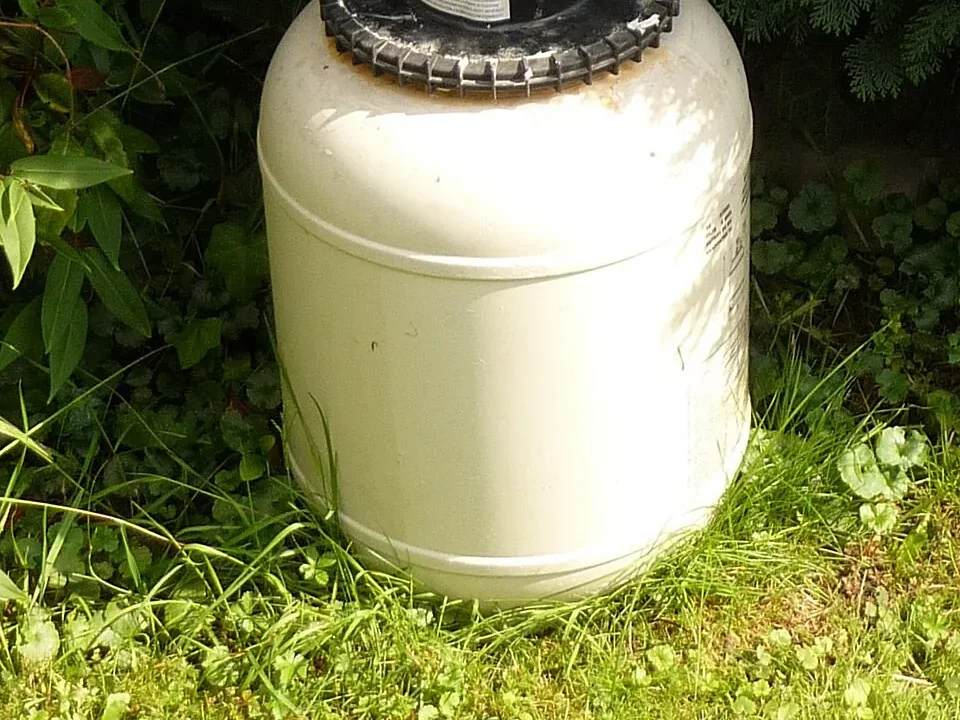
Photo: Wikimedia Commons, CC BY-SA 3.0 (cropped)
Above Ground Salt Water Pools
Many above ground pools can run as saltwater pools with a salt system sized for the volume. Check the pool maker's warranty first: some steel-wall pools are not rated for salt, while resin and hybrid pools usually are. The process to add salt to an above ground pool is the same, just with fewer bags. See how to put up an above ground pool.
Choosing a Salt Water Pool System
If you are buying a saltwater pool system, size it to your pool. Salt generators for pools are rated by the maximum gallons they can serve and by how many pounds of chlorine they make per day. Most experts suggest choosing a cell rated for at least 1.5 times your pool volume, so it can run at a moderate output instead of flat out. A larger cell works less hard and often lasts longer.
- Inline cells are plumbed into the return line and are the standard choice for inground pools.
- Drop-in or above ground salt systems are simpler units for smaller pools.
- Self-cleaning cells reverse polarity to reduce scale; nearly all modern cells do this.
- Automation-ready systems connect to pool controllers and phone apps.
A swimming pool salt system should match your equipment: check the plumbing size, flow rating and whether it can work with your existing control system and pump. Have an electrician install the power supply to code.
Testing Salt: Strips, Meters and Cell Readings
There are three common ways to measure salt:
- Salt test strips are inexpensive and accurate enough for routine checks.
- Digital pool salt testers give quick readings and are handy for frequent testing; calibrate them as directed.
- The cell's own reading is convenient but can drift as the cell ages or scales. Confirm it with a strip or meter.
Pool stores also test salt for free or a small fee. Test in the same way each time and record results to see trends.
Salt and Your Pool Equipment
At normal salt levels, most modern pool equipment handles salt water well. Problems usually come from poor water balance, high salt, or salt water drying on surfaces and concentrating. Pay attention to:
- Heaters: some heater heat exchangers are rated for salt only within certain limits. Check your heater manual.
- Metal ladders, rails and light rings: rinse and inspect for corrosion.
- Natural stone coping and decks: seal soft stone and rinse splash-out, because salt crystals can damage porous stone over time.
- Plaster: keep calcium and pH balanced; salt alone does not harm properly cured plaster.
- Steel-wall above ground pools: confirm the wall is rated for salt.
Salt Cells in Cold Weather
Salt cells produce less chlorine in cold water, and many stop working below about 50 to 60°F. Cell salt readings can also read low in cold water. In spring and fall, you may need to supplement with liquid chlorine. In freezing climates, remove or bypass the cell and store it for winter as part of closing the pool; see how to winterize a pool.
Salt Water Pool Chemicals You Still Need
A saltwater pool uses fewer chemicals, but not zero. Keep these on hand:
- Pool salt for top-ups.
- Muriatic acid or dry acid to lower pH, which tends to rise in salt pools; see how to lower pH in a pool.
- Baking soda to raise alkalinity; see how to add baking soda to a pool.
- Stabilizer (cyanuric acid) for outdoor pools; see how to add stabilizer to a pool.
- Calcium hardness increaser for plaster pools when hardness is low.
- Liquid chlorine or shock for problems and cold weather.
- Cell cleaning solution if scale builds up.
Common Myths About Salt Water Pools
- "Salt pools have no chlorine." False. They make chlorine from salt.
- "Salt water pools taste like the ocean." False. They are about one-tenth as salty as seawater.
- "Salt pools need no maintenance." False. They need testing, pH control, cleaning and cell care.
- "Salt ruins everything." Mostly false. Balanced water and proper materials prevent most problems.
- "You add salt every week." False. Salt is only replaced when water is lost or diluted.
How to Add Salt to Pool Water After Rain or Draining
Heavy rain dilutes the pool, and draining part of the water for a chemistry correction removes salt with it. After either event, test the salt level, calculate the shortfall with the formula above, and add salt the same way: pump running, cell off, spread around the shallow end, brush and circulate. After a partial drain, it is easy to estimate: if you replaced 20% of the water, salt dropped about 20%, so a pool at 3,200 ppm would read about 2,560 ppm and needs about 640 ppm added. In a 20,000 gallon pool, that is about 107 pounds of salt.
Adding Salt to a Pool for the First Time: A Checklist
If you are adding salt to a pool for the first time after installing a salt system, use this checklist:
- Confirm the salt cell is installed after the filter and heater, with the flow switch in place.
- Clean the pool and filter, and balance alkalinity, pH, calcium hardness and stabilizer.
- Measure the current salt level (fresh tap water often reads 100 to 500 ppm).
- Calculate the salt needed for your target with the pool salt chart above.
- Add about 80% to 90% of the total, brush, and circulate for 24 hours.
- Retest and add the rest in small amounts.
- Turn on the cell at around 50% output and test free chlorine the next day.
- Adjust the output percentage until free chlorine stays steady in range.
It usually takes a week or two of small adjustments to find the right output setting for your pool, weather and swimmer load. Keep notes, and the system soon runs with little attention. In very hot weather or after parties, raise the output for a few days, then lower it again when demand drops.
How Salt Pools Compare With Chlorine Tablets Day to Day
With tablets, you add chlorine in a floater or chlorinator and the chlorine level rises and falls between refills. Tablets also add stabilizer every time, which can build up over a season. With a pool salt system, chlorine is made continuously in small amounts, so levels stay steadier and stabilizer only rises when you add it. The routine shifts from buying and handling chlorine to managing pH and cell care. Many owners find that a well-set salt system makes pool care calmer, especially in hot summers when chlorine demand is high.
Troubleshooting Salt Levels
- Low salt warning after adding salt. Salt may not have dissolved yet; wait 24 hours. Also check that the cell is clean, because scale causes false low readings.
- Salt level dropping fast. Look for a leak, heavy splash-out or frequent backwashing; see how to find a leak in a pool.
- Too much salt. Drain part of the water and refill with fresh water. A 10% water change lowers salt by about 10%.
- Salt reading differs between cell and test strip. Trust a fresh, quality test; recalibrate or clean the cell.
- White salt crust on stone. Rinse decks and coping regularly and seal natural stone.
Frequently Asked Questions
How much salt do I add to my pool?
Use pounds = gallons × ppm increase × 8.34 ÷ 1,000,000. About 27 pounds per 1,000 gallons takes fresh water to 3,200 ppm.
Can I add salt directly to the pool?
Yes. Pour it into the shallow end and around the edges with the pump running, brush it, and let it dissolve. Do not pour it into the skimmer.
How long after adding salt can I swim?
You can usually swim right away, though it is best to let salt dissolve and circulate first. Wait until chlorine and pH are in range.
How often do you add salt to a saltwater pool?
Only when testing shows it is low, typically a few times a season after rain, backwashing or splash-out.
What is the ideal salt level in a pool?
Usually about 3,000 to 3,400 ppm, often 3,200 ppm. Follow your cell manufacturer's range.
Can I use water softener salt in my pool?
Only if it is pure sodium chloride without additives. Pool salt is the safer choice.
Does a salt water pool still have chlorine?
Yes. The salt cell makes chlorine from the salt; the pool is sanitized by chlorine like any other.
Can I add salt to a pool with the pump off?
It is better to run the pump so the salt spreads and dissolves evenly. If you add salt with the pump off, brush well and start the pump soon after, and keep the salt cell off until the salt has fully dissolved.
Why is my salt water pool cloudy after adding salt?
Low-purity salt or salt with additives can cloud the water briefly. Run the filter, clean it afterward, and use 99% pure pool salt next time.
Does a salt water pool need a special filter?
No. A salt water pool filter is a regular sand, cartridge or DE filter. The salt system works with any properly sized filter.
How many bags of salt does a 20,000 gallon pool need?
From fresh water to 3,200 ppm, about 534 pounds, or 13 to 14 bags of 40 pounds. For a top-up, it depends on the current level.
How long does a salt cell last?
Usually about 3 to 7 years, depending on use, water balance and cleaning.
Sources
- CDC: Healthy Swimming (chlorine and pH guidance)
- Pool & Hot Tub Alliance: water chemistry resources
- USGS: Saline water and salinity (seawater ppm)
- HomeAdvisor: Cost to convert to a saltwater pool
- National Plasterers Council: start-up and salt guidance for new plaster