
How to Convert Pool to Salt Water: Turn a Chlorine Pool Into a Saltwater Pool
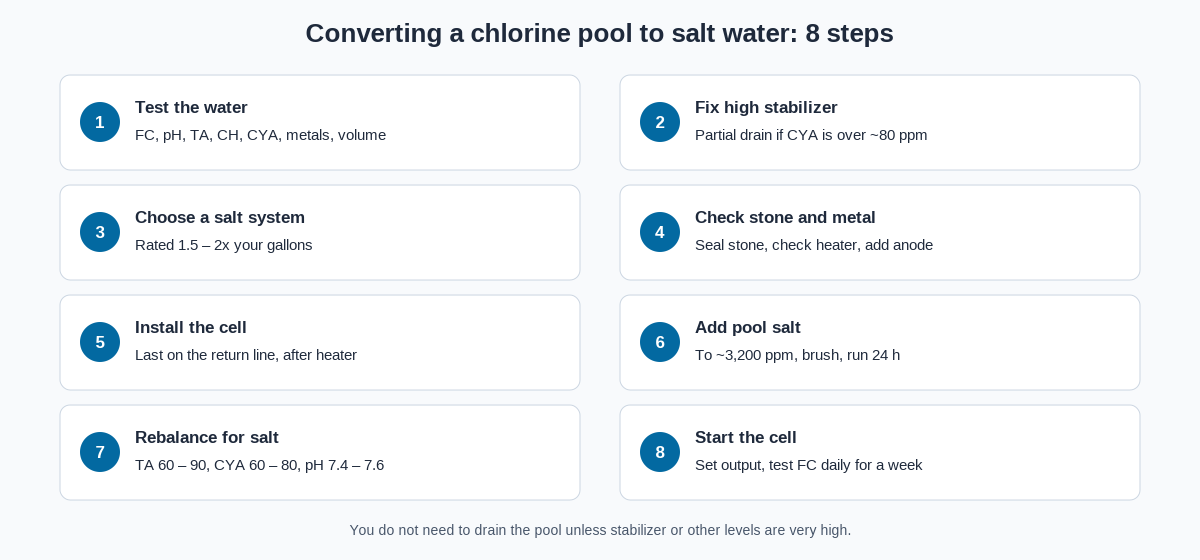
Diagram: Asphapro.com
Quick Answer
To convert pool to salt water, test the water and lower stabilizer by partial draining if it is above about 80 ppm. Choose a salt chlorine generator rated for 1.5 to 2 times your pool volume, and install the cell last on the return line, after the filter and heater, with the control box on a GFCI circuit. Add pool salt (99%+ sodium chloride) to reach about 3,200 ppm, about 267 pounds per 10,000 gallons from zero, brush it to dissolve, and run the pump for 24 hours. Rebalance for salt: alkalinity 60 to 90 ppm, stabilizer 60 to 80 ppm, pH 7.4 to 7.6. Then turn on the cell and adjust the output until free chlorine holds steady. You usually do not need to drain the pool.
A salt water pool is still a chlorine pool. The difference is that a salt chlorine generator makes chlorine from dissolved salt as water passes through its cell, instead of you adding chlorine by hand. Owners like the steady chlorine levels, the softer feel of the water and not having to buy, carry and store as much chlorine. Converting is straightforward and usually takes a day of work plus a day for the salt to dissolve, and most owners can do much of it themselves with basic tools.
This guide explains how to convert pool to salt water step by step, including a salt calculator, new water targets and tips for protecting your pool. For prices, see our guide on convert pool to salt cost.
Do You Need to Drain Your Pool to Convert to Salt Water?
No. In most cases you can convert to salt water pool chlorination without draining. Salt is added to the existing water. The main exception is high stabilizer (cyanuric acid). Pools that have used trichlor tablets for years often have CYA well above 80 to 100 ppm. Salt pools run best at 60 to 80 ppm, so if yours is much higher, partly drain and refill to bring it down before converting. Very high calcium or total dissolved solids may also call for partial draining.
Step 1: Test Your Water and Know Your Volume
Test free chlorine, pH, total alkalinity, calcium hardness, cyanuric acid, and if possible salt (some tap water already has a little) and metals. Calculate your pool volume accurately: length × width × average depth × 7.5 for rectangles. Volume determines both the salt system size and how much salt to add, so measure carefully rather than guessing.
Step 2: Choose a Salt Chlorine Generator
Choose a system rated for 1.5 to 2 times your pool volume. A larger cell runs at a lower output percentage, which extends its life. Check that the system works with your pump (some cells need a minimum flow), your automation if you have it, and your local power supply. Features such as automatic salt and temperature readings, reverse polarity self-cleaning and a flow switch are worth having.
Step 3: Check Stone, Metal and Equipment
Salt water can damage some natural stone coping and decks, such as limestone and soft sandstone, through salt crystallization. Seal stone before converting. Check your heater; some older heaters with copper heat exchangers are not recommended for salt. Consider a sacrificial zinc anode to protect metal parts. Steel-walled above ground pools may not be suitable for salt; check with the maker. See does salt damage concrete.
Step 4: Install the Salt Cell and Control Box
Turn off power at the breaker. Cut the return line after the filter, heater and any other equipment, and glue in the salt cell with its unions so it is the last piece of equipment before water returns to the pool. Install the flow switch if separate. Mount the control box on a wall or post, wire it to power on a GFCI-protected circuit according to the instructions (hire a licensed electrician for hard-wired systems), and bond the cell to the pool's bonding grid. Remove or bypass any tablet chlorinator, since trichlor tablets lower pH and add stabilizer.
Step 5: Add Pool Salt
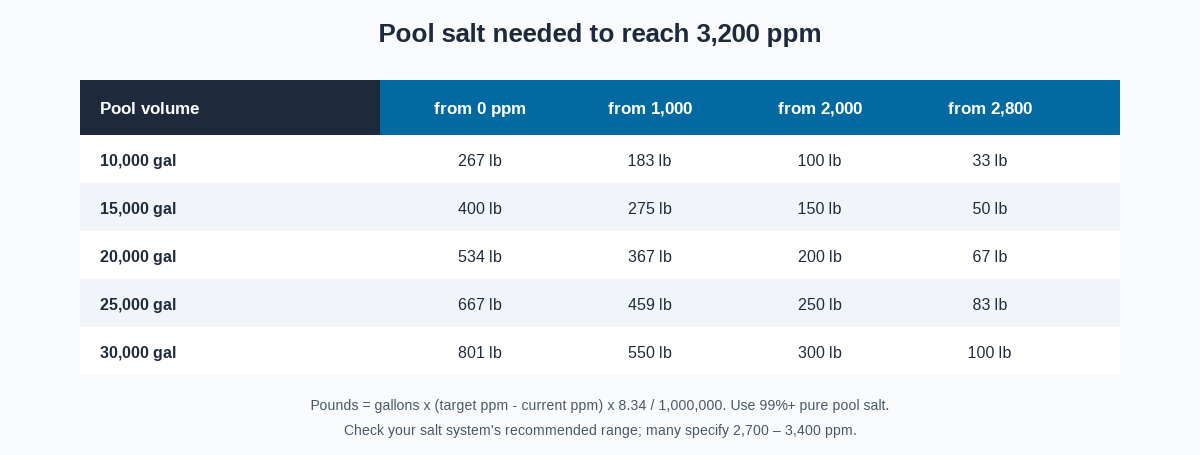
Chart: Asphapro.com
Use pool salt that is at least 99% pure sodium chloride, without iodine, anti-caking agents or additives. With the pump running and the cell off, pour salt into the shallow end, spreading it around. Brush the salt toward the main drain to help it dissolve. Do not pour salt into the skimmer, where concentrated brine can harm equipment. Run the pump for 24 hours with the cell off, then test the salt level and add more if needed.
Pool Salt Calculator
Enter your pool volume and current and target salt levels to see how much salt to add.
Photo: Mark Schellhase, Wikimedia Commons, CC BY-SA 3.0
Step 6: Rebalance the Water for Salt
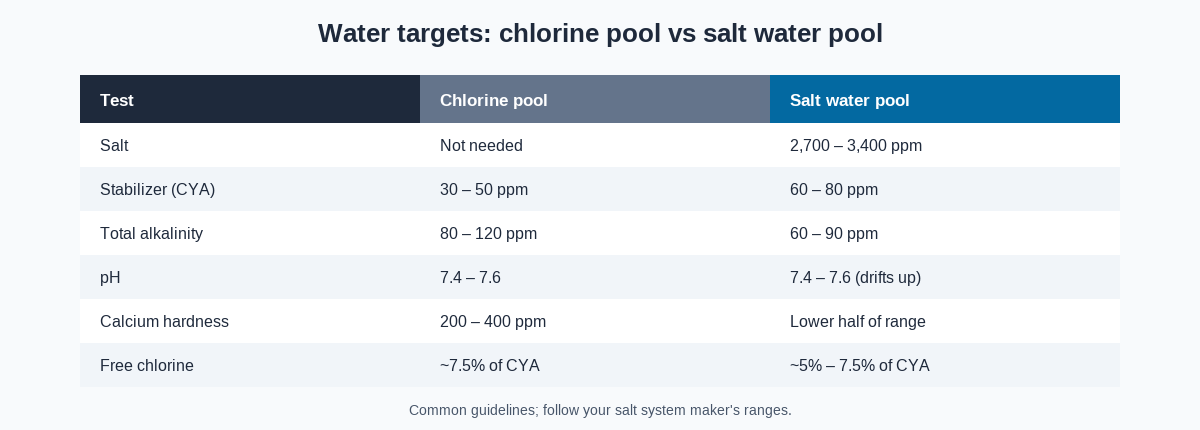
Chart: Asphapro.com
Salt pools work best with slightly different targets. Keep stabilizer at 60 to 80 ppm, since the cell makes chlorine steadily and higher CYA protects it from sunlight. Lower total alkalinity to about 60 to 90 ppm; salt pools tend to drift up in pH, and lower alkalinity slows that rise. Keep pH at 7.4 to 7.6. Keep calcium hardness in the lower half of the range for your surface to reduce scale on the cell.
Step 7: Start the Cell and Set the Output
Once salt is dissolved and the water is balanced, turn on the salt system. Start at about 50% output and test free chlorine daily for the first week. Raise or lower the output until free chlorine holds at your target. Run the pump long enough each day for the cell to make enough chlorine, often 8 to 12 hours in summer. See how long to run pool pump equipment.
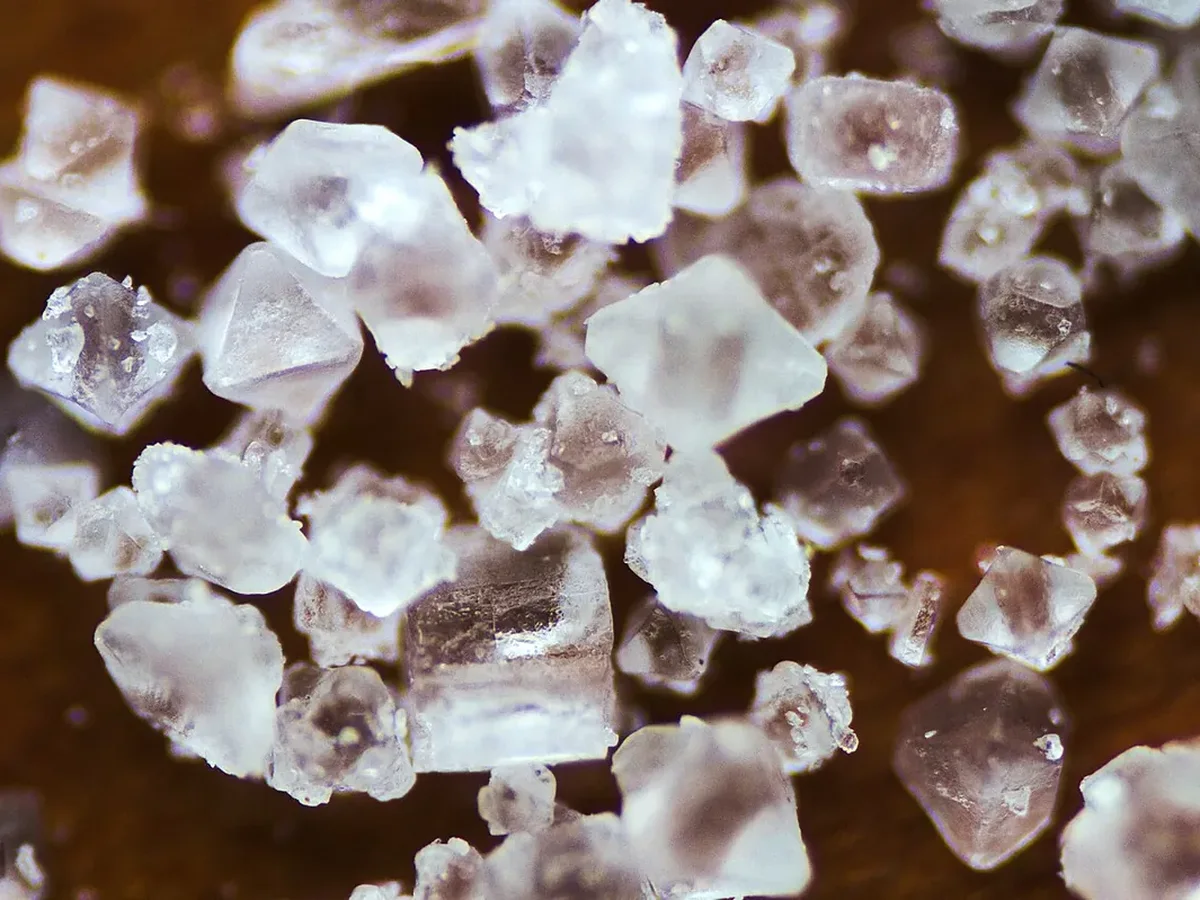
Photo: Stanislav.nevyhosteny, Wikimedia Commons, CC BY-SA 4.0
How to Turn a Chlorine Pool Into a Saltwater Pool: Before You Start
Before you learn how to turn a chlorine pool into a saltwater pool in practice, take stock of your pool. Check the age and condition of your pump, filter and heater; a conversion is a good time to replace a failing pump with a variable-speed model or upgrade an old heater with a copper heat exchanger. Look at your coping, deck and any natural stone; soft stone may need sealing. Check the bonding and electrical panel near the equipment pad; a salt system needs a proper circuit and bonding. Look at your water history; if you have used trichlor tablets for years, stabilizer is probably high. Planning these details first makes the conversion smoother and avoids surprises.
Converting Pool to Saltwater: Inground vs Above Ground
Inground pools. Converting pool to saltwater in an inground pool usually means a hard-wired salt system with a cell rated for 25,000 to 60,000 gallons, installed in the return plumbing at the equipment pad. Concrete, vinyl and fiberglass pools all convert well, with care for natural stone and metal parts.
Above ground pools. Many above ground salt systems plug into a GFCI outlet and fit in the return hose, making them easy to install. The main question is the pool wall. Resin and hybrid pools handle salt well. Steel-walled pools can rust faster with salt, and some makers advise against it or void the warranty. Check your pool's documentation before converting pool to saltwater in an above ground pool.
How to Turn a Chlorine Pool to a Saltwater Pool After Using Tablets
Most owners who want to know how to turn a chlorine pool to a saltwater pool have been using trichlor tablets. Tablets add stabilizer every time they dissolve, so after a few seasons CYA can reach 100 ppm or more. High CYA makes chlorine slow to work, which a salt system cannot fix. Test CYA first. If it is over about 80 ppm, drain and refill part of the pool: replacing a third of the water lowers CYA by about a third. Remove the tablet floater or inline chlorinator, or bypass it, so no more tablets go in. Tablets also lower pH and alkalinity, so expect to raise alkalinity at first and then manage rising pH once the salt cell takes over.
Turn Chlorine Pool to Saltwater: What Changes Day to Day
Once you turn chlorine pool to saltwater operation, daily care changes. You stop adding chlorine by hand, except for shocking. You adjust the salt system's output percentage and the pump run time to keep free chlorine steady. You test salt every month or so and add a bag when it drops, since salt only leaves with splash-out, backwashing and rain overflow. You check pH more often, since salt pools tend to drift up, and add acid as needed. You inspect the cell every one to three months and clean it when you see scale. See how to maintain a saltwater pool and how to clean salt water pool cell plates.
How to Turn Chlorine Pool Into Saltwater: DIY or Professional?
Many owners handle the whole job themselves, especially with plug-in systems. If you are comfortable cutting and gluing PVC pipe and following wiring instructions for a plug-in unit, how to turn chlorine pool into saltwater is a one-day DIY project. Hard-wired systems should be connected by a licensed electrician, and bonding must meet code. A professional install usually costs $300 to $1,000 in labor and may be required for some warranties. If your equipment pad is crowded or your plumbing is old, a pro can also reroute pipes and replace worn fittings at the same time.
Convert Pool to Saltwater: First Weeks Troubleshooting
In the first weeks after you convert pool to saltwater, small problems are common. If the control box shows low salt but your test shows normal, the cell may need calibration or the water may still be mixing; wait 24 hours and retest. If free chlorine stays low, check that stabilizer is in range, the pump runs long enough and the output is high enough; add liquid chlorine to boost it while you adjust. If pH rises quickly, lower alkalinity toward 60 to 70 ppm and add acid. If the cell shows a flow error, check the flow switch direction and that valves are open. If the water is cloudy, run the filter longer and check calcium and pH. Most systems settle into a steady routine within two to three weeks.
Converting Pool to Saltwater on Plaster, Vinyl and Fiberglass
Plaster and pebble pools handle salt well when water is balanced. Keep calcium hardness in range to avoid etching, and keep pH from drifting high to avoid scale.
Vinyl pools are not harmed by salt. Check that wall panels and fittings are rated for salt, especially on older steel-wall pools.
Fiberglass pools are well suited to salt. The gelcoat resists salt, and there are few metal parts. Keep calcium moderate to avoid scale on the surface.
Salt Cells in Cold Water
Most salt cells stop making chlorine when the water drops below about 50 to 60 °F, to protect the cell. When you convert pool to salt water in early spring or late fall, add liquid chlorine to keep chlorine in range until the water warms. In winter, if the pool stays open in a mild climate, you may need to use liquid chlorine for part of the season. In freezing climates, remove and store the cell indoors during winterizing, following the maker's instructions.
Worked Examples
Example 1: inground vinyl pool. A 20,000-gallon vinyl pool tests at CYA 60, alkalinity 100, pH 7.6 and salt 0. The owner installs a 40,000-gallon salt system, adds 534 pounds of salt (14 bags of 40 lb), runs the pump for 24 hours, lowers alkalinity to about 80 with acid and turns on the cell at 50%. After a week of adjusting, the cell holds free chlorine at 4 to 5 ppm at 45% output.
Example 2: tablet-heavy concrete pool. A 25,000-gallon plaster pool has CYA of 120 after years of tablets. The owner drains and refills about 40% of the water, bringing CYA to about 70 ppm, then installs the salt system and adds about 667 pounds of salt. With balanced water, the conversion is complete in three days.
Example 3: above ground resin pool. A 12,000-gallon resin above ground pool gets a plug-in salt system on the return hose. The owner adds 320 pounds of salt and is swimming in a salt pool the next day.
Common Mistakes When You Convert Pool to Saltwater
The most common mistake is converting without checking stabilizer, which leaves the new salt pool struggling to hold chlorine. Others include undersizing the salt system, using salt with additives, pouring salt into the skimmer, turning the cell on before the salt dissolves, ignoring pH drift, forgetting to seal soft stone, and assuming a salt pool is maintenance-free. A salt pool needs less hands-on chlorine work, but regular testing and cell care are still essential.
Choosing the Right Pool Salt
Not all salt is the same. Pool salt sold in 40-pound bags is usually 99% or more pure sodium chloride and dissolves quickly. Some water softener salt is also pure enough, but many softener salts are pellets with added cleaning agents or anti-caking chemicals, which can cause foam, stains or cloudiness. Avoid rock salt, which contains dirt and minerals, and iodized table salt. Read the label and look for "pool salt" or "99%+ sodium chloride with no additives." Finer crystals dissolve faster than coarse ones in cool water. Store unopened bags dry, since damp salt clumps and is harder to spread.
How Long Until You Can Swim?
Salt itself does not prevent swimming; the water is only about one tenth as salty as the sea. Once the salt has dissolved, which takes about a day with the pump running, and free chlorine and pH are in range, the pool is ready. If you added large amounts of acid or other chemicals while rebalancing, wait until they have circulated and retest before swimming. Many owners convert on a weekday and are swimming by the weekend.
Maintaining Salt Levels
Salt is not used up by the chlorine generator; the chlorine it makes turns back into salt after it does its work. Salt leaves the pool only when water leaves: splash-out, backwashing, draining for rain overflow, and leaks. That is why most salt pools need only one to four bags of salt a season after the initial fill. Test salt monthly with test strips or a meter, and compare with the control box reading. If the control box consistently reads low while your test reads normal, clean the cell and check the sensor. Never add salt beyond the maker's recommended range, since very high salt can shut down the cell and make water taste salty.
Protecting Your Pool and Yard
Salt water can affect some materials around the pool over time. Seal natural stone coping and decks every one to three years. Rinse metal furniture, ladders and rails occasionally with fresh water. Direct backwash water away from lawns and gardens, since salt can harm plants; check local rules for discharging salt water. Keep the equipment pad dry and well ventilated to protect metal fittings. Installing a sacrificial zinc anode in the plumbing or skimmer helps protect metal parts. These steps keep the benefits of salt without unwanted damage.
Is Converting Worth It?
For most owners who use a lot of chlorine, want steady sanitizer levels and dislike handling chlorine, converting is worth it. The water feels softer, chlorine stays steadier, and chemical shopping trips drop. The trade-offs are the upfront system cost, a replacement cell every 3 to 7 years, more frequent acid additions to control pH, and some care for stone and metal. Our guide on salt pool versus chlorine compares the two systems in more depth.
How Do I Convert My Pool to Saltwater on a Budget?
If you are asking how do I convert my pool to saltwater without overspending, start by sizing the system correctly rather than buying the biggest model. Buy during off-season sales in fall or winter, when salt systems are often discounted. Install the system yourself if it plugs in or if a spare circuit already exists, and hire an electrician only for the wiring. Buy salt in bulk from a farm or pool supply store. Use up any chlorine you already have during the switch. If your stabilizer is only slightly high, let it fall naturally through splash-out and rain instead of draining. These steps can cut the cost to convert pool to saltwater by several hundred dollars while still giving you a reliable system.
Converting Pool to Saltwater Mid-Season
You can convert at any time of year, but there are advantages to timing. Converting pool to saltwater at spring opening means you start the season with fresh balance and the cell can take over as the water warms. Converting mid-summer is fine, but plan for a day or two of extra liquid chlorine while the salt dissolves and you fine-tune the output. Converting in fall gives you time to learn the system before next season but means the cell may stop making chlorine as water cools. Whenever you do it, test daily for the first week.
How to Turn a Chlorine Pool Into a Saltwater Pool With Automation
If your pool has automation, choose a salt system that integrates with it, or one the automation maker supports. Integration lets you set output, see salt readings and receive alerts on your phone, and lets the automation run the pump on a schedule that matches chlorine demand. When you turn a chlorine pool into a saltwater pool with automation, set a pump schedule that gives the cell enough run time during the day, and use a boost mode after heavy use or storms.
A Simple Conversion Checklist
Use this checklist when you convert pool to salt water. Test all water levels and calculate your volume. Lower stabilizer if it is above about 80 ppm. Seal natural stone and check the heater and metal parts. Buy a salt system rated for 1.5 to 2 times your volume and enough pure pool salt. Turn off power, install the cell last on the return line, mount the control box and connect it to a GFCI circuit with proper bonding. Remove or bypass the tablet feeder. Add about three quarters of the salt, brush it, and run the pump for 24 hours with the cell off. Retest and add the rest. Lower alkalinity to 60 to 90 ppm, set stabilizer to 60 to 80 ppm and pH to 7.4 to 7.6. Turn on the cell at about 50% output and test daily for a week, adjusting until chlorine holds steady. Keep a jug of liquid chlorine on hand for shocking.
How to Convert Pool to Salt Water: Key Points
- Test the water and lower high stabilizer before converting.
- Install a properly sized cell last on the return line.
- Add pure pool salt to about 3,200 ppm and dissolve it fully.
- Rebalance for salt, start the cell and adjust output daily at first.
Frequently Asked Questions
How do I convert my pool to saltwater?
Test and balance the water, lower stabilizer if it is very high, install a properly sized salt system on the return line, add pure pool salt to about 3,200 ppm, let it dissolve for a day, rebalance for salt and then start the cell, adjusting the output until chlorine holds steady.
Can any pool be converted to salt?
Most can. Check that metal parts, heaters with copper exchangers, natural stone coping and steel above ground pool walls are suitable for salt, and seal or upgrade them where needed.
How much salt do I need?
About 267 lb per 10,000 gallons to reach 3,200 ppm from zero. Use the calculator above for your exact volume and starting level.
How long does it take to convert?
About a day of work to install the system plus a day for the salt to dissolve and the water to be rebalanced. Draining to lower stabilizer adds a day or two.
Is a salt pool chlorine free?
No. The cell makes chlorine from salt, so a salt pool is still a chlorine pool, just with a steadier, automatic supply.
Can I use water softener salt?
Only if it is pure sodium chloride with no additives, cleaning agents or anti-caking chemicals. Pool salt is the safest choice.
Sources
- CDC: Pool chemistry and testing
- Trouble Free Pool: Pool water chemistry
- NFPA 70: National Electrical Code
- Pool and Hot Tub Alliance