
How to Reduce Cyanuric Acid in Pool Water: Step-by-Step Guide
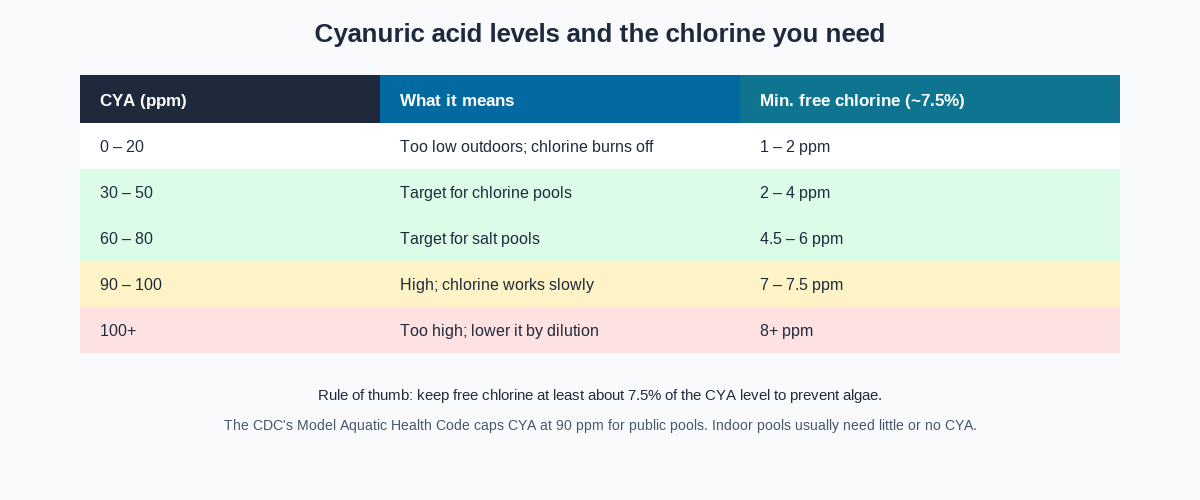
Chart: Asphapro.com
Quick Answer
The only reliable way to reduce cyanuric acid in pool water is to replace some of the water with fresh water, because cyanuric acid (stabilizer) does not break down or filter out on its own. To bring CYA from 100 ppm down to 50 ppm, drain and refill about half of the pool; the formula is % to replace = (current − target) ÷ current × 100. For large drops, replace water in stages and never fully drain a vinyl pool. Reverse osmosis treatment can lower CYA without wasting as much water, and enzyme CYA reducer products work in some pools but are not reliable. To keep it from climbing again, switch from trichlor tablets and dichlor shock to liquid chlorine or a salt system. Aim for 30 to 50 ppm in chlorine pools and 60 to 80 ppm in salt pools.
Cyanuric acid, often called CYA, stabilizer or conditioner, is one of the most helpful and most misunderstood chemicals in pool care. A little protects chlorine from the sun and saves money. Too much makes chlorine slow and weak, leading to cloudy water, algae and wasted shock. And because CYA does not go away on its own, it slowly builds up in many pools until it causes problems.
This guide explains how to reduce cyanuric acid in pool water, why levels climb, how much water to replace, when other methods make sense, and how to keep stabilizer in range. To raise CYA instead, see our guide on how to add stabilizer to pool water.
What Is Cyanuric Acid in a Pool?
What is cyanuric acid in pool water, and why does it matter? Cyanuric acid is a chemical that bonds loosely with chlorine and shields it from ultraviolet light. Without it, sunlight can destroy most of the chlorine in an outdoor pool in a few hours. With the right amount, chlorine lasts much longer, so you use less and keep steady sanitizer levels.
The trade-off is that CYA also slows chlorine down. The more stabilizer in the water, the more free chlorine you need to kill algae and germs quickly. Pool experts use a rule of thumb that free chlorine should be at least about 7.5% of the CYA level. At 40 ppm CYA, that means about 3 ppm chlorine; at 100 ppm, about 7.5 ppm. When CYA is very high, it becomes hard to keep enough chlorine to prevent algae.
What Should Cyanuric Acid Be in a Pool?
- Outdoor chlorine pools: 30 to 50 ppm.
- Salt water pools: 60 to 80 ppm, since the cell makes chlorine steadily and higher CYA protects it.
- Indoor pools: 0 to 20 ppm, since there is little sunlight.
- Public pools: the CDC's Model Aquatic Health Code sets a maximum of 90 ppm; many states use similar limits.
If your test shows CYA above about 80 ppm in a chlorine pool, or above about 100 ppm in a salt pool, it is time to lower cyanuric acid in pool water.
Signs Your Cyanuric Acid Is Too High
- Algae keeps coming back even with normal chlorine readings.
- Cloudy water that does not clear with shock.
- Shock seems to do little, or chlorine needs to be very high to work.
- Chlorine tests look fine, but the water still feels or looks dirty.
- Test shows CYA over 80 to 100 ppm.
Why Cyanuric Acid Builds Up
CYA is added to the water with every dose of stabilized chlorine. Trichlor tablets and dichlor granules both contain cyanuric acid. For every 10 ppm of chlorine added with trichlor, about 6 ppm of CYA is added; with dichlor, about 9 ppm. Over a season, that adds up quickly. CYA does not evaporate, filter out or break down much in a normal pool, so it stays until water leaves the pool through splash-out, backwashing, draining or overflow from rain. Pools in dry climates that rarely overflow and use tablets all summer often reach 100 to 200 ppm.
Photo: Matti Blume, Wikimedia Commons, CC BY-SA 4.0
How to Reduce Cyanuric Acid in Pool: Drain and Refill
Partial draining and refilling is the standard way to reduce cyanuric acid in swimming pool water. Since tap water normally has no CYA, every gallon you replace removes stabilizer in proportion.
1. Test CYA. Use a turbidity test kit or a good test strip. Drop kits that measure cloudiness are more accurate, especially between 30 and 100 ppm. If the reading is above the top of the scale, dilute a sample half and half with tap water, test, and double the result.
2. Work out how much to replace. Use the formula or the calculator below. For example, to go from 120 to 40 ppm, replace about 67% of the water.
3. Drain in stages. Use a submersible pump or the filter's Waste setting. For large drops, replace about a third to half at a time. Never fully drain a vinyl liner pool, and be careful with fiberglass and concrete pools in areas with high groundwater. See our guide on how to drain a pool.
4. Refill and retest. Refill with fresh water, circulate for a day, and test CYA, chlorine, pH, alkalinity, calcium and salt. Adjust as needed.
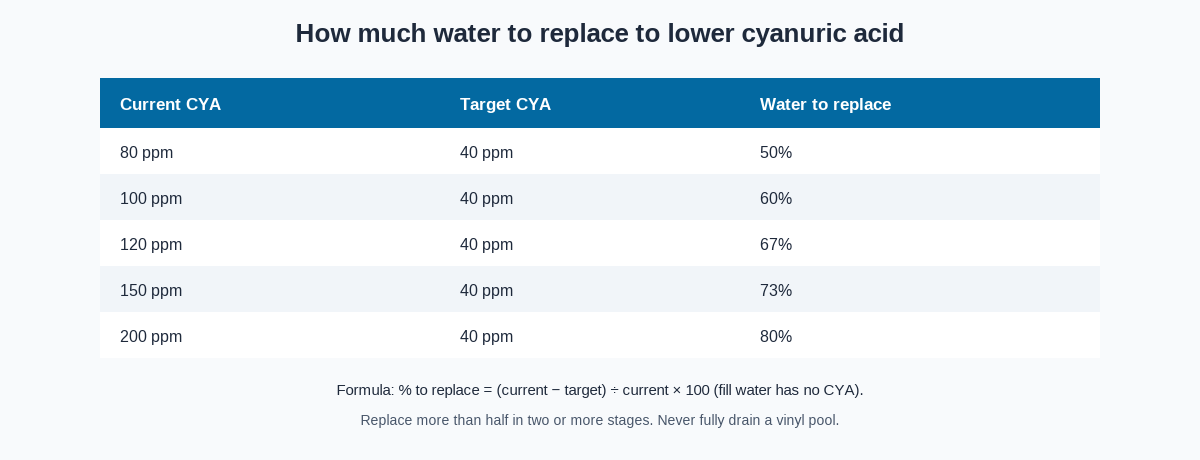
Chart: Asphapro.com
Cyanuric Acid Drain Calculator
Enter your pool volume, current and target CYA, and the CYA in your fill water (usually 0). The calculator shows how much water to replace.
How to Lower Cyanuric Acid in Pool Water Without Draining
Many owners want to know how to lower cyanuric acid in pool water without draining. There are two main options, and both have limits.
Reverse osmosis (RO). A mobile RO service pumps pool water through a trailer-mounted filtration system that removes dissolved solids, including CYA, calcium and salts, and returns clean water to the pool. RO can lower CYA by 70% to 90% in a day while saving most of the water. It usually costs $300 to $800 for an average pool and is widely available in the Southwest, where water is scarce and hard. It is the best option if you cannot drain or your local rules limit draining.
Enzyme CYA reducers. Some products use bacteria or enzymes to break down cyanuric acid in pool water. They can work, but results vary a lot. They need warm water (often above 60 to 70°F), low chlorine during treatment, balanced pH and time, usually a week or more. Many owners find they lower CYA only partly or not at all, and the product can cost as much as a partial refill. If you try one, follow the label closely and retest before and after.
Other "CYA removers" that claim to work instantly usually do not remove CYA at all. Filtration, flocculants, clarifiers and shock do not lower stabilizer.
How Do You Lower Cyanuric Acid in a Swimming Pool That Is Very High?
How do you lower cyanuric acid in a swimming pool when the test reads 150 or 200 ppm? The same dilution rule applies, but you need to replace most of the water. From 200 to 50 ppm, you would replace 75%. In concrete pools, a full drain may be possible with care and is sometimes combined with an acid wash or resurfacing. In vinyl pools, you must keep water in the pool to protect the liner, so do it in stages: replace half, refill, then replace half again. Two 50% exchanges remove 75% of the CYA. Three 40% exchanges remove about 78%. Each stage takes a day or two, plus time to rebalance the water.
Swimming Pool Cyanuric Acid and Algae
The biggest problem with high swimming pool cyanuric acid is algae. Because stabilizer slows chlorine, a pool with 100 ppm CYA and 3 ppm chlorine has far less active sanitizer than a pool with 30 ppm CYA and 3 ppm chlorine. Algae can grow even though the test shows chlorine. Owners respond by adding more shock, often dichlor, which raises CYA further and makes the problem worse. Lowering CYA breaks this cycle. Once CYA is in range, normal chlorine levels can keep the pool clear. If your pool already has algae, lower CYA first if you can, then treat the algae; see our guide on how to get rid of algae in pool water.
Photo: Kolforn, Wikimedia Commons, CC BY-SA 4.0
How to Keep Pool Cyanuric Acid From Climbing Again
Once you lower cyanuric acid in pool water, change habits so it does not climb back. The main step is to rely less on stabilized chlorine. Use liquid chlorine (sodium hypochlorite) or cal-hypo for daily chlorine and shock, since neither adds CYA. A salt chlorine generator makes chlorine from salt without adding CYA. If you like tablets, use them only part of the season, or only during vacations. Test CYA every month, and when it reaches your upper limit, switch to unstabilized chlorine until splash-out and backwashing bring it down. In dry climates, plan a small drain and refill each year to keep stabilizer, calcium and dissolved solids in check.
Cyanuric Acid for Pool Owners With Salt Systems
Salt pool owners need more cyanuric acid for pool chlorine protection than chlorine pool owners, usually 60 to 80 ppm. The salt cell makes chlorine slowly through the day, and higher CYA keeps that chlorine from burning off in the sun. Because salt pools do not use tablets, CYA rarely climbs too high unless someone adds dichlor shock or extra stabilizer. If CYA in a salt pool rises above 100 ppm, dilute as with any other pool, then add salt to restore the salt level. See our guide on how to maintain a saltwater pool.
How to Test Cyanuric Acid Accurately
CYA tests measure how cloudy a water sample becomes when a reagent is added. In a drop kit, you fill a tube with the mixed sample and look down through it at a black dot, then note the level where the dot disappears. Testing outdoors in daylight, with your back to the sun, gives the most consistent results. Test strips are easier but less precise. Readings below 30 ppm and above 100 ppm are hard to read on most kits. For high readings, mix pool water half and half with tap water, test, and double the number. Because CYA changes slowly, testing once a month is enough for most pools.
What Is Pool Cyanuric Acid Made Of?
What is pool cyanuric acid, chemically? It is a white powder or granule with the formula C3H3N3O3, made of a ring of carbon and nitrogen atoms. In pool stores, it is sold as stabilizer or conditioner. It dissolves slowly, so it is usually added in a sock in front of a return or through the skimmer with the pump running. It is also the base for trichlor and dichlor, which is why those chlorine products add CYA every time you use them.
Acid Cyanuric Pool Myths
Several myths surround cyanuric acid. One is that CYA "locks" chlorine so it stops working. In fact, CYA holds chlorine in reserve; chlorine still works, just more slowly, which is why you need more of it at high CYA. Another myth is that CYA evaporates or breaks down quickly; in most pools, it only leaves with water. A third is that you can lower CYA by shocking; shock does not remove it. Understanding these facts makes it easier to keep acid cyanuric pool levels in the right range.
Worked Examples
Example 1: tablet pool in Arizona. A 15,000-gallon plaster pool has used trichlor tablets for two summers and now tests at 150 ppm CYA. The owner wants 50 ppm. The calculator shows about 67% must be replaced. Because local water rates are high and draining is restricted, the owner books an RO service for $550, which brings CYA down to about 30 ppm in one day. They then switch to liquid chlorine and add a little stabilizer to reach 40 ppm.
Example 2: vinyl pool in New Jersey. A 20,000-gallon vinyl pool reads 110 ppm in August after a season of dichlor shock. The target is 40 ppm, so about 64% of the water must go. The owner drains 40%, refills, and a week later drains 40% again, keeping at least a foot of water in the pool. CYA ends at about 40 ppm. The total water cost is about $200.
Example 3: salt pool. A salt pool has drifted to 120 ppm because the owner kept adding stabilizer. The target is 70 ppm. Replacing about 42% of the water brings it there. The owner then adds salt to restore 3,200 ppm.
Cost of Reducing Cyanuric Acid in Pool Water
The cost of reducing cyanuric acid in pool water depends on the method. A partial drain and refill costs only the water, often $50 to $300 for an average pool, plus chemicals to rebalance, including salt for salt pools. Trucked water costs more, often $200 to $500 per load. RO treatment costs about $300 to $800. Enzyme reducers cost $40 to $150 per treatment for an average pool, with uncertain results. For most pools, partial draining is the cheapest and most reliable option, as long as local rules allow it.
Best Time to Reduce Cyanuric Acid
Spring and fall are good times to dilute, when the pool is being opened or closed and the water is cool. Fresh water is also cool in spring and fall, so it is less likely to turn green while chlorine is being rebalanced. Many owners close their pools by lowering the water level for winter, then refill with fresh water in spring, which lowers CYA naturally. In hot climates, avoid draining large amounts in midsummer, since empty or low pools can be damaged by heat and sun, and the fresh water may need a lot of chlorine right away.
How Much CYA Stabilized Chlorine Adds
Knowing how much CYA you add each season helps you plan. For every 10 ppm of chlorine added with trichlor tablets, CYA rises by about 6 ppm. A pool using 1 ppm of chlorine a day from tablets adds about 0.6 ppm CYA a day, or roughly 55 ppm over a 90-day season. Dichlor adds about 9 ppm of CYA for every 10 ppm of chlorine, so a few heavy dichlor shocks can add 20 to 40 ppm at once. Liquid chlorine and cal-hypo add no CYA. This is why many pool experts recommend liquid chlorine as the main sanitizer for outdoor pools.
Cyanuric Acid in a Pool Indoors
Indoor pools usually need little or no cyanuric acid, since there is no sunlight to break down chlorine. CYA in an indoor pool slows chlorine without any benefit, so most indoor pool owners keep it below 20 ppm. If an indoor pool has high CYA from tablets or dichlor, dilution is the fix, followed by a switch to unstabilized chlorine.
Common Mistakes When Lowering Stabilizer
The most common mistake is trying products that promise to lower CYA quickly instead of diluting. Another is draining too much at once, especially in vinyl pools. Some owners forget to test their fill water, which in rare cases already contains CYA from a previous use or a tank. Others lower CYA but keep using tablets, so the level climbs again within a season. Finally, many owners forget to rebalance after refilling: fresh water lowers salt, calcium and alkalinity too.
Balancing the Pool After You Lower CYA
Fresh water changes more than stabilizer. After refilling, test and adjust free chlorine first, since lower CYA means chlorine will burn off faster in the sun until you add the right amount of stabilizer back. Next, check pH and total alkalinity; tap water often has a different pH and lower alkalinity than old pool water. Then test calcium hardness, which drops with dilution and may need a boost in plaster pools. In salt pools, add salt to the cell's target level. Finally, add stabilizer only if CYA ended up below your target. Run the pump and filter for at least a full day, brush the walls and floor, and retest. Taking these steps carefully means the water will be clear, comfortable and properly protected from the first swim after the change.
Draining Rules and Water Use
Before you drain, check local rules. Many towns require pool water to be dechlorinated before it is released, and some require it to go to the sanitary sewer cleanout rather than the street or storm drain, which leads to rivers and lakes. Some areas in drought limit how much water can be used to refill pools, and some water utilities offer a credit or special rate for pool filling. If water is scarce or costly where you live, reverse osmosis may be the better way to reduce cyanuric acid in pool water, since it reuses most of the water. Planning around these rules avoids fines and keeps the project simple.
Choosing the Right Sanitizer Plan
Your chlorine source decides where CYA goes over time. A simple plan for most outdoor pools is to keep CYA at 30 to 50 ppm, use liquid chlorine daily or every other day to hold free chlorine at about 7.5% of CYA or higher, and use liquid chlorine or cal-hypo for shock. Tablets in a floater or feeder can still be handy for vacations, but treat them as a short-term tool. Salt pools can run at 60 to 80 ppm CYA with the cell doing most of the work. Pools with automation can use a liquid chlorine feeder for hands-off dosing without adding stabilizer. Whatever plan you choose, test CYA monthly so you catch a rise early, when a small drain is enough to fix it. A little planning means you rarely need a large drain again, and the pool stays easy to keep clear all season.
Keeping Records
A simple log makes stabilizer much easier to manage. Each month, write down the date, CYA, free chlorine, pH and any chlorine products you added. Over a season, you will see how fast CYA rises with your routine and exactly when you need to act, long before algae appears. Keep notes on drains and refills too, so you know how much water you replaced and what the readings were before and after the change.
How to Reduce Cyanuric Acid in Pool: Key Points
- Partial drain and refill is the reliable way to lower CYA.
- % to replace = (current − target) ÷ current × 100.
- Target 30 to 50 ppm for chlorine pools, 60 to 80 ppm for salt pools.
- Switch from trichlor and dichlor to liquid chlorine to stop CYA building up.
Frequently Asked Questions
Does shock lower cyanuric acid?
No. Chlorine shock does not remove CYA, and dichlor shock adds more. Use liquid chlorine or cal-hypo for shock if your stabilizer is already high.
Will rain lower cyanuric acid?
Only if the pool overflows or you drain the extra water. Rain dilutes CYA slightly when water leaves the pool, so pools in rainy climates build up less stabilizer than pools in dry ones.
How do I reduce cyanuric acid in pool water fast?
Drain and refill part of the pool water, or book reverse osmosis treatment. Both lower CYA in a day or two. Use the calculator above to find how much water to replace.
How to lower CYA in pool without draining?
Reverse osmosis is the main option. Enzyme reducers sometimes help but are not reliable, and they need warm water, low chlorine and a week or more to work.
How do you lower cyanuric acid in pool water with a vinyl liner?
Replace water in stages, keeping at least a foot of water in the pool, and refill the same day so the liner does not shrink or shift.
How to lower cyanuric acid in a swimming pool with a salt system?
Use the same dilution method, then add salt back to the target level and let it dissolve for a day before turning the cell back on.
Can I reduce cyanuric acid swimming pool levels with a filter?
No. Pool filters do not remove dissolved CYA. Only water replacement or reverse osmosis works reliably, because stabilizer is dissolved in the water rather than floating as particles.
What is cyanuric acid pool chemistry used for?
It shields chlorine from sunlight so outdoor pools need less chlorine. Too much slows chlorine down and makes algae harder to control.
How to lower cyanuric acid pool levels in winter?
Lower the water for winter closing, then refill with fresh water in spring to dilute CYA. Test after opening and adjust as needed.
Sources
- CDC: Model Aquatic Health Code
- CDC: Pool chemistry and testing
- Trouble Free Pool: Pool water chemistry
- Pool and Hot Tub Alliance