
Salt Pool Versus Chlorine: Which Is Better for Your Pool?
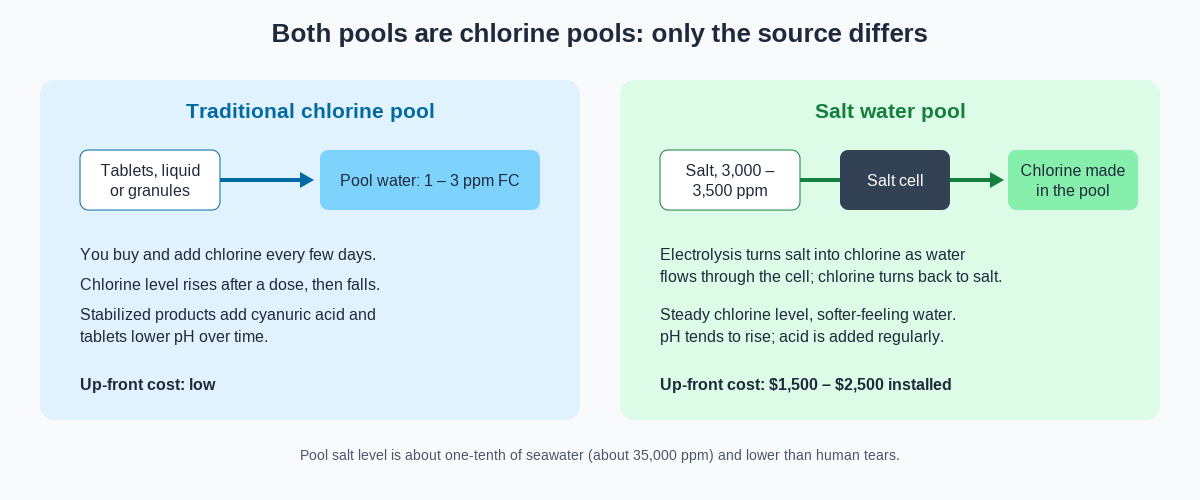
Diagram: Asphapro.com
Quick Answer
In a salt pool versus chlorine pool comparison, both pools are sanitized by chlorine. A salt water pool makes its own chlorine from dissolved salt (about 3,000 to 3,500 ppm) using a salt chlorine generator, while a traditional chlorine pool gets chlorine from tablets, liquid or granules you add by hand. Salt pools cost more up front ($1,500 to $2,500 for the system installed, plus a new salt cell every 3 to 7 years at $200 to $900), but yearly chemical costs are lower (about $70 to $150 versus $300 to $800). Salt water feels softer and keeps chlorine levels steadier, but it can corrode metal and natural stone and tends to push pH up. Chlorine pools are cheaper to start and simpler to repair.
The salt water pool vs chlorine pool question is one of the most common choices new pool owners face, and one of the most misunderstood. Many people think a salt water pool has no chlorine. It does. The difference is where the chlorine comes from and how it gets into the water. That one difference changes the cost, the upkeep, how the water feels and what can wear out.
This guide compares a salt pool versus chlorine pool side by side: how each system works, the setup cost and yearly cost, what maintenance each needs, how the water feels, health and safety, effects on equipment and surfaces, and how to convert a chlorine pool to salt. By the end you will know which is better for your pool, your budget and how you use it.
How a Traditional Chlorine Pool Works
In a traditional chlorine pool, you add chlorine to pool water yourself. The main forms are:
- Trichlor tablets in a floater, skimmer or inline chlorinator. They dissolve slowly and contain cyanuric acid (stabilizer) to protect chlorine from the sun. They are acidic and lower pH over time.
- Liquid chlorine (sodium hypochlorite, 10% to 12.5%), poured in daily or every few days. It has no stabilizer and raises pH slightly.
- Granular chlorine such as cal-hypo or dichlor, often used as shock.
Chlorine in the pool kills bacteria and algae and breaks down sweat, oils and other waste. As it works, it is used up, so you test and add more regularly. The goal is a free chlorine level of about 1 to 3 ppm (higher with more stabilizer).
Photo: Misterfacts1234, Wikimedia Commons, CC BY-SA 4.0
How a Salt Water Pool Works
A salt water pool uses a salt chlorine generator (also called a salt chlorinator or salt system). It has two parts: a control box, and a salt cell installed in the return plumbing after the filter. You add pool-grade salt to the water, about 3,000 to 3,500 ppm, which is roughly one-tenth as salty as the ocean. As water flows through the cell, a low-voltage current splits the salt into chlorine (electrolysis). The chlorine sanitizes the pool, then turns back into salt, and the cycle repeats.
So does a salt water pool have chlorine? Yes. The free chlorine level in a salt pool is the same as in a chlorine pool, about 1 to 3 ppm (often 3 to 5 ppm with the higher stabilizer many salt pools use). The difference is that the salt cell makes it steadily, every hour the pump runs.
Salt Pool Versus Chlorine at a Glance
Here is the salt vs chlorine pool comparison in one table. Whether you call it saltwater vs chlorine pool or chlorine pool versus salt water, these are the points that matter.
| Factor | Salt water pool | Chlorine pool |
|---|---|---|
| Chlorine source | Made from salt by a salt cell | Added by hand (tablets, liquid, granules) |
| Up-front cost | $1,500 – $2,500 installed | $0 – $150 (floater or chlorinator) |
| Yearly chemicals | About $70 – $150 | About $300 – $800 |
| Major replacement | Salt cell every 3 – 7 years ($200 – $900) | None |
| Chlorine level | Steady | Rises after each dose, then falls |
| Water feel | Softer, silkier | Can feel harsher, especially at high doses |
| Chlorine smell | Low | Can be strong when chloramines build up |
| pH trend | Rises; needs acid often | Falls with tablets; rises a little with liquid |
| Corrosion risk | Higher for metal, natural stone, some heaters | Lower |
| Weekly work | Less: test, add acid | More: test, add chlorine, adjust |
| Repairs | Need a technician for the cell or board | Simple |
Salt Water Pool vs Chlorine Cost
Cost is where the salt water vs chlorine pool decision gets real. A saltwater pool vs chlorine pool comparison has to include both the setup and the yearly bills.
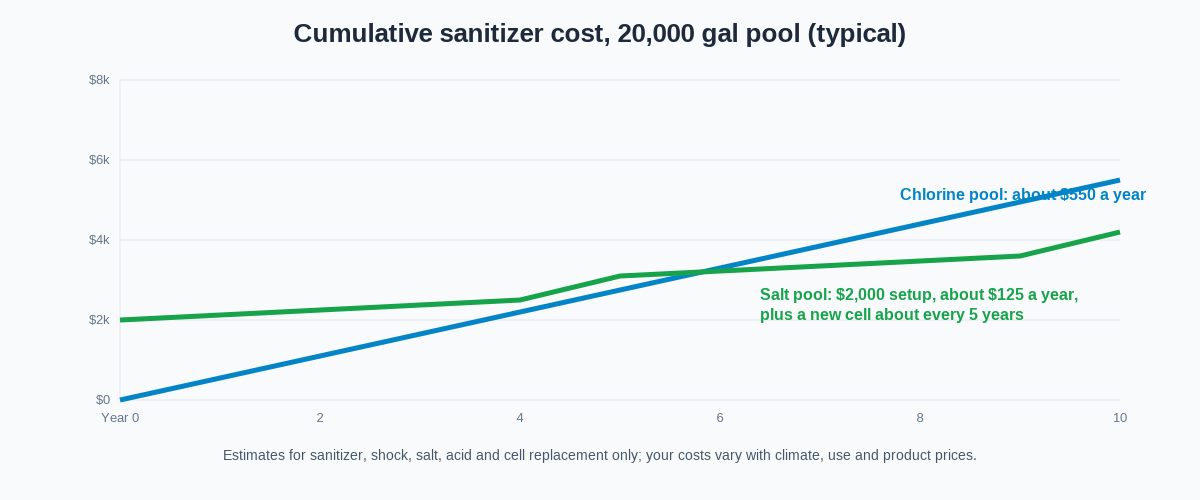
Chart: Asphapro.com
Up-front costs
- Salt chlorine generator for pool use: $700 to $2,000 for the equipment, depending on pool size and brand.
- Installation: $300 to $800 for a plumber or pool tech, plus electrical work if needed.
- Initial salt: about 40 to 60 bags of 40 lb salt for a 20,000 gallon pool starting from zero, $250 to $500.
- Total: about $1,500 to $2,500 installed for most residential pools.
A chlorine pool needs only a floater ($15 to $30) or an inline chlorinator ($100 to $300).
Yearly costs
| Yearly cost item | Salt pool | Chlorine pool |
|---|---|---|
| Chlorine or salt | $20 – $60 (top-up salt) | $250 – $650 (tablets, liquid) |
| Shock | $0 – $50 | $50 – $150 |
| Acid for pH | $30 – $80 | $10 – $40 |
| Extra electricity for the cell | $20 – $100 | $0 |
| Salt cell replacement (spread over its life) | $50 – $200 | $0 |
| Total yearly | about $120 – $490 | about $310 – $840 |
Over 5 to 10 years, the two pools often cost about the same, with the salt pool slightly cheaper in the long run if the cell lasts. The salt pool's savings come from not buying chlorine; its extra costs are the generator, the cell and acid. For full yearly upkeep, see cost to maintain a pool.
Maintenance: Salt Pool vs Chlorine Pool
Weekly work is another big difference in a chlorine pool vs saltwater pool.
Salt pool maintenance
- Test free chlorine, pH and salt weekly; test alkalinity and stabilizer monthly.
- Add muriatic acid often, because salt pools tend to drift up in pH.
- Add salt after heavy rain, splash-out or backwashing.
- Clean the salt cell 2 to 4 times a year to remove scale (more in hard water).
- Adjust the generator output for the season and pool use.
- Shock occasionally with the generator's boost mode or with liquid chlorine.
Chlorine pool maintenance
- Test chlorine and pH 2 to 3 times a week.
- Add tablets to the floater or chlorinator weekly, or liquid chlorine daily or every few days.
- Shock weekly or after heavy use; see when to shock a pool.
- Watch stabilizer levels if you use tablets; cyanuric acid builds up and must be diluted with fresh water.
- Adjust pH (often raise it with tablets); see how to raise pH in pool.
Water Feel, Smell and Comfort
Salt water pools are known for water that feels soft and silky. The salt level is too low to taste much like the ocean, but it is close to the salt level of human tears, so it is gentler on eyes. Because a salt cell makes chlorine steadily, the level stays even, without the spikes that come right after adding a big dose of chlorine.
The strong "chlorine smell" people notice in some pools is actually chloramines: chlorine combined with sweat and other waste. Both types of pools can get chloramines if the chlorine level is too low. Salt pools tend to have fewer complaints because the chlorine level stays steadier. A well-kept chlorine pool can be just as comfortable.
Health and Safety
- Both are safe when balanced. Each kills germs with the same chemical, chlorine.
- Salt pools mean less handling and storage of strong chlorine products, which some owners prefer, especially with children in the home.
- Chlorine pools require storing tablets and liquid safely, away from acids and heat.
- Sodium in salt pools is low. People on low-sodium diets usually do not need to worry about swimming, but should not drink the water.
- Skin and eyes: people with sensitive skin often prefer salt pools.
Effects on Pool Surfaces and Equipment
Salt is corrosive over time, especially where water splashes and dries, leaving salt crystals behind. Owners of salt pools should know:
- Natural stone coping and decks (limestone, sandstone, some travertine) can pit and flake. Sealing helps.
- Metal parts such as ladders, rails, light rings and some heater parts can corrode. Use stainless steel rated for salt, and install a sacrificial zinc anode.
- Steel wall pools (some above ground and inground kits) may need a resin or salt-rated wall.
- Heaters may need a cupronickel or titanium heat exchanger; check the warranty.
- Plaster can be affected by high pH and scale if water is not balanced.
- Concrete decks can scale or spall from salt splash in freeze-thaw climates; seal them.
Chlorine pools are not risk-free. Tablets in a skimmer can damage equipment with very acidic water, and low pH corrodes metal. But overall, chlorine pools are easier on surfaces and equipment.
What Does Chlorine Do in a Pool?
Whether it comes from a jug or a salt cell, chlorine in the pool does three jobs:
- Sanitizes: it kills bacteria, viruses and other germs that swimmers bring in, which protects people from illness.
- Oxidizes: it breaks down sweat, oils, sunscreen, urine and other organic waste so the water stays clear.
- Prevents algae: enough chlorine keeps algae spores from growing into a green pool.
When chlorine reacts with waste, part of it becomes combined chlorine (chloramines), which is weak and causes odor and eye irritation. Shocking the pool, by raising chlorine well above normal for a short time, breaks those chloramines down. Sunlight also destroys chlorine quickly, which is why most outdoor pools use cyanuric acid (stabilizer) to protect it. Salt pools and chlorine pools both need stabilizer outdoors, typically 30 to 50 ppm for chlorine pools and 60 to 80 ppm for salt pools.
How to Add Chlorine to Pool Water
In a chlorine swimming pool, the main ways to add chlorine are:
- Tablets in a floater or inline chlorinator: fill weekly; adjust the floater vents or chlorinator dial to control how fast it dissolves.
- Liquid chlorine: pour it slowly in front of a return jet with the pump running, usually in the evening so the sun does not burn it off.
- Granular chlorine: pre-dissolve cal-hypo in a bucket of water before adding; dichlor can be broadcast directly in most pools.
Never put tablets in the skimmer of a pool with a heater, and never mix different chlorine types in the same container: they can react violently.
Pool Chlorine Calculator: Liquid Chlorine Dose
This pool chlorine calculator estimates how much liquid chlorine raises free chlorine to your target. It works for chlorine pools, and for salt pools when you want to boost chlorine quickly without waiting for the cell.
The math: 1 ppm in 10,000 gallons equals about 10 to 11 fluid ounces of 12.5% liquid chlorine. The swimming pool chlorine calculator above uses that ratio, adjusted for strength and pool size. Always add a little less than the full amount, wait an hour with the pump on, and retest.
Choosing a Salt Chlorine Generator for Pool Use
If you decide on salt, choose the salt water pool chlorine generator carefully:
- Size it up: pick a salt cell rated for at least 1.5 times your pool volume. A larger cell runs at a lower percentage, lasts longer and keeps up in hot weather.
- Check the cell life rating: cells are rated in hours (often 8,000 to 10,000). More hours means fewer replacements.
- Self-cleaning (reverse polarity) cells reduce scale build-up and cleaning work.
- Flow and temperature sensors protect the cell from running without water or in cold water, when it cannot make chlorine.
- Compatibility: make sure the pool salt chlorine generator works with your pump speed, automation system and plumbing size.
- Above ground models are smaller and plug in near the pump; they cost $300 to $800.
A salt chlorine generator pool owners buy online may save money, but a local pool store or installer can help with warranty claims and cell testing. A chlorine generator for salt water pool use is an electrical device, so install it according to the manual and local code.
How to Convert a Chlorine Pool to Salt
Converting from chlorine to salt water pool operation is a common upgrade and does not require draining the pool. Here is how to convert a chlorine pool to saltwater:
- Check your pool and equipment. Confirm the surface, coping, deck, heater, ladder and walls can handle salt. Replace or protect metal parts as needed.
- Balance the water. Get pH to 7.4 to 7.6, alkalinity to 60 to 90 ppm, calcium to 200 to 400 ppm and stabilizer to 60 to 80 ppm.
- Remove the old chlorinator or empty the floater. Use up remaining tablets elsewhere.
- Install the salt cell in the return line after the filter and heater, and mount the control box near the pump.
- Wire the system, often to the pump's timer or automation, so the cell only runs when water is flowing.
- Add salt: test the current salt level, then add pool-grade salt to reach the level your generator requires, usually 3,000 to 3,400 ppm. See how to add salt to pool.
- Brush and circulate for 24 hours so the salt fully dissolves.
- Turn on the generator and set the output to about 50%. Test chlorine daily for the first week and adjust.
- Install a zinc anode in the skimmer or plumbing to protect metal parts.
Converting usually costs $1,500 to $2,500 with professional installation, or $800 to $2,000 if you install the equipment yourself.
Salt Water Pool or Chlorine: Which Should You Choose?
| Your situation | Better choice |
|---|---|
| You want the lowest up-front cost | Chlorine |
| You want soft water and less weekly work | Salt |
| Natural stone coping or deck | Chlorine (or seal stone well for salt) |
| Swimmers with sensitive skin or eyes | Salt |
| Above ground pool with a steel wall | Chlorine, unless the wall is rated for salt |
| Vacation home or often away | Salt (steady chlorine without dosing) |
| Very hard water | Chlorine, or salt with frequent cell cleaning |
| Indoor pool | Either; salt cuts chlorine odor |
In short: the saltwater or chlorine pool choice comes down to comfort and convenience versus cost and simplicity. Many owners who switch from chlorine to salt are happy with the change; those with stone decks or older metal parts should weigh corrosion carefully.
Common Myths About Salt Water vs Chlorine Pools
- "Salt pools are chlorine-free." False. A salt chlorinated pool is sanitized by chlorine made in the cell.
- "Salt pools taste like the ocean." Pool salt is about 3,200 ppm, compared with about 35,000 ppm for seawater. Most people can barely taste it.
- "Salt pools need no maintenance." They need less dosing, but you still test, add acid, clean the cell and balance the water.
- "Chlorine pools always smell strongly." A strong smell means chloramines, which come from too little chlorine, not too much. A well-run chlorine pool smells clean.
- "Salt ruins every pool." Plaster, vinyl and fiberglass pools handle salt well when the water is balanced. Natural stone and unprotected metal are the main risks.
Salt vs Chlorine Pool for Above Ground Pools
Many above ground pools can use salt, but check the manufacturer's rules first. Steel wall pools and steel frames can rust where salt water reaches them, and some warranties are void with salt. Resin (plastic) frame pools are salt-friendly. Small plug-in salt systems for above ground pools cost $300 to $800 and install in an hour. For a soft-sided or frame pool used only in summer, a simple chlorine floater is often the more practical choice.
Swimming Pool Salt Water vs Chlorine in Different Climates
- Hot, sunny climates: salt cells can keep up with high chlorine demand when sized large. Chlorine pools burn through more product in the sun.
- Cool climates: salt cells make little or no chlorine below about 50 to 60 °F, so spring and fall may need liquid chlorine as a backup.
- Freeze-thaw areas: salt splash can speed up scaling and spalling on concrete decks; seal the deck and rinse it often.
- Hard water areas: scale builds up faster on salt cells; plan to clean the cell more often.
Salt Water Pool vs Chlorine Pool Cost: A Real-World Example
Take a 20,000 gallon inground pool open year-round in a warm climate. The chlorine pool owner spends about $550 a year on tablets, liquid chlorine and shock. The salt pool owner pays about $2,000 to install a salt system, then about $125 a year for salt top-ups, acid and power, plus a new cell (about $500) every five years. After five years, the chlorine pool has spent about $2,750 and the salt pool about $3,100. After ten years, the chlorine pool is near $5,500 and the salt pool near $3,750 to $4,250. In this example, the salt water pool vs chlorine pool cost evens out in year six or seven, and salt is cheaper after that if the equipment lasts.
Pros and Cons Summary
Salt water pool pros
- Softer, gentler water.
- Steady chlorine levels.
- Lower yearly chemical cost.
- Less handling of chlorine products.
- Less weekly work.
Salt water pool cons
- Higher up-front cost.
- Salt cell replacement every 3 to 7 years.
- Rising pH needs regular acid.
- Corrosion risk to stone and metal.
- Repairs need a pro.
Chlorine pool pros
- Low up-front cost.
- Simple, no electronics to fail.
- Easier on stone and metal.
- Quick to adjust and shock.
Chlorine pool cons
- Higher ongoing chemical costs.
- More frequent testing and dosing.
- Storing and handling strong chemicals.
- Stabilizer build-up with tablets.
Frequently Asked Questions
Is a salt water pool better than a chlorine pool?
It depends. Salt pools are better for comfort and low weekly work; chlorine pools are better for low up-front cost, simplicity and protecting natural stone.
Does a salt water pool have chlorine?
Yes. The salt cell turns salt into chlorine, which sanitizes the water.
Does a salt water pool have chlorine smell?
Rarely. Steady chlorine output keeps chloramines low, so a balanced salt pool has little odor. A strong smell in any pool means it needs shock, not less chlorine.
Which is cheaper, salt or chlorine?
Chlorine pools are cheaper to start; salt pools are usually cheaper per year. Over 10 years, costs are often close.
Is salt water pool better than chlorine for kids?
Many families prefer salt because the water is gentler on eyes and skin and there are fewer strong chemicals to store. Both are safe when the water is balanced.
Can you switch from chlorine to saltwater pool easily?
Yes. Balance the water, install a salt chlorine generator, add salt and turn it on. You do not need to drain the pool. How to switch from chlorine to saltwater pool operation is covered step by step above.
Can I convert pool from chlorine to saltwater myself?
Many owners do. The plumbing is simple, but the electrical connection must meet code. If you are not comfortable with wiring, hire an electrician for that part.
What is the difference between a salt chlorine generator and a salt water chlorine generator?
They are the same thing. Salt chlorine generator, pool salt water chlorine generator, salt chlorinator and salt system are all names for the cell and control box that make chlorine from salt.
How much salt does a salt pool need?
Most systems need 2,700 to 3,400 ppm. Starting from zero, a 20,000 gallon pool needs about 500 to 550 lb of salt.
Do salt pools need shock?
Occasionally. Use the cell's boost mode or add liquid chlorine after heavy use, rain or algae.
Does a chlorine pool or salt water pool cost more to run?
A salt pool costs more to set up and less per year; a chlorine pool costs less to set up and more per year.
What does chlorine do to a pool surface?
At normal levels, nothing harmful. Very high chlorine with low pH can bleach vinyl and etch plaster, so keep levels in range in both pool types.
Is salt water pool vs chlorinated pool water better for hair?
Salt water is often gentler on hair, but both can dry it. Rinse after swimming either way.
What does chlorine do for the pool besides kill germs?
It oxidizes organic waste and prevents algae, keeping water clear.
Sources
- HomeGuide: Saltwater pool conversion cost
- CDC: Pool chemistry
- Swim University: Saltwater pool vs chlorine pool
- Angi: Saltwater vs chlorine pool