
How to Maintain a Saltwater Pool: Complete Maintenance Guide
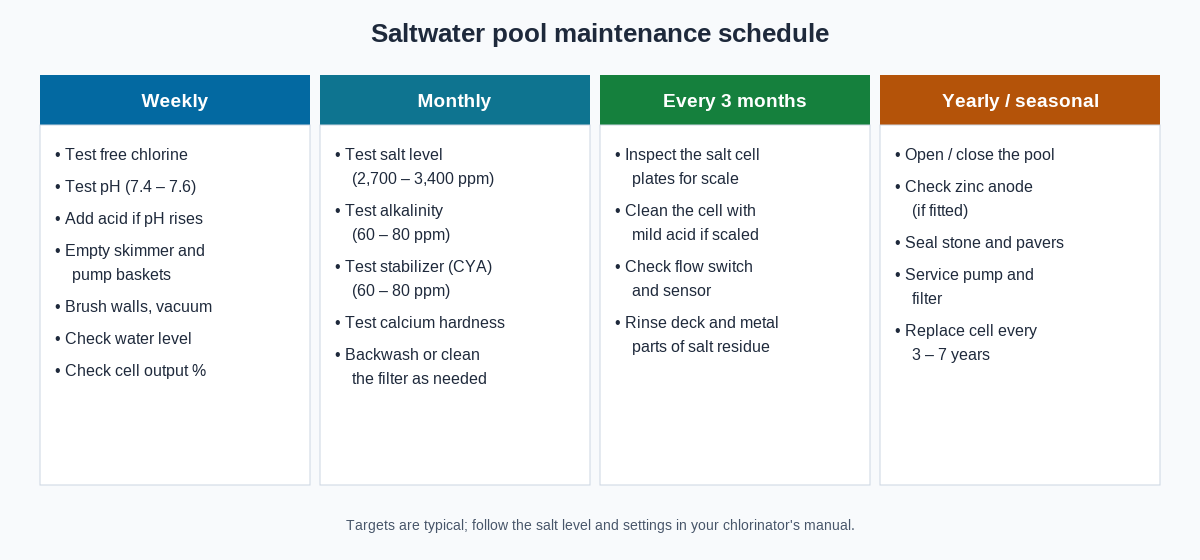
Chart: Asphapro.com
Quick Answer
To maintain a saltwater pool, test free chlorine and pH every week, add muriatic acid when pH rises above about 7.6, empty the baskets, brush and vacuum. Each month, test salt (2,700 to 3,400 ppm, often 3,200), total alkalinity (60 to 80 ppm), stabilizer (60 to 80 ppm) and calcium hardness (200 to 400 ppm). Every 3 months, inspect the salt cell and clean off scale with a mild acid solution if needed. Adjust the chlorinator's output percentage to keep free chlorine at about 2 to 4 ppm. Salt water pool maintenance takes less time than a traditional chlorine pool, but the cell needs care and replacement every 3 to 7 years at about $200 to $1,100.
A saltwater pool is still a chlorine pool. The difference is where the chlorine comes from. Instead of adding tablets or liquid chlorine, you dissolve pool salt in the water, and a salt chlorinator, also called a salt cell or salt chlorine generator, turns that salt into chlorine as water flows through it. The chlorine sanitizes the pool, then breaks down back into salt, so the salt stays in the water and is used again and again.
That makes saltwater pool maintenance simpler in many ways: no buying, storing and adding chlorine every few days, and steadier chlorine levels. But a salt pool has its own needs. pH tends to rise, the cell builds up scale, and salt can be hard on some stone, metal and concrete surfaces. This guide explains how to maintain a saltwater pool week by week, what levels to aim for, how to clean the cell and how to fix the most common problems. If you are still deciding between systems, see salt pool versus chlorine.
How a Salt Chlorinator Works and Why It Shapes Salt Pool Maintenance
The salt cell holds a stack of thin titanium plates coated with precious metals such as ruthenium or iridium. When the control box sends a low-voltage current through the plates, the salt water flowing past is split by electrolysis, making chlorine gas that dissolves at once into hypochlorous acid, the same sanitizer you get from liquid chlorine. A by-product of the process is sodium hydroxide, which is why pH tends to rise in salt pools. Hydrogen gas is also released in small amounts and bubbles out of the water.
The control box lets you set the output as a percentage of the cell's maximum, and it shows the salt level, cell status and any warnings. A flow switch or sensor shuts the cell off if water is not moving. Most systems also reverse the polarity of the plates every few hours to shed scale, which is called a self-cleaning cell, though most cells still need manual cleaning from time to time.
Saltwater Pool Maintenance: Target Levels
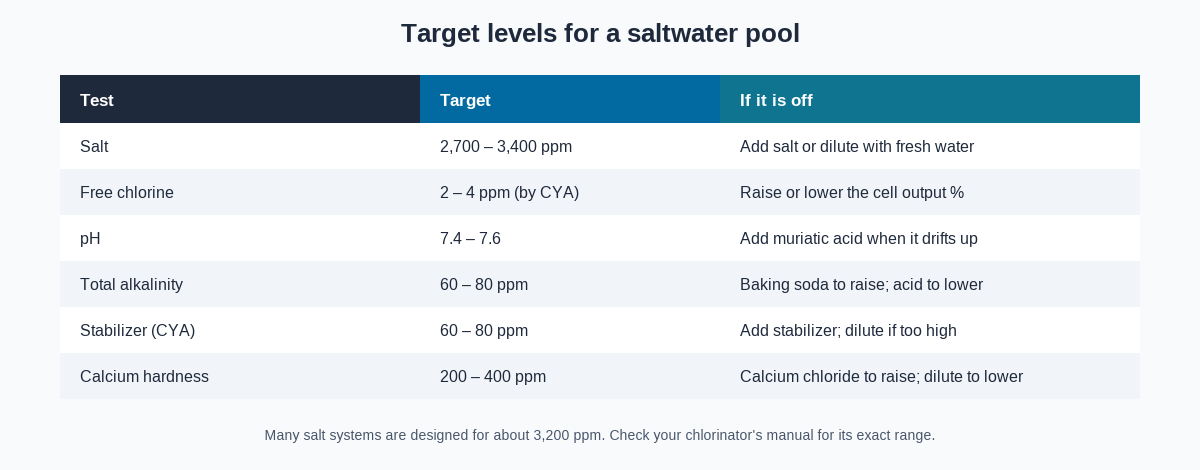
Chart: Asphapro.com
- Salt: 2,700 to 3,400 ppm, with 3,200 ppm the most common design target. Check your cell's manual.
- Free chlorine: about 2 to 4 ppm, or roughly 7.5% of your stabilizer level as a minimum.
- pH: 7.4 to 7.6. Salt pools tend to drift up, so you will mostly lower pH.
- Total alkalinity: 60 to 80 ppm, lower than in a regular chlorine pool, which slows pH rise.
- Stabilizer (cyanuric acid): 60 to 80 ppm outdoors, to protect chlorine from the sun.
- Calcium hardness: 200 to 400 ppm for plaster pools; lower is fine for vinyl and fiberglass.
These levels are the backbone of salt pool maintenance. When they are in range, the cell works efficiently, the water stays clear and comfortable, and surfaces last longer.
Weekly Salt Water Pool Maintenance
Weekly saltwater pool maintenance checks take about 15 to 30 minutes and cover most of the routine work of maintenance of a salt water pool.
- Test free chlorine and pH. Use a drop test kit or good test strips. If chlorine is low, raise the cell output or run the pump longer; if it is high, lower the output.
- Lower pH if needed. Add muriatic acid or dry acid in small doses when pH is above about 7.6. Our guide on how to lower pH in pool water has an acid calculator.
- Empty the skimmer and pump baskets. Low flow can trip the cell's flow sensor and stop chlorine production.
- Brush the walls and floor and vacuum. Brushing stops algae from getting a foothold in corners and steps.
- Check the water level. Keep it near the middle of the skimmer opening. Top up with fresh water, which also slightly dilutes salt.
- Glance at the control box. Note the output percentage, the salt reading and any warning lights.
- Check the filter pressure. Backwash or clean the filter when the gauge is 8 to 10 psi above clean.
Monthly Saltwater Pool Maintenance
Once a month, take a full set of readings as part of your salt pool maintenance. This is where pool maintenance salt checks come in:
- Test salt with salt test strips or a drop kit, and compare with the control box reading. If the two disagree by more than a few hundred ppm, trust the test and check the cell sensor.
- Test total alkalinity and adjust to 60 to 80 ppm.
- Test stabilizer, which slowly drops through splash-out, backwashing and rain dilution.
- Test calcium hardness, especially in plaster pools, to avoid etching or scale.
- Inspect the equipment for leaks, salt crust on fittings and loose wiring.
If salt is low, add pool-grade salt following the dose on the bag or the chart in our guide on how to add salt to pool water. Salt is only lost through splash-out, backwashing, draining and rain overflow, not through chlorine production, so most pools need only small top-ups during the season.
Photo: Jens Hilligsøe, Wikimedia Commons, CC BY 2.0
Salt Chlorinator Pool Maintenance: Cleaning the Salt Cell
Salt chlorinator pool maintenance centers on the cell. Over time, calcium scale forms on the plates, especially in hard water areas or when pH and calcium run high. Scale blocks the plates, cuts chlorine output and shortens the cell's life. Inspect the cell every 3 months, or whenever the control box shows a "check cell" or "inspect cell" warning.
How to clean a salt cell
- Turn off the power to the pump and chlorinator at the breaker.
- Remove the cell. Close valves if the cell is below water level, then unscrew the unions and take out the cell. Unplug the cord.
- Look inside. If you see white, crusty scale between the plates, it needs cleaning. Light scale can often be rinsed off with a strong hose spray.
- Make a cleaning solution. Add 1 part muriatic acid to 4 parts water in a bucket, always adding acid to water, never water to acid. Some makers sell a ready-made cell cleaner or a cleaning stand.
- Soak the cell. Cap one end or use a cleaning stand, fill the cell with the solution so the plates are covered, and let it foam for 10 to 15 minutes until the bubbling stops. Do not soak the cord connection.
- Rinse well with clean water and check the plates. Repeat if scale remains.
- Reinstall the cell, check the unions and o-rings, restore power and check for leaks.
Do not scrape the plates with metal tools, which damage the coating. Wear gloves and eye protection and work outdoors. Pour the used solution slowly into the pool or neutralize it with baking soda before disposal, following local rules. Cleaning too often shortens cell life, so clean only when you see scale.
Setting the Chlorinator Output: A Key Part of Salt Water Pool Maintenance
In salt chlorinator pool maintenance, the output percentage controls how many hours per day the cell makes chlorine while the pump runs. Start at the maker's suggestion, often 40% to 60%, and adjust in steps of 10% based on weekly chlorine tests. Hot weather, heavy use, rain and sunshine all raise chlorine demand, so expect to turn the output up in summer and down in spring and fall.
The pump must run long enough for the cell to make enough chlorine. Many pools run 8 to 12 hours a day in summer. A variable-speed pump can run longer at a low speed, which keeps the cell working while using less power. Many control boxes have a "boost" or "superchlorinate" mode that runs the cell at 100% for 24 hours after a pool party or a storm.
How to Shock a Saltwater Pool
Learning how to maintain a saltwater pool includes knowing when to shock it. Salt pools still need shocking from time to time, after heavy use, algae, cloudy water or a big storm. You can use the boost mode on the chlorinator, but it raises chlorine slowly. For a faster result, add liquid chlorine or a non-stabilized shock directly to the water. Avoid trichlor and dichlor shock, which add more stabilizer to the pool. For more on timing, see when to shock a pool.
Saltwater Pool Maintenance Problems and Fixes
- Low chlorine with the cell running: salt too low, cell scaled, output too low, pump time too short, or stabilizer too low so the sun burns off chlorine. Test and fix each.
- pH always rising: normal in salt pools. Lower alkalinity to 60 to 80 ppm and add acid weekly. Reduce aeration from waterfalls and jets.
- "Low salt" warning with good salt tests: a scaled cell or worn sensor. Clean the cell; if it continues, the cell may be near the end of its life.
- Scale on tile and the cell: pH, alkalinity or calcium too high. Lower pH and alkalinity, and drain part of the water if calcium is very high.
- Etched stone coping or rusted rails: salt and splash-out damage. Rinse surfaces, seal natural stone and use the right metals.
- Cloudy water: poor filtration, high pH or low chlorine. Clean the filter and balance the water. Our guide on how to clear a cloudy pool covers the full list.
- No flow warning: blocked baskets, a dirty filter or air in the system.
Salt Pool Maintenance for Decks, Coping and Metal
Salt water is far less salty than seawater, about one tenth as salty, but splash-out dries and leaves salt behind. Over years, salt crystals can grow in the pores of soft natural stone and some concrete, causing flaking. To protect the deck and coping, rinse with fresh water every few weeks in the swim season, seal natural stone and concrete pavers every 1 to 3 years with a penetrating sealer, and fix poor drainage that lets salty water pool. Some owners install a sacrificial zinc anode in the plumbing to help protect metal parts such as heaters and ladders from corrosion. For deck details, see our guide to the concrete pool deck and concrete pool coping.
Photo: Calistemon, Wikimedia Commons, CC BY-SA 4.0
Saltwater Pool Maintenance When Opening and Closing
In cold climates, the salt cell needs special care when you close the pool. Most cells stop making chlorine when the water is below about 50 to 60°F, and freezing water in the cell can crack it. To winterize, clean and remove the cell, store it indoors, and replace it with the spool piece many makers supply. Drain the pump, filter and plumbing as usual. Our guide on how to winterize a pool covers the full process.
When you open the pool, reinstall the cell, balance the water, check salt, and shock with liquid chlorine to get the water clean before letting the cell take over. Salt does not evaporate, so the salt level after winter is usually close to where you left it, minus any rain overflow.
How Do You Maintain a Saltwater Pool Week to Week? A Sample Routine
How do you maintain a saltwater pool without it taking over your weekends? The answer is a short, steady routine. Here is how a typical week of salt water pool maintenance looks for a 15,000-gallon backyard pool in summer.
Saturday morning, 20 minutes. Skim the surface, empty the skimmer basket and check the pump basket. Test free chlorine and pH. If chlorine reads 3 ppm and pH reads 7.8, add about 12 to 16 fluid ounces of muriatic acid in front of a return with the pump running, then leave the cell output where it is. Brush the walls, steps and waterline, and run the robot cleaner or vacuum.
Wednesday evening, 5 minutes. Quick check of chlorine and pH. If chlorine has dropped to 1 ppm after a hot, sunny week, raise the cell output by 10% and check again on Saturday. Look at the water level and the filter pressure.
First weekend of the month, 15 extra minutes. Test salt, alkalinity, stabilizer and calcium. Add salt, baking soda or stabilizer if needed, and write the readings in a log. Every third month, take out and check the salt cell.
That is the whole routine for most pools. The maintenance of a salt water pool is mostly about watching chlorine and pH, because the cell takes care of the daily chlorine dose that a traditional pool owner would add by hand.
How to Maintain Salt Water Pool Chemistry in Hot Weather
Heat, sun and heavy swimming all increase chlorine demand. In the hottest weeks of summer, many owners find their cell output needs to run at 70% to 100% to keep up. If the cell is running at 100% and chlorine still drops, check three things before blaming the cell: stabilizer (low stabilizer lets the sun destroy chlorine quickly), pump run time (the cell only works while water flows), and the cell's size compared to the pool. A cell rated for a 20,000-gallon pool is often too small for a 20,000-gallon pool in a hot climate; many pros suggest a cell rated for about 1.5 times your pool volume.
Water temperature also affects the cell. Above about 95°F, some cells reduce output to protect themselves. Shade, a solar cover at night and running the pump in the cooler evening hours can all help. When you work out how to maintain salt water pool chemistry in a hot climate, plan on testing a little more often and adding liquid chlorine as a backup on very hot weeks.
Salt Pool Maintenance for Vinyl, Plaster and Fiberglass Pools
Salt pool maintenance changes slightly with the pool surface. Plaster and pebble pools need calcium hardness kept at 200 to 400 ppm and pH kept in range, so the water does not etch the surface or deposit scale. Saltwater is no harder on plaster than chlorine water when the chemistry is balanced, but high pH is common and can leave scale on tile and in the cell.
Vinyl liner pools work well with salt systems, but metal wall panels and steps need protection. Keep chlorine steady and avoid very high levels, which can fade the liner. Check the wall around the skimmer and returns for rust each season.
Fiberglass pools are well suited to salt, since the gel coat does not react with salt. Keep calcium a little lower, around 150 to 250 ppm, and keep pH in range to avoid staining and scale on the surface.
Choosing and Adding Salt: Pool Maintenance Salt Basics
Use pool-grade salt that is at least 99% pure sodium chloride, without iodine, anti-caking agents or yellow prussiate of soda, which can stain. Pool salt comes in 40-lb bags. Water softener salt in pellet form can work if it is pure, but it dissolves more slowly. Never use rock salt, which carries dirt and minerals into the pool.
To add salt, turn off the cell, broadcast the salt over the shallow end or around the edge with the pump running, and brush it toward the main drain to help it dissolve. Wait 24 hours before turning the cell back on, so the salt has fully mixed and the cell reads the right level. Adding too much salt is hard to fix: the only cure is draining part of the water and refilling, so add it in steps and test between them.
Maintenance of Salt Water Pool Equipment
Beyond the cell, maintenance of salt water pool equipment covers the pump, filter and plumbing. Salt pools can be harder on metal parts, so check the pump motor, heater and any metal fittings for corrosion every few months. Keep the equipment pad clean and dry, and make sure the pump is not leaking at its seal, because salty drips can corrode the motor. Many heater makers specify a maximum salt level, so check your heater's manual if you plan to switch to salt. Some recommend titanium or cupronickel heat exchangers for salt pools.
Filters need the same care in a salt pool as any other pool. Backwash a sand or DE filter when pressure rises 8 to 10 psi above clean, and remember that backwashing removes some salt with the waste water. For cartridge filters, hose them off and soak them in a filter cleaner once or twice a season. Our guide on how to clean swimming pool filter media covers each type.
Saltwater Pool Maintenance When You Go on Vacation
One of the benefits of a salt system is that it keeps making chlorine while you are away. Before a vacation of one to two weeks, balance the water, raise free chlorine to the upper end of the range, raise the cell output by 10% to 20%, clean the filter and empty all baskets. Make sure the pump timer will run the full daily cycle. If you will be gone longer, ask a neighbor or pool service to empty baskets and check the water once a week. Coming home to clear water is much more likely with a salt pool than with a pool that depends on hand-added chlorine.
Testing Tips for Salt Water Pool Maintenance
Good saltwater pool maintenance depends on good testing. A drop-based kit using the FAS-DPD method gives exact free chlorine readings and is worth the cost. Test strips are fine for quick checks, but they are less accurate, especially for salt and stabilizer. Take samples from about elbow depth, away from returns and the skimmer, and test soon after taking the sample. Store test kits out of the sun and replace reagents every year. Do not rely only on the salt reading on the control box: it estimates salt from the cell's electrical readings and can drift as the cell ages or scales up.
Saltwater Pool Maintenance Cost
Saltwater pool maintenance often costs less per year than a traditional chlorine pool, mainly because you buy salt instead of chlorine. Typical yearly costs:
- Salt: $20 to $100 a year for top-ups after the first fill.
- Acid: $50 to $200 a year to control rising pH.
- Other chemicals: stabilizer, alkalinity increaser, shock and test supplies, about $100 to $300.
- Electricity: the cell itself uses little power, but longer pump runs add cost.
- Cell replacement: about $200 to $1,100 every 3 to 7 years, or $50 to $200 per year spread over its life.
- Professional service: about $80 to $200 a month if you hire a weekly pool service.
For a full comparison of yearly pool costs, see our guide on the cost to maintain a pool.
How to Maintain a Saltwater Pool: Key Points
- Test chlorine and pH weekly; salt, alkalinity, stabilizer and calcium monthly.
- Keep salt at 2,700 to 3,400 ppm and pH at 7.4 to 7.6.
- Expect pH to rise; add acid weekly and keep alkalinity at 60 to 80 ppm.
- Inspect the salt cell every 3 months and clean only when scaled.
- Rinse and seal stone and concrete surfaces to protect them from salt.
Frequently Asked Questions
Is saltwater pool maintenance easier than chlorine?
For most owners, yes. You do not need to add chlorine every few days, and levels stay steadier. You do need to watch pH more closely and clean the cell.
How often should I add salt to my pool?
Only when a test shows it is low. Most pools need a bag or two after heavy rain, backwashing or partial draining.
How long does a salt cell last?
Usually 3 to 7 years, depending on the cell size, how hard it works, water chemistry and how often it is cleaned.
How do you maintain a saltwater pool in winter?
In cold climates, clean and remove the cell, store it indoors and winterize the pool as usual. In warm climates, keep the pump running, lower the cell output as chlorine demand drops, and keep testing every week or two.
How much time does salt water pool maintenance take?
About 20 to 30 minutes a week in the swim season, plus 15 minutes a month for full testing and about 30 minutes every three months to check the cell.
What is the most important part of saltwater pool maintenance?
Keeping pH in range. Salt pools drift up in pH, and high pH causes scale on the cell and tile, weaker chlorine and cloudy water.
Can I use regular chlorine in a salt pool?
Yes. Liquid chlorine is a good backup for salt pool maintenance after storms or heavy use. Avoid stabilized tablets, which raise stabilizer over time.
Sources
- CDC: Pool chemistry and testing
- Trouble Free Pool: Pool water chemistry
- Swim University: Saltwater pool maintenance
- Pool and Hot Tub Alliance