
Cost to Replace Sand in Pool Filter and How to Change Pool Filter Sand
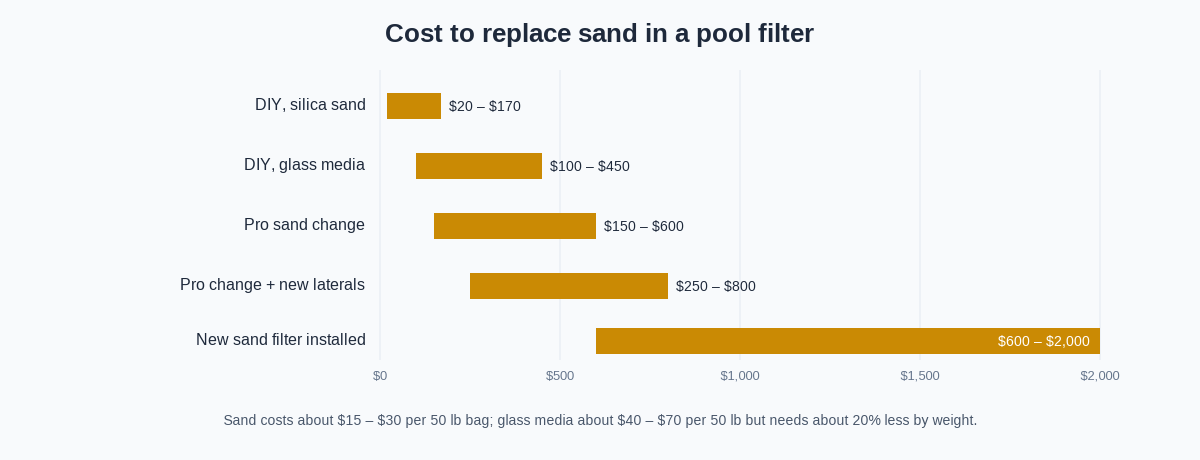
Chart: Asphapro.com
Quick Answer
The cost to replace sand in pool filter tanks is about $20 to $170 DIY with standard #20 silica pool filter sand (about $15 to $30 per 50 lb bag), or $100 to $450 DIY with glass filter media. A professional sand change usually costs $150 to $600, or $250 to $800 if broken laterals must be replaced. Most filters need 50 to 150 lb (above ground) or 150 to 400 lb (inground) of sand; check the tank label. Change pool filter sand every 5 to 7 years (glass media lasts 10 years or more), or sooner if pressure climbs fast after backwashing or water stays hazy. Changing sand in pool filter tanks is a 1 to 3 hour DIY job.
A sand filter is the simplest and most common pool filter. Water flows down through a bed of special sand, which traps dirt and debris, and backwashing flushes the dirt out. But the sand does not last forever. Over years, its sharp edges wear smooth and stop catching small particles, and oils and minerals cement the grains into clumps and channels. When that happens, the filter cannot keep the water clear, no matter how often you backwash.
This guide explains the cost to replace sand in pool filter tanks, DIY versus professional prices, the types of filter media, how much sand you need, signs that it is time for a pool sand filter change, and how to change sand in pool filter tanks step by step. For routine cleaning, see how to clean swimming pool filter.
Cost to Replace Sand in Pool Filter: DIY vs Pro
| Option | Typical cost | Notes |
|---|---|---|
| DIY, #20 silica sand | $20 – $170 | 1 to 7 bags at $15 – $30 each |
| DIY, glass media | $100 – $450 | Lasts longer, filters finer |
| DIY, zeolite media | $80 – $350 | Filters fine particles; needs regular backwash |
| Professional sand change | $150 – $600 | Includes labor, sand and disposal |
| Pro change plus new laterals | $250 – $800 | When laterals are cracked |
| New sand filter installed | $600 – $2,000 | When the tank or valve is worn |
Labor for a professional pool filter sand replacement is usually $100 to $350, depending on the filter size and how hard the old sand is to remove. Old sand that has turned into a solid cake takes much longer to dig out. Disposal of old sand is usually included, and the old sand can often be used in the garden or on paths.
How Much Sand Does a Pool Filter Need?
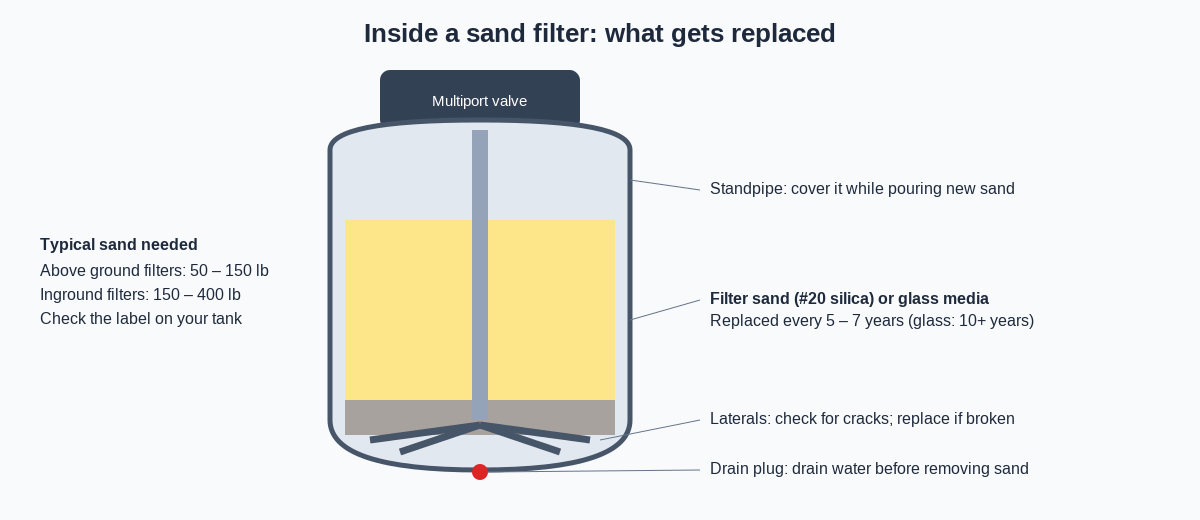
Diagram: Asphapro.com
The amount of sand depends on the tank diameter. The filter label lists the exact weight and the media type. Typical amounts:
| Tank diameter | Typical sand needed | Typical pool |
|---|---|---|
| 14 – 16 in | 50 – 100 lb | Small above ground pools |
| 19 – 21 in | 150 – 200 lb | Large above ground and small inground pools |
| 22 – 24 in | 200 – 300 lb | Average inground pools |
| 26 – 30 in | 300 – 450 lb | Large inground pools |
If you switch to glass media, you usually need about 15% to 20% less by weight, because glass is lighter for the same volume. Follow the media maker's chart.
Pool Filter Media: Sand, Glass and Zeolite
#20 silica sand
Standard pool filter sand is #20 silica sand, sized about 0.45 to 0.55 mm. It is the lowest-cost media, filters to about 20 to 40 microns, and lasts about 5 to 7 years. Never use play sand or builder's sand; they are the wrong size and will pass into the pool or clog the filter.
Glass filter media
Crushed, recycled glass media is smooth-edged and safe to handle. It filters slightly finer than sand, resists clumping and bacteria buildup, backwashes more easily (using less water), and lasts 10 years or more. It costs more up front.
Zeolite media
Zeolite is a natural volcanic mineral with a porous structure that traps very fine particles, down to about 5 microns, and can absorb some ammonia. It costs more than sand and needs a careful start-up rinse.
Signs It Is Time for a Pool Sand Filter Change
- Pressure rises quickly after backwashing, sometimes within days.
- Short filter runs: you need to backwash far more often than you used to.
- Hazy or dull water that will not clear despite balanced chemistry and long pump runs.
- Sand in the pool, which points to broken laterals or a cracked standpipe.
- Channeling: when you open the filter, the sand has cracks, holes or hard clumps.
- Age: the sand is more than 5 to 7 years old.
If you see one or more of these, changing sand in pool filter tanks is usually the cheapest fix. A filter cleaner soak may help for a while if the sand is only coated with oils, but old, rounded sand cannot be restored.
How to Change Sand in Pool Filter: Step by Step
Here is how to change pool filter sand yourself. These are the same steps for how to change the sand in a pool sand filter of almost any brand, and for how to change swimming pool filter sand on above ground models. The same steps apply to most top-mount and side-mount sand filters; check your manual for details.
Tools and materials
- New pool filter sand or glass media (the amount on the label)
- Screwdrivers or wrenches for the valve clamp or bolts
- A shop vac (wet/dry vacuum) or a small cup and scoop
- A plastic cup or bag to cover the standpipe
- Garden hose
- New valve O-ring or gasket (recommended)
- Silicone lubricant
- Dust mask and gloves
Steps
- Turn off the pump at the breaker and close any valves to stop water flow.
- Drain the filter: open the drain plug at the bottom and the air relief at the top. Let all the water drain out.
- Remove the valve: disconnect the pipes or unions to the multiport valve, loosen the clamp or bolts, and lift the valve off the tank. Be careful not to bend the standpipe.
- Remove the old sand: scoop it out with a cup, or use a shop vac. If it is caked hard, break it up gently with a hose and a stick, avoiding the laterals at the bottom.
- Inspect the laterals and standpipe: rinse the bottom of the tank and look for cracked or broken laterals. Replace any damaged parts.
- Center the standpipe and cover it with a cup or plastic bag so sand cannot fall inside.
- Fill the tank about halfway with water to cushion the laterals when the sand goes in.
- Pour in the new sand or glass media slowly, keeping the standpipe centered. Fill to the level marked in the manual, usually about two-thirds of the tank.
- Remove the standpipe cover, clean sand off the tank rim and O-ring area, and fit a new or lubricated O-ring.
- Reinstall the valve and tighten the clamp or bolts evenly. Reconnect the plumbing and close the drain plug.
- Backwash for 2 to 3 minutes to flush fine dust, then rinse for about a minute.
- Return to FILTER, start the pump, bleed air from the relief valve, and note the new clean pressure.
Most owners finish a pool sand filter change in 1 to 3 hours. Large inground filters with hundreds of pounds of caked sand take longest.
Photo: KateGoodall, Wikimedia Commons, CC BY-SA 4.0
How to Change a Sand Pool Filter on an Above Ground Pool
Above ground sand filters are smaller and lighter, which makes the job easier. Many have a top-mount valve held by a clamp. Some owners unbolt the whole filter from its base and tip it to pour out the old sand, but this risks breaking the laterals, so scooping is safer. Small filters usually take one to three 50 lb bags of sand. If the filter body is cracked or the valve is worn, a new combo pump and filter unit may cost only a little more than new sand plus parts.
Laterals, Standpipes and Other Parts
Laterals are the slotted fingers at the bottom of the standpipe that let water out while keeping sand in. They become brittle with age and can crack, especially when sand is poured onto them in a dry tank. Replacement lateral sets cost about $20 to $80. Also inspect the standpipe, the valve's spider gasket and the tank O-ring. Replacing these small parts while the filter is open saves another teardown later.
Should You Replace the Sand or the Whole Filter?
If the tank is sound, the valve works and the filter is properly sized for the pool, new sand is usually all you need. Consider a full pool sand filter replacement if the tank has cracks, the multiport valve leaks or sticks, the filter is undersized, or it is more than 15 to 20 years old. A new filter installed costs about $600 to $2,000. Some owners also switch to a cartridge filter at this point to save backwash water.
Starting Up After a Sand Change
New sand is very clean and filters a little less finely for the first days, until a light layer of debris builds up. Run the pump longer than usual for a day or two, check the pressure gauge, and backwash only when the pressure rises 8 to 10 psi above the new clean reading. If you see sand in the pool after the change, a lateral may be broken or the sand level too high; turn off the pump and check.
Common Mistakes When Changing Sand in a Pool Filter
- Using the wrong sand, such as play sand or masonry sand.
- Pouring sand into a dry tank and cracking the laterals.
- Letting sand fall into the standpipe.
- Overfilling the tank, which reduces backwash space and pushes sand into the pool.
- Not cleaning sand off the tank rim, causing the valve O-ring to leak.
- Skipping the first backwash, which sends fine dust into the pool.
How to Replace Sand in Pool Filter Tanks With Caked Sand
Old filter sand is often hard as concrete after years of oils, calcium and dirt binding it together. Knowing how to replace sand in pool filter tanks in this condition saves time and protects the laterals:
- Drain the tank fully and remove the valve.
- Fill the tank with water and let it soak overnight. Adding a filter cleaner or degreaser to the water helps soften the cake.
- Use a garden hose with a narrow nozzle to break up the top layer, then scoop out the loosened sand.
- Work down in layers. A shop vac removes wet sand quickly and keeps the area clean.
- Near the bottom, slow down and use your hand or a plastic cup to avoid hitting the laterals.
- Rinse the bottom with the hose and vacuum out the last sand.
Never use a metal tool near the laterals or hit the standpipe. If the sand is extremely hard and you have a small filter, it can be cheaper and faster to replace the whole unit.
Example Cost Breakdowns
Example 1: DIY, above ground pool, 19 inch tank
The filter needs 150 lb of #20 silica sand: three 50 lb bags at about $20 each, $60. A new valve O-ring adds $8. Total cost to replace sand in pool filter: about $70 and two hours of work.
Example 2: DIY with glass, inground pool, 24 inch tank
The filter takes 300 lb of sand or about 250 lb of glass media. Five 50 lb bags of glass at about $55 each is $275, plus a lateral set ($45) and O-ring ($10). Total: about $330, with media that should last 10 years or more.
Example 3: Professional sand change, inground pool
A pool service charges $200 labor plus $120 for 300 lb of sand and $40 for disposal. Total: about $360, done in a morning, with the tank, laterals and valve checked by a pro.
Changing Pool Sand Filter Media: Should You Switch Filter Type?
Changing pool sand filter media is a good time to think about whether a different filter suits you better:
| Filter type | Fineness | Water use | Upkeep |
|---|---|---|---|
| Sand | 20 – 40 microns | Backwash uses 200 – 500 gal | Easiest day to day; media every 5 – 7 years |
| Sand with glass media | About 10 – 20 microns | Less backwash water | Media lasts 10+ years |
| Cartridge | 10 – 20 microns | No backwash | Hose cartridges; replace every 1 – 3 years |
| DE | 3 – 5 microns | Backwash plus new DE | Most work; finest filtration |
For most owners, staying with sand and upgrading to glass media gives better water with little extra work. Owners in areas with water restrictions sometimes switch to cartridge filters to stop backwashing.
Pool Filter Sand Replacement and Water Savings
Fresh sand or glass media backwashes faster and more completely, so each backwash uses less water. Old, channeled sand often needs longer and more frequent backwashing, wasting hundreds of gallons each time. A pool filter sand replacement can pay back part of its cost in water and chemicals saved, especially in regions with high water rates. For backwashing tips, see how to backwash a pool.
Hiring a Pro to Change Pool Filter Sand
If you prefer not to lift heavy bags or wrestle with the valve, a pool service can do the job. Ask whether the price includes the sand or glass, disposal of old sand, a new O-ring and inspection of the laterals and valve. Ask what they will charge if laterals or the spider gasket need replacing. A good technician will also check the pressure gauge, air relief and pump basket while the system is open.
What to Do With Old Filter Sand
Old pool filter sand is usually safe to reuse in the garden, as a base for pavers, or on paths, after it has dried and any strong chlorine smell is gone. Do not dump large amounts into storm drains or waterways. Old DE or zeolite should be handled according to local rules. Some pool stores will take old media when you buy new.
How Sand Filters Work and Why the Sand Wears Out
In a sand filter, water enters through the top of the multiport valve, spreads across the top of the sand bed through a diffuser, and is pushed down through the sand. Dirt and debris are caught between the sand grains, mostly in the top few inches. Clean water passes through the laterals at the bottom, up the standpipe and back to the pool. When you backwash, the flow reverses, the sand bed lifts and tumbles, and trapped dirt is flushed out the waste line.
New silica sand grains have sharp, jagged edges that grip fine particles. Each backwash tumbles the grains against each other, and over years they wear smooth and round, which makes them much worse at catching small particles. At the same time, oils from sunscreen and body products, calcium scale and organic matter coat the grains and stick them together. Water then finds easy paths, called channels, through cracks in the bed, bypassing most of the sand. That is why even a filter that backwashes normally can stop keeping the water clear after 5 to 7 years.
Extending the Life of Pool Filter Sand
- Backwash only when needed: when pressure is 8 to 10 psi above clean. Over-backwashing wears sand faster.
- Use a filter cleaner once or twice a year to remove oils and scale.
- Keep water balanced: high pH and calcium cause scale that cements the sand.
- Shower before swimming to reduce oils entering the filter.
- Use a skimmer sock or keep baskets clean so less debris reaches the filter.
With good care, silica sand often reaches the high end of its 5 to 7 year life, and glass media can go well beyond 10 years.
Timing Your Sand Change
The best time for changing sand in pool filter tanks is at spring opening or fall closing, when the pool is not in heavy use and you can take your time. Changing sand at opening also means you start the season with the best possible filtration. In warm climates where pools run year round, pick a mild week in winter or early spring, when algae growth is slow and the pool can run on a shorter schedule while you work.
Safety When Changing Pool Filter Sand
- Turn off power at the breaker, not just the timer, before working on the filter.
- Release pressure with the air relief valve before loosening any clamp. A pressurized filter can blow apart.
- Wear a dust mask when pouring dry silica sand; fine silica dust should not be breathed in. Wetting the sand slightly and pouring slowly helps.
- Lift with care: 50 lb bags are heavy; get help or use a dolly.
- Protect your hands from sharp edges and old, dirty sand.
- Reinstall clamps correctly and stand clear when restarting the pump.
Troubleshooting After Replacing Filter Sand
| Problem | Likely cause | Fix |
|---|---|---|
| Sand returning to the pool | Broken lateral or sand level too high | Open the tank, check laterals, remove extra sand |
| Cloudy water for a day or two | Fine dust from new media | Backwash again and run the pump longer |
| Leak at the valve | Sand on the O-ring or rim | Clean the rim and O-ring, reseat the valve |
| High pressure right away | Too much sand, wrong sand size or closed valve | Check sand level and type, open valves |
Most problems after a sand change are easy to fix once you know where to look, and a correctly done pool filter sand replacement should give years of clear water.
Cost to Replace Sand in Pool Filter: Key Points
- DIY sand change costs about $20 to $170 with silica sand, $100 to $450 with glass.
- A pro charges about $150 to $600.
- Change sand every 5 to 7 years, glass every 10+ years.
- Use the media type and amount on your filter label.
Frequently Asked Questions
How much does it cost to replace sand in a pool filter?
About $20 to $170 DIY with silica sand, or $150 to $600 for a professional.
How often should you change pool filter sand?
Every 5 to 7 years for silica sand, or when the filter stops working well. Glass media lasts 10 years or more.
How to change the sand in pool filter tanks safely?
Drain the filter, remove the valve, scoop out the old sand, check the laterals, cover the standpipe, add water and new sand, reinstall the valve, and backwash before filtering.
Can I change the sand without removing the valve?
On top-mount filters, no; the valve must come off to reach the sand. On some side-mount filters, you remove the top dome instead.
Do I need to replace sand if I use a filter cleaner?
Cleaners extend sand life by removing oils and scale, but they cannot restore worn, rounded grains. Expect to replace silica sand every 5 to 7 years anyway.
How much sand does a 24 inch pool filter need?
Usually about 250 to 300 lb of #20 silica sand, or about 15% to 20% less glass media. Check the filter label.
Why is there sand at the bottom of my pool?
Most often a broken lateral or standpipe, or a sand level that is too high. It can also come from wind or swimmers.
How long does it take to change pool filter sand?
Usually 1 to 3 hours, longer if the old sand is caked hard or the valve is stuck.
Should I replace the pool filter sand myself or hire someone?
Most owners can do it in an afternoon. Hire a pro if the sand is caked solid, the filter is very large, or you suspect broken laterals or a bad valve.
Can I use play sand in my pool filter?
No. Use #20 silica pool filter sand or a media approved for your filter. Play sand is too fine and irregular; it clogs the filter quickly and can pass through the laterals into the pool.
Is the cost to replace sand in pool filter tanks worth it?
Yes, in most cases. For under $200 DIY, a pool sand filter change restores clear water and shorter backwashes, often saving that cost in water and chemicals within a season or two.
Can I mix glass media with old sand?
No. Remove all the old sand before adding glass, so the new media works as designed.
Is glass media worth the cost?
Often, yes. It costs more up front but lasts twice as long, filters finer and backwashes with less water.
What is the cost to replace pool sand filter units completely?
About $600 to $2,000 installed, depending on filter size and brand.
Do I need to replace the laterals when changing sand?
Only if they are cracked or broken. Inspect them every time the filter is open.
Sources
- Swim University: How to change pool filter sand
- HomeGuide: Pool filter replacement cost
- EPA WaterSense: Pools and spas
- Pool and Hot Tub Alliance