
Pool Filter Size Calculator: How to Size Sand, Cartridge and DE Filters
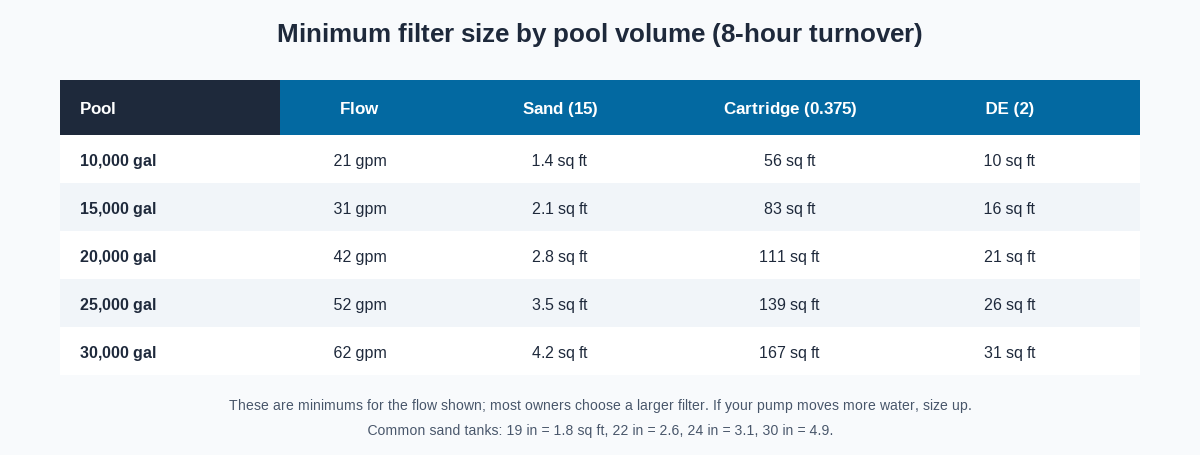
Chart: Asphapro.com
Quick Answer
To size a pool filter, first find your flow rate: pool gallons ÷ (turnover hours × 60), or your pump's actual flow if it is higher. Then divide by the filter's design rate: about 15 to 20 gpm per sq ft for sand, 0.375 gpm per sq ft for cartridge (for long cleaning cycles), and 2 gpm per sq ft for DE. A 20,000-gallon pool with a 42 gpm flow needs at least 2.8 sq ft of sand (a 24-inch tank), about 112 sq ft of cartridge (most owners choose 200 to 400 sq ft), or 21 sq ft of DE (usually a 36 to 48 sq ft model). Bigger than the minimum is better. Use the pool filter size calculator below.
The filter is what keeps pool water clear. A filter that is too small for the pump's flow clogs quickly, raises pressure, needs constant cleaning and may let fine particles through. A generously sized filter traps more dirt, runs at lower pressure, saves energy and goes longer between cleanings. Getting the size right is one of the most important equipment choices for a pool, and it is easy once you know your pump's flow and the filter type you want.
This guide explains how to use a pool filter size calculator, common pool filter sizes, pool filter cartridges by size, and how to match the filter to your pump. For filter care, see how to clean swimming pool filter parts.
How Pool Filter Sizes Are Worked Out
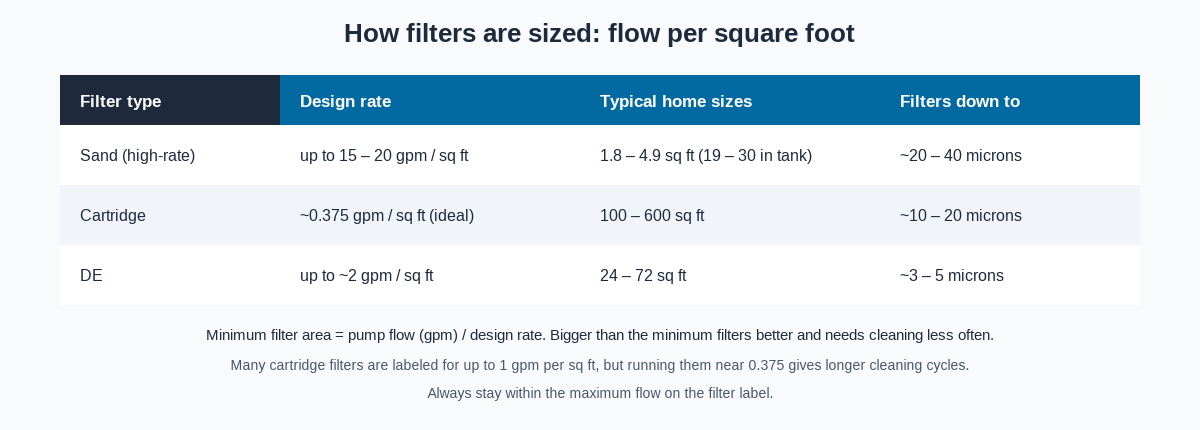
Chart: Asphapro.com
Every filter type has a design rate: the flow in gallons per minute (gpm) that each square foot of filter area can handle while filtering well. The minimum filter area is the flow divided by the design rate. Sand filters can handle high flow per square foot, so their area numbers look small even for large pools. Cartridge filters have large pleated areas but a low design rate, so their numbers look big. DE filters fall in between the two.
Pool Filter Size Calculator Step 1: Find Your Flow Rate
Calculate the flow needed for your turnover: gallons ÷ (hours × 60). For a 20,000-gallon pool with an 8-hour turnover: 20,000 ÷ 480 = about 42 gpm. Then compare with your pump's actual flow. If your pump pushes 60 gpm, size the filter for 60 gpm, since the filter must handle whatever the pump actually delivers at full speed. See our pool pump size calculator.
Pool Filter Size Calculator Step 2: Divide by the Design Rate
Sand: 42 gpm ÷ 15 = 2.8 sq ft. A 24-inch sand tank (about 3.1 sq ft) fits.
Cartridge: 42 gpm ÷ 0.375 = 112 sq ft minimum. Most owners choose 200 to 400 sq ft for longer cleaning intervals.
DE: 42 gpm ÷ 2 = 21 sq ft. A 36 or 48 sq ft DE filter gives a comfortable margin.
Pool Filter Size Calculator Step 3: Check the Filter Label
Every filter lists a maximum flow rate on its label or in its manual. Your pump's flow must always stay below it. Many residential codes and filter standards also set maximum design rates. When in doubt, size up; a filter that is too large causes no problems, while one that is too small causes many.
Pool Filter Size Calculator
Enter your pool volume, turnover time, pump flow (if known) and filter type. This pool filter size calculator gives the minimum and recommended filter area.
Pool Filter Cartridges by Size
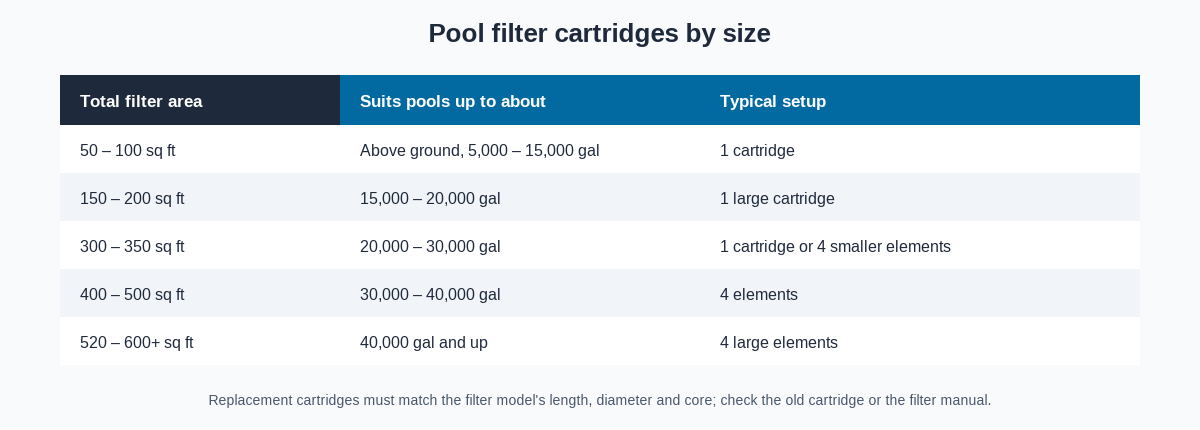
Chart: Asphapro.com
Cartridge filters are sold by total square feet of pleated area. Small above ground pools often use 50 to 100 sq ft. Mid-size inground pools use 150 to 350 sq ft. Large pools use 400 to 600 sq ft or more, often with four cartridge elements. When replacing, match the old cartridge's length, diameter, core size and end caps, not just the area.
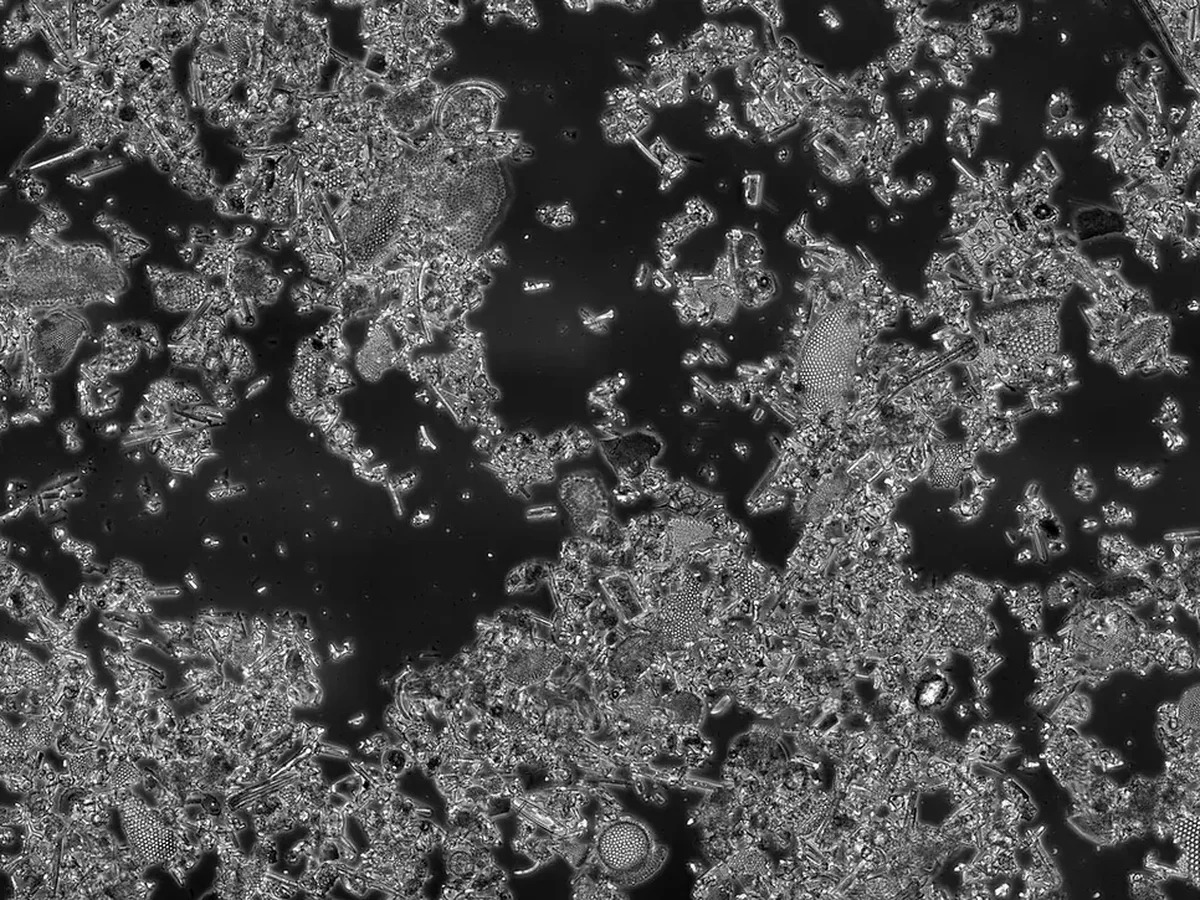
Photo: Zephyris, Wikimedia Commons, CC BY-SA 3.0
Pool Filter Sizes for Inground Pools
Here are common pool filter sizes for inground pools, assuming an 8-hour turnover and typical pump flows. Use the pool filter size calculator above for your own pool.
Up to 15,000 gallons (flow about 30 to 45 gpm): sand 22 to 24 inch tank; cartridge 150 to 250 sq ft; DE 36 sq ft.
15,000 to 25,000 gallons (flow about 40 to 60 gpm): sand 24 to 26 inch tank; cartridge 250 to 400 sq ft; DE 36 to 48 sq ft.
25,000 to 35,000 gallons (flow about 55 to 75 gpm): sand 26 to 30 inch tank; cartridge 400 to 520 sq ft; DE 48 to 60 sq ft.
Over 35,000 gallons (flow 75 gpm and up): sand 30 to 36 inch tank; cartridge 520 sq ft or more; DE 60 to 72 sq ft.
These pool filter sizes are typical choices, not strict rules. If your pump is large, or the pool has water features, a spa or heavy use, choose the next size up.
Pool Filter Sizes for Above Ground Pools
Above ground pools use smaller pumps, often 1 hp or less, and smaller filters. Common pool filter sizes for above ground pools are 14 to 22 inch sand tanks, 50 to 150 sq ft cartridges, and small DE filters of 15 to 24 sq ft. Soft-sided and frame pools often come with tiny cartridge filters rated by gallons per hour; upgrading to a larger sand or cartridge filter matched to the pump usually gives clearer water and less maintenance. Check that hoses and fittings can handle the larger filter's connections.
Sand Pool Filter Sizes
Sand filters are sold by tank diameter, which sets the filter area. A 19-inch tank has about 1.8 sq ft, a 22-inch tank about 2.6 sq ft, a 24-inch tank about 3.1 sq ft, a 26-inch tank about 3.7 sq ft, a 30-inch tank about 4.9 sq ft and a 36-inch tank about 7 sq ft. At a design rate of 15 to 20 gpm per sq ft, a 24-inch tank handles about 46 to 62 gpm. Larger tanks hold much more sand, which costs a little more to replace but filters more water between backwashes. Glass media can replace sand in the same tank without changing the size.
DE Pool Filter Sizes
DE filters are sold by grid area, commonly 24, 36, 48, 60 and 72 sq ft. At about 2 gpm per sq ft, a 48 sq ft DE filter handles up to about 96 gpm, though running below the maximum gives longer filter cycles. DE filters need fresh DE powder after each backwash, in an amount based on the filter area, often about 1 pound of DE per 10 sq ft. DE gives the finest filtration of any common residential filter type available today.
Pool Filter Cartridges by Size: Replacing a Cartridge
When you shop for pool filter cartridges by size, the square footage is only part of the story. Replacement cartridges must match the length, outer diameter, inner core diameter and end cap design of your filter. Two cartridges with the same 100 sq ft rating may not fit the same filter. Check the old cartridge or the filter manual for the model number and dimensions, and match them exactly. Many cartridges are interchangeable between brands when the dimensions match. Higher-quality cartridges use more pleats, stronger cores and better fabric, which can last longer and filter better.
Matching Pool Filter Sizes to the Pump
The filter must handle the pump's full flow. A large pump on a small filter raises pressure, makes the pump work harder, wastes energy and may force dirt through the filter media. If you replace a pump with a larger one, check that the filter is large enough. With a variable-speed pump, size the filter for the highest speed you will use, such as for vacuuming or water features, even if the pump runs at low speed most of the day. Low-speed running with a large filter gives excellent filtration and very low pressure.
Why Bigger Pool Filter Sizes Are Better
Choosing a filter larger than the minimum from a pool filter size calculator has real benefits. Water moves more slowly through the media, which traps finer particles. Pressure stays lower, so the pump uses less energy. The filter holds more dirt before it needs cleaning, so you clean or backwash less often and save water. Cartridges and sand last longer because they are not overloaded. The extra upfront cost is usually small compared with these savings. The main limits are space on the equipment pad and the plumbing connections.
Pool Filter Size Calculator for Special Cases
Pools with spas. Spa jets often need more flow than the pool alone; size the filter for the spa flow.
Heavy use pools. Rental properties and busy family pools benefit from a shorter turnover, such as 6 hours, which raises the flow and filter size.
Pools under trees. Lots of debris calls for a larger filter and a good skimmer, so the filter does not clog quickly.
Salt pools. Salt pools often run longer at lower flow, which works well with larger filters.
Water features. Waterfalls and sheer descents may need separate pumps or higher flow; include that flow when using the pool filter size calculator.
Filter Pressure and Pool Filter Sizes
Clean filter pressure tells you whether the filter is the right size. Most residential filters run at about 10 to 20 psi when clean. If a clean filter reads 25 psi or more, the filter may be too small for the pump, the pump may be oversized, or there may be a restriction in the return plumbing. Clean or backwash when pressure rises 8 to 10 psi above the clean reading. A properly sized filter takes days or weeks to reach that point; an undersized one may get there in a day or two.
Pool Filter Sizes and Costs
Filter prices rise with size. Typical residential prices are about $300 to $700 for sand filters, $400 to $1,200 for cartridge filters, and $600 to $1,500 for DE filters, plus installation of $150 to $500. Replacement media costs: sand $50 to $150, cartridges $40 to $250 each, DE grids $150 to $500 per set, and DE powder $20 to $40 a bag. A larger filter costs a little more upfront but often saves money over time through less cleaning, less water and longer media life. See how long do pool filters last.
Pool Filter Size Calculator: Worked Examples
Example 1: standard inground pool. A 20,000-gallon pool with a 1 hp pump moving about 45 gpm. Sand: 45 ÷ 15 = 3 sq ft, so a 24-inch tank (3.1 sq ft) is the minimum and a 26-inch tank gives margin. Cartridge: 45 ÷ 0.375 = 120 sq ft minimum; the owner chooses 300 sq ft. DE: 45 ÷ 2 = 22.5 sq ft; a 36 sq ft model fits.
Example 2: large pool with spa. A 30,000-gallon pool with a spa needing 80 gpm. Cartridge: 80 ÷ 0.375 = 213 sq ft minimum; the owner chooses 520 sq ft with four elements for long cycles.
Example 3: above ground pool. A 15,000-gallon above ground pool with a pump moving 35 gpm. Sand: 35 ÷ 15 = 2.3 sq ft; a 22-inch tank (2.6 sq ft) works. Cartridge: 35 ÷ 0.375 = 93 sq ft; a 100 to 150 sq ft cartridge fits.
Common Pool Filter Size Calculator Mistakes
The most common mistakes are sizing the filter for the turnover flow while the pump actually moves much more water, choosing the cheapest small filter to save money, upgrading the pump without upgrading the filter, buying replacement cartridges by square footage alone without checking dimensions, and ignoring the maximum flow on the filter label. Using a pool filter size calculator, checking pump flow and choosing a filter with extra margin avoids these problems.
Water Use and Filter Choice
Filter type and size affect how much water you use. Sand and DE filters are cleaned by backwashing, which sends 150 to 300 gallons or more to waste each time. Cartridge filters are cleaned by removing and hosing the cartridges, which uses far less water. In drought-prone areas or where water is expensive, a large cartridge filter is often the best choice. A larger sand or DE filter backwashes less often than a small one, which also saves water. When using a pool filter size calculator, think about how often you will need to clean each size and how much water that will use over a season.
Space and Plumbing Considerations
Bigger filters take more space on the equipment pad and may need larger plumbing connections. Sand filters are wide and heavy when full of sand; a 30-inch tank needs a solid, level base. Cartridge filters are tall and need clearance above to lift out the cartridges. DE filters need room to remove the lid and grids. Check the filter's footprint and height, the size of its inlet and outlet, and whether it will fit next to your pump, heater and other equipment. Most residential filters use 1.5-inch or 2-inch connections; larger filters may use 2-inch connections, which suit larger pumps and lower friction.
Upgrading an Existing Filter
If your filter clogs quickly, runs at high pressure or leaves the water dull, it may be undersized. Upgrading to a larger filter is often one of the easiest improvements you can make. Use the pool filter size calculator with your actual pump flow to find the minimum size, then choose a larger model that fits your pad and plumbing. Switching from sand to a large cartridge filter can cut water use and give finer filtration, while switching to DE gives the clearest water. When upgrading, also check the pressure gauge, air relief valve and o-rings, and replace them if worn.
Pool Filter Sizes and Commercial Rules
Public and commercial pools must meet health codes that limit filter design rates more strictly than many residential filters. For example, codes may limit sand filters to about 15 gpm per sq ft and cartridge filters to 0.375 gpm per sq ft, and require turnover times of 6 hours or less. These rules exist because busy pools need excellent filtration. Even for home pools, following commercial design rates when using a pool filter size calculator is a good way to make sure the filter does its job well.
How Often Will I Need to Clean Each Size?
Cleaning frequency depends on bather load, debris and filter size. As a rough guide for a typical residential pool, an undersized cartridge filter may need cleaning every one to two weeks in summer, while a generously sized cartridge may go four to eight weeks or more. A small sand filter may need backwashing weekly, while a larger tank may go two to four weeks. DE filters often go several weeks between backwashes when well sized. If you find yourself cleaning much more often, check your pool filter sizes against your pump flow.
Choosing Between Filter Types
Each filter type has strengths. Sand is simple, cheap and durable, with easy backwashing, but filters the least finely. Cartridge filters finer, uses little water and runs at low pressure when sized generously, but cartridges need hosing off and replacing every one to three years. DE filters the finest and gives sparkling water, but needs fresh DE after backwashing and more careful maintenance. Whichever you choose, use a pool filter size calculator to make sure it handles your pump's flow with margin to spare.
Installing a New Filter
Installing a filter involves setting it on a level pad, connecting the inlet from the pump and the outlet to the heater or return line, and adding the media: sand, cartridges or DE grids. Sand filters need the correct grade and amount of filter sand, poured carefully around the laterals after partly filling the tank with water to protect them. Cartridge filters need the cartridges seated properly on their cores. DE filters need the grid assembly installed and DE added after start-up. Many owners hire a pool technician for the plumbing, which typically costs $150 to $500. After installation, record the clean pressure, since it becomes your guide for when to clean the filter.
Seasonal Care by Filter Type
In spring, check the media and replace worn cartridges or old sand before the season starts. In summer, clean or backwash when pressure rises, and soak cartridges in a cleaner once or twice to remove oils. In fall, clean the filter thoroughly before closing. In freezing climates, drain the filter, remove the drain plug, take the pressure gauge indoors and store cartridges dry. A well-maintained filter of the right size can keep media lasting toward the top of its normal life.
Final Checklist
Measure your pool volume and find your pump's actual flow. Choose a turnover time, usually 6 to 8 hours. Run the pool filter size calculator for your filter type. Choose a size at least 20 to 25% above the minimum. Check that it fits your pad and plumbing, and that the pump flow stays under the filter's labeled maximum. When buying cartridges, match dimensions as well as square footage. With the right size, your filter will keep the water clear with less work, less water and lower running costs.
Understanding Filter Labels
Filter labels can be confusing. Sand filter labels show the tank diameter, filter area in square feet, maximum flow and maximum operating pressure. Cartridge labels show the total cartridge area and maximum flow; some list a "residential" and a "commercial" flow rating. DE labels show the grid area, maximum flow and the amount of DE to add. When comparing pool filter sizes from different makers, compare the same numbers: area and maximum flow. Ignore marketing claims about pool volume alone, since the right size depends on your pump's flow, not just the gallons in the pool.
Pool Filter Cartridges by Size: Quick Tips
When buying pool filter cartridges by size, start with the model number printed on the filter tank or the old cartridge. Measure the cartridge length, outside diameter and the inside diameter of the center hole, and note whether the end caps are open, closed or have a handle. Choose the same square footage or slightly more if the filter allows it. Buying pool filter cartridges by size alone, without these measurements, often leads to a cartridge that does not seal and lets dirty water bypass it. Keep a spare set so you can rotate cartridges and let one dry while the other is in use. Using the pool filter size calculator first tells you the minimum area you need; the cartridge measurements make sure it fits. Together, these steps make choosing pool filter sizes simple.
Pool Filter Size Calculator: Key Points
- Flow (gpm) = gallons ÷ (turnover hours × 60), or your pump flow if higher.
- Minimum area = flow ÷ design rate (sand 15, cartridge 0.375, DE 2).
- Choose a filter larger than the minimum for better filtering.
- Stay within the filter's labeled maximum flow.
Frequently Asked Questions
What size filter do I need for a 20,000 gallon pool?
About a 24-inch sand filter, a 200 to 400 sq ft cartridge or a 36 to 48 sq ft DE filter, depending on your pump's actual flow. Enter your numbers in the pool filter size calculator above for a closer answer.
Can a pool filter be too big?
Not really. Larger filters work fine, run at lower pressure, filter more finely and need cleaning less often. The only limits are cost, pad space and plumbing connections.
Can a pool filter be too small?
Yes. An undersized filter clogs fast, raises pressure, makes the pump work harder and lets fine particles through, leaving the water dull.
Which filter type is best?
Cartridge for low water use and fine filtering, sand for simplicity and low cost, and DE for the clearest water. All three work well when sized correctly for the pump.
How do I know my filter's size?
Check the label on the filter tank or the owner's manual for the filter area in square feet and the maximum flow in gpm. For sand filters, the tank diameter tells you the area.
Do I need a bigger filter for a variable-speed pump?
Size for the highest speed you will use, such as for vacuuming, a spa or water features, even if the pump runs at low speed most of the time.
Sources
- CDC: Model Aquatic Health Code
- US Department of Energy: Swimming pool pumps
- NSF: Pool and spa equipment standards
- Pool and Hot Tub Alliance