
How to Clean Swimming Pool Filter Systems: Sand, Cartridge and DE
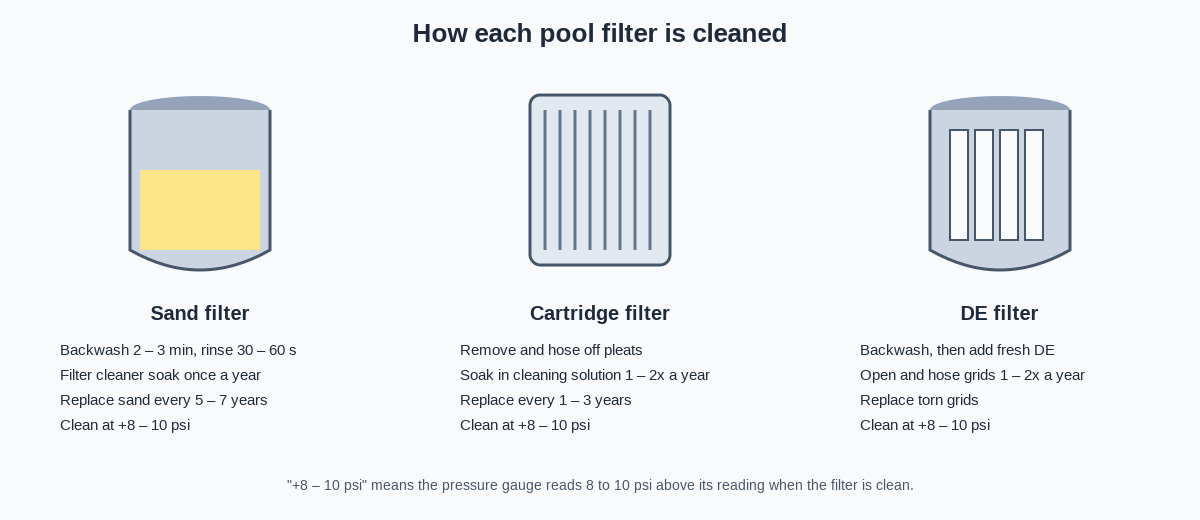
Diagram: Asphapro.com
Quick Answer
How to clean swimming pool filter systems depends on the type. Clean any pool filter when the pressure gauge reads 8 to 10 psi above its clean reading. A sand filter is cleaned by backwashing for 2 to 3 minutes and rinsing for 30 to 60 seconds, plus a filter cleaner soak once a year and new sand every 5 to 7 years. A cartridge filter is cleaned by removing the cartridge and hosing each pleat from top to bottom, with a soak in a pool filter cleaning solution once or twice a season. A DE filter is backwashed and recharged with fresh DE, then taken apart and the grids hosed off once or twice a year. Always turn off the pump and release pressure before opening a filter.
In any pool and filter system, the pool filter is the part that actually makes the water clear. The pump moves water, the chlorine kills germs, but the filter traps the dirt, dead algae, hair, pollen, sunscreen and tiny particles that make water cloudy. As a filter traps dirt, water flow slows, the pressure rises, and the pool starts to look dull. Cleaning the filter on time keeps the water sparkling, lowers the strain on the pump and makes your chemicals work better.
This guide explains how to clean swimming pool filter types step by step: sand, cartridge and DE. It covers how often to clean, how to tell when it is time, which cleaning solutions and tools to use, how to deep clean, how to clean popular filters such as Hayward models, and the mistakes that shorten filter life. For backwashing in detail, see how to backwash a pool.
Types of Pool Filters
Cleaning pool filters starts with knowing which kind of filter pool equipment you have.
There are three main types of filter for pool use. Knowing which one you have is the first step in cleaning it.
- Sand filter: a tank filled with special pool filter sand (or glass or zeolite media). Water flows down through the sand, which traps particles down to about 20 to 40 microns. Usually has a multiport or push-pull valve. Cleaned by backwashing.
- Cartridge filter: a tank holding one or more pleated fabric cartridges. Traps particles down to about 10 to 20 microns. No backwash valve. Cleaned by removing and hosing the cartridges.
- DE (diatomaceous earth) filter: a tank with fabric-covered grids coated with DE powder. Traps the finest particles, down to about 3 to 5 microns. Cleaned by backwashing and adding fresh DE, plus periodic teardown.
Look at the filter label or the top of the tank to confirm the type and model before you start. The owner's manual lists the right cartridge size, DE amount and spare parts.
Photo: ReplayTheSage, Wikimedia Commons, CC0 (cropped)
Before cleaning the filter itself, empty the skimmer and pump baskets. Leaves and debris in the baskets cut flow and can make a clean filter look dirty on the gauge.
When to Clean a Pool Filter
Cleaning a pool filter too early or too late both cause problems. Here is how to time cleaning the pool filter.
The best guide is the pressure gauge on the filter. After cleaning, note the pressure with the pump running at its normal speed. This is the "clean" reading. When the gauge reads 8 to 10 psi higher, the filter is full of dirt and needs cleaning. Other signs:
- Weak flow from the return jets.
- Cloudy water that will not clear even with good chemistry.
- The pool cleaner or vacuum losing suction.
- After a storm, heavy pollen, algae treatment or a pool party.
How Often to Clean Pool Filter Types
| Filter type | Routine cleaning | Deep cleaning | Replacement |
|---|---|---|---|
| Sand | Backwash every 4 – 6 weeks or by pressure | Filter cleaner once a year | Sand every 5 – 7 years |
| Cartridge | Hose off every 2 – 6 weeks or by pressure | Soak 1 – 2 times a season | Cartridge every 1 – 3 years |
| DE | Backwash and recharge by pressure | Teardown and grid cleaning 1 – 2 times a year | Grids every 5 – 10 years |
How often clean pool filter types need attention depends on your pool. A pool under trees, with heavy use or algae problems, needs more frequent cleaning than a covered pool in a clean yard. Cleaning too often can actually make filtration worse, especially with sand, because a slightly dirty filter traps fine particles better than a perfectly clean one.
How to Clean a Sand Filter for a Swimming Pool
Here is how to clean sand filter for swimming pool systems, from routine backwashing to a full deep clean.
Photo: KateGoodall, Wikimedia Commons, CC BY-SA 4.0 (cropped)
Routine cleaning: backwash and rinse
- Turn off the pump.
- Attach a backwash hose to the waste port and run it to a safe drain area.
- Set the multiport valve to BACKWASH.
- Turn on the pump and run for 2 to 3 minutes, until the sight glass runs clear.
- Turn off the pump, set the valve to RINSE, and run for 30 to 60 seconds.
- Turn off the pump, return the valve to FILTER, and restart.
- Top up the pool water.
Deep cleaning a sand filter
Backwashing removes loose dirt, but oils, lotions and minerals slowly coat the sand and cause clumps or channels. Once a year, or when pressure stays high after backwashing:
- Backwash the filter.
- Turn off the pump, and pour a sand filter cleaner (a degreaser or a combination cleaner) into the skimmer or directly into the filter, following the label.
- Run the pump for a minute to draw it into the sand, then turn it off and let it soak, often 8 to 12 hours or overnight.
- Backwash and rinse thoroughly, then return to FILTER.
Replacing filter sand
Every 5 to 7 years, replace the sand. Drain the filter, remove the valve, scoop out the old sand, cover the standpipe opening, refill with fresh #20 silica pool filter sand (or a glass or zeolite media if your filter allows it), reinstall the valve, then backwash and rinse before filtering. Check the laterals at the bottom for cracks while the filter is empty; a broken lateral lets sand into the pool.
How to Clean a Swimming Pool Cartridge Filter
Routine cleaning: hosing the cartridge
- Turn off the pump and close any valves to stop water flow.
- Open the air relief valve on top of the filter to release pressure.
- Remove the clamp band or lid and lift out the cartridge (some filters have four cartridges).
- Hose the cartridge from the top down, spraying between each pleat. Turn the cartridge and work all the way around. A filter cleaning wand or a pool filter cleaning tool that fits a garden hose makes this faster.
- Rinse the inside of the filter tank and check the tank O-ring. Clean and lubricate it with silicone lubricant.
- Reinstall the cartridge, close the filter, open the valves and start the pump.
- Bleed air from the air relief valve until a steady stream of water sprays out, then close it.
Do not use a pressure washer. It can tear the fabric and flatten the pleats, which ruins the cartridge.
Deep cleaning: soaking in a pool filter cleaning solution
Hosing does not remove oils from sunscreen, lotions and body products, which clog the fabric over time. Once or twice a season:
- Hose the cartridge clean.
- Fill a large bucket or trash can with water and a cartridge cleaning solution made for pool filters (follow the label for the amount). Many owners use a dedicated filter cleaner; some use a mild solution of trisodium phosphate.
- Soak the cartridge for 8 to 24 hours.
- Rinse very well with a hose.
- If there is calcium scale (white, crusty deposits), follow with a short soak in a mild acid solution made for cartridges, then rinse again.
Always degrease first and use acid only after. Acid used first can set oils into the fabric permanently. Never mix cleaning products. Many owners keep a spare cartridge so one can soak and dry while the other is in use.
How to Clean a DE Pool Filter
Routine cleaning: backwash and recharge
- Backwash the filter for 2 to 3 minutes until the water runs clear. Some owners backwash, pause the pump for a minute, then backwash again.
- Return the valve to FILTER (rinse first if your valve has a rinse setting).
- With the pump running, mix DE powder with water in a bucket to make a slurry, and pour it slowly into the skimmer. Use about 80% of the amount on the filter label after a backwash.
- Check that the pressure returns to normal.
Deep cleaning: DE pool filter teardown
Once or twice a year, DE pool filter cleaning should include taking the filter apart:
- Turn off the pump, close valves, open the air relief and drain the tank.
- Remove the clamp and lid, then lift out the grid assembly (or the "fingers" in some models).
- Hose off each grid thoroughly, removing all old DE and dirt.
- Soak the grids in a filter cleaner if they are oily, then rinse.
- Inspect each grid for tears or holes. A torn grid lets DE into the pool and should be replaced.
- Reassemble, close the tank, and add fresh DE at the full label amount.
Wear a dust mask when handling dry DE powder, and check local rules on disposing of used DE.
How to Clean a Hayward Pool Filter
Hayward makes some of the most common filters in the US, so many owners ask how to clean a Hayward pool filter. The steps depend on which type you have:
- Hayward sand filters (top-mount or side-mount multiport valves): backwash and rinse as described above. Use the multiport settings in the same order: BACKWASH, RINSE, FILTER, always with the pump off when changing.
- Hayward cartridge filters: release pressure with the air relief valve, loosen the clamp or lid, remove the cartridge or cartridges, hose them off and reinstall. Large four-cartridge models have a manifold; lift the whole assembly out and clean each cartridge.
- Hayward DE filters: backwash (or "bump" models with a bump handle), recharge with DE, and take apart to clean the grids or fingers once or twice a year.
Cleaning a Hayward pool filter follows the same rules as any other brand: check the manual for the correct DE amount, replacement cartridge size and tank O-ring part number, and never open a filter under pressure.
Pool Filter Cleaning Tools and Stands
A few simple tools make cleaning the pool filter faster and easier:
- Pool filter cleaning tool or wand: attaches to a garden hose and has a comb or angled nozzle that sprays between pleats. Some spin the water to clean several pleats at once. Cost: $15 to $50.
- Pool filter cleaning stand: a stand or turntable that holds the cartridge upright and lets it spin while you spray. It keeps the cartridge off the dirty ground and saves your back. Cost: $20 to $80.
- Large bucket or soaking tub with a lid for deep cleaning.
- Silicone lubricant for tank and lid O-rings.
- Gloves and eye protection when using cleaners or acid.
- Dust mask for handling dry DE.
Choosing a Pool Filter Cleaning Solution
Pool filter cleaning solutions fall into three groups:
- Degreasers: remove oils, lotions and organic buildup. Use these first and most often.
- Descalers: mild acids that dissolve calcium and mineral scale. Use only after degreasing, and only when you see scale.
- Combination cleaners: remove both, convenient for routine deep cleaning.
Avoid household dish soap, which leaves foam in the pool, and avoid bleach soaks on cartridges unless the maker approves them, since strong chlorine can weaken some fabrics. Never mix cleaners together. Always rinse very well before putting the filter back in service.
Common Mistakes When Cleaning the Pool Filter
- Cleaning too often. Filters work best when slightly dirty. Use the gauge, not the calendar.
- Using a pressure washer on cartridges. It tears the fabric.
- Acid before degreaser. This locks oils into the cartridge.
- Moving the multiport handle with the pump on. This damages the valve gasket.
- Skipping the rinse step after backwashing a sand filter, which sends dirt back to the pool.
- Adding too much DE. Overloading a DE filter raises pressure and can clog it.
- Forgetting the O-ring. A dry or damaged tank O-ring causes leaks and air in the system.
- Not noting the clean pressure. Without it, you cannot tell when cleaning is due.
Troubleshooting After Cleaning a Pool Filter
| Problem | Likely cause | Fix |
|---|---|---|
| Pressure still high | Clogged sand or cartridge, closed valve, dirty impeller | Deep clean; check valves; clean pump impeller |
| Pressure very low | Clogged baskets, low water, air leak | Empty baskets; top up water; check pump lid O-ring |
| Sand in the pool | Broken lateral or standpipe | Open filter and replace parts |
| DE in the pool | Torn grid or loose manifold | Replace grid; reseat parts |
| Water stays cloudy | Filter too small, worn cartridge, chemistry | Check sizing; replace cartridge; balance water |
| Leak at filter lid | Dirty or worn O-ring | Clean, lubricate or replace O-ring |
Pool and Filter Sizing
A pool and filter must be matched. A filter that is too small clogs fast and needs constant cleaning; one that is too large for the pump will not backwash well. As a rule of thumb, the filter should handle the pump's full flow rate and turn over the pool water in 6 to 8 hours. Many pool pros recommend sizing cartridge filters generously, with at least 100 to 150 square feet of cartridge area per 10,000 gallons, so the cartridge clogs less often. For pump sizing, see how to prime a pool pump, which includes a flow calculator.
Which Filter Is Easiest to Clean?
Sand filters are the easiest day to day: a few minutes of backwashing, no handling of the media. Cartridge filters take more hands-on time but use no backwash water. DE filters filter best but take the most work and involve handling DE powder. If you are choosing a filter for a pool, think about how much time you want to spend cleaning and whether water use is restricted in your area.
A Season-Long Pool Filter Cleaning Schedule
Planning pool filters cleaning around the season keeps the water clear with the least effort:
- Opening day: clean or backwash the filter after the opening shock and brushing. If you closed with a dirty filter, give it a full deep clean now. Record the clean pressure.
- Early season (pollen and leaves): check the gauge twice a week. Pollen clogs cartridges quickly, so expect more frequent cleaning.
- Mid-season: clean by pressure, usually every 3 to 6 weeks. Deep clean cartridges once around midsummer.
- After storms or algae: brush, shock, then clean or backwash the next day.
- Closing: deep clean the filter so it does not sit all winter with oils and dirt baked in.
Winterizing the Pool Filter
In freezing climates, water left in a filter can crack the tank or valve. When closing the pool:
- Clean the filter thoroughly: backwash sand or DE, or remove and deep clean cartridges.
- Open the drain plug at the bottom of the tank and let all water drain out.
- Open the air relief valve and remove the pressure gauge to drain it.
- Set multiport valves to WINTER (or between settings) to relieve pressure on the gasket.
- Store cartridges indoors, clean and dry. Some owners store small above ground filters indoors too.
- Keep drain plugs in the pump basket so they are easy to find in spring.
When to Replace Instead of Clean
Cleaning cannot fix a worn-out filter. Replace parts when you see these signs:
- Cartridge: torn fabric, flattened or frayed pleats, cracked end caps, or pressure that rises within days of cleaning. Most cartridges last 1 to 3 years.
- Sand: pressure rises quickly after each backwash, or water stays hazy; replace sand every 5 to 7 years.
- DE grids: holes, tears or DE returning to the pool.
- Tank: cracks, bulges or leaks at seams. A cracked tank under pressure is dangerous and should be replaced at once.
Pool Filter Cleaning Service Costs
If you prefer to hire help, a pool service company usually charges $75 to $150 for a cartridge filter cleaning, $100 to $200 for a DE filter teardown, and $150 to $300 for replacing sand in a sand filter, plus the cost of new sand or parts. Many weekly service plans include routine filter cleaning. Doing it yourself saves these costs and takes little time once you know the steps, and you will spot worn parts early.
Cleaning an Above Ground Pool Filter
Above ground pools usually have smaller sand or cartridge filters, often combined with the pump on one base. The cleaning steps are the same, but a few points differ. Small cartridges clog quickly, so check them weekly in busy periods and keep a spare to swap in. Many small sand filters have a top-mount valve with fewer settings; follow the label. Because the pool holds less water, each backwash lowers the level more, so check that the skimmer still draws water before restarting. Small filters are also easy to carry indoors for winter storage, which protects them from cracking.
Safety When Cleaning a Pool Filter
- Turn off the pump at the switch or breaker before opening the filter.
- Always open the air relief valve and wait for the pressure gauge to read zero before loosening a clamp or lid. Filters under pressure can blow apart.
- Wear gloves and eye protection when using cleaners, acid or DE.
- Keep chemicals away from children and pets, and never mix them.
- Reassemble clamps and lids exactly as the manual shows, and stand clear of the lid when restarting the pump.
With these steps, cleaning the pool filter becomes a quick, safe routine that keeps the water clear all season.
How to Clean Swimming Pool Filter: Key Points
- Clean when the gauge reads 8 to 10 psi above clean.
- Sand: backwash and rinse; filter cleaner yearly; new sand every 5 to 7 years.
- Cartridge: hose off; soak 1 to 2 times a season; replace every 1 to 3 years.
- DE: backwash and add DE; tear down and clean grids 1 to 2 times a year.
- Always turn off the pump and release pressure before opening a filter.
Frequently Asked Questions
How to clean a pool filter of any type?
Backwash sand and DE filters, adding fresh DE to DE filters. Remove cartridge filters and hose them off. Deep clean all types with a filter cleaner once or twice a year.
How often should I clean my pool filter?
When the pressure is 8 to 10 psi above its clean reading, usually every 2 to 6 weeks in season.
How to clean a pool filter without a hose?
Soak the cartridge in a bucket of clean water with a filter cleaner, swish it, then rinse it in fresh water. A hose works much better, so borrow one if you can.
What is the best pool filter cleaning solution?
A dedicated cartridge or filter cleaner made for pools, used as a degreaser first. Use a mild acid descaler only if you see calcium scale.
Why is my pool cloudy after cleaning the filter?
Fine dirt can pass through a freshly cleaned filter until it builds a light layer again. Run the pump longer, check chemistry, and give it a day or two. If it stays cloudy, check for a torn cartridge or grid.
Does a pool filter need cleaning in winter?
In warm climates where the pool runs year-round, yes, by pressure as usual. In cold climates, clean it at closing and drain it for winter.
Can I clean a pool filter with vinegar?
Diluted white vinegar can loosen light scale on cartridges, but it does not remove oils. Use a degreaser first.
How do you clean a pool filter cartridge that is very dirty?
Hose it, soak it overnight in a cartridge cleaner, rinse, and repeat if needed. If it stays dirty or the pleats are damaged, replace it.
Should I clean the pool filter after shocking?
Wait a day after shocking and brushing, then clean or backwash if pressure has risen. This removes dead algae trapped in the filter.
How long does cleaning a pool filter take?
About 10 minutes to backwash a sand filter, 15 to 30 minutes to hose a cartridge, and 1 to 2 hours for a DE filter teardown.
Do I need to turn off the pump to clean the pool filter?
Yes, always. Turn it off at the switch or breaker and release pressure before opening the filter or changing valve settings.
Can a pool run without the filter?
Only briefly, using the recirculate setting while a filter is repaired. Without filtering, water clouds quickly.
Sources
- Swim University: How to clean a pool filter
- CDC: Healthy swimming
- Pool and Hot Tub Alliance
- EPA WaterSense: Pools and spas