
How to Change Sand in a Hayward Pool Filter: Step-by-Step Guide
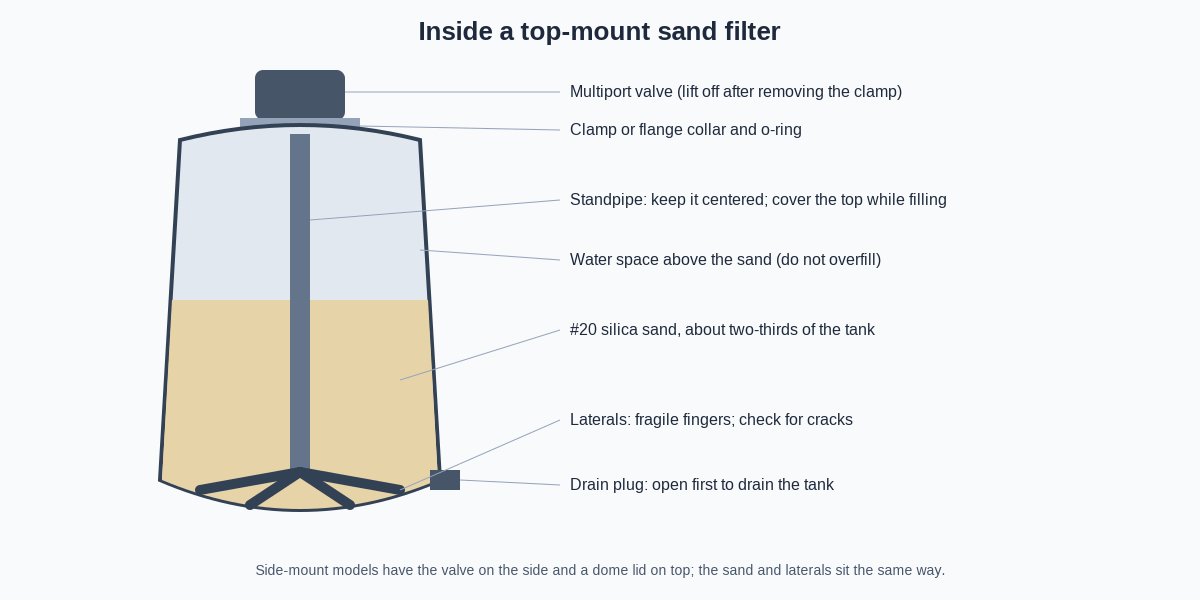
Diagram: Asphapro.com
Quick Answer
To change sand in a Hayward pool filter, turn off the pump and breaker, close the valves, and open the drain plug at the bottom of the tank. Remove the clamp and lift off the multiport valve (top-mount ProSeries models) or the dome lid (side-mount models). Cover the top of the standpipe, then scoop or vacuum out the old sand. Check the laterals for cracks, rinse the tank, fill it halfway with water, and pour in new #20 silica pool filter sand: about 100 lb for a 16-inch, 150 lb for an 18-inch, 200 lb for a 21-inch and 300 lb for a 24-inch filter. Level the sand, clean and lube the o-ring, reinstall the valve, backwash for 2 to 3 minutes, rinse for 30 seconds, then set the valve to Filter. The job takes 1 to 3 hours and new sand costs about $20 to $60.
A pool sand filter is one of the simplest and toughest filters you can own. Water flows down through a deep bed of sand, the sand traps dirt and debris, and you clean it by backwashing. But the sand does not last forever. Over the years, the sharp edges of each grain wear smooth, oils and minerals clump the bed together, and the filter stops trapping fine particles. When that happens, changing the sand brings the filter back to like-new performance.
This guide explains how to change sand in a Hayward pool filter, step by step, including the popular ProSeries top-mount models found on many backyard pools. The same method works for most other brands of sand pool filter, because they share the same basic parts. If you want to compare doing it yourself with paying a pro, see our guide to the cost to replace sand in pool filter tanks.
How a Sand Filter for Pool Water Works
A sand filter for pool water is a sealed tank, usually plastic or fiberglass, filled about two-thirds of the way with sand. The pump pushes pool water into the top of the tank through the multiport valve. The water spreads over the sand and flows down through it. Dirt, leaves, hair and small particles stick in the spaces between the grains. At the bottom, a set of slotted plastic fingers called laterals collects the clean water and sends it up through a center pipe, the standpipe, back to the valve and on to the pool.
As dirt builds up, the pressure on the filter gauge rises. When it is about 8 to 10 psi above the clean starting pressure, you backwash: the valve reverses the flow, lifting and loosening the sand bed so the trapped dirt washes out the waste line. A good pool sand filter catches particles down to about 20 to 40 microns, which is enough to keep most residential pools clear.
When to Change the Sand in a Pool Sand Filter
Most manufacturers, including Hayward, suggest replacing the sand in pool filter tanks every 5 to 7 years, though some pools go longer with good water chemistry and regular backwashing. Signs it is time to change the sand:
- Cloudy water that will not clear even with balanced chemistry and the pump running long hours.
- Short filter cycles: you have to backwash every few days because pressure rises quickly.
- Low pressure that stays low even when the water is dirty, a sign the water is channeling through the sand instead of being filtered.
- Sand in the pool: fine sand on the floor near the returns, which can mean broken laterals or a cracked standpipe.
- Clumped or crusted sand when you open the tank, often from calcium, oils and lotions.
- Age: if you do not know when the sand was last changed and the pool has been open for years, it is probably due.
How Much Sand for Pool Filter Tanks?
The amount of sand depends on the tank diameter. The label on the side of the tank lists the exact amount, and you should always follow it. For Hayward ProSeries filters, the published sand capacities are:
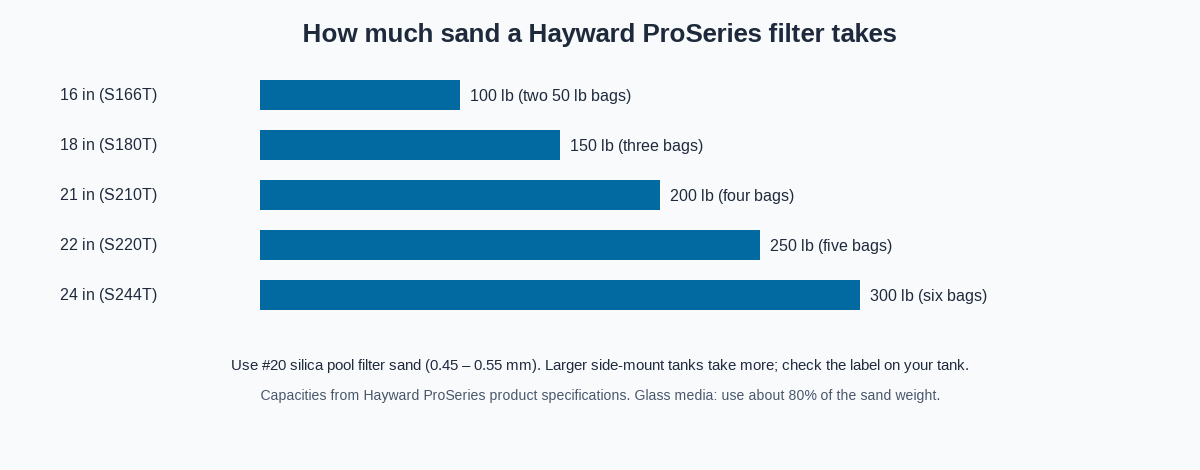
Chart: Asphapro.com
- 16-inch (S166T): 100 lb, two 50-lb bags.
- 18-inch (S180T): 150 lb, three bags.
- 21-inch (S210T): 200 lb, four bags.
- 22-inch (S220T): 250 lb, five bags.
- 24-inch (S244T): 300 lb, six bags.
Larger side-mount tanks, often found on bigger inground pools, take 350 lb or more. When in doubt about how much sand in pool filter tanks you need, read the tank label or look up the model number. Too little sand lets dirt pass through; too much leaves no room for the sand to lift during backwashing, so it cannot clean properly and may push sand into the pool.
What Sand for Swimming Pool Filter Tanks Should You Use?
Use #20 silica pool filter sand, which has grains of about 0.45 to 0.55 millimeters. It is sold in 50-lb bags at pool stores and home centers. Hayward recommends #20 silica sand for its sand filters. Do not use play sand, masonry sand or beach sand: the grains are the wrong size and shape and will either pass through the laterals into the pool or pack so tightly that water cannot flow.
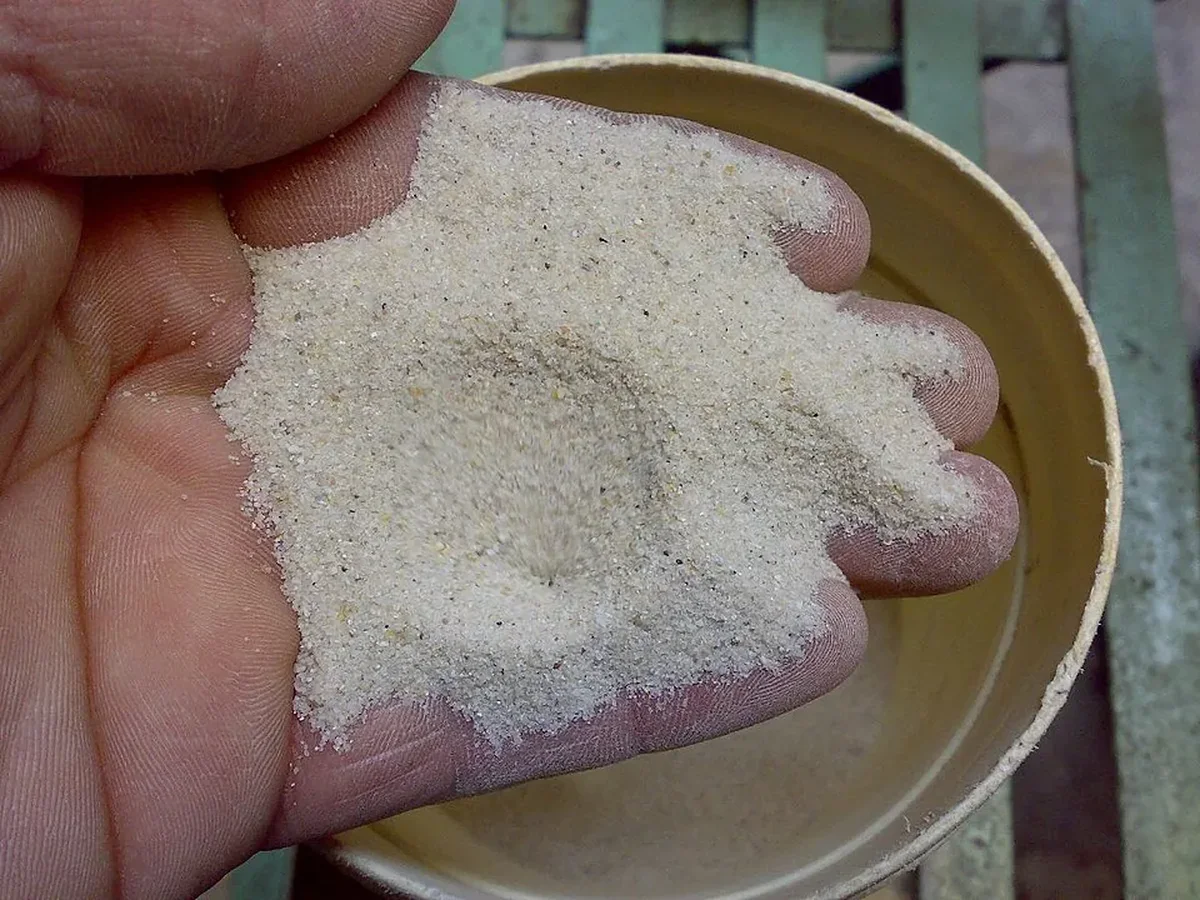
Photo: Sergio esteban cardenas, Wikimedia Commons, CC BY-SA 4.0
There are two common alternatives to sand. Zeolite is a natural mineral with a rough, porous surface that traps finer particles than sand; use about half the weight of sand by volume, following the bag's directions. Filter glass is crushed, recycled glass with smooth, rounded edges; it filters finer than sand, backwashes faster and lasts longer, but costs more. Use about 80% of the sand weight. Check your filter manual before switching, because some warranties specify sand only.
Tools and Supplies
- New #20 silica sand (or approved glass or zeolite), the amount on your tank label.
- A wet/dry shop vacuum, or a plastic cup and scoop.
- A garden hose with a spray nozzle.
- A large plastic cup, bag or tape to cover the top of the standpipe.
- A screwdriver or nut driver for the clamp, and pliers for unions if needed.
- Silicone-based o-ring lubricant (not petroleum jelly).
- Replacement o-ring for the valve or lid, if the old one is flat or cracked.
- Gloves, a dust mask and eye protection for pouring dry sand.
- Replacement laterals, if any are broken (check the size for your model).
How to Change Sand in a Hayward Pool Filter: Step by Step
Step 1: Turn off the power and close the valves
Switch off the pump at the timer and the breaker so it cannot start while the tank is open. If your filter sits below the pool water level, close the valves on the suction and return lines so the pool does not drain back through the open tank. Set the multiport valve handle to Winter or Closed if your valve has that setting.
Step 2: Drain the tank
Open the drain plug at the bottom of the tank and let the water run out. Opening the air relief valve on top helps it drain faster. This takes 5 to 15 minutes. Point the water away from the equipment pad and the house foundation.
Step 3: Remove the multiport valve or lid
On top-mount Hayward ProSeries filters, the valve sits on top of the tank and is held by a clamp or a flange collar. Disconnect the pipes from the valve; if they are glued, you may need to cut them, so plan unions for next time. Undo the clamp, then gently twist and lift the valve straight up off the standpipe. On side-mount models, unscrew the dome lid on top instead; the valve stays connected to the side of the tank.
Step 4: Cover the standpipe
Put a plastic cup, bag or tape over the top of the standpipe so sand cannot fall into it. Sand inside the standpipe goes straight to the pool when you restart. Keep the standpipe centered while you work.
Step 5: Remove the old sand
The quickest way is a wet/dry shop vacuum. Vacuum the sand out a little at a time, emptying the vacuum often because wet sand is very heavy. You can also scoop it out with a cup. Some owners flood the tank with a hose and let the drain plug carry sand out; this is messy and slow but works. As you get near the bottom, work gently: the laterals are thin plastic and break easily if you push down hard.
Step 6: Inspect the laterals and standpipe
Once the sand is out, look at each lateral for cracks or missing slots, and check the standpipe for cracks. If a lateral is broken, unscrew or unclip it from the hub and replace it. This is the best time to fix them, because broken laterals let sand into the pool. Rinse the inside of the tank with the hose to wash out leftover sand, scale and oily residue.
Step 7: Add water, then sand
Close the drain plug. Fill the tank about halfway with water. The water cushions the falling sand and protects the laterals. Then pour the new sand in slowly, one bag at a time, keeping the standpipe centered and covered. Wear a mask, because dry silica dust should not be breathed. Stop when you reach the fill line on the tank or the amount on the label. The sand should sit about 6 to 9 inches below the top of the tank, leaving water space above it.
Step 8: Level the sand and clean the rim
Smooth the sand so it is level. Remove the cover from the standpipe. Wipe all sand off the tank rim and the threads, because grains on the sealing surface cause leaks.
Step 9: Reinstall the valve or lid
Clean the o-ring, check it for cracks and flat spots, and coat it lightly with silicone lube. Lower the valve onto the standpipe, line it up with the pipes, and tighten the clamp evenly. Reconnect the pipes. On side-mount filters, screw the dome lid back on hand-tight.
Step 10: Backwash and rinse
Open the valves, set the multiport to Backwash, and open the air relief valve. Turn on the pump and backwash for 2 to 3 minutes, until the sight glass runs clear. New sand has fine dust that must be flushed out. Turn off the pump, set the valve to Rinse, run for 30 seconds to 1 minute, turn off the pump again, and set it to Filter. Always turn the pump off before moving the valve handle.
Step 11: Note the new clean pressure
Once the filter is running, write down the pressure gauge reading. This is your new clean pressure. Backwash when the gauge reads 8 to 10 psi above it.
How Long Does It Take to Change Pool Filter Sand?
For a first-timer with a 16- or 18-inch tank, plan on 1.5 to 3 hours. Removing the old sand takes the longest. With a shop vacuum and an easy-to-remove valve, an experienced owner can do it in about an hour. Larger tanks and glued pipes add time.
Changing Sand in Other Brands of Swimming Pool Sand Filters
The same basic steps work for most sand pool filter models from other makers, including Pentair, Jandy and Intex above ground filters. The main differences are how the valve attaches, how much sand the tank holds and the type of sand for above ground pool systems. Small above ground sand filter pumps often use #20 silica sand in amounts from 25 to 100 lb. Always read your tank label and manual for the right amount and sand type.
Common Mistakes When Changing Pool Filter Sand
- Forgetting to cover the standpipe, which sends sand straight into the pool.
- Pouring sand into an empty tank, which can crack the laterals.
- Overfilling, which stops the sand from lifting during backwash.
- Using the wrong sand, such as play sand or pool sand of the wrong grade.
- Skipping the o-ring check, which leads to leaks at the valve or lid.
- Leaving sand on the rim, which stops the seal from closing tight.
- Not backwashing new sand, which sends fine dust into the pool.
- Moving the valve handle while the pump runs, which damages the valve gasket.
Hayward Pool Filter Replacement or Just New Sand?
Changing the sand fixes most performance problems. But sometimes a full Hayward pool filter replacement makes more sense. Replace the whole filter if the tank is cracked or leaking at the seams, if the tank is old and sun-damaged with chalky, brittle plastic, or if you are upgrading to a larger pool or a new pump. A new ProSeries sand filter with valve costs about $400 to $900 for the filter, plus labor if you hire it out. A new valve alone costs about $100 to $250 if the old valve leaks to waste or will not turn smoothly.
How to Keep Pool Sand Filters Working Well
- Backwash at 8 to 10 psi above clean pressure, not on a fixed schedule.
- Keep water chemistry balanced so calcium does not crust the sand.
- Use a sand filter cleaner once or twice a season to remove oils and scale.
- Clean the skimmer and pump baskets often so the filter does less work.
- Check the pressure gauge works; replace it if it sticks or reads zero with the pump on.
- Winterize properly in cold climates: drain the tank and store the drain plug in the pump basket.
For more on cleaning and maintaining all filter types, see our guide on how to clean swimming pool filter cartridges, sand and DE, and our guide on how to backwash a pool.
What Is Pool Filter Sand?
What is pool filter sand, and why does it matter which kind you buy? Pool filter sand is crushed and screened quartz, a hard mineral made of silica. The screening process sorts the grains to a narrow size range, usually 0.45 to 0.55 millimeters for #20 grade. The grains are sharp-edged when new, and those edges are what catch dirt as water flows through. Over years of use, the water and backwashing slowly round off the edges, which is why filter sand for pools eventually stops filtering as well and needs changing.
Good filter sand pool supply stores sell is washed, so it has very little dust, but every new bag has some fines. That is why you backwash after a sand change. Filter pool sand is also heavy: a 50-lb bag is only about half a cubic foot, so a 24-inch tank needs six bags even though the tank does not look that large.
Hayward Pool Sand Filter Models
Hayward makes several lines of sand filters for pools. The ProSeries top-mount filters, from 16 to 24 inches, are the most common on residential pools, especially above ground and smaller inground pools. The valve sits on top and is held by a clamp, so you lift the valve off to reach the sand. The ProSeries side-mount filters, from 21 to 36 inches, are used on larger inground pools; the valve is bolted to the side, and a dome lid on top lets you reach the sand without disconnecting the plumbing.
Each Hayward sand pool filter has a label on the side of the tank listing the model number, filter area, flow rate and sand capacity. If you are not sure what you have, that label is the first place to look. The steps in this guide on how to change the sand in a Hayward pool filter apply to both types, with the valve or the lid as the only real difference.
How to Replace Sand in Hayward Pool Filter Side-Mount Models
If you have a side-mount Hayward sand pool filter, the job is a little easier because you do not need to disconnect the plumbing. Turn off the pump, close the valves, drain the tank through the drain plug, and unscrew the dome lid on top. Inside, you will see the sand bed and, in most models, a diffuser at the top. Cover any openings at the top of the internal pipe, remove the old sand with a shop vacuum, inspect the laterals, rinse, refill halfway with water, add the new sand to the fill line, clean the lid o-ring and threads, then screw the lid back on. Backwash and rinse as with any other pool with sand filter equipment.
Sand in Pool From Filter: Causes and Fixes
Seeing sand in pool from filter returns is one of the most common reasons owners open the tank. A little fine dust right after a sand change is normal and clears with another backwash. But steady piles of sand near the returns usually mean one of these problems:
- Broken lateral: a crack lets sand pass straight into the return line. Replace the lateral.
- Cracked standpipe: sand enters through the crack. Replace the standpipe and lateral assembly.
- Too much sand: an overfilled tank pushes sand out during backwash and into the valve. Remove sand to the fill line.
- Wrong sand size: sand that is too fine passes through the lateral slots.
- Worn valve gasket: lets water and sand bypass the filter. Replace the spider gasket in the multiport valve.
- Pump too large for the filter: very high flow can push sand through. Check the filter's maximum flow rate.
If you find Hayward sand filter sand in pool water after a sand change, the most likely cause is a lateral cracked while the sand was poured, or sand that fell into the standpipe. Open the tank again and check.
Pool Sand Filters vs Cartridge and DE Filters
Pool sand filters are the cheapest to buy and the easiest to maintain: you backwash and change the sand every several years. They filter down to about 20 to 40 microns. Cartridge filters catch finer particles, about 10 to 20 microns, and do not need backwashing, but the cartridges need hosing off and replacing every 2 to 3 years. DE filters catch the finest particles, down to about 3 to 5 microns, but need fresh DE powder after every backwash and are the most work. For most backyard pools, a well-kept sand filter keeps the water clear and costs the least over time.
When comparing sand filters for pools of different sizes, the key number is the filter area in square feet and the flow rate the filter can handle. Match the filter to your pump's flow, not just to the pool's volume. A swimming pool sand filter that is too small for the pump will need frequent backwashing and may let sand pass.
How to Change Sand in a Hayward Pool Filter: Key Points
- Change the sand every 5 to 7 years, or when water stays cloudy or filter cycles get short.
- Use #20 silica pool filter sand: 100 lb (16 in), 150 lb (18 in), 200 lb (21 in), 300 lb (24 in).
- Drain, remove the valve, cover the standpipe, remove old sand, check the laterals.
- Fill the tank halfway with water before adding sand.
- Backwash 2 to 3 minutes and rinse before returning to Filter.
Frequently Asked Questions
How often should you change the sand in a Hayward pool filter?
Every 5 to 7 years for most pools. Pools with heavy use, poor chemistry or many trees may need it sooner.
Can I use play sand in my pool filter?
No. Play sand is the wrong size and shape. Use #20 silica pool filter sand or a media approved for your filter.
Do I have to remove the pipes to change the sand?
On top-mount filters, you usually need to disconnect the pipes from the valve so you can lift it off. Unions make this much easier.
Why is there sand in my pool after changing it?
Usually because sand got into the standpipe or a lateral was cracked during the job. A small amount right after a sand change can also be fine dust from new sand; backwash again.
What do I do with the old pool filter sand?
Old sand is usually safe to reuse in the garden, under pavers or as fill once it has dried. Check local rules if the sand is heavily stained or smells of chemicals, and bag it for disposal if in doubt.
Can I change the sand without taking out the laterals?
Yes. In most filters, the laterals stay in place on the standpipe. Just work gently near the bottom so you do not crack them, and only remove them if one is broken.
Is glass media better than sand for pool filter use?
Glass filters finer and lasts longer than sand, but costs about two to three times as much. It is a good upgrade if your filter manual allows it.
Sources
- Hayward: ProSeries 16 inch sand filter specifications
- Hayward: ProSeries 18 inch sand filter specifications
- Hayward: ProSeries 24 inch sand filter specifications
- Hayward ProSeries sand filter owner's manual (PDF)