
How to Clear a Cloudy Pool: Why It Happens and How to Fix It
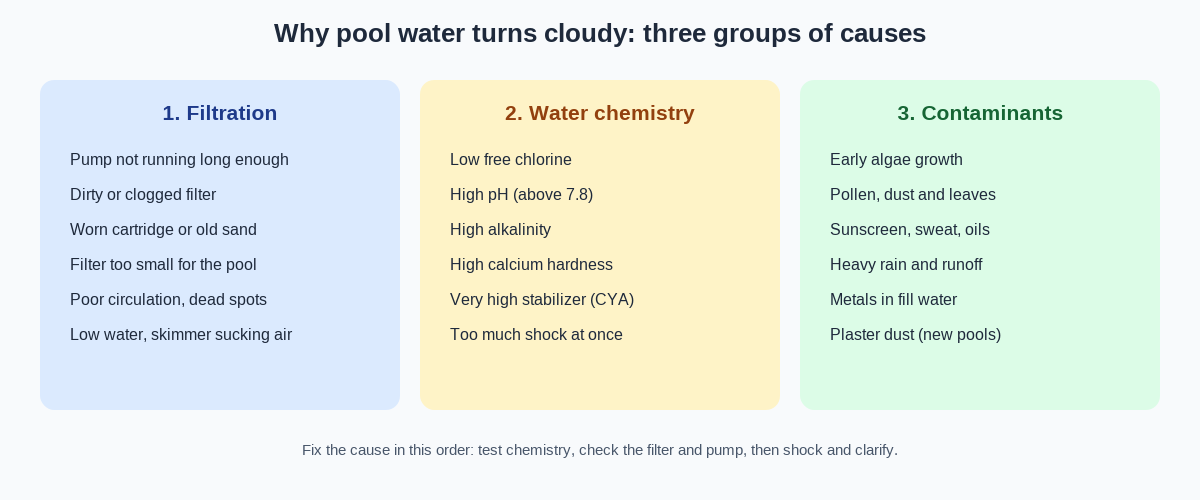
Chart: Asphapro.com
Quick Answer
How to clear a cloudy pool: first test the water. Cloudy pool water usually comes from low chlorine, high pH or alkalinity, high calcium, a dirty or undersized filter, not running the pump long enough, or debris and early algae. Fix it in this order: balance pH to 7.4 to 7.6 and alkalinity to 80 to 120 ppm, clean or backwash the filter, shock the pool to a high chlorine level, then run the pump for 24 hours and brush the walls. If the water is still hazy after a day or two, add a pool clarifier (which helps the filter catch tiny particles) or a flocculant (which sinks them so you can vacuum to waste). Most cloudy pools clear in 24 to 72 hours.
A cloudy pool, or cloudy water in pool systems of any kind, is one of the most common pool problems, and one of the most frustrating. Water that was sparkling yesterday can turn milky or dull overnight, especially after a storm, a pool party or a hot spell. Cloudy pool water is not just unattractive; it can hide the bottom of the pool, which is a safety risk, and it often signals that chlorine is too low to keep germs and algae in check.
The good news is that a cloudy pool can almost always be cleared with basic steps and common chemicals. This guide explains why your pool is cloudy, how to clear a cloudy pool step by step, when to use clarifier or flocculant, how to fix cloudy water after shock, rain or algae, how long it takes, and how to keep pool water clear.
Why Is My Pool Cloudy?
Why is pool water cloudy, and what causes cloudy pool water in the first place? Cloudiness is caused by tiny particles suspended in the water that are too small for the filter to catch, or that the filter is not catching because it is not working well. They scatter light and make the water look milky. The causes fall into three groups.
Filtration and circulation problems
- The pump does not run long enough. Most pools need the full volume to pass through the filter at least once a day, often 8 to 12 hours of run time.
- The filter is dirty, so flow is low. Check the pressure gauge.
- The filter media is worn: old sand, a torn cartridge, or DE grids with holes.
- The filter is too small for the pool or for the pump.
- Dead spots where water does not circulate, often in corners and steps.
Water chemistry problems
- Low free chlorine: bacteria, algae and organic waste build up and cloud the water.
- High pH: above about 7.8, calcium can come out of solution and chlorine works poorly.
- High total alkalinity: pushes pH up and encourages scale and haze.
- High calcium hardness: calcium can precipitate as fine white particles, especially in hot weather.
- Very high stabilizer (CYA): makes chlorine weak, so the pool clouds even with "some" chlorine.
- Shock added too fast, especially cal-hypo in hard water, which can cloud the pool temporarily.
Contaminants
- Early algae often looks like a dull, hazy or slightly green tint before it turns fully green.
- Pollen, dust and leaves, especially in spring and after wind.
- Sunscreen, sweat and body oils after heavy use.
- Rain and runoff carrying soil and fertilizer into the pool.
- Metals from well water or corroded equipment.
- Plaster dust in a newly plastered pool.
How to Clear a Cloudy Pool: Step by Step
Here is how to clear up a cloudy pool in the right order. These steps are also how to clear pool water after most kinds of haze.
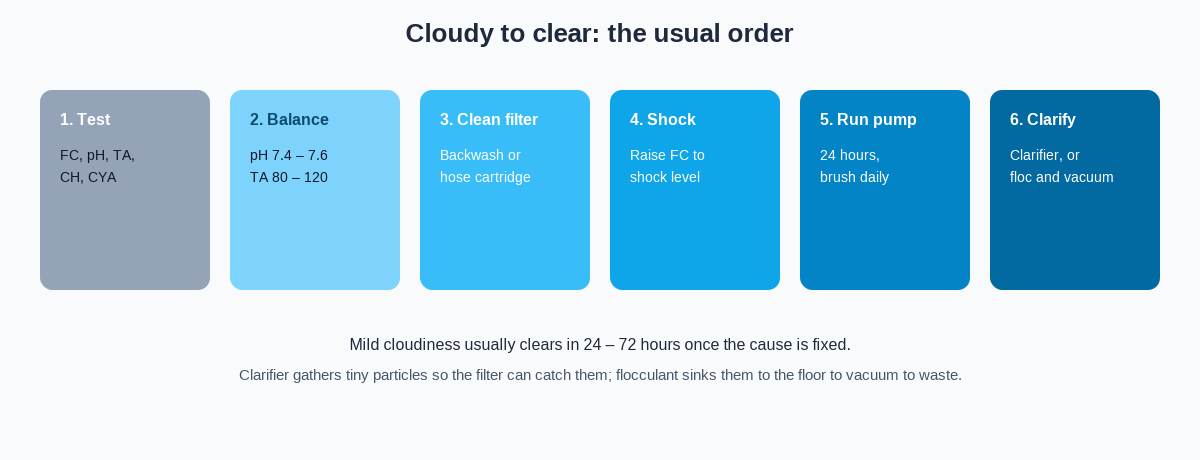
Chart: Asphapro.com
Step 1: Test the water
Test free chlorine, combined chlorine, pH, total alkalinity, calcium hardness and cyanuric acid. A pool store can test them all if your kit cannot. The results tell you whether the cause is chemistry, filtration or both.
Step 2: Balance pH and alkalinity
Bring pH to 7.4 to 7.6 and alkalinity to 80 to 120 ppm. If pH and alkalinity are high, lower them with muriatic acid or dry acid in small doses. If they are low, raise alkalinity with baking soda first; see how to raise pH in pool. Balanced water lets chlorine work and stops calcium from clouding the water.
Step 3: Clean the filter and check the pump
Backwash a sand or DE filter, or remove and hose off a cartridge. Empty the skimmer and pump baskets. Make sure the water is at the middle of the skimmer and the pump is running at full flow with no air leaks. See how to clean swimming pool filter.
Step 4: Shock the pool
Raise free chlorine to shock level, about 10 ppm for pools without stabilizer, or about 40% of your CYA level. Liquid chlorine is usually best because it dissolves instantly and does not add calcium or stabilizer. Add it at dusk with the pump running, and brush the walls and floor. See how much chlorine to add to pool for doses.
Step 5: Run the pump for 24 hours
Run the filter continuously for at least 24 hours. Brush the pool once or twice to stir up particles so the filter can catch them. Check the filter pressure; if it rises 8 to 10 psi, clean it again.
Step 6: Use a clarifier or flocculant if needed
If the pool is still hazy after a day of filtering with good chemistry, use a clarifier or floc (see below). Most cloudy pools are clear within 24 to 72 hours.
Clarifier vs Flocculant: Which to Use?
| Feature | Pool clarifier | Flocculant (floc) |
|---|---|---|
| How it works | Clumps tiny particles so the filter can catch them | Clumps particles into heavy flakes that sink to the floor |
| Speed | 1 to 3 days | Overnight settling, then vacuum |
| Work needed | Little; keep the pump running | Turn off pump, then vacuum to waste carefully |
| Water loss | None | Several inches when vacuuming to waste |
| Best for | Mild to moderate haze | Very cloudy water, after an algae kill |
| Filter type | All, best with sand and cartridge | Sand filters with a waste setting work best |
How to use a pool clarifier
- Make sure chemistry is balanced and chlorine is in range.
- Clean the filter.
- Add clarifier as the label directs, usually through the skimmer or around the pool.
- Run the pump continuously for 24 to 48 hours.
- Clean the filter again when pressure rises.
Do not overdose clarifier; too much can make the water cloudier, and adding more will not speed things up.
How to use flocculant
- Balance pH to about 7.2 to 7.6.
- Set the filter valve to recirculate (if you have one) and add floc as directed.
- Run the pump for 1 to 2 hours to mix, then turn it off.
- Let the pool sit undisturbed for 8 to 24 hours while particles settle into a cloud on the floor.
- Vacuum slowly on the WASTE setting so the debris goes out the backwash line, not into the filter. Add water as you go.
- Refill, rebalance and resume normal filtering.
Cartridge filters have no waste setting; if you have one, use clarifier instead, or vacuum floc with a pump and hose that discharges directly to waste.
Cloudy Pool After Shock
A pool can look cloudy for a day after shocking, especially with cal-hypo in water with high calcium or high pH. Cal-hypo adds calcium, and at high pH some of it comes out as fine white particles. Usually the haze clears as the filter runs. To avoid it, pre-dissolve cal-hypo in a bucket, lower pH before shocking, or use liquid chlorine. If the pool stays cloudy for days after shock, the cause is likely algae or organic waste still using up chlorine, so test free chlorine the next morning and keep shocking until it holds overnight.
Cloudy Pool After Rain
Heavy rain dilutes chlorine, lowers pH and alkalinity, and washes in soil, pollen and fertilizer. After a storm, skim and empty baskets, test and rebalance, shock if chlorine has dropped, and run the pump longer. Phosphates from fertilizer runoff can feed algae, so a phosphate remover may help if your pool clouds after every rain.
Cloudy Pool After Opening or After Algae
When opening a pool in spring, or after killing a green algae bloom, the water often turns cloudy gray or blue as dead algae and debris stay in suspension. This is normal. Keep chlorine at shock level, brush daily, run the filter continuously and clean it often. A clarifier or floc speeds up the final clearing. For green water, see how to clean a green pool.
Photo: Shixart1985, Wikimedia Commons, CC BY 2.0
How Long Does It Take to Clear a Cloudy Pool?
| Situation | Typical time to clear |
|---|---|
| Mild haze from low chlorine or a dirty filter | 12 – 24 hours |
| Moderate cloudiness after a party or storm | 1 – 3 days |
| Very cloudy after algae or opening | 2 – 5 days (or overnight with floc) |
| High calcium or very high CYA | May need partial drain and refill |
How to Keep Pool Water Clear
Once you know how to make pool water clear, keeping it that way is simpler than any cleanup. Here is how to get pool water clear and keep it clear pool water all season.
- Keep free chlorine at the right level for your stabilizer, and test 2 to 3 times a week.
- Keep pH at 7.4 to 7.6 and alkalinity at 80 to 120 ppm.
- Run the pump long enough for at least one turnover a day.
- Clean the filter when pressure rises 8 to 10 psi above clean.
- Brush and vacuum weekly; empty baskets often.
- Shock after heavy use, storms and heat waves.
- Ask swimmers to shower before swimming.
- Use a cover when the pool is not in use.
Photo: Government of the US Virgin Islands, Wikimedia Commons, public domain
My Pool Is Cloudy: What Do I Do First?
If you walk out and think "my pool water is cloudy," start with these quick checks before buying any chemicals:
- Is the pump running? A tripped breaker or timer change is a common cause of a pool that is cloudy overnight.
- Is the water level right? Low water makes the skimmer suck air and cuts filtering.
- Are the baskets full? Empty the skimmer and pump baskets.
- What does the filter gauge say? High pressure means the filter needs cleaning; very low pressure points to a blockage or air leak.
- Test chlorine and pH. Low chlorine or high pH explain most cloudy pools.
These five checks solve many cloudy pools within a day. If my pool is cloudy even after them, the next step is a full water test, including calcium and stabilizer.
What Causes Pool Water to Be Cloudy? Reading Your Test Results
| Test result | What it means | Fix |
|---|---|---|
| Free chlorine below target | Germs, algae and waste are building up | Shock and keep chlorine in range |
| Combined chlorine above 0.5 ppm | Chloramines from sweat and urine | Shock to break them down |
| pH above 7.8 | Calcium can precipitate; chlorine is weak | Lower pH with acid |
| Alkalinity above 150 ppm | pH keeps rising; scale and haze | Lower with acid in steps |
| Calcium above 400 – 500 ppm | Calcium clouds water in heat | Partial drain and refill |
| CYA above 80 – 100 ppm | Chlorine is too weak | Partial drain and refill |
| All normal | Filtration is the likely problem | Clean filter, run pump longer, check media |
What makes pool water cloudy in your pool is usually one of these, or a combination. Fixing the chemistry first makes every other step work better.
How to Clean Murky Pool Water
Murky pool water is different from milky haze. Pool water murky with a brown, gray or green tint usually has a lot of debris, dirt or dead algae, often after a storm, a long period with the pump off, or opening a pool after winter. To clean murky pool water:
- Skim and net out leaves and large debris.
- Vacuum heavy dirt to waste so it does not clog the filter.
- Brush the walls and floor.
- Balance pH and shock to a high chlorine level.
- Run the filter continuously and clean it as often as the pressure demands, sometimes daily.
- Use floc overnight if the water stays thick, then vacuum to waste.
Murky water from runoff may need a phosphate remover, and brown or rust-colored water may point to metals, which call for a metal sequestrant.
Cloudy Water in Pool Systems With Different Filters
- Sand filters catch particles down to about 20 to 40 microns, so very fine haze can pass through. Clarifier helps sand filters the most. Old sand loses its sharp edges and filters poorly; replace it every 5 to 7 years.
- Cartridge filters catch smaller particles but clog quickly during a cloudy-water cleanup. Hose them often and keep a spare cartridge. Oily, dirty cartridges filter poorly even when the pressure looks normal.
- DE filters catch the finest particles and usually clear cloudy water fastest. Make sure DE is added at the right amount after each backwash, and check grids for tears if DE appears in the pool.
Cloudy Above Ground Pool Water
Above ground pools often have small filters and pumps, which struggle to clear a cloudy pool quickly. Run the pump 24 hours a day during the cleanup, clean the filter often, and use clarifier rather than floc if you have a cartridge filter. Make sure the return points down and to the side so the whole pool circulates. Brush the floor and wall corners, where debris settles. Small pools also respond quickly to chemistry changes, so dose carefully and retest.
Mistakes to Avoid When Clearing a Cloudy Pool
- Adding clarifier before fixing chemistry. It treats the symptom, not the cause.
- Overdosing clarifier, which can make water cloudier.
- Using floc and then filtering instead of vacuuming to waste; it clogs the filter.
- Turning the pump off at night during a cleanup.
- Not cleaning the filter often enough while it is catching the extra dirt.
- Shocking with cal-hypo into high-pH, hard water, which adds to the haze.
- Swimming before the water is clear.
When a Cloudy Pool Will Not Clear
If you have balanced the water, shocked, cleaned the filter and run the pump for several days and the pool is still cloudy, look at these less common causes:
- Very high calcium or total dissolved solids. Old water that has been topped up for years can carry so much dissolved material that it stays hazy. The fix is to drain part of the pool and refill with fresh water.
- Very high stabilizer. With CYA above 100 ppm, chlorine works poorly and the pool stays dull. Partial draining is the only practical way to lower it.
- Worn filter media. Sand that has turned into clumps, a cartridge past its life, or torn DE grids let fine particles pass straight through.
- Broken laterals or a cracked standpipe in a sand filter, which return sand and dirt to the pool.
- Hidden algae in the filter, behind ladders, in light niches or under steps. Brush these areas hard during shock.
- Phosphates and nitrates from runoff or fertilizer that keep feeding algae.
- Metals from source water, copper algaecides or a corroding heater, which can give a tinted haze.
A pool professional can test for total dissolved solids, phosphates and metals and inspect the filter. Sometimes the fastest way to clear up cloudy water in my swimming pool, or any pool with very old water, is a partial or full drain and refill; see how to drain a pool for the safe way to do it.
How to Clear Cloudy Pool Water Quickly Before a Party
If guests are coming tomorrow and you need to know how to clear cloudy pool water quickly, combine the fastest tools: clean the filter, balance pH, shock with liquid chlorine in the evening, run the pump all night, and add a fast-acting clarifier. If the water is very cloudy, use floc in the afternoon, let it settle overnight, and vacuum to waste early in the morning. Retest before anyone swims, and wait until chlorine is back to a safe level and you can clearly see the main drain.
Cloudy Pool Water by Season
Spring
Pollen, opening debris and cold water that slows chlorine all make spring a common time for a cloudy pool. Clean the filter often in the first weeks after opening, skim daily during heavy pollen, and keep chlorine steady as the water warms.
Summer
Heat, sun and heavy use burn through chlorine quickly, and warm water lets calcium come out of solution more easily. Test more often, add chlorine in the evening, keep pH from drifting up, and run the pump longer on hot days.
Fall
Falling leaves add organic matter that uses up chlorine and stains surfaces. Use a leaf net or cover, empty baskets daily, and shock after big leaf drops.
Winter (warm climates)
With shorter pump schedules, circulation can be too low to keep the water clear. Keep at least one turnover a day and test chlorine weekly.
A Simple Weekly Routine for Clear Water
The best answer to "how can I get my pool water clear and keep it that way" is a steady routine: test chlorine and pH two or three times a week, adjust as needed, brush and vacuum once a week, empty baskets, check the filter pressure, and shock after heavy use or storms. Write down your readings. Patterns in the log, such as chlorine dropping fast after rain or pH climbing every week, show you what to fix before the pool ever turns cloudy.
How to Clear a Cloudy Pool: Key Points
- Test first; most cloudy pools have low chlorine, high pH or alkalinity, or a dirty filter.
- Balance pH and alkalinity, clean the filter, then shock.
- Run the pump 24 hours and brush.
- Use clarifier or floc only after fixing the cause.
Frequently Asked Questions
Why is my swimming pool water cloudy even with chlorine?
Usually low chlorine, high pH, alkalinity or calcium, a dirty or undersized filter, too little pump time, or debris and early algae.
How do you clear a cloudy swimming pool?
Balance pH and alkalinity, clean the filter, shock, run the pump for 24 hours, and use a clarifier or flocculant if needed.
How to clear cloudy pool water fast?
Clean the filter, balance pH, shock with liquid chlorine, run the pump around the clock, and use floc overnight followed by vacuuming to waste.
How do I get rid of cloudy pool water without chemicals?
Run the pump longer, clean the filter, brush the pool and add fresh water. Chemistry problems still need treatment, though, so test first.
How long should I run my pump to clear a cloudy pool?
Continuously, 24 hours a day, until the water is clear, then return to a normal schedule of at least one turnover a day.
Can a pool be cloudy from too much stabilizer?
Yes, indirectly. Very high CYA makes chlorine weak, letting algae and bacteria cloud the water even when the chlorine test reads normal.
Why does my pool get cloudy every summer?
Heat, sun and swimmers use up chlorine fast and raise pH. Test more often in summer, run the pump longer and shock after busy days.
Is it safe to swim in a cloudy pool?
No. Can you swim in a cloudy pool safely? Not until it clears. If you cannot see the bottom, swimmers in trouble may not be seen, and low chlorine may mean germs are present. Wait until the water is clear.
Why is my pool foggy but chlorine is high?
Usually high pH, high calcium or high stabilizer, or a filter problem. Test pH, alkalinity, calcium and CYA, and check the filter.
Can too much chlorine make a pool cloudy?
Chlorine itself does not cloud water, but some shock products (cal-hypo) can cause temporary haze in hard or high-pH water.
Will a robotic cleaner help clear a cloudy pool?
It helps by picking up fine debris from the floor, and many have their own fine filters. It works best alongside a clean main filter and good chemistry.
Can cloudy water damage my pool?
The water itself does little harm, but the causes can: high pH and calcium leave scale, and low chlorine allows algae that stains surfaces.
Does baking soda clear a cloudy pool?
Only if low alkalinity is part of the problem. Raising alkalinity helps stabilize pH, but it does not remove particles.
How do I get my pool water clear and sparkling?
Keep chemistry balanced, run the pump enough, clean the filter on time, and brush weekly. Sparkling water is mostly good filtration plus steady chlorine.
Sources
- CDC: Pool chemistry and testing
- Swim University: Cloudy pool water
- Trouble Free Pool: Pool water chemistry
- Pool and Hot Tub Alliance