
Pool Rules Signs: A Complete Guide With Sample Rules
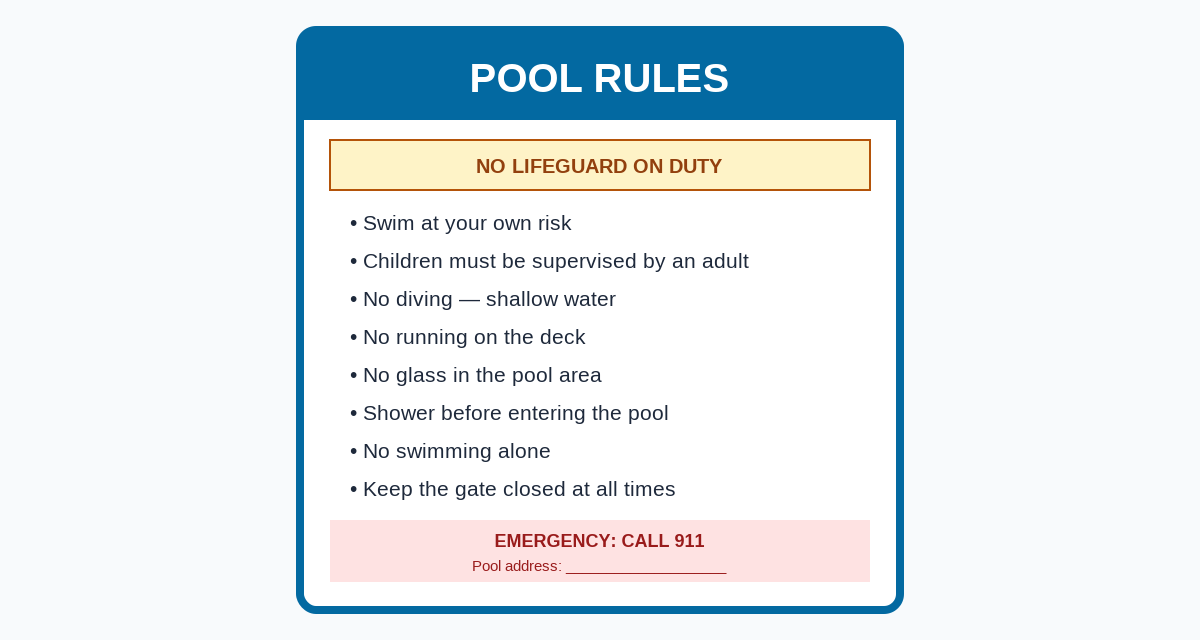
Diagram: Asphapro.com
Quick Answer
Pool rules signs list the basic rules for using a pool safely and are usually mounted at the pool entrance. Common rules include no lifeguard on duty, swim at your own risk, children must be supervised, no diving in shallow water, no running, no glass, shower before swimming and keep the gate closed. Public, HOA, apartment and hotel pools are usually required by health codes to post a rules sign, depth markers, no diving markers, an emergency phone number and sometimes capacity and hours. Home pools rarely require signs, but they help with safety and rentals. Signs cost about $15 to $60 for standard aluminum or plastic, and $75 to $300 for large custom signs.
A pool is one of the best features a home or community can have, and one of the riskiest. Clear rules, posted where everyone can see them, help prevent accidents, set expectations for guests and children, and show that the owner has taken reasonable steps to keep people safe. For public and shared pools, many of those signs are required by law.
This guide explains what to put on pool rules signs, which pool safety signs are commonly required, where to place them, and how to choose materials and sizes. For physical barriers, see our guide to pool fence cost.
Why Pool Signs Matter
Pool signs do three jobs. First, they warn: shallow water, deep water, no lifeguard, hot water, slippery surfaces and chemical areas are all hazards that are easy to miss. Second, they set rules so guests, children and residents know what is allowed. Third, they help show that the owner or operator took reasonable care, which matters if there is an accident and a claim. A sign is not a substitute for a fence, supervision or good maintenance, but it is an important layer of protection.

Photo: TagaSanPedroAko, Wikimedia Commons, CC0
Common Rules on a Swimming Pool Rules Sign
Most swimming pool rules sign designs include a short list of clear, simple rules. The most common are:
- No lifeguard on duty; swim at your own risk. Required wording at many unguarded public and community pools.
- Children must be supervised by an adult, often with an age, such as under 14.
- No diving, or no diving in shallow areas.
- No running on the deck.
- No glass in the pool area.
- Shower before entering the pool.
- No swimming alone.
- Keep the gate closed and latched.
- No pets in the pool.
- Swim diapers required for small children.
- Do not swim if you have diarrhea or have had it in the past two weeks, a key public health rule.
- Pool hours and maximum bather load for shared pools.
- Emergency number and the pool's street address.
Which Pool Safety Signs Are Required?
Rules for pool safety signs depend on the type of pool and where you live. In the United States, most states and counties regulate public and semi-public pools, which include hotel, motel, apartment, condo, HOA, club, campground and gym pools. Many local codes are based on the CDC's Model Aquatic Health Code, and they commonly require:
- A pool rules sign at the entrance, listing the posted rules in clear letters.
- A "No Lifeguard on Duty" sign at unguarded pools, often with set letter heights.
- Depth markers on the deck and on the pool wall above the water, at set intervals and at depth changes.
- "No Diving" markers or symbols in water shallower than a set depth, often 5 feet.
- An emergency sign with 911 and the facility's address near an emergency phone.
- A maximum bather load or capacity sign.
- Pool hours and, for spas, a separate spa warning sign.
- Chemical storage and equipment room warning signs.
- Signs about diarrheal illness, showering and swim diapers in some jurisdictions.
Exact wording, letter sizes and locations differ by state and county, so check your local health department's pool code. Private residential pools usually do not need signs by law, though some HOAs, insurers and short-term rental platforms may expect them.
Depth Markers and No Diving Pool Signs
Depth markers are among the most important swimming pool safety signs. They show the water depth in feet (and often meters) on the deck near the edge and on the vertical wall above the waterline, so swimmers can see depth from the deck and from the water. Codes usually require markers at the shallow end, the deep end, the point where the floor slope changes, and at set spacing around the pool. Markers are often ceramic tiles set into the deck and coping, with slip-resistant surfaces.
No diving markers warn swimmers not to dive into shallow water, a leading cause of serious spinal injuries. They usually combine the words "No Diving" with a standard symbol: a diver crossed out in a red circle. Many codes require them wherever water is shallower than about 5 feet and at the top of steps. Even at home, no diving markers are strongly recommended for pools without a proper diving well.
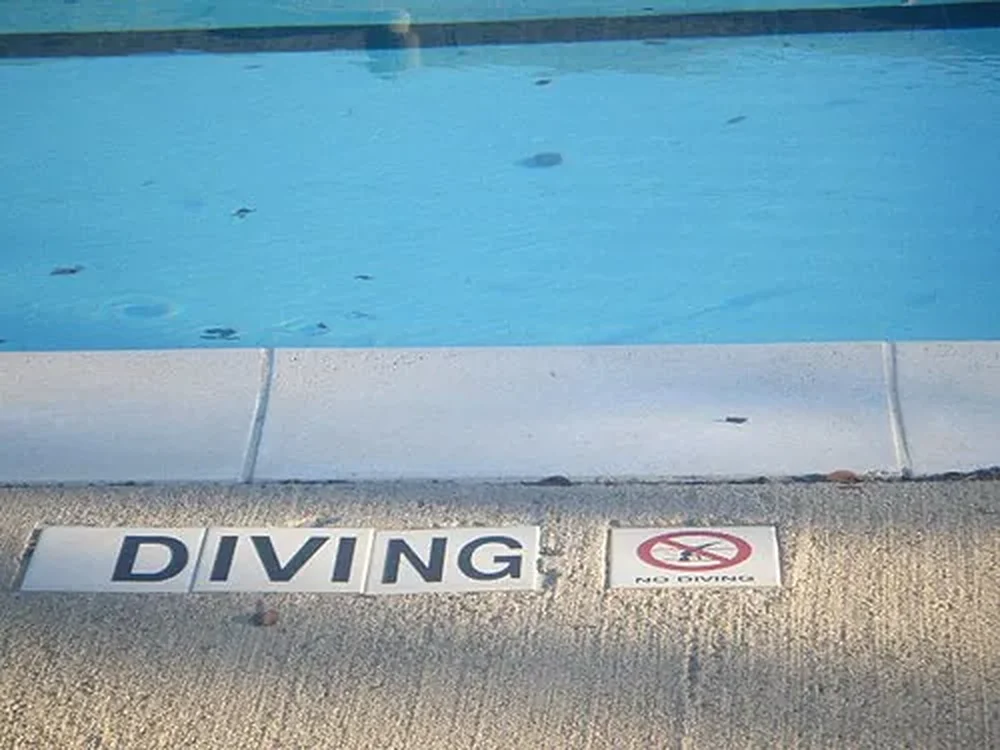
Photo: Lyn Lomasi, Wikimedia Commons, CC BY 3.0
Hot Tub and Spa Pool Safety Signs
Spas need their own warnings because hot water carries extra risks. Common spa signs warn that water temperature should not exceed 104°F, that users should limit soaks to about 10 to 15 minutes, that pregnant women, young children, the elderly and people with heart conditions or high blood pressure should consult a doctor first, that alcohol and drugs increase the risk of drowning and overheating, and that users should never use the spa alone. Many codes require a spa warning sign at public spas, and the hot water risk sign shown below is a typical example.
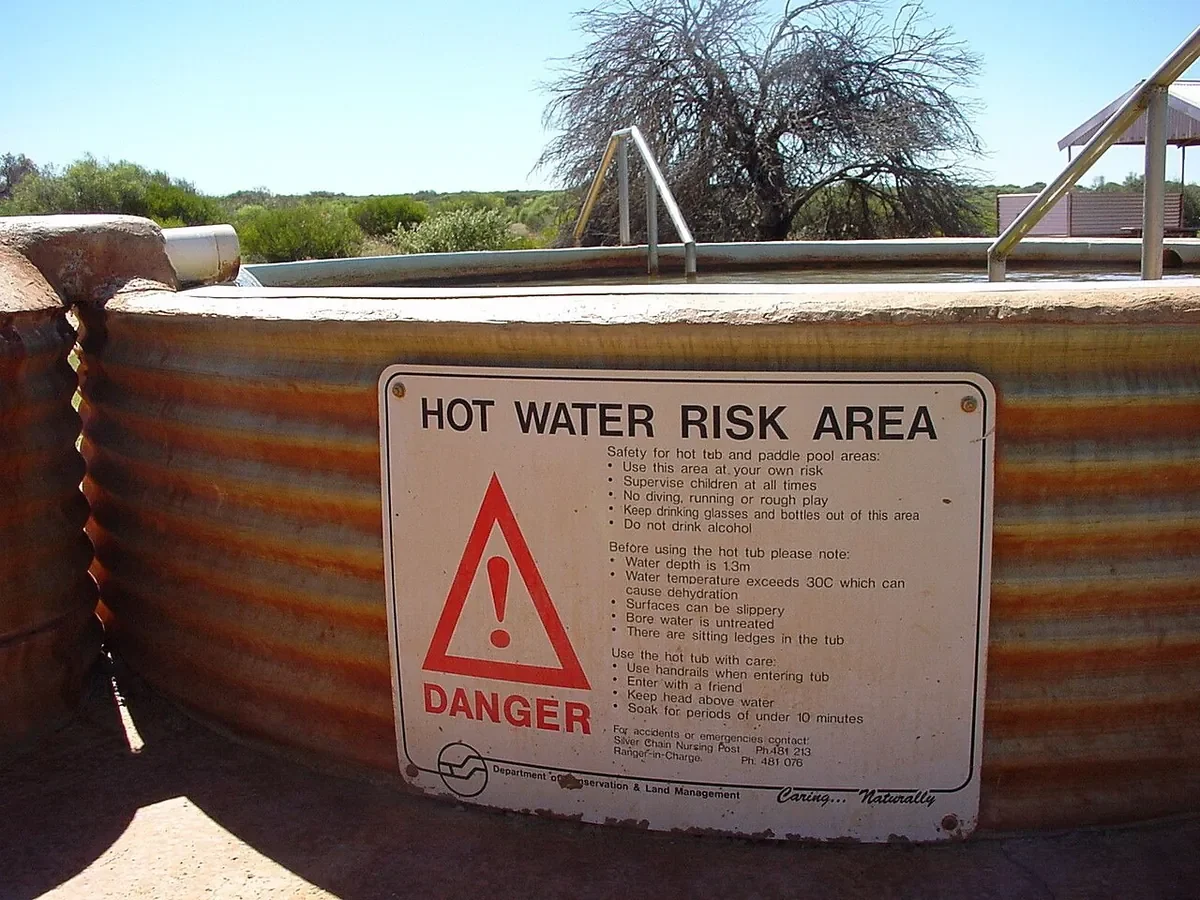
Photo: Wikimedia Commons, public domain
Writing a Good Pool Sign
A good pool sign is short, clear and easy to read from a distance. Use simple words and short lines, start each rule with an action word ("Shower before swimming," "Keep the gate closed"), and put the most important rules first. Use bold headings such as "POOL RULES" and "NO LIFEGUARD ON DUTY" in large letters, often 4 inches tall or more at public pools. Use high-contrast colors, such as dark text on a white background, and standard safety colors: red for danger, yellow or orange for warning, blue for information. Add symbols, such as the no diving symbol, so non-readers and visitors who speak other languages understand. In multilingual communities, consider signs in two languages.
Pool Sign Materials
Pool signs live in sun, water and chemicals, so materials matter. Aluminum signs are the most popular: rustproof, durable and available with UV-resistant printing or reflective sheeting. Plastic (styrene or PVC) signs are cheaper and fine for sheltered spots, but can crack and fade in strong sun. Composite (aluminum composite or HDPE) signs are tough and fade resistant. Vinyl banners work for temporary or seasonal use. Ceramic tile is used for depth markers and no diving symbols set into the deck. Choose UV-stable inks and a laminate for long life.
Pool Sign Sizes and Mounting
A main pool rules sign is often 18 by 24 inches or 24 by 36 inches, large enough to read from several feet away. Smaller 10 by 14 or 12 by 18 inch signs work for single messages like "No Diving" or "Keep Gate Closed." Mount signs at eye level, about 5 to 6 feet high, on the fence near the gate, on a wall, or on a post. Use stainless steel or aluminum hardware so screws do not rust and stain the sign. Avoid mounting signs on the outside of a pool fence where the hardware could become a foothold for a child climbing in.
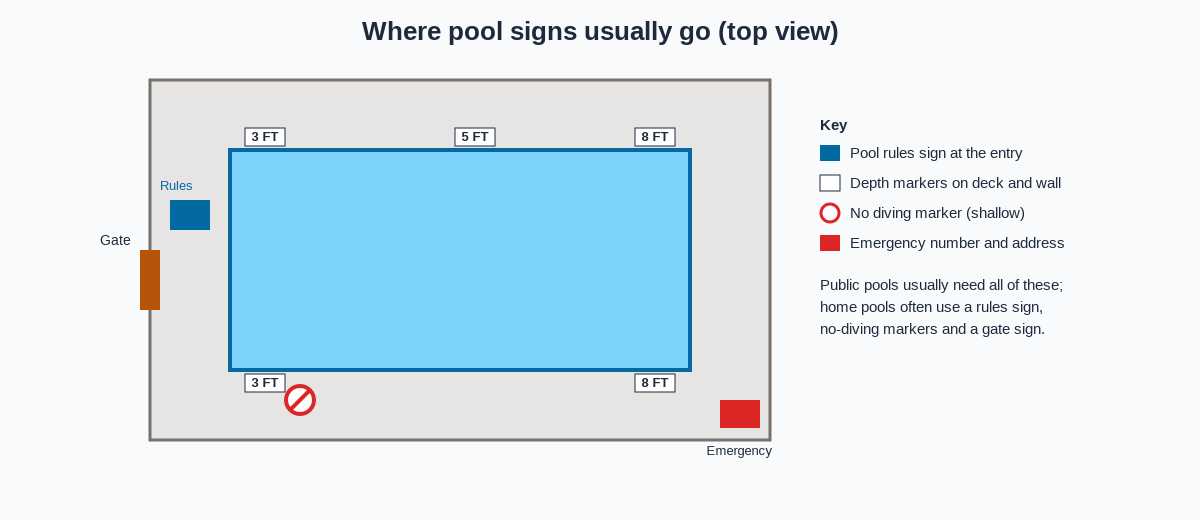
Diagram: Asphapro.com
Where to Put Pool Signs
Place the main rules sign at every entrance to the pool area, where people see it before entering. Put depth markers on the deck and wall at the required intervals and at slope changes. Place no diving markers along shallow sections and at the top of steps. Put the emergency sign next to the phone or first-aid station, with the full street address so callers can direct emergency services. Mount spa warnings at the spa entry. Put chemical warnings on the equipment room or storage area door. Make sure signs are never blocked by umbrellas, plants or furniture.
Pool Rules Signs for Rentals and HOA Pools
Short-term rental hosts, landlords and HOAs face higher risk because guests and residents may not know the pool. A clear rules sign, no lifeguard sign, depth markers and an emergency sign help protect guests and owners. Many rental platforms and insurers ask hosts to post pool rules, keep gates self-closing and provide safety equipment such as a life ring and reaching pole. HOA and apartment pools are usually treated as public or semi-public pools and must meet the local code. Keep a printed copy of the posted rules in the rental welcome book too.
Pool Rules Signs Costs
A standard aluminum pool sign costs about $15 to $60. Large custom pool rules signs with your community name, hours and rules cost about $75 to $300. Ceramic depth marker tiles cost about $10 to $40 each, plus installation. A full sign package for an HOA or hotel pool, including rules, no lifeguard, depth markers, no diving, spa warning and emergency signs, often costs $300 to $1,500 depending on the number of signs and materials. Replacing faded signs every few years is a small cost compared with the safety benefit.
International Water Safety Symbols
International standard ISO 20712 defines water safety signs and symbols, such as no diving, deep water, shallow water, no lifeguard and lifesaving equipment. Using these familiar symbols makes a sign swimming pool visitors from anywhere can understand at a glance. Many sign makers offer signs that combine words with ISO symbols, which is especially useful at hotels and resorts.
Caring for Pool Signs
Check signs each season. Replace signs that are faded, cracked, peeling or hard to read, and tighten loose mounts. Clean them gently with mild soap and water and a soft cloth. Update rules, hours and emergency information whenever they change. A faded or missing sign at a public pool can lead to inspection failures, so include signs in your opening checklist each year.
Pool Signs for Home Pools
At home, pool signs are mostly about guests and children. A simple pool rules sign at the gate reminds visitors that there is no lifeguard, that children must be watched, and that there is no diving in shallow water. A "Keep Gate Closed" pool sign on the gate helps everyone remember the most important safety habit. A small no diving pool sign or deck tile at the shallow end protects guests who do not know the pool. Some families add a pool sign near the door with the house address and emergency numbers, which helps babysitters and guests call for help quickly.
Home owners also enjoy decorative pool signs, such as "Welcome to Our Pool" or funny rules for guests. These are fine for fun, but keep at least one clear, plain safety sign alongside them so the real rules are not lost among the jokes.
Pool Rules for Kids
Children respond best to short, positive rules they can remember. A pool rules sign for kids might say: "Walk, don't run," "Ask before you swim," "Feet first in the shallow end," "Swim with a buddy," "Stay away from the drains," and "Get out when an adult says." Pictures help younger children who cannot read yet. Review the rules with children before the swim season and whenever new friends come over. Even the best pool sign cannot replace an adult who is watching the water at all times.
DIY Pool Signs
You can make a pool sign yourself with a weatherproof board, outdoor paint or vinyl lettering, and a clear UV-resistant sealant. DIY pool signs work well for home pools and decorative rules. For public, HOA and rental pools, buy professional pool safety signs that meet local code for wording, letter size and materials, since inspectors may reject homemade signs. If you design your own, use large, high-contrast letters, standard safety colors and the no diving symbol, and mount the sign with stainless hardware.
Sample Swimming Pool Rules Sign for a Community Pool
Here is example wording for a community or HOA swimming pool rules sign. Your local code may require different or additional items, so check before ordering. "POOL RULES. NO LIFEGUARD ON DUTY. Swim at your own risk. Pool hours: 8 a.m. to 9 p.m. Children under 14 must be accompanied by an adult. No diving. No running, pushing or rough play. No glass containers. No pets. Shower before entering the pool. Swim diapers required for children not toilet trained. Do not swim if you have had diarrhea in the past two weeks. Maximum capacity: 40 persons. In an emergency, call 911. Pool address: [address]." Many communities add residents-only rules, guest limits and a contact number for the management office.
Pool Safety Signs and Equipment Go Together
Pool safety signs work best alongside safety equipment. Public and semi-public pools often must have a life ring with a rope and a reaching pole mounted near the water, a first-aid kit, and sometimes an emergency phone. A pool sign that says "Emergency equipment" helps people find these quickly. At home, keep a reaching pole and life ring near the pool, and post CPR instructions near the gate. Learning CPR is one of the most valuable steps any pool owner can take.
Pool Rules Signs Checklist
Use this checklist when planning pool rules signs. At the entry: a pool rules sign, a no lifeguard on duty sign where needed, pool hours and capacity for shared pools, and a keep gate closed sign. Around the pool: depth markers on the deck and wall, no diving markers in shallow areas, and a pool sign at any slope change. At the spa: a spa warning sign with temperature and time limits. Near the phone: an emergency pool sign with 911 and the address. At the equipment area: chemical and electrical warning signs. Check each pool sign at the start of every season and replace any that are faded or damaged.
Safety Colors and Symbols
Standard colors help people understand a sign instantly. Red is used for danger and prohibited actions, such as a red circle and slash over a diver. Yellow or orange signal warnings, such as slippery surfaces or hot water. Blue is used for information and mandatory actions, such as "Shower before entering." Green marks safety equipment and first aid. Using these colors consistently across all signs at a pool makes the whole set easier to read and follow, even for children and visitors who do not read the language on the sign.
Night Visibility
Pools used after dark need signs people can see at night. Mount signs where pool and deck lights fall on them, or add a small light. Reflective sheeting on aluminum signs helps them stand out in low light. Depth markers on the pool wall should be visible from the water at night; underwater pool lights usually make this easy. If your pool closes at dusk, post the hours clearly and lock the gate when the pool is closed.
Accessibility and Language
Signs should be easy for everyone to understand. Use clear, plain language and short sentences. Add symbols for key rules. At shared pools, consider signs in the main languages spoken in the community, or bilingual signs. For people with low vision, large letters and high contrast are essential; some facilities also provide tactile or Braille signs at entrances as part of broader accessibility plans. Mount signs where wheelchair users can read them, without obstructions.
Signs for Hotel and Gym Pools
Hotel and gym pools see many first-time visitors, so clear signs are especially important. In addition to the standard rules, these pools often post hours, guest age limits, towel and footwear rules, rules for the spa and sauna, and how to call for help. Many hotels post the same rules on a card in each room or in an app. Because these pools are inspected regularly, operators should keep a list of required signs from the local code and check them during each inspection walk-through.
Updating Signs After Changes
When a pool changes, update the signs too. Replastering or adding a sun shelf can change depths, so depth markers may need to be moved or replaced. Adding a spa means adding spa warnings. Changing hours, capacity or management contact details means updating the main sign. After any renovation, walk the pool deck with the code list in hand and confirm every required sign is present, accurate and readable before reopening.
Choosing Pool Rules Signs That Last
Pool rules signs face strong sun, splashing, chlorine in the air and winter weather, so a cheap sign can fade within one season. For outdoor pools, choose aluminum or aluminum composite pool signs with UV-resistant inks and a clear laminate, which usually stay readable for five years or more. Indoor pools have chemical-laden air that can corrode hardware, so use stainless steel or plastic fasteners. Order a few spares of the most important signs, such as "No Diving" and "No Lifeguard on Duty," so you can replace a damaged pool sign right away rather than waiting for an order. A well-chosen set of signs is a small investment that protects swimmers every day.
Signs Are One Layer of Safety
Safety experts talk about layers of protection around water. Pool safety signs are one layer. Others include a fence with self-closing, self-latching gates, door and pool alarms, a safety cover when the pool is closed, swimming lessons, life jackets for weak swimmers, and above all, active adult supervision. Signs remind people of the rules, but they work best when every other layer is in place too. See our guide on DIY pool fence installation for another key layer.
Common Mistakes With Pool Signs
The most common mistakes are posting too many rules in small print, so no one reads them; mounting signs where they are hidden by plants or umbrellas; letting signs fade until they are unreadable; using homemade signs at public pools that do not meet code; forgetting depth markers after a renovation; and leaving out the emergency address, which emergency callers need most. Another mistake is mounting a sign on the outside of a fence in a way that gives a child a foothold. Keep rules short, signs visible and information current, and review the whole set at the start of each swim season so every sign still does its job.
Ordering Signs
When ordering, list every sign you need, the size, material, quantity and mounting method. Ask the supplier whether wording meets your local code, and request a proof before printing custom signs. Allow one to three weeks for custom orders, longer in early spring when many pools are opening at the same time, so order early and install the signs before the first swim of the season.
Pool Rules Signs: Key Points
- Pool rules signs list safety rules and belong at the pool entrance.
- Public, HOA and rental pools usually must post rules, depth and no diving signs.
- Keep wording short, clear and large enough to read from a distance.
- Standard signs cost $15 to $60; custom signs $75 to $300.
Frequently Asked Questions
Do I need pool rules signs at home?
Usually not by law, but signs are a good idea, especially if guests, renters or neighbors' children use the pool. A simple rules sign and no diving markers are a good start.
Where should a pool rules sign go?
At the main entrance or gate to the pool area, at eye level, where everyone sees it before entering. Add a second sign at any other entrance.
What should a pool sign say?
At minimum: no lifeguard on duty, swim at your own risk, children must be supervised, no diving in shallow water, no running and no glass. Shared pools add hours, capacity and emergency information.
Are swimming pool safety signs required for Airbnb rentals?
Rules vary by area and platform, but posting pool rules signs, no diving markers and emergency information is strongly recommended and sometimes required. Check your local rules and your insurance policy.
How big should pool signs be?
Main pool rules signs are often 18 by 24 inches or larger. Public pools may need set letter heights for key warnings, such as 4-inch letters for "No Lifeguard on Duty."
What material is best for an outdoor pool sign?
Aluminum or aluminum composite with UV-resistant printing lasts longest in sun and chlorine. Use stainless steel screws so the mounting hardware does not rust.
Sources
- CDC: Model Aquatic Health Code
- CDC: Healthy swimming
- CPSC: Pool and spa safety
- ISO 20712: Water safety signs