
DIY Solar Pool Heater: How to Size, Build and Install One
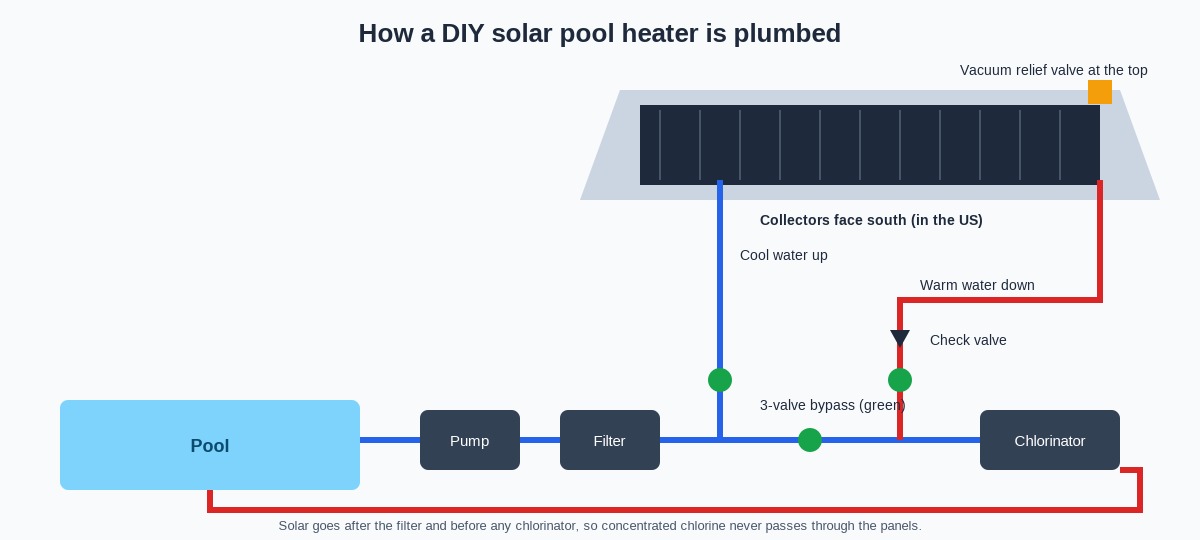
Diagram: Asphapro.com
Quick Answer
A DIY solar pool heater sends pool water from the filter through black solar collectors (panels or coiled black tubing) in the sun and back to the pool. To build one, size the collector area at 50% to 100% of the pool's surface area, mount the collectors facing south on a roof or rack, and plumb them after the filter and before any chlorinator with a three-valve bypass, a check valve and a vacuum relief valve at the top. A good system raises water temperature about 5 to 15 °F and extends the swim season by weeks. DIY kits cost about $300 to $800 for above ground pools and $1,000 to $3,500 for inground pools, versus $3,000 to $7,000 for a professionally installed solar pool heater. Running costs are close to zero because your existing pump moves the water.
Heating a pool with gas or a heat pump can cost hundreds of dollars a month. A solar pool heater uses free sunshine instead. The idea is simple: dark tubing or panels in the sun get hot, pool water runs through them, and warm water flows back into the pool. Because the pump you already run for filtering does the work, the only real cost is building the system.
That simplicity makes a DIY solar pool heater one of the most popular do it yourself pool projects. This guide explains how solar pool heaters work, how much collector area you need, the main DIY options from a coil of black hose to full panel kits, how to install and plumb the system safely, what it costs, how much heat to expect, and the mistakes to avoid. If you want to compare with gas or heat pump heaters, see swimming pool heater cost.
How a Solar Pool Heater Works
Every solar heater for pool water, from a store-bought system to a do it yourself pool heater, works the same way. A pool solar heater has four parts:
- Solar collectors: panels or tubing that absorb sunlight and heat the water inside. Pool collectors are usually unglazed (no glass cover), black polypropylene or rubber, because pool water only needs to be warmed a few degrees.
- The pump: your existing pool pump pushes water up to the collectors. A larger roof system may need a slightly stronger pump.
- The filter: water is filtered before it goes to the collectors so debris does not clog them.
- Valves and controls: a manual three-valve bypass or an automatic controller sends water to the collectors when they are warmer than the pool, and around them when they are not.
On a sunny day, water leaving the collectors is often 3 to 10 °F warmer than the water going in. Pass the whole pool through several times a day and the pool slowly warms. At night, water should bypass the collectors, or they will cool the pool instead.
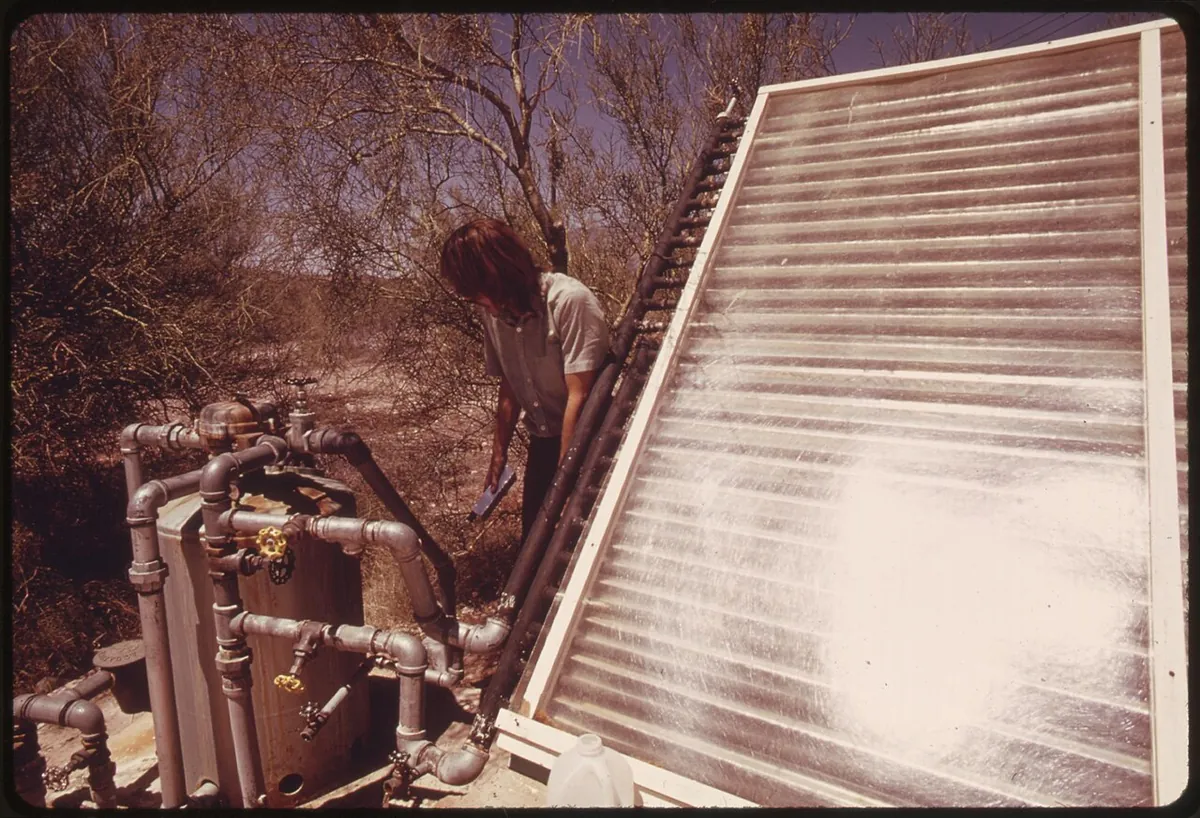
Photo: Boyd Norton, US National Archives, Wikimedia Commons, public domain
How Big Should a DIY Solar Pool Heater Be?
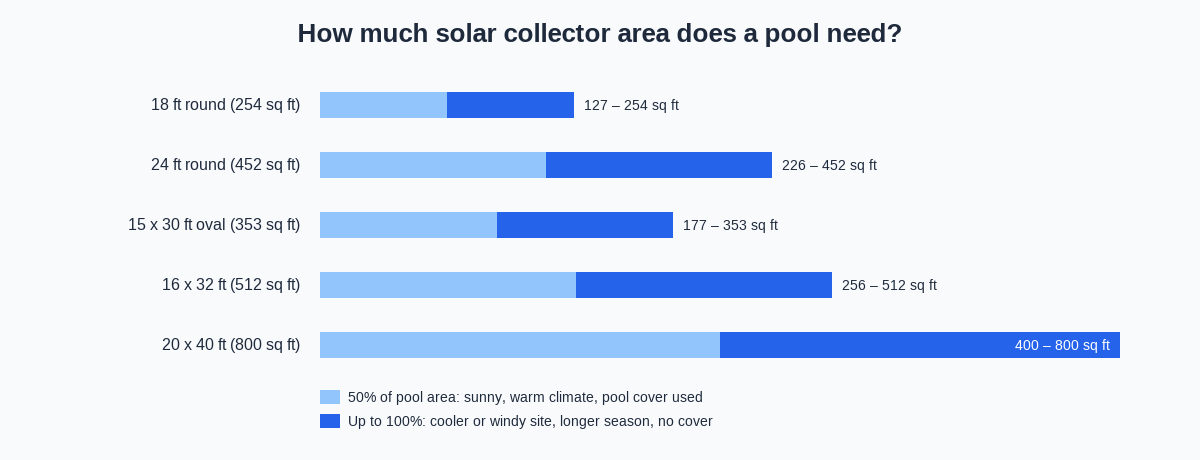
Chart: Asphapro.com
The US Department of Energy recommends solar collector area equal to about 50% to 100% of the pool's surface area. Use the low end in warm, sunny climates with a pool cover, and the high end in cooler or windy areas, for longer seasons, or if the collectors are not facing south.
- Find the pool surface area: length x width for rectangles, diameter x diameter x 0.785 for round pools.
- Multiply by 0.5 to 1.0 for the collector area.
- Divide by the size of one panel (common sizes: 4 x 10 ft = 40 sq ft, 4 x 12 ft = 48 sq ft, 2 x 20 ft = 40 sq ft).
Example: a 16 x 32 ft pool has 512 sq ft of surface. At 70%, it needs about 360 sq ft of collectors, or nine 4 x 10 ft panels. A 24 ft round above ground pool has 452 sq ft; 50% is about 226 sq ft, or six panels.
DIY Solar Pool Heater Options
There are five main ways to build a solar heater pool diy project, from free to a few thousand dollars. Do it yourself pool solar heaters range from simple coils to full kits.
1. Black hose coil heater
The simplest diy pool heater is a long coil of black polyethylene irrigation tubing or garden hose laid on a board or roof in the sun. Pool water runs through it from the pump's return line. A 100 ft coil of 1/2 inch tubing holds only about 1 gallon of water, so you need many coils in parallel to make a real difference. Hose coils work well for small above ground pools and as a starter project, costing $50 to $300. They restrict flow, so use several coils in parallel, not one long run.
2. DIY flat panel collectors
Some owners build panels from black ABS or PVC pipe manifolds with many small tubes between them, or black corrugated roofing over black tubing in an insulated box. These take more skill and time, and they must be strong enough to handle pump pressure and summer heat. Homemade panels can work, but commercial unglazed panels usually last longer per dollar.
3. Solar pool heater kits
The most reliable DIY approach is a kit with factory-made polypropylene panels, manifold connectors, roof mounting straps, a vacuum relief valve and fittings. Above ground kits with 2 to 4 panels cost $200 to $800. Inground kits sized for 300 to 500 sq ft of collector cost $1,000 to $3,500. Panels typically last 10 to 20 years.
4. Solar dome and pod heaters
Small dome or "pod" collectors sit on the ground and connect to the return line. They are easy to set up for small above ground pools but add only a little heat; several are needed for a real effect.
5. Solar covers and rings (no plumbing)
A solar cover (bubble blanket) floats on the pool, traps heat and stops evaporation. It is the cheapest solar heating of all and can add 5 to 10 °F on its own. Solar rings float on the surface and do a similar job. Use a cover with any DIY solar heater; it can cut heat loss by half or more.
Where to Mount the Collectors
- Roof: the most common spot. South-facing roofs are best in the US; east and west roofs work with about 20% to 40% more panel area. The roof must be in good shape and able to take the weight of water-filled panels (about 1 to 2 lb per sq ft).
- Ground rack: a sloped wood or aluminum frame next to the pool. Easier to build and service, no roof work, but takes yard space.
- Pool house, shed or pergola roof: often closer to the pump with shorter plumbing runs.
- Fence or slope: for small hose coil systems.
Tilt the collectors toward the sun. For summer-only heating, a tilt of about your latitude minus 10 to 15 degrees works well. Avoid shade from trees and buildings, especially between 10 a.m. and 4 p.m.
How to Install a DIY Solar Pool Heater: Step by Step
- Plan the layout. Measure the panel area, choose the mounting spot, and plan the supply and return pipe route from the equipment pad. Keep runs short and use 1.5 or 2 inch pipe for inground systems.
- Check rules and the roof. Some towns require a permit for roof-mounted collectors. HOAs may have rules too. Repair the roof before mounting panels.
- Mount the collectors. Follow the kit instructions for roof straps and clips. Collectors must be held down against wind but allowed to expand and contract.
- Install the bypass at the equipment. After the filter, install three valves (or a three-way valve) so water can go to the collectors or straight back to the pool.
- Run the supply line from the bypass up to the bottom of the collectors.
- Run the return line from the top of the collectors back down to the return plumbing, before any chlorinator.
- Add a vacuum relief valve at the highest point of the system, so water drains out of the panels when the pump stops and pipes do not collapse.
- Add a check valve before the filter or heater to stop water draining back through the equipment.
- Pressure test by running the pump and checking every joint for leaks.
- Optional: add an automatic controller with sensors on the roof and in the pool. It opens the solar valve only when the collectors are warmer than the pool.
Never put a chlorinator or tablet feeder before the solar panels. Concentrated chlorine damages collectors and voids warranties.
How Much Heat Will a DIY Solar Pool Heater Add?
A well-sized system usually raises pool temperature about 5 to 15 °F above an unheated pool, and can extend the swim season by 1 to 3 months in mild climates. Results depend on:
- Collector area relative to pool size.
- Sun, shade, roof direction and tilt.
- Air temperature and wind.
- Whether you use a pool cover at night.
- How long the pump runs during sunny hours.
Solar will not heat a pool on cloudy days or in winter in most climates. Many owners pair solar with a heat pump as a backup. A simple pool thermometer, checked at the same time each morning, is the easiest way to track how much your system is adding over a week of sunny weather.
DIY Solar Pool Heater Cost
Here is what a do it yourself pool heater using the sun typically costs, compared with a pro-installed solar heater swimming pool system.
| Option | Typical cost | Best for |
|---|---|---|
| Solar cover or rings | $50 – $250 | Every pool |
| Black hose coil system | $50 – $300 | Small above ground pools |
| Above ground solar kit (2 – 4 panels) | $200 – $800 | 15 – 30 ft above ground pools |
| Inground DIY panel kit | $1,000 – $3,500 | Most inground pools |
| Automatic solar controller and valve | $300 – $700 | Hands-off operation |
| Professional solar pool heater | $3,000 – $7,000+ | Large pools, complex roofs |
Operating costs are very low. The pump may need to run a little longer during the day, and a larger roof system may need a slightly stronger pump. In some areas, solar pool heaters qualify for local rebates; check with your utility.
How to Build a Hose Coil Solar Heater for Pool Use
If you want to try a diy solar heater for pool water before buying panels, a hose coil is the classic first project. Here is a simple build for an above ground pool.
Materials
- 4 to 8 rolls of 100 ft black polyethylene tubing (1/2 inch) or black garden hose
- A sheet of plywood (4 x 8 ft) for each coil, painted black
- Cable ties or pipe clips to hold the coil flat
- Two manifolds made from 1.5 inch PVC pipe with barbed fittings for each coil
- A diverter or three-way valve for the pump's return hose
- Hose clamps and adapters to match your pool's return fittings
- Optional: a clear polycarbonate cover sheet to cut wind losses
Steps
- Lay each tubing roll in a flat spiral on its plywood board, starting from the center, and fasten it with clips.
- Set the boards on a south-facing slope, roof or rack, tilted toward the sun.
- Connect the inner end of each coil to a supply manifold and the outer end to a return manifold. This puts the coils in parallel, which keeps flow high.
- Connect the supply manifold to the pump's return hose through the diverter valve, and the return manifold back to the pool return fitting.
- Turn on the pump and bleed air from the coils by opening the top fitting briefly.
- Run the system during the sunniest hours, roughly 10 a.m. to 4 p.m., and bypass it at night.
Each 100 ft coil gives about 20 to 30 square feet of collector area. A 24 ft round pool needs about 8 to 10 coils for a noticeable gain. This is why many owners who start with hose coils later move to a panel kit: the panels give far more area for the space and money.
Solar Heater for Above Ground Pool: Easy Setup
Above ground pools are ideal for do it yourself solar pool heater projects. They hold less water than inground pools, the pump and return hose are easy to reach, and panels can sit on the ground or a simple rack next to the pool. A typical above ground setup:
- 2 to 6 panels (2 x 20 ft or 4 x 10 ft) on a sloped ground rack or the roof of a shed.
- Flexible hose from the filter outlet to the bottom of the panels.
- Flexible hose from the top of the panels back to the pool return.
- A bypass valve at the filter outlet.
Most above ground pool pumps can push water through ground-level panels without trouble. Lifting water onto a high roof may need a stronger pump. Expect a pool solar heater kit for an above ground pool to take one afternoon to install.
Other Do It Yourself Pool Heaters
Solar is the most popular DIY swimming pool heater, but not the only one. Here is how the main do it yourself pool heaters compare:
| DIY heater type | Cost | Heat added | Running cost |
|---|---|---|---|
| Solar cover | $50 – $250 | 5 – 10 °F | None |
| Hose coil solar | $50 – $300 | 2 – 6 °F (small pools) | None |
| Solar panel kit | $200 – $3,500 | 5 – 15 °F | Very low |
| Wood-fired coil heater | $200 – $1,500 | Varies; good for small pools and hot tubs | Firewood |
| Plug-in electric heater (above ground) | $150 – $500 | Small | High |
| Heat pump (owner-installed) | $2,000 – $5,000 | Holds any set temperature | Medium |
For most owners, a diy pool heater solar system plus a good cover gives the best value: low build cost and almost no running cost. A heat pump is the next step up if you need guaranteed warmth on cloudy or cool days.
Running Your Solar Pool Heater
- Run the pump in the sun: schedule the pump to run mostly between 9 or 10 a.m. and 4 or 5 p.m., when the collectors are hot.
- Use the cover at night: it keeps the heat you gained during the day.
- Watch the return temperature: on a sunny day, water returning from the panels should feel warm to the hand. If not, check for shade, air in the lines or low flow.
- Use a controller in hot climates: it can also cool the pool on very hot summer nights by running water through the panels after dark.
- Check the flow: panels need good flow; a dirty filter reduces solar heating.
Maintaining and Winterizing a DIY Solar Pool Heater
- Inspect panels and hoses each spring for cracks, leaks and loose straps.
- Clear leaves and dirt from the collector surface.
- Keep water balanced; low pH and high chlorine shorten panel life.
- Before freezing weather, close the solar valves, open drain plugs and let the collectors drain completely. Blow out lines with a shop vac if needed.
- For hose coil systems, store the tubing out of the sun in winter to extend its life.
DIY or Professional Solar Heater Swimming Pool Install?
| Factor | DIY | Professional |
|---|---|---|
| Cost for a 16 x 32 pool | $1,500 – $3,500 | $3,500 – $7,000 |
| Roof work | You (risk of falls and leaks) | Insured crew |
| Automatic controls | Optional add-on | Usually included |
| Warranty | Panels only | Panels and installation |
| Permits | You apply | Installer handles |
A ground-mounted system or an above ground pool is a great diy swimming pool solar heating project. Steep or high roofs, tile roofs and large systems are often worth paying a pro, because roof leaks and falls cost far more than the labor saved.
Two Example DIY Solar Pool Heater Builds
Example 1: 24 ft round above ground pool
The pool surface is about 452 sq ft. The owner lives in a sunny area and uses a solar cover at night, so 50% is enough: about 226 sq ft. Six 2 x 20 ft panels (240 sq ft) go on a sloped wood rack beside the pool, facing south. Flexible hoses connect the filter outlet to the panels through a bypass valve. Total cost: about $700 for panels, fittings, valve and lumber. Result: the pool runs about 8 to 10 °F warmer in spring and fall than before, and the swim season starts about a month earlier.
Example 2: 16 x 32 ft inground pool
The pool surface is 512 sq ft. The owner wants a longer season in a cooler area, so aims for about 80%: roughly 400 sq ft. Ten 4 x 10 ft panels go on a south-facing garage roof. Two-inch PVC supply and return lines run from the equipment pad, with a motorized valve and an automatic controller. The owner hires a roofer for the mounting and does the plumbing. Total cost: about $3,200. Result: 10 to 12 °F gain on sunny days and a swim season from April to October.
Both builds show the key rule of any solar heater for pool diy plan: enough collector area, full sun, and a cover at night. If you already own a gas heater, a pool heater solar diy system can carry most of the load in summer and leave the gas heater for cool snaps.
Safety Tips for DIY Solar Installations
- Use fall protection and a helper for any roof work.
- Seal every roof penetration with roof-rated sealant and flashing.
- Keep plumbing and electrical controllers away from each other and follow the controller's wiring instructions.
- Secure panels for your local wind loads, especially in storm areas.
- Turn the pump off at the breaker before cutting into pool plumbing.
Common Mistakes With DIY Solar Pool Heaters
- Too little collector area. A few small panels on a large pool barely help.
- One long hose run. Restricts flow and loses heat; use parallel coils.
- Running water through collectors at night. They cool the pool. Use a timer, a controller or close the solar valve.
- No vacuum relief valve on roof systems.
- Chlorinator before the collectors.
- No pool cover. Most of the heat gained in the day is lost at night without one.
- Leaving water in panels in freezing weather. Drain them before winter.
DIY Solar Pool Heater: Key Points
- Size the collectors at 50% to 100% of the pool surface area.
- Mount them facing south with no shade.
- Plumb after the filter and before the chlorinator with a bypass, check valve and vacuum relief valve.
- Expect 5 to 15 °F of extra heat and a longer season.
- Kits cost $200 to $3,500; pro systems cost $3,000 to $7,000+.
- Use a pool cover at night.
Frequently Asked Questions
Does a diy swimming pool solar heater really work?
Yes, when they are sized correctly and in full sun. Small hose coils make only a small difference on large pools.
Do I need a bigger pump for a DIY solar pool heater?
Usually not for ground-mounted or single-story roof systems. Tall roofs, long pipe runs or very large panel arrays may need a pump with more head; check the panel maker's flow chart.
How long does it take a solar pool heater to heat a pool?
Several sunny days to raise the pool 5 to 10 °F, depending on collector area and weather.
What is the best diy heater for pool water on a budget?
A solar cover plus a small solar panel kit. Together they add the most heat for the least money and cost almost nothing to run.
How many solar heaters for pool use do I need?
Enough panels to cover 50% to 100% of the pool surface area. For a 24 ft round pool, that is about 6 to 10 panels of 4 x 10 ft.
Can I put a solar heater pool system on a flat roof?
Yes. Use tilted racks if possible, or lay panels flat with slightly more area to make up for the lower angle.
Will pool solar heaters work in cloudy weather?
Very little. Solar pool heaters need direct sun; on cloudy days, bypass them and keep the cover on.
Do solar pool heaters diy kits work with salt pools?
Yes. Most polypropylene panels are fine with salt water. Keep the salt cell after the panels, never before them.
Can a solar pool heater overheat a pool?
In hot climates it can make the pool warmer than you like. Bypass the panels during the day, or run them at night to cool the water.
How long do solar pool heaters last?
Commercial panels last 10 to 20 years. Black hose coils may need replacing every 3 to 5 years.
Sources
- US Department of Energy: Solar swimming pool heaters
- US Department of Energy: Swimming pool covers
- HomeGuide: Solar pool heater cost
- Florida Solar Energy Center: Solar pool heating