
How to Lower Alkalinity in Pool Water: Step-by-Step Guide
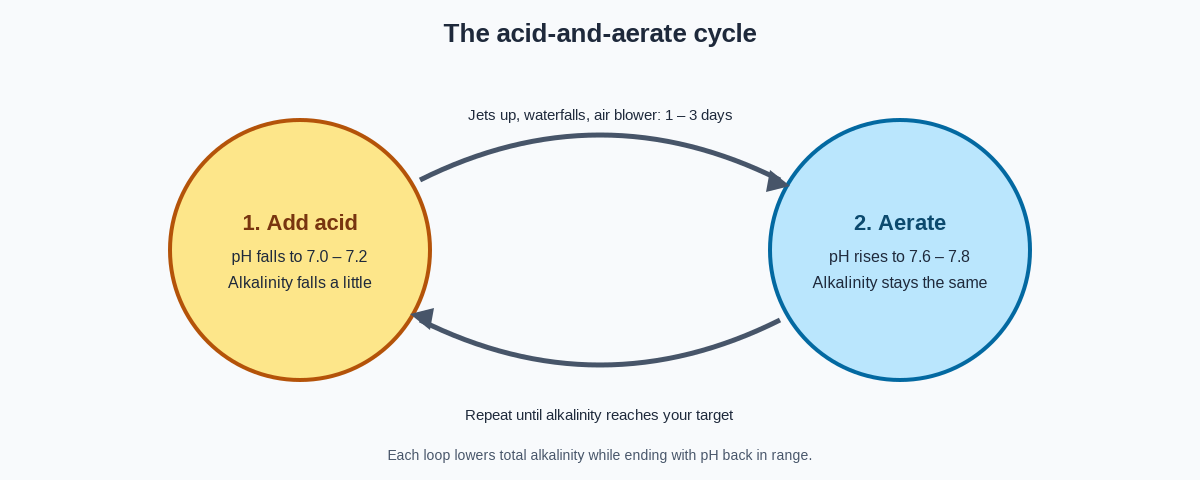
Diagram: Asphapro.com
Quick Answer
How to lower alkalinity in pool water: add muriatic acid or dry acid. About 26 fl oz of 31.45% muriatic acid lowers total alkalinity by 10 ppm in 10,000 gallons. Because acid also lowers pH, the best method is the acid-and-aerate cycle: add acid until pH reaches about 7.0 to 7.2, then aerate the water (point jets up, run waterfalls, use an air blower) so pH rises back to about 7.6 without raising alkalinity, and repeat until alkalinity reaches your target. Most pools do best at 80 to 120 ppm; salt and plaster pools often prefer 60 to 90 ppm. Lower alkalinity in steps over several days and never let pH fall below 7.0.
Total alkalinity is one of the most misunderstood numbers in pool care. It is not the same as pH, but it controls how pH behaves. When alkalinity is too high, pH keeps creeping up no matter how often you add acid, scale forms on tile and equipment, and the water can turn cloudy. Learning how to lower alkalinity in pool water is often the key to finally getting pH under control.
This guide explains what pool alkalinity is, the right range for your pool, what causes high alkalinity, how to lower alkalinity in pool water step by step with acid and aeration, how much acid to use with a pool alkalinity calculator, how to lower pH and alkalinity together, and how to keep alkalinity steady. For pH alone, see how to lower pH in pool.
What Is Alkalinity in a Pool?
What is pool alkalinity, and how is total alkalinity in pool water different from pH? Total alkalinity (TA) measures the amount of dissolved alkaline substances in the water, mainly bicarbonates and carbonates. It is reported in parts per million (ppm) as calcium carbonate. Alkalinity acts as a buffer: it absorbs acids and bases and keeps pH from swinging up and down. Think of alkalinity as the anchor and pH as the boat. With too little alkalinity, pH bounces around with every rain shower or chemical dose. With too much, pH is anchored too high and resists coming down.
The alkalinity of a pool also affects how much acid you need to change pH, whether water tends to scale or etch, and how stable the water is over the week.
What Should Alkalinity Be in a Pool?
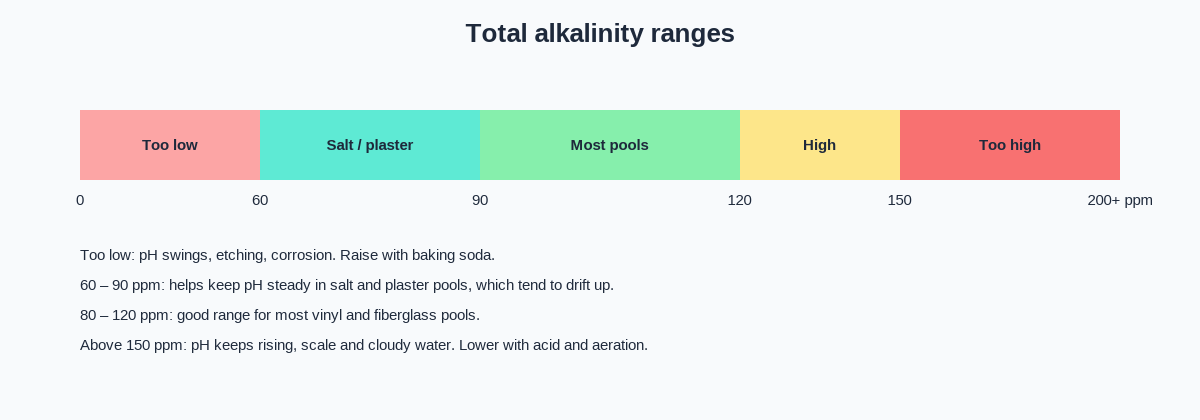
Chart: Asphapro.com
For most residential pools, the target for total alkalinity is 80 to 120 ppm. Salt water pools and plaster pools often run better at 60 to 90 ppm, because their pH tends to drift up and lower alkalinity slows that drift. Vinyl and fiberglass pools usually do well at 80 to 120 ppm. Anything above about 150 ppm is high and usually causes problems.
Signs and Problems of High Alkalinity
- pH keeps rising back up within days of adding acid.
- Cloudy water, especially in warm weather.
- Scale on tile lines, fittings, heaters and salt cells.
- Weaker chlorine, because high pH makes chlorine less active.
- Skin and eye irritation from high pH.
- Higher acid use week after week.
What Causes High Alkalinity in a Pool?
- Fill water that is high in alkalinity, common with well water and some city water.
- Too much baking soda or alkalinity increaser.
- Liquid chlorine and cal-hypo used over a long time, which add a little alkalinity.
- New plaster, which releases alkaline compounds as it cures.
- Evaporation and top-ups that concentrate dissolved minerals over time.
Pool Alkalinity Calculator: Acid to Lower TA
Use this pool alkalinity calculator to estimate how much acid lowers total alkalinity to your target.
The math: lowering 10,000 gallons by 10 ppm of alkalinity takes about 25.6 fl oz of 31.45% muriatic acid, about 55 fl oz of 14.5% acid, or about 2.1 lb (34 oz) of dry acid. The calculator splits the total into three doses because adding it all at once can drop pH too low. Retest pH and alkalinity before each dose.
How to Lower Alkalinity in Pool: Step by Step
Here is how to lower pool alkalinity safely. These methods also answer how to decrease alkalinity in pool water, how to lower alkalinity in swimming pool systems of any type, and how to lower total alkalinity in pool water that has been high for months.
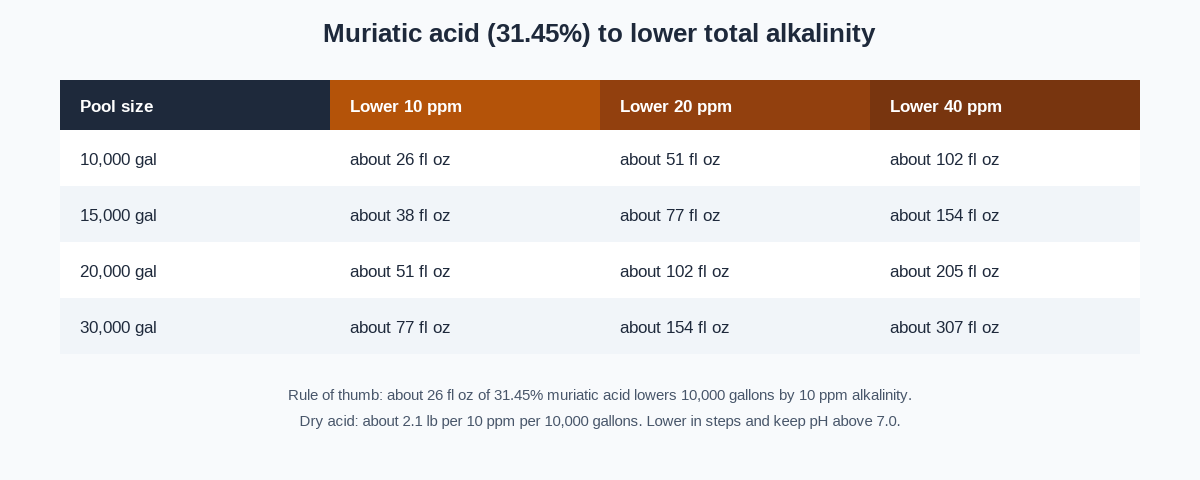
Chart: Asphapro.com
Method 1: Acid and aerate (recommended)
- Test pH and total alkalinity. Write both down.
- Add acid with the pump running, pouring slowly in front of a return jet in the deep end, enough to bring pH down to about 7.0 to 7.2. Use gloves and eye protection.
- Wait 4 to 6 hours and retest pH and alkalinity.
- Aerate: point return jets up toward the surface, run waterfalls, spillovers or fountains, turn on spa jets or an air blower, or set up a pump that sprays water into the air. Aeration releases carbon dioxide, which raises pH without changing alkalinity.
- Test pH once or twice a day. When it rises back to about 7.6 to 7.8, add acid again to bring it back to 7.0 to 7.2.
- Repeat until alkalinity reaches your target, then stop aerating heavily and let pH settle at 7.4 to 7.6.
Each loop lowers alkalinity by 10 to 30 ppm, depending on pool size and how much acid you add. Bringing alkalinity down from 180 to 100 ppm can take several days to two weeks, but the result is stable water that holds pH.
Method 2: Concentrated acid in one spot (the "column" method)
Some pool owners turn the pump off and pour acid slowly into one spot in the deep end, so it sinks and reacts with the water before mixing. This method claims to lower alkalinity more than pH. Studies and experienced owners disagree on whether it works better than normal dosing, and it risks etching plaster or damaging a liner where the acid collects. Most experts recommend the acid-and-aerate method instead.
Method 3: Partial drain and refill
If alkalinity is very high and your fill water has low alkalinity, replacing part of the water lowers it quickly. This also lowers calcium, stabilizer and dissolved solids, which may be useful if those are high too. It does not help if your tap water itself is high in alkalinity.
How to Aerate a Pool
- Point all return eyeballs upward so they break the surface.
- Run waterfalls, sheer descents, spillover spas and deck jets.
- Turn on spa jets or an air blower if you have one.
- Use a fountain attachment on a return fitting.
- Place a small submersible pump in the pool that sprays water into the air.
- Run the pump on higher speed during aeration periods.
Aeration works faster when the water is warm, the air is dry and there is a breeze. Expect pH to rise about 0.1 to 0.3 per day with strong aeration.
Pool Alkalinity vs pH: How to Lower pH and Alkalinity in Pool Water
Acid lowers both pH and alkalinity; aeration raises pH but leaves alkalinity unchanged. That is why the two together let you control each number. If both pH and alkalinity are high, add acid and both will come down. If alkalinity is high but pH is normal, use the acid-and-aerate cycle so pH ends up where it started while alkalinity falls. If alkalinity is high and pH is low (rare), lower alkalinity carefully and aerate more. Always correct alkalinity first, then fine-tune pH, because alkalinity determines how pH behaves.
Lowering Alkalinity in Salt and Plaster Pools
Salt pools tend to push pH up steadily. Keeping alkalinity at 60 to 80 ppm, and adding borates at 30 to 50 ppm, greatly reduces how often you need acid. New plaster pools release lime for weeks, raising both pH and alkalinity; your plasterer's start-up plan will include regular acid additions. In both cases, the acid-and-aerate approach works, but go slowly with new plaster to avoid etching. For more on salt systems, see salt pool versus chlorine.
How to Test Total Alkalinity
Total alkalinity is tested with a titration test: add an indicator to a measured water sample, then add drops of a reagent until the color changes. Each drop usually equals 10 ppm. Test strips are faster but less precise. For accurate results, test with fresh reagents, count drops carefully, and test after acid has had at least 4 to 6 hours to mix. Test alkalinity weekly while you are lowering it, and every two to four weeks once it is in range.
Common Mistakes When Lowering Alkalinity
- Adding too much acid at once, dropping pH below 7.0 and risking etching and corrosion.
- Not aerating, so pH falls and stays low while alkalinity barely moves.
- Raising pH with soda ash during the process, which adds alkalinity back.
- Testing too soon after adding acid.
- Pouring acid into the skimmer, sending it through the equipment.
- Lowering alkalinity too far, below 60 ppm, which makes pH unstable.
- Swimming right after adding acid.
How to Keep Pool Alkalinity in Range
- Test alkalinity every few weeks.
- Avoid adding baking soda unless alkalinity is truly low.
- Use the right alkalinity target for your pool type.
- Add borates to help hold pH steady with less acid.
- Know your fill water: if it is high in alkalinity, expect to add acid after top-ups.
- Keep water features running moderately, which helps keep pH up without raising alkalinity.
What Does Alkalinity Do in a Pool?
What does alkalinity do to a pool day to day? It protects pH from sudden changes. When you add acidic chemicals like trichlor tablets or rain falls into the pool, alkalinity absorbs the acid so pH drops only slightly. When basic chemicals like liquid chlorine are added, it slows the rise. Swimming pool alkalinity also affects the saturation balance of the water: together with pH, calcium and temperature, it decides whether water tends to dissolve plaster and grout or leave scale on them. That is why pool alkalinity should be neither too high nor too low.
What Lowers Alkalinity in a Pool?
- Muriatic acid: the most common and lowest-cost way to decrease alkalinity in pool water.
- Dry acid (sodium bisulfate): works the same way, in powder form.
- Trichlor tablets: acidic, so they slowly lower alkalinity and pH over the season.
- Rain: dilutes alkalinity and is slightly acidic.
- Draining and refilling with low-alkalinity water.
Aeration does not lower alkalinity; it only raises pH. That is why it pairs so well with acid.
How to Lower Alkalinity in Pool Without Affecting pH
Strictly speaking, any acid that lowers total alkalinity in pool water will also lower pH. But you can end with lower alkalinity and the same pH you started with by using acid and aeration together. Add acid to drop alkalinity and pH, then aerate to bring pH back up. Because aeration only removes carbon dioxide, it raises pH without adding alkalinity back. After several cycles, alkalinity is lower and pH is where you want it. This is the practical answer to how to lower alkalinity in pool without affecting pH in the long run.
Worked Examples: Lowering Total Alkalinity in Pool Water
Example 1: 15,000 gallon vinyl pool, TA 160, target 100
The pool needs to drop 60 ppm. Total acid: about 25.6 x 6 x 1.5 = 230 fl oz (about 1.8 gallons) of 31.45% muriatic acid. Split into three or four doses over several days, aerating between doses and keeping pH at or above 7.0.
Example 2: 20,000 gallon salt pool, TA 120, target 70
A 50 ppm drop needs about 25.6 x 5 x 2 = 256 fl oz (2 gallons) of acid. Salt pools respond well to aeration because the salt cell already pushes pH up, so the cycles go quickly.
Example 3: 13,000 gallon above ground pool, TA 140, target 100
A 40 ppm drop needs about 25.6 x 4 x 1.3 = 133 fl oz of acid. Add about 40 fl oz at a time, wait, aerate and retest.
How to Add Alkalinity to Pool Water When It Is Too Low
If your test shows alkalinity below about 60 ppm, you need pool alkalinity up, not down. Baking soda (sodium bicarbonate) is the standard alkalinity increaser. About 1.5 lb of baking soda raises alkalinity by 10 ppm in 10,000 gallons, with only a small rise in pH. Pre-dissolve it in a bucket or broadcast it across the deep end with the pump running, wait 6 hours and retest. Low alkalinity often follows heavy rain, long use of trichlor tablets or overdosing acid. For pH adjustments, see how to raise pH in pool.
Alkalinity in Above Ground Pools and Spas
Above ground pools use the same targets, but smaller volume means doses must be smaller. Lower alkalinity in an above ground pool in steps of 10 to 20 ppm, and keep acid from pooling on the vinyl floor by adding it in front of the return with the pump running. In hot tubs, alkalinity changes quickly; keep it at about 80 ppm, add acid in small measured amounts with the jets running, and retest after 30 minutes.
Why Alkalinity Matters for Chlorine and Clarity
High alkalinity keeps pH high, and at high pH chlorine is much weaker. A pool can show a normal chlorine reading yet still grow algae or look dull because most of the chlorine is in its less active form. High pH and high alkalinity also make calcium come out of the water as scale and cloudiness. Bringing alkalinity into range is often the missing step for owners who cannot get their pool to stay clear; see how to clear a cloudy pool.
A Sample Plan for Lowering Pool Alkalinity Over One Week
Here is how lowering alkalinity in pool water might look for a 15,000 gallon pool starting at TA 170 and pH 7.9, with a target of TA 100 and pH 7.5:
- Day 1, morning: add about 60 fl oz of 31.45% acid. pH drops to about 7.1, TA to about 155. Turn returns up and start aeration.
- Day 2, evening: pH back to about 7.6. Add another 60 fl oz. TA about 140.
- Day 4: pH back to about 7.6 again. Add 60 fl oz. TA about 125.
- Day 6: repeat. TA about 110.
- Day 7: add a smaller dose to reach about 100 ppm, then stop strong aeration and let pH settle to 7.4 to 7.6.
Real results vary with temperature, water features and how strongly you aerate, so test each day and adjust. The key is small, repeated steps rather than one big dose.
Safety When Using Acid
- Wear chemical-resistant gloves and eye protection; work outdoors and stand upwind.
- Always add acid to water, never water to acid.
- Never mix acid with chlorine or other chemicals; store them apart.
- Keep children and pets away while adding acid.
- Rinse any splashes immediately with plenty of water.
- Keep swimmers out for 30 to 60 minutes after each dose.
When to Call a Pool Professional
If alkalinity will not come down, keeps climbing after you lower it, or your pool has heavy scale, a pro can test for calcium, dissolved solids and the saturation index and suggest whether a partial drain, borates or an automatic acid feeder makes more sense. Pros can also help with new plaster start-ups, where alkalinity and pH change quickly for the first weeks.
Borates: Helping Alkalinity Hold pH
Borates (from products containing boric acid or sodium tetraborate) add a second buffer to the water. At 30 to 50 ppm, they slow the upward drift of pH, which means you can keep alkalinity lower and still have stable pH. Many salt pool owners use borates for this reason. Borates also give the water a soft feel and may help slow algae. Add them after alkalinity is in range, following the product directions, and test borate levels with special strips once or twice a season.
Alkalinity and Fill Water
Your tap or well water sets the starting point for pool alkalinity. Many city water supplies have alkalinity of 50 to 150 ppm, and some wells are higher still. Test a glass of fill water once so you know what every top-up adds. If your fill water is high in alkalinity, expect to add a small dose of acid after topping up, and avoid using drain-and-refill as a way to lower alkalinity, since it will not help. If your fill water is low, partial refills are an easy way to bring high alkalinity down.
How Alkalinity Changes Through the Season
Alkalinity usually rises slowly over a season in pools that use liquid chlorine or salt cells and in pools that are topped up often with hard water. It usually falls in pools that use trichlor tablets or get a lot of rain. Testing every two to four weeks shows the trend so you can make small corrections instead of large ones. Check alkalinity again at opening and before closing, so the water rests in balance over winter.
How to Lower Alkalinity in Pool: Key Points
- Target 80 to 120 ppm for most pools; 60 to 90 ppm for salt and plaster pools.
- About 26 fl oz of 31.45% acid lowers 10,000 gallons by 10 ppm.
- Use the acid-and-aerate cycle to lower alkalinity while keeping pH in range.
- Work in steps over several days; never let pH drop below 7.0.
Frequently Asked Questions
How do I lower the alkalinity in my pool?
Add muriatic acid or dry acid to lower alkalinity, then aerate to bring pH back up, and repeat until alkalinity is in range.
What is total alkalinity in a pool?
It measures the buffering minerals in the water that keep pH steady, mainly bicarbonates.
How much muriatic acid to lower alkalinity in a pool?
About 26 fl oz of 31.45% acid per 10,000 gallons for each 10 ppm. Split the total into several doses with aeration between them.
How long does it take to lower pool alkalinity?
Usually several days to two weeks with the acid-and-aerate method, depending on how high it started.
Can I lower alkalinity without lowering pH?
Not directly, since acid lowers both. But aeration raises pH back without raising alkalinity, so the end result is lower alkalinity with pH in range.
How do you decrease alkalinity in a pool quickly?
Add acid in larger, measured doses with strong aeration in between, testing twice a day. Even fast methods usually take a few days to do safely.
What lowers alkalinity in a pool naturally?
Rain and partial water replacement with low-alkalinity water. Trichlor tablets also lower it slowly over time.
Should I lower alkalinity or pH first?
Alkalinity first, because it controls how pH behaves. Then fine-tune pH.
Is 150 alkalinity too high for a pool?
Yes, for most pools. Aim for 80 to 120 ppm, or 60 to 90 ppm for salt and plaster pools, and lower it gradually over a few days.
Does baking soda lower alkalinity?
No. Baking soda raises alkalinity. Use acid to lower it.
How often should I test total alkalinity?
Every one to two weeks while you are adjusting it, then every two to four weeks once it is steady.
Can I use dry acid instead of muriatic acid?
Yes. Use about 2.1 lb of dry acid per 10 ppm per 10,000 gallons. It is easier to handle but adds sulfates over time.
Why does my alkalinity keep going up?
Usually high-alkalinity fill water, frequent use of liquid chlorine or cal-hypo, or new plaster. Test your tap water and adjust your routine.
Is high alkalinity dangerous to swim in?
Not directly, but it usually comes with high pH, which can irritate skin and eyes and weakens chlorine. Bring it down over a few days and the water will feel and look better, and chlorine will work much more effectively.
Can I swim while lowering alkalinity?
Yes, between doses, once acid has mixed for 30 to 60 minutes and pH is above about 7.0.
What happens if alkalinity is too low?
pH swings widely, and water can become corrosive, etching plaster, loosening grout and corroding metal parts such as ladders and heater exchangers. Raise it with baking soda in measured doses and retest after six hours.
Sources
- CDC: Pool chemistry and testing
- Trouble Free Pool: Pool water chemistry
- Swim University: How to lower pool alkalinity
- Pool and Hot Tub Alliance