
How to Raise Alkalinity in Pool Water: Step-by-Step Guide
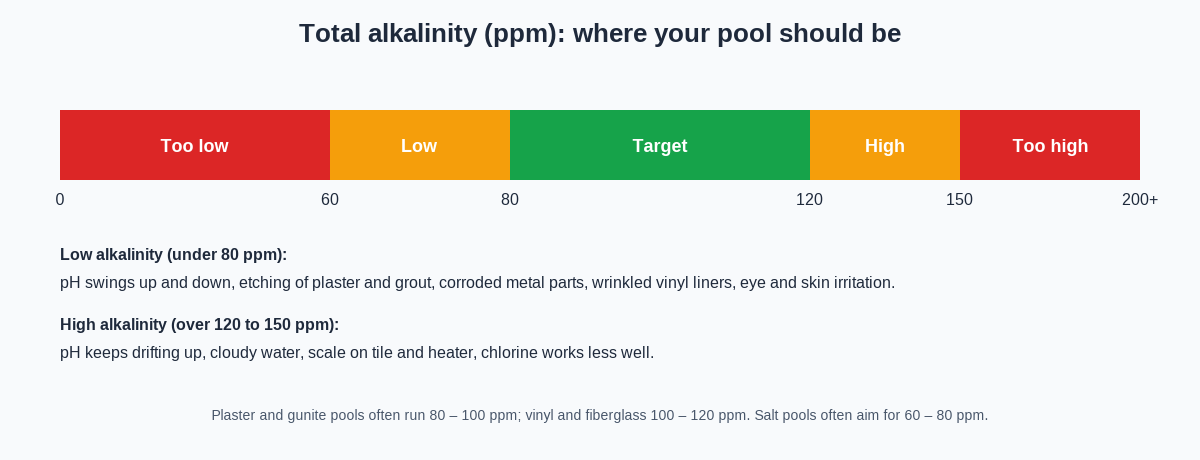
Diagram: Asphapro.com
Quick Answer
To raise alkalinity in pool water, add baking soda (sodium bicarbonate). About 1.5 pounds per 10,000 gallons raises total alkalinity by about 10 ppm. Test first, work out how many ppm you need to reach the 80 to 120 ppm target, then broadcast the baking soda over the deep end with the pump running. Add about three quarters of the dose, let it circulate for at least 6 hours, retest, and add the rest if needed. Baking soda raises pH only a little, so it is the best way to raise alkalinity in pool water without affecting pH much. If both pH and alkalinity are low, use baking soda for alkalinity and then aerate or add a small amount of soda ash for pH.
Total alkalinity is the quiet number in pool chemistry. It does not kill germs or clear water by itself, but it holds pH steady. When alkalinity drops too low, pH starts swinging every time it rains, every time you add chlorine and every time swimmers get in. Low alkalinity water can etch plaster, corrode metal heaters and ladders, and leave a vinyl liner wrinkled and stiff.
The good news is that knowing how to raise alkalinity in pool water is simple. The main chemical is ordinary baking soda, the same sodium bicarbonate sold in the baking aisle, though pool stores sell it in larger bags as "alkalinity increaser" or "alkalinity up". This guide covers the target range, the dose for any pool size, a calculator, the step-by-step method and the common mistakes. If your alkalinity is too high instead, see our guide on how to lower alkalinity in pool water.
What Is Total Alkalinity in a Pool?
Total alkalinity (TA) measures how much of the water's buffering compounds, mostly bicarbonate and carbonate, are dissolved in the pool. It is reported in parts per million (ppm) as calcium carbonate. These compounds soak up acid, so they keep pH from dropping quickly when acid enters the water from rain, chlorine products, swimmer waste or the pool's own chemistry.
Think of alkalinity as a shock absorber for pH. With good alkalinity, small amounts of acid barely move pH. With low alkalinity, the same small amount of acid can drop pH from 7.6 to 7.0 in a day. That is why pool pros always say to fix alkalinity first, then pH.
What Should Alkalinity Be in a Pool?
Most guides, including the CDC and the Pool and Hot Tub Alliance, put the target at 80 to 120 ppm. Within that range, the right number depends on the pool:
- Plaster, gunite and concrete pools: 80 to 100 ppm is common, though plaster pools with a lot of fresh calcium may need a bit more.
- Vinyl liner and fiberglass pools: 100 to 120 ppm is common.
- Salt chlorine pools: often 60 to 80 ppm, because salt cells raise pH and lower alkalinity keeps pH rising more slowly.
- Pools using trichlor tablets: trichlor is acidic, so these pools may run alkalinity toward the top of the range.
- Hot tubs: 80 to 120 ppm, the same range, but the small volume means doses are much smaller.
If your test shows less than 80 ppm, it is time to raise alkalinity in pool water. If it is under 60 ppm, raise it soon, because pH will be hard to hold.
Signs of Low Alkalinity
- pH bounce: pH keeps changing and will not stay where you set it.
- Low pH: low alkalinity and low pH often go together.
- Etching: rough plaster, pitted grout and dissolving tile grout lines.
- Corrosion: rust stains from ladders, rails, screws and heater parts; green or blue stains from copper.
- Vinyl liner problems: wrinkles and a liner that loses its stretch.
- Burning eyes and itchy skin: from water that has gone acidic.
- Greenish water even with chlorine present, which can come from dissolved metals.
What Causes Low Alkalinity?
- Acid: muriatic acid and dry acid used to lower pH also lower alkalinity.
- Trichlor and dichlor: these stabilized chlorine products are acidic and slowly use up alkalinity.
- Rain: rain water is slightly acidic and contains almost no alkalinity, so heavy rain dilutes and lowers TA.
- Draining and refilling: soft fill water may have very low alkalinity.
- Swimmer waste and the natural breakdown of chlorine also add acid over time.
What Raises Alkalinity in a Pool? What Increases It Most?
Several chemicals raise alkalinity, but they behave differently:
- Sodium bicarbonate (baking soda): the main product to raise alkalinity in pool water. Its own pH is about 8.3, so it raises alkalinity a lot and pH only a little.
- Sodium carbonate (soda ash): raises pH strongly and also raises alkalinity. Best used when pH is low, not as the main alkalinity product.
- Sodium hydroxide and calcium hypochlorite: raise pH and alkalinity a little; not used for dosing alkalinity.
- Borax: raises pH with almost no change in total alkalinity.
- Aeration: raises pH without changing alkalinity at all.
For almost every pool, the answer to "what raises alkalinity in a pool" is baking soda. Pool store alkalinity increaser is usually 100% sodium bicarbonate, often sold at a higher price per pound than grocery or warehouse baking soda. Check the label: if it says sodium bicarbonate and nothing else, it does the same job.
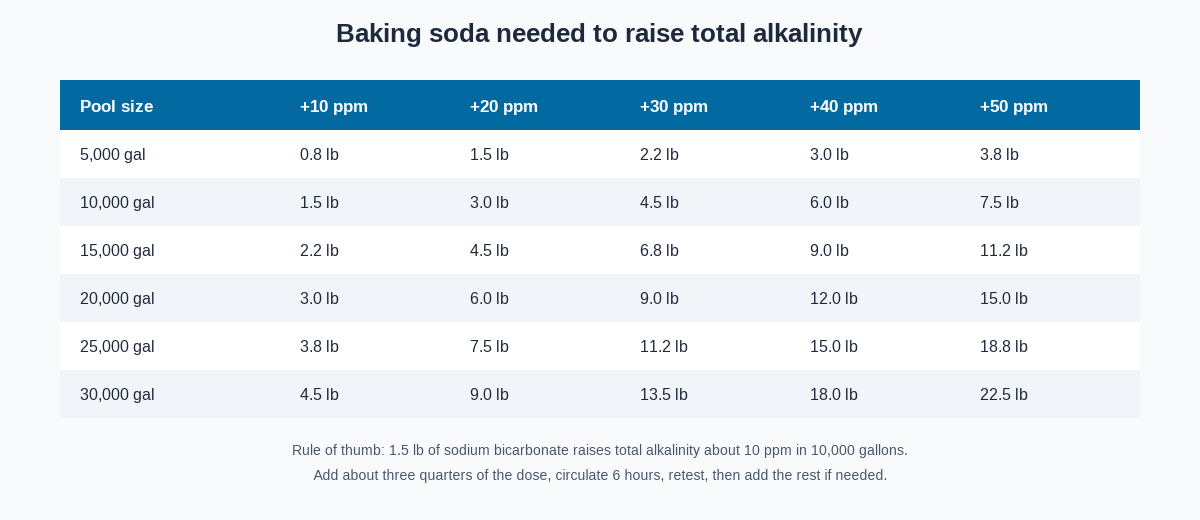
Chart: Asphapro.com
How Much Baking Soda to Raise Pool Alkalinity?
The standard rule is that 1.5 pounds of baking soda raises total alkalinity by about 10 ppm in 10,000 gallons. The exact chemistry gives about 1.4 pounds, so 1.5 pounds is a safe round number. To find your dose:
- Subtract your current reading from your target. For example, target 100 ppm minus current 60 ppm = 40 ppm.
- Divide the increase by 10. Here, 40 ÷ 10 = 4.
- Multiply by 1.5 pounds. Here, 4 × 1.5 = 6 pounds for 10,000 gallons.
- Scale for your pool size. For 20,000 gallons, double it: 12 pounds.
The chart above shows the dose for common pool sizes. If you do not know your pool's volume, see our guide on how many gallons is my pool, which has a gallon calculator.
Pool Alkalinity Calculator: How Much to Add
Enter your pool size, current alkalinity and target alkalinity. The calculator gives the amount of baking soda or soda ash to raise alkalinity in pool water, and a first dose to add before you retest.
The calculator uses 1.5 pounds of baking soda or about 0.9 pounds of soda ash per 10 ppm per 10,000 gallons. Soda ash will also raise pH a lot, so use it only when pH is low too, and add it in small steps.
How to Raise Alkalinity in Pool: Step by Step
- Test the water. Use a drop-based test kit or a good test strip to read total alkalinity and pH. Drop kits are more accurate for alkalinity.
- Work out the dose. Use the chart or calculator above.
- Run the pump. The pump should run during and after the addition so the baking soda mixes through the whole pool.
- Measure about 75% of the dose. Adding in steps avoids overshooting.
- Broadcast it over the water. Walk around the deep end and spread the powder in a wide arc over the surface, close to the water so the wind does not blow it around. Baking soda dissolves easily, so you do not need to premix it in most pools.
- Brush the floor. Brush any powder that settles so it dissolves.
- Wait at least 6 hours, ideally a full pump cycle or overnight.
- Retest alkalinity and pH. Add the rest of the dose if you are still below target.
- Adjust pH last. Once alkalinity is in range, raise or lower pH as needed.
In a small pool or above ground pool, you can dissolve the baking soda in a bucket of pool water first and pour it in front of a return. This avoids powder sitting on a vinyl floor. Never add chemicals through the skimmer in large amounts, and never mix baking soda with other chemicals in the same bucket.
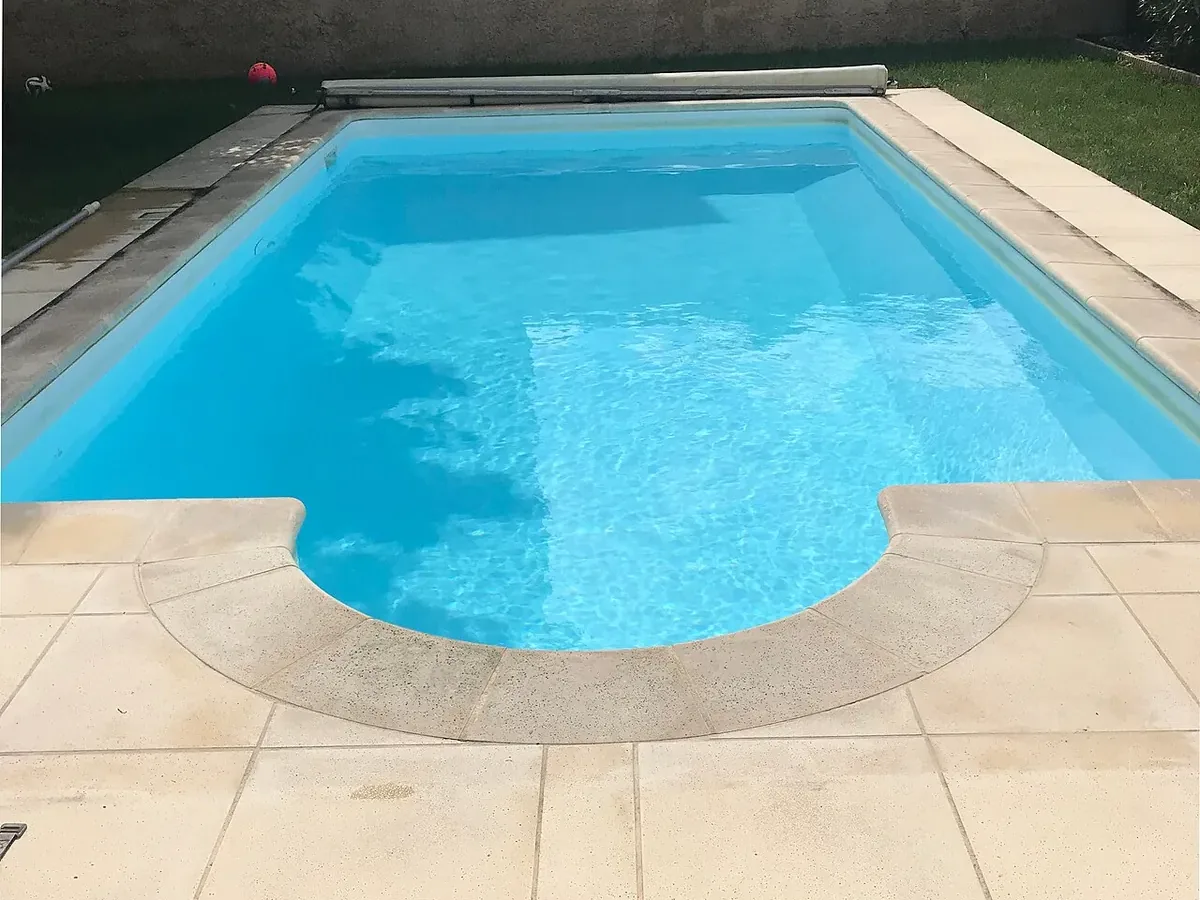
Photo: Benoît Prieur, Wikimedia Commons, CC0
How to Raise Alkalinity in Pool Without Affecting pH
Many owners search for how to raise alkalinity in pool without affecting pH, because pH is already in range and they do not want to push it high. Baking soda is the right product. Because its pH is about 8.3, it lifts pH only slightly, usually by 0.1 to 0.2 for a normal dose. In most pools, pH settles back within a day or two.
If pH does rise more than you want after raising alkalinity, a small dose of acid will bring it down. Remember that acid also lowers alkalinity a little, so retest both and avoid chasing one number back and forth.
How to Raise pH and Alkalinity in Pool Water Together
If both numbers are low, which is common after heavy rain or a long period of using trichlor tablets, raise alkalinity first with baking soda. Then check pH. Often, the baking soda brings pH up enough. If pH is still low, you have two choices:
- Aeration: run water features, point the returns up toward the surface, or use a fountain. Aeration drives out carbon dioxide and raises pH without changing alkalinity.
- Soda ash: add a small dose to raise pH quickly. It also raises alkalinity, so the next test may show both higher.
Our guide on how to raise pH in pool water covers soda ash doses and aeration in more detail.
Baking Soda vs Soda Ash for Alkalinity
Both raise alkalinity, but baking soda is the better choice for alkalinity and soda ash is the better choice for pH. Baking soda gives the most alkalinity increase with the least pH change. Soda ash gives about 1.6 times as much alkalinity per pound, but it also raises pH sharply and can cloud the water if pH and calcium are already high. A good rule: when you want to increase alkalinity in pool water, reach for baking soda. When you want to raise pH and alkalinity is fine, reach for aeration or soda ash.
How to Test Before Raising Total Alkalinity in Pool Water
The most accurate home test is a titration kit using drops. You fill a sample tube, add an indicator that turns the water green, then add a reagent drop by drop until the color turns red. Each drop equals 10 ppm in most kits. Test strips are quicker but less exact. Test alkalinity once a week and after heavy rain, large water additions or acid doses. Store test reagents out of the sun and replace them each season.
Common Mistakes When Raising Alkalinity in Pool Water
- Adding the whole dose at once: overshooting means you then need acid to come back down.
- Fixing pH before alkalinity: pH will not hold until alkalinity is right.
- Using soda ash for alkalinity: pH jumps and the water may go cloudy.
- Testing too soon: wait at least 6 hours so the baking soda mixes in.
- Guessing the pool volume: a wrong volume makes every dose wrong.
- Pouring powder in one spot: it can sit on the floor and cloud the water nearby.
Why Is My Alkalinity Not Going Up?
If you added baking soda but alkalinity has not risen, check a few things. First, make sure you used enough: many people underestimate pool volume, especially in pools with deep ends. Second, retest after a full pump cycle; a reading taken an hour after the addition may not show the full change. Third, check your test reagents: old or sun-damaged reagents read low. Finally, if you use trichlor tablets or add acid often, the pool may be using up alkalinity as fast as you add it. In that case, consider switching some of your chlorine to liquid chlorine, which has a higher pH and does not use up alkalinity.
Raising Alkalinity in Pool Water With a Salt System
Salt pools make chlorine through electrolysis, which tends to raise pH. Many salt pool owners keep alkalinity at 60 to 80 ppm, lower than in a regular chlorine pool, so pH rises more slowly and they add less acid. If your salt pool's alkalinity falls below about 60 ppm, raise it in small steps with baking soda. For more on how salt pools differ, see salt pool versus chlorine.
Raising Alkalinity in Above Ground Pools and Hot Tubs
The method to raise alkalinity in pool water is the same for an above ground pool, but the doses are smaller. A 15-foot round pool, 48 inches deep, holds about 4,500 gallons, so 1.5 pounds of baking soda raises its alkalinity by about 33 ppm. Pre-dissolve the baking soda in a bucket of water to protect the liner.
In a hot tub of 400 gallons, 1 ounce of baking soda raises alkalinity by about 15 ppm. Add small amounts with the jets running and the cover open, then retest after 30 minutes.
Worked Examples
Example 1: inground plaster pool. A 20,000-gallon pool tests at 60 ppm alkalinity and 7.2 pH. Target is 90 ppm. Increase needed: 30 ppm. Dose: 3 × 1.5 × 2 = 9 pounds of baking soda. Add 7 pounds, wait overnight, retest, then add the last 2 pounds if needed. pH will likely settle near 7.4 to 7.5.
Example 2: vinyl pool after a storm. A 15,000-gallon pool tests at 70 ppm after two days of rain. Target is 110 ppm. Increase needed: 40 ppm. Dose: 4 × 1.5 × 1.5 = 9 pounds. Pre-dissolve in buckets, pour in front of the returns, retest the next morning.
Example 3: salt pool. A 25,000-gallon salt pool tests at 50 ppm. Target is 70 ppm. Increase needed: 20 ppm. Dose: 2 × 1.5 × 2.5 = 7.5 pounds. Add 5.5 pounds first, retest, then top up.
How to Keep Alkalinity Steady After You Raise Pool Alkalinity
- Test once a week and after heavy rain.
- Use liquid chlorine instead of only trichlor tablets if alkalinity keeps dropping.
- Add acid in small doses, because every dose of acid also lowers alkalinity.
- Keep a bag of baking soda on hand for quick top-ups.
- Record your readings so you can see trends through the season.
- Keep calcium hardness and pH in range, so scale and etching do not occur.
How to Bring Down Alkalinity in Pool Water If You Overshoot
If you overshoot, or your fill water is naturally high in alkalinity, you will need to lower it. The method is to add muriatic acid or dry acid, which lowers pH and alkalinity, then aerate to raise pH back without raising alkalinity, and repeat. Our full guide on how to lower alkalinity in pool water explains acid doses and the aeration cycle.

Photo: Benoît Prieur, Wikimedia Commons, CC0
How Do You Raise Alkalinity in a Pool Fast?
How do you raise alkalinity in a pool fast without causing new problems? The quickest safe method is to add the full calculated baking soda dose in two parts a few hours apart, with the pump running on high and the returns pointed down so the water mixes well. Baking soda dissolves in minutes, so the alkalinity pool increase shows up within a few hours of good circulation. There is no faster chemical that is also safe: soda ash works just as quickly but pushes pH up too far, and very large single doses can cloud the water for a day. If you need to raise pool alkalinity before a party or a pool opening, start the day before so you have time to retest.
How to Increase Alkalinity in a Swimming Pool When Opening for the Season
Opening day is when many owners first learn how to increase alkalinity in a swimming pool, because winter rain and snowmelt dilute the water. Start by removing the cover, topping up the water level and running the filter for a day. Then test alkalinity, pH, calcium hardness, stabilizer and chlorine. Raise alkalinity first, then adjust pH, then shock. Following this order means the pH stays put once you set it and the chlorine works as well as it should.
If the water is green or very cloudy, you can shock and clean the pool while you raise total alkalinity in pool water, but test again after the water clears because a lot of chlorine can shift pH. For more help bringing a neglected pool back, see our guide on how to clear a cloudy pool.
How to Increase Alkalinity in Pool Water After Rain
After heavy rain, it is common to see alkalinity drop by 10 to 30 ppm, along with lower pH and chlorine. Test the next day once the water has circulated. If alkalinity is below 80 ppm, follow the same dose method: 1.5 pounds of baking soda per 10,000 gallons for every 10 ppm. Rain also raises the water level, so drain back to the middle of the skimmer opening first if needed, then raise alkalinity in pool water with the level correct, so your dose matches the real volume.
How to Raise Alkalinity in My Pool Without a Pool Store
If you are asking how to raise alkalinity in my pool without driving to a pool store, the answer is in your kitchen or at any grocery or warehouse store. Plain baking soda works just like branded alkalinity increaser. A 12-pound bag from a warehouse store usually costs much less than the same weight of pool store product. Make sure the label lists only sodium bicarbonate, with no added scents, cleaning agents or anti-caking chemicals that could cloud the water.
Pool Raise Alkalinity Checklist
Before you add anything, run through this short checklist to raise alkalinity in a pool the right way:
- Test kit reagents are fresh and stored out of the sun.
- Pool volume is known, measured or calculated, not guessed.
- Target alkalinity is chosen for your pool type and chlorine type.
- The pump is running and the filter is clean.
- Baking soda is weighed, not scooped by eye.
- You have time to wait 6 hours and retest before adjusting pH.
Following these steps every time you increase pool alkalinity keeps doses small and accurate, saves money and avoids the back-and-forth of raising and lowering numbers.
Safety When Adding Baking Soda and Soda Ash
Baking soda is one of the safest pool chemicals. Even so, wear eye protection when broadcasting powder in the wind, and keep it dry and sealed so it does not cake. Soda ash is more irritating: wear gloves and eye protection and avoid breathing the dust. Never mix pool chemicals together, always add chemicals to water and not water to chemicals, and store them away from acid and chlorine.
How to Raise Alkalinity in Pool: Key Points
- Target total alkalinity is 80 to 120 ppm for most pools; salt pools often run 60 to 80 ppm.
- Use baking soda: 1.5 lb per 10,000 gallons raises alkalinity about 10 ppm.
- Add about 75% of the dose, wait at least 6 hours, retest and finish.
- Fix alkalinity first, then pH.
- Baking soda raises pH only a little; soda ash raises pH a lot.
Frequently Asked Questions
Can I use household baking soda to raise alkalinity in my pool?
Yes. Household baking soda is pure sodium bicarbonate, the same as pool store alkalinity increaser. Buying it in large bags from a warehouse store is usually cheaper.
How long does it take for baking soda to raise alkalinity?
It dissolves in minutes, but give it at least 6 hours of circulation, or one full pump cycle, before you retest.
Can I swim after adding baking soda?
Yes. Most owners wait about an hour after broadcasting so the powder dissolves, but baking soda does not make the water unsafe.
Does baking soda raise pH?
A little. It raises alkalinity much more than pH, which is why it is the best product to increase alkalinity in pool water when pH is fine.
Does shock raise alkalinity?
Calcium hypochlorite shock raises pH and alkalinity a small amount. Dichlor shock is close to neutral. Neither is a reliable way to raise alkalinity.
What happens if alkalinity is too low?
pH becomes unstable and tends to drop, which can etch plaster, corrode metal parts, wrinkle vinyl liners and irritate eyes and skin.
How to raise alkalinity in swimming pool water without raising calcium?
Use baking soda. It adds sodium and bicarbonate only, so it raises alkalinity without changing calcium hardness. Avoid using calcium hypochlorite as a way to raise alkalinity.
How often should I raise alkalinity in a pool?
Only when a test shows it below your target. Many pools need a top-up a few times a season, usually after rain, refills or a run of acid doses.
Sources
- CDC: Pool chemistry and testing
- Trouble Free Pool: Pool water chemistry
- Swim University: How to raise pool alkalinity
- Pool and Hot Tub Alliance