
How to Raise pH in Pool Water: Step-by-Step Guide With Doses
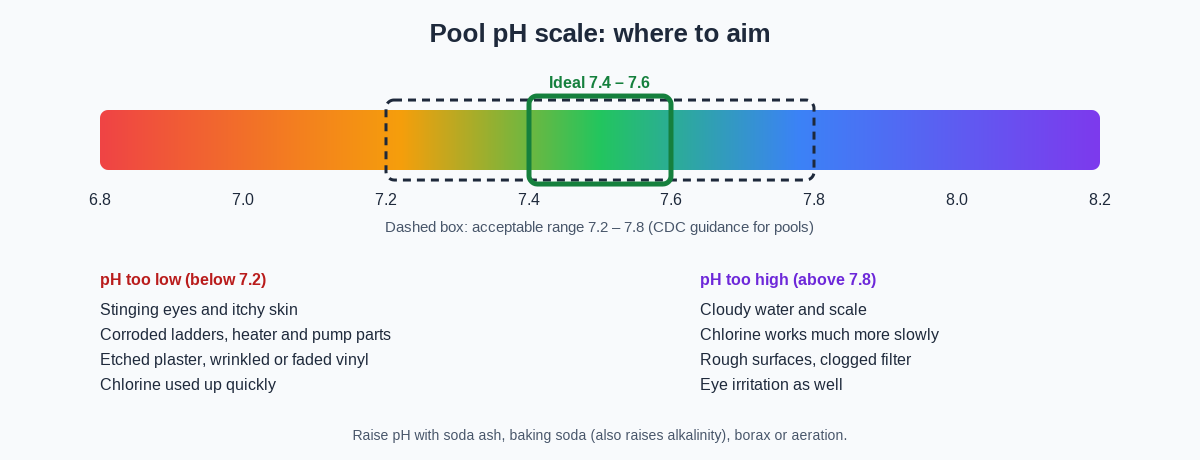
Chart: Asphapro.com
Quick Answer
How to raise pH in pool water: test the water first, including total alkalinity. If pH and alkalinity are both low, add baking soda (about 1.5 lb per 10,000 gallons raises alkalinity 10 ppm and nudges pH up). If pH is low but alkalinity is fine, use soda ash (about 6 oz per 10,000 gallons raises pH about 0.2) or borax. If alkalinity is high, raise pH with aeration: point the return jets up, run a fountain or waterfall. Dissolve the product in a bucket of pool water, pour it in front of the return jets with the pump running, wait 4 to 6 hours and retest. Aim for pool pH of 7.4 to 7.6; 7.2 to 7.8 is acceptable.
Pool pH is a measure of how acidic or basic the water is. It runs on a scale from 0 to 14, where 7 is neutral. Pool water should be slightly basic, close to the pH of human tears, around 7.4 to 7.6. When pool pH drops below 7.2, the water becomes acidic. Swimmers' eyes sting, metal parts corrode, plaster etches, vinyl liners wrinkle and chlorine burns off faster than it should.
Low pH in a pool is common. Rain, acid-based chlorine products, many swimmers and an over-dose of acid can all push pH down. The good news is that raising pool pH is simple once you know which product to use and how much. This guide explains how to raise pH in pool water step by step, which chemicals raise pH, how much to add for your pool size, how to raise pH quickly, how to raise pH without raising alkalinity, and how to stop pH from dropping again.
What Is the Right pH for a Pool?
| Reading | pH | What it means |
|---|---|---|
| Too low | Below 7.2 | Acidic, corrosive, irritating; raise pH |
| Acceptable | 7.2 – 7.8 | CDC range for pools |
| Ideal | 7.4 – 7.6 | Comfortable and chlorine works well |
| Too high | Above 7.8 | Scale, cloudiness, weak chlorine; lower pH |
Many owners ask what ph for pool water is safe for kids. The same 7.2 to 7.8 range applies to everyone; children often notice stinging eyes first, which makes them a good early warning that the ph of pool water has drifted. Pool pH and total alkalinity work together. Total alkalinity (TA) acts as a buffer that holds pH steady. Most pools do best with TA around 80 to 120 ppm. When TA is low, pH swings up and down quickly. When TA is high, pH tends to drift up and is hard to lower. Always test both before you adjust pH.
Signs of Low pH in a Pool
- Stinging eyes and dry, itchy skin after swimming.
- Corrosion on ladders, rails, light rings, heater parts and pump seals. Green or brown stains can come from dissolved copper or iron.
- Etched or rough plaster and loose grout in concrete pools.
- Wrinkles or faded color in vinyl liners; low pH softens the vinyl and lets it stretch.
- Chlorine disappearing quickly. Chlorine is more active at low pH but also burns off faster.
- Test strip or drop test reading below 7.2.
If you see these signs, test the water and correct low pH in the pool before swimming again.
What Causes Low pH in a Pool?
- Rain: rainwater is naturally acidic, often pH 5 to 6.
- Acid-based chlorine: trichlor tablets and dichlor shock are acidic and lower pH over time.
- Too much muriatic acid or dry acid added when lowering pH or alkalinity.
- Heavy swimmer load: sweat, body oils and other waste can lower pH.
- Low total alkalinity: without a buffer, pH drops easily.
- Fill water: some municipal and well water has low pH.
- Leaves and debris: decaying organic matter is mildly acidic.
What Raises pH in Pool Water?
Four things raise pool pH: soda ash, baking soda, borax and aeration. Here is what raises the pH in a pool and when to use each one.
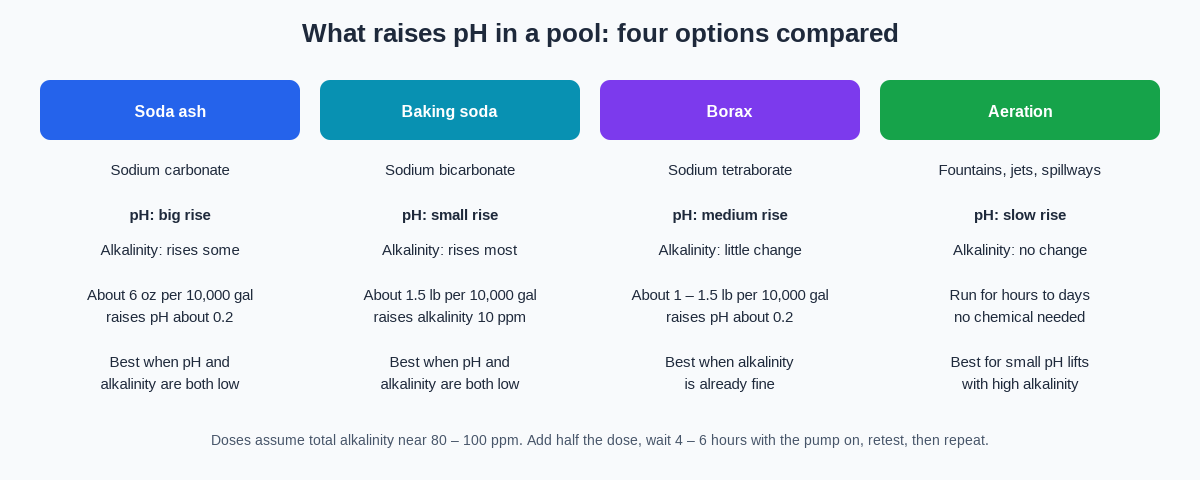
Chart: Asphapro.com
Soda ash (sodium carbonate)
Soda ash is the main pH increaser sold for pools, often labeled "pH Up" or "pH Plus." It raises pH strongly and raises alkalinity somewhat. It is the best choice when pH is low and alkalinity is normal or a little low. Add it in small doses: large doses can cloud the water for a few hours.
Baking soda (sodium bicarbonate)
Baking soda is sold as "alkalinity increaser" or "alkalinity up." It is the same chemical as kitchen baking soda. It raises total alkalinity strongly and pH only slightly, which makes it the right choice when both pH and TA are low. It is gentle and rarely clouds the water.
Photo: Thavox, Wikimedia Commons, public domain
Borax (sodium tetraborate)
Borax raises pH with little effect on alkalinity. Many owners use it when TA is already in range or slightly high. Borax also adds borates, which help keep pH steady. Use plain borax laundry booster without added scents or fillers.
Aeration
Aeration raises pH without adding any chemical and without raising alkalinity. Moving water lets carbon dioxide escape, which pushes pH up. Point return jets toward the surface, run a waterfall, fountain or spillway, or use an aerator attachment. It works slowly but is the best way to raise pH when TA is high.
How to Raise pH in Pool Water: Step by Step
- Test the water. Use a good test kit or strips to check pH, total alkalinity and free chlorine. Write the numbers down.
- Know your pool gallons. Doses are given per 10,000 gallons. If you are not sure, see how many gallons is my pool.
- Pick the product. Low pH and low TA: baking soda first. Low pH and normal TA: soda ash or borax. Low pH and high TA: aeration.
- Work out the dose from the tables below, and plan to add about half to three-quarters of it first.
- Turn on the pump and keep it running.
- Pre-dissolve the product in a bucket of pool water. Always add chemical to water, not water to chemical.
- Pour slowly in front of the return jets around the deep end, or walk it around the pool. Do not pour it into the skimmer in large amounts.
- Wait 4 to 6 hours (at least one full turnover) with the pump running.
- Retest pH and alkalinity, then add more if needed.
How Much Soda Ash to Raise pH in a Pool
To raise ph level in pool water with soda ash, use the table below. As a rule of thumb, about 6 ounces of soda ash per 10,000 gallons raises pH by about 0.2 when total alkalinity is near 100 ppm. Lower TA means a bigger pH change from the same dose; higher TA means less.
| Starting pH | 5,000 gal | 10,000 gal | 15,000 gal | 20,000 gal |
|---|---|---|---|---|
| 7.2 → 7.4 | 3 oz | 6 oz | 9 oz | 12 oz |
| 7.0 → 7.4 | 6 oz | 12 oz | 18 oz | 24 oz |
| 6.8 → 7.4 | 9 oz | 18 oz | 27 oz | 36 oz |
Do not add more than about 1 to 2 pounds per 10,000 gallons in one dose; split larger corrections into steps several hours apart.
How Much Baking Soda to Raise pH and Alkalinity
About 1.5 pounds of baking soda per 10,000 gallons raises total alkalinity by about 10 ppm. The pH rise is small, usually 0.1 or less per dose.
| Raise TA by | 5,000 gal | 10,000 gal | 15,000 gal | 20,000 gal |
|---|---|---|---|---|
| 10 ppm | 0.75 lb | 1.5 lb | 2.25 lb | 3 lb |
| 20 ppm | 1.5 lb | 3 lb | 4.5 lb | 6 lb |
| 40 ppm | 3 lb | 6 lb | 9 lb | 12 lb |
If TA is very low (below 60 ppm), bring it up with baking soda first, then fine-tune pH with soda ash or aeration.
Pool pH Calculator: Soda Ash Dose
Use this swimming pool pH calculator to estimate how much soda ash raises pH in pool water from your current reading to your target. It assumes total alkalinity near 80 to 120 ppm. Add about three-quarters of the result first, then retest.
This pool pH calculator gives an estimate only. Water with low alkalinity reacts more strongly; water with high alkalinity needs more product for the same change. That is why adding most of the dose, waiting and retesting works better than adding the full amount at once.
What Should Pool pH Be?
What should the pH of a pool be? The ideal pH for pool water is 7.4 to 7.6. This range is close to the pH of the human eye (about 7.5), which is why swimmers feel most comfortable there. It is also where chlorine works well without being used up too fast, and where water is least likely to corrode metal or leave scale.
What is pH in a pool, exactly? It is a measure of hydrogen ion activity. Each whole number on the scale is ten times more acidic or basic than the next, so a pool at pH 6.8 is about four times more acidic than one at 7.4. That is why even a small drop in swimming pool pH has a big effect on comfort and equipment.
Testing Pool pH the Right Way
Accurate tests are the first step in adjusting pool pH. A few tips:
- Take samples from about elbow depth, away from return jets and the skimmer.
- Test in the evening or at the same time each day, since pH can drift during the day.
- Use fresh test strips or reagents. Old reagents give wrong readings.
- When free chlorine is above about 10 ppm (just after shocking), many pH tests read falsely high. Wait until chlorine drops before testing pH.
- A drop test kit is more accurate than strips; digital testers are fastest if kept calibrated.
pH Up for Swimming Pool Use: Reading the Label
Store shelves sell many pH up products. Most pH up for swimming pool use is simply soda ash, sold under names like pH Up, pH Plus or pH Increaser. Alkalinity Up or Alkalinity Increaser is baking soda. Check the active ingredient on the label:
| Label name | Active ingredient | Main effect |
|---|---|---|
| pH Up, pH Plus, pH Increaser | Sodium carbonate (soda ash) | Raises pH strongly |
| Alkalinity Up, Alkalinity Increaser | Sodium bicarbonate (baking soda) | Raises alkalinity, small pH rise |
| pH Balancer or Stabilizer (borate) | Borax or boric acid blends | Raises pH (borax) and steadies it |
Generic soda ash and baking soda in large bags cost much less per pound than branded pool ph up products, and work the same.
Adjusting Pool pH: Up or Down?
Adjusting pool pH goes both ways. If your swimming pool ph is low, use the products above. If it is high, lower it with muriatic acid or dry acid (sodium bisulfate). Never add both on the same day, and always correct total alkalinity first if it is far out of range, because alkalinity controls how much pH moves.
| Problem | First step | Second step |
|---|---|---|
| Low pH, low TA | Baking soda to raise TA | Soda ash if pH is still low |
| Low pH, normal TA | Soda ash or borax | Retest after 4 – 6 hours |
| Low pH, high TA | Aerate to raise pH | Acid to lower TA, then aerate again |
| High pH, high TA | Acid to lower both | Retest, repeat in small steps |
| High pH, low TA | Baking soda to raise TA | Small acid dose to lower pH |
Raising pH in a Pool After Rain, Shock or an Acid Wash
After heavy rain
Rain dilutes alkalinity and adds acidic water. Test after every big storm. Raising ph in pool water after rain usually starts with baking soda, since TA often drops too.
After shocking with dichlor or trichlor
These stabilized chlorine products are acidic. If pH is low a day after shocking, raise it with soda ash. Using cal-hypo or liquid chlorine instead raises pH slightly rather than lowering it.
After an acid wash or new plaster
An acid-washed or freshly plastered pool often has low ph in pool water for weeks. New plaster needs careful start-up chemistry from the plasterer, with frequent pH and TA tests. See pool resurfacing cost.
Is Low pH in a Swimming Pool Dangerous?
Low ph in swimming pool water is not usually an emergency, but it should be fixed within a day or two. A pool ph low reading of 7.0 causes discomfort and slow damage. A reading of 6.8 or lower can etch plaster, damage heaters (which often have copper heat exchangers) and stain the pool with dissolved metals. Pool owners with a low pool ph should avoid swimming until pH is back above 7.2, especially children and anyone with sensitive skin or eyes.
How to Raise pH Without Raising Alkalinity
When TA is already in range or high, use one of these:
- Aeration: point the returns up, add a fountain, run a waterfall or use a spa blower. Retest every 12 to 24 hours.
- Borax: roughly 1 to 1.5 pounds per 10,000 gallons raises pH about 0.2 with little change in TA.
- Lower TA first, then aerate: if TA is high and pH is low, add acid to lower TA, then aerate to bring pH back up. Repeat until both are in range.
How to Raise pH in Pool Quickly
If you need to know how to raise ph in pool quickly, soda ash is the fastest way to raise pH. Dissolved in a bucket and poured in front of the returns with the pump on, it starts working at once, and the full effect shows within an hour or two. For the fastest result:
- Use soda ash, not baking soda.
- Pre-dissolve it completely.
- Run the pump on high speed.
- Brush the pool to mix the water.
- Retest after 1 to 2 hours instead of waiting overnight, then add more if needed.
Do not try to make a big jump with one huge dose. It can cloud the water and overshoot pH, which then needs acid to bring back down.
How to Raise pH in a Salt Water Pool
Salt water pools tend to have pH that rises, not falls, because the salt cell produces a little sodium hydroxide. If pH is low in a salt pool, it is often from too much acid, rain or low TA. Use the same products: baking soda for low TA, soda ash or borax for low pH. Many salt pool owners keep borates at 30 to 50 ppm to steady pH. See how to add salt to pool.
How to Raise pH in an Above Ground Pool
How to raise ph in swimming pool models that sit above ground? The method is the same. Above ground pools hold less water, so doses are smaller and easier to overshoot. Measure carefully, add half the dose, and retest. Vinyl liners are sensitive to low pH, so keep it above 7.2.
Common Mistakes When Raising Pool pH
- Not testing alkalinity. pH problems often start with TA.
- Adding too much at once. Leads to cloudiness and overshooting.
- Pouring dry powder into the skimmer. Can clog or damage equipment.
- Adding pH up and acid at the same time. They cancel each other.
- Mixing pH up with chlorine in the same bucket. Never mix pool chemicals.
- Testing too soon. Wait at least 4 hours.
- Ignoring the cause. If pH keeps dropping, look at trichlor tablets, rain, fill water and low TA.
Safety When Adding pH Increaser
- Wear gloves and eye protection; soda ash dust irritates eyes and skin.
- Add chemical to water, never water to chemical.
- Never mix pH increaser with chlorine, acid or any other pool chemical in the same bucket.
- Keep chemicals dry, sealed and away from children and pets.
- Add products with no swimmers in the pool, and wait until the water has mixed before anyone swims.
Following these steps every time you raise pool ph keeps both swimmers and equipment safe, and keeps your water in balance with the least effort.
How to Keep pH From Dropping
- Keep total alkalinity at 80 to 120 ppm.
- Test pH 2 to 3 times a week in season.
- If you use trichlor tablets, expect pH to drop and check it more often.
- After heavy rain, test and adjust.
- Consider borates (30 to 50 ppm) to steady pH.
- Keep the pool covered when not in use to reduce rain and debris.
How to Raise pH in Pool: Key Points
- Ideal pool pH is 7.4 to 7.6; acceptable is 7.2 to 7.8.
- Test pH and total alkalinity before adjusting.
- Low pH and low TA: baking soda. Low pH, normal TA: soda ash or borax. Low pH, high TA: aeration.
- Soda ash: about 6 oz per 10,000 gallons raises pH about 0.2.
- Pre-dissolve, add in front of the returns with the pump on, wait 4 to 6 hours, retest.
Frequently Asked Questions
How do I raise the pH in my pool?
Test pH and alkalinity, then add soda ash (or baking soda if alkalinity is also low), dissolved in water, in front of the return jets with the pump running. Retest after 4 to 6 hours.
Does baking soda raise ph in swimming pool water?
Yes, a little. Baking soda mainly raises total alkalinity, with a small rise in pH.
Can I swim after raising pH?
Usually after about 20 to 30 minutes, once the product has mixed. Wait longer after large doses.
Why is my pool pH low again after a week?
Common causes are low alkalinity, trichlor tablets, rain and acid overdoses.
How do I raise pH in a pool without pool chemicals from a store?
Plain baking soda from a grocery store raises alkalinity and pH a little, and plain borax raises pH. Aeration raises pH with no chemicals at all. All three work as well as branded products.
How to increase pH in pool water that also has high alkalinity?
Use aeration. Point the returns at the surface, run a waterfall or fountain, and retest daily. Adding soda ash would push alkalinity even higher.
What raises the pH in a swimming pool the fastest?
Soda ash. It starts working at once and shows its full effect within one to two hours with the pump running.
How to bring pH up in pool water after adding too much acid?
Retest pH and alkalinity. If both dropped, add baking soda to restore alkalinity, then use soda ash for the rest of the pH rise. Add in steps and retest each time.
How to increase the pH level in a pool that has just been filled?
Test the fill water first. Many water supplies run pH 7.0 to 8.0. If it is low, balance alkalinity to 80 to 120 ppm with baking soda, then adjust pH with soda ash.
How to raise pool pH in a hot tub or spa?
Use the same products in much smaller amounts, often a teaspoon or two at a time for a 300 to 500 gallon tub, and retest after 30 minutes with the jets running.
How do you increase pH in pool water with borax?
Dissolve about 1 to 1.5 pounds per 10,000 gallons in a bucket of pool water and pour it in front of the return jets. Retest after several hours.
How to get pH up in pool water that keeps going back down?
Raise total alkalinity to 80 to 120 ppm. Low alkalinity is the most common reason pool pH low readings return within days. Switching from trichlor tablets to liquid chlorine also helps.
What increases pH in pool water naturally?
Aeration, splashing, rain-free sunny days and running water features all raise pH slowly as carbon dioxide leaves the water.
What is the pH of a pool supposed to be?
About 7.4 to 7.6. The pH for pool water may range from 7.2 to 7.8 and still be acceptable.
How long does it take to raise pH in a pool?
Soda ash raises pH within 1 to 2 hours; baking soda and borax within several hours; aeration over 1 to 3 days.
Can low pH pool water damage a vinyl liner?
Yes. A low ph pool softens vinyl, which then stretches and wrinkles. Keep pH above 7.2 in vinyl pools.
How much does it cost to raise pH in a pool?
Very little. A 25 lb bag of soda ash or baking soda costs about $20 to $40 and treats a 15,000 gallon pool many times.
Sources
- CDC: Pool chemistry and testing
- Swim University: How to raise pool pH
- Trouble Free Pool: ABCs of pool water chemistry
- Pool and Hot Tub Alliance