
How to Add Baking Soda to Pool Water: Doses and Steps
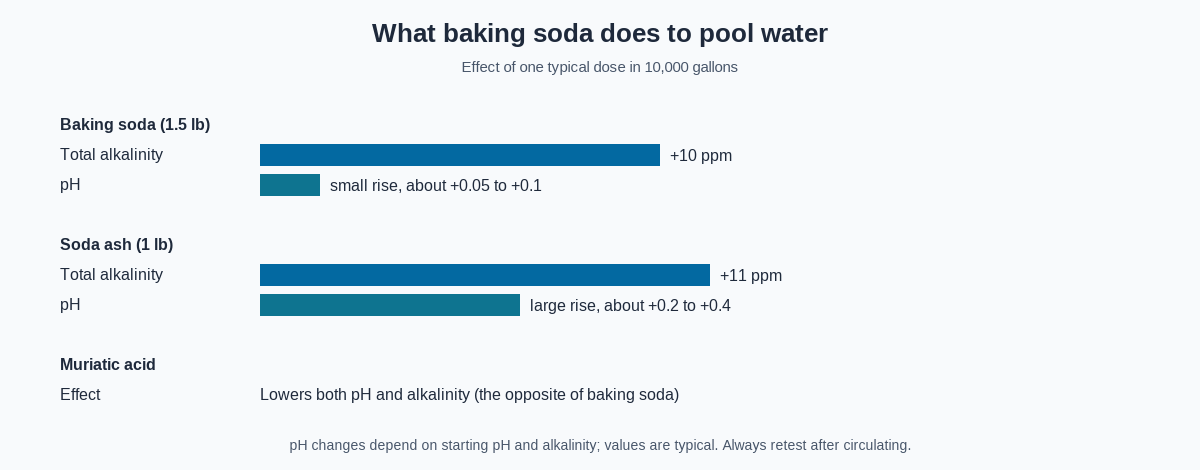
Chart: Asphapro.com
Quick Answer
To add baking soda to pool water, test total alkalinity first, then add 1.5 pounds of baking soda per 10,000 gallons for every 10 ppm you want to raise alkalinity. With the pump running, broadcast the baking soda over the surface in a wide arc across the deep end, or pre-dissolve it in a bucket of pool water for vinyl and small pools. Add about three quarters of the dose, wait at least 6 hours, retest and add the rest if needed. Baking soda in pool water raises alkalinity a lot and pH only a little, so it is the right choice when alkalinity is low (under 80 ppm). If pH is low but alkalinity is fine, aerate or use soda ash instead.
Baking soda is one of the most useful, cheapest and safest chemicals a pool owner can keep on hand. It is the same sodium bicarbonate you find in the baking aisle. In a pool, it is the main ingredient in products sold as "alkalinity increaser" or "alkalinity up," often at several times the price per pound of plain baking soda from a warehouse store.
This guide explains what baking soda does in a pool, how much baking soda to add to pool water, how to add it step by step, and when to use something else. For the full method of fixing low alkalinity, including target ranges for different pools, see our guide on how to raise alkalinity in pool water.
What Does Baking Soda Do for a Pool?
What does baking soda do for a pool? Its main job is to raise total alkalinity, which is the water's ability to resist changes in pH. When you dissolve baking soda in pool water, it adds bicarbonate, the main buffer in pool water. More bicarbonate means more buffering, so pH stays steadier when rain, chlorine, acid or swimmers push it around.
Baking soda has a natural pH of about 8.3, close to the upper end of the ideal pool range. That is why baking soda in pool water raises pH only slightly. In most pools, a normal dose nudges pH up by 0.05 to 0.2 at most, and sometimes pH barely moves. This makes baking soda the gentlest way to adjust water balance.
Baking soda also helps in a few other ways. Steady alkalinity protects plaster and grout from etching, keeps metal parts from corroding, and helps chlorine work at its best. Water with balanced alkalinity is also more comfortable for swimmers, with less eye and skin irritation.
What Does Baking Soda Do to a Pool That It Does Not Do?
It helps to know what baking soda does not do, because many owners expect too much from it. Baking soda does not kill algae, clear green water or sanitize the pool. It does not lower chlorine or "shock" the water. It is not a good way to raise pH when alkalinity is already in range, because you will push alkalinity too high before pH moves much. And it does not fix cloudy water on its own, although balanced alkalinity can help other treatments work better.
When to Add Baking Soda in Pool Water
Add baking soda when your total alkalinity test reads below your target, usually below 80 ppm for most pools, or below 60 to 70 ppm for salt pools that aim lower. Common times when alkalinity drops include after heavy rain, after a partial drain and refill with soft water, after adding a lot of acid to lower pH, and in pools that use trichlor tablets for weeks, since trichlor is acidic. Many owners also add baking soda when opening the pool in spring, after testing the water.
Do not add baking soda just because pH is low. Test both pH and alkalinity first. If both are low, add baking soda first to fix alkalinity, then check pH again. If only pH is low, aeration or soda ash is the better tool.
How Much Baking Soda to Add to Pool Water
The rule of thumb is 1.5 pounds of baking soda raises total alkalinity by about 10 ppm in 10,000 gallons. To work out how much baking soda to add to pool water, subtract your current alkalinity from your target, divide by 10, multiply by 1.5, and then adjust for your pool's volume in units of 10,000 gallons.
For example, a 15,000-gallon pool testing at 60 ppm with a target of 100 ppm needs a 40 ppm increase. That is 4 × 1.5 = 6 pounds per 10,000 gallons, times 1.5 for 15,000 gallons, which equals 9 pounds of baking soda. You would add about 7 pounds first, wait, retest, and then add up to 2 more pounds.
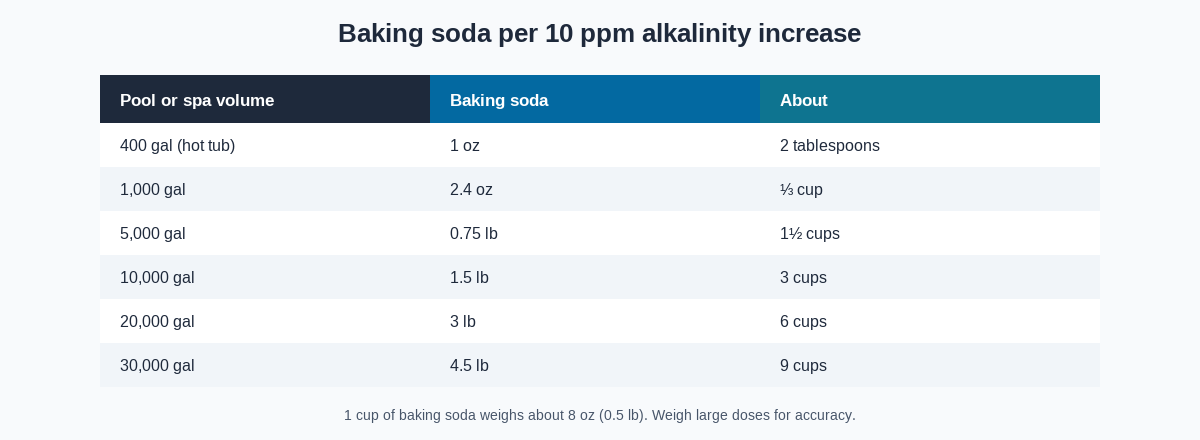
Chart: Asphapro.com
Baking Soda for Pool Calculator
Enter your pool volume and your current and target alkalinity to see how much baking soda for pool use you need, in pounds and approximate cups.
How to Add Baking Soda to Pool: Step by Step
1. Test the water. Test total alkalinity and pH with a drop kit or good test strips. Drop kits give more exact alkalinity readings.
2. Work out the dose. Use the rule of thumb, the chart or the calculator above. Make sure you know your pool's volume; see our guide on how many gallons is my pool if you are not sure.
3. Weigh it. Use a kitchen or bathroom scale for big doses. Measuring by cups is fine for small pools and spas, but scoops vary.
4. Turn on the pump. The pump should run during and after adding baking soda so it mixes through the pool.
5. Add about 75% of the dose. Adding in steps prevents overshooting.
6. Broadcast it over the water. Walk along the deep end and toss the powder in a wide arc low over the water, so wind does not carry it. Baking soda dissolves quickly. In vinyl pools, above ground pools and spas, dissolve it in a bucket of pool water first and pour it slowly in front of a return.
7. Brush. Brush any powder that settles on the floor so it dissolves.
8. Wait and retest. Wait at least 6 hours, ideally a full pump cycle, then test alkalinity and pH again. Add the rest of the dose if needed.
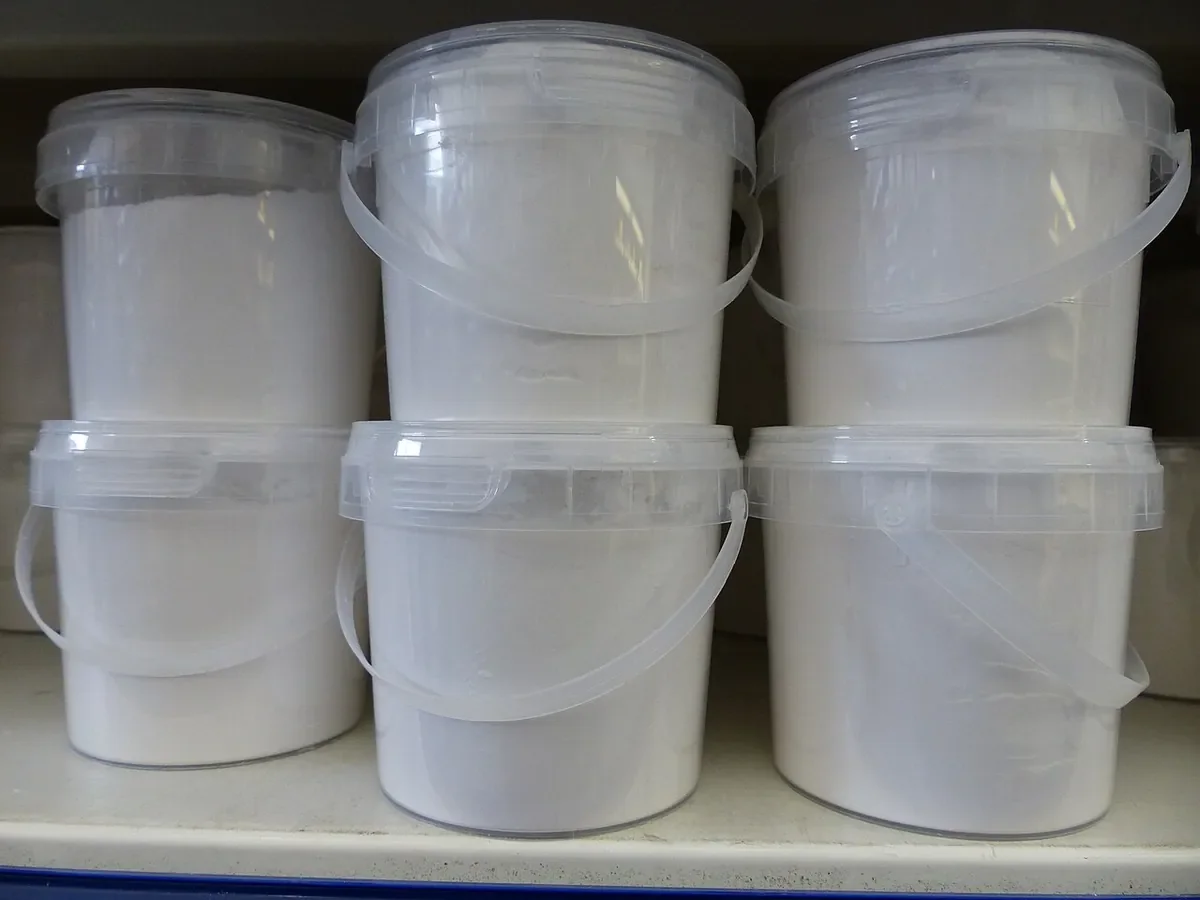
Photo: DracoEssentialis, Wikimedia Commons, CC BY 3.0
Baking Soda vs Alkalinity Increaser
Pool store alkalinity increaser is usually pure sodium bicarbonate, the same chemical as household baking soda. Check the label: if it lists only sodium bicarbonate, it works exactly the same. The main differences are price and grain size. Pool products may have slightly coarser grains that dissolve a bit more slowly and blow around less. Household baking soda in large bags from warehouse or grocery stores often costs much less per pound. Avoid baking soda products with added scents or other ingredients.
How Much Baking Soda to Raise pH in Pool Water?
Many owners search for how much baking soda to raise pH in pool water, but baking soda is not the best tool for raising pH on its own. Because its pH is about 8.3, baking soda pulls pool pH toward 8.3 only slowly, and it raises alkalinity much faster than pH. If you keep adding baking soda to push pH up, you will usually overshoot alkalinity first, which leads to cloudy water and scale.
That said, if both pH and alkalinity are low, adding baking soda for pool pH and alkalinity together often fixes both. A typical case: a pool at pH 7.0 and alkalinity 50 ppm. Raising alkalinity to 90 ppm with about 6 pounds of baking soda per 10,000 gallons often brings pH up to around 7.3 to 7.5 as well. If pH is still low after the baking soda has mixed in, aerate the water by running fountains and pointing returns at the surface, or add a small dose of soda ash. For more detail, see our guide on how to raise pH in pool water.
How Much Baking Soda to Raise Alkalinity in Pool Water, by Pool Size
Here is how much baking soda to raise alkalinity in pool water by 10, 20 or 30 ppm for common pool sizes, using the 1.5 pounds per 10,000 gallons per 10 ppm rule.
For a 5,000-gallon above ground pool, a 10 ppm rise needs about 0.75 pounds, 20 ppm about 1.5 pounds, and 30 ppm about 2.25 pounds. For a 10,000-gallon pool, use 1.5, 3 and 4.5 pounds. For a 15,000-gallon pool, use 2.25, 4.5 and 6.75 pounds. For a 20,000-gallon pool, use 3, 6 and 9 pounds. For a 25,000-gallon pool, use 3.75, 7.5 and 11.25 pounds. For a 30,000-gallon pool, use 4.5, 9 and 13.5 pounds. These numbers make it easy to plan your baking soda pool alkalinity adjustments and buy the right size bag.
Baking Soda in Swimming Pool Water: Above Ground, Vinyl and Plaster
Baking soda in swimming pool water works the same way in every pool type, but how you add it can differ. In plaster and pebble pools, you can broadcast baking soda directly over the deep end, because a little powder on the floor will dissolve with brushing and does no harm. In vinyl liner pools and above ground pools, pre-dissolving is safer: undissolved powder sitting on the liner can leave marks, and brushing a liner hard can wrinkle it. In fiberglass pools, either method works, but brush away any settled powder.
Spas and hot tubs need very small doses. One ounce of baking soda in 400 gallons raises alkalinity about 15 ppm. Add it slowly with the jets running and the cover open, then wait about 30 minutes before retesting.
Baking Soda for Pool Alkalinity in Salt Water Pools
Salt pools are a special case for baking soda for pool alkalinity. The salt cell makes chlorine in a way that slowly raises pH, so many salt pool owners keep alkalinity lower, around 60 to 80 ppm. Lower alkalinity slows the pH rise and means less acid is needed. Use baking soda in a salt pool only when alkalinity drops below your target, and add it in small steps. Adding too much baking soda for alkalinity in pool water with a salt system makes pH climb faster and can increase scale on the cell. See our guide on how to maintain a saltwater pool for target levels.
What Does Baking Soda Do in a Pool With Trichlor Tablets?
Trichlor tablets are acidic, with a pH of about 3. Every tablet that dissolves in the pool slowly lowers pH and uses up alkalinity. Pools that rely on trichlor for weeks often see alkalinity fall below 60 ppm and pH drop toward 7.0 or lower. This is one of the most common reasons to use baking soda in a pool. Adding baking soda every few weeks counters the acid from the tablets and keeps the water balanced. If you find yourself adding a lot of baking soda pool after pool season, consider switching some of your chlorine to liquid chlorine, which does not lower alkalinity.
Adding Baking Soda to Pool Water After Rain
Rainwater is naturally slightly acidic and has almost no alkalinity. After heavy rain, pool alkalinity often drops by 10 to 30 ppm, and pH can drop too. The day after a storm, run the pump, skim debris, and test the water. If alkalinity is below target, adding baking soda to pool water is the quickest fix. If the water level rose a lot, lower it back to the middle of the skimmer first, so you dose the correct volume.
Photo: Benoît Prieur, Wikimedia Commons, CC0
What Does Baking Soda Do to Pool Water Clarity?
What does baking soda do to pool water clarity? In a balanced pool, it has no visible effect: it dissolves completely and the water stays clear. If you add a large amount at once, the water may look a little hazy near where you added it for a few minutes until the powder dissolves. If the pool already has high calcium hardness and high pH, a big dose of baking soda can tip the water toward scaling, which can cause a lasting haze. That is one more reason to test first and add in steps. If cloudiness persists, check pH, alkalinity and calcium, and see our guide on how to clear a cloudy pool.
Common Mistakes When Adding Baking Soda to a Pool
The first mistake is adding baking soda without testing. Without a test, you cannot know whether alkalinity is low, and you may push it too high. The second is trying to raise pH with baking soda alone when alkalinity is already fine. The third is adding the whole dose in one spot, especially in vinyl pools, where clumps can sit on the liner. The fourth is pouring baking soda into the skimmer in large amounts, which can cloud the water and clog the filter for a short time. The fifth is mixing baking soda with other chemicals in the same bucket. Always add one chemical at a time, with time between them, and never mix pool chemicals together.
Baking Soda Pool Myths
There are a few common baking soda pool myths. One is that baking soda clears green water. It does not; algae needs chlorine, brushing and filtration. Another is that baking soda lowers chlorine. It does not change chlorine levels. A third is that you should add baking soda every week. You only need it when a test shows low alkalinity. A fourth myth is that pool store alkalinity increaser is stronger than kitchen baking soda. If the label says sodium bicarbonate, it is the same chemical.
What Is Baking Soda Used for in a Pool Besides Alkalinity?
What is baking soda used for in a pool apart from raising alkalinity? It can be used to neutralize small acid spills on the deck, sprinkled on and then rinsed away with lots of water. Mixed into a paste, it is a gentle scrub for light stains and oily rings on tile, though a pool tile cleaner works better for heavy buildup; see our guide on how to clean pool tile. Some owners also use baking soda when cleaning a salt cell or other parts after an acid wash, to neutralize the used acid before disposal.
Storing Pool Baking Soda
Keep pool baking soda in a sealed container in a dry place, away from acid and chlorine products. Baking soda absorbs moisture and can clump if left open in a damp shed, which makes it harder to measure and slower to dissolve. A large plastic bucket with a lid works well. Label the container clearly so no one confuses it with another white powder such as cal-hypo shock or soda ash.
Worked Examples
Example 1: spring opening. A 20,000-gallon plaster pool opens in May with alkalinity at 70 ppm and pH at 7.3. The owner wants alkalinity at 90 ppm. The increase is 20 ppm, so the dose is 2 × 1.5 × 2 = 6 pounds. They broadcast 4.5 pounds over the deep end, run the pump overnight, and retest the next morning: alkalinity is 86 ppm and pH 7.4. They add the last 1.5 pounds and the pool settles at 90 ppm.
Example 2: vinyl pool after storms. A 12,000-gallon vinyl pool drops to 55 ppm after a week of rain. The target is 100 ppm, a 45 ppm increase. The dose is 4.5 × 1.5 × 1.2 = about 8 pounds. The owner dissolves the baking soda in three buckets of pool water and pours each in front of a return, an hour apart. The next day, alkalinity reads 95 ppm.
Example 3: hot tub. A 350-gallon hot tub reads 50 ppm. Raising it to 90 ppm needs about 40 ppm, or roughly 2.5 ounces of baking soda. The owner adds it with the jets on and retests after 30 minutes.
How to Test Before and After
The best way to answer "baking soda in pool how much" is a good test. Drop-based alkalinity tests use a sample of pool water, an indicator that turns it green, and a reagent added one drop at a time until the color changes to red. Each drop equals 10 ppm in most kits. Test strips are quicker but less exact, especially for small changes. Test before you add baking soda, then again after at least 6 hours of circulation. Keep a log of your readings and doses; over a season, you will learn how fast your pool loses alkalinity and how much baking soda it usually needs.
Why Baking Soda and Pool Water Chemistry Go Together
Baking soda and pool water chemistry are closely linked because bicarbonate is the main buffer in almost every pool. Even pools that never get baking soda have bicarbonate from tap water and from carbon dioxide in the air. When alkalinity is in range, the bicarbonate soaks up the acid from rain, chlorine and swimmers, and pH stays steady. Adding baking soda simply tops up that natural buffer. This is why the same chemical has been used in pools for decades: it is cheap, safe, easy to handle and does exactly one job well.
Safety When Adding Baking Soda
Baking soda is among the safest pool chemicals, but basic care still applies. Wear eye protection if you broadcast it on a windy day, since the fine powder can blow back into your face. Keep it away from children and pets, even though it is not toxic in small amounts. Never mix it with acid in a bucket, which causes rapid fizzing. Add chemicals to water, not water to chemicals, and wait several hours between adding baking soda and adding acid or other balancing chemicals, so you can test each change clearly.
Where to Buy and How Much It Costs
Plain sodium bicarbonate is sold almost everywhere. Grocery stores carry small boxes, which are fine for spas but expensive for pools. Warehouse clubs sell 12- to 15-pound bags at a low price per pound. Pool stores sell alkalinity increaser in 5- to 50-pound containers. Farm supply stores sometimes carry 50-pound bags of feed-grade sodium bicarbonate, which is the same chemical and often the cheapest option. For most pools, a season's supply costs $15 to $50. Compare the price per pound, check that the only ingredient is sodium bicarbonate, and buy enough to handle a couple of rainy weeks without another trip to the store.
How to Add Baking Soda to Pool: Key Points
- Baking soda raises alkalinity a lot and pH only a little.
- 1.5 lb per 10,000 gallons raises alkalinity about 10 ppm.
- Add 75% of the dose, wait 6 hours, retest, then finish.
- Broadcast over the deep end with the pump on, or pre-dissolve for vinyl pools.
Frequently Asked Questions
Can I swim after adding baking soda to my pool?
Yes. Wait until the powder dissolves and has mixed for about an hour. Baking soda is safe to swim in, and many people cannot tell any difference in the water.
Can you add too much baking soda to a pool?
Yes. Too much raises alkalinity above range, which can cause cloudy water, scale and pH that keeps drifting up. Fix it with acid and aeration: add muriatic acid to lower pH and alkalinity, then aerate to bring pH back up while alkalinity stays lower, and repeat until it is in range.
What does baking soda do in a swimming pool?
It raises total alkalinity, which steadies pH. It raises pH only slightly, and it does not sanitize or clear the water.
Is baking soda for a pool the same as alkalinity increaser?
Yes, if the alkalinity increaser label lists only sodium bicarbonate. Pool alkalinity baking soda from a grocery store works the same way and often costs less.
How do I add baking soda to a pool without clouding it?
Add it in steps, broadcast it widely or pre-dissolve it, and keep the pump running. Any light haze from the powder clears within minutes. If the haze lasts, check pH and calcium hardness, which may be high.
Is there a calculator for baking soda doses?
Yes. Use the baking soda calculator above, which shows pounds, cups and a first dose for your pool size.
Sources
- CDC: Pool chemistry and testing
- Trouble Free Pool: Pool water chemistry
- Swim University: Baking soda for pools
- Pool and Hot Tub Alliance