
How to Lower pH in Pool Water: Step-by-Step With Doses
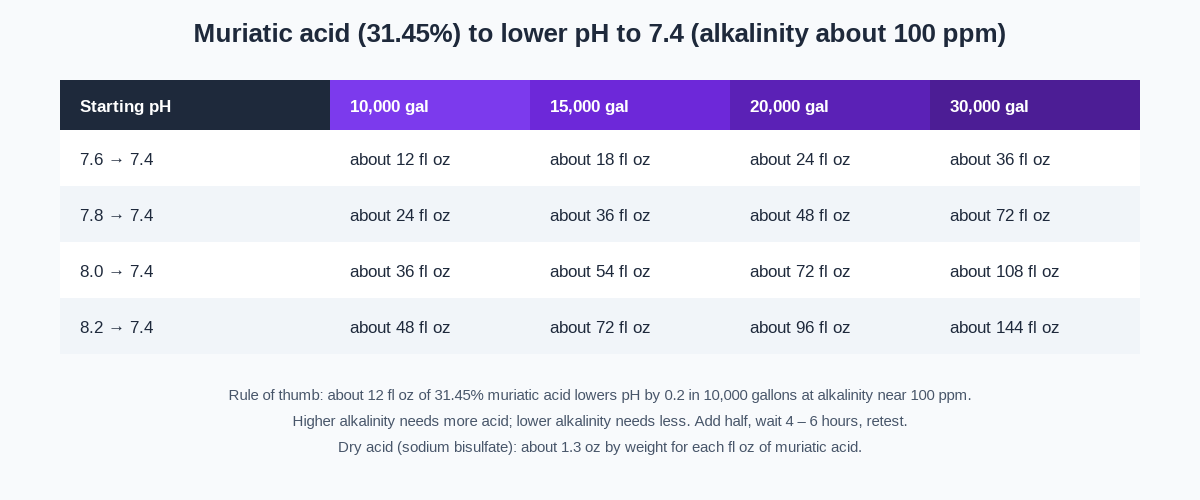
Chart: Asphapro.com
Quick Answer
How to lower pH in pool water: add an acid, either muriatic acid (hydrochloric acid, usually 31.45% or 14.5%) or dry acid (sodium bisulfate, sold as "pH Down"). As a rule of thumb, about 12 fl oz of 31.45% muriatic acid lowers pH by 0.2 in 10,000 gallons when alkalinity is near 100 ppm. With the pump running, pour the acid slowly in front of a return jet in the deep end (or pre-dilute it in a bucket of pool water, always adding acid to water), wait 4 to 6 hours, and retest. Add about half the calculated dose first. Aim for pH 7.4 to 7.6. If pH keeps rising, lower total alkalinity too, and check for causes like salt cells and aeration.
High pH in pool water, or ph in pool is high readings on your test kit, is one of the most common pool water problems, especially in salt pools, new plaster pools and pools with waterfalls or spillovers. When pH climbs above about 7.8, chlorine becomes much less effective, calcium starts to come out of the water as scale and cloudiness, and swimmers may notice itchy skin and red eyes. Lowering pH is simple once you know which product to use and how much.
This guide explains how to lower pH in pool water step by step: what causes high pH, how muriatic acid and dry acid work, how much to add with a calculator and dose charts, how to add acid safely, how to lower pH and alkalinity together, how to keep pH from rising, and what to do in salt pools. If your pH is low instead, see how to raise pH in pool.
Muriatic Acid Pool Calculator
Use this calculator to estimate how much muriatic acid or dry acid to add to lower pH to your target. It adjusts for pool size, acid strength and total alkalinity.
This muriatic acid pool calculator gives an estimate. Water with higher alkalinity resists pH change and needs more acid; water with low alkalinity reacts strongly and needs less. Always add about half, circulate for 4 to 6 hours, and retest before adding more.
What Is the Right pH, and What Does High pH Do?
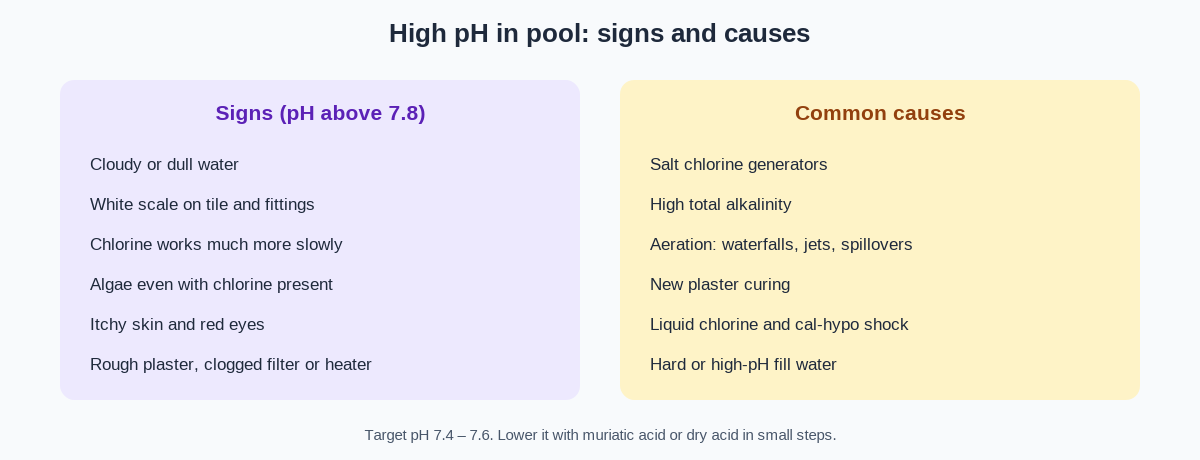
Chart: Asphapro.com
The ideal pool pH is 7.4 to 7.6, and 7.2 to 7.8 is acceptable. High pH in pool water (above 7.8) causes:
- Weak chlorine: at pH 8.0, a much smaller share of chlorine is in its strong, germ-killing form than at 7.5, so algae and cloudiness can appear even with a normal chlorine reading.
- Scale: calcium deposits form on tile, plaster, the heater and the salt cell.
- Cloudy water: fine calcium particles and poor sanitizing both cloud the pool.
- Discomfort: high pool pH can cause dry, itchy skin and eye irritation.
- Equipment wear: scale clogs filters and reduces heater efficiency.
What Causes High pH in Pool Water?
If your pool ph high readings keep coming back, one of these is usually the reason. High pH pool water rarely happens by chance.
- Salt chlorine generators produce sodium hydroxide as a byproduct, which pushes pH up steadily.
- High total alkalinity: carbon dioxide escapes from the water, raising pH; high alkalinity feeds this drift.
- Aeration: waterfalls, fountains, spillovers and jets speed up the loss of carbon dioxide.
- New plaster: fresh plaster releases lime for weeks or months.
- Liquid chlorine and cal-hypo are slightly basic and raise pH a little each time.
- Fill water with high pH or high alkalinity.
- Too much pH increaser or baking soda.
How to Lower pH in Pool: Step by Step
Here is how to lower pool pH safely. These are the same steps for how to lower pH in swimming pool water of any type, and the basic method for how to bring pH down in pool water after any spike.
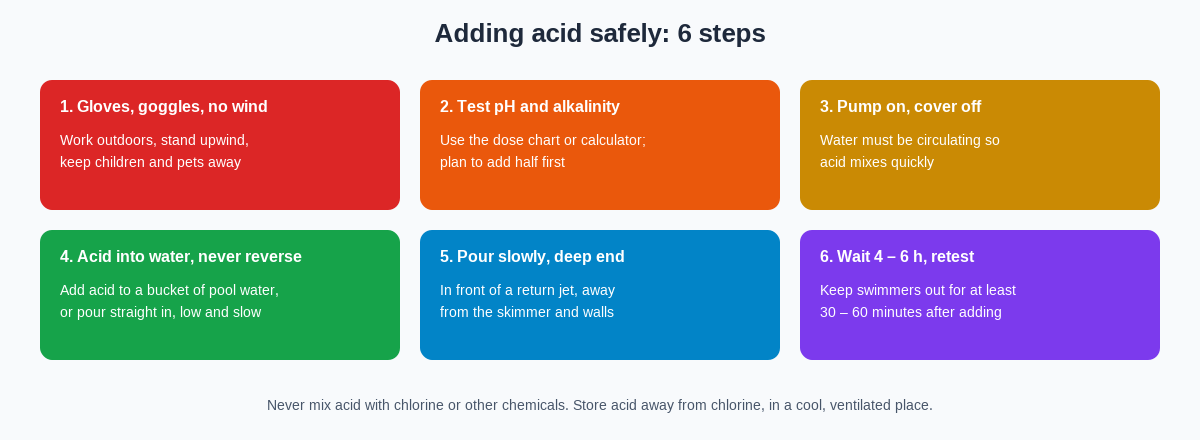
Diagram: Asphapro.com
- Test pH and total alkalinity. Note both numbers.
- Work out the dose with the calculator or chart, and plan to add half.
- Put on gloves and eye protection. Work outdoors, upwind of the acid.
- Turn on the pump and keep it running.
- Add the acid: pour it slowly and low, close to the water, in front of a return jet in the deep end. If you prefer, fill a plastic bucket with pool water and slowly add the acid to the water (never water to acid), then pour it in.
- Keep acid away from the skimmer, walls and steps, and do not let it pool on the floor of a vinyl or plaster pool.
- Wait 4 to 6 hours with the pump running.
- Retest and add more if needed.
What Does Muriatic Acid Do for a Pool?
Muriatic acid is a diluted form of hydrochloric acid. In a pool it does three main jobs:
- Lowers pH: the acid neutralizes the basic compounds that push pH up.
- Lowers total alkalinity: each dose also reduces alkalinity, which is useful when alkalinity is high and keeps pushing pH up.
- Cleans: diluted muriatic acid is used to remove scale and stains, and for acid washing plaster pools (a job for pros).
What does muriatic acid do to a pool if overused? It can drive pH and alkalinity too low, which etches plaster, corrodes metal parts and can wrinkle vinyl. That is why small doses and retesting matter. Pool muriatic acid is sold in two common strengths: 31.45% (about 20° Baumé, the standard) and 14.5% "low-fume" or "half-strength" acid, which is milder to handle but needs about twice the volume.
Muriatic Acid vs Dry Acid (pH Down)
| Feature | Muriatic acid | Dry acid (sodium bisulfate) |
|---|---|---|
| Form | Liquid | Granular powder |
| Cost | Lowest per dose | Higher per dose |
| Handling | Strong fumes; splash risk | Easier to store and measure; dust can irritate |
| Side effects | Adds chlorides (minor) | Adds sulfates, which can affect plaster and salt cells over time |
| Best for | Regular dosing, larger pools | Small pools, spas, owners who prefer not to handle liquid acid |
Most "pH Down" or "pH Decreaser" products sold for pools are dry acid. Read the label for the active ingredient. Both work; muriatic acid is the more common choice for inground pools because it is cheaper and does not build up sulfates.
How to Lower Alkalinity and pH Together
If total alkalinity is above about 120 to 150 ppm, pH will keep rising no matter how often you add acid. To bring alkalinity down, many pool owners use the "acid and aerate" method:
- Add enough acid to lower pH to about 7.0 to 7.2.
- Aerate the water: point return jets up, run waterfalls or spillovers, or use an air blower. This drives off carbon dioxide and raises pH back up without raising alkalinity.
- When pH rises back to about 7.6 to 7.8, add acid again to bring it back down to 7.2.
- Repeat over several days until alkalinity reaches your target (often 60 to 90 ppm for salt and plaster pools, 80 to 120 ppm for vinyl).
Each cycle lowers alkalinity a little, while pH ends up in range. Test pH and alkalinity daily during this process.
Lowering pH in a Salt Water Pool
Salt pools are known for rising pH because the salt cell makes sodium hydroxide as it makes chlorine. To manage high pool pH in a salt pool:
- Keep total alkalinity lower, often 60 to 80 ppm.
- Add borates (30 to 50 ppm), which buffer pH and slow the rise.
- Run the salt cell at the lowest output that keeps chlorine in range.
- Add acid regularly in small doses, or use an automatic acid feeder.
- Clean the salt cell when scale builds up.
For more on salt systems, see salt pool versus chlorine.
How to Lower pH in Pool Quickly
If you need to lower pH in pool water quickly, muriatic acid works fastest. Pour it in front of a return with the pump on high, brush the pool to mix, and retest after an hour. pH changes within 30 to 60 minutes, though full mixing takes a few hours. Avoid adding a large dose at once to "save time"; overshooting pH below 7.0 creates a new problem to fix.
Common Mistakes When Lowering pH
- Adding water to acid instead of acid to water, which can cause violent splashing.
- Pouring acid into the skimmer, which sends concentrated acid through the pump, filter and heater.
- Adding the full dose at once without retesting.
- Ignoring alkalinity, so pH keeps bouncing back up.
- Adding acid and chlorine at the same time or mixing them in one bucket. This can release toxic chlorine gas.
- Swimming right after adding acid. Wait at least 30 to 60 minutes.
- Testing pH right after shocking, when high chlorine can make pH readings false.
Storing Muriatic Acid Safely
- Keep acid in its original, closed container, in a cool, ventilated place.
- Store it away from chlorine, ideally in a separate area; fumes from acid can react with chlorine products.
- Keep it away from metal tools and equipment, which the fumes will corrode.
- Keep it out of reach of children and pets.
- Have water nearby to rinse skin or eyes in case of a splash.
How to Keep pH From Rising
- Keep total alkalinity in the right range for your pool type.
- Run waterfalls and spillovers only when you are enjoying them.
- Add borates to buffer pH.
- In salt pools, run the cell at the lowest effective output.
- Test pH 2 to 3 times a week and correct small changes early.
What Lowers pH in a Pool?
What lowers pool pH is anything acidic. The options, from most to least common:
- Muriatic acid: the standard, low-cost choice. Muriatic acid for pool use lowers pH and alkalinity together.
- Dry acid (sodium bisulfate): the powder in most pool pH down products.
- Carbon dioxide (CO2) feeders: used in some commercial pools; they lower pH without lowering alkalinity much.
- Trichlor tablets: acidic, so they slowly lower pH as they dissolve, but they also add stabilizer, so they are not a pH tool.
- Rain: naturally a little acidic, which is why pH sometimes drops after storms.
Baking soda, soda ash and borax all raise pH. So if you are asking "does baking soda lower pH in pool water?", the answer is no.
How Much Muriatic Acid to Lower pH in Pool: Worked Examples
Example 1: 15,000 gallon pool, pH 7.9, alkalinity 100
Target pH 7.5 is a drop of 0.4, or two steps of 0.2. That needs about 12 fl oz x 2 x 1.5 = 36 fl oz of 31.45% acid. Add about 18 fl oz, wait 4 to 6 hours, retest, and add the rest if needed.
Example 2: 20,000 gallon salt pool, pH 8.1, alkalinity 80
A drop of 0.6 at 20,000 gallons and lower alkalinity: about 12 x 3 x 2 x 0.8 = 58 fl oz. Add about 29 fl oz first. Salt pools need this kind of correction often, so many owners add a smaller amount every few days.
Example 3: 24 ft round above ground pool (about 13,000 gallons), pH 7.8, alkalinity 120
A drop of 0.4 with higher alkalinity: about 12 x 2 x 1.3 x 1.2 = 37 fl oz. Start with about 18 fl oz.
These examples show why the same pH change needs different amounts of acid in different pools. The muriatic acid pool calculator above does the math for you.
Adding Muriatic Acid to Swimming Pool Water: Direct or Diluted?
There are two common ways of adding muriatic acid to pool water:
- Pour directly: many pool pros pour acid slowly and low into the deep end in front of a return jet with the pump running. The water flow mixes it quickly. Keep the jug close to the surface to avoid splashing and fumes.
- Pre-dilute in a bucket: fill a plastic bucket about three-quarters with pool water, then slowly add the acid to the water. Pour the mix into the pool in front of a return. This lowers the risk of splashing strong acid, which some owners prefer.
Either way, always add acid to water, never water to acid; wear gloves and goggles; stand upwind; and never use a metal bucket. When adding muriatic acid to swimming pool water with a vinyl liner, spread it along the deep end so it does not settle in one spot.
High pH in Swimming Pool Water After Shock, Rain or Refill
After shocking
Liquid chlorine and cal-hypo raise pH a little. Also, very high chlorine can give a false high pH reading. Wait until chlorine drops below about 10 ppm before testing and adjusting pH.
After rain
Rain usually lowers pH and alkalinity, but runoff from limestone, concrete decks or fertilized lawns can raise them. Test after storms rather than guessing.
After refilling or topping up
Some fill water has pH above 8.0 and high alkalinity, especially from wells. Test the tap water once so you know what you are adding. If it is high, expect to add acid after each top-up.
New plaster
Fresh plaster releases lime that keeps pushing pH up for several weeks. Follow your plasterer's start-up instructions and test daily during this period.
Testing pH Accurately
Accurate pH readings make dosing much easier. Take samples from elbow depth away from returns, test at the same time of day, and use fresh reagents or strips. A drop test kit with a phenol red indicator is the standard, and a digital tester is faster when calibrated. If pH reads above about 8.2, many kits cannot show the true value, so add some acid, wait and retest. An acid demand test, included in better kits, tells you how much acid a sample needs to reach your target, which is especially useful for large corrections.
Lowering pH in Above Ground Pools and Spas
The method is the same for an above ground pool, but doses are smaller and easier to overshoot, so measure carefully and add a third to half the calculated dose at first. In hot tubs and spas, pH changes quickly because the water is hot and the volume is small. Use dry acid or a spa pH decreaser in teaspoon amounts, run the jets, wait 30 minutes and retest. Spas with heavy jet aeration tend to drift up in pH often.
Acid Feeders and Automation
If your pool needs acid every few days, an automatic acid feeder can take over. A pH controller with a probe measures pH continuously and pumps small amounts of acid (or CO2) into the return line to hold pH at your set point. Systems cost about $800 to $3,000 installed. They are common in commercial pools and increasingly popular for salt pools at home. Keep the acid tank in a ventilated area, calibrate the probe monthly and still test the water by hand once a week to confirm the readings.
How to Reduce pH in Pool Water for the Long Term
Lowering pH once is easy; keeping it down is the real goal. The best long-term steps are to keep alkalinity at the low end of the range for your pool type, add borates to buffer pH, cut back on aeration, use a stabilized or acid-based chlorine source when it makes sense, and test often enough to catch small changes. A pool that holds pH between 7.4 and 7.6 most of the week is easier on surfaces, equipment and swimmers, and uses less chlorine.
Muriatic Acid Safety: First Aid
- Skin: rinse with plenty of water for at least 15 minutes and remove splashed clothing.
- Eyes: rinse immediately with clean water for at least 15 minutes, holding the eyelids open, and get medical help.
- Fumes: move to fresh air. If breathing is difficult, seek medical help.
- Swallowed: do not make the person vomit; call poison control or emergency services right away.
Read the product label and safety data sheet before using any swimming pool muriatic acid, and keep emergency numbers handy.
pH, Alkalinity and Calcium: How They Work Together
pH does not act alone. Total alkalinity is the water's buffer, which resists pH change; calcium hardness and temperature decide whether water tends to scale or etch. Pool pros use a saturation index (often called the LSI) that combines pH, alkalinity, calcium, temperature and dissolved solids to judge whether water is balanced. High pH, high alkalinity and high calcium together, especially in hot water, almost guarantee scale and cloudiness. Lowering pH is the fastest way to bring that balance back, but keeping alkalinity and calcium in range is what keeps it there.
A simple target for most residential pools: pH 7.4 to 7.6, alkalinity 60 to 90 ppm for salt and plaster pools or 80 to 120 ppm for vinyl and fiberglass, and calcium 200 to 400 ppm for plaster (lower for vinyl). If your numbers fit those ranges, pH usually stays steady with only small weekly corrections.
When to Call a Pool Professional
Most owners can lower pH themselves. Consider calling a pro if pH will not stay down even after lowering alkalinity, if you have heavy scale on tile, heaters or salt cells, if a new plaster start-up is under way, or if you are uncomfortable handling acid. A service visit typically costs $75 to $150, and a pro can also test for calcium, total dissolved solids and metals that affect how your water behaves.
How to Lower pH in Pool: Key Points
- Use muriatic acid or dry acid to lower pH.
- About 12 fl oz of 31.45% muriatic acid lowers pH 0.2 in 10,000 gallons at alkalinity 100.
- Add half the dose, wait 4 to 6 hours, retest.
- Always add acid to water, with gloves and goggles, pump running.
- If pH keeps rising, lower alkalinity and check for salt cells and aeration.
Frequently Asked Questions
How do I lower the pH in my swimming pool?
Add muriatic acid or dry acid in front of a return jet with the pump running, wait 4 to 6 hours and retest.
Does baking soda lower pH in a pool?
No. Baking soda raises alkalinity and slightly raises pH. Use acid to lower pH.
How much muriatic acid to add to pool water?
About 12 fl oz of 31.45% acid per 10,000 gallons lowers pH by 0.2 when alkalinity is near 100 ppm. Use the calculator for your numbers and add half first.
How do I lower the pH in my pool without chemicals?
You cannot lower pH without some form of acid. Aeration raises pH, so turning off waterfalls slows the rise, but acid is needed to bring it down.
How long after adding muriatic acid can you swim?
Usually 30 to 60 minutes after it has mixed, or as the label says. Retest pH first and make sure it is back in range.
What lowers pH in pool water the fastest?
Muriatic acid. It acts within minutes and fully mixes in a few hours with the pump running.
Is high pH in a pool dangerous?
Not immediately, but it makes chlorine weak, which can allow germs and algae, and it causes scale and skin irritation. Correct it within a day or two.
Can I swim with high pH in the pool?
Briefly, a slightly high pH (7.8 to 8.0) is not harmful, but eyes and skin may sting and chlorine protection is weaker. Lower it before regular use.
Can I use vinegar to lower pool pH?
Not practically. Household vinegar is too weak and you would need huge amounts. Use pool acid.
How often should I add acid to my pool?
It depends on the pool. Many plaster and salt pools need a small dose every few days to once a week. Test 2 to 3 times a week and dose when pH reaches about 7.8.
Why does my pool pH keep going up?
Common causes are high alkalinity, a salt cell, aeration from water features and new plaster. Lower alkalinity and reduce aeration.
Is pH down the same as muriatic acid?
Most pH down products are dry acid (sodium bisulfate). Both lower pH; muriatic acid is a liquid and usually cheaper.
How to add muriatic acid to pool with a vinyl liner?
The same way: pump on, pour slowly in front of a return in the deep end, and keep it from pooling on the liner.
Sources
- CDC: Pool chemistry and testing
- Trouble Free Pool: Pool water chemistry
- Swim University: How to lower pool pH
- OSHA: Chemical hazards and safe handling