
Pool Excavation Cost: What It Costs to Dig a Swimming Pool
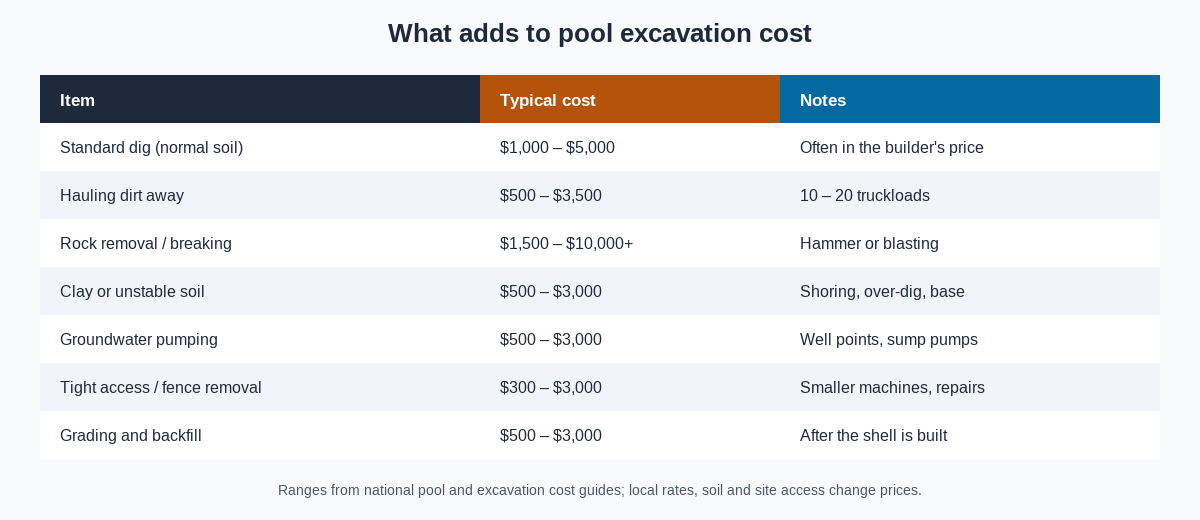
Chart: Asphapro.com
Quick Answer
The typical pool excavation cost for a residential inground pool is about $1,000 to $5,000 for a standard dig in normal soil, often included in the pool builder's price. Hauling the dirt away adds about $500 to $3,500, since a 16 x 32 foot pool produces about 170 cubic yards of loose soil, or roughly 14 truckloads. Rock can add $1,500 to $10,000 or more, and clay, groundwater, tight access and slopes add more. All in, most swimming pool excavation jobs land between $2,000 and $10,000, with difficult sites going higher. Ask for a soil test or a rock clause in the contract so surprises are priced up front.
Pool excavation is the first big step in building an inground pool, and one of the hardest to price before the digging starts. The surface of a backyard can look the same over clean soil, buried rock, an old foundation or a high water table. That is why pool contracts often include an allowance for pool excavation and separate clauses for rock and water.
This guide breaks down pool excavation cost: what a standard dig includes, how much dirt a pool produces, what hauling costs, how rock, clay, groundwater and access affect the price, and how to estimate your own dig. For the full cost of a new pool, see our guides to small inground pool cost and how much does a 12x24 inground pool cost.
What Is Included in Pool Excavation?
Pool excavation is more than digging a hole. A typical job starts with the layout: the builder marks the pool outline on the ground with paint and stakes, adds the over-dig zone around the edge, and sets grade stakes for depth. The excavator operator then digs the shallow end, the slope and the deep end to the planned shape, leaving extra room around the walls for forms, steel, plumbing or wall panels. The dug soil is either piled on site, spread around the yard, or loaded into trucks and hauled away.
After the pool excavation, the crew trims the walls and floor by hand to the final shape. For concrete pools, the floor is shaped to the exact profile of the pool. For vinyl pools, the floor is shaped to the liner pattern, often with a hopper in the deep end. For fiberglass pools, the hole is dug slightly larger than the shell, and a base of gravel or sand is laid and leveled so the shell sits evenly. Later, after the pool is built, the space around the walls is backfilled and compacted, and the yard is graded.
Swimming Pool Excavation Cost by Pool Type
Concrete (gunite or shotcrete) pools. The hole is dug close to the final shape of the pool, with about a foot of over-dig for steel and forms. Concrete pools can be any shape and depth, so the swimming pool excavation can be simple or complex. Deep diving wells and freeform shapes take longer to dig and trim.
Vinyl liner pools. The hole is dug with about 2 feet of over-dig around the walls for the wall panels and bracing. The floor is shaped to match the liner. Pool excavation for vinyl pools is usually quicker because the shapes are standard.
Fiberglass pools. The hole must match the shell closely, with a level gravel or sand base. Accuracy matters more than speed, because an uneven base can stress the shell. Fiberglass pools are often shallower than concrete pools, which reduces dirt volume.
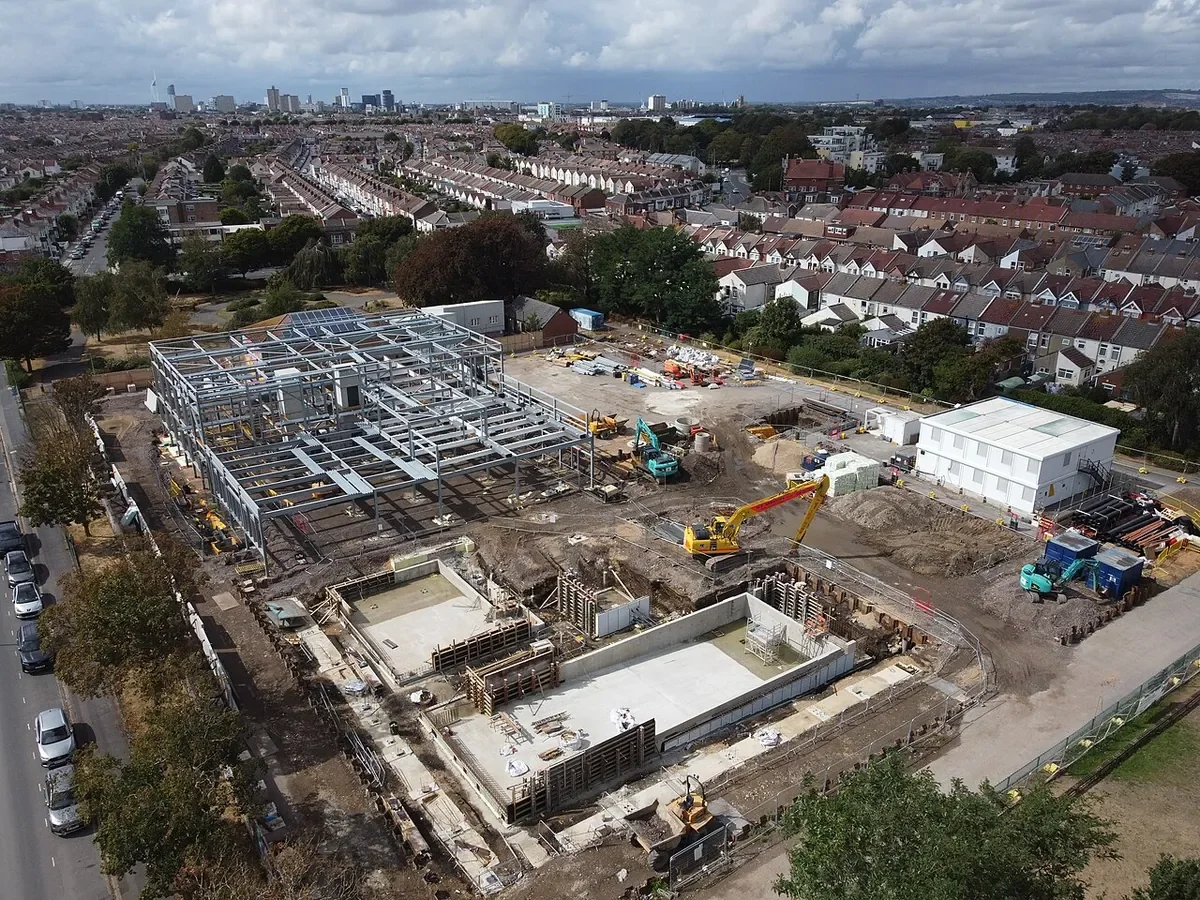
Photo: Tim Sheerman-Chase, Wikimedia Commons, CC BY 4.0
How Much Dirt Does a Pool Excavation Remove?
A pool excavation removes far more dirt than most owners expect. A 16 x 32 foot pool with an average depth of 5.5 feet, plus over-dig, removes about 136 cubic yards of soil from the ground. Once dug, soil loosens and swells by about 25%, so there are roughly 170 cubic yards to move. That is around 14 loads in a standard 12-cubic-yard dump truck. Clay and rocky soils swell even more.
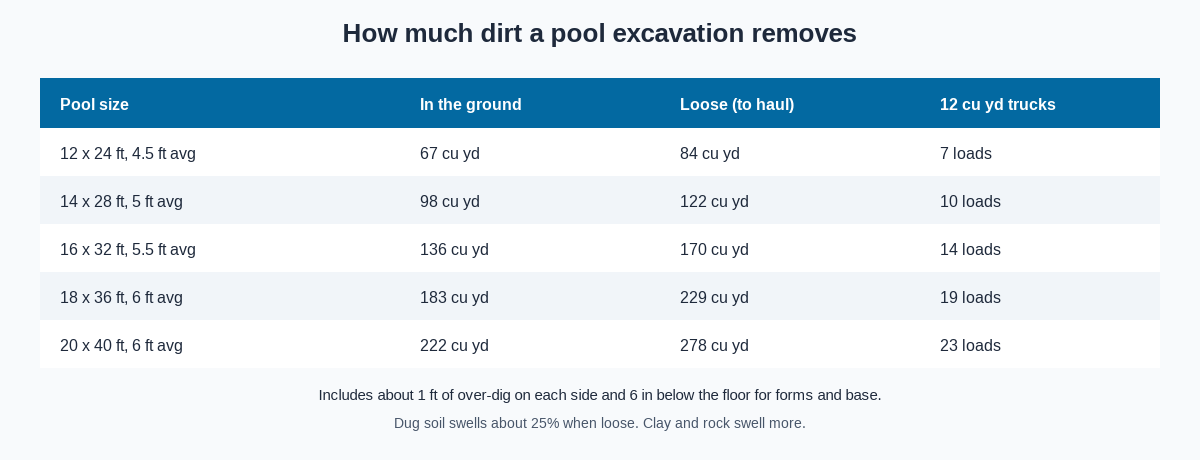
Chart: Asphapro.com
Pool Excavation Calculator
Use this calculator to estimate the dirt volume and the cost of pool excavation and hauling for your pool. Enter the pool size, average depth and local prices per cubic yard. Default prices are typical national averages; ask local excavators for their rates.
Pool Excavation Hauling: Remove the Dirt or Keep It?
Hauling is often the second-largest part of pool excavation cost. Trucking companies usually charge by the load or by the hour, often $75 to $150 per hour or $100 to $250 per load depending on distance to the dump site and local rules. Some areas charge dump fees on top. For a 16 x 32 pool with about 14 loads, hauling can easily cost $1,500 to $3,500.
Keeping some or all of the dirt on site saves money. Pool builders often use part of the soil for backfill around the pool walls once the shell is built, and spread the rest to build up low areas, create raised planting beds, or form a berm. Clean fill is sometimes in demand, so a local landscaper or contractor may take it for free or even pay for it. Ask your builder early how much soil will stay and how much must go, because a big pile of dirt in a small yard can block access and damage lawns. Note that topsoil and subsoil are different: subsoil and clay make poor garden soil, so save the topsoil separately if you plan to replant.
Rock and Pool Excavation Cost
Rock is the biggest wild card in pool excavation. A thin layer of loose rock may be dug out with a large excavator bucket. Solid rock or large boulders need a hydraulic hammer on the excavator, which breaks rock slowly and adds time and machine cost. In extreme cases, blasting may be needed, which requires permits and licensed crews. Rock removal can add $1,500 to $10,000 or more, and large or very hard rock can add much more.
Because rock is hard to predict, most builder contracts include a rock clause: a set price per hour or per cubic yard for rock removal, or a cap on how much the owner will pay. Read this clause carefully. If your area is known for rock, consider asking for test holes or a soil boring before you sign, which may cost a few hundred dollars but can prevent a much larger surprise. You can also look up the soil type for your property on the USDA Web Soil Survey, which shows depth to bedrock in many areas.
Pool Excavation in Clay, Sand and Unstable Soil
Clay soil is dense and sticky. It digs slowly, swells when wet and shrinks when dry, which can stress pool walls and decks. Builders may over-dig and add a gravel base, use extra steel, or recommend drainage to manage clay. Sandy soil digs easily but can cave in, so walls may need to be cut at a slope or shored, which adds work. Fill soil, such as land that was built up in the past, may need extra compaction or deeper footings. Each of these can add $500 to $3,000 to the cost of pool excavation, and sometimes more if engineering is needed.
Pool Excavation on Wet Sites and Groundwater
If the pool excavation hits groundwater, the hole can fill with water, the walls can collapse, and the pool cannot be built until the water is controlled. Builders use sump pumps or well points around the hole to lower the water level during construction. Pumping can add $500 to $3,000 and slow the job. In areas with a high water table, the builder may install a hydrostatic relief valve in the pool floor and a permanent drain system, which protects the pool from lifting when it is drained in the future. Wet sites also affect the choice of pool type, since empty fiberglass and vinyl pools are vulnerable to groundwater pressure.
Pool Excavation Cost for Tight Access, Slopes and Obstacles
Access can change swimming pool excavation costs a lot. Full-size excavators and dump trucks need an opening about 8 to 10 feet wide to reach the backyard. If the only access is a narrow side yard, the crew may need a mini excavator and small dump carts, which take much longer. Fences may need to come down, sprinklers and lawns may be damaged, and driveways may need protection from heavy trucks. Expect $300 to $3,000 in extra costs for difficult access, plus repairs afterward.
Sloped yards may need cut-and-fill grading, retaining walls or extra digging to set the pool level. Buried obstacles such as old foundations, septic tanks, tree roots and utility lines can also slow the dig. Always call 811 to have buried utilities marked before any digging begins.
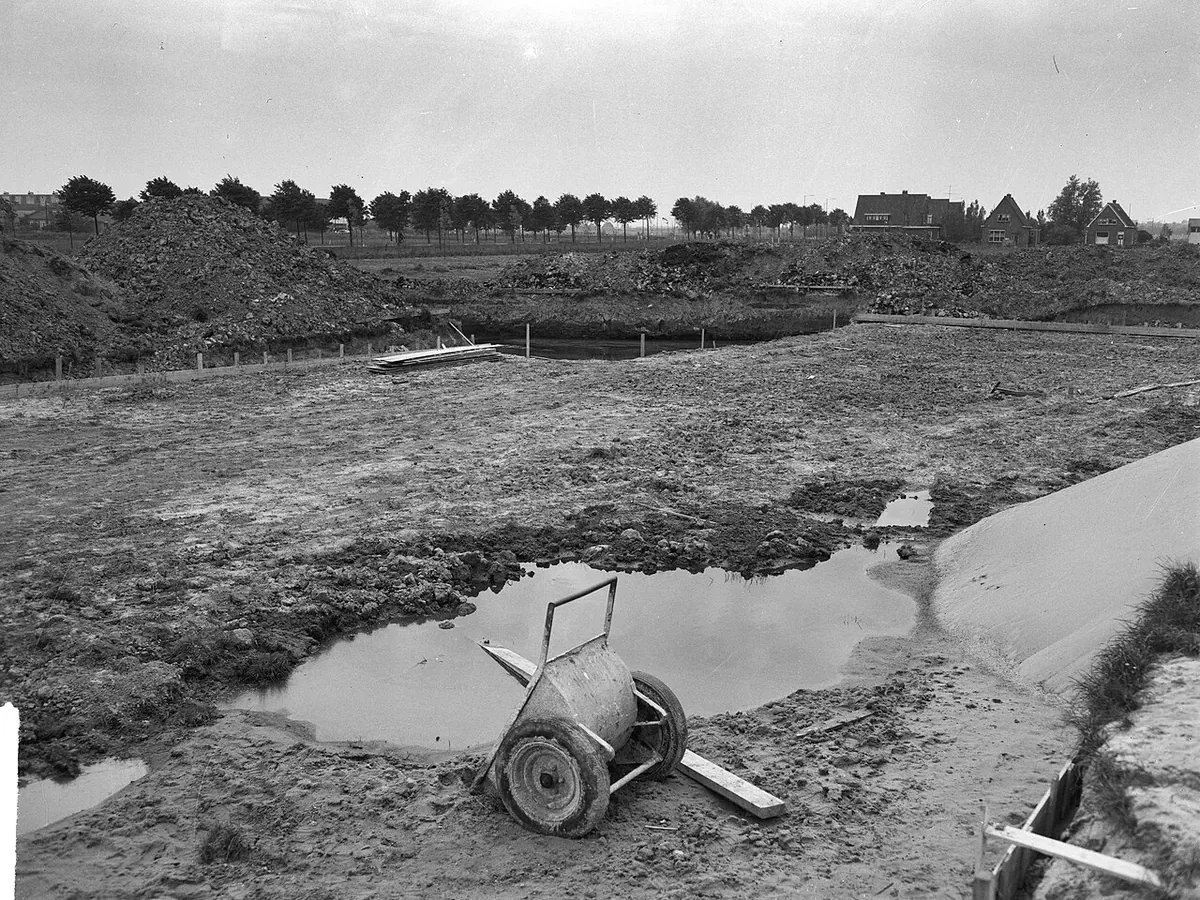
Photo: Henk Lindeboom / Anefo, Wikimedia Commons, CC0
Pool Excavation Cost for Above Ground Pools and Spas
Above ground pools do not need a full pool excavation, but they do need a level base. Leveling the site, removing sod and adding sand or a pad usually costs $500 to $2,000. Semi-inground pools, which sit partly below ground, need a partial dig of 2 to 4 feet, often $1,000 to $3,000. Plunge pools and inground spas need less digging because they are smaller, but they are often deep, so the cost per cubic yard can be similar. See our guide on plunge pool cost for small pool options.
Can You Dig a Pool Yourself?
Some owners consider digging the pool themselves to save on pool excavation cost. Renting a mini excavator costs about $300 to $600 a day, plus delivery, and a larger excavator more. Digging a pool by hand is not realistic. A DIY dig can work for small projects such as a plunge pool or a fiberglass kit, but there are serious risks. Digging to the wrong depth or shape costs money to fix, and pool walls cut too steeply can collapse, which is a safety hazard. OSHA rules for trenches and excavations apply to workers on job sites and show how dangerous deep holes can be. You also still need to haul the dirt, call 811, and coordinate with the pool installer. Most owners find the savings are small compared with the risk, since builders often include excavation at a good price.
Questions to Ask About Pool Excavation Before You Sign
Before you sign a pool contract, ask the builder what the price includes for pool excavation. Is a standard dig included, and how is "standard" defined? Is hauling included, and how many loads? What is the price for rock, and is there a cap? Who pays if groundwater is found? Who repairs damage to lawns, sprinklers, fences and driveways? Will the dirt be spread on site, and where? How will the site be protected from erosion while the hole is open? Clear answers help you compare bids on equal terms and avoid surprise charges.
Pool Excavation Timeline
Once permits are approved and utilities are marked, the pool excavation day is often one of the most exciting days of the project. A typical residential swimming pool excavation takes one to two days with a full-size excavator. The crew digs, trims and checks depths, and trucks haul dirt as they go. Rock, clay, groundwater and access issues can stretch the job to a week. After the dig, the next step comes quickly: steel and plumbing for concrete pools, wall panels for vinyl pools, or setting the shell for fiberglass pools. Rain can delay digging and soften the hole, so builders often try to move to the next step quickly to protect the excavation.
Worked Example: Estimating Pool Excavation Cost
A homeowner plans a 16 x 32 foot vinyl pool with an average depth of 5.5 feet. The calculator above estimates about 136 cubic yards of soil in place and 170 loose cubic yards to move. At $25 per cubic yard for digging and $15 per loose cubic yard for hauling, the estimated pool excavation cost is about $3,400 for digging and $2,550 for hauling, close to $6,000 in total. The builder offers to keep half the dirt on site to build up a low corner of the yard, cutting hauling in half and saving about $1,275. The contract also includes a rock clause at $250 per hour for hammering, with a cap of $3,000. Knowing these numbers in advance helps the owner budget and compare bids.
Pool Excavation Cost by Region
Where you live changes pool excavation cost as much as the size of the pool. In much of the South and Southwest, where pools are common and soils are often easy to dig, a standard pool excavation may be included in a builder's base price. In areas with rocky ground, such as parts of New England, the Ozarks and the Hill Country of Texas, rock clauses are common and rock can double or triple the cost of pool excavation. In coastal areas with sandy soil and high water tables, shoring and dewatering often add cost. Urban areas with tight lots, strict dump rules and higher labor rates also push prices up. Getting at least three local quotes is the best way to learn what swimming pool excavation really costs in your area.
Permits, Inspections and Pool Excavation
Most towns require a building permit before any pool excavation begins. The permit review checks setbacks from property lines, septic systems, wells, easements and buried utilities. Some towns also require an erosion control plan, such as silt fences around the dig, especially near streams or storm drains. Inspections may happen after the pool excavation and steel or wall work, before concrete or backfill. Permit fees for a pool are often $250 to $2,000 and are usually listed separately from the pool excavation cost. Starting the dig before the permit is approved can lead to fines and stop-work orders, so wait for approval.
After the Dig: Backfill and Grading
When the pool shell is in place, the open space around it must be backfilled. For vinyl and fiberglass pools, the backfill is often gravel or a stone mix that drains well and settles less than soil. For concrete pools, native soil is often used, compacted in layers. Backfill and final grading usually cost $500 to $3,000, depending on the material and how much is needed. Good grading slopes the yard away from the pool and deck so rain does not pool around the shell. Poor backfill and grading cause settling, cracked decks and drainage problems later, so treat this step as part of the pool excavation budget.
Ways to Lower Pool Excavation Cost
There are several ways to lower pool excavation cost without cutting corners. Choose a shallower pool if you do not need a deep end; most families use the shallow part far more, and a 4- to 5-foot sport pool can cut the dirt volume by 20% or more. Keep some dirt on site for grading and planting beds to save on hauling. Plan access early, and remove fences or sheds yourself before the crew arrives. Schedule the pool excavation in a dry season to avoid delays and pumping. Ask for a fixed price for the standard dig and clear prices for extras, so you can compare bids. Finally, research your soil and rock depth ahead of time, so your budget covers the most likely conditions.
Pool Removal vs New Pool Excavation
Pool excavation and pool removal are opposite jobs that use the same machines. When an old pool is removed, it is broken up and filled with dirt, often the same amount a new pool excavation would remove. If you are replacing an old pool with a new one, the builder may remove the old shell and dig the new pool in one project, sometimes reusing part of the hole. For more on that process, see our guide to the cost of removing a pool.
Protecting Your Yard During Pool Excavation
A pool excavation brings heavy machines and trucks into the yard, so plan to protect what you want to keep. Mark sprinkler heads, septic lines, propane tanks and anything buried that 811 does not locate, such as private lighting wires. Lay plywood or ground protection mats over lawns and driveways along the truck route. Move outdoor furniture, pots and play sets well out of the way. Talk with neighbors about truck traffic and noise, since a busy dig day can block a street for hours. Ask the builder where the dirt pile will go and how long it will stay. After the job, expect some lawn repair and cleanup; many contracts include basic cleanup but not full landscaping, so budget for new sod or seed.
Safety Around an Open Pool Excavation
An open pool excavation is a deep hole with steep walls, and it can stay open for days or weeks while the pool is built. Rain can fill it with water, and walls can cave in. Keep children and pets away, and make sure the builder puts up temporary safety fencing around the site. Never enter the hole yourself while machines are working. If heavy rain is forecast, ask the builder how the hole will be protected and pumped. These simple steps keep the site safe from the first scoop of dirt until the pool is finished and fenced.
Comparing Pool Excavation Bids
When bids arrive, line them up item by item. Check what each bid calls a standard pool excavation, whether hauling is included and how many loads, the price for rock and its cap, groundwater pumping, access charges, backfill, grading and cleanup. A low base price with high extras can end up costing more than a higher base price that includes most of the work. The cost of pool excavation is easier to compare when every bid covers the same items, so ask builders to fill in any gaps before you decide.
Signs a Pool Excavation Will Cost More
A few clues can warn you that a pool excavation may cost more than average. Exposed rock in the yard, on nearby road cuts or in neighbors' yards suggests rock underground. Soggy lawns, standing water after rain or a nearby creek or pond suggest a high water table. A yard that slopes steeply, has only narrow side access, or has large trees near the pool site will take more work. Older homes may have buried debris, old foundations or abandoned tanks. If you see these signs, tell your builder early and ask how they will price the risk.
Weather and Season
Dry weather is best for digging. Wet soil is heavy, sticky and slow to haul, and trucks can rut lawns and driveways. Frozen ground in winter is hard to dig in cold climates. Many builders plan digs for late spring through early fall, and some offer better pricing for off-season projects in mild climates. If a storm is coming, the crew may wait a day or two, which is better than digging a hole that fills with water.
Pool Excavation Cost: Key Points
- A standard pool excavation costs about $1,000 to $5,000.
- Hauling adds $500 to $3,500; a 16 x 32 ft pool makes about 14 truckloads of dirt.
- Rock, clay, groundwater and tight access can add thousands.
- Ask for rock and water clauses and a soil test before signing.
Frequently Asked Questions
How long does pool excavation take?
Most residential pool excavation jobs take one to two days. Rock, clay, groundwater and tight access can stretch a pool excavation to a week or more.
Is excavation included in the pool price?
Often a standard dig is included, with extra charges for rock, water, hauling or access. Read the contract and ask the builder to list every pool excavation cost that is not included.
What is the cost of pool excavation per cubic yard?
Digging often costs about $15 to $40 per cubic yard, and hauling about $10 to $30 per loose cubic yard, depending on soil, access and local rates.
Who does swimming pool excavation?
Most pool builders use their own excavation crew or a trusted subcontractor. Some owners hire an excavation company directly, but the builder must approve the dig layout and depths.
What happens if rock is found during pool excavation?
The crew switches to a hydraulic hammer or other methods, and the rock clause in your contract sets the extra cost. Ask for a cap before you sign.
Sources
- HomeGuide: Inground pool cost
- OSHA: Trenching and excavation safety
- Call 811: Know what's below
- USDA NRCS: Web Soil Survey