
Size of Swimming Pool: Average, Standard and Olympic Pool Sizes Explained
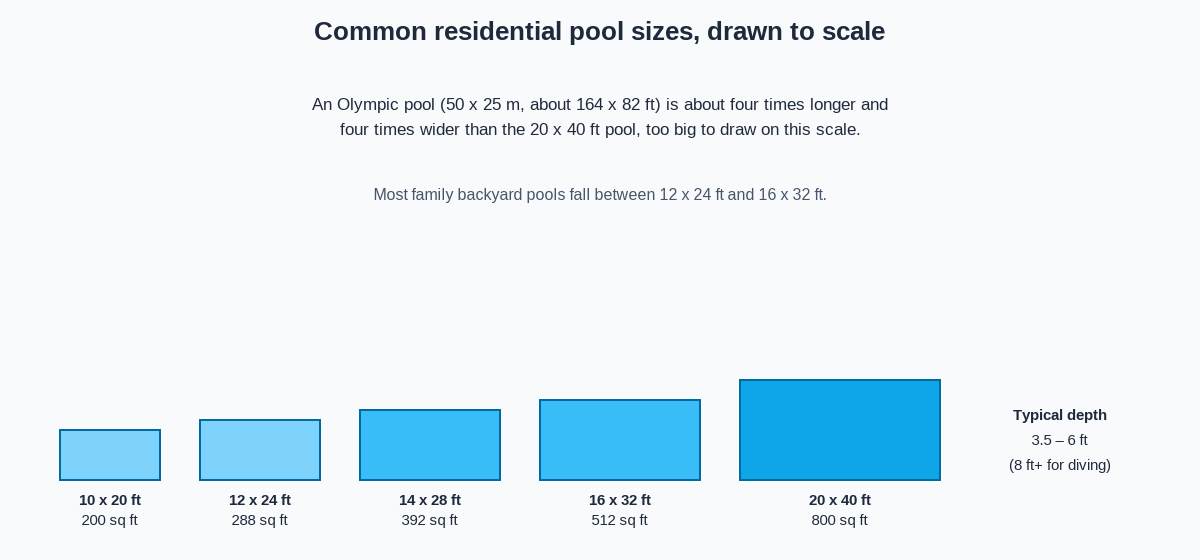
Chart: Asphapro.com
Quick Answer
The size of swimming pool most homeowners choose is between 12 x 24 feet and 16 x 32 feet, with depths of about 3.5 to 6 feet; a common average inground pool size is around 14 x 28 feet, holding roughly 15,000 to 20,000 gallons. Round above ground pool sizes usually run from 12 to 33 feet across, with 18 and 24 feet the most popular, and walls 48 to 54 inches tall. An Olympic size swimming pool is 50 meters long and 25 meters wide (about 164 x 82 feet) with a minimum depth of 2 meters, holding about 2,500 cubic meters, or roughly 660,000 gallons. Fiberglass pools are usually limited to about 16 feet wide and 40 feet long because the shells travel by road.
Pool size affects almost everything: cost, how the pool fits the yard, how much deck you can build, what you can do in the water, and how much it costs to heat, clean and run. A pool that is too small feels cramped for a family; a pool that is too big eats the yard and the budget. Knowing the standard pool sizes and what each one is good for makes the decision much easier.
This guide covers average and standard pool sizes for inground and above ground pools, a pool size chart with gallons, depth, fiberglass and oval sizes, Olympic and competition pool dimensions, space per swimmer, and a step-by-step way to choose the right size of pool for your yard. To turn a size into a budget, see how much does a pool cost.
Average Pool Size for a Home
There is no official standard pool size for homes, but most residential pools cluster in a narrow range:
- Small: 10 x 20 ft to 12 x 24 ft, good for cooling off and small yards.
- Medium (most common): 14 x 28 ft to 16 x 32 ft, room for play, games and short laps.
- Large: 18 x 36 ft to 20 x 40 ft, for big families, entertaining and diving areas.
The average backyard pool size in the United States is often quoted around 14 x 28 to 16 x 32 feet, which gives about 400 to 500 square feet of water. Most average inground pool sizes have a shallow end of about 3.5 feet and a deep end of 5 to 6 feet; pools built for diving go to 8 feet or more.
Pool Size Chart: Inground Pools
| Pool size (ft) | Water area | Avg depth | Approx. gallons | Good for |
|---|---|---|---|---|
| 10 x 20 | 200 sq ft | 4.5 ft | about 6,750 | Plunging, small yards |
| 12 x 24 | 288 sq ft | 4.5 ft | about 9,700 | Couples, small families |
| 14 x 28 | 392 sq ft | 5 ft | about 14,700 | Average family pool |
| 15 x 30 | 450 sq ft | 5 ft | about 16,900 | Family play and laps |
| 16 x 32 | 512 sq ft | 5 ft | about 19,200 | Popular larger family size |
| 18 x 36 | 648 sq ft | 5.5 ft | about 26,700 | Large families, entertaining |
| 20 x 40 | 800 sq ft | 5.5 ft | about 33,000 | Large pools, diving areas |
Gallons use the rectangle formula length × width × average depth × 7.5. Free-form shapes hold somewhat less. See how many gallons is my pool for other shapes.
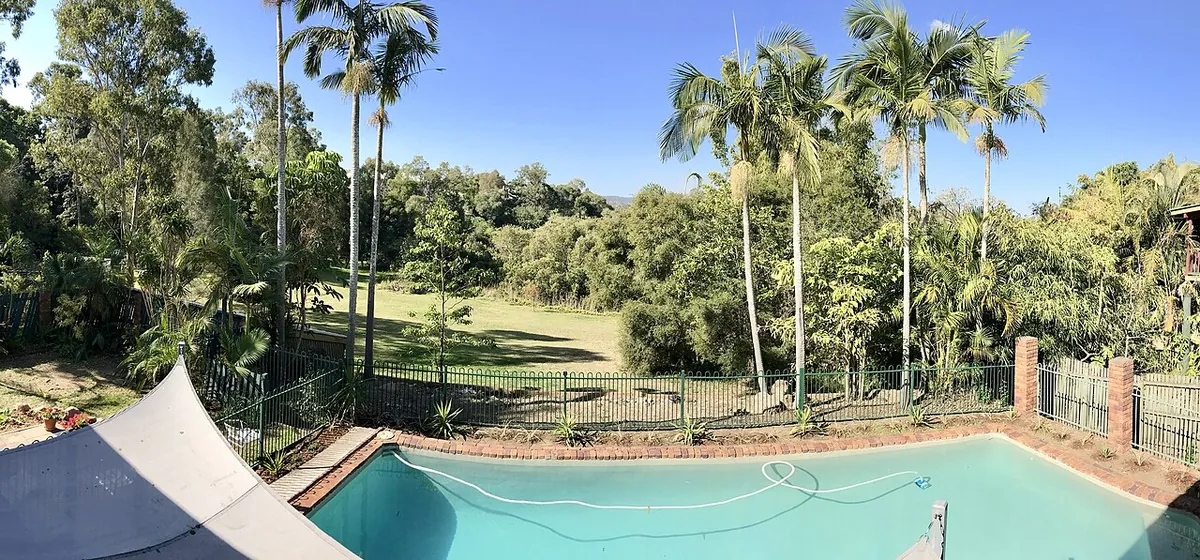
Photo: Kgbo, Wikimedia Commons, CC BY-SA 4.0
Above Ground Pool Sizes
Above ground pool sizes are given as the diameter for round pools and length x width for ovals and rectangles, plus the wall height.
| Above ground pool size | Approx. gallons (water about 3.5 to 4 ft deep) |
|---|---|
| 12 ft round | about 3,000 – 3,400 |
| 15 ft round | about 4,600 – 5,300 |
| 18 ft round | about 6,700 – 7,600 |
| 21 ft round | about 9,100 – 10,400 |
| 24 ft round | about 11,900 – 13,600 |
| 27 ft round | about 15,000 – 17,200 |
| 30 ft round | about 18,600 – 21,200 |
| 33 ft round | about 22,500 – 25,700 |
| 12 x 24 ft oval | about 5,900 – 6,800 |
| 15 x 30 ft oval | about 9,300 – 10,600 |
| 18 x 33 ft oval | about 12,300 – 14,000 |
Round pools use diameter × diameter × depth × 5.9 for gallons. Ovals use length × width × depth × 5.9. Wall heights of 48, 52 and 54 inches are standard; the water sits a few inches below the top. Small easy-set and frame pools from 8 to 18 feet are common seasonal options. For setup, see how to put up an above ground pool.
Fiberglass Pool Sizes
Fiberglass pool sizes are set by the manufacturer's molds and by highway shipping limits. Most fiberglass pools are 10 to 16 feet wide and 20 to 40 feet long, with depths up to about 6 to 8 feet. Small fiberglass plunge pools start around 8 x 12 feet. If you need a pool wider than about 16 feet, a concrete or vinyl pool is usually the answer. See concrete vs fibreglass swimming pool and fiberglass swimming pool cost.
Rectangular and Oval Pool Sizes
Rectangular pool sizes follow the common ratio of about 1:2 (width to length), such as 12 x 24, 16 x 32 and 20 x 40. That shape suits laps, games like volleyball, and pool covers. Oval and oblong pool sizes, often 12 x 24 to 18 x 36, soften the look and fit narrow yards. Kidney and free-form pools are measured by their longest and widest points; their water area is usually 10% to 20% less than a rectangle of the same outside dimensions.
Pool Depth
- Sport or play pools: 3.5 to 5 or 6 feet, the most popular modern design, good for games and standing.
- Shallow to deep pools: 3.5 feet at the shallow end, 6 to 8 feet at the deep end.
- Diving pools: 8 to 9 feet or more in the diving area, with a long, wide deep zone. Diving boards require specific dimensions; follow the board maker and local code.
- Plunge pools: often 4 to 6 feet deep in a small footprint.
- Above ground pools: about 4 feet, deeper in the center with expandable liners.
Deeper pools hold more water, which raises chemical and heating costs. For depth details, see pool depth.
Olympic Size Swimming Pool Dimensions
An Olympic size swimming pool, the kind used for the Olympic Games and world championships, follows World Aquatics (formerly FINA) rules:
| Specification | Olympic pool |
|---|---|
| Length | 50 meters (about 164 feet) |
| Width | 25 meters (about 82 feet) |
| Lanes | 10 lanes, each 2.5 meters wide, for top competitions (8 used for racing) |
| Minimum depth | 2 meters (about 6.6 feet); 3 meters recommended |
| Volume at 2 m deep | 2,500 cubic meters, about 660,000 U.S. gallons |
| Water temperature | about 25 – 28°C (77 – 82°F) |
So what is the size of an Olympic pool in feet? About 164 feet long by 82 feet wide, and at least 6.6 feet deep. An Olympic pool holds roughly 30 to 70 times the water of a typical backyard pool. For more on volume, see how many gallons are in an Olympic size swimming pool.
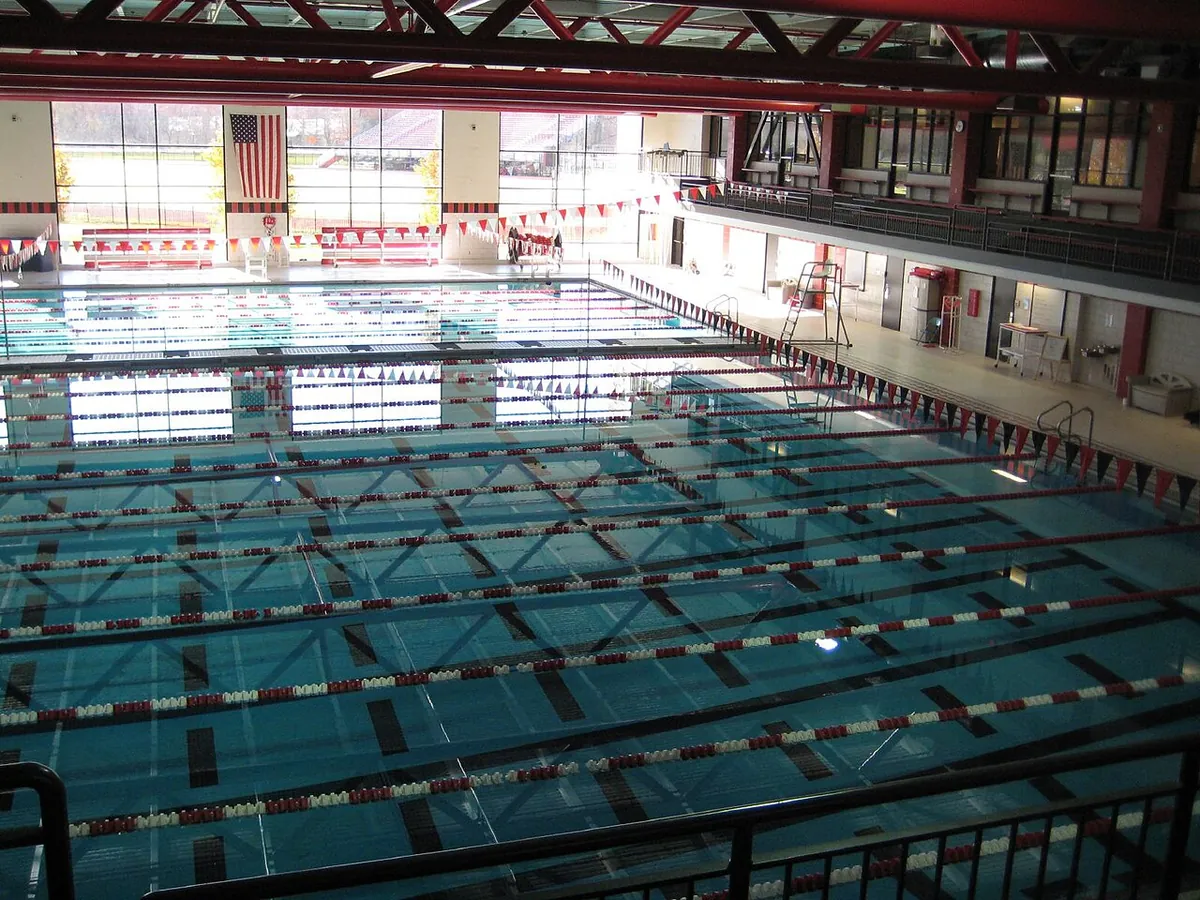
Photo: Richie Diesterheft, Wikimedia Commons, CC BY 2.0
Other Competition and Public Pool Sizes
- Short course meters: 25 meters long, common in Europe and for short-course competitions.
- Short course yards: 25 yards (75 feet) long, the standard for most U.S. high school, college and gym pools.
- Junior Olympic pools: usually 25 meters or 25 yards long, the size many communities call a junior Olympic pool.
- Hotel and gym pools: vary widely; many are 20 to 25 yards long with a few lanes.
- Average indoor pool size at homes: often smaller than outdoor pools, around 12 x 24 to 16 x 32 feet, because the building adds cost.
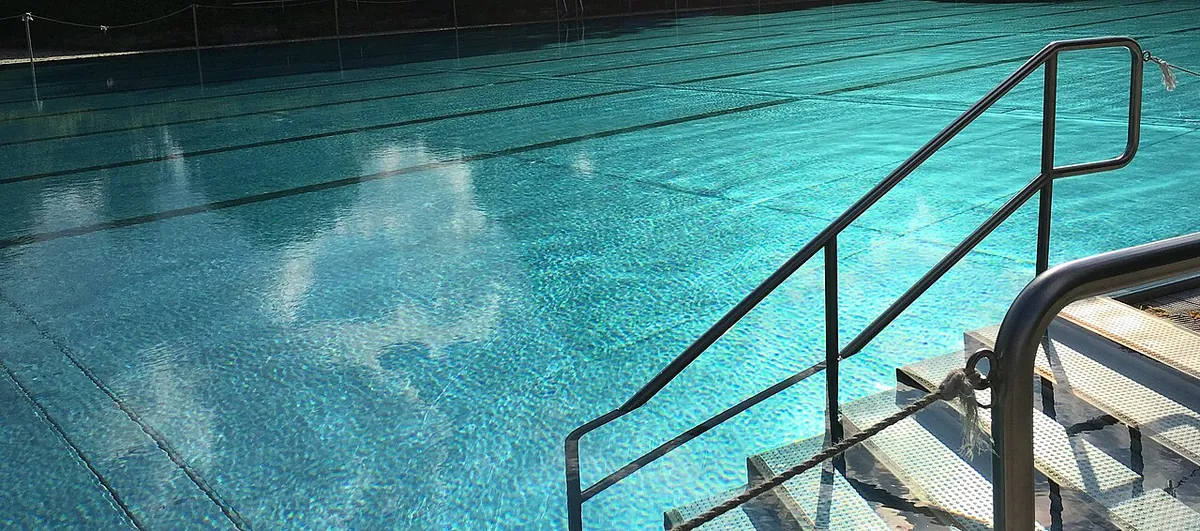
Photo: Pittigrilli, Wikimedia Commons, CC BY-SA 4.0
How Much Space Do Swimmers Need?
A practical way to size a pool is by how many people will use it at once. Pool designers often allow roughly 20 to 36 square feet of water per swimmer for comfortable recreational use, and more for active games. By that rule:
- A 12 x 24 ft pool (288 sq ft) comfortably fits about 8 to 14 people.
- A 16 x 32 ft pool (512 sq ft) fits about 14 to 25 people.
- A 20 x 40 ft pool (800 sq ft) fits about 22 to 40 people.
For lap swimming, length matters more than area: at least 30 to 40 feet makes laps worthwhile, and 50 to 75 feet is ideal. A narrow lap pool can be 8 to 10 feet wide.
How to Choose the Right Pool Size
- Decide how you will use the pool: cooling off, family play, laps, entertaining, diving, or therapy.
- Measure the yard and mark setbacks from property lines, the house, septic systems and easements. Local rules often require 5 to 10 feet or more.
- Leave room for the deck: at least 4 feet around the pool and wider zones for seating; see pool deck ideas.
- Plan for equipment, fencing and access for construction machinery.
- Mark the outline with paint or a garden hose and live with it for a few days.
- Check the budget: each extra foot adds excavation, materials, water, chemicals and heating cost.
Pool Size by How You Will Use It
| Main use | Suggested size of pool | Depth |
|---|---|---|
| Cooling off, relaxing | 8 x 12 to 12 x 24 ft | 4 – 5 ft |
| Young children | 12 x 24 to 14 x 28 ft with a large shallow area | 3 – 4.5 ft |
| Family play and games | 14 x 28 to 16 x 32 ft | 3.5 – 5 ft (sport pool) |
| Lap swimming | 8 – 12 ft wide, 40 – 75 ft long | 4 – 5 ft |
| Entertaining large groups | 18 x 36 to 20 x 40 ft | 3.5 – 6 ft |
| Diving board | 18 x 36 ft or larger with a diving well | 8 – 9 ft+ |
| Exercise and therapy | Swim spa or small pool with current, about 8 x 14 to 8 x 20 ft | 4 – 5 ft |
Many families today choose a sport or play pool with a flat, chest-deep middle instead of a deep end. It is better for games and gives more usable space for the same pool size.
Pool Size for Small, Medium and Large Yards
A rough rule is that the pool and its deck together should take up no more than about a third to half of the usable backyard, leaving room for lawn, planting, equipment and paths. Some examples:
- Small yard (about 40 x 40 ft): a 10 x 20 or 12 x 24 ft pool, or a plunge pool, with a modest deck.
- Medium yard (about 60 x 60 ft): a 14 x 28 or 16 x 32 ft pool with a comfortable deck and some lawn.
- Large yard (80 x 80 ft or more): an 18 x 36 or 20 x 40 ft pool, spa and generous patio.
Always check setbacks, easements and utility lines first; they often decide the maximum pool size more than the yard itself.
Pool Size and Cost
| Inground pool size | Vinyl (approx.) | Concrete (approx.) |
|---|---|---|
| 12 x 24 ft | $35,000 – $55,000 | $55,000 – $85,000 |
| 16 x 32 ft | $45,000 – $75,000 | $75,000 – $120,000 |
| 20 x 40 ft | $60,000 – $95,000 | $95,000 – $150,000+ |
These planning ranges come from typical per-square-foot pricing and are explained in how much does a pool cost. For the most popular family size, see how much does a 12x24 inground pool cost.
How Pool Size Is Measured
Builders describe rectangular pools by inside length and width at the waterline. Free-form pools are measured at their longest and widest points, which overstates the water area. Above ground pools are measured by the outside diameter of the wall. When comparing pool sizes, ask for the water surface area in square feet and the volume in gallons, not just the outside dimensions, especially for kidney, lagoon and other free-form shapes.
Equipment Sizing by Pool Size
Pool size also sets the equipment you need. The pump and filter should be sized so the whole volume is filtered at least once a day, often in 6 to 10 hours of run time. A larger pool needs a larger filter area: a common guideline is to choose a sand or cartridge filter rated for more than the pool's volume, so it runs efficiently and needs cleaning less often. Heaters are sized by pool surface area and the temperature rise you want. Covers and robotic cleaners are rated by pool dimensions. When you check a pool sand filter size chart from a manufacturer, match the filter rating to your gallons and the pump's flow rate. See cost to replace sand in a pool filter.
Easy-Set and Frame Pool Sizes
Seasonal easy-set and metal frame pools, sold under several brands, come in sizes from about 8 feet to 18 feet round, and rectangles from about 9 x 6 feet to 24 x 12 feet, with depths from about 30 to 52 inches. They are popular for small yards and renters. Their volume ranges from a few hundred gallons to about 7,000 gallons, so they are cheap to fill and treat but still need a pump, a filter and basic chemistry.
Hot Tub and Spa Sizes
Spas attached to pools are commonly 6 to 8 feet across, holding about 500 to 1,000 gallons. Portable hot tubs usually range from about 6 x 6 to 8 x 8 feet and seat 2 to 8 people. Swim spas are longer, often 12 to 20 feet, for exercise in place. See hot tub cost.
Standard Swimming Pool Size in Meters
Outside the United States, pool sizes are usually given in meters. Common residential sizes are 3 x 6, 4 x 8, 5 x 10 and 6 x 12 meters. Public pools are typically 25 meters (short course) or 50 meters (long course) long. One meter is about 3.28 feet, so a 4 x 8 meter pool is about 13 x 26 feet, and a 5 x 10 meter pool is about 16 x 33 feet.
Pool Size Mistakes to Avoid
- Choosing a pool so large that there is no room left for a usable deck.
- Picking a deep end the family will rarely use, which adds cost and limits play.
- Forgetting setbacks and easements until the permit stage.
- Ignoring the ongoing cost of heating and chemicals for a very large pool.
- Comparing free-form pools by outside dimensions instead of water area.
- Not marking the pool outline in the yard before deciding.
Inground Pool Sizes by Pool Type
Concrete and gunite pools can be any size and shape, so inground pool sizes for concrete are limited only by the yard and budget. Vinyl liner pools come in standard kit sizes, commonly from 12 x 24 to 20 x 40 feet in rectangles, L-shapes, Roman ends and free-forms, with custom sizes available at extra cost. Fiberglass pools are set by the molds each manufacturer offers, typically up to about 16 x 40 feet. When comparing inground swimming pool sizes between types, check the water area and depth profile, not only the length and width.
Olympic Size Swimming Pool Specifications in More Detail
Besides length, width and depth, Olympic size swimming pool specifications cover many details. Lane ropes separate the lanes and reduce waves. Touch pads at each end record times electronically, so the official length must be exact with the pads installed. Starting blocks sit at one end, and backstroke ledges help swimmers start. Water temperature, lighting levels and lane markings on the floor are all set by the rules. Many venues also add a separate warm-up pool and a diving pool, which has its own size and depth rules. The result is a pool built to tight tolerances, very different from a backyard pool.
People often ask what size is an Olympic pool compared with a home pool. A typical 16 x 32 ft backyard pool would fit into an Olympic pool about 26 times by surface area. In volume, an Olympic pool holds roughly as much water as 30 to 70 family pools.
Above Ground Pool Sizes Compared With Inground Pool Sizes
Above ground pool sizes are generally smaller and shallower than inground pool sizes. The most popular 24 ft round above ground pool has about 450 square feet of water surface, similar to a 15 x 30 ft inground pool, but holds less water because it is only about 4 feet deep throughout. Above ground pools are a good way to get a large swimming area at a lower cost, while inground pools allow deeper water, steps, benches and custom shapes.
Pool Size and Running Costs
Bigger pools cost more to run, roughly in proportion to their water volume and surface area. A 20 x 40 pool holds about three times the water of a 12 x 24 pool, so it uses more chemicals, more filtration time, and much more energy to heat. Surface area drives evaporation and heat loss. If you plan to heat the pool, a smaller, well-covered pool can save a lot each year; see cost to maintain a pool.
Small Pool Sizes
Small pool sizes have grown in popularity as yards shrink. Plunge pools, cocktail pools and dipping pools usually range from about 8 x 12 to 10 x 20 feet. They are cheaper to heat and maintain, fit tight spaces, and are ideal for cooling off and socializing rather than swimming laps. See what is a plunge pool and small inground pool cost.
Pool Size Calculator: Quick Method
A pool size calculator or pool size estimator answers two questions: how much water area and how many gallons. Do it by hand:
- Water area: length × width for rectangles; 3.14 × radius × radius for circles.
- Average depth: (shallow depth + deep depth) ÷ 2.
- Gallons: rectangle: L × W × avg depth × 7.5; round: diameter² × avg depth × 5.9; oval: L × W × avg depth × 5.9.
Our volume calculator and square footage calculator can do the math.
Size of Swimming Pool: Key Takeaways
- Most family pools are 12 x 24 to 16 x 32 feet and 3.5 to 6 feet deep.
- Above ground pool sizes of 18 to 24 feet round suit most families.
- An Olympic size swimming pool is 50 x 25 meters and at least 2 meters deep.
- Choose the pool size by how you will use it, then check yard space, setbacks and budget.
- Bigger pools cost more to build, heat and maintain every year.
Frequently Asked Questions
What is the average size of a swimming pool?
Around 14 x 28 to 16 x 32 feet for inground residential pools, with depths of 3.5 to 6 feet.
What is a standard pool size?
There is no single standard, but 12 x 24, 14 x 28, 16 x 32 and 20 x 40 feet are the most common rectangular sizes.
How big is an Olympic size swimming pool?
50 meters long, 25 meters wide and at least 2 meters deep, about 164 x 82 feet and 660,000 gallons.
What size above ground pool is best?
An 18 to 24 ft round pool suits most families; 24 ft is the most popular.
What is a good pool size for a family of four?
A 14 x 28 or 16 x 32 ft pool gives enough room for play and some laps, with space for everyone to swim at once.
What is the smallest inground pool size?
Plunge pools as small as about 8 x 12 feet are common; most small family pools start around 10 x 20 or 12 x 24 feet.
What is a medium size pool?
A medium size pool is usually around 14 x 28 to 16 x 32 feet, big enough for family games and short laps without taking over the yard.
What is the average size of an above ground pool?
Round above ground pools of 18 to 24 feet are the most common sizes, holding about 7,000 to 13,000 gallons.
What size pool do I need for laps?
At least 30 to 40 feet long, ideally 50 feet or more, and about 8 to 10 feet wide for one swimmer.
How much yard space does a pool need?
Add the pool, at least 4 feet of deck on each side, setbacks from property lines and room for equipment. A 16 x 32 ft pool with deck often needs an area of about 30 x 45 feet.
How deep is an Olympic size swimming pool?
At least 2 meters (about 6.6 feet); 3 meters is recommended for top competition.
Sources
- World Aquatics: Facilities rules (pool dimensions)
- USGS Water Science School: Olympic pool volume
- U.S. CPSC: Pool and spa safety
- HomeAdvisor: Inground pool sizes and costs