
Concrete Pool Guide: Construction, Costs, Finishes and Concrete vs Other Pools
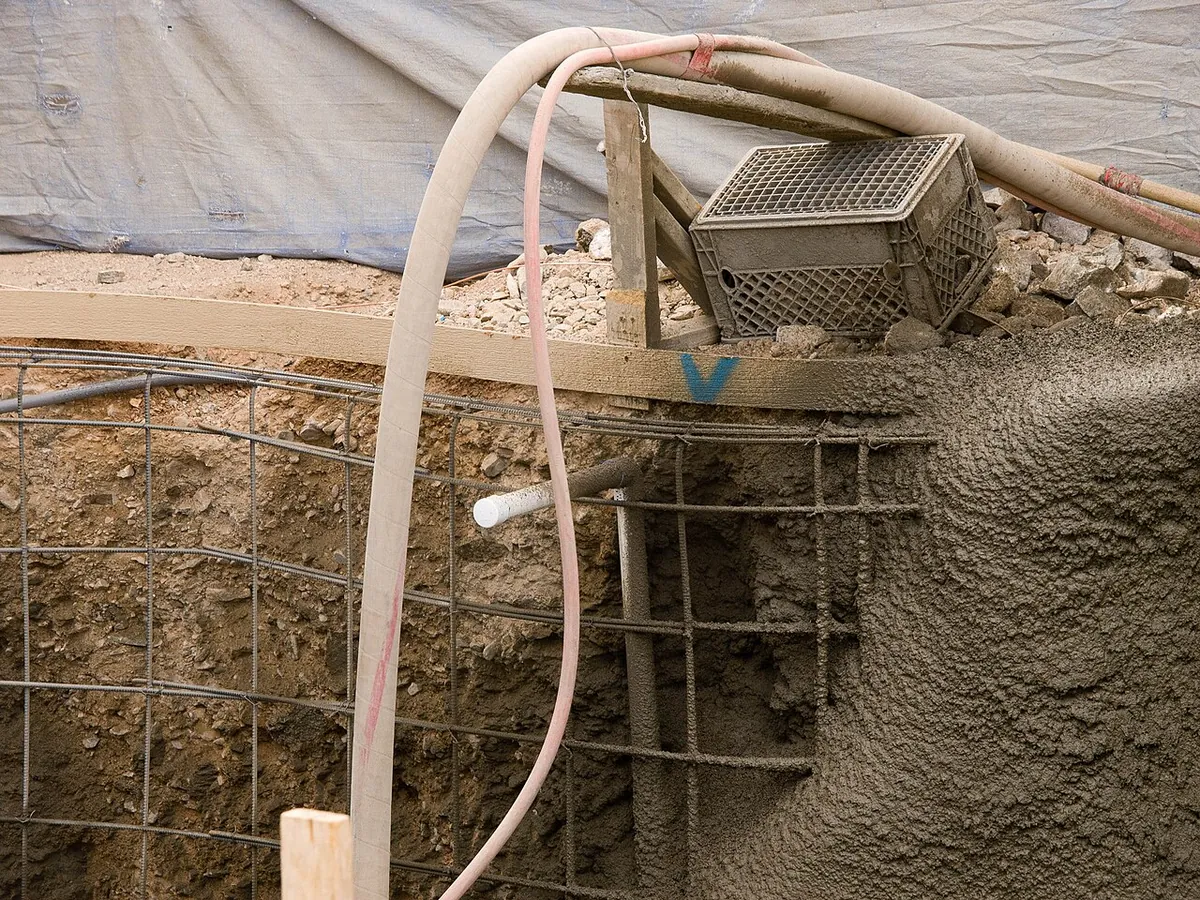
Photo: Dorian Wallender, Wikimedia Commons, CC BY-SA 2.0
Quick Answer
A concrete pool is a swimming pool with a shell of steel-reinforced concrete, usually sprayed in place as gunite or shotcrete over a rebar cage in an excavated hole, then finished with plaster, pebble, quartz or tile. Concrete pools can be built in any shape, size and depth and last 50 years or more with care. A typical residential inground concrete pool costs about $50,000 to $120,000 installed, more with spas, decks and features, and takes 8 to 16 weeks to build. Compared with fiberglass and vinyl, concrete pools cost more up front and need resurfacing every 10 to 20 years, plus more chemicals and brushing, but they are the most durable and flexible option. Above ground concrete pools exist but are rare.
When people picture a custom backyard pool with curves, a beach entry, a tanning ledge, a spa spilling into the main pool or a vanishing edge, they are usually picturing a concrete pool. Concrete is the oldest and most versatile pool material. It can be shaped to any design, finished in any color, and built to almost any size, from small plunge pools to Olympic competition pools like the one in the photo further down. The shell is built on site in a series of trades: excavation, steel, plumbing, gunite or shotcrete, tile and coping, decking and interior finish. The photo above shows the key moment, when a crew sprays concrete through a hose onto a cage of rebar to form the pool wall.
This guide explains how concrete pools are built, the concrete used for swimming pool shells, finishes, the pros and cons compared with fiberglass and vinyl liner pools, costs, timelines, maintenance, common repairs, and what to know about above ground concrete pools.
Types of Concrete Pools
The term concrete pool covers several construction methods. The most common is the sprayed concrete pool, built with gunite or shotcrete. Gunite is a dry mix of cement and sand blown through a hose, with water added at the nozzle; shotcrete is a ready-mixed wet concrete pumped through the hose and sprayed with compressed air. Both are applied over a steel rebar framework that follows the shape of the excavation, and both produce a strong, dense, monolithic shell. In much of the United States and Australia, the terms gunite pool and concrete pool are used interchangeably. See shotcrete vs gunite.
Poured concrete pools are another method, with walls formed with wood or metal forms and filled with ready-mix, and a floor poured separately. They are common in commercial pools and in some regions, and they suit simple rectangular shapes. Concrete block pools use reinforced, grouted concrete masonry units for the walls on a poured concrete floor, then a waterproof render and finish; they are common in parts of Europe and for DIY builders. Precast concrete pools, cast in a plant and delivered in one piece or in panels, exist for small pools and plunge pools. Each type ends with a waterproof interior finish. See concrete masonry unit and precast concrete.
How a Concrete Pool Is Built
Concrete pool construction starts with design and permits. The designer and owner decide the shape, size, depths, steps, benches, spa, water features and equipment location, and the builder prepares plans, engineering and permit applications. Many cities require engineered plans for concrete pools, setbacks from property lines and septic systems, safety barriers, and inspections at several stages. Soil reports may be needed on hillsides or in expansive clay. See concrete footings.
Excavation comes next. An excavator digs the pool to the planned shape and depths, leaving room for the thickness of the shell, typically 6 to 12 inches. Spoil is hauled away or regraded on site. The crew then forms the pool perimeter with boards and stakes to set the top edge, called the bond beam. Steel workers tie a grid of rebar, usually #3 or #4 bars at 10 to 12 inch spacing in both directions, throughout the floor and walls, with extra steel in the bond beam, steps and deep end transitions. The steel is held off the soil with spacers so concrete can surround it fully. Plumbers then install the main drains, return lines, skimmer bodies and lighting niches, and run pipes to the equipment pad. Inspectors check the steel and plumbing before concrete is placed. See rebar in concrete.
The shell is then sprayed. A gunite or shotcrete crew shoots the concrete onto the steel, building up the floor and walls to the specified thickness, then trims, shapes and finishes the surface with trowels and cutting rods. A pool shell might take one day for an average backyard pool. The concrete must cure properly: crews or owners water the shell several times a day for about a week, and many builders wait three to four weeks before applying the interior finish so the shell shrinks and gains strength. During this time, the tile line, coping and deck are installed. Electricians bond all metal parts and install lights and equipment. Finally, the interior finish, such as plaster, aggregate or tile, is applied, and the pool is filled with water and started up with a careful chemical balance during the first weeks. See how long concrete takes to cure and concrete curing compound.
Concrete for Swimming Pool Shells
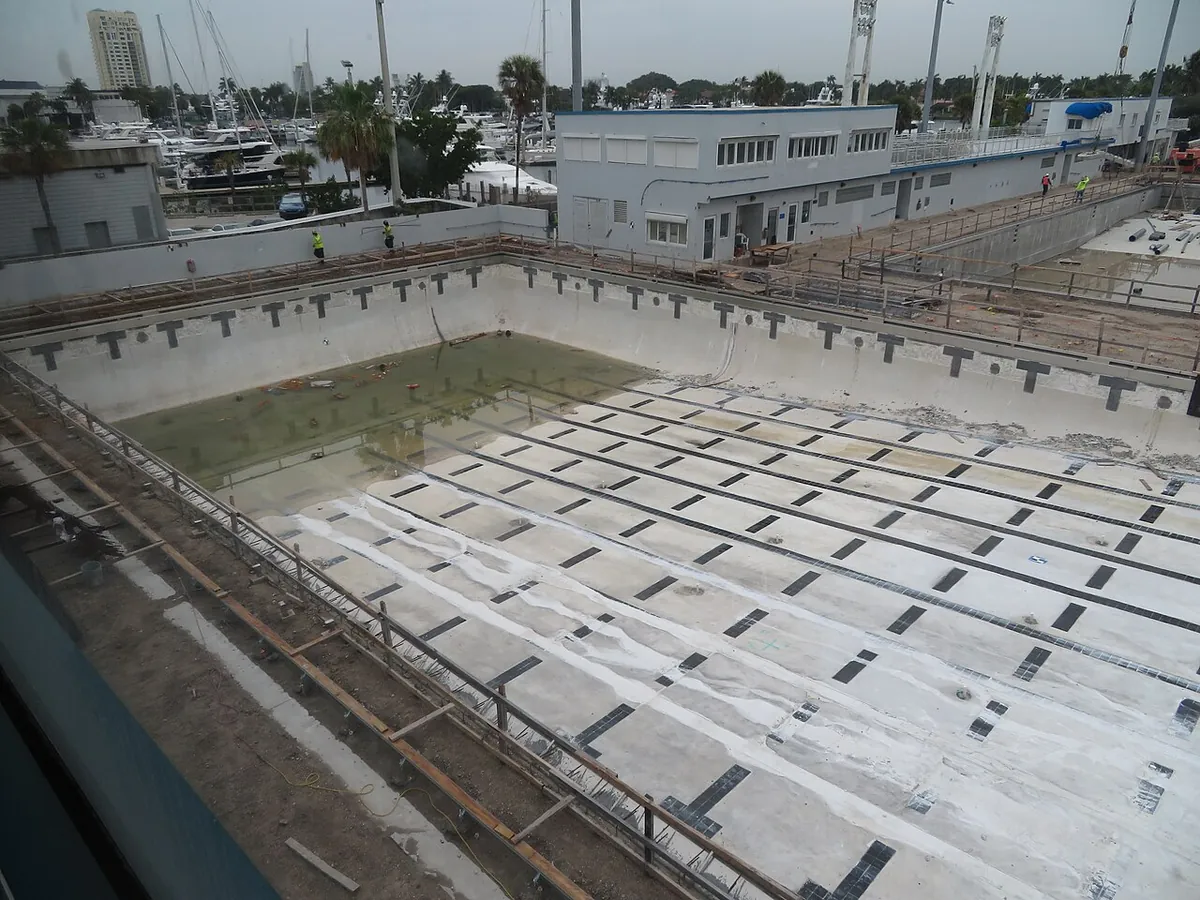
Photo: Ken Lund, Wikimedia Commons, CC BY-SA 2.0
Swimming pool concrete must be strong, dense and watertight, because it holds hundreds of tons of water and stays wet for decades. Most residential gunite and shotcrete pool shells are specified at 4,000 psi or higher at 28 days, and well-applied pneumatic concrete often reaches 5,000 to 7,000 psi. The American Shotcrete Association and pool industry standards recommend low water-cement ratios, proper nozzle technique, and removal of rebound, the loose material that bounces off during spraying, which must not be built back into the shell. Shells are typically 6 to 8 inches thick in walls and floors for residential pools, thicker in deep ends, on hillsides and in commercial pools. The large competition pool above, drained and stripped during a renovation, shows how a concrete pool shell stays sound for decades even when the finish and fittings are replaced. See high-strength concrete and concrete mix ratio.
Concrete for swimming pool decks and coping is a separate pour, typically 4 inches thick on compacted base, with control joints, a non-slip finish, and an expansion joint at the coping so the deck can move without cracking the bond beam. See pool deck concrete and concrete pool coping.
Interior Finishes for Concrete Pools
The interior finish is what you see and touch. White plaster, also called marcite, is the traditional finish: a mix of white cement and marble dust troweled smooth. It is the cheapest option and gives a classic bright blue water color, but it typically lasts 7 to 12 years before it needs replastering. Colored plaster adds pigment for deeper water colors but can mottle. Quartz aggregate finishes add colored quartz crystals to the plaster for more durability and color, lasting about 10 to 15 years. Pebble finishes, with small polished stones exposed at the surface, are the most durable cementitious finish, lasting 15 to 25 years, with a textured feel underfoot. Full tile interiors, in glass or porcelain mosaic, are the most expensive and the longest lasting, often in high-end and commercial pools. Painted concrete pools, using epoxy or chlorinated rubber paint, are cheaper upfront but need repainting every few years. See concrete pool deck resurfacing.
Concrete Inground Pool Design Options
The biggest reason to choose a concrete inground pool is design freedom. Because the shell is shaped by hand over steel, almost anything is possible. Freeform pools follow curves that fit around trees, patios and slopes. Geometric pools with straight lines and sharp corners suit modern homes. Beach or zero-depth entries slope gently into the water like a shoreline, which is great for children and older swimmers. Tanning ledges, also called sun shelves, are shallow platforms 6 to 12 inches deep where loungers and umbrellas can sit in the water. Built-in benches, swim-up bars, raised bond beams with water features, grottos, rock waterfalls, slides and diving wells can all be cast into the shell. Spas can be attached and raised so water spills over into the pool. Vanishing or infinity edges, where water spills over one wall into a hidden catch basin, are especially popular on sloping sites with views. Lap pools long and narrow enough for swimming exercise fit side yards. None of these features are practical with standard fiberglass shells, which is why designers default to concrete for custom work.
Each feature adds cost and complexity. Raised walls, spas and vanishing edges need more steel, more engineering, more tile and more plumbing. Plan features around how the pool will actually be used, and talk with the builder about long-term maintenance for each one, such as cleaning a catch basin or resealing a rock waterfall.
Is a Concrete Pool Worth It?
A concrete pool is worth it for buyers who want a custom design, plan to stay in the home for many years, want the longest-lasting structure, or need a size or depth that prefabricated pools cannot provide. In warm regions where pools are expected, a well-designed concrete pool can add to a home's appeal and value, though it rarely returns its full cost at resale. It may not be worth it for buyers on a tight budget, those who want the lowest maintenance, or those who expect to move within a few years, where a fiberglass or vinyl pool may make more sense. Insurance, property taxes, fencing requirements and ongoing running costs should be included in the decision. Get several quotes, look at pools each builder completed years ago, and ask previous customers about service, warranty and how the finish has held up.
Cement Pools Through History
Cement pools have a long history. Roman baths used waterproof hydraulic mortars, and the first modern swimming pools of the late 1800s and early 1900s were built from poured concrete with cement render. Public pools of the 1920s and 1930s in Europe and the United States were massive cast concrete basins, many of which are still in use after repeated refurbishment. Gunite, invented in the early 1900s for repairing structures, was adopted for pools after World War II, which made curved, affordable backyard pools possible and fueled the boom in residential pools in California, Arizona, Florida and Australia. Many older cement pools have been resurfaced several times; with sound shells, they can keep going indefinitely with new finishes, plumbing and equipment.
Resurfacing a Concrete Pool
Resurfacing is the major maintenance job for concrete pools. Signs it is due include rough surfaces that snag swimsuits and scrape feet, widespread staining, etching, chalking, and hollow-sounding delaminated areas. The process starts with draining the pool carefully, with hydrostatic relief valves opened or groundwater checked. The old finish is chipped, blasted or ground away, at least at the edges and any loose areas, so the new finish bonds. Cracks and damaged areas are repaired, tile and coping are replaced if needed, and a bond coat is applied. The new plaster, quartz or pebble finish is then troweled on in a single day, and the pool is filled immediately and started up with a careful plaster start-up procedure over the following weeks. Many owners use resurfacing as a chance to update tile, lighting and equipment at the same time. See how to resurface concrete.
Concrete vs Fiberglass vs Vinyl Pools
Homeowners usually compare three main types of inground pools. Concrete inground pools are fully custom in shape, size and depth, very strong, and long lasting, and they add the most value in markets where custom pools are common. They cost the most, take the longest to build, need resurfacing every 10 to 20 years, and their porous surface needs more brushing and chemicals to control algae. Fiberglass pools are factory-molded shells delivered by truck and set in a hole in a few days. They have a smooth, non-porous gel coat that resists algae and uses fewer chemicals, and they rarely need resurfacing for decades. But shapes and sizes are limited to what the factory makes and what can be shipped on roads, usually up to about 16 by 40 feet. Vinyl liner pools use a steel or polymer wall kit and a custom-fitted vinyl liner. They are the cheapest to install and can be built in many shapes, but liners need replacing every 7 to 15 years and can be punctured.
Over 20 to 30 years, total costs of ownership are closer than the initial prices suggest, because concrete pools need resurfacing and more chemicals, fiberglass pools need little, and vinyl pools need liner replacements. The right choice depends on budget, design goals, climate, soil and how long you plan to stay in the house. For a fully custom design, a large size, a deep diving well, or an integrated spa and water features, a concrete pool is usually the only option.
Concrete Pool Costs
Costs vary widely by region, size, design, site and finishes. A basic residential inground concrete pool of about 15 by 30 feet with plaster finish, simple coping and a modest deck often costs about $50,000 to $80,000 in many US markets. Larger pools, pebble or tile finishes, attached spas, waterfalls, lighting, automation, heaters, extensive decking and landscaping push totals to $100,000 to $200,000 or more. Difficult sites, with rock, hillside retaining walls, poor access or high water tables, add cost. Typical cost components include design and permits, excavation and hauling, steel and plumbing, the gunite or shotcrete shell, tile and coping, interior finish, equipment, electrical, decking, fencing and startup. Ongoing costs include chemicals, electricity, water, cleaning, repairs and resurfacing about every 10 to 20 years, which costs roughly $10,000 to $25,000 depending on size and finish. See concrete cost per square foot and concrete pump truck cost.
How Long Does It Take to Build a Concrete Pool?
Concrete pool construction usually takes 8 to 16 weeks from permit to swimming, longer for complex designs or during busy seasons. Design and permitting may take 2 to 8 weeks. Excavation, forming, steel and plumbing take about 1 to 2 weeks. The shell is shot in a day or two, then cures for about 3 to 4 weeks while tile, coping, deck and equipment work continue. The interior finish takes 1 to 2 days, and filling and startup another few days. Weather, inspections and trade scheduling cause most delays. Fiberglass pools, by comparison, can often be installed in 2 to 4 weeks once permitted.
Maintaining a Concrete Pool
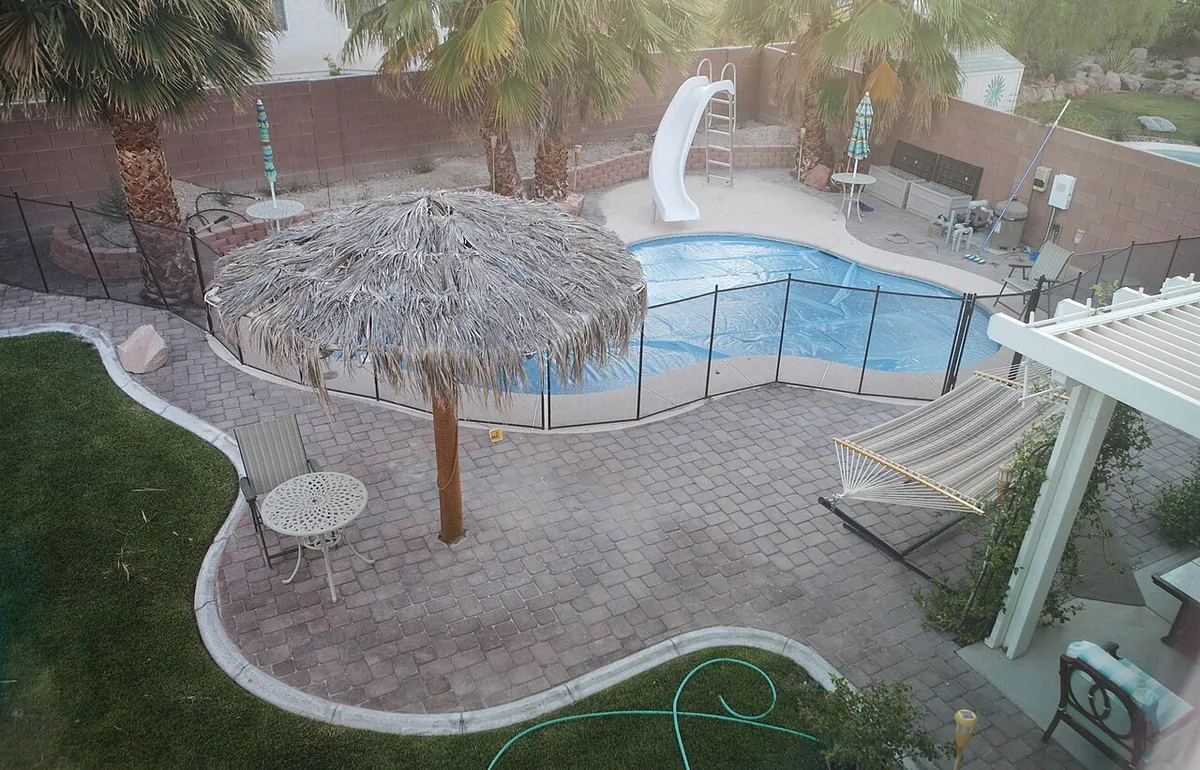
Photo: Mwirig, Wikimedia Commons, CC BY-SA 4.0
Concrete pools need a little more care than fiberglass because their finish is porous. Brush walls and floor weekly to stop algae from settling into the surface, especially in corners, steps and behind ladders. Keep water chemistry balanced: pH, total alkalinity, calcium hardness and sanitizer levels all matter. Water that is too aggressive, with low pH or low calcium, dissolves the plaster and etches the surface; water that is too scaling, with high pH or calcium, leaves rough calcium deposits. Many owners use the Langelier Saturation Index to keep water balanced. Clean the tile line to remove scale and oils. Run the filter long enough each day to turn over the water. Cover the pool when not in use to save heat and chemicals and keep debris out, like the solar cover on the backyard pool above. In freezing climates, winterize the pool by lowering the water level slightly, blowing out lines, adding winter chemicals and covering it. Never fully drain a concrete pool without professional advice: groundwater pressure can lift an empty shell out of the ground. See how to clean concrete.
Common Concrete Pool Repairs
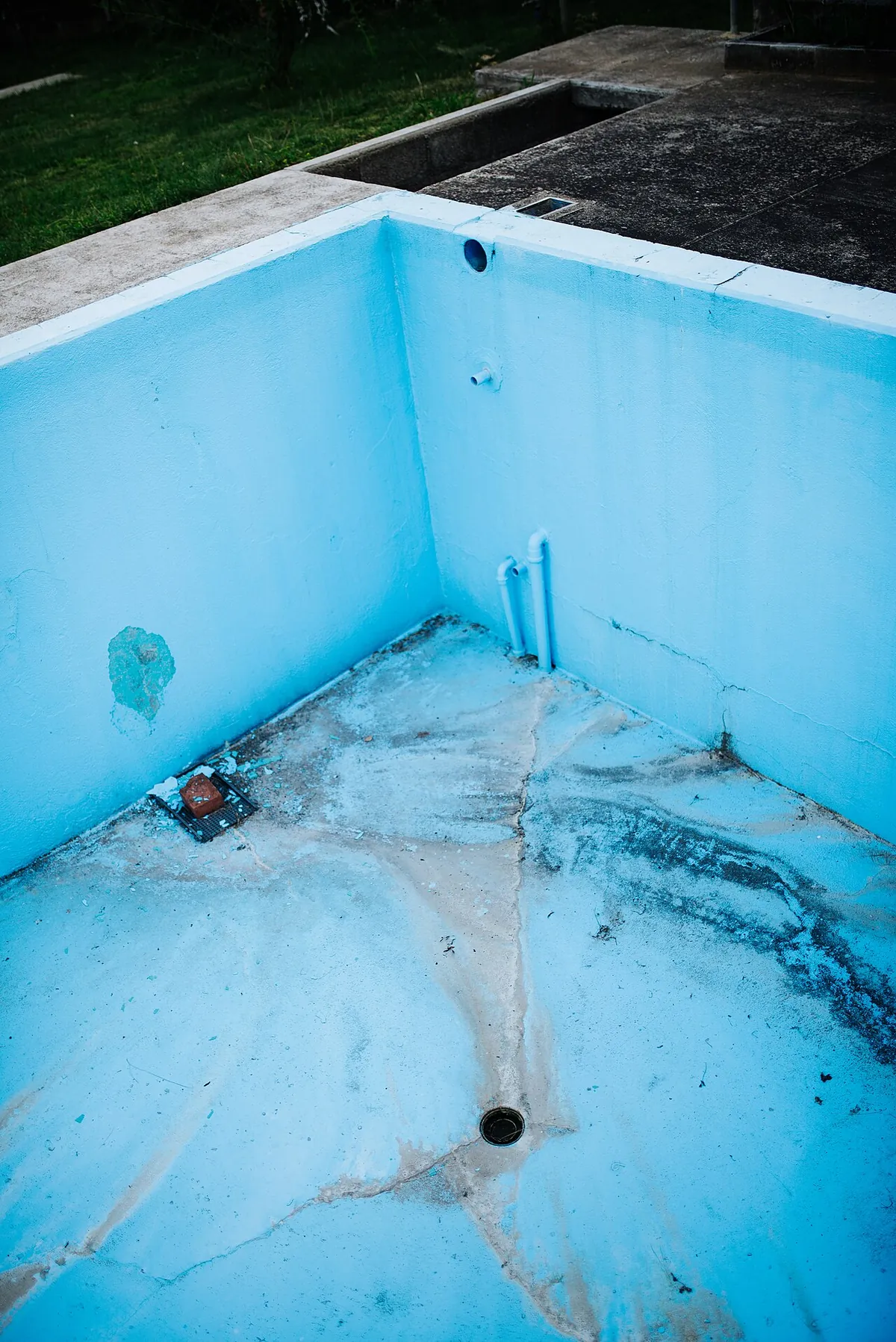
Photo: Shixart1985, Wikimedia Commons, CC BY 2.0
Over decades, concrete pools need repairs. Surface wear, staining, etching and rough plaster are fixed by acid washing, sanding or, eventually, resurfacing with new plaster, quartz or pebble finish. Delamination, where the finish separates from the shell and sounds hollow when tapped, is repaired by removing the loose finish and replastering. Hairline shrinkage cracks in the finish are common and usually cosmetic. Structural cracks that go through the shell, like the long cracks across the floor of the old pool above, can leak and grow; they are repaired by routing and epoxy injection, stapling with steel stitches, or in severe cases, rebuilding sections. Loose or cracked tile and coping are reset with new mortar. Leaks at fittings, lights and skimmers are found with dye tests and pressure tests and repaired with sealants or new parts. Settling decks that pull away from the coping need leveling and joint sealing. See epoxy concrete crack repair, why concrete cracks and concrete restoration.
Above Ground Concrete Pools
Above ground concrete pools are much less common than inground ones, but they exist. Some are built with reinforced concrete block or poured walls standing partly or fully above grade, finished with render, tile or stone, and used on rocky sites, steep lots, rooftops or where excavation is difficult. Others are semi-inground, sunk partly into the ground with a raised wall that doubles as seating. Precast concrete plunge pools and stock tank style concrete pools are also sold. An above ground concrete pool must be engineered for the large outward pressure of water against the walls, which increases with depth, and the foundation must carry heavy loads. Waterproofing is critical. Costs per square foot are often similar to or higher than inground pools because of the structural walls and finishes. For most backyards, a conventional inground concrete pool or a prefabricated above ground pool is simpler. See concrete retaining walls.
Choosing a Concrete Pool Builder
The quality of a concrete pool depends heavily on the builder and the subcontractors who handle steel, plumbing, shotcrete and finishes. Ask how long the company has built concrete pools, whether they use their own crews or subcontractors, and who will supervise the job day to day. Ask for the shell thickness, steel size and spacing, concrete strength, and whether they test the concrete or core the shell. Find out what warranty covers the structure and the finish, and for how long. Check licenses, insurance and reviews, and visit pools they built five or ten years ago to see how they have aged. Get the payment schedule in writing, tied to completed stages, and make sure permits and inspections are in the builder's scope. A careful builder will talk about drainage, soil, curing and startup chemistry, not only about tile colors. Be wary of very low bids, rushed schedules that skip curing time, and contracts that leave out excavation surprises such as rock, groundwater or hauling, since these are where budgets most often grow after the hole is dug.
Concrete Pool Safety and Rules
Every pool must meet local safety rules. Most jurisdictions require a fence or barrier at least 4 to 5 feet tall around the pool, with self-closing, self-latching gates, and some require door alarms or safety covers. Anti-entrapment drain covers and dual main drains are required by federal law in the United States for public pools and are good practice at home. Steps, handholds and depth markers help swimmers. Electrical bonding and ground-fault protection prevent shocks. The backyard pool above shows a removable mesh safety fence around the water, a common solution for families with small children. Check local codes before designing the pool and deck layout, because barrier rules can affect where the pool can go, where gates swing and how close the pool can sit to the house.
Frequently Asked Questions
How long does a concrete pool last?
The shell can last 50 years or more. Interior finishes last about 7 to 25 years depending on type and care.
Is a concrete pool better than fiberglass?
Concrete offers unlimited design and durability; fiberglass offers faster installation, a smoother surface and lower upkeep. The better choice depends on design and budget.
How much does an inground concrete pool cost?
Typically about $50,000 to $120,000 installed for a residential pool, more with spas, features and large decks.
Do concrete pools crack?
Small surface cracks in the finish are common. Structural cracks are uncommon in well-built pools but can result from poor soil, poor construction or draining the pool.
Can you build an above ground concrete pool?
Yes, but it needs engineered walls and foundations and careful waterproofing, so it is less common and often costly.
Sources
- Pool & Hot Tub Alliance: pool construction standards
- American Shotcrete Association: shotcrete for pools
- US CPSC: Pool Safely and drain safety
- American Concrete Institute: shotcrete and water-retaining structures
Related Guides
- Concrete pool coping — poured and precast coping, joints and repair
- Pool deck concrete — installation, finishes and cost
- Concrete tub — concrete bathtubs and bathrooms
- Concrete fountain — tiered fountains, pumps and care