
Types of Concrete Anchors: How to Choose, Install and Remove Them
Quick Answer
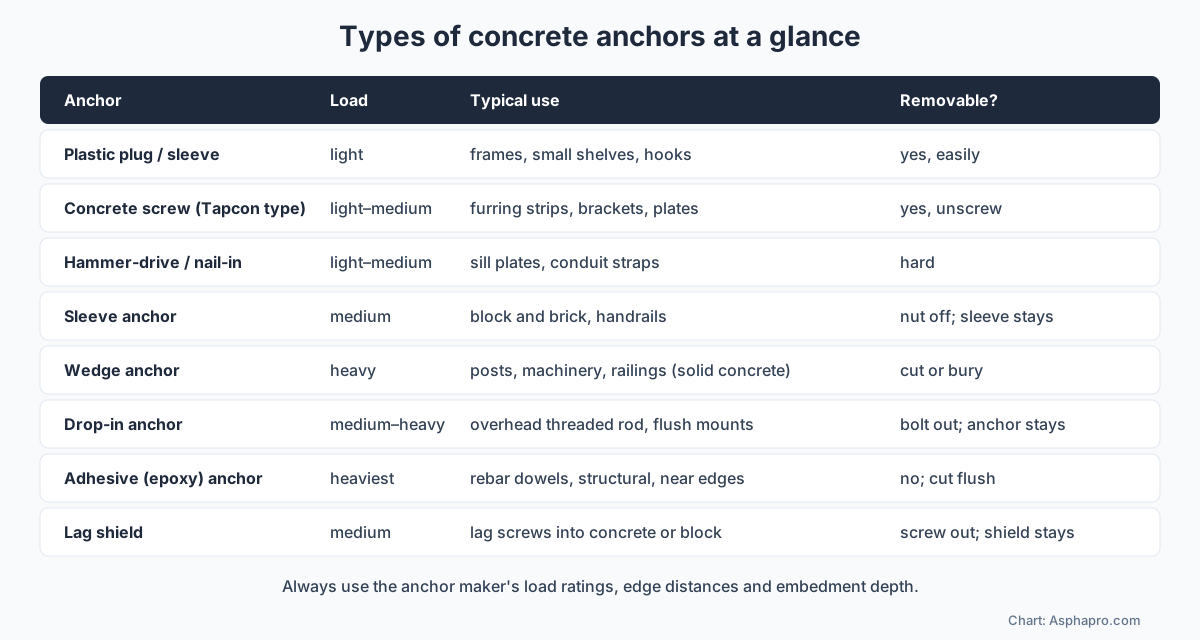
The main types of concrete anchors are plastic plugs (light loads like frames), concrete screws such as Tapcon-type screws (light to medium loads, removable), hammer-drive anchors, sleeve anchors (medium loads, good in block and brick), wedge anchors (heavy loads in solid concrete), drop-in anchors (flush mounting, overhead rod), lag shields, and adhesive (epoxy) anchors (the strongest, used for structural work and near edges). To choose, match the anchor to the load, base material (solid concrete, hollow block or brick), edge distance and whether you need to remove it later. Always drill with a hammer drill and the bit size the anchor maker specifies, clean the hole, and follow the rated embedment depth.
Concrete is hard, brittle and dense, so ordinary wood screws and drywall anchors do not hold in it. Concrete anchors work by expanding against the hole, cutting threads into the concrete, or bonding with adhesive. Choosing the right anchor is the difference between a shelf that holds for decades and one that pulls out of the wall.
This guide explains the types of concrete anchors, which one to use for common jobs, how to hang things on concrete walls (including frames), how to secure a handrail to concrete, and how to remove concrete anchors when you are done.
How Concrete Anchors Hold
- Expansion (friction): the anchor expands inside the hole and presses against the sides. Plastic plugs, sleeve, wedge and drop-in anchors work this way.
- Thread-forming (keying): hardened threads cut into the concrete, like concrete screws.
- Bonding (adhesive): epoxy or another adhesive fills the space around a threaded rod or rebar and bonds it to the concrete.
Expansion anchors put outward stress on the concrete, which is why they need minimum distances from edges and from each other. Adhesive anchors put less stress on the concrete and can be placed closer to edges.
The Main Types of Concrete Anchors
1. Plastic plugs (sleeve plugs)
Ribbed plastic sleeves that expand when you drive a screw into them. Cheap and simple. Best for light loads: picture frames, small mirrors, smoke detectors, light curtain rods and cable clips. Drill the hole to the size printed on the package, tap the plug in flush, and drive the screw.
2. Concrete screws (Tapcon-type)
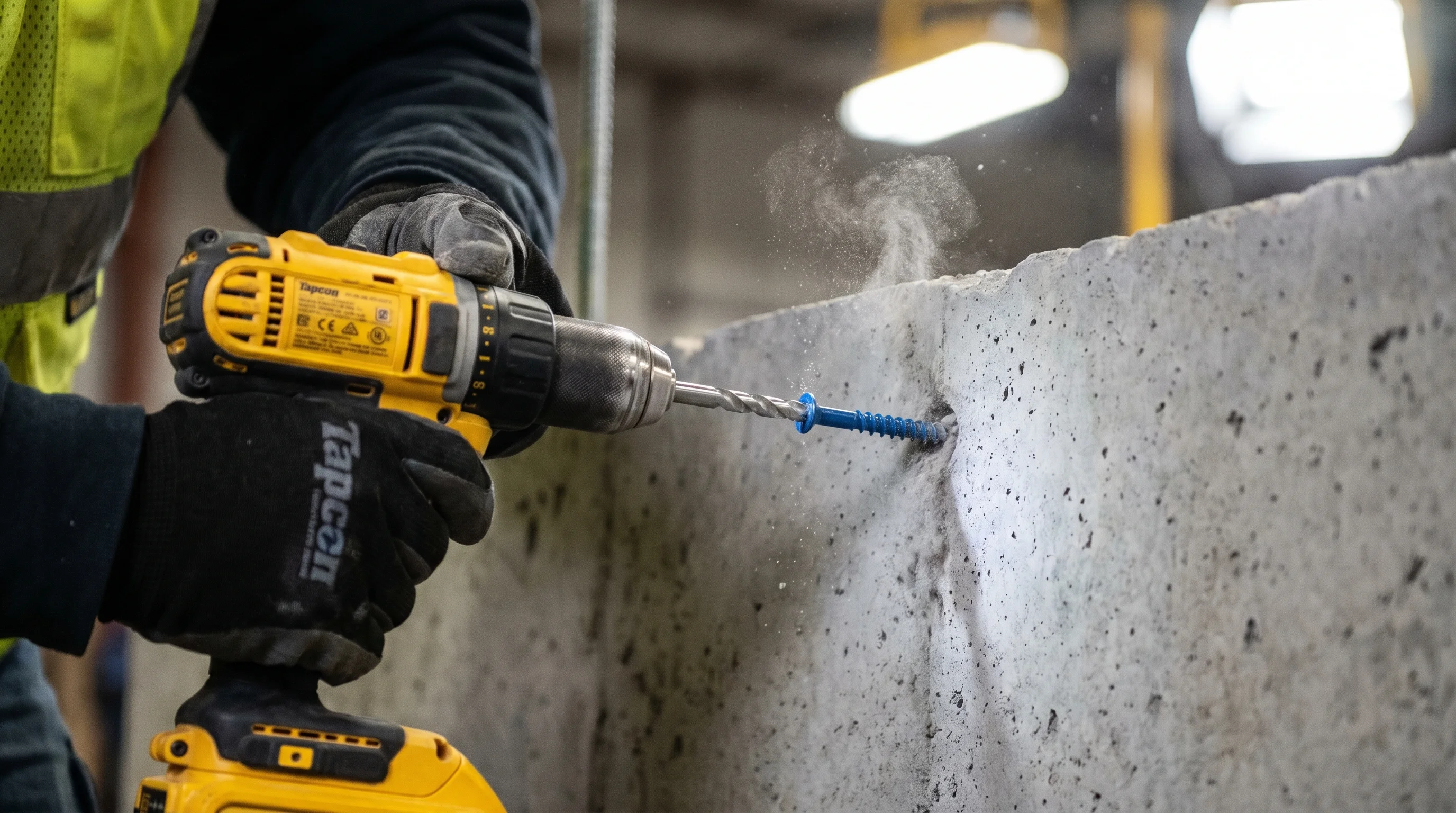
Blue or silver hardened screws with special threads that cut into concrete, brick and block. You drill a pilot hole with the matched carbide bit and drive the screw in. They are fast, need no separate anchor, and can be removed. Good for furring strips, brackets, shelf standards, electrical boxes, door thresholds and window frames. Common diameters are 3/16 and 1/4 inch, with heavier-duty versions available. See concrete screws.
3. Hammer-drive anchors (nail-in anchors)
A sleeve with a pin you hammer in to expand it. Quick for light-to-medium fastening such as conduit straps, lath and sill plates. They are hard to remove.
4. Sleeve anchors
A bolt with an expanding sleeve. You drill a hole through the item and into the concrete, insert the anchor, and tighten the nut, which pulls the cone into the sleeve. Sleeve anchors work in concrete, brick and block, making them versatile for handrails, brackets and fixtures.
5. Wedge anchors
A threaded stud with an expansion clip at the bottom. Tightening the nut pulls the stud up and wedges the clip against the hole. Wedge anchors are among the strongest mechanical anchors and are used for heavy loads in solid concrete only: post bases, racking, machinery, structural brackets. They are not suited for hollow block or brick.
6. Drop-in anchors
An internally threaded sleeve set flush with the surface. You drop it in the hole and set it with a setting tool, then thread in a bolt or threaded rod. Popular for overhead hanging of pipes, ductwork and lights from concrete ceilings and for flush mounts.
7. Lag shields
Soft metal or alloy shields that expand when a lag screw is driven in. Used for medium loads in concrete and block, and convenient when you want to use standard lag screws.
8. Adhesive (epoxy) anchors
A two-part adhesive injected into a drilled, cleaned hole, followed by a threaded rod or rebar. After it cures, it is the strongest and most reliable anchor type, especially in cracked concrete, near edges and for structural work like rebar dowels. Cure time depends on temperature. Hole cleaning (brushing and blowing out dust) is critical.
Which Anchor for Which Base Material
| Base material | Good anchors | Avoid |
|---|---|---|
| Solid poured concrete | All types; wedge and epoxy for heavy loads | Undersized plugs for heavy items |
| Hollow concrete block (CMU) | Sleeve anchors, concrete screws, plastic plugs, epoxy with screen tubes, toggle-type anchors in the cell | Wedge anchors, drop-ins in hollow cells |
| Solid brick | Sleeve anchors, concrete screws, epoxy | Wedge anchors near edges |
| Mortar joints | Light loads only | Heavy loads; mortar is weaker |
| Old or weak concrete | Epoxy anchors | Expansion anchors that can crack it |
For more on block, see cinder block vs concrete block.
How to Install a Concrete Anchor
- Choose the anchor and size for the load, using the maker's ratings.
- Mark the hole and check edge distance and spacing from other anchors.
- Drill with a hammer drill and a carbide masonry bit of the exact diameter specified. Drill straight, slightly deeper than the embedment depth. See concrete drill bits.
- Clean the hole: blow out and brush out dust. Dust reduces holding power, especially for adhesive anchors.
- Insert and set the anchor following its method: tap, drive, tighten to the torque specified, or inject adhesive and insert the rod.
- Wait for adhesive cure time before loading.
Wear eye protection and a respirator when drilling concrete; drilling releases silica dust. See how to cut concrete for dust safety.
Common Drill Bit Sizes for Concrete Anchors
| Anchor | Typical bit size | Note |
|---|---|---|
| 3/16-inch concrete screw | 5/32 inch | Use the bit packed with the screws |
| 1/4-inch concrete screw | 3/16 inch | Drill ¼ inch deeper than embedment |
| Wedge anchor | Same as anchor diameter (e.g., 3/8-inch bit for 3/8-inch anchor) | Hole through fixture same size |
| Sleeve anchor | Same as anchor diameter | Size listed is the sleeve |
| Drop-in anchor for 3/8-inch rod | 1/2 inch | Use the matching setting tool |
| Plastic plug | Printed on the package (often 1/4 inch) | Match the screw gauge too |
| Adhesive anchor | Usually 1/16 to 1/8 inch larger than the rod | Follow the adhesive maker's table |
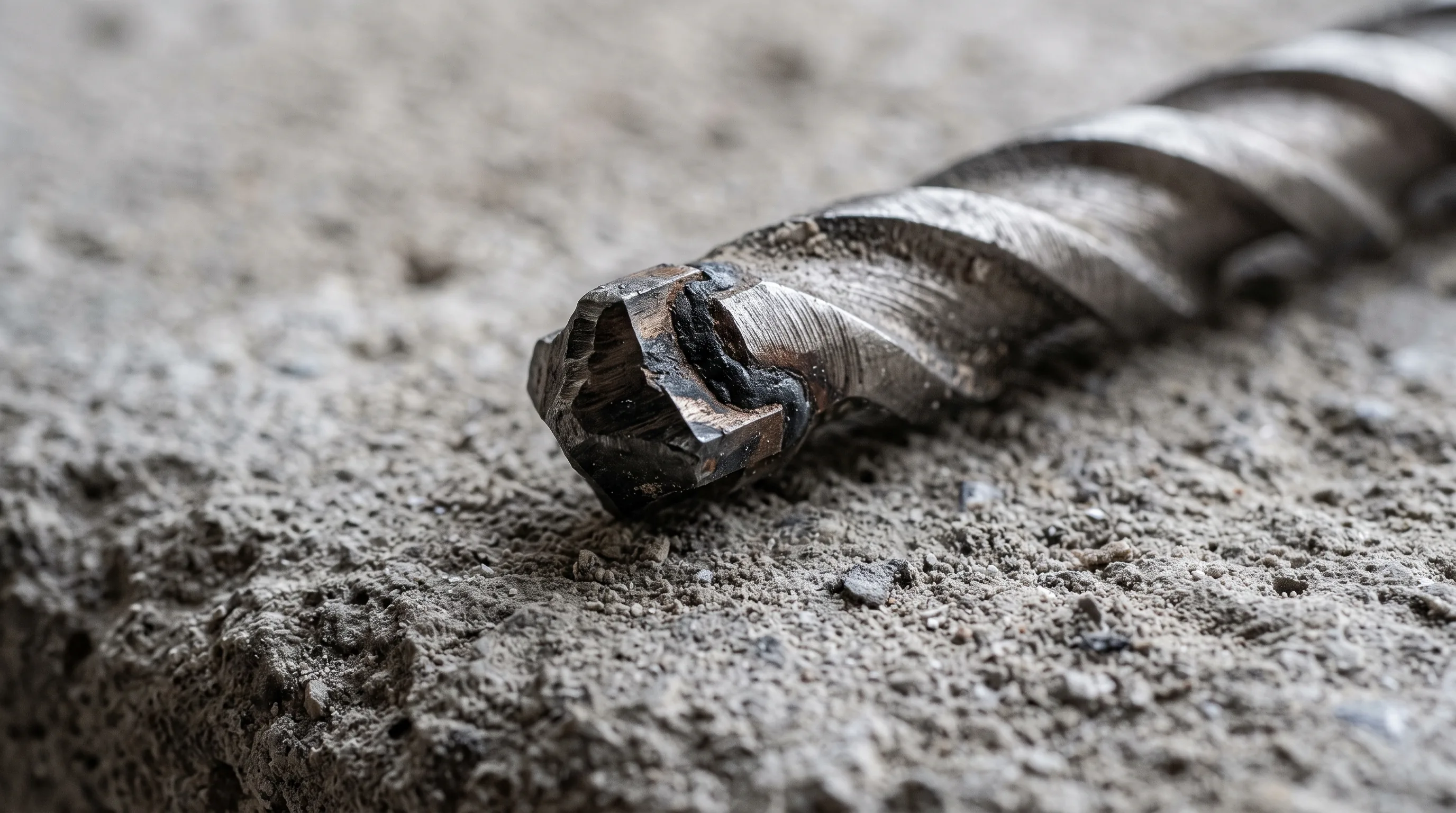
These are typical values; always confirm with the anchor maker. A worn bit drills undersized holes, so replace dull bits.
How to Choose: A Simple Decision Path
- What is the base? Solid concrete, hollow block, brick or mortar joint? This rules some anchors in or out.
- How heavy is the load, and which direction? Light (frames, small shelves), medium (TVs, cabinets, handrails), heavy (posts, machinery, overhead).
- How close to an edge? Near edges or in old concrete, favor epoxy.
- Indoors or outdoors? Choose galvanized or stainless outside.
- Will you remove it later? Concrete screws and plastic plugs come out easily; wedge and epoxy anchors are permanent.
- Is it safety-critical? Handrails, overhead loads and structural connections need rated anchors installed exactly to the data sheet, and sometimes an engineer.
Outdoor Uses: Posts, Hoops and Mailboxes
Outdoor fixtures often bolt to concrete slabs or footings. For a post base on an existing patio, wedge or epoxy anchors through the base plate are common. For new pours, cast-in anchor bolts or J-bolts set in the wet concrete are stronger and simpler than drilling later. Basketball hoops and flagpoles usually come with an anchor bolt kit set into a new concrete footing. Mailbox posts often use a surface-mount plate on a curb or slab with sleeve or wedge anchors. See concrete footing cost for footing work.
Tools You Need
- Hammer drill or SDS rotary hammer.
- Carbide masonry bits in the right sizes.
- Blow-out bulb or compressed air and a wire hole brush.
- Hammer, wrench or socket set, and a torque wrench for structural anchors.
- Setting tool for drop-in anchors; dispensing gun for adhesive.
- Safety glasses, hearing protection and a dust mask or respirator.
Cost of Concrete Anchors
Plastic plugs and concrete screws are inexpensive and sold in packs. Sleeve and wedge anchors cost more per piece, especially in larger diameters or stainless steel. Adhesive anchoring systems cost the most because of the cartridge, mixing nozzle and dispensing gun, but one cartridge sets many anchors. For most home projects, the drill bits and a good hammer drill are a bigger expense than the anchors themselves. Renting a rotary hammer for a day is a good option if you only have a few heavy anchors to set and do not want to buy one.
Drilling Tips for Clean, Accurate Holes
- Start slow: begin without hammer mode, or at low speed, to keep the bit from walking, then switch to hammer mode once the hole is started.
- Use a depth stop: set the drill's depth rod or wrap tape around the bit at the right depth.
- Hold it square: a hole drilled at an angle makes anchors sit crooked and reduces holding power.
- Pull back often: back the bit out every inch or so to clear dust, especially in deep holes.
- Hit rebar? Stop. Move the hole slightly, or use a rebar-cutting bit if the design allows cutting the steel. Never cut reinforcing in structural members without approval.
- Control dust: hold a vacuum nozzle next to the bit or use a drill with dust extraction, and wear a respirator.
- Drilling tile or finished surfaces: start with a tile bit through the finish layer, then switch to a masonry bit in hammer mode for the concrete behind it.
- Mark through fixtures: hold the bracket in place and mark every hole, or drill through the fixture for wedge and sleeve anchors so holes line up perfectly.
Clean, accurate holes are half the job with any of the types of concrete anchors. An anchor in a sloppy hole will never reach its rated strength.
How to Hang Things on Concrete Walls
- Very light items: adhesive hooks or strips rated for the weight work on smooth, painted concrete without drilling.
- Frames and mirrors: plastic plugs and screws, or small concrete screws.
- Shelves: concrete screws or sleeve anchors through the bracket.
- TV mounts: sleeve anchors or heavy-duty concrete screws as the mount maker specifies; for poured concrete walls, wedge anchors may be specified.
- Cabinets: screw a furring strip or ledger to the wall with concrete screws, then attach cabinets to it.
- Heavy items overhead: drop-in or wedge anchors, or epoxy anchors, per the load.
How to Hang Frames on Concrete Walls
Hanging frames on concrete walls is easier than it looks. For light pictures, adhesive strips or hooks rated for masonry can work on smooth, painted concrete. How to hang picture frames on concrete walls that are heavy, like mirrors, is with a masonry drill bit and plastic plugs or small sleeve anchors.
- Decide where the hook will go and mark it with a pencil.
- Drill a hole with a masonry bit matched to the plastic plug, usually ¼ inch for common plugs, using a hammer drill.
- Blow out the dust and tap the plug in until flush.
- Drive a screw into the plug, leaving the head out far enough to hang the frame's wire or hanger.
- For heavy frames, use two anchors to keep the frame level and share the load.
No drill? Try hardened steel picture hooks with thin nails designed for masonry, or heavy-duty adhesive strips rated for the frame weight. They work on many concrete and plaster walls.
Concrete Anchors for Renters and Shared Walls
If you rent, or the wall is shared with a neighbor, check rules before drilling. Many leases allow small picture holes but not large anchors. For light items, adhesive hooks, tension rods, freestanding shelves and leaning mirrors avoid drilling altogether. If drilling is allowed, plastic plugs and small concrete screws leave the smallest holes, which can be filled with patching compound when you move out. In apartment buildings with concrete walls and ceilings, ask management about embedded conduit, pipes and post-tension cables before drilling; building staff often know where it is safe.
How to Secure a Handrail to Concrete
How to secure handrail to concrete steps safely depends on where the posts land. Posts set on top of the steps use a base plate and wedge or sleeve anchors; posts set near an edge need anchors placed far enough back that the concrete does not crack out.
Handrails must hold a person's weight, so anchoring matters. Building codes commonly require residential handrails to resist a concentrated load of 200 pounds applied in any direction.
- Choose the base plate or bracket: surface-mount posts with base plates are common on concrete steps.
- Stay away from edges: place anchors at least the minimum edge distance the maker specifies, often several anchor diameters from the edge of the step. Anchors too close to edges can crack the concrete.
- Pick the anchor: wedge anchors or epoxy anchors in solid concrete; sleeve anchors in brick or block steps. Epoxy is best near edges.
- Drill and clean: drill through the base plate holes, then blow and brush out the holes.
- Install and torque: tighten nuts to the specified torque, or let epoxy cure fully before loading.
- Test: push and pull hard on the rail.
For old or cracked steps, repair the concrete before mounting a rail; see how to fix concrete steps. Core-drilled posts set in non-shrink grout or epoxy are another strong option, often used by railing contractors.
How to Remove Concrete Anchors
- Plastic plugs: back out the screw, then drive the screw partway back in and pull with pliers, or drill out the plug with the same bit.
- Concrete screws: unscrew them. The hole can be reused with a slightly larger screw.
- Sleeve anchors: remove the nut and washer, then tap the bolt into the hole, or pull it with pliers. If stuck, cut flush with a grinder.
- Wedge anchors: they are not designed to come out. Cut flush with an angle grinder and a metal cutoff wheel, or remove the nut and hammer the stud down into a deeper drilled hole.
- Drop-in anchors and lag shields: remove the bolt; the anchor usually stays. Fill or cover it.
- Epoxy anchors: cut the rod flush.
Patch the holes with patching mortar or epoxy filler, then paint or finish to match.
Understanding Load Ratings
Anchor makers publish how much load each size can carry in different materials. Two directions matter:
- Tension (pull-out): a load pulling straight out of the wall or ceiling, such as a hanging light or a ceiling-mounted rack.
- Shear: a load pushing down along the wall surface, such as a shelf bracket or TV mount.
Published values can be ultimate loads (the point of failure) or allowable loads with a safety factor already applied. Many makers suggest using a quarter of the ultimate load for working loads on mechanical anchors, but check the data sheet; never load an anchor to its failure value. Loads also drop in weak concrete, near edges, when anchors are too close together, and in hollow block.
For structural uses, look for anchors with an ICC-ES evaluation report, which shows the anchor has been tested to recognized acceptance criteria (such as AC193 for mechanical anchors and AC308 for adhesive anchors) and lists design values, including values for cracked concrete.
Edge Distance and Spacing
Expansion anchors push outward on the concrete. Too close to an edge, the concrete can split off in a cone or wedge. Too close to another anchor, their stress zones overlap and both lose strength. Anchor data sheets list minimum edge distance and spacing, usually as a multiple of the anchor diameter. Adhesive anchors generally allow closer edge distances because they do not wedge the concrete. On steps, curbs and slab edges, this is often why epoxy is the right choice.
Cracked vs Uncracked Concrete
Concrete in tension zones, such as the underside of a slab or beam, can have fine cracks. Some anchors lose a lot of holding power when a crack runs through the hole. Anchors rated for cracked concrete, and most quality adhesive anchors, are designed and tested for this. For overhead loads and anything safety-related, choose anchors approved for cracked concrete and follow an engineer's design where required.
Anchor Materials and Corrosion
- Zinc-plated steel: fine for dry indoor use.
- Hot-dip galvanized: better for outdoor and damp locations.
- Stainless steel (304 or 316): best for coastal areas, pools, chemical exposure and long life outdoors.
- Coated concrete screws: many have corrosion-resistant coatings for exterior use; check the rating.
When fastening pressure-treated lumber to concrete, use fasteners rated for contact with treated wood, as the treatment chemicals can corrode plain steel.
Anchoring Wood to Concrete
Common wood-to-concrete jobs include basement wall furring strips, sill plates on slabs, garage shelving cleats and deck ledger boards on foundations.
- Furring strips: concrete screws every 16 to 24 inches, or construction adhesive plus screws.
- Bottom plates for interior walls on slabs: concrete screws, powder-actuated pins or wedge anchors; use treated lumber or a sill gasket against concrete.
- Sill plates for new construction: anchor bolts cast into the foundation or adhesive anchors, as code requires.
- Deck ledgers on concrete foundations: wedge, sleeve or epoxy anchors per local code and an approved detail. Never attach a ledger to brick veneer.
Powder-Actuated Fasteners
Powder-actuated tools fire hardened pins into concrete and steel using a small explosive charge. They are fast for fastening wall plates, furring and track to concrete. They require training, eye and hearing protection, and the right charge strength. They are not for brittle or thin concrete, block faces or near edges. Many rental stores and home centers sell single-shot tools for DIY use, but read the safety instructions carefully.
Anchoring to Concrete Ceilings
Overhead anchors carry loads in tension, and failure means something falls. Use drop-in anchors, wedge anchors or adhesive anchors rated for overhead and cracked concrete, never plastic plugs for anything heavy. For post-tensioned slabs, which are common in some buildings and homes, do not drill without locating the tendons first. See the warning in how to cut concrete.
A Worked Example: Heavy Garage Shelving
Say you want to mount steel wall standards for garage shelves that will hold paint cans and tools on a poured concrete foundation wall.
- Choose ¼-inch concrete screws long enough for about 1 to 1¾ inches of embedment, per the screw maker.
- Space standards about 16 to 24 inches apart, with screws every 12 to 16 inches down each standard.
- Drill pilot holes with the matched bit using a hammer drill, ¼ inch deeper than the screw will go.
- Blow out the dust and drive the screws until snug, not over-tightened, which can strip the threads.
- Load the shelves gradually and keep the heaviest items low.
If the wall is hollow block, use sleeve anchors or block-rated screws placed into the solid face shell, not the mortar joints.
Common Mistakes
- Using drywall anchors or wood screws in concrete.
- Drilling the wrong size hole; even 1/16 inch oversize can ruin holding power.
- Not cleaning dust out of the hole.
- Over-tightening, which can crack concrete or strip screws.
- Placing expansion anchors too close to edges or each other.
- Using wedge or drop-in anchors in hollow block.
- Loading epoxy anchors before the adhesive cures.
- Anchoring into mortar joints for heavy loads, where the mortar is much weaker than the block or brick around it.
Frequently Asked Questions
What are the main types of concrete anchors?
Plastic plugs, concrete screws, hammer-drive anchors, sleeve anchors, wedge anchors, drop-in anchors, lag shields and adhesive (epoxy) anchors.
What is the strongest concrete anchor?
Adhesive (epoxy) anchors, followed by wedge anchors in solid concrete.
How do you hang things on concrete walls without drilling?
Use adhesive hooks or strips rated for the weight, or masonry picture hooks with hardened nails.
What anchor should I use for a handrail on concrete steps?
Wedge or epoxy anchors in solid concrete, sleeve anchors in brick or block, with proper edge distance.
Can I use wedge anchors in concrete block?
No. Wedge anchors are for solid concrete. Use sleeve anchors, concrete screws or epoxy with screen tubes in block.
How do you remove a wedge anchor?
Cut it flush with an angle grinder, or drive it deeper into a drilled hole, then patch.
Do I need a hammer drill for concrete anchors?
Yes for most anchors. A regular drill struggles in concrete. A hammer drill or rotary hammer with carbide bits makes clean, correctly sized holes.
How deep should a concrete anchor go?
To the minimum embedment depth on the anchor's data sheet, often at least 1 inch for small screws and more for heavy anchors.
Can you reuse a hole for a concrete screw?
Often once, but holding power drops. Use the next larger diameter screw or move the hole.
How long does epoxy anchor adhesive take to cure?
It depends on the product and temperature, from under an hour in warm weather to a day or more in cold. Check the label.
Sources
- International Code Council, International Residential Code (handrail load requirements). iccsafe.org
- Anchor manufacturer technical data for load ratings, edge distance and installation.
- Image credits: images and chart by Asphapro.com.
Use the anchor maker's ratings; consult an engineer for structural or overhead loads. Checked November 2026.