
How to Cut Concrete: Tools, Step-by-Step Method and Dust Safety
Quick Answer
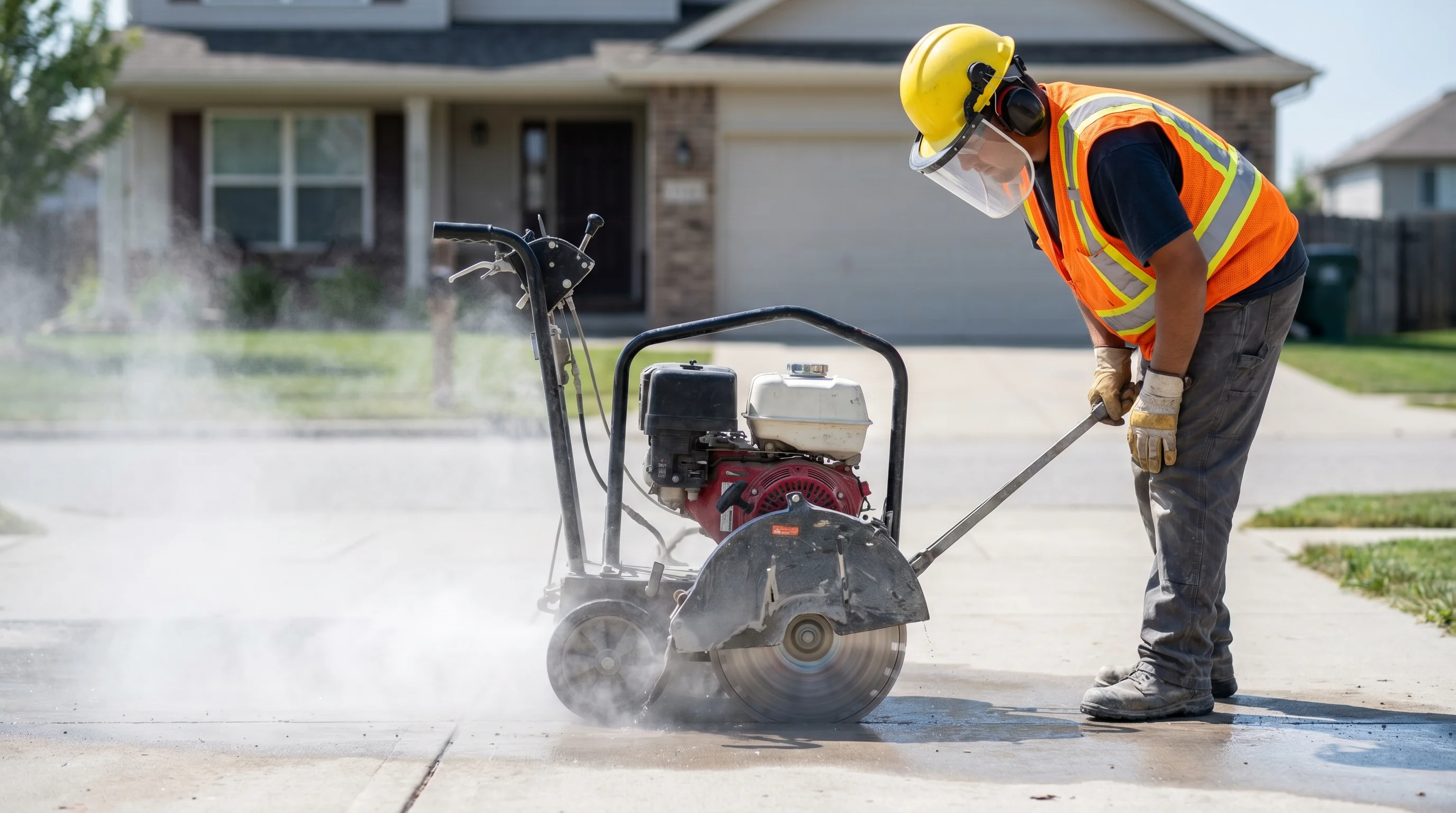
To cut concrete, mark the line and check for pipes, wires, radiant heat tubing and post-tension cables. Choose a saw that can reach the depth: a 4½-inch angle grinder cuts about 1 inch, a circular saw with a diamond blade about 2 inches, a 14-inch cut-off saw about 5 inches, and a walk-behind saw for long, deep cuts. Fit a diamond blade, cut wet to control dust, start with a shallow scoring pass, and deepen in passes of 1 to 2 inches. For slabs thicker than your saw can reach, cut as deep as you can and break the rest with a sledgehammer or breaker. Concrete dust contains crystalline silica; OSHA's limit is 50 µg/m³ over an 8-hour day, and even short dry cutting can exceed it, so always use water or dust collection and a respirator.
Cutting concrete is a common job for remodeling, plumbing repairs, adding a doorway, removing part of a driveway, cutting control joints in a new slab, or trimming pavers and blocks. With the right saw and blade, it is very doable for a careful homeowner. The two things that make it different from cutting wood are the weight and power of the tools and the dust, which is a real health hazard.
This guide explains how to cut concrete step by step, which saw and blade to use for each job, how deep different saws cut, how to cut control joints, what to do about rebar, and how much exposure to concrete dust is dangerous.
How Much Exposure to Concrete Dust Is Dangerous?
Concrete is made with sand and stone that usually contain quartz, a form of crystalline silica. Cutting, grinding, drilling and breaking concrete releases tiny respirable silica particles that reach deep into the lungs. OSHA links breathing respirable crystalline silica to silicosis (an incurable lung disease), lung cancer, chronic obstructive pulmonary disease (COPD) and kidney disease.
OSHA's construction silica standard (29 CFR 1926.1153) sets:
- Permissible exposure limit (PEL): 50 micrograms per cubic meter of air (µg/m³), averaged over an 8-hour workday.
- Action level: 25 µg/m³ over 8 hours, the point at which employers must start monitoring.
Fifty micrograms is a tiny amount, far less than you can see. Dry cutting concrete with a hand saw can create a visible cloud of dust within seconds, and studies OSHA relied on show dry cutting can far exceed the limit. That is why the standard's Table 1 lists water or dust collection for every concrete cutting task:
| Task (OSHA Table 1) | Required control | Respirator outdoors | Respirator indoors / enclosed |
|---|---|---|---|
| Handheld power saws (any blade size) | Integrated water delivery that continuously feeds water to the blade | None up to 4 h/shift; APF 10 over 4 h | APF 10 at any duration |
| Walk-behind saws | Integrated water delivery feeding the blade | None | APF 10 |
| Handheld grinders (not mortar removal) | Water feed (outdoors) or shroud with dust collector of 25 cfm per inch of wheel, 99% filter | None | None up to 4 h; APF 10 over 4 h (with dust collector) |
APF 10 means a respirator with an assigned protection factor of 10, such as a properly fitted half-face respirator with N95 or P100 filters, or an N95 filtering facepiece. OSHA's rules apply to employers, but the same controls are the best guide for homeowners: cut wet or with a vacuum shroud, work outdoors when you can, wear a fitted respirator, and keep others away. A paper dust mask that is not N95-rated does little.
Other Safety Gear
- Hearing protection: concrete saws are very loud.
- Eye protection: safety glasses or goggles, plus a face shield for cut-off saws.
- Gloves and boots: steel- or composite-toe boots protect against dropped slabs.
- Long sleeves and pants: wet slurry is alkaline and can irritate skin.
- GFCI protection: use a ground-fault outlet or cord when cutting wet with electric tools.
- Kickback awareness: cut-off saws can kick back violently if the upper front of the blade binds. Hold firmly with both hands and stand to the side of the blade's path.
Choosing a Saw
How do you cut concrete without fighting the tool? Pick the saw for the depth and length of the cut. A small cut in a thin slab is easy with a grinder; a long cut through a 4 inch driveway needs a walk-behind or handheld concrete saw.
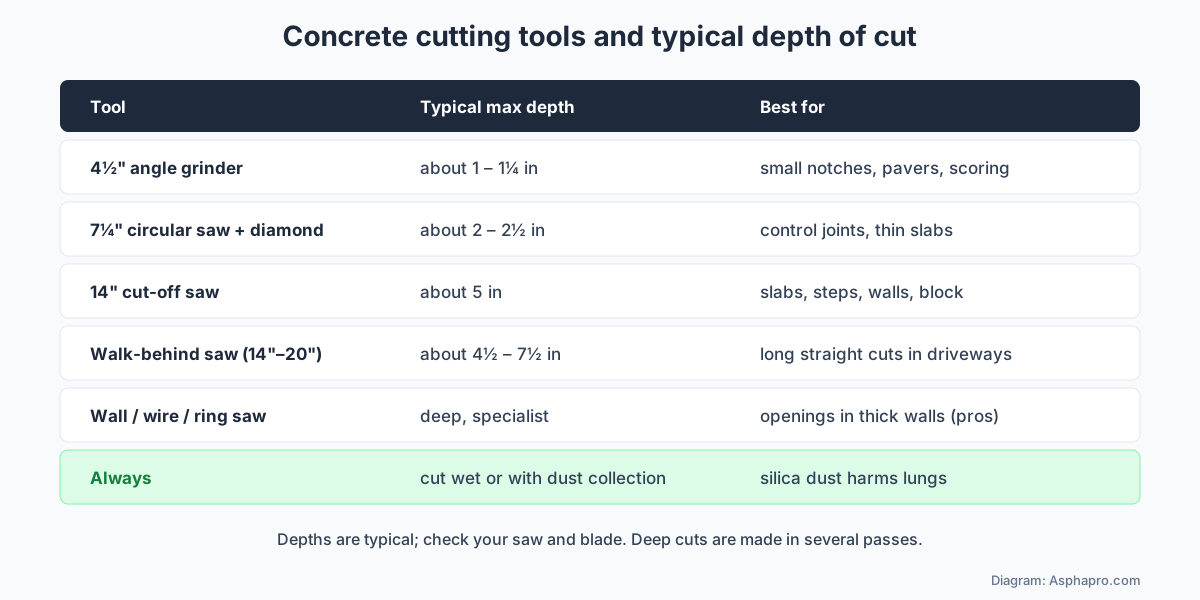
- Angle grinder (4½ to 9 inch): small cuts, notches, scoring, cutting pavers and tile. A 4½-inch grinder cuts about 1 inch deep.
- Circular saw with a diamond blade: a 7¼-inch saw cuts about 2 inches. Good for control joints and thin slabs, but saws not designed for masonry wear quickly from dust. Worm-drive or masonry-specific saws hold up better.
- Cut-off saw (power cutter): gas, electric or battery, usually with a 12- or 14-inch blade, cutting about 4 to 5 inches. The go-to rental tool for slabs, steps, walls and block.
- Walk-behind saw (flat saw): rolls along the slab, cuts straight lines in driveways and floors, often 14 to 20 inch blades and deeper cuts. Easier to control than a handheld saw for long cuts.
- Wall saws, wire saws and ring saws: specialist tools for thick walls, openings and deep cuts, usually used by concrete cutting contractors.
- Core drill: for round holes for pipes and vents; see concrete drill bits.
For more on saw types, see concrete saw.
Gas, Electric or Battery Saw?
- Gas cut-off saws: the most power and no cord, the standard rental. They produce carbon monoxide, so never use them indoors or in a garage, even with doors open.
- Electric cut-off and walk-behind saws: safe to use indoors with water feed and GFCI protection. Good for basements and interior slabs.
- Battery cut-off saws: newer, cordless and emission-free, handy for short cuts and indoor work. Runtime is limited, so have spare batteries for longer jobs.
- Hydraulic saws: used by pros, powered by a separate hydraulic unit; good for indoor and underwater cutting.
For indoor concrete cutting, choose electric or battery tools to avoid carbon monoxide, and combine them with water to control concrete dust.
Choosing a Blade
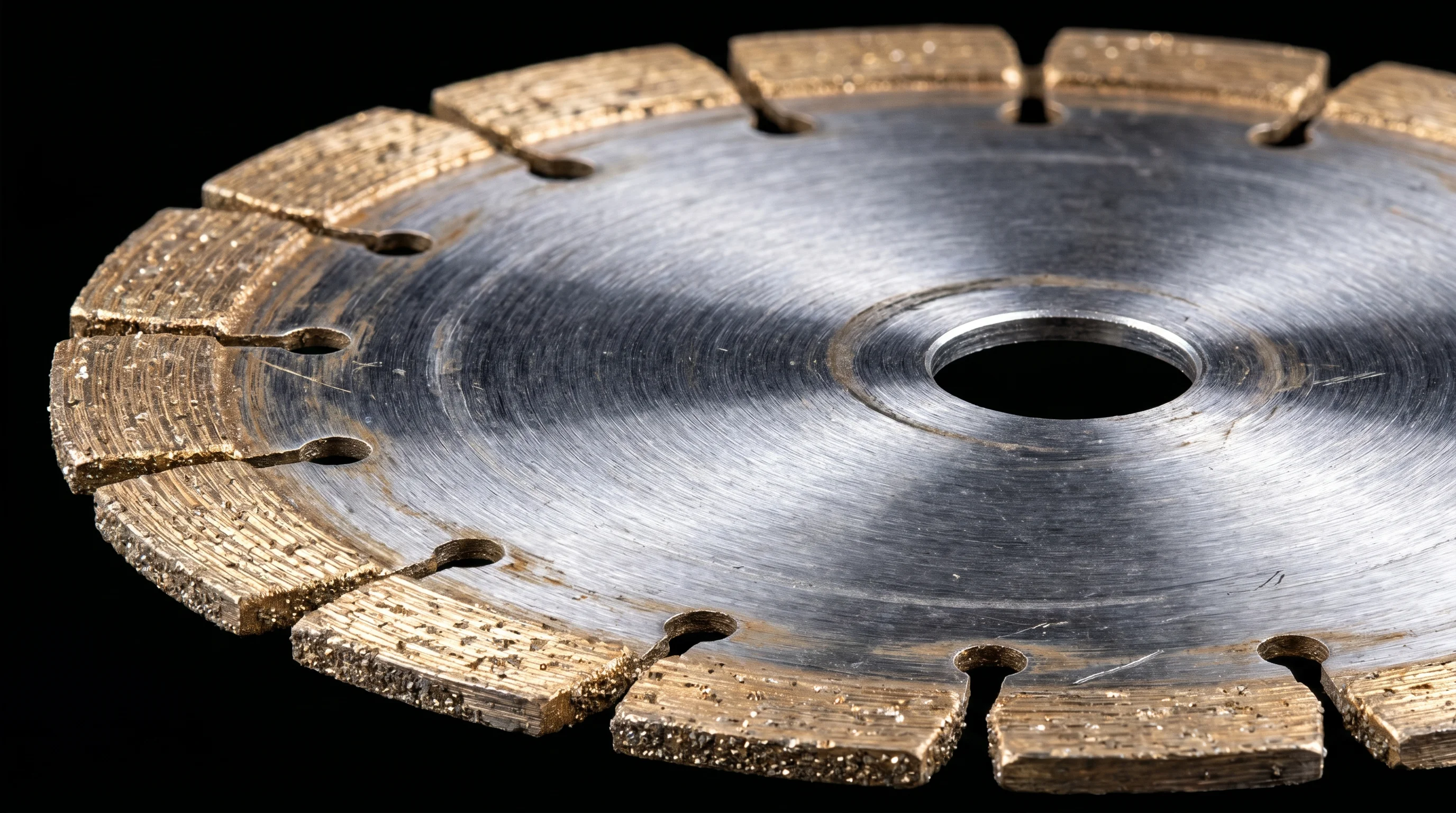
- Segmented diamond blades: gaps between segments help cool and clear debris. Good general concrete blades, especially for dry cutting.
- Turbo diamond blades: a continuous serrated rim that cuts fast and smoother. Good for general use.
- Continuous rim blades: smooth edge for clean cuts in tile and stone; usually wet use.
- Wet vs dry rated: some blades are made only for wet cutting. Even dry-rated blades last longer and cut cooler with water.
- Hard vs soft bond: blades are matched to material. Concrete with hard aggregate needs a softer bond; abrasive material like green concrete or block needs a harder bond. The blade box usually lists the materials.
- Abrasive blades: cheap silicon carbide wheels work but wear down quickly and change diameter as they wear. Diamond blades are better value for more than a few cuts.
Before You Cut Concrete: A Checklist
- Utilities located: 811 called for outdoor work; plans or a scan for indoor slabs.
- Slab type known: no post-tension warning stamps, no radiant heat tubing in the cut path.
- Thickness checked: measure at an edge or drill a small test hole so you know how deep to cut concrete and which saw you need; see concrete slab thickness.
- Water ready: hose connected to the saw, or a helper with a sprayer, for wet cutting concrete.
- Slurry plan: storm drains blocked, wet vacuum on hand.
- Gear on: respirator, eye and face protection, hearing protection, boots and gloves.
- Area cleared: kids, pets and bystanders away from the concrete dust and kickback zone.
- Blade checked: right blade for the material, arrow pointing the correct direction, flange tight.
Dry Cutting Concrete: When It Happens
Sometimes cutting concrete wet is not practical, such as indoors near finished floors or electrical equipment. In those cases, use a saw or grinder with a dust shroud connected to a vacuum with a high-efficiency filter, the method OSHA Table 1 lists for grinders. Some handheld saws also have vacuum shrouds. Even with good dust collection, wear a respirator, keep cuts short and take breaks so concrete dust can be cleared. Never dry cut concrete with a saw that has no dust control in an enclosed room; silica dust levels can climb far above safe limits in minutes and linger in the air long after you stop.
Making Straight, Clean Saw Cuts
A straight saw cut makes breaking out easier and gives a clean joint for new concrete. Clamp or screw a straight 2x4 to the slab as a guide for handheld concrete saws, or use the pointer on a walk-behind saw and follow a chalk line. Keep the saw cut moving at a steady pace. If the blade wanders, back out and restart the pass rather than steering in the cut. Mist the line between passes so concrete dust does not hide the chalk. For a crisp finished edge, make the last pass slowly with plenty of water.
Step-by-Step: How to Cut a Concrete Slab
- Plan and check: call 811 before cutting outdoor slabs, and check for plumbing, electrical conduit, radiant heat tubing and gas lines in or under the slab. Look for stamps or signs warning of post-tensioned cables (see below).
- Mark the line: snap a chalk line or use a straightedge and a crayon or marker. Mark both sides if you will cut from both.
- Set up water: connect the saw's water feed to a hose, or have a helper keep the cut wet. Plan where slurry will go.
- Set the depth: start with a shallow depth of about 1/4 to 1/2 inch for the first pass.
- Score the line: make a shallow pass along the whole line. This guides later passes and keeps the cut straight.
- Deepen in passes: increase depth 1 to 2 inches per pass. Let the blade cut at its own speed; forcing it overheats the blade and the saw.
- Keep the blade straight: twisting the saw can bind the blade and cause kickback.
- Cut full depth or partial: if the saw reaches through, cut through. If not, cut as deep as you can.
- Break out: strike the section with a sledgehammer or use a jackhammer or breaker. The saw cut gives a clean break line. Pry out pieces with a pry bar.
- Deal with rebar or mesh: cut exposed steel with an angle grinder and metal blade or a reciprocating saw.
- Clean up: collect slurry and dust.
Cutting Control Joints in New Concrete
Control joints are shallow cuts that create a weak line so the slab cracks there as it shrinks, instead of randomly. Common guidance from the concrete industry, including the American Concrete Institute:
- Depth: about one quarter of the slab thickness, so about 1 inch in a 4-inch slab.
- Spacing: in feet, roughly two to three times the slab thickness in inches, so about 8 to 12 feet for a 4-inch slab, with panels as close to square as possible.
- Timing: as soon as the concrete is hard enough that the saw does not ravel the edges, often within 6 to 18 hours with a conventional saw. Early-entry saws can cut within 1 to 4 hours of finishing. Waiting too long lets random cracks form first.
For more on cracking, see why does concrete crack and concrete slab thickness.
Post-Tensioned Slabs: Do Not Cut
Some homes, especially in parts of the South and West, have post-tensioned slabs with steel cables under very high tension inside the concrete. Cutting or drilling a tendon can release it with great force, injure people and seriously damage the structure. These slabs often have a stamped warning in the garage or near an entry. If you are unsure, do not cut or core; consult a structural engineer or a contractor with scanning equipment (ground-penetrating radar) to locate tendons first.
How to Cut Concrete Steps
Cutting concrete steps comes up when you want to remove a step, shorten a landing, or cut out a damaged section for repair. Steps are often thicker than slabs and may be solid concrete or filled with rubble and soil inside a concrete shell.
- Mark the cut on the tread and riser.
- Use a cut-off saw, cutting wet, from the tread down and from the riser in. Cutting concrete at the corners from both faces meets in the middle for a clean edge.
- Break out the waste with a sledgehammer or a small electric breaker.
- Check whether steps are tied to the house foundation with rebar; cutting that steel may need a contractor's advice.
If you want to repair rather than cut, see how to fix concrete steps and concrete steps cost.
How to Cut Concrete Walls and Openings
Cutting a doorway, window or vent opening in a concrete or block foundation wall is structural work. In many places it requires a permit and an engineer's design for a header or lintel to carry the load above the opening.
- Get the opening designed and permitted.
- Shore or support the wall above if the design calls for it.
- Mark the opening on both sides of the wall, using a drilled pilot hole at each corner to line them up.
- Cut from both sides with a cut-off saw. A 14-inch saw cuts about 5 inches from each side, enough for many 8-inch walls. Thicker walls need a wall saw, ring saw or wire saw.
- Do not overcut corners on structural walls; finish corners with a chipping hammer or core holes.
- Remove the cut section in pieces.
Cutting concrete walls indoors creates heavy dust, so use wet cutting, seal off the area and wear a respirator. Basement wall cutting is a common job for concrete cutting contractors, who have wall saws on tracks and slurry vacuums.
How to Cut Concrete Block and Pavers
How do I cut concrete blocks for a wall end or a window opening? Mark the cut on all sides, score it with a masonry blade, then either cut through with a concrete saw or split it with a brick set and hammer. How do you cut concrete blocks cleanly for exposed walls? Use the saw; splitting leaves a rough edge.
- Concrete block (CMU): mark all faces, score with a cut-off saw or angle grinder, and cut wet. A 14-inch saw can cut through an 8-inch block from two sides. For a rough cut, score deeply and split with a brick chisel.
- Concrete pavers: a wet tile saw or masonry saw gives clean cuts. A cut-off saw works for many pavers. A hydraulic or manual paver splitter makes straight breaks without dust.
- Retaining wall block: similar to pavers; score and split, or saw wet.
See concrete blocks and concrete block wall cost for block sizes and prices.
How to Cut Concrete Countertops
Cured concrete countertops are cut with a wet saw or a grinder with a diamond blade, much like stone. Sink and faucet holes are usually formed in the mold before the pour, but cutouts after the fact can be made with a diamond core bit or a grinder. Clamp a straightedge as a guide, cut wet and slowly to avoid chipping, and support both sides of the cut so the piece does not snap. See concrete countertops.
Cutting a Driveway Section or Curb
To replace part of a driveway, widen a driveway apron or remove a damaged panel, cut along existing control joints when possible; they are already weak lines. Otherwise, use a walk-behind saw for a straight, full-depth cut, which gives a clean edge to pour against. Cutting a city curb or sidewalk usually needs a permit from the local public works department. For prices, see concrete driveway cost and concrete removal cost.
Cutting Concrete With Rebar or Wire Mesh
Diamond blades made for reinforced concrete can cut through rebar, but they slow down and wear faster when they hit steel. Ease off pressure, let the blade work, and keep water flowing. Many people cut concrete to the steel, break out the concrete, and then cut the exposed rebar or mesh with an angle grinder and a metal cutoff wheel, or with a reciprocating saw and a metal blade. Bolt cutters work on light wire mesh. If you hit a lot of heavy rebar unexpectedly, stop and check whether the slab is structural.
Wet Cutting Cleanup
Wet cutting turns dust into a gray slurry of water, cement and fine stone. It is alkaline and can harm plants and fish if it reaches storm drains or streams. The EPA and many cities treat concrete slurry as a pollutant.
- Block storm drains and direct slurry to a low area you can contain.
- Use a wet vacuum or slurry vacuum to collect it.
- Let the solids settle and dry, then dispose of them with other concrete debris or as your local rules require.
- Wash slurry off nearby surfaces before it dries, as dried slurry leaves gray stains on brick and pavers; see how to get concrete splash off bricks.
Rent the Saw or Hire a Pro?
Equipment rental stores rent cut-off saws, walk-behind saws and diamond blades by the day or half day, and some charge for blade wear by the fraction of an inch of diamond used. For a weekend project like cutting out a patio section, cutting a few control joints, or trimming pavers, renting is often reasonable for a careful DIYer.
Hire a concrete cutting contractor when:
- The cut is structural, such as a wall opening or a load-bearing slab.
- The slab may be post-tensioned or has radiant heat or embedded utilities.
- You need deep cuts beyond 5 inches, or many feet of cuts.
- The work is indoors where dust control is critical.
- You are not comfortable with the kickback risk of a cut-off saw.
Concrete cutting contractors typically price by the linear foot and depth of cut, with a minimum charge per visit. Get a quote that covers slurry cleanup and debris removal, and ask whether they scan the slab before cutting concrete, since that small extra step can prevent a very costly mistake.
Common Mistakes When Cutting Concrete
- Cutting dry indoors without dust control.
- Trying to cut full depth in one pass.
- Forcing the saw, which glazes the blade and overheats the motor.
- Twisting the saw in the cut, causing binding and kickback.
- Cutting without checking for utilities, tendons or radiant tubing.
- Using a blade not rated for the material.
- Letting slurry run into the street drain, where it can clog pipes and harm local streams.
- Standing directly behind a handheld cut-off saw.
Quick Reference
- How to cut concrete for a control joint: circular saw or walk-behind saw, depth a quarter of the slab, within hours of the pour.
- How to cut concrete slabs for removal: cut-off or walk-behind saw, wet, in passes, then break out.
- How to cut concrete pavers and block: wet masonry saw, cut-off saw or splitter.
- How to cut concrete walls: permit and design first, cut from both sides, pro equipment for thick walls.
- How much exposure to concrete dust is dangerous: above 50 µg/m³ averaged over 8 hours; always cut wet or with a vacuum shroud.
Frequently Asked Questions
What is the best tool to cut concrete?
A cut-off saw with a diamond blade for most slabs, steps and walls; a walk-behind saw for long straight cuts; an angle grinder for small cuts.
Can I cut concrete with a circular saw?
Yes, with a diamond blade, cutting about 2 inches deep. Cut wet if the saw allows it, and expect extra wear on a woodworking saw.
How deep should I cut concrete before breaking it?
As deep as your saw allows. A cut of at least a third to half the thickness gives a reasonably clean break line.
How much exposure to concrete dust is dangerous?
OSHA's limit is 50 µg/m³ of respirable crystalline silica over 8 hours, an invisible amount. Dry cutting can exceed it quickly, so cut wet and wear a respirator.
Should I cut concrete wet or dry?
Wet whenever possible. Water controls silica dust, cools the blade and extends its life.
How long after pouring should I cut control joints?
Usually within 6 to 18 hours with a conventional saw, as soon as the edges do not ravel.
Can you cut concrete with an angle grinder?
Yes, for shallow cuts and small jobs. A 4½-inch grinder with a diamond blade cuts about 1 inch deep. Use a water feed or vacuum shroud.
Can I cut concrete with rebar in it?
Yes. Diamond blades rated for reinforced concrete cut through rebar slowly. Many people cut the concrete, break it out and cut exposed steel with a grinder.
Is a dust mask enough for cutting concrete?
A basic paper mask is not. Use at least an N95-rated respirator or a half-face respirator with P100 filters, plus wet cutting.
How long does it take to cut concrete?
A cut-off saw cuts a few feet per minute at shallow depth; full-depth cuts in a 4-inch slab take longer in multiple passes. Breaking out often takes more time than the cutting.
Sources
- OSHA, Respirable Crystalline Silica standard for construction, 29 CFR 1926.1153 (PEL, action level, Table 1). osha.gov
- OSHA, Silica, crystalline: health effects. osha.gov
- American Concrete Institute, guidance on contraction (control) joints in slabs. concrete.org
- Image credits: images and chart by Asphapro.com.
Follow your saw and blade maker's instructions. Checked November 2026.
Related Guides
- Why does concrete crack? — causes, joints and prevention