
Cinder Block vs Concrete Block: What Is the Difference, and Which Should You Use?
Quick Answer
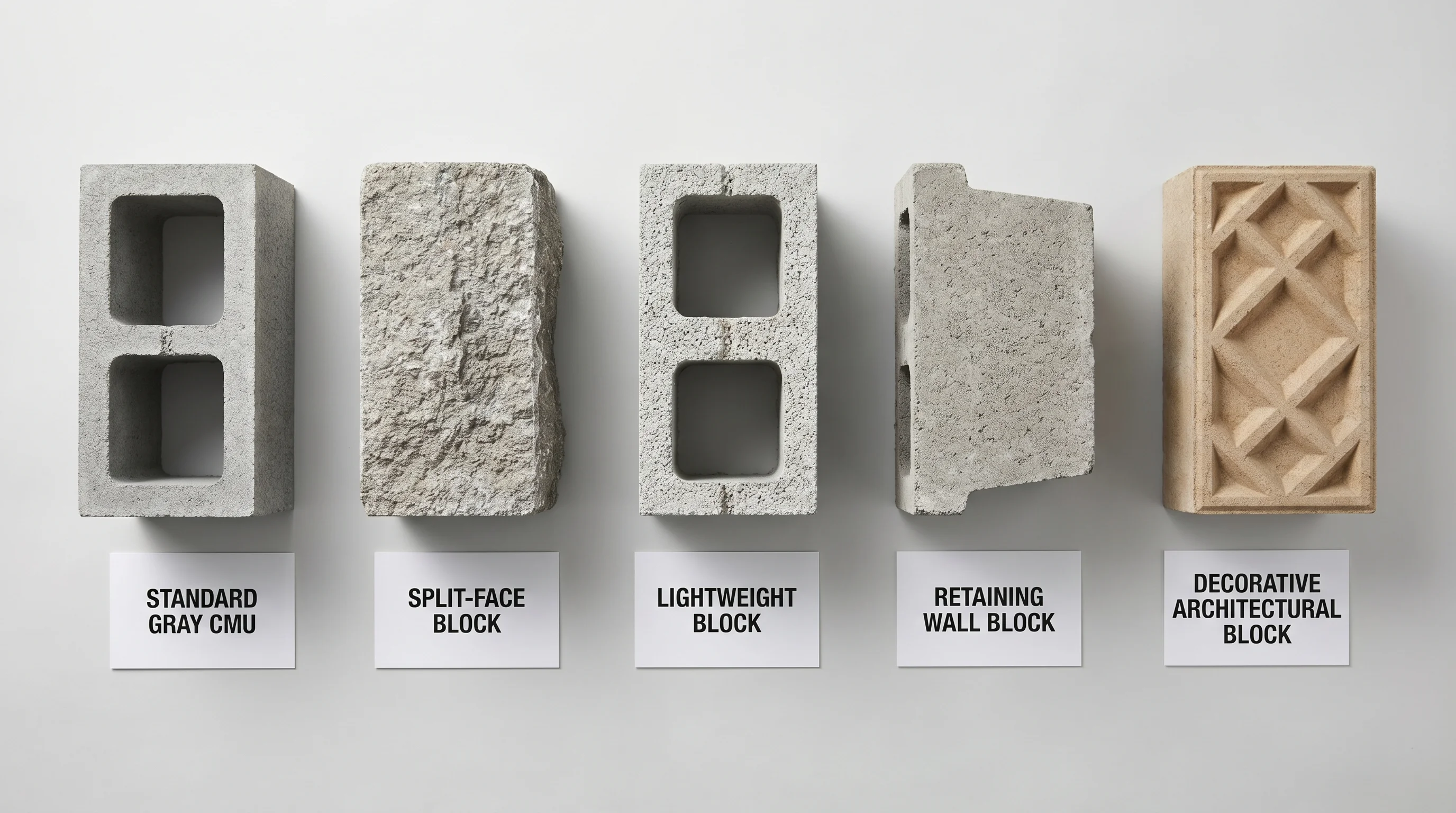
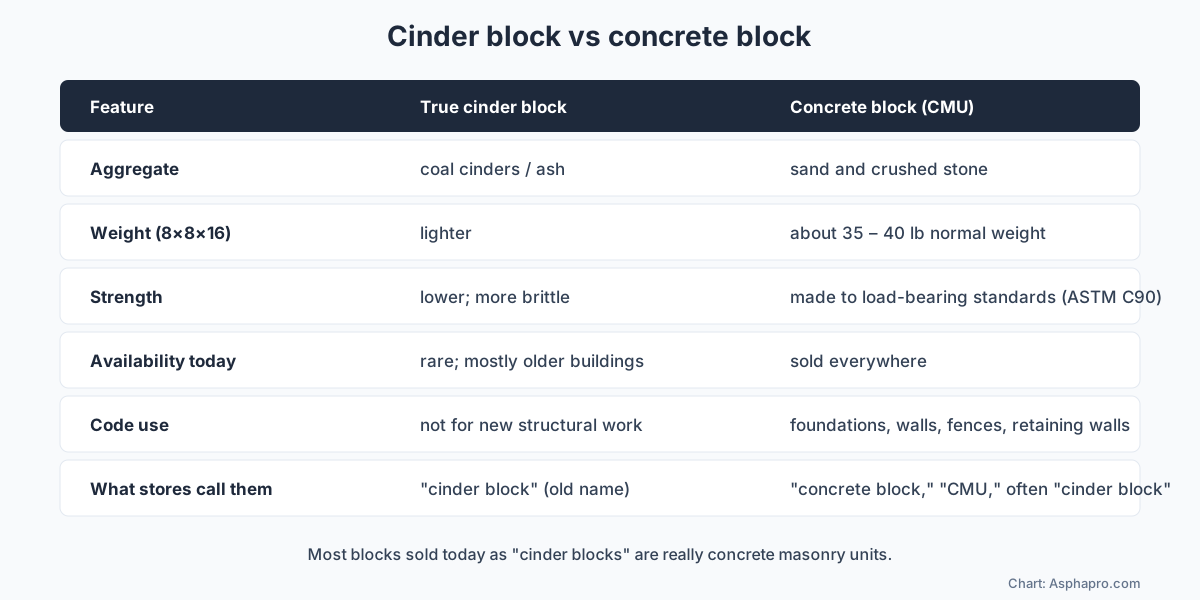
In the cinder block vs concrete block debate, the difference is the aggregate. True cinder blocks were made with coal cinders or ash, which made them lighter but weaker and more brittle. Concrete blocks, also called concrete masonry units (CMU), are made with cement, sand and crushed stone and are manufactured to load-bearing standards such as ASTM C90. A standard normal-weight 8 × 8 × 16 inch concrete block weighs roughly 35 to 40 pounds. Today, almost every "cinder block" sold in stores is actually a concrete block, so for new walls, foundations and retaining walls, you will be using concrete blocks.
People use "cinder block" and "concrete block" as if they mean the same thing, and in everyday speech they usually do. But historically they were different products with different strengths, and the difference still matters when you are looking at an older building, buying blocks for a project, or reading building plans. There is also confusion with "breeze blocks," which can mean different things in different countries.
This guide explains cinder block vs concrete block in plain terms: what each is made of, how they compare in strength and weight, breeze blocks vs concrete blocks, the different types of concrete blocks you can buy today, and which block to use for common projects.
Cinder Block vs Concrete Block at a Glance
Concrete vs cinder block is mostly a question of age. Cinder blocks used coal cinders as aggregate and are rarely made today, while concrete blocks use sand and gravel and are what stores sell now. So when people compare cinder blocks vs concrete blocks, they are usually comparing an old wall with a new one.
What Is a Cinder Block?
Cinder blocks got their name from cinders, the leftover ash and clinker from burning coal in furnaces and power plants. Mixed with cement and formed into hollow blocks, cinders made a lightweight building unit that was cheaper and easier to lift than solid stone or concrete. Cinder blocks were common in the early and mid 20th century. Because cinders are porous and weaker than stone, true cinder blocks are less strong, absorb more water, and are more prone to cracking and crumbling over time. Many older buildings, garages and basements still have walls made from them.
What Is a Concrete Block?
A modern concrete block, or concrete masonry unit, is made from portland cement, water, sand and crushed stone or gravel, pressed in molds and cured. Blocks are produced to standard sizes and strengths, and load-bearing units in the U.S. are typically made to meet ASTM C90, the standard specification for loadbearing concrete masonry units. That gives builders and inspectors a predictable product. Concrete blocks are heavier than true cinder blocks but much stronger, and they are used in foundations, basement walls, garages, commercial buildings, fences and retaining walls. For prices, see concrete block wall cost.
Strength and Durability
Concrete blocks made with stone aggregate are significantly stronger in compression than old cinder blocks and stand up better to weather, freeze-thaw cycles and loads. That is why building codes rely on concrete masonry units for structural walls today. Cinder blocks may still be fine in old, lightly loaded walls that have stood for decades, but they are not used for new structural work. If you are adding loads to an old cinder block wall, for example building a second story or attaching heavy equipment, have it evaluated first.
Weight
True cinder blocks were lighter than concrete blocks of the same size, which was one of their main selling points. Today, a normal-weight hollow 8 × 8 × 16 inch concrete block usually weighs about 35 to 40 pounds; Lowe's lists a minimum of 38 pounds for its standard normal-weight 8 × 8 × 16 block, and a Home Depot listing shows 37.5 pounds. Lightweight concrete blocks, made with expanded shale, clay or slag, are lighter and are the modern replacement for the old cinder block's weight advantage. See how much a concrete block weighs for full details.
Breeze Blocks vs Concrete Blocks
When people compare concrete blocks vs breeze blocks, they are usually talking about decorative screen blocks with open patterns, used for privacy walls and shade rather than structure.
"Breeze block" means different things depending on where you are. In the UK, breeze block traditionally meant a lightweight block made with ash or clinker, similar to the American cinder block; today it is often used loosely for any lightweight building block. In the U.S., "breeze block" usually means a decorative screen block: a concrete block with open patterns that let air and light through, popular in mid-century modern design for walls, fences and carports. Decorative screen blocks are made from concrete but are not designed to carry heavy loads like a structural CMU. So in the breeze blocks vs concrete blocks comparison, breeze blocks are usually either lightweight ash blocks or decorative screen blocks, while concrete blocks are standard structural units.
Different Types of Concrete Blocks
| Block type | Description | Common use |
|---|---|---|
| Standard hollow (stretcher) block | Two or three cores, flat faces | Most walls |
| Corner and end blocks | One finished end | Corners, door and window openings |
| Bond beam block | Channel for horizontal rebar | Tops of walls, reinforced courses |
| Solid block | No or small cores | Caps, high-load areas |
| Half block | Half length | Ends of courses |
| Lightweight block | Expanded shale, clay or slag aggregate | Easier handling, insulation |
| Split-face block | Rough, stone-like face | Decorative walls and buildings |
| Ribbed or fluted block | Vertical ridges | Decorative walls |
| Cap block | Solid, flat top | Finishing walls and fences |
| Screen (breeze) block | Open decorative pattern | Privacy screens, decorative walls |
| Segmental retaining wall block | Interlocking, dry-stacked | Landscape retaining walls |
| Pilaster block | Larger units around a column | Stiffening long fences |
A Short History
Hollow masonry units became popular in the early 1900s, when machines made it possible to mold them quickly and cheaply. Coal was the main fuel for homes, factories and power plants, so cinders were plentiful and nearly free, and builders mixed them with cement to make light, cheap units. After the middle of the century, coal use in homes declined, quarried stone and sand became the standard aggregate, and manufacturers adopted industry standards for strength and size. The old name stuck, which is why many people still say "cinder block" for any gray hollow unit. Today, ash from power plants is still used, but mostly as fly ash replacing part of the cement, not as the coarse aggregate.
How Modern Blocks Are Made
Block plants mix cement, sand, crushed stone or lightweight aggregate and a small amount of water into a stiff, almost dry mix. Machines press the mix into steel molds and vibrate it so it compacts tightly, then push the formed units out onto pallets. The fresh units are cured, often in kilns or chambers with heat and moisture, so they gain strength quickly. Plants test samples for compressive strength, size and absorption to meet product standards. Because the mix is so stiff, the units hold their shape right out of the mold, which allows fast, automated production.
How to Tell if an Old Wall Is Cinder Block
In an older house or garage, you can often tell the difference by looking closely. True cinder units tend to look darker and coarser, sometimes with visible bits of black or gray clinker in broken edges. They often feel lighter for their size, can be softer when scratched with a screwdriver, and may show more crumbling at the surface. Stone-aggregate units are usually lighter gray, harder and heavier. If you are not sure, a mason or engineer can test a sample. This matters most when you plan to drill anchors, add loads, or waterproof a basement, because older cinder walls absorb more water and hold fasteners less well.
Nominal vs Actual Sizes
Block sizes are given as nominal dimensions, which include a standard 3/8 inch mortar joint. A "8 × 8 × 16" unit actually measures about 7 5/8 × 7 5/8 × 15 5/8 inches, as shown on retail listings such as Lowe's. With mortar, each unit takes up 8 × 16 inches of wall face. Common nominal sizes:
| Nominal size (W × H × L) | Typical use |
|---|---|
| 4 × 8 × 16 in. | Veneer, partitions, caps |
| 6 × 8 × 16 in. | Interior and light walls |
| 8 × 8 × 16 in. | Standard walls and foundations |
| 10 × 8 × 16 in. | Taller or heavily loaded walls |
| 12 × 8 × 16 in. | Basements, retaining walls, heavy loads |
Insulation, Fire and Sound
Masonry walls are excellent at resisting fire and blocking sound, especially when the cores are grouted. They are poor insulators on their own because heat passes through the solid parts of each unit. Lightweight aggregate units insulate slightly better than normal-weight ones, and the cores can be filled with insulation in some wall designs, but most heated buildings with masonry walls add rigid foam or framed insulation on one side. Old cinder walls in basements often feel cold and damp for this reason. See insulated concrete forms cost for a wall system with insulation built in.
Moisture and Efflorescence
All masonry absorbs some water, and older cinder units absorb more. Water moving through a wall carries dissolved salts to the surface, where they dry into a white powder called efflorescence. It is usually harmless but signals moisture. In basements, damp masonry walls can lead to musty air, peeling paint and mold on organic materials nearby. Exterior waterproofing, footing drains, good grading and gutters are the real fixes; interior masonry waterproof paints help only with minor dampness. See mold on concrete.
Living With Old Cinder Block Walls
Many homes have sound cinder walls that have stood for a century. If yours are dry and not cracking, regular care is usually enough: repoint loose mortar joints, keep water away from the foundation, and use the right anchors when hanging things, such as sleeve anchors or screws designed for hollow masonry, placed in solid parts or grouted cores. Before adding loads, cutting large openings or building on top of an old wall, have an engineer check it. Walls that are bowing, crumbling or cracking in stair-step patterns need professional evaluation, since repair or replacement may be required.
Environmental Notes
Using coal by-products in construction keeps them out of landfills, which is one reason fly ash is now widely used to replace part of the cement in modern mixes. Masonry units are long-lasting and can be crushed and recycled as aggregate at the end of their life. On the other hand, cement production is energy-intensive. Lightweight aggregates and supplementary materials such as fly ash and slag help reduce the impact of each unit.
Cost of Different Block Types
Standard gray hollow units are the cheapest masonry units at home centers and supply yards. Half blocks, corner units and bond beam units cost about the same each, though you buy fewer of them. Lightweight units usually cost a little more than normal-weight ones because the aggregate is more expensive to produce. Decorative split-face, ribbed and colored units cost noticeably more per piece but save the cost of stucco or paint. Screen or breeze units are priced as decorative products and vary widely by pattern. Installed wall prices depend far more on labor, footings and reinforcement than on the units themselves; HomeGuide puts installed block walls at about $15 to $30 per square foot. See concrete block wall cost.
Working With Masonry Units
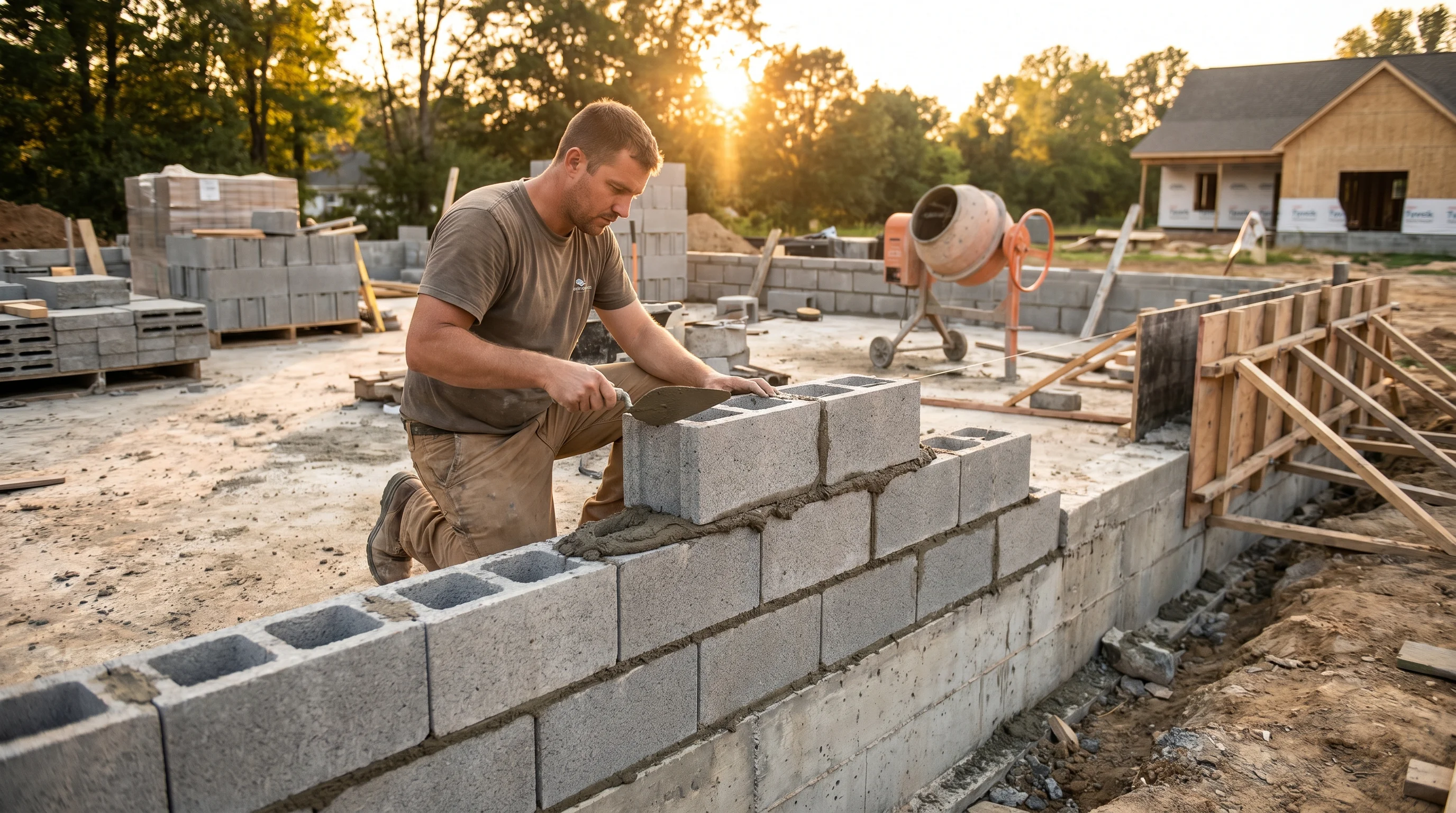
Laying any hollow masonry unit follows the same basics. Units sit on a level concrete footing and are bedded in mortar, usually Type N or Type S depending on the wall, with joints about 3/8 inch thick. Courses are laid in a running bond, with each unit centered over the joint below, and corners are built first so a string line can guide the rest. To cut units, masons use a masonry saw with a diamond blade, or score and split them with a brick set and hammer for rough cuts. Wear eye protection and a dust mask when cutting. For heavy units, lift with your legs and keep loads close to your body; a standard normal-weight unit weighs about 35 to 40 pounds, and you may lift hundreds of them on a single wall.
Building With Decorative Screen Blocks
Screen or breeze units create bright, airy walls, but they are not built like a structural wall. Most patterns have less solid material, so they rely on steel and mortar to hold together. Common practice is to build screen walls on a concrete footing, include reinforced pilasters or posts every so often, place horizontal reinforcement in the joints, and add a solid cap. Keep screen walls short unless a designer or engineer sizes the reinforcement, and do not use them to retain soil. They work well as privacy screens on patios, around trash areas and as decorative fences.
Anchoring Into Hollow Units
Hanging shelves, railings, gates or equipment on a masonry wall takes the right anchors. In hollow units, use sleeve anchors, masonry screws or toggle-style anchors rated for hollow masonry, and place them in the solid face shells rather than the hollow cores where possible. For heavy loads, anchor into grouted cores or bond beams, or use through-bolts with plates. Old cinder units are softer and can crack around anchors, so use more anchors with lighter loads each, and avoid drilling too close to edges. See types of concrete anchors.
Painting and Finishing Block Walls
Masonry surfaces are porous and rough, so paint goes on best over a block filler primer that fills the pores. Elastomeric masonry coatings stretch over small cracks and resist rain. Basement walls often get a waterproofing paint, though it cannot stop serious water problems. Stucco gives a smooth, finished look and is common on garden walls and fences. Exposed split-face units can be left natural or sealed with a clear water repellent.
Buying Blocks: What to Check
- Confirm the size you need, using nominal sizes (8 × 8 × 16 is the common wall unit).
- Ask whether the units are normal-weight or lightweight, and whether they meet ASTM C90 for structural work.
- Buy matching corner, half and cap units at the same time so colors match.
- Inspect for cracked or chipped units before loading.
- Order about 5 percent extra for cuts and breakage.
- Plan delivery; a pallet of units can weigh well over a ton. See concrete block weight.
Masonry Walls vs Poured Concrete Walls
Once you have settled the cinder block vs concrete block question, the next choice for a foundation or tall wall is often masonry units versus a poured concrete wall. Masonry walls are built unit by unit, need no large forms, and suit irregular layouts, small jobs and places a concrete truck cannot reach. Poured walls are cast in one piece inside forms, go up quickly on long, straight runs, and resist water and soil pressure well because they have fewer joints. Both can be reinforced and both are common for basements. Costs depend on local labor: in some areas masons are plentiful and masonry is cheaper; in others, forming crews dominate and poured walls win. Get quotes for both on larger projects.
Repairing Cracked or Damaged Units
Small cracks in mortar joints can be repointed: rake out loose mortar to about 1/2 to 3/4 inch, dampen the joint, and pack in new mortar. Cracked face shells can be patched with a masonry repair mortar. Badly broken units can be cut out and replaced, which takes care to support the wall above. Stair-step cracks, bowing or leaning walls point to footing or soil pressure problems and need professional evaluation, not just patching. See concrete repair cost.
Common Myths
- "All gray blocks are cinder blocks." Most are stone-aggregate units; the name is a habit.
- "Hollow units are weak." Hollow units with rebar and grout in the right cores are very strong and are designed that way on purpose.
- "Masonry walls never need maintenance." Mortar joints, caps and drainage need attention over time.
- "Masonry is waterproof." Units and mortar absorb water; basements need exterior waterproofing and drainage.
- "Lightweight means not structural." Many lightweight units meet load-bearing standards.
Choosing Units for a DIY Garden Wall
For a low planter or garden wall, you have three main choices. Standard gray hollow units are cheapest and can be stuccoed or painted. Split-face or colored decorative units look finished without extra work but cost more per piece. Segmental retaining wall units stack without mortar, which is easier for beginners, and many have a lip that sets the wall back slightly into the slope. For any of them, start with a level, compacted base or a small footing, keep the first course perfectly level, and finish with caps. Mortared walls need a concrete footing; segmental walls usually sit on compacted gravel. If the wall will hold back soil higher than a couple of feet, follow the manufacturer's height limits or get professional help.
Safety When Handling and Cutting
Cutting masonry with a saw creates fine dust that contains crystalline silica, which can damage lungs. Use a wet saw or a saw with dust extraction, and wear a respirator, eye and hearing protection. Handle units with gloves to protect hands from rough edges, and stack them on firm, level ground so piles do not tip. When building, never stand on an unfinished wall, and brace tall walls until the grout and mortar have cured.
Quick Summary: Cinder Block vs Concrete Block
If you only need the short version: in the cinder block vs concrete block comparison, true cinder blocks used coal ash, were lighter and weaker, and are mostly found in older buildings. Concrete blocks use sand and crushed stone, meet modern load-bearing standards, and are what you will buy today, even if the store calls them cinder blocks. Choose normal-weight units for structural walls, lightweight units where weight matters and strength is still adequate, decorative units for looks, and screen blocks for airy, non-structural walls.
Which Block Should You Use?
- Foundation or basement walls: normal-weight concrete blocks that meet structural standards, with reinforcement as required.
- Garage and shop walls: standard concrete blocks with bond beams and rebar.
- Garden and planter walls: standard, split-face or decorative blocks, or segmental blocks.
- Retaining walls: reinforced, grouted concrete blocks or engineered segmental systems.
- Decorative screens: breeze or screen blocks, not for retaining soil or supporting heavy loads.
- DIY projects where weight matters: lightweight concrete blocks, if their strength suits the job.
Frequently Asked Questions
Is a cinder block the same as a concrete block?
Not originally. True cinder blocks used coal cinders as aggregate; concrete blocks use sand and stone. Today, most blocks called "cinder blocks" are actually concrete blocks.
Which is stronger, cinder block or concrete block?
Concrete block. It is made with stone aggregate and produced to load-bearing standards, while true cinder blocks are weaker and more brittle.
Are cinder blocks still made?
True cinder blocks are rare today. Stores still use the name, but the product is usually a concrete masonry unit.
What is a breeze block?
In the UK, a lightweight ash or clinker block; in the U.S., usually a decorative concrete screen block with an open pattern.
How much does a concrete block weigh?
A normal-weight 8 × 8 × 16 inch hollow block usually weighs about 35 to 40 pounds. Lightweight blocks weigh less.
Are breeze blocks strong enough for a fence?
Decorative screen units can make attractive low fences and screens when built on a footing with reinforced posts or pilasters and a cap. They are not meant to retain soil or carry heavy loads.
What mortar should I use with masonry units?
Type N mortar is common for above-grade, non-load-bearing walls, and Type S for foundations, retaining walls and walls that need more strength. Follow your plans or local code.
What size are standard concrete blocks?
The common wall unit is nominally 8 × 8 × 16 inches and actually about 7 5/8 × 7 5/8 × 15 5/8 inches, leaving room for a 3/8 inch mortar joint.
Why are cinder blocks called breeze blocks in the UK?
"Breeze" was an old British term for fine cinders and ash from coal, which were used as the aggregate in these lightweight blocks for much of the 20th century, which is where the name comes from.
Do cinder blocks need to be filled with concrete?
Not every core. Structural walls usually have rebar in some cores filled with masonry grout, as plans or code require. Retaining walls often have more cores grouted.
Is a lightweight block weaker than a normal-weight block?
Lightweight units can still meet load-bearing standards. Check the product rating, and use normal-weight units where plans call for them.
Can I paint old cinder block walls?
Yes. Clean them, fix any leaks, apply a block filler primer, then use a masonry or elastomeric paint. Paint will not solve active water problems.
Can I use cinder blocks for a retaining wall?
Use modern concrete blocks designed for structural or retaining walls, with reinforcement and drainage, or an engineered segmental block system.
Sources
- ASTM International, ASTM C90 "Standard Specification for Loadbearing Concrete Masonry Units."
- Lowe's, 8 in. × 8 in. × 16 in. standard cored concrete block listing (weight). lowes.com
- The Home Depot, 8 in. × 16 in. × 8 in. concrete block listing. homedepot.com
- HomeGuide, "How much does a cinder block wall cost?" homeguide.com
- Image credits: images and chart by Asphapro.com.
Checked November 2026.
Related Guides
- Insulated concrete forms cost — ICF wall prices
- Can mold grow on concrete? — what kills it and drying a cellar
- How to get concrete splash off bricks — fresh splatter, lumps and haze
- Types of concrete anchors — plugs, screws, wedge and epoxy
- Mortar vs concrete — differences and which to use
- Can concrete burn? — fire resistance and heat damage
- Can rats chew through concrete? — rodent entry points and termites