
When Should You Seal a New Asphalt Driveway? How Long to Wait and How Often to Reseal
Quick Answer
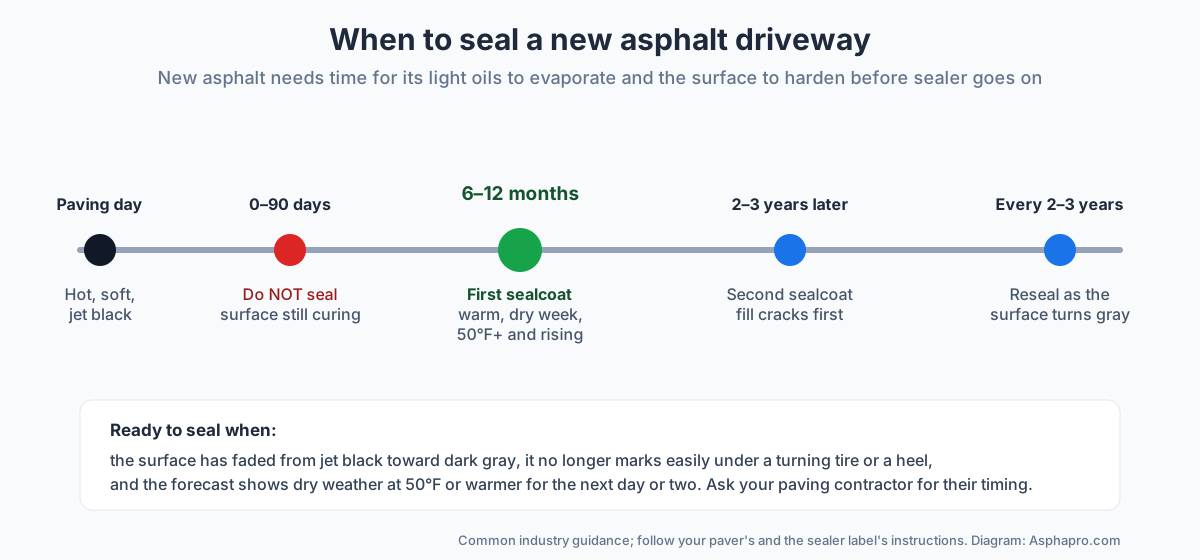
Most paving contractors recommend waiting 6 to 12 months after paving before you seal a new asphalt driveway, and never less than about 90 days. Fresh asphalt still contains light oils that need to evaporate so the surface can harden; sealing too soon traps them. Seal on a dry day at 50°F or warmer and rising, with no rain expected for at least 24 hours. After the first sealcoat, reseal about every 2 to 3 years, not every year.
A new asphalt driveway looks perfect on paving day: deep black, smooth and soft underfoot. It is natural to want to protect it right away. But when should you seal a new asphalt driveway? Sealing too early is one of the most common mistakes homeowners make, and it can leave the surface soft and easily marked for longer than it should be.
This guide explains when to seal new asphalt driveway surfaces, why you need to wait, the weather you need on sealing day, simple signs that your driveway is ready, how often to reseal after that, and what it costs to do it yourself or hire it out. The timings below are common industry guidance; your paving contractor and the sealer label have the final word for your driveway.
Why You Have to Wait Before Sealing New Asphalt
Hot mix asphalt is stone and sand held together by asphalt binder. When it is laid, the binder still contains lighter oils, which is part of why new asphalt is so black and so soft. Over the first months these light oils slowly evaporate and the binder hardens, a process usually called curing. As it cures, the surface:
- firms up so it no longer scuffs easily under turning tires or high heels,
- fades from jet black toward a dark charcoal gray,
- becomes ready to take a sealer that will bond properly.
A sealcoat is a film over the surface. Put that film on too soon and it slows the escape of those oils, which can keep the asphalt soft longer. The sealer also bonds less well to a fresh, oily surface. That is the short answer on timing: not until the new asphalt has had time to cure.
How Long to Wait: 90 Days, 6 Months or a Year?
You will see different numbers quoted for when to seal new asphalt driveway surfaces. Here is how they fit together:
| Time since paving | Status | Should you seal? |
|---|---|---|
| 0 – 30 days | Soft, curing fast in warm weather | No |
| 30 – 90 days | Firming, still releasing oils | No |
| About 90 days | Often quoted as the minimum | Only if your paver says so and weather is warm |
| 6 – 12 months | Cured surface, color fading | Yes, the usual window |
| 1 – 2 years | Cured, may be graying | Yes, if not sealed yet |
The right timing depends on the season you paved. Asphalt cures faster in hot, sunny weather. A driveway paved in late spring may be ready by fall; one paved in late fall barely cures over winter and is usually sealed the following summer or early fall. If you paved late in the season, plan to seal the next warm season, not before winter.
When to Seal New Asphalt Driveway Surfaces by Paving Season
| Driveway paved in | Typical first sealing window | Why |
|---|---|---|
| Spring | Early to late fall of the same year, or the next spring | A full summer of heat cures the surface quickly |
| Early summer | Late summer of the next year, or late fall the same year in hot climates | Curing is fast, but give it at least 6 months |
| Late summer | The following late spring or summer | Not enough warm months left before winter |
| Fall | The following summer | Little curing happens over winter |
So if you are wondering "when should I seal my new asphalt driveway" and it was paved in fall, the answer is almost always the next summer.
Signs Your New Asphalt Driveway Is Ready to Seal
- Color. The surface has faded from deep black to a dark gray, especially in sunny areas.
- Firmness. Turning the steering wheel while parked, or pressing a heel into it on a warm day, no longer leaves a mark.
- Texture. The surface looks dry and slightly more open, rather than smooth and oily.
- Time. At least about 6 months have passed, or your paving contractor has said it is ready.
Some contractors use a simple water test: pour a little water on a sunny section on a warm day; if you still see an oily sheen, it is too early. Treat that as a rough guide only.
Best Weather to Seal an Asphalt Driveway
Once the asphalt has cured, the next question is which day. Most sealers are water-based emulsions that need warmth and dry conditions to cure:
| Condition | What you want |
|---|---|
| Air temperature | About 50°F (10°C) or warmer and rising; check the label |
| Surface temperature | Also about 50°F or warmer; not extremely hot |
| Rain | None expected for at least 24 hours, ideally 48 |
| Overnight lows | Not near freezing for the next night or two |
| Sun and wind | Sun and a light breeze help it dry |
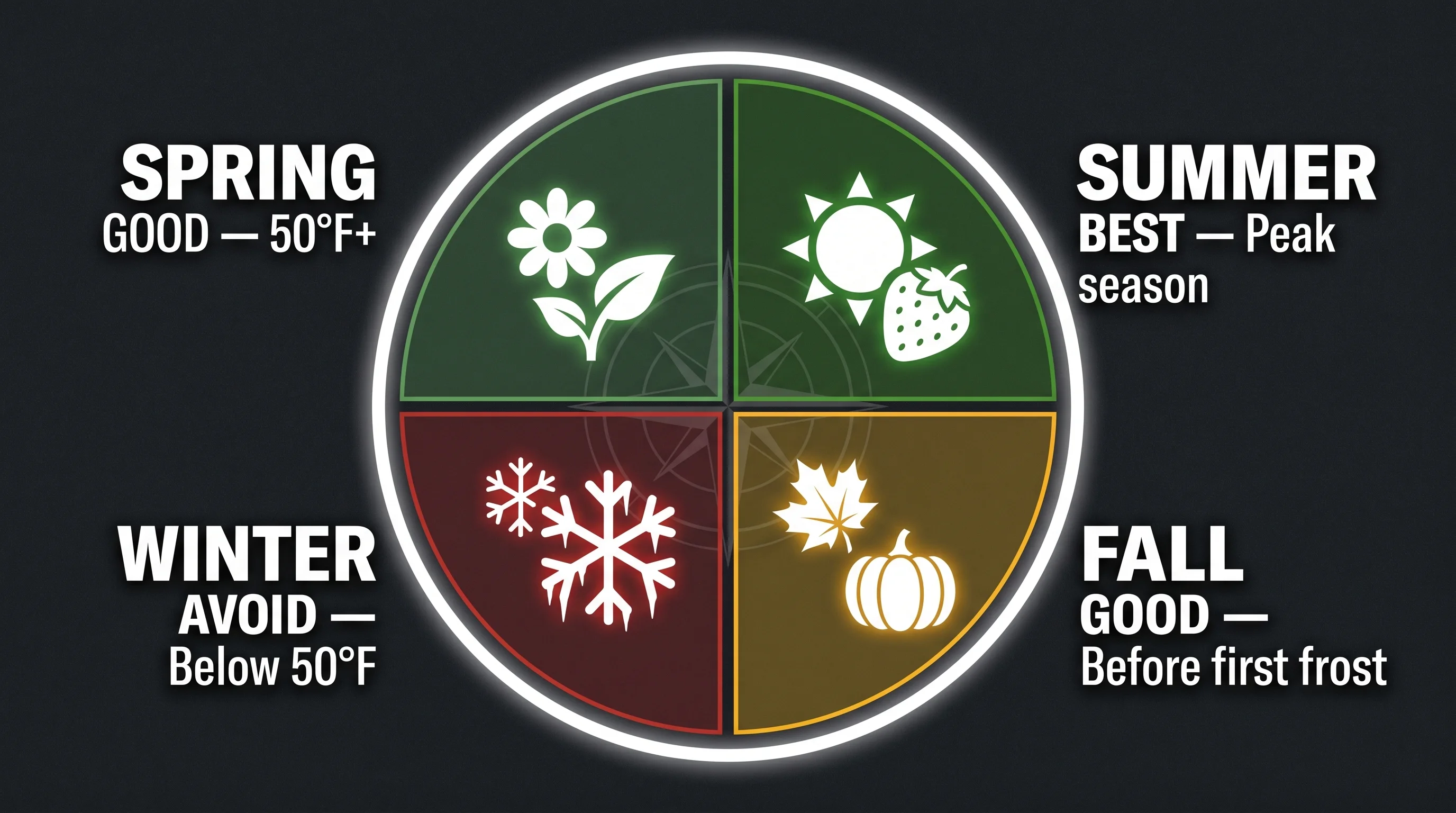
In most of the U.S., late spring through early fall gives the best weather. Very hot afternoons can make sealer dry too fast and leave lap marks; morning starts often work better in midsummer. Avoid sealing late in the fall when nights turn cold.
How Often to Reseal After the First Time
After you seal a new asphalt driveway the first time, the usual schedule is to reseal about every 2 to 3 years. Heavy traffic, lots of sun, or a lot of snowplowing may justify a shorter cycle; a lightly used, shaded driveway can go longer. The sign it is time again is the same: the surface has faded to gray and the texture of the stone is showing through.
How to Seal a New Asphalt Driveway
- 1
Check the weather
Pick a dry stretch with temperatures of 50°F or warmer for the application day and the next day.
- 2
Clean the surface
Sweep, blow off debris and wash away dirt. Treat any oil spots with an oil spot primer.
- 3
Fill cracks
New driveways rarely have cracks, but fill any you find with crack filler and let it cure first.
- 4
Edge first
Brush sealer along the edges, against the garage and around obstacles.
- 5
Apply thin coats
Spread the sealer with a squeegee or brush in thin, even coats. Two thin coats are better than one thick one.
- 6
Let it cure
Keep foot traffic off for the time on the label (often several hours) and cars off for about 24 to 48 hours.
- At least 6 months since paving (or your paver says it is ready)
- Surface has faded to dark gray and no longer scuffs
- 50°F or warmer and rising, dry for the next 24 to 48 hours
- Driveway swept, washed and dry; oil spots primed
- Cars moved out, sprinklers off, edges taped where needed
- Enough sealer for two thin coats, plus a little extra
Our sealcoating calculator estimates how many gallons you need for your driveway, and our asphalt sealer guide covers how to apply it.
How Much Sealer a New Asphalt Driveway Needs
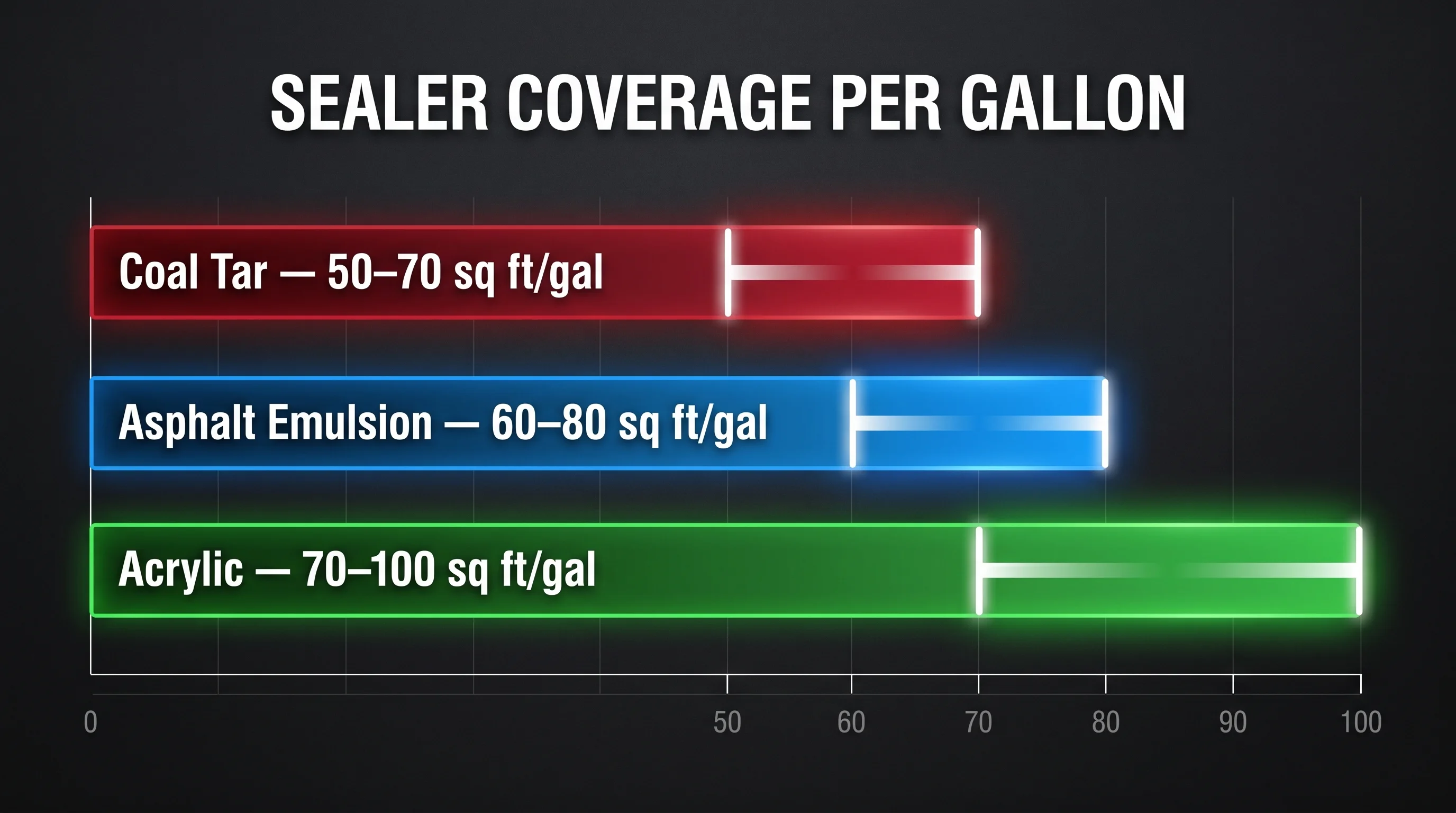
The amount of sealer depends on the size of the driveway, the product's coverage and the number of coats. Coverage is printed on every pail and varies by brand and by how porous the surface is. A newer, tighter surface usually takes a little less sealer than an old, rough one. The basic math is:
Gallons = driveway sq ft ÷ coverage per gallon (from the label) × number of coats
Measure length and width, add any flares or parking pads, and plan for two thin coats. Buy a little extra for edges and rough spots. Our sealcoating calculator does the math for you, and the coverage chart below shows how coverage changes with surface texture.
Sealing a New Asphalt Driveway vs an Old One
Sealing a new asphalt driveway is simpler than sealing an old one. There are usually no cracks to fill, no potholes to patch and few oil stains, so the job is mostly cleaning and applying two thin coats. On an older driveway, preparation takes longer: cracks must be cleaned and filled, oil spots primed, grass edges trimmed back and damaged areas repaired before any sealer goes on.
The other difference is timing. An old, gray driveway can be sealed on any suitable warm, dry day. A new one has to wait for the asphalt to cure first, which is the whole point of asking when to seal new asphalt driveway surfaces rather than just how.
What If It Rains After You Seal?
Rain is the most common thing that goes wrong on sealing day. What happens depends on how long the sealer has had to dry:
- Rain within the first hour or two: wet sealer can wash off, leaving streaks on the driveway and sealer runoff on the street or lawn. You will probably need to reapply that area.
- Rain after several hours of good drying: the surface has usually skinned over. Light rain often does little harm, though some products may show spotting.
- Rain after about a day: most sealers are fine.
Check the hourly forecast, not just the daily one, before you start, and leave yourself a margin. If storms are possible, wait. Sealer is cheap; redoing the job and cleaning runoff off the street is not.
DIY or Professional for the First Sealcoat?
Sealing a new asphalt driveway yourself is one of the easier home projects: the surface is clean and smooth, there are few repairs, and the tools are a broom, a squeegee and a brush. Many homeowners do the first coat themselves to save money. Hiring a sealcoating company makes sense if your driveway is large or long, if you want a sprayed application that goes on very evenly, or if you would rather not handle the mess. Professionals also know how thin to apply the sealer, which matters on a new driveway because thick coats are the most common DIY mistake.
Whichever you choose, the timing rule is the same: let the new asphalt cure first. A good sealcoating contractor will tell you if your driveway is too new and suggest coming back later, which is a sign of a company worth hiring. Compare prices in our sealcoating cost guide.
Which Sealer to Use on a New Driveway
The two common sealer types for driveways are asphalt emulsion and coal tar emulsion, with acrylic and polymer-modified sealers as premium options.
- Asphalt emulsion sealer is made from asphalt, like the driveway itself. It is widely available, lower in odor and allowed everywhere.
- Coal tar sealer has traditionally been valued for its resistance to fuel and oil, but several states and many cities restrict or ban it because of concerns about polycyclic aromatic hydrocarbons (PAHs) washing into waterways. Check local rules before buying.
- Acrylic and polymer sealers cost more but are durable and come in some colors.
See our comparisons of asphalt sealers, asphalt emulsion sealer and asphalt sealer prices for product details.
Cost to Seal a New Asphalt Driveway
Sealing is the cheapest maintenance an asphalt driveway gets. DIY costs mostly the sealer itself, plus a squeegee, brush and crack filler. Professional sealcoating adds labor and equipment, and many contractors include crack filling and oil spot treatment. For current price ranges and a DIY versus professional comparison, see our sealcoating cost guide and the driveway sealing cost calculator.
Mistakes to Avoid With a New Asphalt Driveway
- Sealing in the first few months. The surface needs to cure first.
- Sealing before rain or a cold night. The sealer can wash off or fail to cure.
- Thick coats. They take longer to dry and are more likely to peel.
- Sealing every year. Too many layers build up.
- Sealing over oil spots without primer. The sealer will not bond there.
- Parking or turning on the fresh driveway in hot weather. In the first weeks, avoid turning the wheels while stopped and keep heavy trucks, trailers and kickstands off it.
How Long Does Driveway Sealer Take to Dry?
Once you seal an asphalt driveway, the sealer goes through two stages. First it dries to the touch, often within a few hours in warm sun, when it changes from brown or gray to black. Then it cures, hardening fully over the next day or two and continuing to toughen for weeks. Cool, humid or shaded conditions slow both stages. That is why most labels say to keep foot traffic off for several hours and vehicles off for about 24 to 48 hours. Close the driveway with cones, a rope or tape across the entrance so delivery drivers and visitors do not drive onto it early, and park on the street for the day, and turn off lawn sprinklers that could spray the fresh sealer.
Caring for New Asphalt Before It's Sealed
The months between paving and the first sealcoat matter. New asphalt is at its softest, so a little care prevents marks that will be there for years:
- Keep cars off for the time your paver recommends, often a few days, longer in hot weather. See how long asphalt takes to dry.
- Avoid parking in the same spot every day during the first hot summer; move the car a little.
- Do not turn the steering wheel while the car is stopped.
- Keep sharp objects, jack stands, bike kickstands and trailer tongues off the surface; use a board under them.
- Water the driveway lightly on very hot days if your paver suggests it, to cool the surface.
- Keep the edges supported with soil or stone so they do not crumble.
When Should You Seal a New Asphalt Driveway in Different Climates?
Climate changes the calendar more than the rule. In hot, sunny southern states, asphalt cures quickly and the sealing season is long, so many driveways are ready within six months. In northern states with short summers and cold winters, a driveway paved in summer may be sealed the next year, and one paved in fall waits until the following summer. In cool, shaded or very wet locations, curing is slower; when in doubt, wait the full year.
A Year-by-Year Plan for a New Asphalt Driveway
| When | What to do |
|---|---|
| Paving day to 1 week | Keep cars off for the time your paver recommends; no heavy loads. |
| First summer | Avoid turning wheels while stopped; vary where you park; protect from kickstands and jacks. |
| 6 – 12 months | First sealcoat on a warm, dry day once the surface has cured. |
| Every year | Inspect in spring and fall; fill any new cracks before winter; keep edges supported. |
| Every 2 – 3 years | Clean, prime oil spots, fill cracks and reseal. |
| As needed | Patch any damaged areas promptly; see asphalt repair cost. |
Following this plan keeps a new asphalt driveway looking good and helps it reach its full life before it needs resurfacing. For the bigger picture, see how long an asphalt driveway lasts and our asphalt driveway maintenance guide.
Cracks and Edges in the First Year
A well-built new driveway should not crack in its first year, but two things sometimes show up. The first is hairline cracking at the edges, usually where the asphalt was not supported by soil or stone along the side. Backfill the edges with topsoil and seed, or with crushed stone, so the edge is held up. The second is a seam line where two paver passes meet; a tight, sealed seam is normal, but an open seam should be reported to your paving contractor, as most will fix workmanship issues in the first year.
If you do find a crack before the first sealcoat, fill it with a crack filler made for asphalt and let it cure, then include it in the first sealing. Do not seal over open cracks; water keeps getting in under the sealer.
Myths About Sealing a New Asphalt Driveway
"Seal it right away to protect it."
The opposite is true. New asphalt needs months to cure, and sealing a new asphalt driveway too early can keep it soft longer. Protection comes later, once the surface has hardened.
"Sealer fills cracks."
Sealer is a thin coating. It can hide hairline cracks, but it does not fill or bridge real cracks. Those need crack filler first.
"More sealer is better."
Thick coats and yearly sealing build up layers that crack and peel. Two thin coats every two to three years work better.
"Sealing makes the driveway last forever."
Sealing slows surface wear, but a driveway's life depends mostly on its base, drainage and thickness. Sealing is maintenance, not a substitute for a well-built driveway.
Sealing After a Patch, Overlay or Repair
The same curing rule applies to any new asphalt, not just a brand-new driveway. If your driveway was resurfaced with an overlay, treat it like new asphalt and wait about 6 to 12 months before sealing. Small hot mix patches on an older driveway cure faster because the area is small, but most contractors still suggest waiting at least a few weeks, longer for larger patches, before sealing over them. Cold patch repairs usually need time to harden as well; check the product instructions. When the whole driveway is due for resealing, include the cured patches in the job so the color evens out. See our asphalt overlay cost and asphalt repair cost guides for those jobs.
Questions to Ask Your Paving Contractor
- How long should I wait to seal my new asphalt driveway, given the time of year it was paved?
- When can I drive and park on it, and are there any restrictions for the first summer?
- Do you offer sealcoating later, and what sealer do you use?
- What does your workmanship warranty cover in the first year?
- Is there anything about my driveway's drainage or edges I should watch?
Write the answers down with the paving date and keep them with the invoice and warranty, since you will want them again when it is time to seal an asphalt driveway in two or three years. When the first sealing window arrives, you will know exactly when to seal new asphalt driveway surfaces on your property.
Do You Have to Seal a New Asphalt Driveway at All?
No law says you must, and some driveways, especially lightly used rural ones, go many years without sealer. But sealing does three useful things: it slows the drying and graying caused by sun, it keeps water from soaking into the surface, and it resists oil and fuel. Together that helps the asphalt last longer before it needs resurfacing. If you skip sealing, at least keep up with crack filling, which matters even more.
Frequently Asked Questions
When should you seal a new asphalt driveway?
Usually 6 to 12 months after paving, on a dry day at 50°F or warmer, with no rain expected for at least a day.
What happens if you seal new asphalt too soon?
It can keep the surface soft longer, make it easier to scuff and stop the sealer from bonding well.
Can I seal my driveway after 30 days?
Generally no. Most contractors want at least about 90 days and prefer 6 to 12 months.
How often should you seal an asphalt driveway?
About every 2 to 3 years after the first sealcoat.
What temperature is needed to seal asphalt?
Usually at least about 50°F and rising, with dry weather for 24 to 48 hours. Check the sealer label.
Can you seal a new asphalt driveway in the fall?
Yes, if the asphalt has already cured (for example, it was paved the previous year or early in spring) and you have a dry stretch at 50°F or warmer. Do not seal a driveway paved that same fall; wait until the next warm season.
Should the paving contractor seal my new driveway?
Not on paving day. Most paving contractors recommend waiting several months to a year before the first sealcoat. Many offer to come back and seal it once it has cured.
Does sealing make a new driveway last longer?
Sealing protects the surface from sun, water and oil, which helps slow wear and graying. Crack filling and good drainage matter just as much for a long life.
How long after sealing can you drive on the driveway?
Most sealers need about 24 to 48 hours before cars, and several hours before foot traffic. Follow the product label.
Sources
- Sealer manufacturers' label directions — application temperature, dry and cure times.
- U.S. Geological Survey, research on coal-tar-based pavement sealants and PAHs. usgs.gov
- Images and diagram: Asphapro.com.
Timings are common industry guidance. Your paving contractor and the sealer label have the final word.
Related Guides
- How long does concrete take to cure? — when to seal new concrete