
Concrete Railroad Ties: How They Are Made, Size, Weight, Uses and Cost
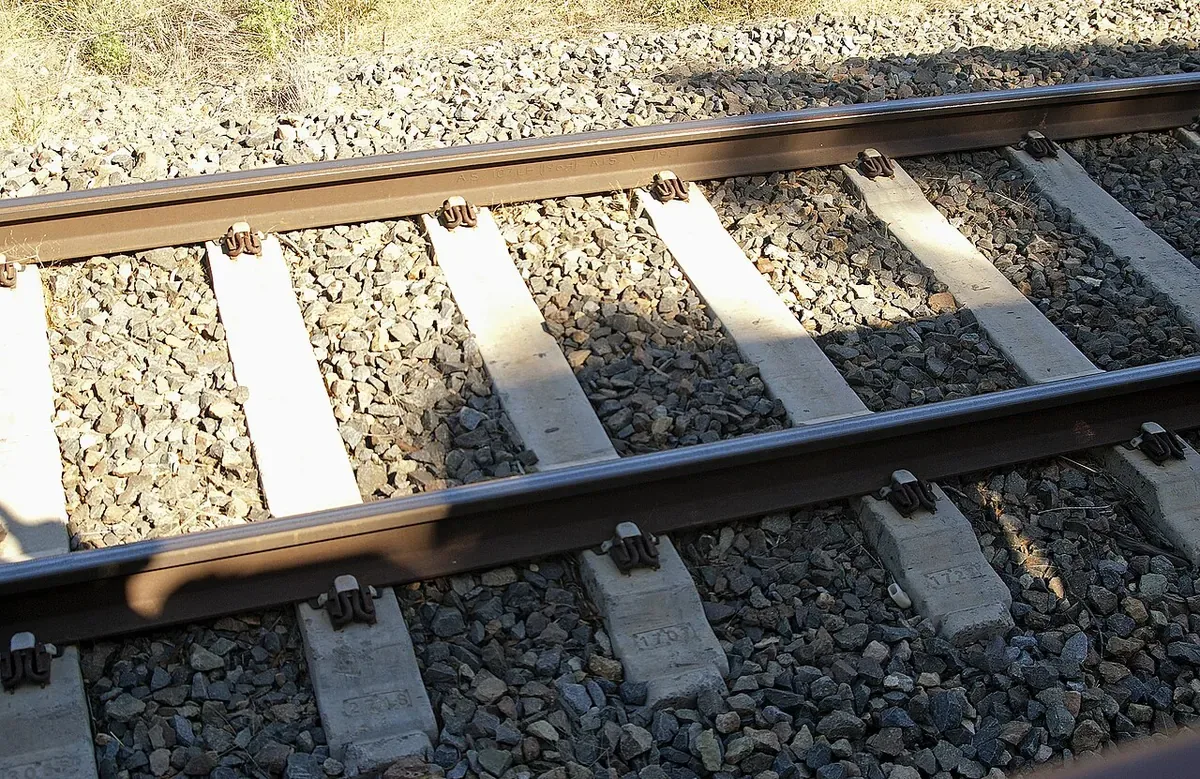
Photo: Bidgee, Wikimedia Commons, CC BY-SA 2.5 AU
Quick Answer
Concrete railroad ties (called concrete sleepers outside North America) are prestressed concrete beams that sit under the rails, hold them to gauge and spread train loads into the ballast. A typical North American mainline concrete tie is about 8 feet 3 inches long, weighs roughly 600 to 800 pounds, is laid about 24 inches apart and can last 40 to 50 years, compared with 20 to 35 years for treated wood. New concrete ties cost about $100 to $250 each for railroads; used concrete ties for landscaping often sell for $20 to $75 each, plus delivery, because of their weight.
Look closely at a busy mainline, a high-speed line or a modern transit system and you will usually see gray concrete ties instead of brown wooden ones. Concrete railroad ties are heavier, stiffer and longer lasting than wood, and they keep the track in line under heavy freight and fast passenger trains. The photo above shows concrete ties with elastic rail clips on an Australian mainline, a typical modern track.
This guide covers how concrete railroad ties are designed and made, their size and weight, fastening and ballast, how long they last and why they fail, how they compare with wood ties, and what homeowners should know about buying used concrete ties for retaining walls, steps, raised beds and other landscape projects.
What Are Concrete Railroad Ties?
A railroad tie is the cross member that sits under the two rails. It has three jobs: hold the rails at the correct gauge (4 feet 8.5 inches on standard gauge track), transfer the loads from the wheels through the rails into the ballast below, and resist the track moving sideways and lengthwise. Wood ties did this job for more than a century. Concrete railroad ties do the same job with a heavier, stiffer and more uniform product.
Most concrete railroad ties today are prestressed monoblock ties: a single concrete beam, thicker under the rail seats and slimmer in the middle, with high-strength steel wires or strands stretched before the concrete is cast. After the concrete hardens, the wires are released, putting the concrete into compression. That built-in compression lets the tie resist the bending and cracking that repeated wheel loads would otherwise cause. A second design, the twin-block or bi-block tie, uses two reinforced concrete blocks under the rails, joined by a steel bar; it is common in France and some other countries but rare in North America.
Concrete ties were tried in the early twentieth century, but early designs cracked. They became practical after World War II, when European railways, short of timber, developed prestressed concrete sleepers. North American railroads adopted concrete railroad ties widely from the 1970s and 1980s, especially for heavy-haul freight lines, curves, the Northeast Corridor and new transit systems.
How Concrete Railroad Ties Are Made
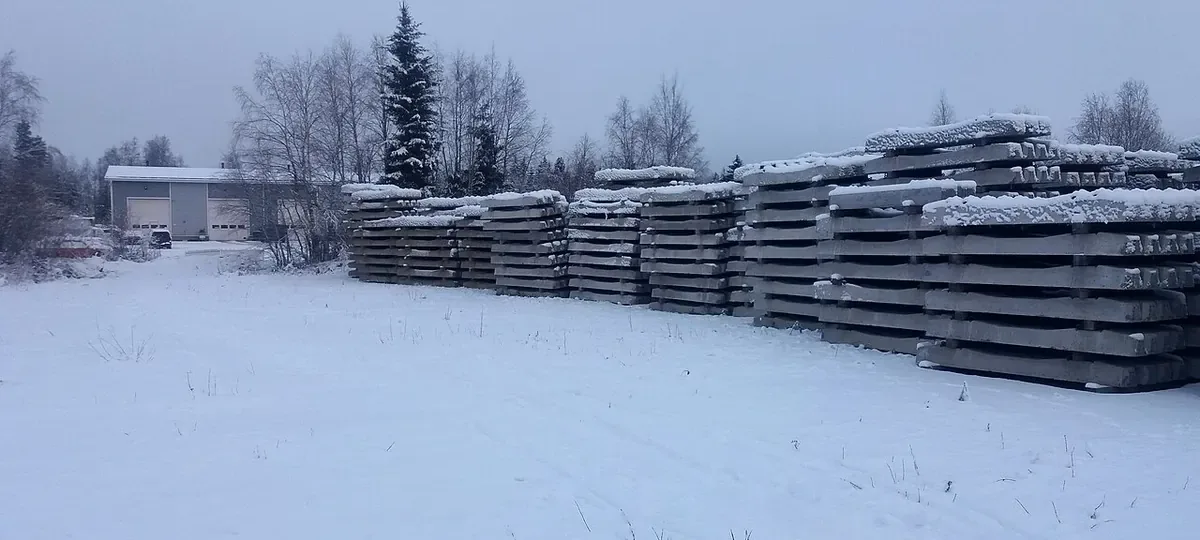
Photo: Mikko J. Putkonen, Wikimedia Commons, CC BY 4.0 (cropped)
Concrete railroad ties are made in specialized precast plants, usually on long-line pretensioning beds. The process follows these steps:
1. Tensioning. High-strength steel wires or seven-wire strands are threaded through a row of steel molds, often enough for dozens of ties end to end, and stretched with hydraulic jacks to a high tension.
2. Inserts. Cast-in shoulders or inserts, the steel anchors that the rail clips will grip, are placed in the molds at each rail seat.
3. Casting. A stiff, high-strength concrete, often 7,000 psi or more at 28 days, is placed and consolidated with vibration. Low water-cement ratios and careful aggregate selection give the dense, durable concrete the ties need.
4. Curing. The ties are steam or heat cured so they reach release strength, often 4,000 to 4,500 psi, within hours. Curing temperatures are controlled because overheating can lead to delayed ettringite formation, a durability problem that caused early failures in some ties.
5. Release and cutting. The strands are cut between molds, transferring the prestress into the concrete. The concrete railroad ties are demolded, inspected, tested on a sampling basis for bending strength, and stacked for shipping, as in the photo above.
Plants produce thousands of concrete ties per day, and the uniform factory product is one of the big advantages over wood, which varies from tree to tree.
Size and Weight of Concrete Railroad Ties
Exact dimensions depend on the railroad's specification and the manufacturer, but typical North American mainline concrete railroad ties are:
Length: about 8 feet 3 inches (2.5 m), slightly shorter than the 8 foot 6 inch or 9 foot wood ties they often replace.
Width: about 11 to 13 inches at the base.
Height: about 9 to 10 inches at the rail seat and less, often 7 to 8 inches, at the center.
Weight: roughly 600 to 800 pounds each. Heavy-haul ties are at the upper end; transit and light rail concrete ties can be lighter and shorter. European concrete sleepers for standard gauge are often about 2.6 m long and weigh around 250 to 320 kg.
The weight is one of the main advantages of concrete railroad ties in service, because it holds the track in place and resists buckling in hot weather, but it is also the main challenge when people want to move or reuse them. A single tie is far too heavy to lift by hand. See how much a concrete block weighs for comparison with masonry units.
Fastening, Spacing and Ballast
Wood ties use steel tie plates and cut spikes or screw spikes. Concrete railroad ties use elastic fastening systems: steel shoulders cast into the tie, rubber or polymer rail seat pads under the rail, insulators to electrically separate the rail from the tie (important for track signal circuits), and spring clips that hold the rail down with a steady force. The clips resist rail movement and allow much faster installation and maintenance.
Concrete ties are usually spaced about 24 inches center to center in North America, compared with roughly 19.5 to 21 inches for wood ties, so fewer ties are needed per mile, about 2,640 concrete ties versus about 3,000 to 3,250 wood ties. Because concrete ties are stiffer, the track needs good, deep ballast, often at least 12 inches of crushed stone under the tie, and a well-drained subgrade. On bridges and at some special locations, railroads still use wood or composite ties because of weight and flexibility needs.
Concrete Railroad Ties vs Wood Ties
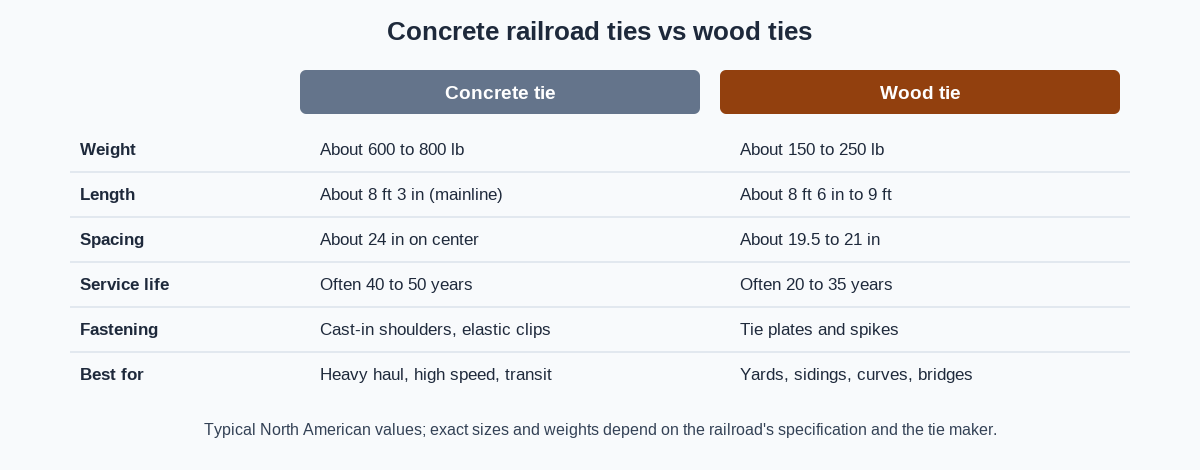
As the comparison shows, concrete railroad ties and wood ties each have their place.
Advantages of concrete ties: longer service life, often 40 to 50 years on mainline track; better gauge holding and track stability, especially on curves and under heavy axle loads; no decay, insects or fire damage; uniform quality; no creosote or other wood preservatives; and fewer ties per mile.
Disadvantages of concrete ties: much heavier, so they need machines to handle and install; higher first cost per tie; need deeper, better ballast; can crack from impact loads such as wheel flats or derailments; and rail seat abrasion, where the concrete under the rail pad wears away, can be a problem in heavy-haul curves. Mixing concrete and wood ties in the same stretch of track causes uneven stiffness, so railroads usually install concrete ties in long continuous sections, with a transition at the ends, like the one in the photo below.
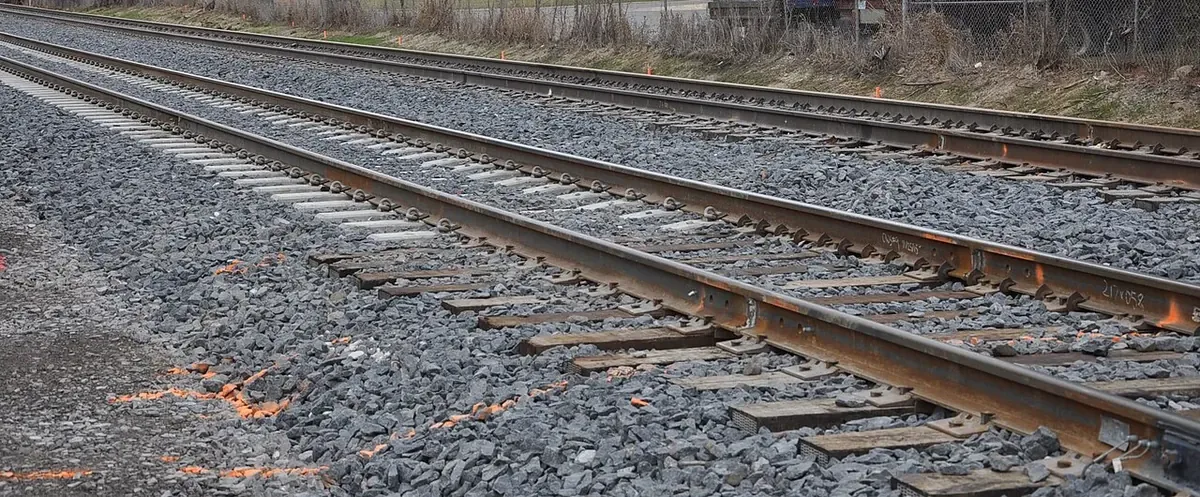
Photo: Reaperexpress, Wikimedia Commons, CC BY-SA 4.0 (cropped)
Wood ties remain the most common tie in North America by count. They are lighter, cheaper per tie, easy to cut and drill, forgiving on poor subgrade, and simple to replace one at a time with basic equipment, which suits yards, sidings, branch lines and short lines. Composite plastic ties and steel ties fill some niche uses.
How Long Concrete Railroad Ties Last and Why They Fail
Well-made concrete railroad ties on good ballast often last 40 to 50 years or more. When they fail early, the usual causes are:
Rail seat abrasion. Movement of the rail and pad grinds away concrete at the rail seat, especially with water and fine sand present. Better pads and abrasion-resistant concrete reduce it.
Cracking from impact. Wheel flats, rail joints and derailments deliver impact loads that can crack ties. Prestress helps, but severe impacts still damage them.
Center binding. When ballast compacts under the center of the tie, the tie rests on its middle and bends the wrong way, cracking at the center. Proper tamping, which keeps ballast firm under the rail seats and looser at the center, prevents it.
Material problems. Alkali-silica reaction and delayed ettringite formation in poorly specified or overheated concrete caused cracking in some batches of ties in past decades, leading to large replacement programs. Modern specifications limit curing temperatures, use low-reactivity aggregates and add supplementary cementitious materials to prevent this. See why concrete cracks.
Freeze-thaw and drainage. Poor drainage keeps ties and ballast wet, increasing freeze-thaw damage, pumping of fines and abrasion. Clean ballast and good drainage matter as much for concrete ties as for the rail itself.
Buying Used Concrete Railroad Ties
When railroads replace or rebuild track, old concrete railroad ties are removed. Some are reused in yards or on lower-speed track, some are crushed and recycled as aggregate, and some are sold to the public through salvage yards, tie brokers and online listings. Homeowners and farmers buy used concrete ties for landscape walls, steps, livestock pens, windbreak anchors, bunker walls for gravel and mulch, and erosion control.
Price. Used concrete railroad ties often sell for about $20 to $75 each, depending on condition and location, with delivery often the biggest cost, because a flatbed truck carries only a limited number at 600 to 800 pounds each. Buyers usually need equipment such as a skid steer with forks, a tractor with a loader, or a mini excavator to unload and place them.
Condition. Look for ties without major cracks, missing chunks or exposed, rusted strand. Cast-in shoulders and leftover clips stick up from the top surface; they can be left in place, cut off with an abrasive saw or turned to face down or into the soil. Cracked ties may still be fine for low walls or edging, but not for load-bearing steps.
Safety. Unlike old wood ties, concrete ties do not contain creosote, which is one reason they are attractive for gardens and play areas. Still, they may carry oil, grease or herbicide residue from the railway, so clean them, and avoid using them in direct contact with vegetable beds if their history is unknown. Never take ties from railroad property without permission; it is trespassing and theft, and active rail lines are dangerous.
Landscape Uses for Concrete Railroad Ties
Retaining walls. Stacked concrete railroad ties make strong, heavy retaining walls, often stepped back slightly with each course, with ties pinned together using rebar driven through drilled holes or with deadmen tied back into the soil. Walls over about 3 to 4 feet tall, or walls that hold back driveways, buildings or slopes, need an engineer's design and may need a permit. Provide drainage gravel and a perforated drain pipe behind the wall so water pressure does not push it over. See concrete retaining wall.
Steps and terraces. Concrete ties set into a slope make long-lasting garden steps. Each tie is bedded on compacted gravel, leveled and pinned, and the tread behind it is filled with gravel, pavers or compacted soil. Their weight keeps them from shifting, though the rough top surface can be slippery when wet or mossy. See how to pour concrete steps.
Raised beds and borders. Laid on their sides or flat, concrete railroad ties make low, durable raised beds, planters and borders around parking areas and driveways. See concrete raised beds.
Farm and storage uses. On farms and in bulk material yards, concrete ties are used as bunker walls for gravel, sand, mulch and salt storage; as wheel stops; as anchors for fences and windbreaks; and as footings for sheds and hay platforms.
Erosion control. Along streams, ditches and slopes, concrete ties can form check structures and toe walls, though work near waterways usually needs permits.
Building a Low Wall with Concrete Railroad Ties
A low garden wall of used concrete railroad ties, up to about three courses high, is a common weekend project for owners with access to a skid steer or tractor. Start by marking the wall line and digging a trench about 6 inches deeper than the bottom of the first course and wider than the tie. Fill the trench with compacted crushed stone, leveling it carefully, because any rock or low spot under a stiff concrete tie makes it rock and sit unevenly. Set the first course of concrete ties end to end, partly buried for stability, and check level along the length and across the width. Lay a perforated drain pipe behind the bottom course, wrapped in fabric or set in clean gravel, and lead it to daylight. Set each higher course back about an inch toward the slope, stagger the joints like brickwork, and pin courses together with rebar driven through drilled holes. Backfill behind the wall with gravel, not clay, in lifts, compacting as you go. Keep the wall low enough that it does not need engineering, and check local rules about wall height, property lines and drainage before you start.
Moving and Placing Concrete Railroad Ties Safely
At 600 to 800 pounds, concrete railroad ties can crush feet and hands and injure backs. Use machines: a skid steer or tractor with pallet forks, a mini excavator with a thumb, or a lifting clamp or chain sling rated for the load. Lift from the center so the tie balances, keep people clear of suspended loads, and set ties down on blocks or timbers so forks and chains can be removed without pinching hands. Wear steel-toed boots and gloves. When stacking, place each course carefully; once set, a concrete tie is hard to adjust by hand. Plan the layout first, prepare a level, compacted gravel base, and work from the lowest course up.
Cutting and Drilling Concrete Railroad Ties
Cutting concrete ties is harder than cutting ordinary concrete because of the dense, high-strength concrete and the prestressing steel inside. A gas-powered cut-off saw with a diamond blade works, but cutting through the strands releases tension in that section and the tie can crack. Wear eye, hearing and dust protection, and use water to control silica dust. Drilling holes for rebar pins uses a rotary hammer with carbide or diamond bits; avoid drilling through the strands where possible. In most landscape projects it is easier to design around full-length ties than to cut them. See how to cut concrete and how to drill into concrete.
Recycling Old Concrete Railroad Ties
Concrete railroad ties that cannot be reused are commonly crushed. Crushers break the concrete, magnets pull out the steel strand for scrap, and the crushed concrete becomes road base, fill or drainage aggregate. Because the ties are made of very high-quality concrete, the recycled aggregate is strong and clean. See crushed concrete.
How Railroads Install Concrete Railroad Ties
Because concrete railroad ties are heavy and need uniform support, railroads install them with specialized machines, usually in long continuous stretches. On a major replacement project, a train delivers concrete ties to the site in special cars. A track renewal machine, sometimes called a tie and rail renewal train, lifts the rails, removes the old wood or concrete ties, plows and levels the ballast bed, places new concrete ties at the correct spacing, and sets the rails back onto the rail seats in one continuous pass. Crews or machines then install the pads, insulators and clips. Smaller projects use excavators or loaders fitted with tie grapples that can lift several ties at a time.
After the concrete ties are placed, ballast is dumped from hopper cars and a tamping machine lifts and lines the track while vibrating tamping tines squeeze ballast firmly under each rail seat. A ballast regulator shapes the shoulders, and a dynamic track stabilizer may vibrate the track to settle it quickly. Speed restrictions usually apply for a short period until the ballast consolidates under traffic. Getting the tamping right is important for concrete ties, since uneven support leads to center binding and cracking later.
Concrete Ties for Transit, Light Rail and Crossings
Concrete railroad ties are not just for freight mainlines. Light rail, subway and commuter rail systems use concrete ties on ballasted track, often shorter and lighter than freight ties, and many systems use concrete ties for new lines because of low maintenance and good electrical insulation for signal circuits. In tunnels and on elevated structures, transit agencies often use direct fixation track or concrete blocks set in a concrete slab instead of conventional concrete ties on ballast. Highway-rail grade crossings frequently use concrete ties with precast concrete crossing panels on top, giving a smooth, durable surface for road traffic. Switches and turnouts use special long concrete ties made in sets, each tie a different length to fit the geometry of the switch. See precast concrete for more on factory-made concrete units.
Environmental Points: Concrete vs Treated Wood Ties
Environmental impact is one reason some railroads and landowners favor concrete railroad ties. Wood ties are usually treated with creosote or other preservatives, and old creosoted ties are regulated as a waste in many places, often burned for energy in approved facilities rather than reused around homes and gardens. Concrete ties contain no wood preservatives, last longer and can be crushed and recycled at the end of their life. On the other side, making cement for concrete ties produces carbon dioxide, and concrete ties are heavy to ship. Life-cycle studies generally find the comparison depends on traffic, service life and how the old ties are handled. For homeowners, the main practical point is that used concrete ties avoid the creosote concerns that come with old wooden ties, which is why concrete ties are often preferred for garden walls, play areas and steps near the house.
Alternatives to Concrete Ties for Landscaping
If used concrete railroad ties are hard to find or too heavy for the site, several alternatives give a similar look and function. Large precast concrete blocks, sometimes called lock blocks or ecology blocks, are interlocking concrete blocks used for bunker walls and gravity retaining walls; they are even heavier than ties but stack quickly with equipment. Segmental retaining wall blocks are much lighter, easy to place by hand and engineered for walls with geogrid reinforcement. Poured concrete walls and concrete steps give a finished look and can be formed to any shape. New landscape timbers made of treated wood or plastic composite are light and easy to cut, but they do not last as long as concrete. Natural stone and boulder walls suit rural settings. Compare cost, delivery, the equipment you have and the wall height you need before choosing concrete railroad ties. See precast concrete steps and concrete stepping stones.
Concrete Railroad Ties Cost
Typical price ranges in 2026:
New mainline concrete ties: about $100 to $250 each for railroads buying in volume, before fastening components and installation. Fastening systems can add a significant amount per tie.
Installed track: concrete tie track costs more per mile up front than wood tie track, but railroads often find lower life-cycle cost on heavy-traffic lines because of the longer service life and lower maintenance.
Used landscape concrete ties: about $20 to $75 each, with delivery often $150 to $500 or more per load depending on distance, and equipment rental for placement around $250 to $400 per day for a skid steer.
For a landscape wall, compare the cost of used concrete railroad ties plus delivery and equipment with poured concrete, segmental retaining wall blocks or large precast blocks. Ties are often cheapest where they are available locally. See concrete retaining wall cost.
Frequently Asked Questions
How much does a concrete railroad tie weigh?
Typical North American mainline concrete ties weigh about 600 to 800 pounds each.
How long are concrete railroad ties?
About 8 feet 3 inches for most mainline ties, a little shorter than common wood ties.
Are concrete railroad ties better than wood?
For heavy, fast traffic they last longer and hold gauge better. Wood is cheaper, lighter and easier for yards, sidings and spot replacement.
Can I use concrete railroad ties for a retaining wall?
Yes, for low walls with good drainage and pinning. Taller or load-bearing walls need an engineered design.
Do concrete railroad ties contain creosote?
No. Concrete ties are not treated with creosote, though used ties may carry oil or grease from service.
Sources
- AREMA Manual for Railway Engineering: Chapter 30, Ties
- Federal Railroad Administration: concrete crosstie research and track safety standards
- University of Illinois RailTEC: concrete crosstie and fastening system research
- Railway Tie Association: tie counts and service life data