
Concrete Raised Beds: Block, Poured and Precast Beds and Raised Beds on Concrete
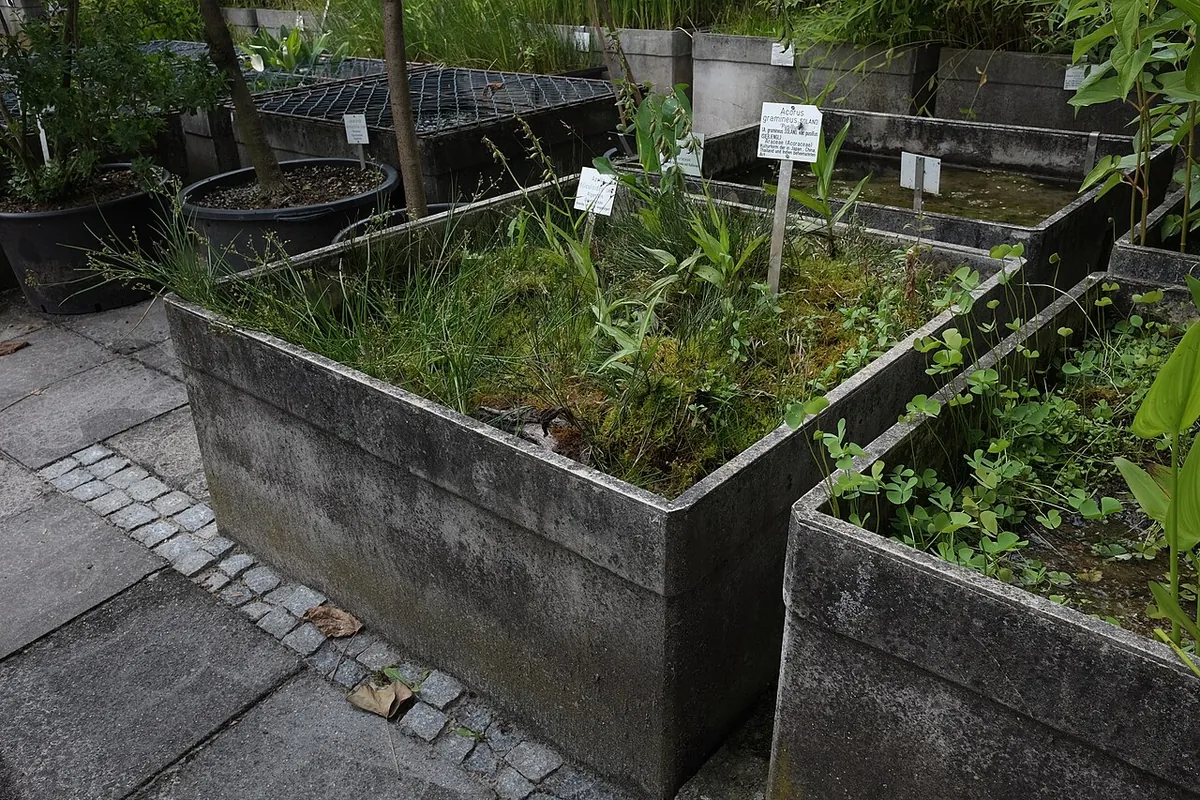
Photo: Yeerge, Wikimedia Commons, CC BY 4.0
Quick Answer
Concrete raised beds are garden beds with walls of concrete block, poured concrete, precast concrete panels or concrete sleepers. They last decades, never rot, hold heat for earlier planting, and make a neat, permanent edge. A concrete raised garden bed is safe for vegetables in normal use; new concrete can raise the soil pH slightly near the walls, which fades with time and is easy to manage. You can also build a raised bed on concrete patios and driveways by making it at least 12 to 18 inches deep, adding a drainage layer, and leaving a gap so water can escape. A cinder block bed costs about $3 to $8 per linear foot of wall in materials; poured and precast concrete raised beds cost more.
Raised beds make gardening easier: the soil warms faster in spring, drains better, is easier to reach without stepping on it, and can be filled with good soil even where the ground is poor, rocky or paved. Most raised beds are built with wood, but wood rots in 5 to 15 years, especially in wet climates. Concrete raised beds are the long-term alternative. The beds in the botanical garden above are simple concrete boxes set on a paved path, holding plants at a comfortable height for decades with almost no maintenance.
This guide covers the types of concrete raised beds, their pros and cons, whether concrete is safe for growing food, how to size and build them, how to put a raised garden bed on concrete, soil and drainage, planting tips, and costs.
Types of Concrete Raised Beds
Cinder block and concrete block beds
The most popular DIY concrete raised beds are made of standard hollow concrete blocks, often called cinder blocks, laid dry in one or two courses. An 8 x 8 x 16 inch block gives an 8 inch tall wall per course, and the hollow cores can be filled with soil and planted with herbs, strawberries or flowers, adding growing space. Blocks are cheap, easy to find, need no tools beyond a level and a shovel, and can be rearranged later. Two courses (16 inches) make a comfortable bed for most vegetables. Taller walls should be laid with mortar or construction adhesive, or have rebar driven through the cores, so the soil does not push them over. See concrete masonry unit and concrete blocks.
Poured concrete raised beds
Poured concrete raised beds are cast in place in forms, like a small concrete wall. They can be any shape, including curves, built-in seats and tiered beds, and they have a clean, modern look. Walls are usually 4 to 6 inches thick, reinforced with rebar or mesh, on a small footing or a gravel base. Poured beds are permanent, so plan the layout carefully. See how to build concrete forms and concrete retaining walls.
Precast concrete beds and planters
Precast concrete raised beds are factory-made boxes, panels or large planters, like the beds in the first photo. Some systems use interlocking precast panels or concrete corner posts with slots for concrete or wood boards. Precast beds are quick to set but heavy, so delivery and placement may need equipment. See precast concrete and how to make concrete planters.
Concrete sleepers and panel edging
Concrete sleepers, long precast beams that imitate wood railroad ties, are stacked or set on edge to make raised beds and low retaining walls. Thin concrete or fiber cement boards are also used as bed edging, as in the vegetable garden below. See concrete railroad ties.
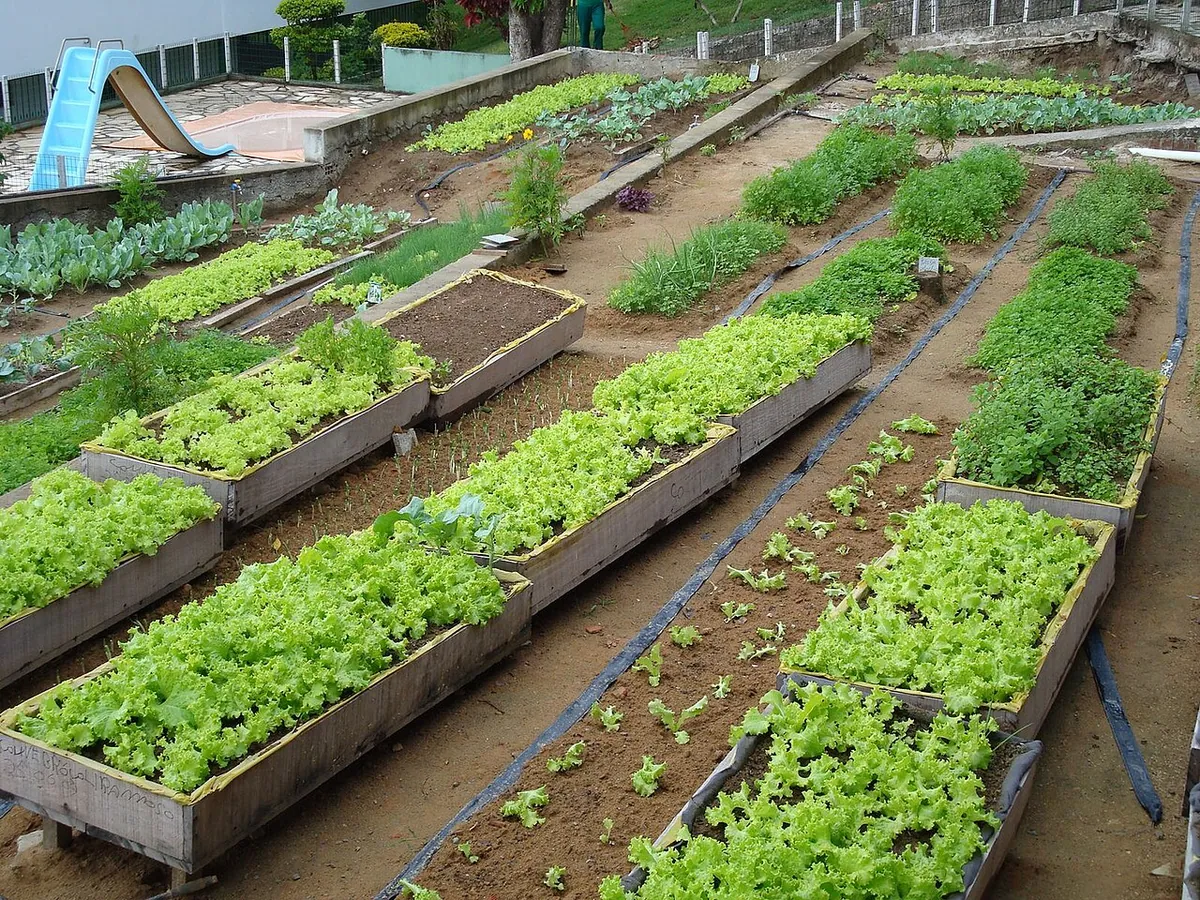
Photo: AlmostBrazilian, Wikimedia Commons, CC BY-SA 3.0
Concrete bag beds
Bags of dry concrete mix can be stacked and wetted to make a rustic low wall, the same way a concrete bag retaining wall is built. The paper weathers away and leaves rounded concrete pillows. This is a cheap way to make permanent, curved raised beds. See dry pour concrete.
Pros and Cons of Concrete Raised Beds
Longevity. Concrete raised beds last 30 years or more. They do not rot, warp, or attract termites, and they need no treatment.
Warmth. Concrete absorbs heat from the sun and releases it slowly, warming the soil for earlier spring planting and longer fall harvests. In very hot climates, this can stress plants near south- and west-facing walls; shade or lighter colors help.
Stability and neatness. Heavy concrete walls hold their shape and keep a clean, permanent edge. They resist burrowing animals better than wood.
Seating. Wide concrete caps can double as seats for comfortable gardening.
Drawbacks. Concrete raised beds cost more than simple wood beds, are heavy and hard to move, can raise soil pH slightly near the walls when new, and poured beds are permanent. Hollow blocks can shift if not set on a level base. In freezing climates, frost can move dry-stacked blocks over time.
Are Concrete Raised Beds Safe for Vegetables?
This is the most common question about concrete raised garden beds. Concrete is made of cement, sand, gravel and water, and once cured it is a stable, inert material. It is used for water tanks, pipes and fish ponds. The main effect on garden soil is alkalinity: new concrete contains calcium hydroxide (lime), which can leach slowly into the soil right next to the walls, raising the pH a little. Most vegetables grow well in slightly acidic to neutral soil (pH 6 to 7), and the effect is usually small and confined to a few inches from the wall. It decreases over the first year or two as the surface of the concrete carbonates. You can reduce it further by rinsing new concrete, letting it weather for a few weeks before filling the bed, sealing the inside of the walls with a non-toxic masonry sealer, or lining the walls with landscape fabric or a food-safe plastic liner. Acid-loving plants such as blueberries are best grown in a separate bed or container.
Some gardeners worry about fly ash in cinder blocks. Historically, true cinder blocks were made with coal cinders, and some modern blocks contain fly ash, a byproduct of coal power plants, as a partial cement replacement. Fly ash is locked into the cement matrix, and studies of leaching from concrete products show very low levels. Most blocks sold today are standard concrete masonry units made with sand and gravel. If you are concerned, ask your supplier what is in the block, line the inside of the bed, or plant food crops a few inches away from the walls. Avoid using old blocks of unknown origin that may be contaminated with oil, paint or chemicals. See cinder block vs concrete block and what is concrete made of.
Size and Depth of Concrete Raised Beds
Width. Keep beds no wider than about 4 feet if you can reach from both sides, or 2 to 3 feet if you can reach from only one side, so you never need to step on the soil.
Length. Any length works, but 8 to 12 feet is common, with paths at the ends so you can walk around.
Height. Over good ground soil, 8 to 12 inches is enough for most vegetables, since roots can grow down into the soil below. For root crops, poor soil, or a raised bed on concrete, aim for 12 to 24 inches. For gardeners who cannot bend easily, beds 24 to 36 inches tall bring the soil to a comfortable working height, and wide caps make a place to sit.
Paths. Leave 18 to 24 inches between beds for walking, and 36 inches or more for wheelbarrows and wheelchairs. Paths can be gravel, mulch, pavers or concrete. See concrete walkway ideas.
How to Build a Cinder Block Raised Bed
1. Pick a sunny spot. Most vegetables need 6 to 8 hours of direct sun. Choose a level site with good access to water.
2. Mark and level. Mark the outline with string. Remove grass along the wall line and level the ground. For a stable bed, dig a shallow trench 2 to 4 inches deep along the wall line, fill it with compacted gravel or sand, and level it carefully.
3. Lay the first course. Set the blocks on the base with the cores facing up, tight together, checking level along each wall and across corners. A level first course is the key to a straight, stable bed.
4. Add a second course. Stagger the joints like brickwork. Use masonry adhesive between courses for extra strength, or drive lengths of rebar down through the cores into the ground at the corners and every few feet.
5. Line the base if needed. Over weedy ground, lay cardboard on the bottom to smother grass and weeds; it decomposes within a season. Use hardware cloth on the bottom if gophers or moles are a problem.
6. Fill. Fill with a good raised bed soil mix and fill the block cores with soil too. Water to settle the soil, then top it up.
7. Cap if desired. Concrete caps glued on top make the wall look finished and give a place to sit or set tools. See how to paint cinder blocks if you want color.
How to Build a Poured Concrete Raised Bed
Poured concrete raised beds take more work than block, but they give a seamless, custom result. Mark the outline, dig a shallow trench along the wall lines, and fill it with 4 inches of compacted gravel. Build two-sided forms from plywood or boards for each wall, 4 to 6 inches apart, braced and staked so they stay straight under the weight of wet concrete. Place rebar or wire mesh inside the forms, held off the gravel on small blocks. Leave a few drainage gaps at the base by setting short pieces of PVC pipe through the forms. Pour the concrete, tap the forms to release air bubbles, and finish the top edge smooth with a trowel or round it with an edging tool. Keep the concrete damp for a week, strip the forms after a few days, and let the walls weather or rinse them several times before filling with soil. Poured concrete raised beds can be finished with stain, a smooth plaster coat or a decorative cap. See how to mix concrete and rebar in concrete.
For curved beds, use flexible hardboard or plastic forms bent around stakes. For a modern look, use smooth melamine forms and seal the finished walls. For a rustic look, form against rough boards to leave a wood grain texture in the concrete.
Building a Raised Bed on Concrete
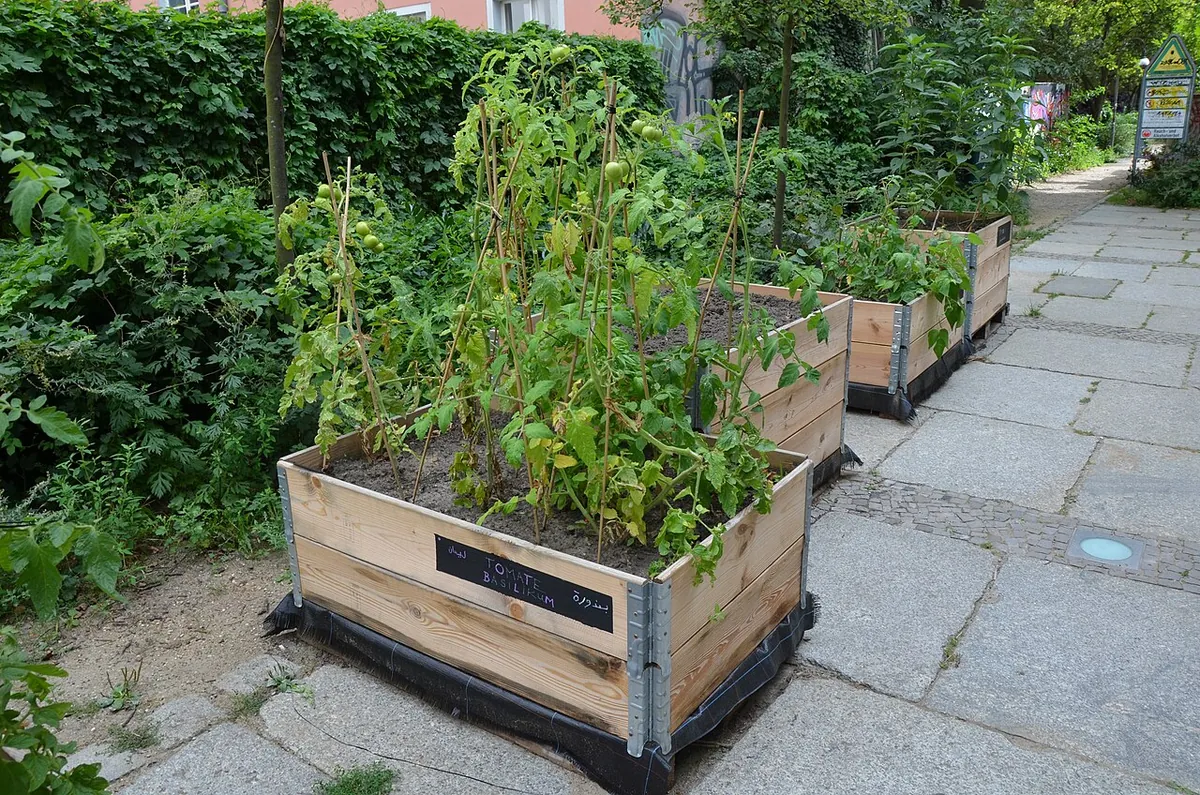
Photo: WS ReNu, Wikimedia Commons, CC BY-SA 4.0
Many people want to garden but have only a concrete patio, driveway, courtyard or rooftop. A raised bed on concrete makes that possible, as the urban garden above shows, with beds set directly on paving. Whether the walls are concrete, wood or metal, a raised garden bed on concrete needs a few extra considerations.
Depth. Plants cannot send roots into the ground, so all the soil they need must be in the bed. Make the bed at least 12 inches deep for greens and herbs, and 18 to 24 inches for tomatoes, squash and root crops.
Drainage. Water has to escape, or the soil becomes waterlogged. Leave small gaps at the base of the walls, or set the bed on slightly raised spacers, so water can drain out onto the concrete. Add a 2 to 3 inch layer of coarse gravel or broken pots at the bottom under landscape fabric if the concrete does not slope. Do not seal the bottom completely.
Protecting the concrete. Soil and water draining onto a patio can leave stains, efflorescence and algae. Place the bed where runoff drains away from doors and walkways, put a layer of landscape fabric at the bottom to hold soil in, and clean the surrounding concrete occasionally. A bed on concrete beside a house should not direct water toward the foundation. See how to clean concrete and efflorescence on concrete.
Weight. Wet soil weighs roughly 100 pounds per cubic foot. A 4 x 8 foot bed 18 inches deep holds about 48 cubic feet, roughly 4,800 pounds of soil and water. That is fine on a slab on grade, but on balconies, rooftops and decks it must be checked by an engineer. Lightweight soil mixes help. See concrete slab thickness.
Heat. Concrete in full sun gets very hot and reflects heat, so beds on concrete dry out faster and may need more water. Mulch the soil surface and consider drip irrigation.
Soil for Concrete Raised Beds
A good mix for raised beds is roughly 50 to 60 percent quality topsoil, 30 to 40 percent compost, and 10 percent coarse material such as perlite, pumice or fine bark for drainage, or a bagged raised bed mix. For beds on concrete or very deep beds, you can fill the bottom third with logs, branches or coarse woody material (a technique called hugelkultur) to reduce the amount of soil needed, though the soil will settle as it decomposes. Test the soil pH after the first season, especially in new concrete raised beds, and add sulfur or acidic organic matter like pine needles if it creeps above 7.5. Top up with compost each spring, and mix a little into the top few inches before planting.
Planting and Watering Tips
Concrete raised beds warm up early, so they suit early spring crops like lettuce, peas and radishes, and heat lovers like tomatoes, peppers and herbs. Plant trailing crops such as squash, strawberries and nasturtiums along the edges to spill over the walls. Use the block cores for herbs, flowers and strawberries. Because concrete beds drain well and warm quickly, they can dry out faster than in-ground beds in summer; mulch the soil and install drip irrigation or soaker hoses on a timer. In very hot climates, provide afternoon shade for leafy greens.
Concrete Raised Bed Ideas
- Tiered beds on a slope, built from concrete block or poured concrete, that also act as small retaining walls.
- Keyhole beds, a circular bed with a notch for reaching a central compost basket.
- Seat-height beds with wide concrete caps for accessible gardening.
- Painted block beds in bright colors for a playful garden.
- Modern poured beds with smooth gray walls and integrated benches.
- Beds combined with paths of gravel or concrete pavers for a tidy potager.
Planning a Concrete Raised Beds Garden
A whole concrete raised beds garden, with several beds laid out together, works best when it is planned like a small room. Start with a simple grid of rectangular beds, all the same width, with straight paths between them, which makes watering, mulching and crop rotation easy. Orient long beds north to south where possible so both sides get even sun. Put the tallest crops, such as tomatoes, pole beans and corn, on the north side so they do not shade shorter plants. Leave one wider path, at least 3 feet, for a wheelbarrow, and place a water tap or a drip irrigation manifold where it can reach every bed. A concrete raised beds garden looks especially tidy when the beds are built from the same block or poured concrete and the paths are finished with gravel, mulch or concrete pavers.
In small yards, two or three concrete raised beds along a sunny fence or wall can produce a surprising amount of food. Vertical supports such as trellises, cattle panels and stakes, fixed to the concrete walls with masonry anchors, let you grow climbing beans, cucumbers and squash upward. Herbs and salad greens near the kitchen door get picked more often, so put one of your concrete raised beds close to the house.
Concrete Raised Beds for Accessible Gardening
For gardeners who use wheelchairs, walkers or canes, or who find bending and kneeling difficult, tall concrete raised beds are a practical solution. Beds 24 to 30 inches high bring the soil within easy reach from a seated position, and 30 to 36 inch beds suit people who prefer to stand. Keep accessible beds no more than 2 feet wide if they are reached from one side, or 4 feet if reached from both. A wide concrete cap, 8 to 12 inches across, gives a place to sit, rest tools or lean. Paths should be firm, level and at least 36 inches wide, with concrete or compacted fine gravel rather than loose mulch. Many community and therapy gardens use poured or precast concrete raised beds for exactly these reasons: they are durable, stable and comfortable to work at. See concrete ramp.
Maintaining Concrete Raised Beds
Concrete raised beds need very little maintenance compared with wood. Each spring, top up the soil with an inch or two of compost, since soil settles and organic matter breaks down. Check block walls for shifting after winter and reset any blocks that have moved. Clean moss and algae off the walls if you prefer a clean look, though many gardeners like the natural patina. Seal poured concrete raised beds occasionally if they show efflorescence or staining. In cold climates, water trapped in hollow block cores can freeze and occasionally crack old blocks, so fill cores with soil rather than leaving them empty. Rotate crops between beds each year to reduce pests and diseases, and plant cover crops or mulch heavily over winter to protect the soil.
Common Mistakes With Concrete Raised Beds
Building on an uneven base. Blocks set on bumpy ground lean and shift. Always level the first course on compacted gravel or sand.
Making beds too wide. Beds wider than 4 feet force you to step on the soil to reach the middle, compacting it.
Too shallow on concrete. A raised bed on concrete that is only 6 to 8 inches deep dries out fast and limits roots. Go deeper.
No drainage. A sealed bottom on a patio leads to waterlogged soil and root rot.
Ignoring pH. Test the soil after the first season in new concrete beds and adjust if needed.
Using contaminated blocks. Reclaimed blocks stained with oil or chemicals do not belong in a food garden.
Forgetting the paths. Narrow, muddy paths between concrete raised beds become a chore. Plan paths wide enough to kneel, push a wheelbarrow and turn around, and give them a firm surface that drains.
Concrete Raised Beds vs Wood and Metal
Wood beds are cheap and easy to build but rot within 5 to 15 years, and treated lumber raises its own questions for food gardens. Galvanized steel beds are light, modern and long lasting, but they heat up quickly in sun and can be sharp at the edges. Concrete raised beds cost more than wood and weigh more than steel, but they outlast both, stay stable in wind and frost, and can be shaped and finished in many ways. For a garden you plan to keep for decades, concrete raised beds are usually the best value over time, while wood or metal suits renters and temporary gardens.
Concrete Raised Beds Cost
Typical costs in the US are about $2 to $4 per standard 8 x 8 x 16 inch block, so a 4 x 8 foot cinder block bed two courses high (about 34 blocks) costs roughly $70 to $140 in blocks, plus soil. Poured concrete raised beds cost about $20 to $50 per linear foot of wall installed by a contractor, depending on height and finish. Precast concrete beds and planters range from about $200 for a small box to $2,000 or more for large units. Soil is often the biggest cost: a 4 x 8 x 1.5 foot bed needs about 1.8 cubic yards, roughly $70 to $200 in bulk or more in bags. See concrete cost per square foot and cubic yard calculator.
Frequently Asked Questions
Are concrete raised beds safe for growing vegetables?
Yes. Cured concrete is inert. New concrete may raise soil pH slightly near the walls, which fades with time and can be reduced by weathering, sealing or lining the walls.
Can you put a raised garden bed on concrete?
Yes. Make it at least 12 to 18 inches deep, add a drainage layer, leave gaps for water to escape, and protect the concrete from staining.
How tall should a concrete raised bed be?
8 to 12 inches over good soil, 12 to 24 inches over poor soil or concrete, and 24 to 36 inches for easy access without bending.
Do cinder block beds need mortar?
Not for one or two courses on a level base. Taller walls should be mortared, glued or pinned with rebar.
How long do concrete raised beds last?
Typically 30 years or more, far longer than wood beds.
Sources
- University of Minnesota Extension: raised bed gardens
- Penn State Extension: soil pH and vegetable gardens
- National Concrete Masonry Association: concrete masonry units
- US EPA: coal combustion residual beneficial use evaluation
Related Guides
- Chicken coop concrete floor — slabs, bedding and predators
- Concrete railroad ties — prestressed ties and reuse in landscaping