
Why Does Concrete Crack? Causes, What to Worry About and How to Prevent It
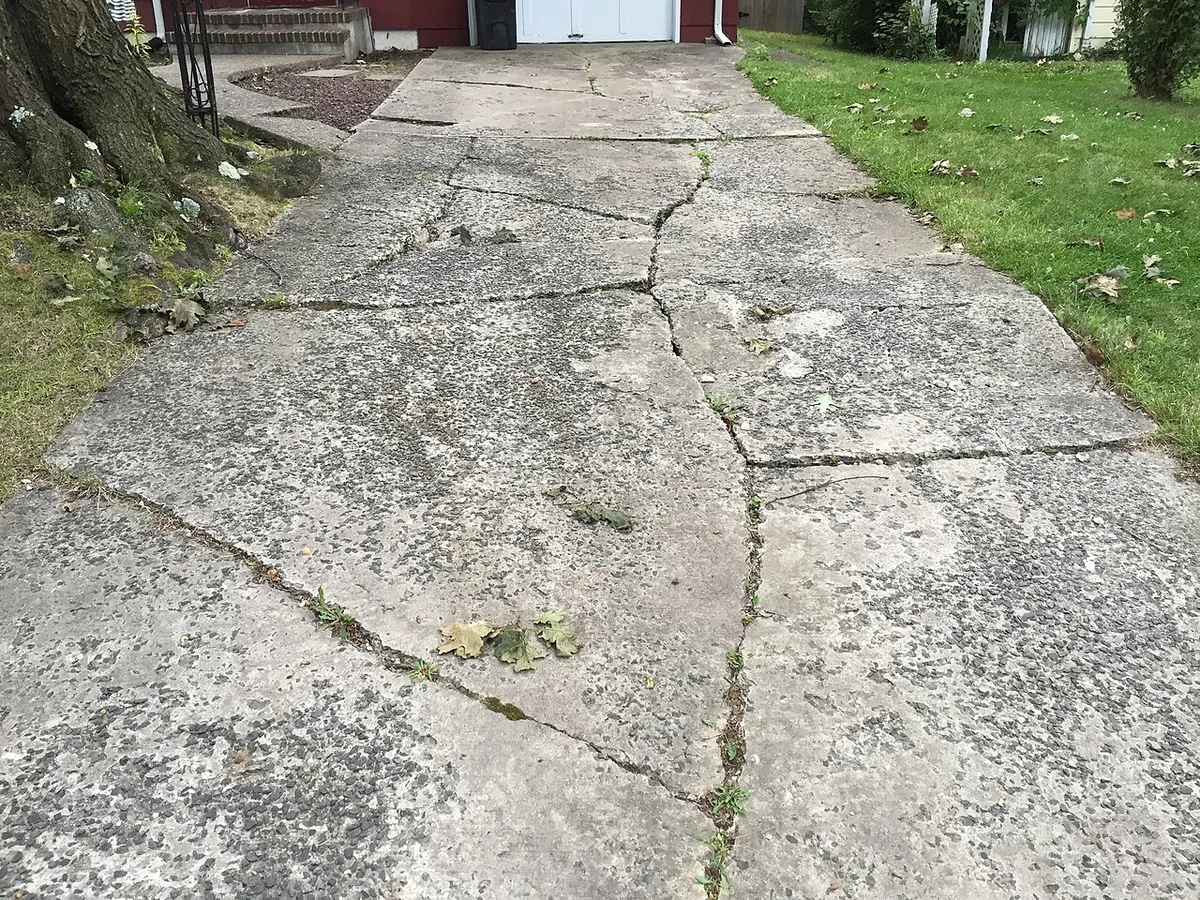
Photo: Famartin, Wikimedia Commons, CC BY-SA 4.0.
Quick Answer
Concrete cracks mainly because it shrinks as it dries and is weak in tension. When shrinkage, temperature changes, or movement of the ground pull on a slab, it cracks. The most common causes are drying shrinkage, fast drying of fresh concrete (plastic shrinkage), control joints spaced too far apart or cut too late, settlement of a poorly compacted base, tree roots, frost heave, overloading by heavy vehicles, and too much water in the mix. Small hairline cracks are normal and usually cosmetic. Wide, offset or growing cracks point to movement and deserve attention. To prevent cracking, use a good base, the right mix, properly spaced joints, reinforcement and good curing.
Almost every concrete slab cracks at some point. Contractors have a saying: there are two guarantees with concrete, it will get hard and it will crack. That sounds discouraging, but most cracks are small and harmless. The goal is to control where concrete cracks and to avoid the causes of large, damaging ones.
This guide answers why concrete cracks, explains the types of cracks and which ones matter, and covers prevention and repair. It also answers three common homeowner questions: how to kill roots under concrete, whether you should caulk the joints in a driveway, and what the black strip seam in a concrete driveway is.
Why Concrete Cracks: The Basic Science
Concrete is very strong when squeezed (compression) but much weaker when pulled (tension), roughly a tenth as strong in tension. Many forces in a slab create tension:
- Shrinkage: concrete loses volume as excess mix water evaporates. A slab shrinking against the friction of the ground below, or restrained by walls and other slabs, gets pulled apart.
- Temperature: concrete expands in heat and contracts in cold. Daily and seasonal swings stress the slab.
- Bending: when the ground under part of a slab settles or heaves, the slab bends and cracks across the weak point.
- Loads: heavy vehicles, especially near thin edges, bend the slab.
When the tension exceeds what the concrete can resist, it cracks to relieve the stress. That is why the industry uses control joints: deliberate weak lines so the concrete cracks there, neatly, instead of randomly.
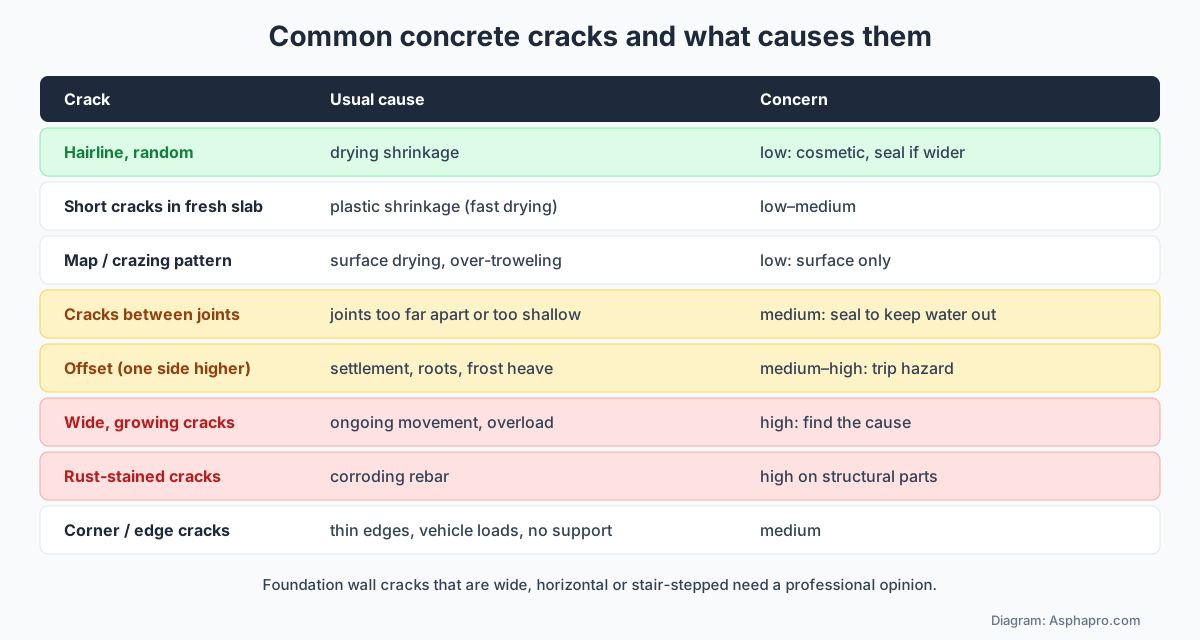
The Main Causes of Concrete Cracks
1. Drying shrinkage
The most common reason concrete cracks. As concrete cures and dries over weeks and months, it shrinks. Typical shrinkage is small per foot, but over a long slab it adds up. Without joints, the slab cracks at roughly regular intervals to relieve the stress. More water in the mix means more shrinkage, which is one reason adding water on site to make concrete easier to place leads to more cracking.
2. Plastic shrinkage
In hot, dry or windy weather, water evaporates from the surface of fresh concrete faster than bleed water can replace it. The surface shrinks while the concrete below is still soft, causing short, often parallel cracks within hours of placing. Sunshades, windbreaks, evaporation retarders, fogging and prompt curing prevent it.
3. Control joints too far apart, too shallow or cut too late
Joints must be close enough, deep enough and timely. Common guidance is joints about a quarter of the slab depth, spaced in feet at roughly two to three times the slab thickness in inches, so about 8 to 12 feet for a 4-inch slab, and cut within hours of finishing. If joints are spaced too far apart, the slab cracks between them. If they are cut too late, random cracks may already have formed. See how to cut concrete.
4. Poor base and settlement
A slab needs uniform support. Soft spots, poorly compacted fill, organic soil, washed-out base or utility trenches that were not compacted let parts of the slab sink. The slab bends over the low spot and cracks, often with one side lower than the other. See how to build concrete forms for base prep.
5. Tree roots
Growing roots lift and crack sidewalks, driveways and patios, especially near large, shallow-rooted trees. Roots can also dry out clay soils, causing settlement. The photo at the top of this page shows a driveway lifted by roots.
6. Frost heave
In cold climates, water in the soil freezes and forms ice lenses that push the slab up. When it thaws, the ground settles unevenly. Poor drainage and frost-susceptible soils like silt make this worse. A free-draining gravel base reduces frost heave.
7. Expansive clay soils
Some clay soils swell when wet and shrink when dry, moving slabs up and down with the seasons. Slabs on expansive clay crack more and may need deeper base preparation, moisture control and stronger reinforcement.
8. Overloading
A 4-inch patio slab is not built for a loaded concrete truck, dumpster, RV or heavy equipment. Overloading, especially near edges and corners, cracks slabs. Driveways for heavy vehicles should be thicker. See how thick a concrete driveway should be.
9. Too much water in the mix
Extra water weakens concrete and increases shrinkage. Concrete that is very soupy when poured is more likely to crack, dust and scale. See what concrete is made of.
10. Poor curing
Concrete that dries too fast in the first days does not gain full strength and shrinks faster at the surface, leading to cracking and crazing. See how long concrete takes to cure.
11. Rusting reinforcement
When water and salts reach steel inside concrete, the steel rusts and expands, cracking the concrete above it and often leaving rust stains. See how to remove rust stains from concrete.
12. Freeze-thaw and deicing salts
Water in concrete expands about 9% when it freezes. Repeated freeze-thaw cycles, especially in non-air-entrained concrete exposed to deicing salts, cause scaling and cracking near the surface. See does salt damage concrete.
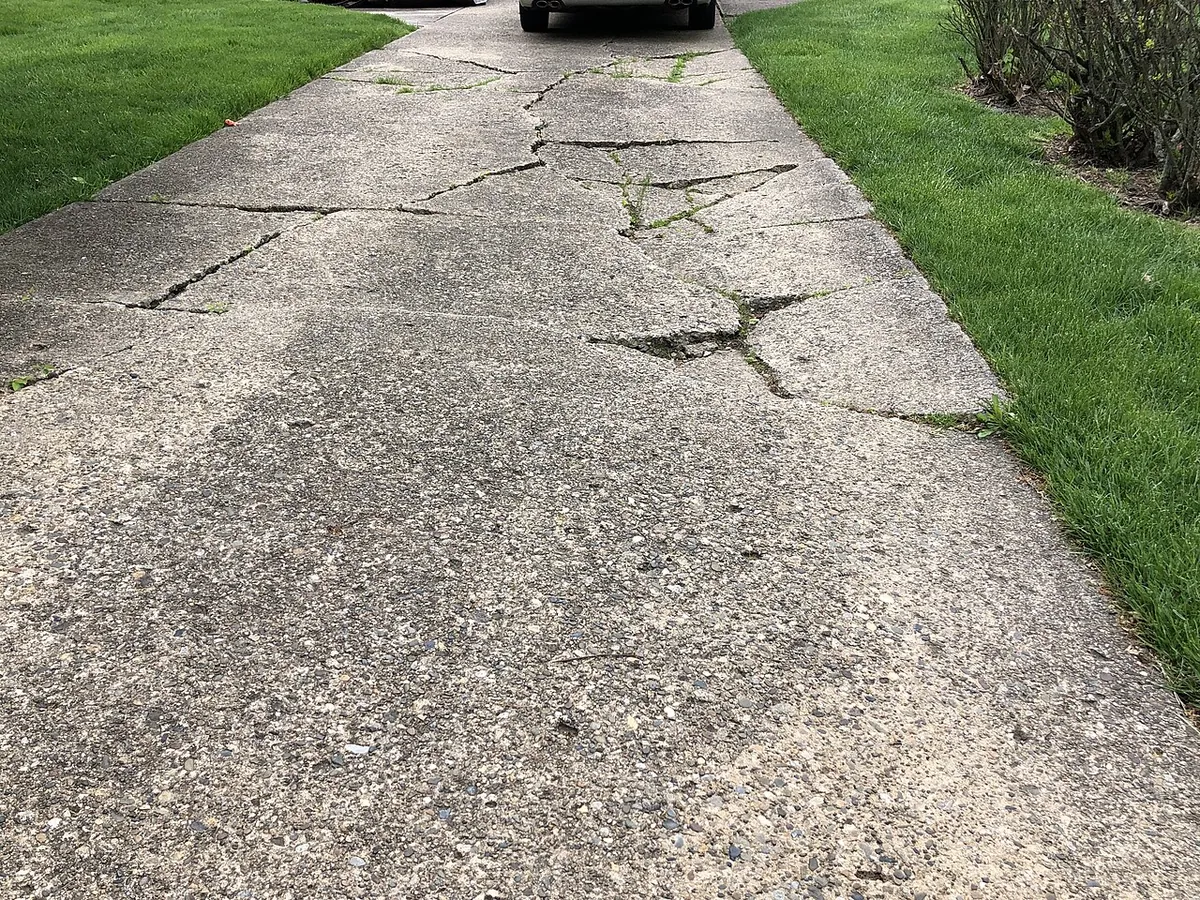
Photo: Famartin, Wikimedia Commons, CC BY-SA 4.0.
Re-Entrant Corners and Other Weak Spots
Some locations in a slab almost always crack if they are not detailed well. Re-entrant corners, the inside corners where a slab changes shape such as an L-shaped patio or the notch around a garage door post, concentrate stress, and cracks often start right at the corner and run diagonally. A control joint lined up with the corner, or extra reinforcing bars placed diagonally across it, helps. Other weak spots include areas around drains, columns and pipes that pass through the slab, which should be isolated with a ring of joint filler, and narrow strips of concrete between joints or near edges, which crack under small loads. Thin sections over buried pipes or footing edges also tend to crack because the slab thickness changes suddenly.
Planning joint layout with these spots in mind, before the pour, prevents many of the cracks homeowners notice first. Ask your contractor to draw the joint plan on the site plan or on the forms so everyone knows where the slab is meant to crack.
Which Cracks Should You Worry About?
Not every crack is a problem. Use these signs to judge whether concrete cracking is cosmetic or a warning:
- Width: hairline cracks narrower than a credit card are typically shrinkage and cosmetic. Cracks wider than about ⅛ inch let in water and deserve sealing; cracks ¼ inch or wider suggest movement.
- Offset: if one side of the crack is higher than the other, the ground under the slab has moved. Offsets are trip hazards on walks and steps.
- Growth: a crack that gets longer or wider over months means ongoing movement. Mark the ends with a pencil and date, or glue a simple crack gauge across it, and check it every few months.
- Pattern: map cracking (crazing) is surface-only. Long straight cracks between joints are shrinkage. Cracks radiating from a corner or a heavy load point suggest overload or lack of support.
- Location: cracks in a patio are mostly cosmetic. Cracks in foundation walls, structural slabs, beams or retaining walls need more scrutiny, especially if they are horizontal, stair-stepped in block walls, wider at one end, or leaking water.
- Rust stains: orange staining from a crack suggests corroding reinforcement.
When in doubt about a foundation or structural crack, have a structural engineer or experienced foundation contractor look at it.
How to Fix Concrete Cracks
Hairline cracks
Usually best left alone or covered by a penetrating sealer, which reduces water entry. Some crack sealers are thin liquids that soak into fine cracks.
Small cracks, about ⅛ to ½ inch
- Clean out debris and loose concrete with a wire brush and blower.
- For deeper cracks, insert a backer rod.
- Fill with a flexible concrete crack filler or polyurethane sealant for cracks that move, or an epoxy or cement-based repair compound for static cracks.
- Tool flush and let it cure.
Wide cracks and broken edges
Widen the crack slightly into an inverted V or a keyed shape with a grinder or chisel, clean it, dampen it, and fill with a polymer-modified patching mortar. For spalled edges, cut back to sound concrete and patch. See concrete repair cost.
Settled or sunken slabs
Slabs that have sunk can often be raised back into place with slabjacking (pumping cement grout under the slab) or polyurethane foam injection, then the cracks sealed. See concrete leveling cost.
Badly damaged slabs
Slabs broken into many pieces, heaved by roots, or crumbling from freeze-thaw damage are usually better removed and replaced with proper base prep and joints. See concrete removal cost and concrete driveway cost.
How to Prevent Concrete Cracks
You cannot make concrete crack-proof, but you can greatly reduce uncontrolled cracking:
- Build a good base: remove topsoil and organics, compact the subgrade, and place a compacted gravel base, especially on clay or frost-prone soils.
- Choose the right thickness: 4 inches for walks and patios, often 5 to 6 inches for driveways with heavier vehicles. See concrete slab thickness.
- Order the right mix: an appropriate strength, air-entrained for freeze-thaw, with a reasonable slump. Do not add water on site.
- Place joints correctly: about 2 to 3 times the slab thickness (in feet), about ¼ of the depth, panels near square, cut early.
- Add reinforcement: rebar or wire mesh, placed in the middle of the slab on chairs, holds cracks tight. Fibers help with early plastic shrinkage cracks.
- Isolate the slab: use isolation (expansion) joints where slabs meet buildings, columns, steps and other slabs.
- Protect from fast drying: in hot, windy weather, use windbreaks, shade and evaporation retarders.
- Cure properly: keep the slab moist or covered for at least about a week.
- Keep heavy loads off: do not drive on a new driveway for about a week (passenger cars) and longer for heavy vehicles.
- Manage water: direct downspouts and runoff away from slab edges.
- Plan for trees: keep paving away from large trees, or use root barriers.
Cracks in Different Places
Driveways
Driveway cracks often come from vehicle loads on thin edges, poor base under the apron, roots and frost. Thickened edges, a solid base and good joints help. Seal joints and cracks to keep water out. If you are comparing materials, see asphalt vs concrete driveway cost.
Garage floors
Garage slabs crack from shrinkage, especially with few joints, and around re-entrant corners at doorways and columns. Most garage floor cracks are cosmetic. Seal them before applying a coating.
Basement floors and walls
Basement floors often have shrinkage cracks that are harmless unless they leak or move. Vertical hairline cracks in poured foundation walls are common shrinkage cracks; they matter mainly if they leak. Horizontal cracks, bowing walls and stair-step cracks in block walls can indicate soil pressure and need a professional.
Patios and sidewalks
Patios and walks crack from shrinkage, settlement, roots and frost. Offsets on walks are trip hazards; many cities require homeowners to repair public sidewalks in front of their homes. See concrete sidewalk cost.
Steps
Steps crack where they meet the house or slab, from settlement, and from freeze-thaw and salt. See how to fix concrete steps.
Common Myths About Concrete Cracks
- "Rebar stops concrete from cracking." Reinforcement does not prevent cracks; it holds them tight and keeps pieces together.
- "Fibers replace rebar." Microfibers mainly reduce early plastic shrinkage cracks. Structural macrofibers can replace some reinforcement in certain designs, but not all.
- "Stronger concrete never cracks." Higher-strength mixes can shrink more if they have more cement paste. Water content and curing matter more.
- "A crack means the contractor did a bad job." Not necessarily. Hairline shrinkage cracks are normal. Wide, random cracks in a new slab without joints may indicate poor practice.
- "Sealing cracks fixes the cause." Sealing keeps water out; it does not stop settlement, roots or heave.
A Worked Example: Cracked Driveway Diagnosis
Say a 15-year-old driveway has three kinds of cracks: fine cracks across several panels, a wide crack near the street with one side 1 inch lower, and a lifted section near a big maple tree.
- The fine cracks are drying shrinkage. They are sealed with a flexible crack filler to keep water out.
- The settled panel near the street sits over a utility trench that was never compacted. A leveling contractor lifts it with polyurethane foam, then the crack is sealed.
- The lifted section is caused by maple roots. An arborist advises that the roots can be pruned on the driveway side without harming the tree. The section is removed, roots are cut, a root barrier is installed, and a new panel is poured on a compacted base.
- The old black fiberboard expansion joints are cut down, backer rod is installed, and all joints are sealed with polyurethane sealant.
The result is a driveway with each problem addressed at its cause rather than just covered up.
When Cracks Appear: A Timeline
When a crack shows up is a strong clue to why concrete cracks in your case:
- Within hours of the pour: plastic shrinkage cracks from fast surface drying, or settlement cracks over rebar or form edges while the concrete was still soft.
- Within days to weeks: early drying shrinkage cracks, often between joints that were too far apart or cut too late; also thermal cracks if a warm slab cooled quickly.
- Within months: continued drying shrinkage, cracks over soft spots as the base settles, and crazing becoming visible as the surface dries.
- After the first winter: frost heave, scaling from deicers, and cracks at edges where water got under the slab.
- After years: tree roots, long-term settlement, rebar corrosion and wear from heavy loads.
A crack that appears early and stays the same width is usually shrinkage. A crack that appears later and keeps growing usually points to movement underneath.
Cost to Repair Cracks
Sealing cracks yourself is cheap: a tube of crack filler or a bottle of joint sealant and some backer rod cover many feet of cracks and joints. Professional crack repair, slab leveling and partial replacement cost more but fix larger problems. Leveling a sunken slab usually costs much less than tearing it out and replacing it, as long as the slab is in one piece. Replacement makes sense when the concrete is badly broken or the cause, such as roots or a poor base, must be fixed from below. For price ranges, see concrete repair cost and concrete leveling cost.
When to Call a Professional
- Cracks in foundation walls that are horizontal, stair-stepped, wider than about ¼ inch, or leaking.
- Walls that bow or lean.
- Cracks in structural slabs, beams, balconies or retaining walls.
- Doors and windows sticking along with new cracks, which can mean the house is moving.
- Slabs that keep settling after repair.
- Large trees causing damage where root cutting could affect tree stability.
For most driveways, patios and walks, though, the answer to why concrete cracks is simple shrinkage and ordinary ground movement, and sealing, leveling or replacing a single panel takes care of it.
What Is the Black Strip Seam in My Concrete Driveway?
The black strip you see between driveway slabs, or between a driveway and a garage floor, sidewalk or house, is usually an expansion joint filler, commonly made of asphalt-impregnated fiberboard. It is placed before the pour to separate slabs so they can expand, contract and move independently without pushing against each other or against the house. That is why it is often called an isolation joint or expansion joint.
Over years, this fiberboard weathers, shrinks, crumbles and lets weeds and water in. You can cut it down below the surface, insert a foam backer rod, and seal over it with a flexible joint sealant. Do not fill it with mortar or concrete, which defeats its purpose.
Should You Caulk Water Joints in Driveway Concrete?
Generally, yes. Sealing expansion joints and wide control joints keeps water, ice, dirt and weeds out. Water that runs down open joints can wash out the base, causing settlement, and in cold climates can freeze under slab edges and lift them. A good seal also reduces weed growth and keeps sand and debris from packing into joints, which can stop slabs from moving freely.
- Clean the joint thoroughly: remove old sealant, debris, weeds and loose fiberboard. Use a wire brush and blower.
- Insert a closed-cell foam backer rod slightly wider than the joint, so the sealant is the right depth and bonds only to the sides.
- Apply a flexible, self-leveling concrete joint sealant, such as polyurethane or silicone made for horizontal concrete joints, on a dry day.
- Keep traffic off until it cures, as the label directs.
Never use rigid materials like mortar, grout or hard epoxy in moving joints. They crack and can cause spalling at the joint edges. Fine saw-cut control joints in a 4-inch slab are often left open, but sealing them is also fine and helps in freeze-thaw areas.
How to Kill Roots Under Concrete
If a tree's roots are cracking your concrete, think carefully before killing or cutting them. Large roots support and feed the tree; damaging them can weaken it or make it unstable, and some trees are protected by local rules. Options include:
- Consult an arborist: they can tell you which roots can be safely cut and whether the tree is healthy.
- Root pruning and barriers: when replacing the concrete, cut offending roots cleanly and install a vertical root barrier between the tree and the slab to guide roots downward.
- Remove the tree: if the tree is unsuitable for the spot, removing it and grinding the stump stops new root growth. Dead roots decay over time, which can leave voids; fill and compact before new concrete.
- Herbicides: chemical root killers are mostly designed for sewer lines. Products that kill roots can kill or harm the whole tree and nearby plants, and you cannot easily target only the roots under a slab. Follow labels carefully and avoid applying chemicals near trees you want to keep.
- Avoid rock salt: salt kills plants and roots but damages concrete and soil.
- Choose better trees: when planting, put large trees well away from paving, and choose species with less aggressive surface roots.
So why does concrete crack? Because it shrinks, it moves with heat, cold and soil, and it resists pulling far less than pushing. You cannot stop all of that, but with good joints, a solid base and proper curing, the cracks stay small, straight and where you planned them.
Frequently Asked Questions
Why does concrete crack?
Mainly from drying shrinkage and tension it cannot resist, plus settlement, roots, frost, overloading, poor joints and too much water in the mix.
Is it normal for new concrete to crack?
Small hairline cracks are common and usually cosmetic. Wide, offset or growing cracks are not normal.
Should you caulk water joints in driveway concrete?
Yes. A flexible sealant over a backer rod keeps water and weeds out and protects the base.
What is the black strip in my concrete driveway?
An expansion joint filler, usually asphalt-impregnated fiberboard, that separates slabs so they can move.
How do I kill roots under concrete?
Consult an arborist; prune roots and add a root barrier when replacing the slab, or remove the tree. Chemical root killers can harm the whole tree.
Can cracked concrete be repaired?
Yes. Small cracks can be sealed; settled slabs can be leveled; badly damaged slabs may need replacement.
How soon does new concrete crack?
Plastic shrinkage cracks can appear within hours. Drying shrinkage cracks usually show up within weeks to months.
Do control joints stop cracks?
They control where cracks form, so the slab cracks neatly at the joint instead of randomly.
What is the best sealant for driveway joints?
A flexible, self-leveling polyurethane or silicone sealant made for concrete joints, installed over a backer rod.
Should I worry about a crack in my basement floor?
Usually not if it is hairline and dry. Get advice if it leaks, widens or one side is higher.
Sources
- American Concrete Institute, guidance on cracking, joints and slab design. concrete.org
- Portland Cement Association, water-cement ratio and concrete basics. cement.org
- Image credits: driveway photos by Famartin, Wikimedia Commons (CC BY-SA 4.0); chart by Asphapro.com.
For foundation or structural cracks, consult a qualified professional. Checked November 2026.
Related Guides
- Does salt damage concrete? — deicers, scaling and protection