
Crushed Concrete: Driveways, Calculator, Cost and How Concrete Crushers Work
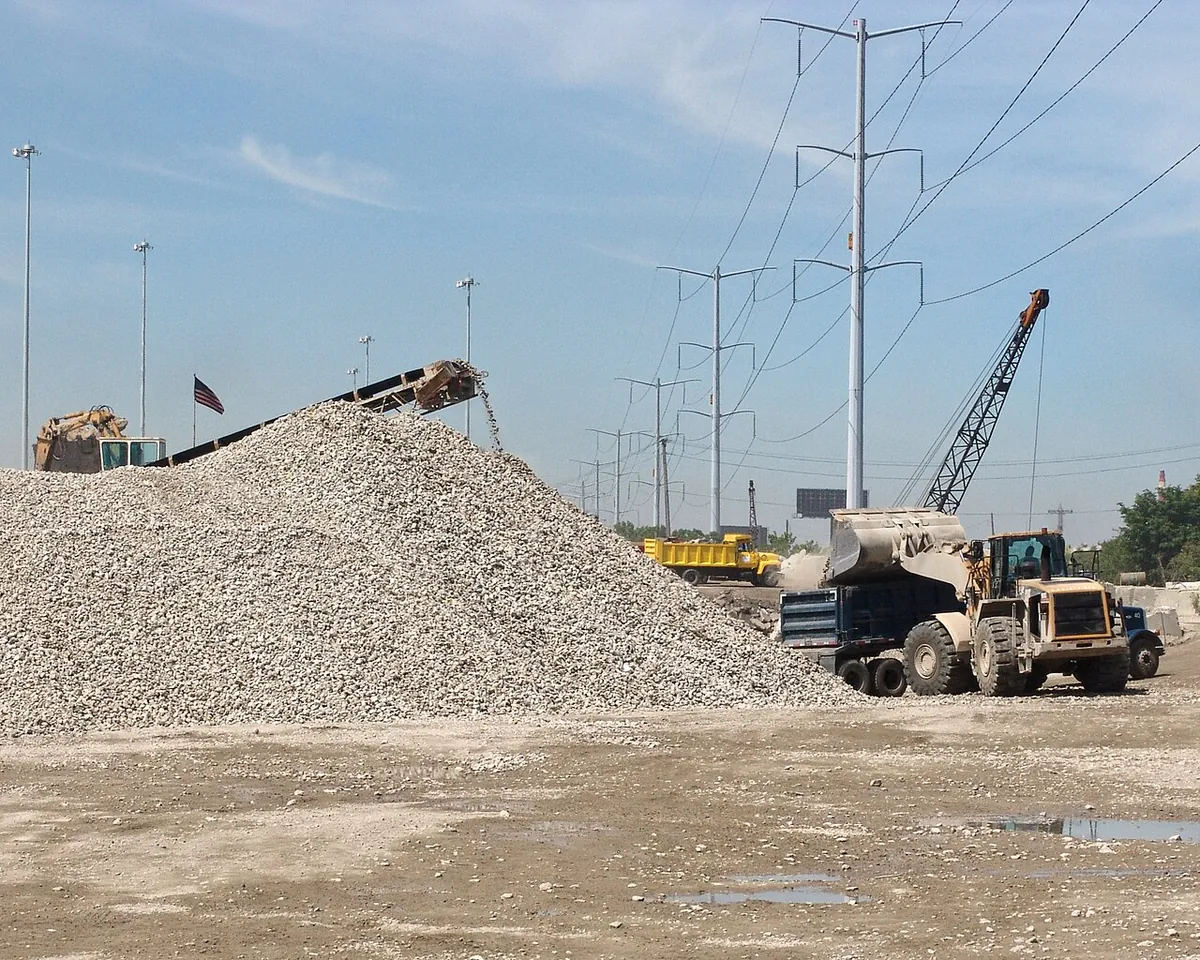
Photo: Chicagoland Concrete, Inc., Wikimedia Commons, CC BY-SA 3.0
Quick Answer
Crushed concrete is old concrete from demolished slabs, driveways, sidewalks and buildings that has been broken up, run through a concrete crusher, cleaned of steel with magnets, and screened into sizes. It is also called recycled concrete aggregate (RCA). It typically costs about $10 to $40 per ton before delivery, often less than new gravel, and weighs roughly 1.2 to 1.4 tons per cubic yard. A crushed concrete driveway is usually built 4 to 6 inches thick over geotextile fabric and compacted in layers; the fines bind together into a hard surface. Use the crushed concrete calculator formula below: length × width × depth in inches ÷ 12 ÷ 27 = cubic yards, × 1.3 = tons, plus about 10 percent for compaction.
Every year, huge amounts of concrete come out of roads, parking lots, foundations and buildings. Instead of hauling it to a landfill, more and more of it goes to a recycling yard, where it is crushed and sold back as aggregate. For homeowners, crushed concrete is one of the cheapest ways to build a driveway, a parking pad, a base under pavers or a path, and for contractors it is a standard fill and base material.
This guide explains what crushed concrete is, the sizes you can buy, how a crushed concrete driveway is built, how much you need with a simple crushed concrete calculator, what it costs, its pros and cons compared with gravel, and how concrete crushing works, including the machines used and whether you can crush concrete yourself.
What Is Crushed Concrete?
Crushed concrete is concrete rubble that has been processed into aggregate. Old concrete is broken into pieces small enough to handle, fed into a concrete crusher that breaks it down further, and passed under magnets that pull out rebar and wire mesh. Screens then sort the material into sizes, from fine sand-sized particles to stones of 2 or 3 inches. The result looks like light gray gravel with sharp, angular faces and some fine powdery material.
Because the concrete crushed at a recycling yard came from many sources, the material is not as uniform as quarried stone. It contains the original stone or gravel aggregate from the old concrete, still coated in hardened cement paste, plus pieces of paste and sand. Some loads may include small amounts of brick, asphalt or tile, depending on how carefully the yard sorts its incoming material. Good recyclers keep clean concrete separate and sell it as a graded product with a known size range.
The Federal Highway Administration has documented recycled concrete aggregate as a long-established material for road base, and many state transportation departments allow it in base and subbase layers under pavement. The U.S. Environmental Protection Agency reports that concrete is the largest single part of construction and demolition debris in the country, and most of it is now recycled, much of it as crushed concrete.
Crushed Concrete Sizes and Grades
Yards sell crushed concrete in several common products. Names vary by region, so ask what size range and whether fines are included.
- Crushed concrete base (3/4 inch minus, crusher run, or road base): stones from 3/4 inch down to dust. The fines fill the gaps and the material compacts into a hard, stable layer. This is the most common product for driveways, pads and base under pavers or slabs.
- Clean crushed concrete (No. 57 size, about 3/4 to 1 inch): stones with the fines washed or screened out. It drains well and is used for drainage, under slabs and as a top layer.
- 1.5 to 3 inch crushed concrete: larger stone for the bottom layer of a driveway over soft ground, for construction entrances and for drainage beds.
- Crushed concrete fines or screenings: sand-sized material for leveling and fill.
- Rip rap or broken concrete: large chunks for erosion control along ditches and shorelines.
For more on how aggregates are graded and used in new concrete, see concrete aggregate.
Crushed Concrete Driveway
A crushed concrete driveway is one of the most popular uses for recycled concrete. It costs less than asphalt or concrete paving, it is quick to build, and the fines in crushed concrete base set up almost like a weak cement after they are wetted and compacted, so the surface gets harder over time than many gravel driveways. Crushed concrete driveways are common on rural properties, long lanes, farm roads, parking areas for trailers and equipment, and as a temporary driveway during home construction that is later paved over.
How to Build a Crushed Concrete Driveway
The steps for crushed concrete for driveways are similar to any gravel driveway, but compaction matters more because that is what makes the material bind.
1. Plan and mark the layout. A single-lane driveway is usually 10 to 12 feet wide; a two-car width is 18 to 24 feet. Mark the edges with stakes and string and check for buried utilities before you dig.
2. Excavate. Remove topsoil, grass and roots to firm subsoil, usually 6 to 12 inches deep depending on how soft the ground is and how thick the layers will be. Topsoil left under a driveway will settle and pump up through the stone.
3. Grade for drainage. Shape the subgrade with a crown or cross slope of about 2 percent so water runs off to the sides, and plan ditches or a swale where water needs to go. Water standing in a crushed concrete driveway is what causes potholes and ruts.
4. Compact the subgrade. Use a plate compactor or roller on the soil before any stone goes down.
5. Lay geotextile fabric. A woven geotextile keeps the stone from pushing into soft soil and the soil from pumping up into the stone. It is the cheapest insurance for a long-lasting crushed concrete driveway.
6. Place the base layer. On soft ground, start with 3 to 4 inches of larger 1.5 to 3 inch crushed concrete. On firm ground you can skip straight to the main layer.
7. Place the crushed concrete base. Spread 3/4 inch minus crushed concrete in lifts of about 2 to 3 inches, wet it lightly, and compact each lift. Total thickness is usually 4 inches for cars on firm ground and 6 inches or more for trucks or soft soil.
8. Finish and maintain. Crown the surface, compact again, and let traffic and rain set it up. Rake or regrade low spots each year and add a thin top-up layer every few years.
For comparison with other materials, see gravel driveway cost, recycled asphalt driveway and asphalt millings.
Choosing Crushed Concrete for a Driveway
When you call a yard and ask for crushed concrete for a driveway, the product they will usually suggest is 3/4 inch minus base with fines, because it packs down and stays put under tires. If your ground is soft or wet, ask for a load of 2 or 3 inch crushed concrete for the bottom layer as well. Some homeowners also want a cleaner look on top; a 1 to 2 inch skim coat of decorative stone over the compacted crushed concrete base gives that without losing the firm layer underneath.
Think about the traffic too. Crushed concrete for driveway use by cars alone can be 4 inches thick on firm soil, but a driveway that will see delivery trucks, a camper, a tractor or a concrete truck during future building work needs 6 to 8 inches, and possibly a heavier bottom layer. Steep driveways benefit from base with plenty of fines, which resists washing out, plus water bars or ditches to move runoff off the surface. On flat sites, crown the surface well so rain does not sit in the middle.
Finally, check the edges. Crushed concrete spreads sideways under traffic if nothing holds it, so many builders set the finished surface slightly below the surrounding ground or add an edge of timber, steel edging or a small berm of soil. This keeps the stone in the driveway and off the lawn.
Crushed Concrete Calculator: How Much Do You Need?
A crushed concrete calculator is simple arithmetic. Measure the area in feet and choose the thickness in inches, then:
- Cubic feet = length × width × (depth in inches ÷ 12)
- Cubic yards = cubic feet ÷ 27
- Tons = cubic yards × about 1.3 (use 1.2 for clean stone and 1.4 for dense base with fines)
- Add 10 to 15 percent for compaction and uneven ground
Suppliers sell by the ton or by the cubic yard, so it helps to know both.
Crushed Concrete Calculator Examples
Single-car driveway, 12 by 50 feet, 4 inches thick: 12 × 50 = 600 square feet. 600 × (4 ÷ 12) = 200 cubic feet. 200 ÷ 27 = 7.4 cubic yards. 7.4 × 1.3 = about 9.6 tons. Add 10 percent and order about 10.5 to 11 tons of crushed concrete base, which is one tandem truckload.
Same driveway at 6 inches for trucks: 600 × 0.5 = 300 cubic feet, or 11.1 cubic yards, or about 14.4 tons. With 10 percent extra, order about 16 tons.
Two-car parking pad, 20 by 20 feet, 4 inches: 400 × 0.333 = 133 cubic feet, 4.9 cubic yards, about 6.4 tons, so order about 7 tons.
Long rural lane, 10 by 300 feet, 6 inches: 3,000 × 0.5 = 1,500 cubic feet, 55.6 cubic yards, about 72 tons, so plan on roughly 80 tons, several truckloads, and ask the yard about a volume price.
A quick rule of thumb from these numbers: one ton of crushed concrete covers about 80 square feet at 3 inches, 60 square feet at 4 inches, or 40 square feet at 6 inches. Use the crushed concrete calculator formula above for exact amounts, and remember that loose material compacts by 10 to 20 percent, so a layer spread 5 inches thick will end up near 4 inches after rolling.
| Area (sq ft) | 4 in deep (tons) | 6 in deep (tons) |
|---|---|---|
| 200 | 3.2 | 4.8 |
| 400 | 6.4 | 9.6 |
| 600 | 9.6 | 14.4 |
| 1,000 | 16 | 24 |
| 2,000 | 32 | 48 |
Tons at 1.3 tons per cubic yard, before the 10 to 15 percent compaction allowance.
Crushed Concrete Cost
Crushed concrete is usually one of the least expensive aggregates you can buy, because the raw material comes in as waste that the recycler is often paid to take. Typical prices, which vary a lot by region and product, run roughly $10 to $40 per ton at the yard, or about $15 to $50 per cubic yard. Delivery adds a charge that depends on distance and truck size, often a flat fee per load. A tandem dump truck typically carries 10 to 15 tons; a tri-axle up to around 20 tons.
For a new crushed concrete driveway with excavation, fabric, material, spreading and compaction, contractors commonly charge something like $1 to $3 per square foot, compared with roughly $1 to $3 for gravel, $3 to $7 for asphalt and $6 to $12 or more for concrete paving. See driveway cost per square foot for a full comparison.
Prices for crushed concrete also depend on how clean and well graded the product is. A recycler that removes steel, wood and brick carefully and screens to a consistent size will charge more than a yard selling mixed rubble, and the clean product is worth it for a driveway. Some yards give away or sell very cheaply unscreened material; it can work as fill in a low spot but makes a poor driving surface. If you are tearing out an old slab, ask local recyclers whether they will take clean concrete for free or at a lower tipping fee than a landfill; see concrete removal cost.
Crushed Concrete vs Gravel
Homeowners usually compare crushed concrete for driveways with crushed limestone or granite gravel. Each has a place.
Cost: crushed concrete is often 20 to 50 percent cheaper than quarried stone in areas with active recycling, though in some regions the prices are close. Always compare delivered prices.
Compaction and hardness: crushed concrete base with fines locks together well and the leftover cement in the fines can re-harden slightly when wet, giving a firm surface. Crushed limestone base also compacts well. Round river gravel does not compact and rolls under tires, so it is a poor choice for a driveway base.
Appearance: crushed concrete is light gray and can look patchy, with occasional bits of brick or asphalt. Many people put a thin top layer of decorative gravel over a crushed concrete driveway if looks matter.
Strength of the stone: crushed concrete is softer than granite and some limestone, so it breaks down a little faster under heavy traffic, producing more fines and dust. For most home driveways this is not a problem.
Drainage: base with fines drains slowly; clean crushed concrete drains well. Use the right product for the job.
Environment: crushed concrete reuses material that would otherwise go to landfill and reduces quarrying, which is its biggest advantage.
Pros and Cons of Crushed Concrete
The advantages are clear: low cost, wide availability near cities, good compaction, a firm surface, and a recycled material that keeps demolition waste out of landfills. Crushed concrete is also easy to work with using ordinary equipment, and a crushed concrete driveway can be paved over later because it makes a good base for asphalt or concrete.
The drawbacks are worth knowing before you order. Pieces of rebar or wire can remain, especially in cheaper product, and can puncture tires or injure bare feet. Quality varies from load to load. Fresh crushed concrete is alkaline, and rainwater running through it can carry high-pH water and fine sediment for a while. Many guidelines recommend keeping it away from streams, wetlands and the root zones of acid-loving plants, and using a filter fabric or setback where runoff goes to water. Crushed concrete fines can also make dust in dry weather. Finally, some state and local rules limit where recycled concrete aggregate can be used, especially near wells or water bodies, so check local requirements for large projects.
Other Uses for Crushed Concrete
- Base under concrete slabs, pavers and patios: compacted crushed concrete base works as the subbase under new concrete and under paver patios; see concrete slab cost.
- Road base and parking lots: highway departments and contractors use recycled concrete aggregate in base and subbase layers.
- Drainage: clean crushed concrete around drain pipes and in French drains, where alkaline runoff is acceptable.
- Backfill: behind retaining walls and around foundations as structural fill.
- Construction entrances: large crushed concrete at site entrances keeps mud off public roads.
- New concrete: recycled concrete aggregate can replace part of the coarse aggregate in new concrete, usually for non-structural or lower-strength work, because it absorbs more water than virgin stone.
- Erosion control: large broken pieces as rip rap along banks and ditches.
Concrete Crushing: How Old Concrete Becomes Aggregate
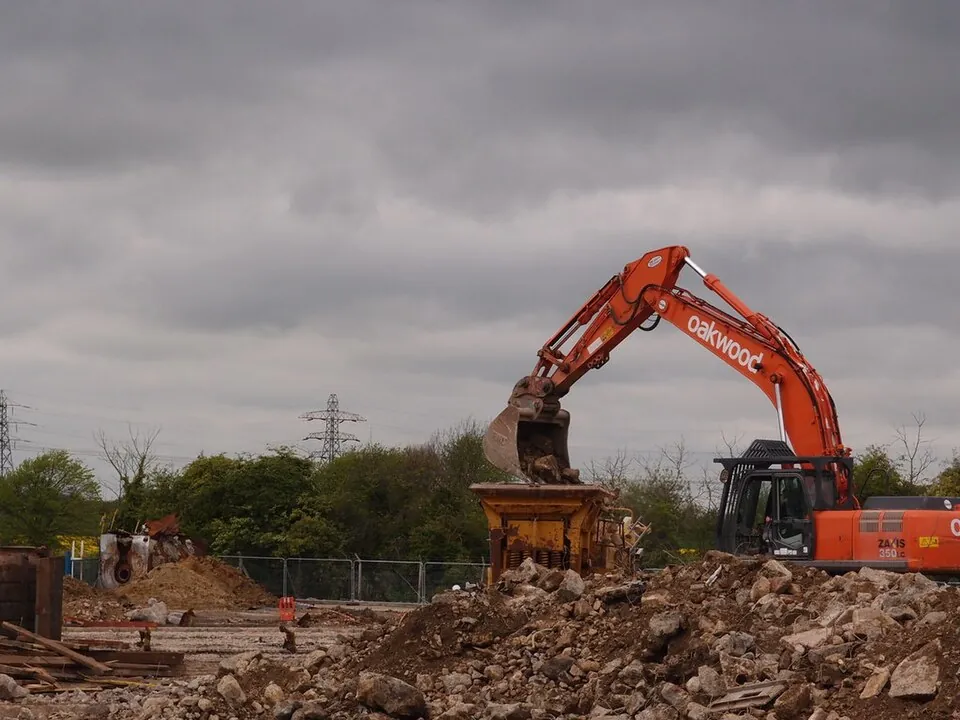
Photo: Michael Trolove, Wikimedia Commons, CC BY-SA 2.0
Concrete crushing happens either at a fixed recycling yard or on the demolition site with mobile equipment. The process has a few stages. First, the slabs and walls are broken into pieces small enough to fit into the crusher, usually with an excavator fitted with a hydraulic breaker or pulverizer jaws, which also cut and separate much of the rebar. Then an excavator or loader feeds the pieces into the crusher, where the concrete is crushed between steel jaws or by spinning hammers. A conveyor carries the crushed material under an overhead magnet that lifts out steel. Finally, screens sort the material into the sizes the yard sells, and oversize pieces go back through the crusher.
On large demolition jobs, crushing on site saves trucking: the concrete crushed there can be used right away as fill or base for the new building, and fewer trucks leave the site. On small jobs, it is usually cheaper to haul the rubble to a recycler. Contractors that offer mobile concrete crushing typically charge by the ton plus a mobilization fee, and the job needs a minimum volume, often several hundred tons or more, to make it worthwhile.
Concrete Crushers: Types of Machines
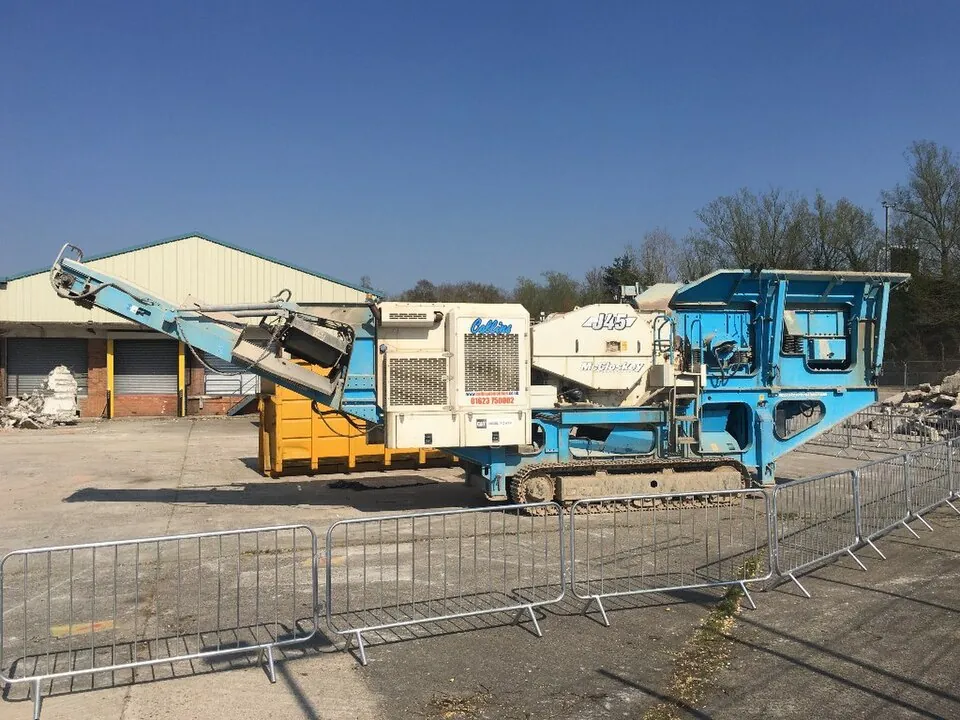
Photo: Mr Ignavy, Wikimedia Commons, CC BY-SA 2.0
Several kinds of concrete crushers are used in recycling, often in combination.
Jaw crushers squeeze concrete between a fixed steel plate and a moving one. They handle large, hard pieces and are the most common primary concrete crusher. They tolerate some rebar, which passes through and is removed by the magnet afterward.
Impact crushers throw the concrete against steel bars and plates with a spinning rotor. They produce a more cubical, well-shaped product and break the bond between old paste and stone better, which suits higher-quality aggregate. They wear faster on abrasive material.
Cone crushers are used as secondary crushers to make smaller sizes from material already broken by a jaw crusher.
Mobile tracked crushers put a jaw or impact crusher, feeder, magnet and conveyor on a tracked chassis that can drive around a site. They are the standard machines for on-site concrete crushing.
Crusher buckets are attachments for excavators and skid steers with a small jaw built into the bucket. They suit small jobs and contractors who crush only occasionally.
New mobile concrete crushers cost from tens of thousands of dollars for bucket attachments to several hundred thousand dollars for tracked plants, which is why most people rent them or hire a crushing contractor. Many equipment rental companies rent crusher buckets by the day or week.
Can You Crush Concrete Yourself?
For small amounts, yes. If you have a few broken slabs or a short walk to remove, you can crush concrete by hand with a sledgehammer or a rented electric jackhammer, then break the pieces smaller on a hard surface. Wear safety glasses, gloves, hearing protection, long sleeves and boots, and use a dust mask or respirator because concrete dust contains crystalline silica, which OSHA regulates as a health hazard. Wetting the concrete keeps dust down. Hand-broken pieces will not be graded like yard crushed concrete, but they work as fill under a new slab, as a base layer in a garden path, or as drainage rubble.
For larger amounts, renting a skid steer with a crusher bucket, or hauling the concrete to a recycler, makes more sense. Many recyclers accept clean concrete at low cost and sell it back as crushed concrete, so you may be able to trade your rubble for finished base. See how to remove concrete for breaking out old slabs.
Where to Buy Crushed Concrete
Search for concrete recycling yards, aggregate suppliers, landscape supply yards and demolition contractors near you. Ask for the product name and size, whether it is screened and graded, whether steel and debris are removed, the price per ton or yard, the minimum order and the delivery charge. If you can, look at a pile before ordering. Good crushed concrete looks uniform, mostly gray, with few bits of brick, wood or metal. For large orders, ask whether the product meets your state transportation department's specification for base material, which is a sign of consistent quality.
Common Mistakes With Crushed Concrete Driveways
The most common mistake is putting crushed concrete straight on topsoil without excavating or using fabric, which leads to ruts and mud within a season or two. Others are making the layer too thin for the traffic, skipping compaction, ignoring drainage so water stands on the surface, ordering clean stone when you need base with fines, and buying cheap unscreened rubble with steel left in. A well-built crushed concrete driveway, by contrast, can last many years with little more than occasional grading and a fresh top layer.
Houston Crushed Concrete
Houston crushed concrete is easy to find because the Houston area has a steady stream of demolition and road work, and local recyclers turn old slabs and paving into base material. Recycling yards around Houston and its suburbs sell crushed concrete in grades such as 1.5 inch base, 3/4 inch and fines, and many deliver by dump truck.
Houston crushed concrete is popular for driveways, parking pads, ranch roads and as base under slabs and pavers. Much of the region sits on expansive clay that swells when wet and shrinks in drought, so a thick, well compacted layer of crushed concrete over geotextile fabric helps a driveway stay firm through heavy Gulf Coast rain. Many builders use 4 to 6 inches for light use and more for heavy trucks.
When you call yards for Houston crushed concrete, ask:
- Which grade they recommend for a driveway or base, and whether it meets TxDOT base specifications if your job requires that.
- The price per ton or per cubic yard at the yard, and the delivery fee to your address.
- How many tons a truck carries, so you know how many loads to order.
- Whether the material is screened and free of rebar, wood and brick.
Prices change with demand and distance, so get two or three quotes. Use the calculator section above to turn your driveway size into tons before you call.
Frequently Asked Questions
Is crushed concrete good for a driveway?
Yes. Crushed concrete base compacts into a firm surface, costs less than most alternatives and is easy to repair. Build it 4 to 6 inches thick over fabric with good drainage.
How much does crushed concrete weigh?
About 2,400 to 2,800 pounds per cubic yard, or roughly 1.2 to 1.4 tons, depending on size and moisture.
How much crushed concrete do I need?
Use the crushed concrete calculator above: length × width × depth in inches ÷ 12 ÷ 27 for cubic yards, times 1.3 for tons, plus 10 to 15 percent.
Does crushed concrete harden?
Crushed concrete base with fines locks together when compacted, and leftover cement in the fines can bond slightly when wet, so it often becomes firmer than ordinary gravel. It does not become solid concrete.
Is crushed concrete bad for the environment?
It reduces landfill waste and quarrying. The main concern is alkaline runoff from fresh material, so keep it away from streams and sensitive plants.
Sources
- Federal Highway Administration: pavement recycling and recycled concrete aggregate
- U.S. EPA: sustainable management of construction and demolition materials
- Construction & Demolition Recycling Association: concrete recycling
- Portland Cement Association: recycled concrete
Related Guides
- Pervious concrete — permeable paving that drains rainwater
- Concrete washout — handling rinse water from trucks and tools
- Concrete dust — silica risks, safe exposure and dusting slabs
- Concrete batching plant — how ready-mix is made
- Concrete parking blocks — wheel stops: sizes and installation
- Concrete barriers — jersey barriers, bollards and interlocking blocks
- Concrete culvert — concrete pipe and box culverts
- Concrete retaining walls — poured, precast and bag walls
- Density of concrete — unit weight and modulus of elasticity
- Roller compacted concrete — RCC pavements and dams
- Concrete railroad ties — prestressed ties and reuse in landscaping
- Concrete disposal — concrete dumpster rental, recycling yards, landfill fees and washout
- Green concrete — low-carbon mixes with fly ash, slag and Type IL, plus fresh green concrete
- Gravel base for concrete — best base material, thickness, compaction and quantities