
Concrete Stakes: Wood vs Steel Form Stakes, Sizes, Spacing and How to Use Them
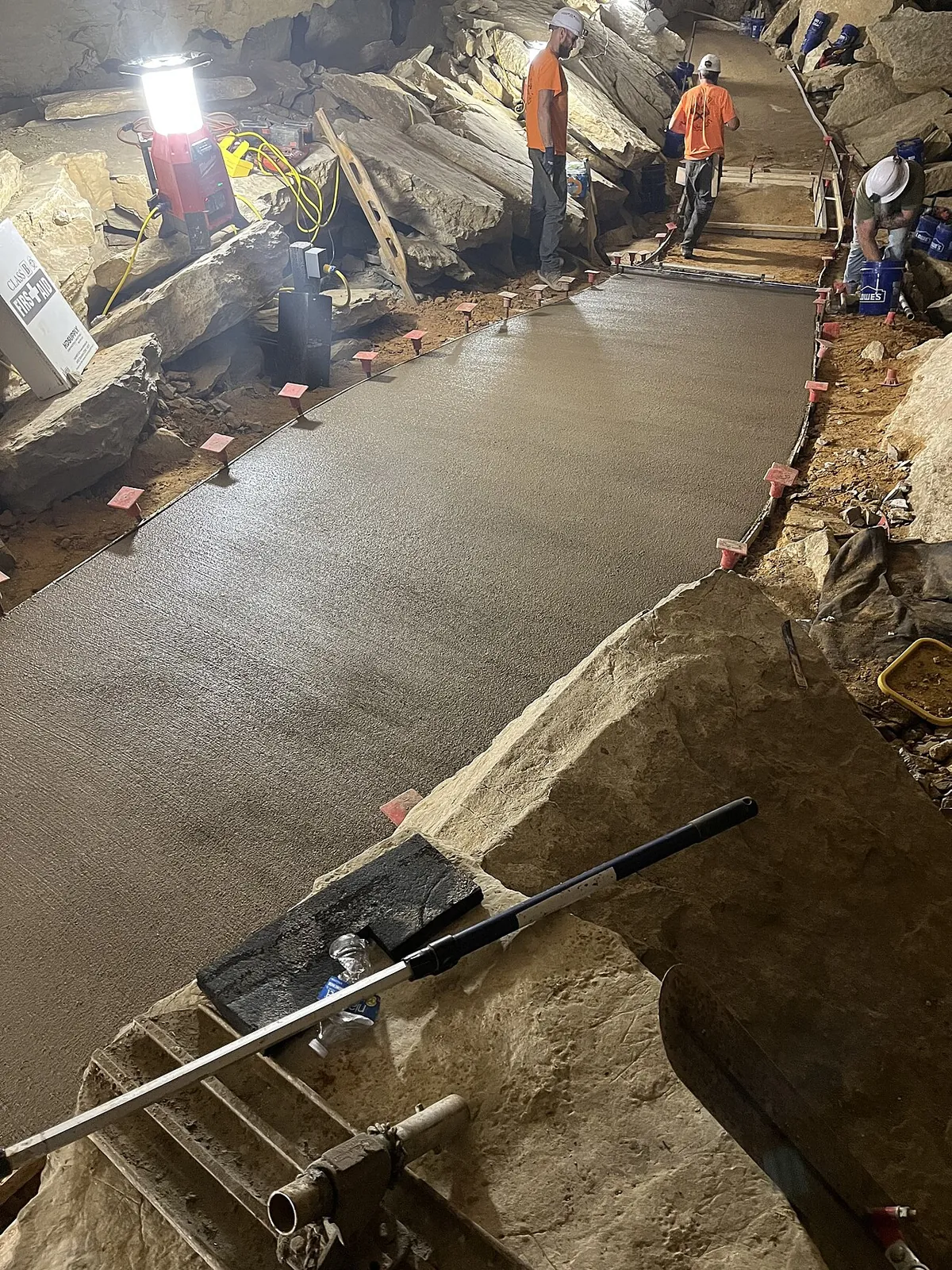
Photo: National Park Service (public domain), Wikimedia Commons
Quick Answer
Concrete stakes, also called form stakes, are driven into the ground along concrete forms to hold the form boards straight, level and in place while concrete is poured. The two main types are wood stakes (cheap, cut from 1x2, 2x2 or 2x4 lumber, used once) and steel stakes (round or flat steel concrete stakes with pre-drilled nail holes, reusable for years). Most residential jobs use stakes 18 to 24 inches long, set every 3 to 4 feet along straight forms and closer on curves and at joints, driven slightly below the top of the form and nailed or screwed to the outside of the boards. Steel concrete stakes cost about $2 to $8 each and wood stakes $0.50 to $2 each.
Wet concrete is heavy and fluid. A 4 inch slab pushes outward on its forms with real force, and a deeper footing or curb pushes much harder. If the forms move during the pour, the slab ends up crooked, too thin in places, or bulging at the edges, and fixing it afterward means grinding or tearing out concrete. Concrete stakes are the simple, inexpensive part that prevents that. In the photo above, a crew pours a new path inside a cave, with the form boards held in line by a row of red-topped steel concrete stakes along each edge.
This guide covers what concrete stakes do, the main types, how to choose the right size, how far apart to set them, how to install them for slabs, sidewalks, curbs, footings and curved forms, how to remove and reuse them, safety tips and costs.
What Concrete Stakes Do
Concrete stakes have three jobs. First, they hold form boards in position, resisting the outward pressure of wet concrete so the edges stay straight and the slab keeps its shape. Second, they set the height and slope of the forms: by fastening the boards to the stakes at the right elevation, the finisher can screed the concrete off the top of the forms and get a slab that is level or sloped exactly as planned. Third, they keep forms from floating or shifting when workers push concrete around, lean screeds on the boards, or walk along them. A form without enough concrete stakes, or with stakes driven too shallow, can bow, lift or kick out during the pour, which is one of the most common problems on DIY concrete projects.
Concrete stakes work together with the form boards, and sometimes with braces, kickers and spreaders. On shallow slabs and walkways, stakes alone are usually enough. On deeper forms such as footings, curbs, steps and walls, stakes are combined with diagonal braces and ties. See how to build concrete forms.
Types of Concrete Stakes
Wood stakes
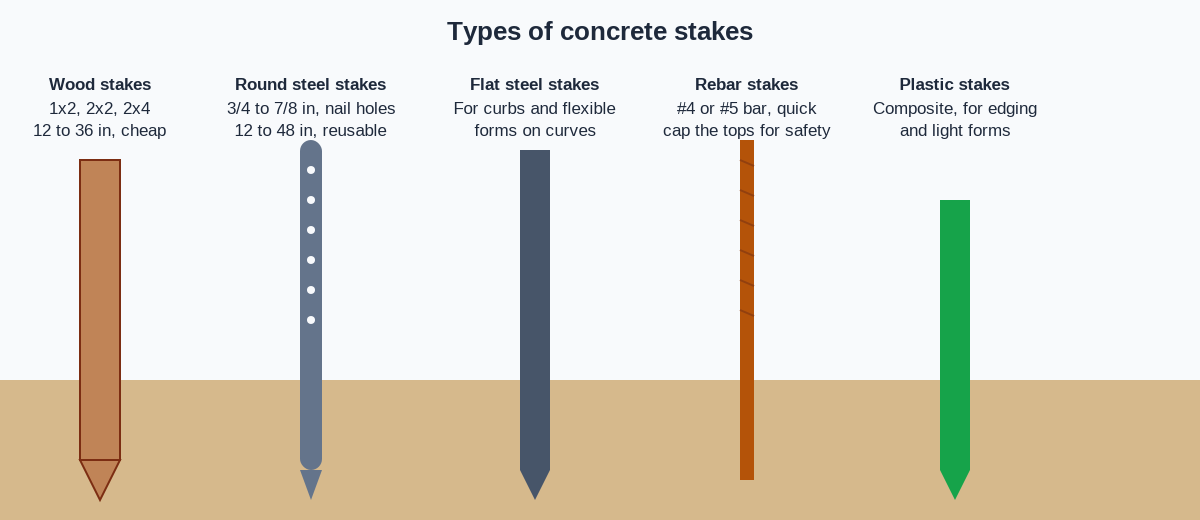
Wood stakes are the traditional choice and still the most common on small jobs. They are cut from 1x2, 1x3, 2x2 or 2x4 lumber, usually 12 to 36 inches long, with a pointed end. Wood concrete stakes are cheap, easy to find at any lumber yard, easy to nail or screw forms to, and can be cut flush with the top of the form so they do not get in the way of the screed. Their drawbacks are that they split when driven into hard or rocky ground, bend or break in clay, rot if left in the ground, and are usually used only once. Wood stakes work well in soft to medium soils and for short-term forms on patios, walkways and small slabs. Pre-pointed bundles of wood stakes are sold for concrete and landscaping work.
Round steel concrete stakes
Round steel concrete stakes are the professional standard. They are solid steel rods, typically 3/4 or 7/8 inch in diameter and 12 to 48 inches long, with a pointed tip and a row of small holes along their length. A nail is driven through one of the holes into the form board to hold it at the right height. Because they are thin and strong, steel stakes drive easily into hard, rocky or frozen ground where wood stakes would split, and they hold firmly. They pull out easily after the pour, especially with a stake puller, and can be reused for years. They cost more per stake than wood, but contractors buy them once and use them on hundreds of jobs. The concrete stakes in the cave path photo above are steel stakes with red safety caps.
Flat steel stakes
Flat steel concrete stakes are thin bars of steel with nail holes, used mainly with steel curb forms, flexible forms on curves, and for landscape edging. Their flat shape sits tight against curved forms and lets the form bend smoothly. They are also used with metal forms that have built-in stake pockets or brackets.
Rebar stakes
Short lengths of rebar, typically #4 or #5, are sometimes used as improvised concrete stakes, especially for holding forms in rocky ground or for pinning landscape timbers and edging. They drive well but have no nail holes, so forms are fastened with wire, form clips or screws through drilled boards. Rebar stakes are hazardous if left sticking up, so always cap the tops with mushroom caps or cut them off.
Plastic and composite stakes
Plastic and composite stakes are used mostly for lightweight landscape edging, paver edge restraints and plastic flexible forms. They do not rust or rot, and some are designed to stay in the ground permanently, but they are not strong enough for most concrete forms.
Choosing the Size of Concrete Stakes
The right length of concrete stakes depends on the soil, the height of the form and the pressure of the concrete. The general rule is that a stake should go into firm ground at least as deep as the form is tall, and deeper in soft or sandy soil. For a 4 inch slab or walkway with 2x4 forms, 18 inch stakes are common; for 6 inch slabs and driveways with 2x6 or 2x8 forms, 24 inch stakes are typical. For footings, curbs and deep forms, 30 to 48 inch concrete stakes may be needed, along with braces. In soft, wet or sandy soil, use longer stakes; in rocky ground, shorter steel stakes driven to refusal may hold better than longer wood stakes that split.
Thickness matters too. Wood 1x2 stakes are fine for light forms on small patios, but 2x2 or 2x4 stakes hold better on longer runs and driveways. Round steel concrete stakes of 3/4 inch suit most residential flatwork, while 7/8 inch stakes are stronger for curbs, footings and commercial work.
How Far Apart to Set Concrete Stakes
For straight forms on slabs and walkways, place concrete stakes about every 3 to 4 feet along the outside of the form boards. Add a stake at every board end and splice, at each corner, and on both sides of any joint between boards. On deeper forms or where workers will lean on the forms, reduce the spacing to 2 to 3 feet. On curves, use stakes every 1 to 2 feet so the flexible form holds a smooth arc without flat spots. Where a form is longer than one board, overlap or splice the boards and put stakes on each side of the splice. If you are unsure, add more stakes; they are cheap compared with fixing a blown-out form, and a few extra minutes driving stakes can save hours of grinding or patching uneven edges later.
How to Set Concrete Stakes for a Slab or Walkway
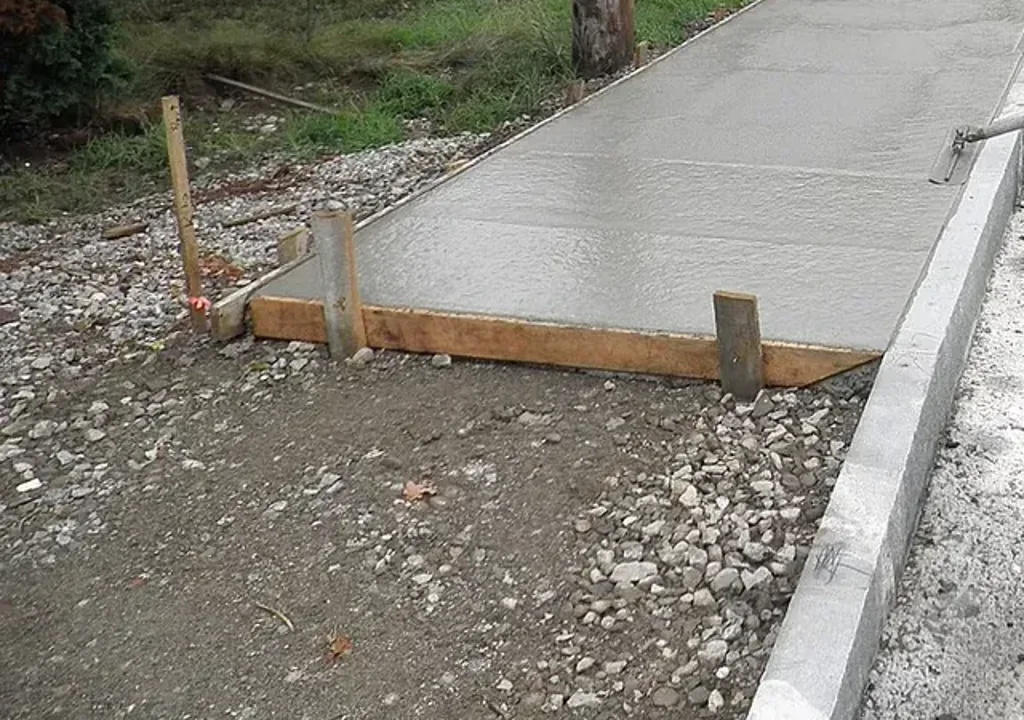
Photo: MassDOT (public domain), Wikimedia Commons (cropped)
The sidewalk above shows a typical result: a newly poured slab held by a form board with wood concrete stakes driven along its outside edge. Here is how to set stakes for a simple slab or walkway.
1. Lay out the edges. Mark the outline of the slab with batter boards and string lines set to the finished height and slope. The strings show where the inside face and top of the form boards will be.
2. Drive the corner stakes. Drive a stake at each corner, outside the string line by the thickness of the form board, so the board will sit against the string. Drive them deep enough to be solid but not so deep that you cannot fasten the board.
3. Set the form boards. Place the boards on edge along the string lines, with the top edge exactly at the string height, and fasten them to the corner stakes with duplex nails or screws. Duplex, or double-headed, nails are easy to pull out later.
4. Add the intermediate stakes. Drive concrete stakes every 3 to 4 feet along the outside of each board, tight against it, and fasten the board to each stake at the right height. Check the top of the form against the string and with a level as you go, and adjust the board up or down before fastening.
5. Cut or drive the stakes below the top. The tops of the stakes must be at or slightly below the top of the form board, so the screed board can slide along the forms without hitting them. Cut wood stakes flush with a saw, or drive steel stakes down until they are just below the top.
6. Backfill and check. Push soil or gravel against the outside of the forms at the bottom to stop concrete from leaking under them, and walk the forms one last time, checking that every stake is solid and the boards are straight. See how to pour a concrete patio and concrete flatwork.
Concrete Stakes for Curves, Curbs and Edging
Curved forms use thin, flexible material such as hardboard, plywood strips, kerfed lumber, or plastic and steel flexible forms. They need more concrete stakes than straight forms, placed close together on the outside of the curve and sometimes on the inside as well, so the form holds a smooth radius. Flat steel stakes work especially well with curved forms. For curbs and landscape edging, steel curb forms come with stake pockets or brackets, and round or flat steel concrete stakes hold them in place. Concrete curbing machines extrude curbs without forms, so they do not need stakes at all. See concrete curb machine and concrete walkway ideas.
Concrete Stakes for Footings and Deep Forms
Footings, grade beams, steps and short walls put much more pressure on their forms than a slab does. For these, concrete stakes are combined with diagonal braces, called kickers, that run from the top of the form to a stake driven a few feet away, and with cross ties or spreaders that keep the two sides of the form the right distance apart. Longer, stronger stakes are needed, and spacing is closer. Footing forms are often set on a stake-supported frame, and rebar is held in position with chairs and tie wire rather than stakes. See concrete footings, how to pour concrete steps and concrete retaining walls.
Removing and Reusing Concrete Stakes
Forms and concrete stakes are usually removed one to three days after the pour, once the concrete is hard enough that the edges will not slump or chip. Pull the nails or screws first, then remove the stakes and boards. Wood stakes can often be pulled by hand or levered out with a hammer or a pry bar. Steel concrete stakes can be stubborn after they have been driven deep in clay; a stake puller, a lever tool that grips the stake and uses the ground for leverage, pulls them out without bending. Twisting the stake as you pull also helps. Clean concrete off steel stakes before it hardens, store them dry, and they will last for years. Wood stakes are usually discarded, though straight, unsplit ones can be reused for light work. Do not leave wood stakes buried beside a slab; they rot and leave holes, and they can attract termites.
Driving Concrete Stakes in Hard, Rocky or Frozen Ground
Driving a concrete stake into hard clay, rocky fill, compacted gravel base or frozen ground can be frustrating. Wood stakes split or snap, and even steel stakes can bend if they hit a large stone. A few techniques help. Use steel concrete stakes rather than wood, since their small diameter and hard point push past gravel and roots. Start the stake with a few light taps to set it straight, then drive it with firm, square blows from a 3 or 4 pound sledge, keeping the hammer face flat on the top of the stake. If the stake hits a rock and stops, pull it and move it a few inches rather than forcing it. In very hard ground, pre-drill a pilot hole with a heavy steel bar, a rotary hammer with a long bit, or a hand auger, then drive the concrete stake into the hole. In frozen ground, thaw the stake locations with blankets or a heater, or wait for warmer weather, and remember that concrete should not be poured on frozen ground anyway. See pouring concrete in cold weather.
When a stake cannot be driven deep enough to hold, use more of them, add a second concrete stake on the outside angled into the ground and nailed to the first, or brace the form with a kicker to another stake farther out. On a compacted gravel base, many finishers set stakes outside the base, in the softer native soil, where they drive more easily and hold well.
Fastening Forms to Concrete Stakes
How you attach form boards to concrete stakes affects how straight the forms stay and how easily they come apart afterward. With wood stakes, duplex nails, which have two heads, are the standard: drive the nail through the stake into the form board until the first head is tight, and leave the second head sticking out so you can pull the nail with a claw hammer after the pour. Screws work well too and are easy to adjust and remove with a drill. Always fasten from the stake side into the form, never from the inside face of the form, so no nail points stick into the concrete. With round steel stakes, drive a 16d or duplex nail through the stake's pre-drilled hole into the form board at the right height; the row of holes lets you choose the exact elevation. Some contractors use special form clamps or brackets that grip steel stakes without nails. For precise height adjustment, fasten the board loosely at one end, check it against the string line and level, then fasten the other end and the intermediate stakes. Stakes should be on the outside of the forms so they do not end up inside the slab.
Common Mistakes With Concrete Stakes
Too few stakes. Spacing stakes 6 or 8 feet apart to save time lets the forms bow outward under the concrete, leaving wavy edges. Keep spacing to about 3 to 4 feet, closer on deep forms.
Stakes too short. A concrete stake that only goes a few inches into soft soil can be pushed over by the concrete or by a worker stepping on the form. Drive stakes into firm ground at least as deep as the form is tall.
Stakes sticking above the form. Stakes that stand above the top of the form block the screed board and leave high spots. Cut or drive every stake below the top.
Stakes on the inside of the form. A concrete stake inside the form becomes part of the slab, leaving a rotting wood void or a buried steel pin. Keep stakes outside.
Forgetting the joints and corners. Board ends, splices and corners are where forms usually fail. Put a stake at every one.
Leaving stakes behind. Wood stakes buried next to a new slab rot and attract insects, and forgotten steel stakes become hazards for mowers and feet. Pull them all.
Other Uses for Concrete Stakes
Steel concrete stakes are useful well beyond forming. Landscapers use them to anchor timber and stone edging, retaining wall timbers, and paver edge restraints. Gardeners use them to secure raised bed corners and to hold irrigation lines and erosion-control fabric. Surveyors and builders use them as grade stakes to mark elevations, and as anchors for string lines and batter boards. Event crews use heavy steel stakes to anchor tents and stages. Because they last for years, a set of steel concrete stakes is a worthwhile purchase for anyone who does regular outdoor projects. See concrete raised beds and concrete curb machine.
Buying and Storing Concrete Stakes
Concrete stakes are sold at home centers, lumber yards, concrete supply houses and online, singly or in bundles of 10, 25 or 50. Look for steel stakes with smooth, well-formed points, clean holes along most of their length, and enough thickness to resist bending; cheap, thin stakes bend quickly in hard ground. For wood stakes, choose straight-grained lumber without large knots, which are where stakes usually split. Store steel concrete stakes off the ground in a dry place, bundled by length, and wipe or brush off concrete splatter after each job so the holes stay clear. A light coat of form oil prevents rust. Keep a few extra stakes on every job, because some always bend, split or go missing, and running out halfway through setting forms wastes valuable time before the truck arrives.
Concrete Stakes vs Other Ways to Hold Forms
Concrete stakes are not the only way to hold forms, and on some jobs other methods work better. On existing concrete or asphalt, where stakes cannot be driven, forms are held with heavy weights, concrete blocks, sandbags, or by drilling and pinning into the pavement. Steel forms for curbs and sidewalks often have their own stake pockets and wedges that lock the stakes to the form. Wall and column forms rely on form ties, walers and braces rather than stakes. For slab-on-grade foundations, some builders use a continuous row of stakes plus a ledger board on top to stiffen the forms. And for small, low projects such as stepping stones or a mailbox pad, sometimes a few bricks or a heavy board against the form are enough. For most residential flatwork, though, a row of well-driven concrete stakes remains the fastest, cheapest and most reliable way to keep forms straight.
Safety With Concrete Stakes
Stakes sticking up from the ground are a serious tripping and impalement hazard, especially rebar and steel stakes. Always drive stakes flush or below the top of the forms, and cover any exposed ends of rebar or steel stakes with bright safety caps, like the red caps in the first photo. Wear gloves and eye protection when driving stakes, since steel stakes can chip and nails can fly. Use a sledgehammer or a post driver with care, keep your hands clear, and call 811 before driving long stakes in case there are buried utilities nearby.
Concrete Stakes Cost
Wood concrete stakes cost about $0.50 to $2 each, or $10 to $30 for a bundle of 25, depending on size and length. Round steel concrete stakes typically cost $2 to $5 each for 18 to 24 inch lengths and $5 to $10 each for 36 to 48 inch lengths, with bulk packs cheaper per stake. Flat steel stakes cost about $2 to $6 each. A stake puller costs $40 to $150. For a typical 10 by 12 foot patio with about 44 feet of forms, you might need 15 to 20 concrete stakes, about $15 to $40 in wood or $40 to $100 in steel that you can reuse on future projects. Rental stores and form suppliers also rent steel forms and stakes for larger jobs. See concrete cost per square foot.
Frequently Asked Questions
How long should concrete stakes be?
For a 4 inch slab, about 18 inches; for 6 inch slabs and driveways, about 24 inches; for footings and curbs, 30 to 48 inches, deeper in soft soil.
How far apart should concrete stakes be?
About every 3 to 4 feet on straight forms, closer on deep forms, and every 1 to 2 feet on curves, plus at every corner and board splice.
Are steel or wood concrete stakes better?
Steel stakes drive into hard ground, hold better and can be reused for years. Wood stakes are cheaper for one-time jobs in soft soil.
When can I remove concrete stakes?
Usually after one to three days, once the concrete edges are firm enough not to slump or chip.
Can I leave concrete stakes in the ground?
It is better not to. Wood rots and leaves voids, and steel stakes left near the surface are a hazard. Pull them or cut them below grade.
Sources
- American Concrete Institute: ACI 347 guide to formwork for concrete
- OSHA 1926.701: protruding reinforcing steel and impalement hazards
- Portland Cement Association: forming and placing concrete flatwork
- Call 811: know what's below before you dig
Related Guides
- Concrete pads — sheds, AC units, hot tubs, carports