
Concrete Curb Machine Guide: Landscape Curbing, Edging Machines, Rental and Costs
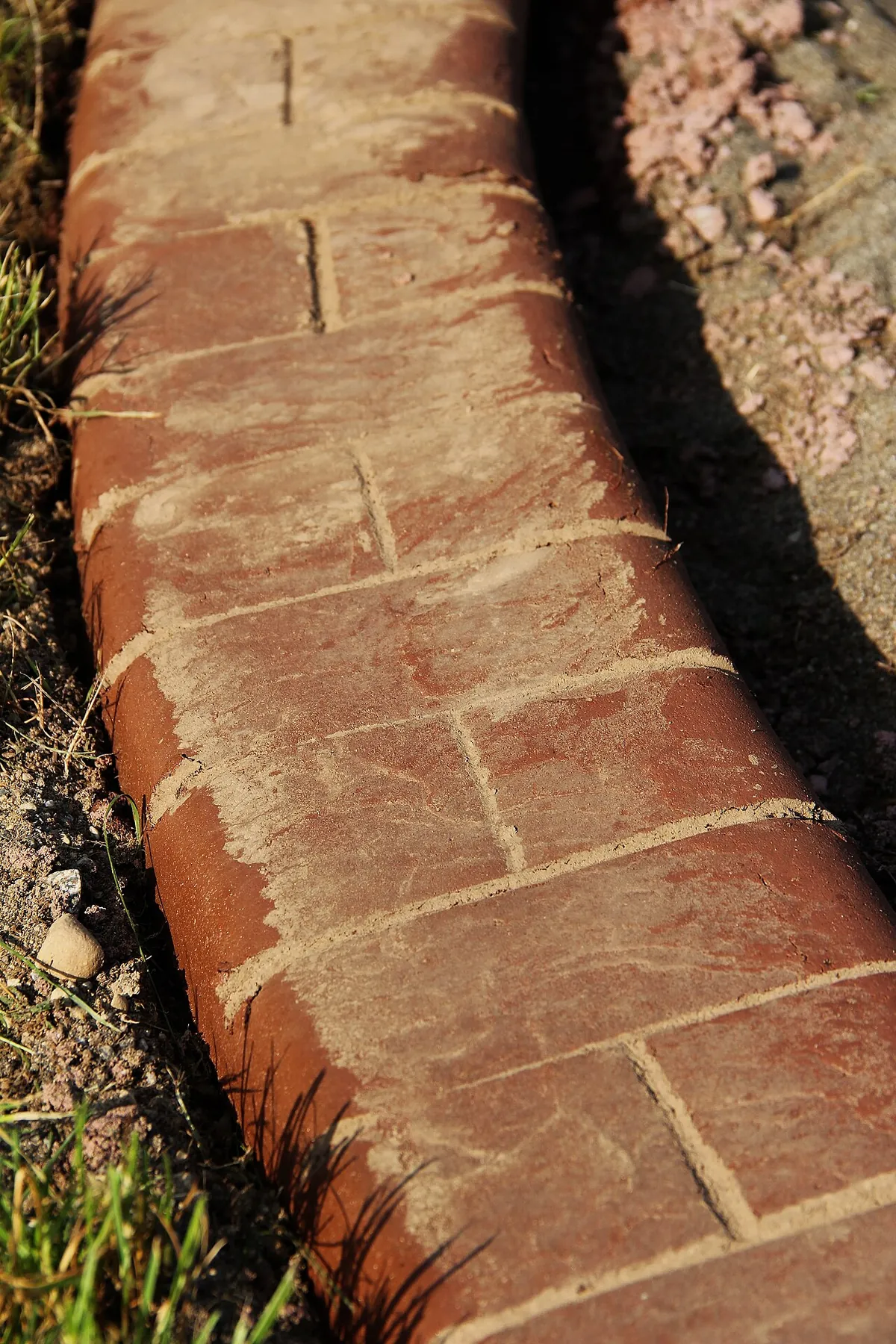
Photo: ~riley, Wikimedia Commons, CC BY-SA 3.0
Quick Answer
A concrete curb machine (also called a landscape curbing or concrete edging machine) extrudes a continuous concrete border along lawns, garden beds, paths and driveways. A stiff concrete mix is fed into the hopper, and an auger or ram pushes it out through a shaped mold as the machine moves forward on its own, leaving a smooth curb that is then trimmed, stamped or colored and cut into joints. Homeowner-grade curbing machines cost about $3,000 to $8,000 to buy; concrete curb machine rental runs about $150 to $400 per day where available. Professional landscape curbing costs about $8 to $15 per linear foot for plain gray and $12 to $25 per linear foot for colored and stamped. Alternatives include precast scalloped concrete edging and concrete paver edging.
Clean, continuous concrete edging is one of the quickest ways to make a yard look finished. It separates lawn from mulch beds, stops grass from creeping into flower beds, gives the mower a clean line to follow, and holds mulch and gravel in place. Landscape curbing, extruded on site by a concrete curb machine, has become a popular service across North America. The freshly made curb in the photo above shows how it works: a continuous ribbon of colored concrete, still damp, stamped with a brick pattern and cut with joints, running between the lawn and a new bed.
This guide explains how concrete curb machines work, the types of machines, concrete curb machine rental and purchase costs, the mix and tools needed, how to install curbing step by step, common profiles including scalloped concrete edging, finishing with color and stamps, alternatives like concrete paver edging, maintenance, and what landscape curbing costs.
What Is a Concrete Curb Machine?
A concrete curb machine is an extruder that forms concrete into a continuous shape without traditional forms. There are two very different scales. Landscape curbing machines are small, walk-behind or self-propelled units, often weighing 100 to 400 pounds, driven by a gas engine or electric motor. They make decorative borders a few inches tall along lawns and beds. Road and site slipform curb machines are large, track or wheel-mounted machines that form full-size street curbs, gutters, barriers and sidewalks, like the yellow slipform machine in the photo further down. Both work on the same principle: stiff, low-slump concrete is fed into a hopper, compressed by an auger, a reciprocating ram or vibration, and pushed out through a mold, and the machine is pushed forward by the pressure of the concrete coming out behind it. The concrete is stiff enough to hold its shape immediately. See concrete slump.
Types of Landscape Curbing Machines
Landscape curbing machines fall into two main groups. Auger machines use a rotating screw to compress and push the concrete through the mold. They are the most common type, relatively simple and good for continuous curbing at a steady pace. Hydraulic ram or tamping machines use a reciprocating ram to pack concrete into the mold with a pulsing action, producing a very dense curb with fewer voids, often favored by professional curbers. Some machines are self-propelled, some move forward as concrete is pushed out, and some have a trailer or hopper cart feeding them. Most machines accept interchangeable molds, also called shoes or forms, for different profiles, such as mower edge, slant, block, mini curb and specialty shapes. A concrete edging machine for DIY or small contractors may be a lighter, simpler model with one or two molds, while full-time curbing businesses use heavier machines with more power and many molds.
Concrete Curb Machine Rental
Concrete curb machine rental is available from some equipment rental stores, landscape supply yards and curbing equipment dealers, but it is less common than renting a mixer or a plate compactor. When available, daily rates are typically about $150 to $400, with weekend and weekly rates. Concrete curbing machine rental often includes one or two molds, and some dealers offer a short training session. Ask about transport, since even small machines are heavy, whether a mixer is included, cleaning requirements and damage deposits. Because curbing takes practice to do well, many homeowners find hiring a professional curbing company worth the cost for a large project, while handy owners with long runs to install sometimes rent for a weekend. Buying a machine makes sense only for frequent use or for starting a curbing business. See concrete mixer rental cost.
Buying a Curbing Machine
New landscape curbing machines generally cost about $3,000 to $8,000 for the machine, with additional molds, stamps, tools, color, release and mixer adding $1,000 to $5,000 or more. Heavy professional machines cost more. Used machines are common, as some curbing businesses upgrade or close. When buying, look at the engine or motor condition, auger or ram wear, the condition of the molds, availability of parts and support from the manufacturer, and what training is included. Starter packages often include a machine, molds for the most popular profiles, finishing tools, a few stamp patterns, release powder and color. A trailer or truck with ramps, a mortar mixer or concrete mixer, wheelbarrows and shovels complete the setup.
The Right Mix for Concrete Curbing
Curbing concrete must be stiff enough to stand up the moment it leaves the mold, yet workable enough to pass through the machine and finish smoothly. Most curbers use a mix of about 1 part portland cement to 3 to 4 parts concrete sand or fine pea gravel, sometimes with fibers for crack resistance, and very little water, producing a mix with a slump of about zero to one inch. Some use bagged high-strength mixes or bagged curbing mixes; others order ready-mix with small aggregate and low slump, though small, steady batches from an on-site mixer are often easier to manage. Polypropylene or nylon fibers help reduce cracking. Integral color can be added to the mix for colored curbing. The mix must be consistent from batch to batch, or the curb will slump, crack or vary in color. Typical curbing uses about 1 cubic yard of concrete for 150 to 250 linear feet, depending on the profile. See concrete mix ratio, fiber-reinforced concrete and concrete sand.
How to Install Landscape Curbing Step by Step
Lay out the line. Mark the curb line with marking paint, a garden hose or string. Use smooth, flowing curves; tight corners are hard to run and look awkward. Plan for mower access, with curves gentle enough that a mower can follow them.
Cut the trench. Remove sod and soil along the line, typically 6 to 10 inches wide and about 2 to 3 inches deep, using a sod cutter, edger or trenching tool. Some curbers use a power trencher designed for curbing. The trench should be level side to side and follow the grade smoothly along its length.
Prepare the base. Compact the trench bottom with a hand tamper. Wet it lightly so the soil does not suck water out of the concrete. Remove roots and loose material. In soft or wet soil, add and compact a thin layer of gravel. See how to kill roots under concrete.
Mix the concrete. Mix small batches to a stiff consistency. A curb run is continuous, so keep batches coming steadily to avoid cold joints. See how to mix concrete.
Run the machine. Place the curbing machine at the start of the trench, fill the hopper, and start the auger or ram. As the curb extrudes, the machine moves forward. The operator steers it along the line, keeping it level, while a helper keeps the hopper full. Smooth, even feeding and steady steering give the best curb.
Finish. Immediately behind the machine, trim and smooth the curb with a trowel or curb finishing tool dipped in water, fill any voids, and round the ends. For stamped curbing, apply release powder and press flexible stamps or texture rollers into the surface. Broadcast color hardener if used.
Cut joints. While the concrete is still green, cut control joints every 2 to 3 feet with a curb knife or trowel, about one third of the curb depth, so shrinkage cracks happen at the joints instead of randomly. See control joints in concrete.
Cure and seal. Protect the curb from traffic, heavy rain and frost for a few days. Keep it damp or use a curing compound. After it cures, typically 2 to 4 weeks, clean off release powder and apply a sealer to protect the color and finish. See concrete curing compound and concrete sealer.
Using a Concrete Edging Machine Well
Running a concrete edging machine looks easy when a pro does it, but there is a learning curve. The machine must be fed steadily: too little concrete in the hopper leaves voids and a rough curb; too much at once can jam the auger or ram. The operator walks slowly, steering with gentle pressure rather than forcing the machine, and keeps the base of the mold flat on the trench bottom so the curb height stays even. On curves, the machine is turned gradually, with the inside edge slowing and the outside edge moving faster, which the operator controls by guiding the handle. Around tight curves, many curbers lift and reposition the machine, then hand-form the joint. Starting and stopping points are finished by hand with a trowel. Practice on a straight run in a back corner of the yard before tackling the front, and expect your first runs to need more hand finishing. Clean the machine thoroughly at the end of every day; concrete left in the auger or mold hardens overnight and is very hard to remove.
Safety matters with curbing machines. Keep hands, tools and loose clothing away from the auger and hopper while the engine runs. Wear gloves, eye protection and boots, because wet concrete is caustic and can burn skin. Lift the machine with two people or a ramp and trailer winch, since even small models are heavy. Use hearing protection with gas engines, and do not run engines in enclosed spaces.
Where Landscape Curbing Works Best
Concrete curbing is most useful where a crisp, permanent line between materials makes maintenance easier. Around flower beds and shrub beds, it keeps mulch in and grass out. Around trees, a ring of curbing protects trunks from mower and trimmer damage, as long as it is set far enough from the trunk to avoid large roots. Along driveways and walkways, a mower edge gives a clean finish and stops lawn from creeping onto paving. Around gravel areas, play areas and rock gardens, block curbs hold loose material in place. On slopes, short terraced curbs can hold back a few inches of soil, though real retaining walls are needed for anything taller. In vegetable gardens, curbing frames beds and paths. Areas with heavy foot or vehicle traffic, large tree roots, very wet soils or frequent digging are less suitable. See concrete raised beds and concrete retaining walls.
Curbing vs Other Edging Materials
Homeowners can choose from many edging materials. Plastic and rubber edging is cheap and easy to install but can heave, crack and look flimsy. Steel and aluminum edging gives a thin, modern line, lasts well and flexes around curves, but does not stop mowers from hitting it and costs more per foot. Natural stone and brick look attractive and traditional but take longer to install and can shift. Wood timbers rot in a few years. Precast concrete edging pieces, including scalloped concrete edging, are cheap and simple but are separate pieces that can move. Extruded landscape curbing from a concrete curb machine is continuous, durable, low maintenance, customizable with color and stamps, and mid-priced. For long, curving runs where a permanent, finished look is wanted, extruded curbing is usually the best value. For short runs, accent borders and DIY projects, precast edging or pavers may be easier.
Planning Curbing Around Drainage and Irrigation
Curbing is a small wall, so it can trap water if it is not planned carefully. Before installing, watch how water flows across the yard in heavy rain. Leave gaps or install small drain pipes through the curb where water needs to pass, and keep the curb top slightly higher on the bed side than the lawn side so water drains away from beds where needed. Mark sprinkler lines and heads before trenching, and move heads that would be blocked by the new curb, since spray patterns often need adjusting after curbing is installed. Drip lines can pass under the curb in a sleeve installed before the concrete is placed.
Curbing Profiles
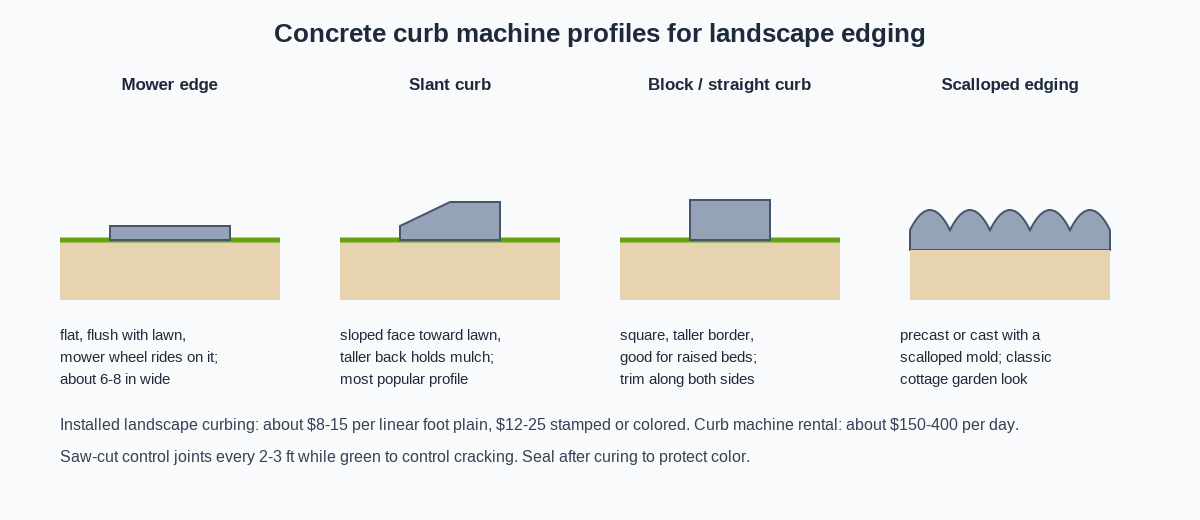
The mold on the concrete curb machine sets the shape of the curb. The most common profiles, shown above, are the mower edge, a flat curb set nearly flush with the lawn so a mower wheel can ride on it, eliminating trimming; the slant curb, with a sloped front facing the lawn and a taller back holding mulch, the most popular style; and the block or straight curb, a square border that stands up like a small wall, good for raised beds and holding gravel. Other profiles include mini curbs for small beds, tall curbs for terraces, and decorative shapes. Each profile uses different amounts of concrete per foot and works best in different situations. Mower edges save the most maintenance, slant curbs look best around mulched beds, and block curbs are best for defining raised areas.
Scalloped Concrete Edging
Scalloped concrete edging has a curved, wavy top edge that gives a classic cottage-garden look. It is most commonly sold as precast concrete edging pieces, typically 12 to 24 inches long, 6 to 8 inches tall, in gray, red, tan and charcoal colors. Each piece is set in a shallow trench on a compacted sand or gravel base, butted against the next, and backfilled. Concrete scalloped edging is cheap, easy to install, and easy to replace or move, but the separate pieces can heave, tilt or shift over time, and grass can grow between them. Some curbing machines can produce a scalloped top using special molds or by shaping the fresh curb by hand. Scalloped edging works well around flower beds, trees and small borders, while continuous extruded curbing is better for long runs and a cleaner look. See how to make concrete stepping stones.
Concrete Paver Edging
Concrete paver edging uses small concrete pavers or bricks set on edge, flat or at an angle to form a border. It is a popular DIY alternative to extruded curbing, giving a crisp, modular look that matches patios and walkways. Pavers are set on a compacted gravel and sand base, sometimes with a concrete haunch behind them to lock them in place. For paver patios and walkways, edge restraints of concrete, plastic or aluminum hold the pavers in place; a row of soldier-course pavers set in concrete makes a strong, attractive edge. Concrete paver edging is easy to repair, since individual pavers can be lifted and reset, but it takes longer to install than curbing and costs more per foot. See paving stones vs concrete, can you lay pavers over concrete and concrete walkway ideas.
Color and Stamped Curbing
Plain gray curbing is the most affordable, but color and stamping are popular upgrades. Integral color is mixed into the concrete for uniform color through the curb. Color hardener is broadcast onto the fresh surface and troweled in, giving richer colors and a harder surface. Release powder or liquid in a contrasting color creates an antique, two-tone look when used with stamps. Stamp patterns include brick, slate, cobblestone, river rock and wood grain. The curb in the photo at the top of this page shows a red color with a brick stamp and light release still on the surface. Stamped and colored curbing typically costs a few dollars more per foot than plain curbing, and it needs sealing to protect the color. See how to color concrete, stamped concrete patterns and concrete staining.
Road and Site Curb Machines
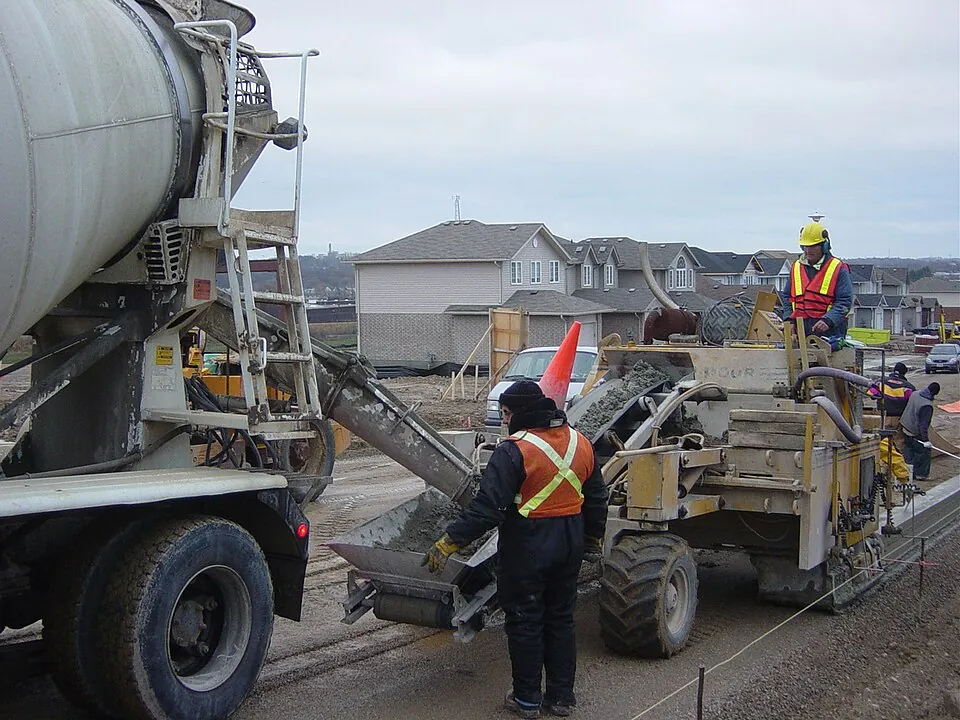
Photo: Imprezzive1, Wikimedia Commons, public domain
For roads, parking lots and subdivisions, large slipform curb machines form full-size curbs and gutters. The machine follows a stringline set by surveyors, steering and grading automatically, while a ready-mix truck feeds stiff concrete into the hopper, as in the new subdivision above. These machines can lay hundreds or thousands of feet of curb per day, much faster than traditional formed curbs. They use very low slump concrete, often with air entrainment for freeze-thaw resistance, and steel reinforcement or dowels where required. Joints are sawn or formed at regular intervals. Road curb machines are owned by specialized contractors, not rented by homeowners. See concrete driveway apron and concrete sidewalk cost.
Landscape Curbing Costs
Professional landscape curbing usually costs about $8 to $15 per linear foot for plain gray concrete, and $12 to $25 per linear foot for colored, stamped or specialty profiles, including sod removal and trenching. Many curbing companies have a minimum charge, often a few hundred dollars. A typical front yard with 150 to 250 feet of curbing might cost about $1,500 to $5,000. Precast scalloped concrete edging costs about $2 to $5 per piece, or roughly $2 to $5 per linear foot in materials, plus installation labor. Concrete paver edging costs about $6 to $15 per linear foot installed. DIY extruded curbing with a rented machine costs about $2 to $5 per linear foot in materials plus rental. See concrete cost per square foot.
Choosing a Curbing Contractor
When hiring a landscape curbing company, look at photos and addresses of finished jobs, ideally a few years old, to see how their curbing holds up. Ask what mix they use, whether they add fibers, how they prepare the trench, how often they cut control joints, and whether sealing is included. Get the price per linear foot, the minimum charge, and what happens with sprinkler heads and sod. A good curber will walk the yard with you, suggest smooth curves and mower-friendly profiles, and point out drainage issues before work begins.
Maintaining Concrete Curbing
Concrete curbing is low maintenance. Reseal colored and stamped curbing every two to three years to protect the color and resist stains. Clean off dirt, algae and mulch stains with water and a brush or a light pressure wash. Trim grass along the curb as needed; mower edges need little trimming. Keep heavy vehicles off curbing, since it is not designed for wheel loads. Cracks at control joints are normal; random cracks can be sealed with flexible concrete caulk. If a section heaves from roots or frost, it can be cut out and replaced. See how to clean concrete and how to fix cracks in concrete.
Starting a Curbing Business
Landscape curbing is a popular small business because startup costs are modest compared with many trades, the work is visible and marketable, and many homeowners want it. A new curber needs a machine and molds, a mixer, a trailer and truck, trenching tools, stamps, color, release, sealer and insurance. Training from a machine dealer or experienced curber shortens the learning curve. Success depends on consistent quality, good-looking lines, fair prices, marketing through photos and yard signs, and working efficiently with a crew of two or three. Seasonal climates limit the working months, so many curbers combine curbing with other landscape or concrete services.
Common Mistakes
The most common mistakes with concrete curbing are using a mix that is too wet, which slumps and cracks; running curbs on soft or unprepared ground, which settles and cracks; skipping control joints; laying out tight, awkward curves the mower cannot follow; placing curbing too high above the lawn so mowers bump it; ignoring drainage, so the curb dams water; and not sealing colored curbing, which fades. Precast scalloped edging often fails because it is set on loose soil without a compacted base. Take time with layout, trench and mix, and curbing will look good for decades.
Frequently Asked Questions
Can you rent a concrete curb machine?
Some rental stores and curbing dealers rent landscape curbing machines, typically for $150 to $400 per day, but availability varies by area.
How much does landscape curbing cost?
About $8 to $15 per linear foot for plain curbing and $12 to $25 per foot for colored and stamped curbing, installed.
How long does concrete curbing last?
Well-installed concrete curbing commonly lasts 20 to 30 years or more.
Is scalloped concrete edging good?
It is cheap and easy to install, but individual pieces can shift. Continuous curbing looks cleaner and lasts longer.
How much concrete does curbing use?
About 1 cubic yard for 150 to 250 linear feet, depending on the profile.
Sources
- Portland Cement Association: concrete mixes and curing
- American Concrete Institute: slipform construction and low-slump concrete
- Interlocking Concrete Pavement Institute: paver edge restraints
- Penn State Extension: landscape bed edging and maintenance
Related Guides
- Concrete raised beds — block, poured and beds on concrete
- Concrete stakes — wood and steel form stakes
- Chicken coop concrete floor — slabs, bedding and predators
- Concrete railroad ties — prestressed ties and reuse in landscaping
- Concrete machines — mixers, placer booms, screeds, trowels, sprayers, saws and scrubbers