
Concrete Flatwork: What It Is, How It Is Built, and What It Costs
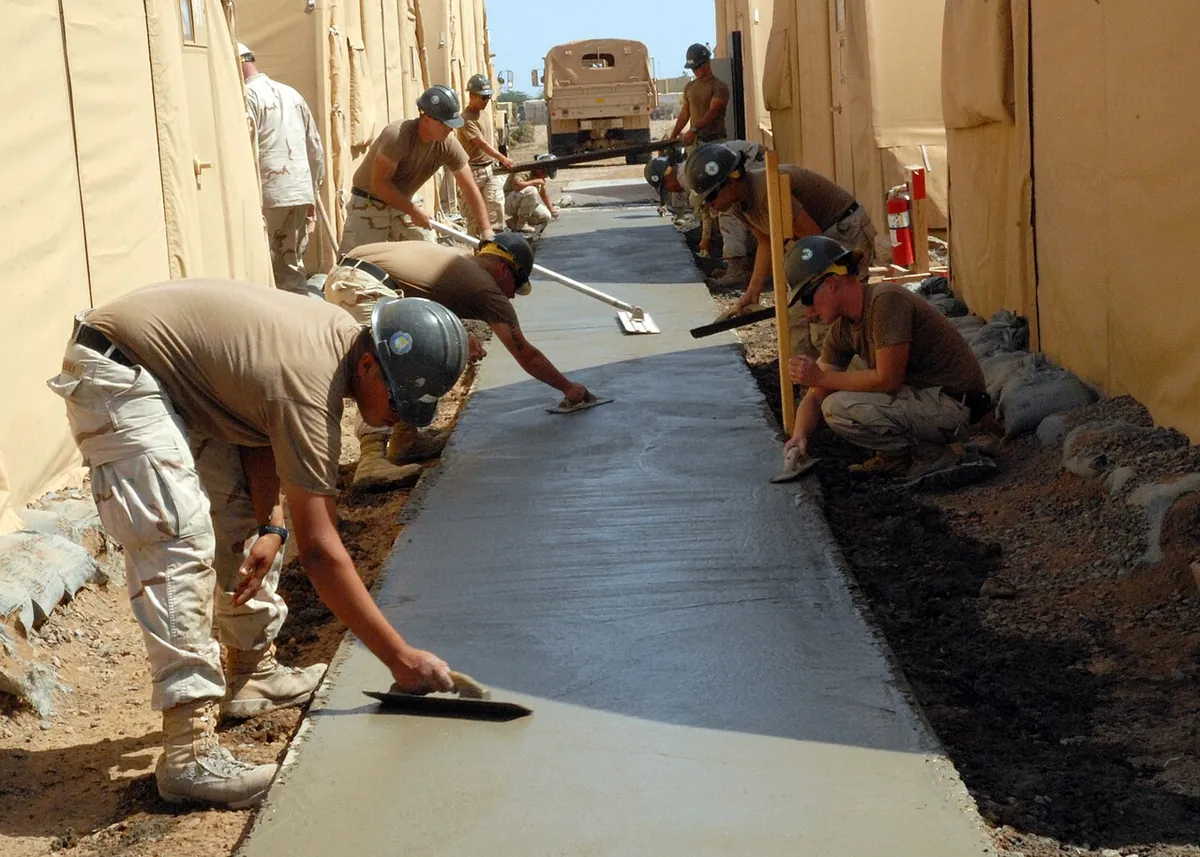
Photo: U.S. Navy, MC2 Ronald Gutridge, Wikimedia Commons, public domain
Quick Answer
Concrete flatwork is any concrete placed in a flat, horizontal plane: driveways, sidewalks, patios, garage floors, basement floors, slabs on grade, pool decks, steps' landings, curbs and gutters. It is different from vertical or structural concrete such as walls, columns and footings. Flatwork concrete is usually 4 inches thick for walks and patios and 4 to 6 inches for driveways, placed on a compacted base, then screeded, floated, edged, jointed, finished (broom, trowel, stamped or exposed aggregate) and cured. Typical installed costs run about $6 to $12 per square foot for plain work and more for decorative finishes.
If you get quotes for a driveway or a patio, you will probably see the words concrete flatwork. Contractors split concrete work into a few trades, and concrete flatwork is the one most homeowners hire: the slabs you walk and drive on. Knowing what goes into good flatwork helps you compare bids, spot shortcuts and keep the new slab from cracking or flaking in the first few winters.
This guide explains what concrete flatwork includes, how it differs from other concrete work, each step of the process, standard thicknesses and joint spacing, finish options, common problems, typical costs, and what to ask a flatwork contractor before you sign.
What Is Concrete Flatwork?
Concrete flatwork means horizontal concrete surfaces that are wider and longer than they are thick and that rest directly on the ground or on a base. The term covers both residential and commercial work. Common examples are driveways, sidewalks and walkways, patios, garage and shop floors, basement floors, slabs on grade for houses and sheds, pool decks, parking pads, curbs and gutters, and the landings of steps. Industrial floors and parking lots are also flatwork, though they often have their own specialist contractors.
What makes flatwork concrete its own trade is the finishing. Walls and footings are poured into forms and mostly hidden; their surface just needs to be sound. Concrete flatwork is the surface people see and use, so it has to be flat, sloped to drain, jointed to control cracking, and finished to the right texture, all within the short window while the concrete is setting. That takes a crew that knows timing, weather and tools.
Flatwork vs Structural and Vertical Concrete
Concrete contractors usually describe their work in three groups. Concrete flatwork covers slabs and paving. Vertical concrete covers walls, including foundation walls and retaining walls, poured in tall forms. Structural concrete covers footings, columns, beams, elevated slabs and other parts designed by an engineer to carry building loads. Some companies do all three, but many specialize, and a flatworks crew may not form walls, while a foundation crew may not finish driveways.
A house slab on grade sits between categories: it is flatwork concrete in how it is placed and finished, but its thickened edges and footings are structural. In practice, the foundation contractor often places the house slab and a flatwork contractor handles the driveway, walks and patio later.
The Concrete Flatwork Process, Step by Step
1. Layout and excavation. The crew marks the area, checks for utilities, and removes topsoil, roots and soft material to firm subgrade. They set the finished height and plan the slope so water drains away from the house, usually about 1/8 to 1/4 inch per foot.
2. Subgrade and base. The subgrade is compacted, then a layer of crushed stone base, often 4 inches, is spread and compacted. A uniform, well-compacted base is the single most important factor in how long concrete flatwork lasts, because soft spots and voids under a slab are what make it crack and settle.
3. Forms. Wood or steel forms are set to line and grade along the edges, staked and braced. Curved walks use flexible forms. See how to build concrete forms.
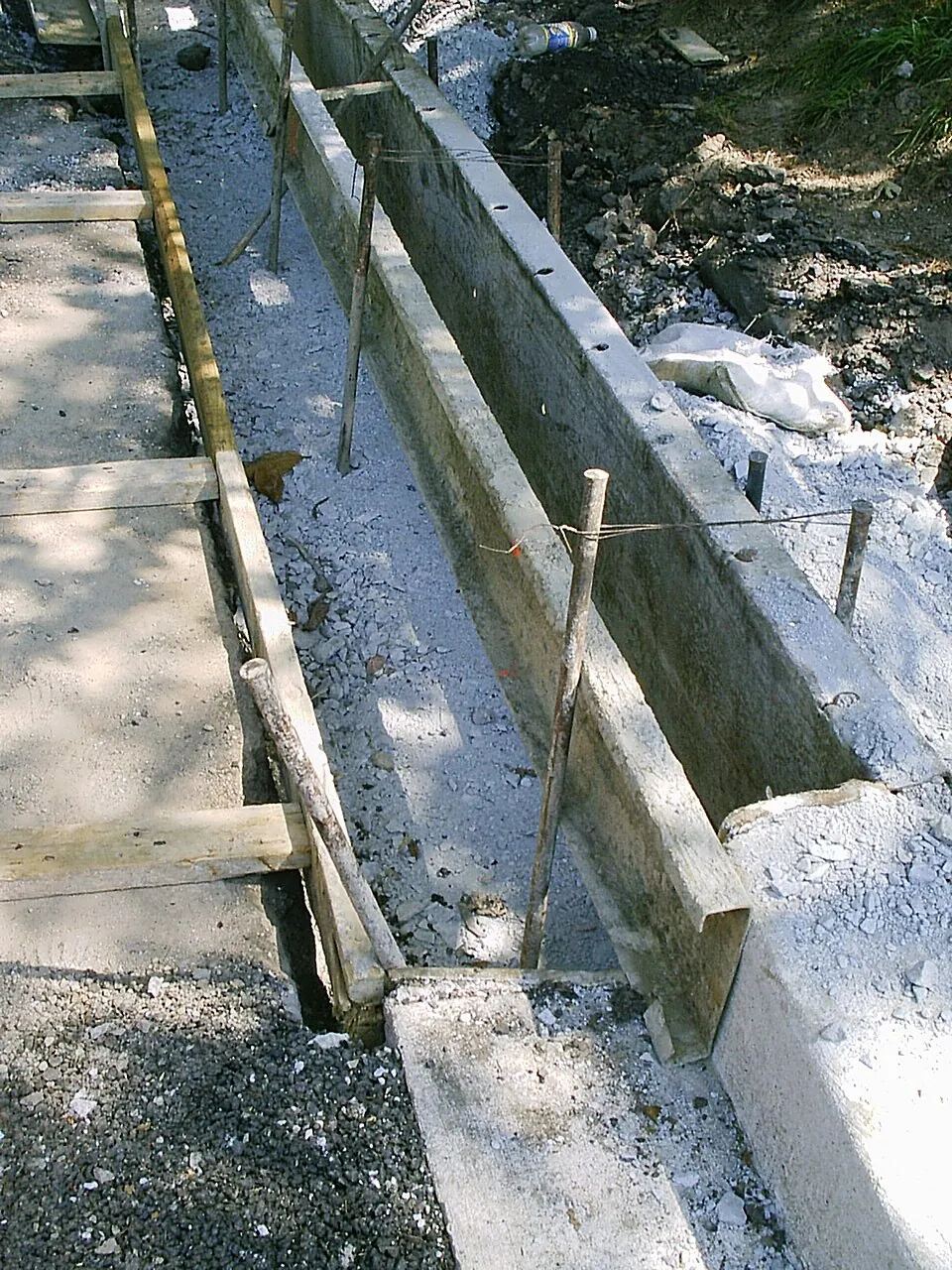
Photo: Christopher Ziemnowicz (CZmarlin), Wikimedia Commons, public domain
4. Reinforcement. Many concrete flatwork slabs get rebar, welded wire mesh or fibers to hold cracks tight. Reinforcement must sit in the middle of the slab on chairs or bricks, not on the ground. See rebar in concrete and wire mesh for concrete.
5. Placing. Flatwork concrete is placed from the truck chute, a pump, a buggy or wheelbarrows, and spread with rakes and come-alongs to slightly above the final height.
6. Screeding. A straight board or power screed is pulled across the forms in a sawing motion to strike the concrete off flat.
7. Bull floating. Right after screeding, a bull float is pushed and pulled across the surface to level ridges, push down stones and bring up a little paste.
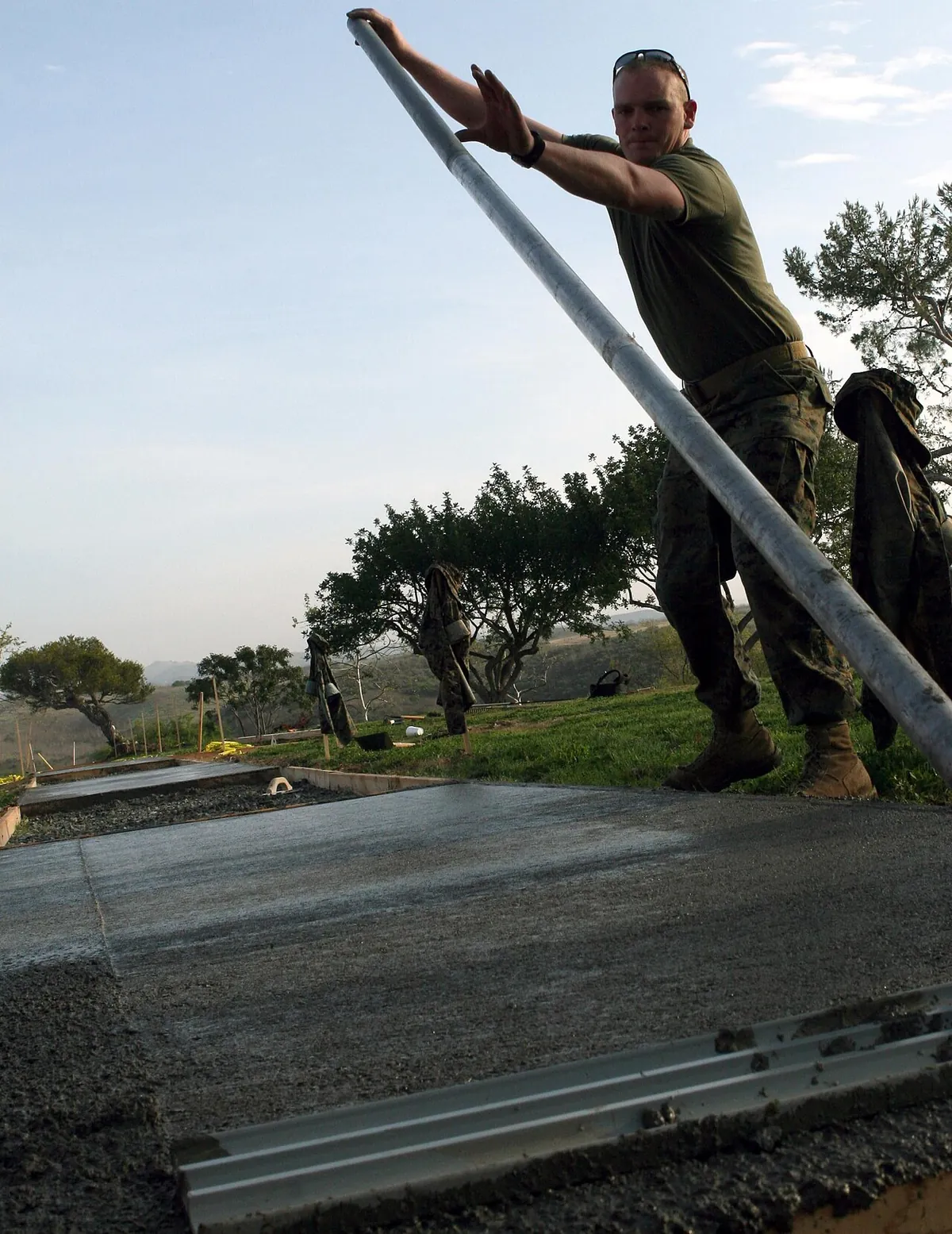
Photo: U.S. Marine Corps, Cpl. Tatum Vayavananda, Wikimedia Commons, public domain
8. Waiting for bleed water. On all concrete flatwork, water rises to the surface as the solids settle. Finishing must wait until this bleed water has evaporated; working it back into the surface weakens the top and causes scaling and dusting later.
9. Edging and jointing. Edgers round the concrete flatwork edges so they do not chip. Control joints are cut with a groover while the concrete is soft or with a saw within the first day.
10. Final finish. Outdoor concrete flatwork usually gets a broom finish for traction. Indoor floors are troweled smooth. Decorative work is stamped, colored or exposed.
11. Curing. The new concrete flatwork is kept moist or sprayed with curing compound for at least several days so it gains strength and a durable surface. See concrete curing compound.
Why the Name: Flatwork Crews and Flatworks Companies
The word comes from the trade itself. Concrete crews that pour slabs call their jobs flatwork to separate them from formwork for walls, and many small firms put the word in their business names, which is why you see so many companies called something-or-other Flatworks. Concrete flatwork contractors usually have a finishing crew, a set of forms, screeds and floats, and a skid steer or two, while foundation and wall contractors own tall wall forms and pumps. When you search for a contractor, searching for concrete flatwork or flatwork concrete in your area usually brings up the slab specialists rather than general builders.
Residential vs Commercial Concrete Flatwork
Residential concrete flatwork is mostly driveways, walks, patios and garage floors, placed by hand from a truck chute or wheelbarrows and finished with hand tools. The main concerns are drainage, appearance and durability through freeze-thaw cycles. Commercial concrete flatwork adds warehouse floors, parking lots, loading docks and sidewalks along streets. These jobs use laser screeds, ride-on power trowels and saw cutting on the same day, and they are measured against flatness and levelness numbers called F-numbers, set out in ACI 117 and ACI 302. A warehouse with high racking may need a very flat floor so forklifts can run safely, which takes specialized crews and equipment.
Public sidewalks and curbs are another branch. Cities set their own standards for thickness, joint spacing, finish and slopes, and the Americans with Disabilities Act guidelines limit cross slope on accessible routes to about 2 percent and running slope to 5 percent unless the walk is designed as a ramp. Concrete flatwork in the public right of way usually needs a permit and inspection of the base and forms before the pour.
Base and Subgrade: Where Good Flatwork Concrete Starts
Most failures in concrete flatwork start below the slab. Concrete is strong in compression but weak in bending, so a concrete flatwork slab that is not evenly supported will crack where it spans a soft spot. That is why a flatwork contractor spends as much time on the ground as on the pour. Organic topsoil is removed completely. Clay soils that swell and shrink may need to be dug out deeper and replaced with granular fill. Utility trenches that cross the slab area are backfilled in thin compacted layers, because a loosely filled trench will settle and crack the slab above it a year later.
The stone base, usually 4 to 6 inches of crushed aggregate, gives uniform support, a level working surface and a drainage layer under the slab. It should be compacted with a plate compactor or roller and checked for soft spots by walking or driving over it before the pour. Wetting the base lightly before placing flatwork concrete keeps it from pulling water out of the bottom of the slab. Under interior slabs, a vapor retarder goes over the base; see vapor barrier under concrete.
Slope and Drainage
Water is the enemy of concrete flatwork. Standing water speeds up freeze-thaw damage, salt damage and settlement of the base, and water flowing toward a house can end up in the basement. Concrete flatwork driveways and patios should slope at least 1/8 inch per foot, and 1/4 inch per foot is better, away from buildings. Walks often slope to one side. Long driveways may need a crown or a trench drain at the garage. Downspouts should discharge away from the edges of the slab or into pipes under it, not onto the surface. A good flatwork contractor sets string lines and checks grades on the forms before any concrete arrives, because slope cannot be added after the pour.
Repair or Replace Old Concrete Flatwork?
Old concrete flatwork that has a few cracks or some surface wear can often be repaired. Hairline and small cracks can be sealed, settled panels can be lifted with mudjacking or polyurethane foam, and a worn or scaled surface can be resurfaced with a thin polymer-modified overlay. These options cost much less than tearing out and repouring. Replacement makes sense when the slab is broken into many pieces, when panels have heaved or sunk badly, when the base has washed out, or when the surface has scaled deeply over large areas. Replacing only the worst panels is also common, and a flatwork contractor can saw cut along joints to remove and repour them. See how to resurface concrete, how to fix cracks in concrete and concrete removal cost.
Flatwork Concrete Quantities
To estimate how much flatwork concrete you need, multiply length by width in feet, multiply by the thickness in feet (inches divided by 12), and divide by 27 for cubic yards. Add about 5 to 10 percent for uneven base and spillage. A 12 by 40 foot driveway at 4 inches is 160 cubic feet, or about 5.9 cubic yards, so order about 6.5 yards. At 5 inches it is about 7.4 yards, and at 6 inches about 8.9 yards. Most ready-mix trucks carry up to 9 or 10 yards, and small loads usually carry a short-load fee. See how to calculate yards of concrete and yards of concrete in a truck.
Concrete Flatwork Thickness
Concrete flatwork thickness depends on what the slab carries and the soil under it. Common residential guidelines for concrete flatwork are:
- Sidewalks and walkways: 4 inches; 6 inches where a driveway crosses a public walk.
- Patios: 4 inches; 5 to 6 inches under hot tubs or heavy outdoor kitchens.
- Driveways for cars: 4 to 5 inches; 6 inches for trucks, RVs or soft soil.
- Garage floors: 4 to 6 inches.
- Basement and house slabs on grade: usually 3.5 to 4 inches, with thickened edges or footings as the plans require.
- Commercial parking and drive lanes: 5 to 7 inches or more, as designed.
An extra inch of flatwork concrete costs about 25 percent more but adds far more load capacity, so it is often worth it on driveways. See concrete slab thickness and how thick a concrete driveway should be.
Joints in Concrete Flatwork
All concrete shrinks as it dries, and flatwork concrete is long and thin, so it will crack somewhere. Control joints decide where. The rule of thumb is to space joints no more than 2 to 3 times the slab thickness in feet: a 4 inch slab gets joints about every 8 to 12 feet, a 6 inch slab every 12 to 15 feet at most. Panels should be close to square, with the long side no more than about 1.5 times the short side, and joints should be cut at least one quarter of the slab depth. Isolation joints separate the concrete flatwork from walls, columns, steps and existing slabs so they can move independently. See control joints in concrete and concrete expansion joints.
Concrete Flatwork Finishes
The finish of concrete flatwork is what you see every day, and it should match how the surface will be used.
Broom finish: a broom dragged across the troweled surface leaves fine ridges that give grip in rain and snow. It is the standard for outdoor concrete flatwork such as driveways, walks and pool decks.
Smooth trowel finish: for indoor concrete flatwork, steel troweling, by hand or with a power trowel, gives a dense, smooth surface for garage, shop and interior floors. It is slippery when wet, so it is rarely used outside.
Stamped concrete: on decorative concrete flatwork, patterned mats are pressed into the surface to imitate stone, brick or wood, usually with color. It costs more and needs sealing. See stamped concrete vs pavers.
Exposed aggregate: on this flatwork concrete finish, the surface paste is washed or retarded away to show the stones, giving a textured, slip-resistant finish.
Colored, salt and swirl finishes: integral color, rock salt texture, and swirl float patterns are lower-cost decorative options. See types of concrete finishes and how to color concrete.
The Right Mix for Flatwork Concrete
Most residential concrete flatwork uses ready-mix concrete of about 3,500 to 4,500 psi. In climates with freezing winters and deicing salts, outdoor flatwork concrete should be air-entrained, usually around 5 to 7 percent air, with a water-cement ratio of 0.45 or lower, because these two things are what protect the surface from scaling. Slump of about 4 to 5 inches is common for hand placement, and a water reducer can raise workability without adding water. Do not let anyone add water to flatwork concrete at the truck beyond what the mix design allows; it is the most common cause of weak, dusty, scaling surfaces. See concrete slump and concrete mix ratio.
Weather and Timing
Timing is everything in concrete flatwork. Hot, dry and windy weather speeds up setting of flatwork concrete and can cause plastic shrinkage cracks before the slab is even finished; crews use evaporation retarders, sunshades, windbreaks and early curing. Cold weather slows setting and can freeze the concrete flatwork surface; crews use heated concrete, accelerators and insulated blankets. Rain on fresh concrete flatwork ruins the finish, so watch the forecast and keep plastic sheeting on hand. See pouring concrete in cold weather and can you pour concrete in the rain.
Common Concrete Flatwork Problems
Random cracking in concrete flatwork: usually from joints too far apart or too shallow, soft base, or too much water in the mix. See why concrete cracks.
Scaling and flaking: the surface peels off in thin layers, usually from finishing bleed water into the surface, non-air-entrained concrete, poor curing or early deicing salt. See concrete pitting and flaking.
Crazing: on flatwork concrete, a fine web of surface cracks from rapid drying or overworking the surface. Mostly cosmetic.
Dusting: a soft, powdery surface from too much water, finishing too early or carbonation in cold weather.
Settlement and heaving: concrete flatwork panels drop or rise from poor compaction, erosion, roots or frost. Small settlement can be fixed by mudjacking or foam lifting; see concrete leveling cost.
Ponding: on flatwork concrete, water sitting on the surface because the slope was not built in. It speeds up freeze-thaw damage.
Concrete Flatwork Cost
Costs vary by region, access, thickness and finish, but typical installed prices for residential concrete flatwork are roughly:
- Plain broom-finish slab, walk or patio: about $6 to $12 per square foot.
- Driveway: about $7 to $15 per square foot, more with demolition of an old drive.
- Colored or exposed aggregate: about $10 to $18 per square foot.
- Stamped concrete: about $12 to $25 per square foot or more.
- Removal of old concrete: often $2 to $6 per square foot extra.
Small concrete flatwork jobs cost more per square foot because a crew, a truck and minimum-load fees are needed whatever the size. See concrete cost per square foot, concrete slab cost, concrete driveway cost and concrete sidewalk cost.
Concrete Flatwork vs Asphalt and Pavers
For a driveway or patio, concrete flatwork competes with asphalt and with pavers. Asphalt costs less up front and is quick to repair, but it needs sealing every few years and softens in heat; concrete flatwork costs more but usually lasts longer with less upkeep. Pavers cost about the same as decorative flatwork concrete or more, but individual units can be lifted and replaced, and they do not need control joints. Plain concrete flatwork is the middle choice on price, very durable, and easy to keep clean. See asphalt vs concrete driveway cost and paving stones vs concrete.
Climate matters too. In hot regions, concrete flatwork stays cooler than asphalt and does not get soft. In cold regions with heavy salt use, both need care: concrete flatwork must be air-entrained and cured well to resist scaling, while asphalt needs crack sealing to keep water out of the base. In either case, the base, the drainage and the quality of the crew matter more than the choice of material.
Hiring a Concrete Flatwork Contractor
Look for a contractor who does concrete flatwork as their main business, not as a side line, and ask to see recent jobs that are at least a couple of winters old. Questions worth asking before you sign:
- How thick will the slab be, and how deep and what type of base will you use?
- What concrete strength and air content will you order? Is it air-entrained?
- What reinforcement, if any, and how will it be held in place?
- Where will control joints go, and will they be tooled or saw cut?
- How will you cure the slab, and for how long?
- What slope and drainage will you build in?
- Does the price include removal, permits, forms, sealing and cleanup?
- What warranty do you give, and what does it cover?
Get at least three written concrete flatwork bids that list these details so you can compare like with like. The cheapest bid often saves money on base, thickness or curing, which are exactly the things that decide how long the concrete flatwork lasts.
Can You Do Concrete Flatwork Yourself?
Small pads, short walks and stepping-stone paths are reasonable DIY concrete flatwork projects with bagged concrete or a short load. Larger concrete flatwork is harder than it looks: a truck delivers several tons of concrete that must be placed, struck off, floated, jointed and finished within a couple of hours, and mistakes are permanent. If you try it, keep the first slab small, have more helpers than you think you need, rent a bull float, edger and groover, and plan the pour for a mild, overcast morning. See how to mix concrete and 12x12 concrete slab cost.
How Long Concrete Flatwork Takes
A typical residential concrete flatwork job, such as a two-car driveway, takes about a day or two for demolition and excavation, a day for base and forms, and one day for the pour and finish. Curing then takes about a week before cars can drive on the new flatwork concrete, and around 28 days to reach design strength. Weather delays are common, because a good concrete flatwork crew will not pour into heavy rain or a hard freeze. Plan for about one to two weeks from start to first use.
Caring for New Concrete Flatwork
Keep foot traffic off new flatwork concrete for at least a day and cars off for about a week, longer in cool weather. Do not use deicing salts during the first winter, and never use ammonium nitrate or ammonium sulfate fertilizers or deicers on concrete. Seal outdoor concrete flatwork with a penetrating sealer after it has cured, usually after about a month, and reseal every few years. Keep downspouts and sprinklers from soaking the slab edges, and fill or seal joints and cracks to keep water out of the base. See how to seal concrete.
Frequently Asked Questions
What does flatwork mean in concrete?
Concrete flatwork is horizontal concrete such as driveways, sidewalks, patios, floors and slabs, as opposed to walls, footings and other vertical or structural concrete.
How thick is concrete flatwork?
Usually 4 inches for walks and patios, 4 to 6 inches for driveways and garage floors, and more for commercial paving.
How much does concrete flatwork cost?
Roughly $6 to $12 per square foot for plain work and $12 to $25 or more for stamped or decorative finishes.
How long does flatwork concrete last?
Well-built concrete flatwork commonly lasts 25 to 50 years or more. See how long concrete lasts.
Sources
- American Concrete Institute: ACI 302.1R guide to concrete floor and slab construction and ACI 330R parking lots
- Portland Cement Association: concrete slabs, driveways and sidewalks
- National Ready Mixed Concrete Association: Concrete in Practice series (CIP 2 scaling, CIP 6 joints, CIP 11 curing)
- American Society of Concrete Contractors: flatwork resources
Related Guides
- Concrete washout — handling rinse water from trucks and tools
- Concrete tools — pouring and finishing tools in order of use
- Bull float concrete — when and how to use a concrete bull float
- Concrete trowel — trowel finishes and technique
- Concrete screed — hand, power and laser screeds
- Stamped concrete patterns — slate, flagstone, brick, cobble and wood
- How to pour a concrete patio — DIY steps, calculator and cost
- Concrete walkway ideas — front walks, garden paths and borders
- Concrete ramp — slope rules, design and cost
- How to kill roots under concrete — tree roots lifting slabs
- Concrete curb machine — landscape curbing and edging
- Exposed aggregate concrete — how it's made, sealing and cost
- Concrete trench drain — channel drains, grates, install and cost
- Brushed concrete — broom finish and concrete brushes
- Concrete catch basin — storm inlets, sizes and install
- Concrete stakes — wood and steel form stakes
- How to smooth concrete — troweling and smoothing hardened concrete
- Roller compacted concrete — RCC pavements and dams
- Rock salt finish concrete — pitted decorative finish for pool decks and patios
- World of Concrete — the industry's annual trade show in Las Vegas
- Temperature to pour concrete — ideal range, minimums and hot or cold precautions
- Commercial concrete — specs, tilt-up, parking decks, testing, costs and contractors