
Solar Pool Cover Bubbles Up or Down? How to Use a Pool Bubble Cover
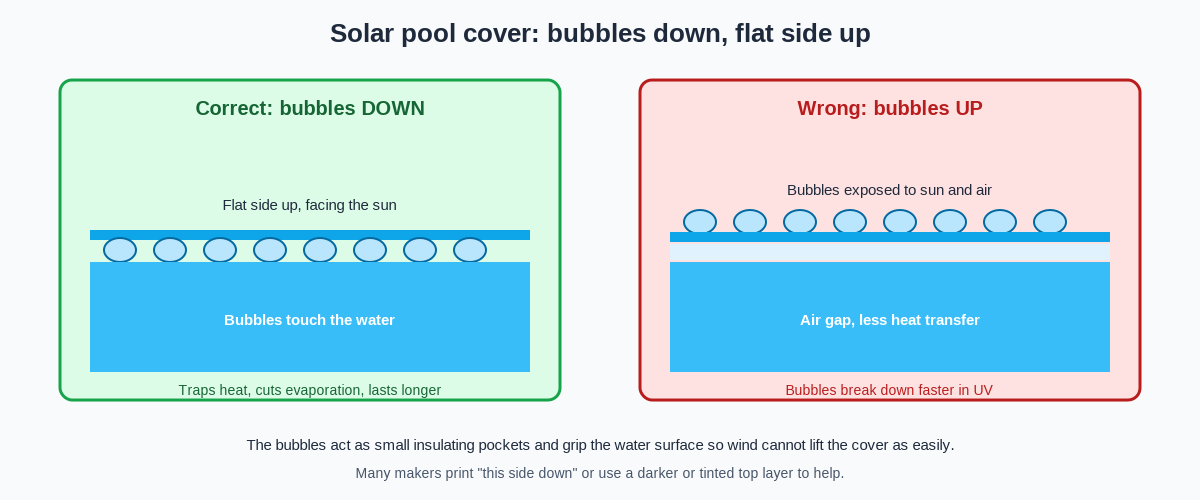
Diagram: Asphapro.com
Quick Answer
Put a solar pool cover bubbles down, with the bubbles touching the water and the flat side facing up toward the sun. The bubbles act as tiny insulating air pockets right at the water surface, hold in heat and grip the water so wind is less likely to lift the cover. With the bubbles facing up, there is a thin air gap under the cover, heat transfer is weaker, and the bubbles are exposed to sunlight and chlorine fumes, so they break down faster. A pool bubble cover used the right way can cut evaporation by up to 90% or more, raise water temperature by several degrees, and lower heating and chemical costs.
Solar covers, also called bubble covers or solar blankets, are one of the simplest and cheapest ways to warm a pool and keep water in it. They look like giant sheets of bubble wrap, usually blue, clear or tinted. When you first unroll one, it is not obvious which side should face the water, and getting it wrong reduces how well it works. The answer to "solar pool cover bubbles up or down" is simple: bubbles down.
This guide explains why, how a bubble pool cover works, how to fit and trim it, how much it saves, and how to make it last. For other cover types and prices, see pool cover cost.
Solar Pool Cover Bubbles Up or Down: Why Bubbles Go Down
Pool cover makers almost all agree: the bubble side goes down on the water. There are three main reasons.
Heat transfer and insulation. Sunlight passes through the cover and warms the water, and the bubbles, sitting on the water, trap a layer of insulating air right at the surface. That slows heat loss from the water to the night air. With the bubbles up, the flat side touches the water and the bubbles insulate against the air above instead, which is less effective, and a gap can form under the cover.
Less evaporation. Most heat loss from a pool comes from evaporation. When the bubbles sit on the water, the cover seals the surface well and stops most evaporation.
Longer life. The bubbles are the thinnest, most fragile part of the cover. Facing up, they take direct sunlight, which breaks down the plastic, and they pop and flatten faster. Facing down, the thicker flat layer takes most of the UV, and the bubbles sit in the water, which keeps them cooler.
So whether you search for "pool solar cover bubbles up or down" or "pool cover bubbles up or down", the answer is the same: bubbles down, flat side up.
How a Pool Bubble Cover Works
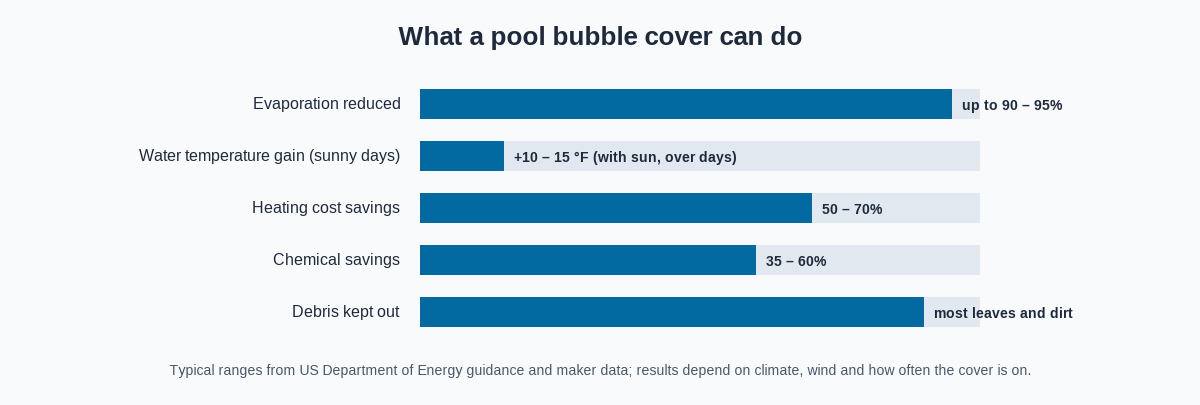
Chart: Asphapro.com
A swimming pool bubble cover works in three ways. First, it lets sunlight through to the water, especially clear and light blue covers, so the water warms. Second, it blocks evaporation, which is the main way pools lose heat; the US Department of Energy notes that evaporation accounts for most pool heat loss and that covers can reduce it by up to 95%. Third, the bubbles add insulation, slowing heat loss at night. Together, these effects can raise pool temperature by several degrees on sunny days and keep it warmer overnight. A bubble cover pool also loses less water and less chlorine to sunlight, and stays cleaner because debris lands on the cover.
Pool Cover Bubbles Up or Down: How to Tell the Bubble Side
The bubble side has rows of raised, round or oval bubbles. The other side is flat and smooth. Many covers also have a darker, silver or tinted top layer, or printing such as "this side up" or arrows, to make it clear. If you are not sure, lay a corner on the deck: the side that rocks on the bubbles is the bottom.
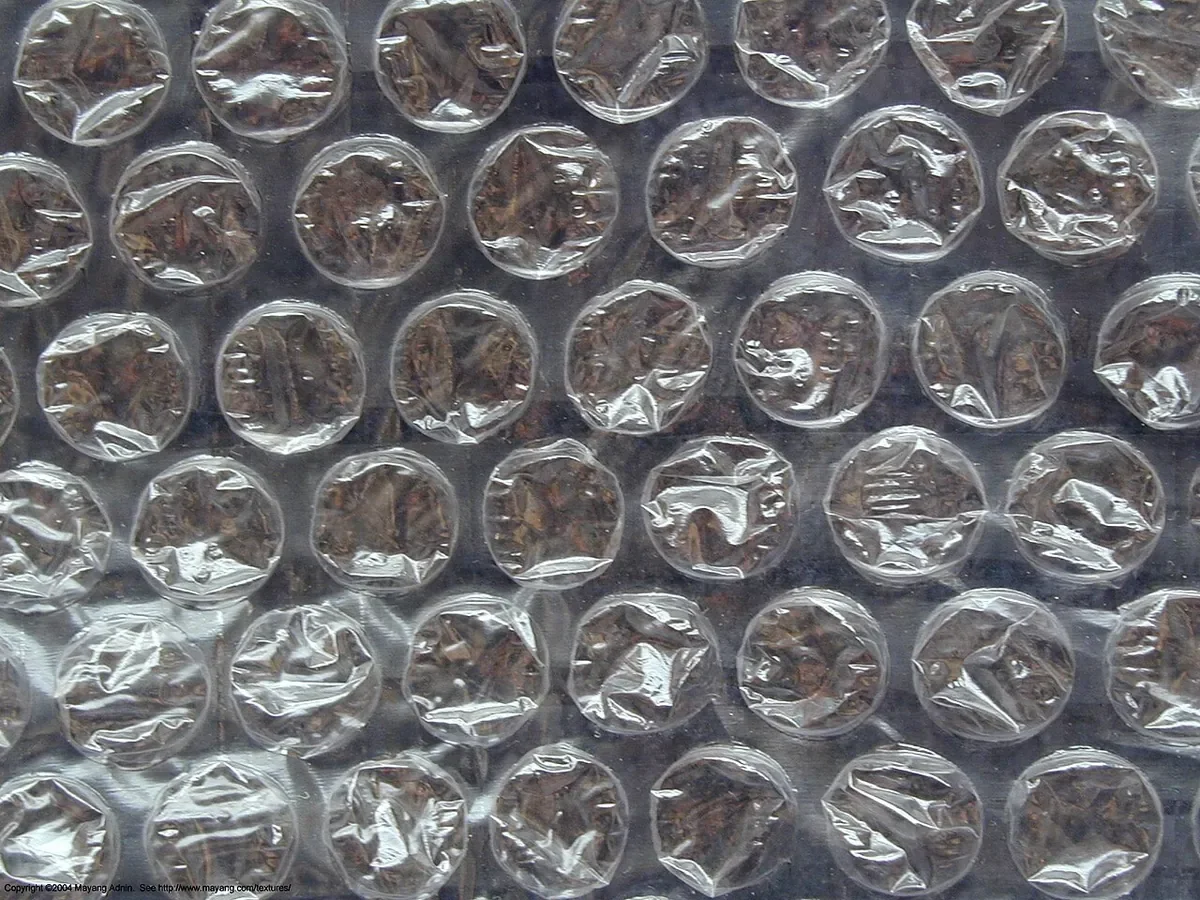
Photo: Consequencefree at English Wikipedia, Wikimedia Commons, CC BY-SA 3.0
How to Install a Pool Bubble Cover
Step 1: Unroll it. Lay the cover over the pool, bubbles down. With two people, it is easiest to pull it from one end to the other. Let it sit in the sun for a day or two to relax and shrink slightly before trimming.
Step 2: Trim to fit. Most covers come in rectangles and need trimming to the pool shape. Let the cover float and smooth out, then cut along the edge of the water with sharp scissors, leaving a little extra to allow for shrinkage. For inground pools, trim so it sits just inside the coping; for above ground pools, trim to the inside of the wall.
Step 3: Cut around fittings. Cut openings for ladders, steps and handrails, and trim around the skimmer if needed.
Step 4: Add a reel (optional). A cover reel on wheels or mounted to the deck makes it far easier to roll the cover on and off, and protects it from damage.
Reels, Storage and Handling
Roll the cover onto a reel when you swim, and keep it out of direct sun when rolled up. A rolled cover in hot sun can overheat and the plastic can warp or melt, especially dark covers. Use a reel cover or store it in shade. Never drag the cover across a rough deck. In the off-season, clean it, let it dry, fold or roll it, and store it in a cool, shaded place out of reach of rodents.
Bubble Pool Cover Thickness and Color
Bubble pool covers come in thicknesses from about 8 to 16 mil. Thicker covers last longer, often 3 to 5 years compared with 1 to 3 years for thin covers, and resist tearing. Color affects performance. Clear covers let the most sunlight through and heat water fastest. Light blue covers are a good balance. Dark blue and black covers absorb heat themselves but transfer less to the water. Some covers have a silver or reflective layer to reduce heat loss at night but warm less in the day.
Common Bubble Cover Pool Mistakes
The most common mistake is putting the bubbles up. Others include leaving a rolled cover in the sun, shocking the pool with the cover on (which traps chlorine gas and damages the cover), leaving the cover on during very high chlorine levels, using a cover that does not fit and lets wind lift it, and storing it wet, which causes mold.
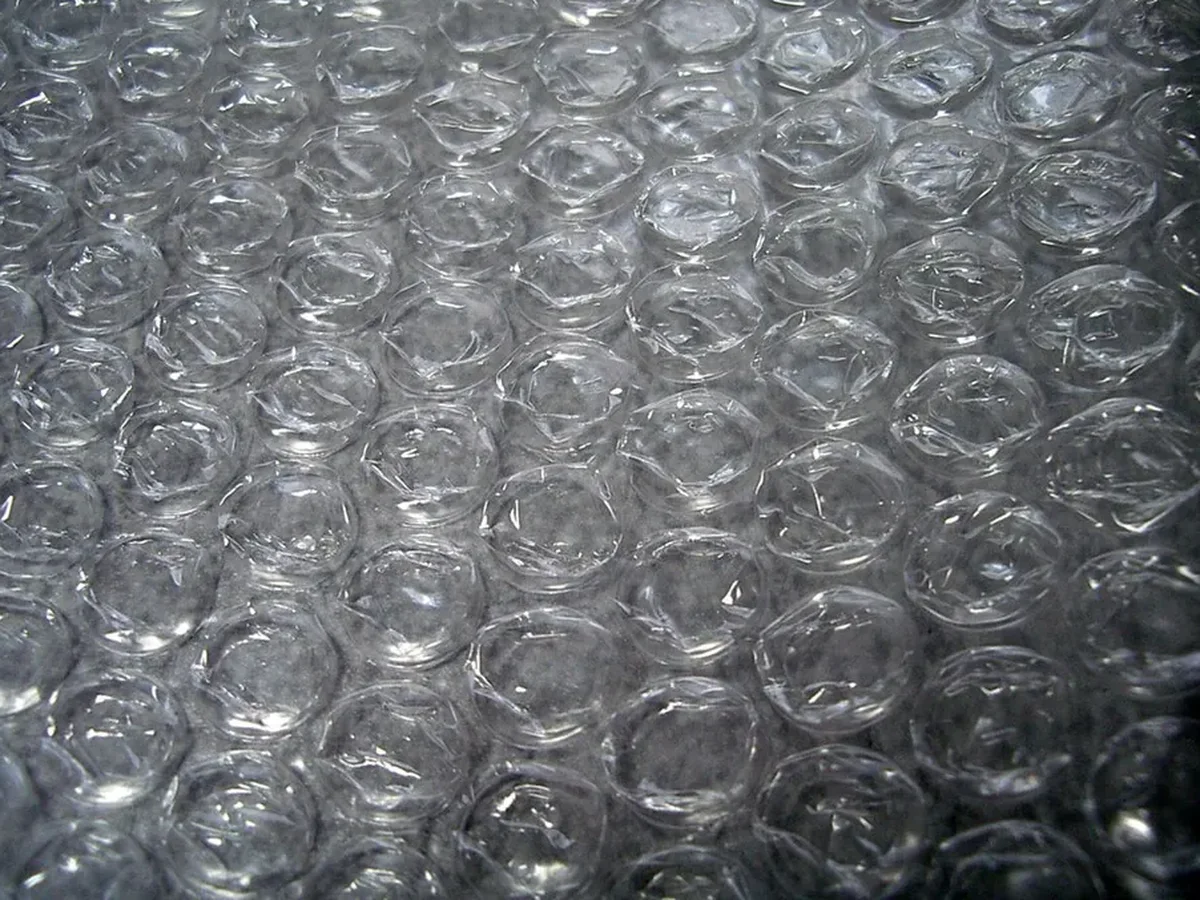
Photo: Wikimedia Commons, public domain
Pool Bubble Cover Up or Down: What the Makers Say
If you check the instructions that come with almost any cover, the answer to pool bubble cover up or down is printed clearly: bubbles down. Some covers even print "this side down" on the bubble side or "this side up" on the smooth side. A few people argue that bubbles up warms the water slightly faster on a sunny afternoon, since the bubbles act like little lenses, but the extra heat loss at night and the faster wear of exposed bubbles outweigh any small gain. In tests and in everyday use, a pool bubble cover with bubbles facing the water holds heat better over a full day and night and lasts longer. When in doubt, follow the maker's label; it also protects your warranty.
Does a Bubble Pool Cover Work in Every Climate?
A bubble pool cover helps in nearly every climate, but in different ways. In cool and temperate climates, its main job is to hold heat overnight and capture solar warmth during the day, extending the swim season by weeks in spring and fall. In hot, dry climates, the biggest benefit is cutting evaporation, which can otherwise remove an inch or more of water a week in summer, along with the chemicals in it. In very hot climates, some owners find a clear cover makes the water too warm in midsummer; using the cover only at night, or switching to a lighter or reflective cover, solves that. In windy areas, a well-fitted cover and a reel make the cover easier to manage.
Bubble Pool Covers for Above Ground Pools
Bubble pool covers work just as well on above ground pools, and they matter even more because above ground pools lose heat through their walls as well as the surface. Buy a round or oval cover sized to your pool, trim it to sit just inside the wall, and cut around the ladder or steps. Small reels and above ground pool reel brackets make it easier to roll the cover off. Some owners use a cover clip or a light strap system to stop wind from pulling it into the pool. As always, put the cover on bubbles down. See above ground pool installation cost.
Using a Swimming Pool Bubble Cover With Heaters
If you heat your pool with a gas heater, heat pump or solar panels, a swimming pool bubble cover is one of the best investments you can make. Without a cover, much of the heat you pay for escapes overnight through evaporation and radiation. With a cover on whenever the pool is not in use, heating costs often drop by half or more. Heat pumps, which heat slowly, benefit especially, since the cover helps them keep up. Put the cover on as soon as you finish swimming in the evening and take it off just before you swim. See how much does it cost to heat a pool.
Bubble Cover and Pool Chemistry
A bubble cover pool needs a little less chlorine because the cover blocks some sunlight that breaks down chlorine and keeps debris out. But the cover also traps gases at the surface. When you shock the pool or raise chlorine to a high level, take the cover off and leave it off until chlorine drops back to normal; trapped chlorine gas can bleach and weaken the cover and, in extreme cases, damage the liner. Keep pH and chlorine in range, since high chlorine and low pH make covers brittle faster. In salt pools, the cover works the same way; just watch that chlorine does not build up too high under the cover when the pool is not in use, and lower the cell output if needed.
Cleaning a Pool Bubble Cover
Clean the cover every few weeks, or whenever it gets dirty. Roll it off, lay it on a clean lawn or deck, and hose both sides. For stubborn dirt or algae, use a soft brush and a mild soap or a cover cleaner, then rinse well. Do not use harsh solvents, pressure washers or stiff brushes, which can damage the bubbles. Let the cover dry before rolling it up for storage, or put it straight back on the pool. If the cover smells musty or shows mold spots, it was stored damp; clean it and dry it fully in the shade.
Repairing Bubble Pool Covers
Small tears can be patched with vinyl or clear repair tape made for pool covers, applied on both sides when the cover is dry. Holes near the edge are often trimmed off. Once the bubbles are flattened or popped over large areas, the cover loses much of its insulating effect, and once the plastic becomes brittle and starts to flake or shed small pieces into the pool, it is time to replace it, since the flakes can clog skimmers and filters.
When to Replace a Pool Bubble Cover
Replace a pool bubble cover when it is brittle, cracking or crumbling, when many bubbles are flat or popped, when it no longer covers the whole surface because of shrinkage, or when it sheds pieces into the water. Thin 8 mil covers often last one to two seasons in sunny climates; 12 to 16 mil covers last three to five or more with good care. Using a reel cover, removing the cover during shocking, and storing it out of the sun all add to its life.
Alternatives to a Bubble Cover
Solar rings are floating discs that cover most of the surface and are easy to handle, but they leave gaps, so they save less heat and water than a full cover.
Liquid solar covers are products that form a thin layer on the surface to reduce evaporation. They are easy to use but less effective than a physical cover and need regular dosing.
Automatic covers roll out with a key switch, add safety and save heat, but cost $8,000 to $20,000 installed.
Safety covers are mesh or solid covers anchored to the deck for winter safety; they are not designed to heat the pool.
Costs and Savings
Bubble pool covers cost about $50 to $300 for most residential pools, depending on size and thickness. A reel adds $100 to $400. Savings vary, but heated pools often save hundreds of dollars a season in heating, and all pools save water and chemicals. For a pool that loses an inch of water a week to evaporation, a cover can save thousands of gallons over a summer. Most owners find a solar cover pays for itself within one season.
Safety Warning
A solar bubble cover is not a safety cover. A child or pet can slip under a floating cover and become trapped. Always remove the cover completely before anyone swims, never let children play on it, and keep the pool fenced and gated. If you need a cover that adds safety, look at automatic covers or anchored safety covers that meet ASTM safety standards.
Pool Solar Cover Bubbles Up or Down in Spring and Fall
Spring and fall are when a solar cover makes the biggest difference. Water temperatures are cool, nights are cold, and the sun is still strong enough to warm the water during the day. Whether you ask "pool solar cover bubbles up or down" in April or September, the answer is still bubbles down. In these seasons, keep the cover on all the time except when swimming, so the pool collects heat in the day and holds it at night. Many owners gain two to six extra weeks of swimming at each end of the season this way. If you also have a heater, the cover cuts the time and fuel needed to reach a comfortable temperature.
How to Put a Bubble Cover On and Take It Off
With a reel, rolling a bubble cover pool on and off takes a minute or two. Without a reel, the easiest method is to fold the cover lengthwise in an accordion pattern as you pull it off one end, then drag the folded bundle to the side. To put it back, pull the bundle to one end and unfold it across the water, bubbles down. Keep the cover from dragging on rough concrete or sharp coping edges. In windy weather, put the cover on from the upwind side so the wind helps rather than fights you. If your pool is large, two people make the job much easier.
Swimming Pool Bubble Cover Sizes and Shapes
Swimming pool bubble covers are sold as rectangles for inground pools, often in sizes such as 16 x 32 feet or 20 x 40 feet, and as rounds and ovals for above ground pools. Most are trimmed to fit on site, so buy one a little larger than your pool. For freeform, kidney and L-shaped pools, lay the cover on the water, let it relax for a day or two in the sun, then trim along the edge. Leave an inch or two extra all around, since covers shrink slightly in the first weeks. Custom-cut covers are available for unusual shapes but cost more.
Solar Pool Cover Bubbles Up or Down: Myths
"Bubbles up heats the water faster." Any small daytime gain is lost at night through the air gap, and the exposed bubbles wear out faster.
"Dark covers heat the pool best." Dark covers get hot themselves but let less sunlight reach the water. Clear and light blue covers usually warm water more.
"A solar cover can replace a heater." A cover helps a lot, but it cannot heat a pool on cloudy, cold days. It works best alongside other heating.
"You can leave the cover on while shocking." Shock with the cover off, and wait until chlorine drops before putting it back.
Knowing the facts about solar pool cover bubbles up or down helps you get the most heat, the longest cover life and the lowest running costs from a simple sheet of plastic.
How Much Warmer Will the Pool Get?
How much a solar cover warms a pool depends on sunshine, air temperature, wind, pool size and how many hours the cover stays on. On a run of sunny days in late spring, many owners see the water rise by 10 to 15 °F over a week or so compared with an uncovered pool, mainly because the cover stops the large overnight losses. On cloudy or cold days, the gain is much smaller, but the cover still slows heat loss. A cover will not turn a 60 °F pool into an 85 °F pool overnight; think of it as a way to keep the heat the sun or your heater has already added. Pools in sheltered, sunny spots gain the most. Pools under trees or in windy spots gain less but still save water and chemicals.
Evaporation and Water Savings
Evaporation removes a surprising amount of water. In hot, dry, windy weather, an uncovered pool can lose a quarter of an inch or more a day, which for a 16 x 32 foot pool is roughly 80 gallons a day, or more than 2,000 gallons a month. Every gallon that evaporates also takes heat with it, and the water you add to replace it is cold and needs more chemicals. A bubble cover can cut evaporation by up to 90% or more. In areas with water restrictions or high water bills, this alone can justify the cover. Less evaporation also means less buildup of calcium and dissolved solids, since minerals stay behind when water evaporates and new water brings in more.
Choosing a Cover: What to Look For
When buying a bubble cover, look at thickness first; 12 mil or thicker lasts noticeably longer than 8 mil. Check the UV inhibitor and the warranty, which is often prorated over three to six years. Choose clear or light blue for the most heating, or a tinted or reflective top layer if your pool already runs warm. Buy a size a little larger than the pool to allow for trimming and shrinkage. If you plan to use a reel, check that the reel is wide enough for your pool and that the cover attaches easily with straps. A good cover, used bubbles down and cared for properly, will repay its cost many times over.
Storing the Cover in Summer and Winter
During the swim season, keep the rolled cover shaded with a reel cover or a white tarp whenever it is off the pool, especially in midday sun. A rolled dark cover can reach very high temperatures and warp or fuse together. At the end of the season, clean the cover, let it dry, sprinkle it lightly with talc if the maker suggests it to stop sticking, then roll or fold it and store it in a sealed bin in a cool, dry place. Do not leave a bubble cover on the pool over winter in freezing climates; it is not designed for snow loads and will be damaged. Use a winter cover instead. See how to winterize a pool.
Solar Pool Cover Bubbles Up or Down: Key Points
- Bubbles go down, touching the water, with the flat side up.
- Facing down, the bubbles hold heat, cut evaporation and last longer.
- Trim the cover to fit and use a reel for easy handling.
- Remove the cover when shocking and store it out of the sun.
Frequently Asked Questions
Which side of a solar cover goes down?
The bubble side goes down on the water, and the flat side faces up toward the sun.
What happens if you put a solar cover bubbles up?
It works less well, since an air gap forms under the cover, and the exposed bubbles wear out faster in the sun.
How much does a solar cover heat a pool?
Often several degrees on sunny days, and more over a week by preventing night heat loss.
Should I leave my solar cover on all the time?
When not swimming, yes, except after shocking or when chlorine is very high.
How long do bubble pool covers last?
Usually 1 to 5 years depending on thickness, sun exposure, water chemistry and how well the cover is stored when off the pool.
Can I swim with the solar cover on?
No. Always remove it fully before swimming; a person can get trapped under a floating cover.
Sources
- US Department of Energy: Swimming pool covers
- US Department of Energy: Solar pool heaters
- CPSC: Pool and spa safety
- Pool and Hot Tub Alliance