
How Many Gallons Are in an Olympic Size Swimming Pool?
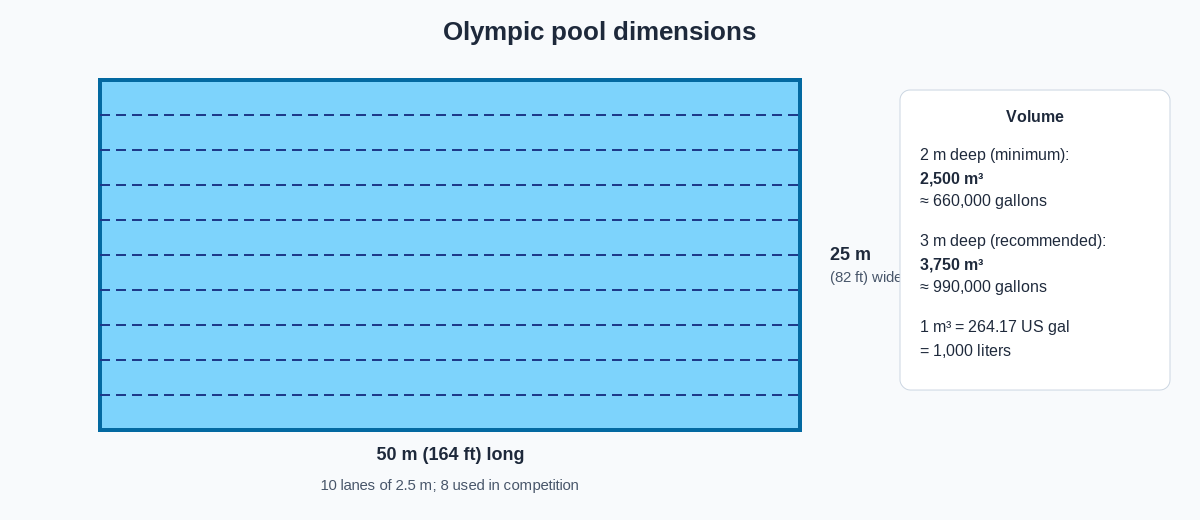
Diagram: Asphapro.com
Quick Answer
An Olympic size swimming pool is 50 meters long (164 feet), 25 meters wide (82 feet) and at least 2 meters deep. At the minimum 2 m depth it holds 2,500 cubic meters, or about 660,000 US gallons (2.5 million liters). At the 3 m depth recommended for top competitions, it holds about 990,000 gallons (3.75 million liters). So the short answer to how many gallons are in an Olympic size swimming pool is about 660,000 gallons, often rounded to "two-thirds of a million." A junior Olympic pool is usually 25 meters long and holds roughly 200,000 to 300,000 gallons.
"Olympic-size swimming pool" is one of the most common units people use to describe large amounts of water, from reservoir volumes to wastewater spills. But how much water is that, exactly? The answer depends on the pool's depth, since the length and width are fixed by the rules for international competition.
This guide explains how many gallons are in an Olympic size swimming pool, how long and wide an Olympic pool is, what depth the rules require, how a junior Olympic pool compares, and how to work out the volume of any pool. For your own backyard pool, see our guide on how many gallons is my pool.
How Long Is an Olympic Size Pool?
How long is an Olympic size pool? Exactly 50 meters, which is about 164 feet. The width is 25 meters, about 82 feet. These dimensions are set by World Aquatics (formerly FINA), the international governing body, for pools used in the Olympic Games and world championships. The 50-meter length means a 100-meter race is two lengths and a 1,500-meter race is 30 lengths. Pools built for competition are also built with very tight tolerances, often just a few centimeters, so that every race is fair, and pools with touchpads are built slightly longer so the pads bring the racing length to exactly 50 meters.
The pool is divided into 10 lanes, each 2.5 meters wide. Eight lanes are used for racing, with an empty lane on each side to reduce waves bouncing off the walls.
How Deep Is an Olympic Pool?
World Aquatics rules call for a minimum depth of 2 meters (about 6.6 feet) for Olympic pools, with 3 meters (about 9.8 feet) recommended for the Olympic Games and world championships. Deeper water reduces turbulence and waves, which helps swimmers go faster. Many modern competition pools are 3 meters deep throughout, which also allows them to be used for water polo and artistic swimming. Some older or public "Olympic-size" pools have a shallow end and are deeper only at one end, so their volume is lower than a full-depth competition pool.
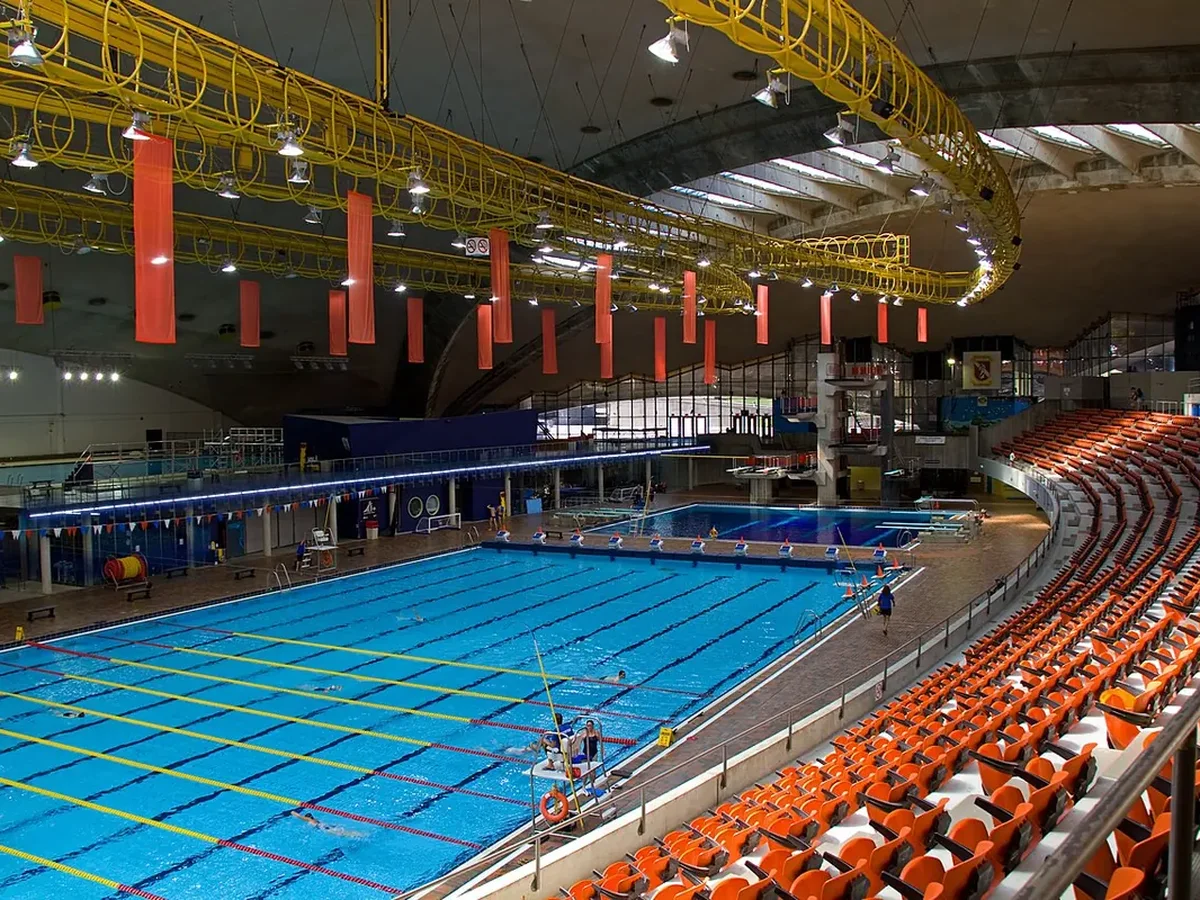
Photo: Tony Hisgett, Wikimedia Commons, CC BY 2.0
How Many Gallons in an Olympic Size Swimming Pool: The Math
Working out how many gallons in an Olympic size swimming pool is simple multiplication. Multiply length by width by depth to get the volume in cubic meters: 50 m × 25 m × 2 m = 2,500 cubic meters. One cubic meter holds 1,000 liters, so the pool holds 2,500,000 liters. One cubic meter equals about 264.17 US gallons, so 2,500 × 264.17 = about 660,430 gallons. At 3 meters deep, the volume is 50 × 25 × 3 = 3,750 cubic meters, or about 990,650 gallons.
Olympic size swimming pool gallons are often rounded to 660,000, but the real number for a given pool depends on its exact depth. A pool with a shallow end at 1.2 meters and a deep end at 3 meters has an average depth closer to 2 meters, giving about 660,000 gallons. A full 3-meter competition pool holds about half again as much.
How Much Water Is in an Olympic Pool in Other Units?
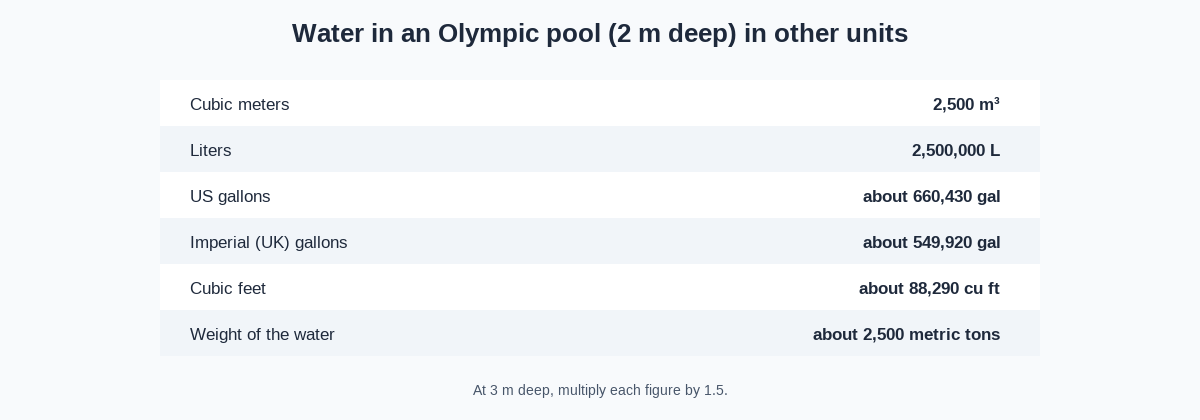
Chart: Asphapro.com
How much water is in an Olympic pool depends on which units you use. At the 2-meter minimum depth, an Olympic pool holds 2,500 cubic meters, 2.5 million liters, about 660,000 US gallons, about 550,000 imperial gallons (used in the UK), or about 88,000 cubic feet. Since a liter of water weighs about one kilogram, the water alone weighs about 2,500 metric tons, roughly the weight of 1,800 cars. At 3 meters deep, multiply each figure by 1.5.
Olympic Pool Volume Calculator
Enter a pool's length, width and average depth in meters to see its volume in gallons, liters and cubic meters. The default values are for an Olympic pool at the minimum depth.
Junior Olympic Size Pool
A junior Olympic size pool is not an official World Aquatics standard, but the term is widely used in the United States for a 25-meter pool, about 82 feet long, used for training, school meets and club swimming. Many are 25 meters long and 13 to 25 meters wide, with six to ten lanes, and depths that range from about 1 meter at the shallow end to 2 meters or more at the deep end. Some pools called junior Olympic are 25 yards long (75 feet), the standard short course for American high school and college racing.
The size of junior Olympic pool facilities varies, so their volume varies too. A 25 × 20 meter pool at 2 meters deep holds about 1,000 cubic meters, or about 264,000 gallons. A 25-yard, six-lane pool with a sloping floor might hold 100,000 to 150,000 gallons. If you search for jr olympic pool size, the answer is usually "25 meters long," with width and depth set by the facility.
Short Course vs Long Course Pools
Competitive swimming uses two main pool lengths. Long course means a 50-meter pool, the Olympic standard. Short course means a 25-meter pool (short course meters) or a 25-yard pool (short course yards). Times are not directly comparable between courses, because swimmers turn and push off the wall more often in a short pool, which makes races faster. Many large aquatic centers have a 50-meter pool with movable bulkheads that can split it into two 25-meter pools for training and short course meets.
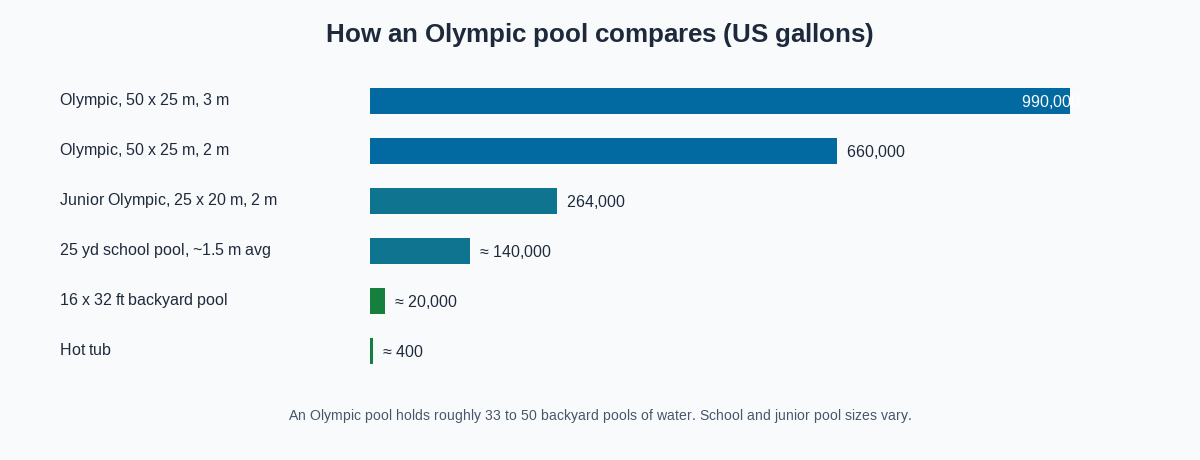
Chart: Asphapro.com
How an Olympic Pool Compares With a Backyard Pool
A typical 16 x 32 foot backyard pool with an average depth of 5 feet holds about 19,000 to 20,000 gallons. An Olympic pool at 2 meters deep holds about 33 times as much water; at 3 meters, about 50 times as much. A hot tub holding 400 gallons would need to be filled about 1,650 times to equal one Olympic pool. These comparisons help explain why the Olympic pool is such a popular unit for large volumes of water.
How Long Is an Olympic Sized Swimming Pool in Feet and Yards?
How long is an Olympic sized swimming pool in US units? Fifty meters equals about 164 feet or about 54.7 yards. The 25-meter width is about 82 feet or 27.3 yards. The 2-meter minimum depth is about 6.6 feet, and the 3-meter recommended depth is about 9.8 feet. A swimmer doing one length covers the same distance as just over half a football field.
How Long Does It Take to Fill an Olympic Pool?
Filling 660,000 gallons takes a long time. A garden hose delivers about 9 to 12 gallons per minute, so filling an Olympic pool with one hose would take about 40 to 50 days of nonstop running. Facilities fill from large water mains or fire hydrants at hundreds of gallons per minute, which can fill the pool in one to three days. Water trucks carrying 6,000 to 8,000 gallons each would need about 85 to 110 loads. The cost of the water depends on local rates; at $5 to $10 per 1,000 gallons, filling an Olympic pool costs roughly $3,300 to $6,600, plus sewer charges in some areas. See our guide to swimming pool filling cost.
How Much Water in an Olympic Swimming Pool Is Lost Each Day?
How much water in an Olympic swimming pool is lost to evaporation and splashing? Outdoor pools can lose a quarter to half an inch of water a day in hot, dry, windy weather. Over 1,250 square meters of surface, a quarter inch is about 2,100 gallons a day. Splash-out from swimmers and backwashing the filters add more. Indoor pools lose less but need large dehumidifiers to handle the moisture. Pool covers at night cut evaporation dramatically and save both water and heat.
Heating and Filtering an Olympic Pool
Competition rules call for water between about 25 and 28°C (77 to 82°F). Heating 660,000 gallons by just one degree Fahrenheit takes about 5.5 million BTUs, so large pools use big gas boilers, heat pumps, solar systems or waste heat from nearby buildings, and covers at night to hold heat. Filtration is just as large: public pool codes often require the whole volume to pass through the filters every four to six hours, which means pumps moving roughly 2,000 to 2,750 gallons per minute. Large pools use banks of sand filters or regenerative media filters, with UV or ozone systems in many facilities.
Chemicals for an Olympic Pool
Keeping 660,000 gallons sanitized takes large amounts of chemicals. To raise chlorine by 1 ppm in an Olympic pool takes about 5.5 pounds of pure chlorine, or about 66 gallons of 10% liquid chlorine. Facilities usually use automatic controllers that measure chlorine and pH constantly and feed liquid chlorine, sodium hypochlorite or calcium hypochlorite, plus acid or carbon dioxide to control pH. Public pools must also meet health code limits for chlorine, pH, clarity and turnover, checked several times a day.
How Much Does an Olympic Pool Cost to Build?
Building a 50-meter competition pool costs far more than a backyard pool. The pool tank alone, with filtration, can cost several million dollars, and a full indoor aquatic center with seating, lighting, heating, ventilation and locker rooms can cost $20 million to well over $100 million. Outdoor 50-meter public pools cost less but still run into millions. Operating costs for water, energy, chemicals, staff and maintenance often run hundreds of thousands of dollars a year.
The Olympic Pool as a Unit of Measure
News reports often describe large volumes, such as reservoir releases, oil spills or snowfall, in "Olympic-size swimming pools." Most writers use 2,500 cubic meters, the volume at the 2-meter minimum depth, or about 660,000 gallons. For example, one million cubic meters of water equals about 400 Olympic pools. When you see this comparison, remember it is approximate, since real Olympic pools are often 3 meters deep and hold 50% more.
A Short History of Olympic Pools
The first modern Olympic swimming events, in 1896, were held in the open sea near Athens. Later Games used rivers and lakes until the 1908 London Games built a 100-meter pool inside the main stadium. The 50-meter standard was adopted for the 1924 Paris Games, along with lane lines. Over the following decades, pools became deeper, wider and better designed to reduce waves, with gutters that absorb ripples, deeper water and empty outside lanes. Today's competition pools are among the most precisely built structures in sport.
Can You Build an Olympic Size Pool at Home?
A true 50 × 25 meter pool is far too large for almost any residential lot, and the cost, water use and upkeep would be enormous. Swimmers who want to train at home usually choose a lap pool, often 20 to 25 meters long and 2.5 to 3 meters wide, or a swim spa with a current. A 25-meter home lap pool, the length of a short course pool, holds about 25,000 to 40,000 gallons depending on width and depth. See our guide to types of swimming pool options.
Junior Olympic Swimming Pool Uses
A junior Olympic swimming pool is the workhorse of community aquatics. These 25-meter or 25-yard pools host high school meets, club practices, swim lessons, water aerobics and lap swimming. Their smaller volume makes them cheaper to heat and treat than a 50-meter pool, and their size fits on school and park sites. Many have a shallow end for lessons and a deeper end with starting blocks.
Other Rules for Olympic Pools
Length, width and depth are only part of the World Aquatics facility rules. Lanes must be 2.5 meters wide, marked with dark lines on the floor that end in a T shape near each wall to help swimmers judge turns. Lane ropes made of spinning discs absorb waves between lanes. Starting platforms have set heights and angled back plates. Touchpads at each end record finishes electronically to a hundredth of a second. Water temperature is set within a narrow range, around 25 to 28°C, and lighting levels over the water are specified for fair timing and television. The pool deck around the water must be wide enough for officials and swimmers, and gutter systems are designed to swallow waves rather than bounce them back.
How Much Water in an Olympic Pool vs a Diving Pool
Olympic venues also have a separate diving pool. Diving pools are usually about 25 meters by 25 meters and 5 meters deep to make high dives safe. At 25 × 25 × 5 meters, a diving pool holds about 3,125 cubic meters, or about 825,000 gallons, more than a 2-meter-deep racing pool despite being half as long. Some facilities combine diving and water polo in one deep pool. When people ask how much water in an Olympic pool complex, the answer can easily pass two million gallons once the racing, diving and warm-up pools are added together.
Why Pool Depth and Design Make Swimming Faster
Swimmers create waves as they move, and those waves bounce off the floor and walls. Deeper water lets waves spread and fade before reaching the surface again, which is why 3-meter pools are called "fast" pools. Wide pools with empty outer lanes, wave-absorbing lane ropes and overflow gutters around the edges all reduce choppy water. Even the water temperature is chosen to help: warm enough for muscles to work well, but cool enough that swimmers do not overheat during hard races.
How Long Is Olympic Pool Racing in Laps?
Because an Olympic pool is 50 meters, race distances translate easily into laps. A 50-meter freestyle is one length, 100 meters is two, 200 meters is four, 400 meters is eight, 800 meters is 16, and the 1,500-meter freestyle is 30 lengths. In a 25-meter short course pool, each of those races takes twice as many lengths, with twice as many turns.
Famous Olympic Pools
Some Olympic pools are landmarks in their own right. The Beijing National Aquatics Center, known as the Water Cube, hosted the 2008 Games and was later partly converted for winter sports. The London Aquatics Centre, with its wave-shaped roof, was built for 2012 and now serves the public. The Montreal Olympic pool from 1976 still operates as a public facility. Many Olympic pools are designed with temporary seating that is removed after the Games, turning a world-class venue into a community pool that hosts lessons, clubs and lap swimmers for decades. Each holds the same basic 50 × 25 meter racing tank, filled with hundreds of thousands of gallons of carefully balanced water.
Water Quality in Competition Pools
With so much water and so many swimmers, competition pools rely on constant monitoring. Automatic controllers measure chlorine and pH every few seconds and adjust chemical feeds. Many pools add UV or ozone systems that break down chloramines, which cause the familiar indoor-pool smell and can irritate swimmers' eyes and lungs. Strong ventilation removes chlorine compounds from the air above the water. Health departments inspect public pools regularly and require clear water, so the main drain can be seen from the deck at all times. The same basics apply at home on a much smaller scale; see our guide on how much chlorine to add to pool water.
Putting the Numbers Together
So how many gallons are in an Olympic size swimming pool? Use about 660,000 gallons for a pool at the 2-meter minimum depth, and about 990,000 gallons for a 3-meter competition pool. That is 2.5 to 3.75 million liters of water, filling a tank 50 meters long and 25 meters wide. Junior Olympic pools, at 25 meters or 25 yards long, usually hold a quarter to a half as much. For any other pool, multiply length by width by average depth in meters, then by 264 to get gallons, or use the calculator above.
Converting Pool Volumes Quickly
A few simple conversions make pool volumes easy to compare. One cubic meter equals 1,000 liters or about 264 US gallons. One cubic foot equals about 7.48 US gallons. One US gallon equals about 3.785 liters, and one imperial gallon equals about 4.546 liters. To estimate any rectangular pool in feet, multiply length by width by average depth, then by 7.48 to get gallons. To work in meters, multiply length by width by average depth, then by 264. Using these factors, you can compare your own pool, a hot tub, or a reservoir with an Olympic pool in seconds, and check any volume you read in the news.
How Many Gallons Are in an Olympic Size Swimming Pool: Key Points
- Olympic pool: 50 m long, 25 m wide, at least 2 m deep.
- About 660,000 US gallons at 2 m; about 990,000 at 3 m.
- That is 2.5 to 3.75 million liters, or 2,500 to 3,750 cubic meters.
- Junior Olympic pools are usually 25 m long and hold far less.
Frequently Asked Questions
How many liters are in an Olympic pool?
About 2.5 million liters at 2 m deep, and 3.75 million liters at 3 m deep. That is 2,500 to 3,750 cubic meters of water.
How long would it take to fill an Olympic pool with a garden hose?
At about 10 gallons per minute, roughly 46 days of nonstop filling for 660,000 gallons. Facilities use large mains or hydrants and fill in a few days.
How long is an Olympic size swimming pool in meters?
50 meters long and 25 meters wide, with a depth of at least 2 meters and 3 meters recommended for top competitions.
How long is a Olympic pool in feet?
About 164 feet long and 82 feet wide, with a minimum depth of about 6.6 feet.
How many gallons in an Olympic sized pool that is 3 meters deep?
About 990,000 US gallons, or 3.75 million liters, half again as much as a 2-meter pool.
How much water is in an Olympic size swimming pool in tons?
About 2,500 metric tons at 2 meters deep, and 3,750 metric tons at 3 meters deep, since each cubic meter of water weighs about one metric ton.
What is a junior size Olympic pool?
A junior size Olympic pool usually means a 25-meter or 25-yard competition pool used for training, lessons and school meets. Width and depth vary by facility.
Are Olympic sized swimming pool gallons the same in every country?
The volume is the same, but UK reports often use imperial gallons: about 550,000 imperial gallons at 2 meters deep, versus about 660,000 US gallons.
How long is a Olympic swimming pool compared to a football field?
A 50-meter Olympic swimming pool is about 164 feet, a little more than half the 300-foot length of an American football field between the goal lines.
How long is an Olympic sized pool lap?
One lap usually means one length of 50 meters, though some swimmers count a lap as down and back, 100 meters.
How many gallons in Olympic size swimming pool water per lane?
Each of the 10 lanes holds about one tenth of the total: roughly 66,000 gallons at 2 meters deep, or about 99,000 at 3 meters.
How much water in an Olympic pool is needed to top it up each week?
Outdoors in summer, evaporation and splash-out can use 10,000 to 20,000 gallons a week. Covers used overnight reduce this a lot and also save heating energy.
Sources
- World Aquatics: Competition regulations and facilities rules
- NIST: Units of volume
- USGS: Water Science School
- USA Swimming