
How Much Chlorine to Add to Pool: Doses, Tablets and Calculator
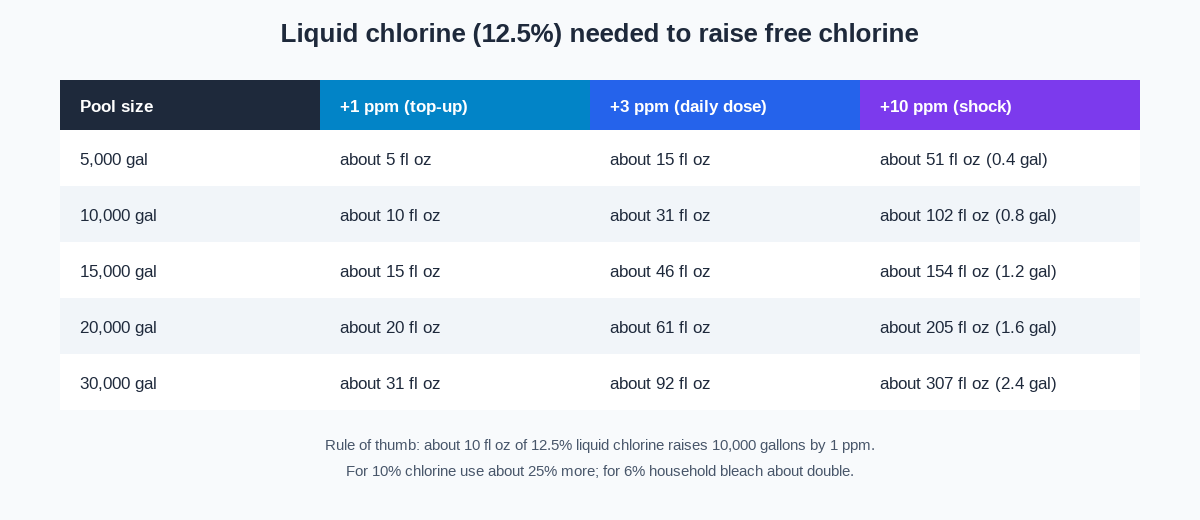
Chart: Asphapro.com
Quick Answer
How much chlorine to add to pool water depends on pool size, the product and how far you need to raise free chlorine (FC). As a rule of thumb, about 10 fluid ounces of 12.5% liquid chlorine raises 10,000 gallons by 1 ppm. A typical daily top-up of 2 to 3 ppm in a 20,000 gallon pool takes about 40 to 60 fl oz of liquid chlorine. For chlorine tablets, start with about one 3-inch tablet per 5,000 gallons per week in a floater or chlorinator, then adjust by testing. Most outdoor pools should keep free chlorine at about 3 to 5 ppm with stabilizer at 30 to 50 ppm. To shock a pool with liquid chlorine, raise FC to about 10 to 20 ppm, which takes about 1 to 2 gallons of 12.5% chlorine for 10,000 to 20,000 gallons.
Chlorine keeps pool water safe by killing germs and algae and breaking down sweat, oils and other waste. Too little chlorine leads to cloudy water, algae and health risks. Too much wastes money and can irritate skin and eyes. The right amount depends on your pool's volume, the type of chlorine you use, how much stabilizer is in the water, the weather and how many people swim.
This guide explains how much chlorine to add to pool water for routine care and for shocking, with a free chlorine calculator, dose charts for liquid chlorine, guidance on how many chlorine tablets for pool sizes, target levels by stabilizer, and safe handling. If you are not sure of your pool size, see how many gallons is my pool.
How Much Chlorine to Add to Pool: Calculator
This is a how much liquid chlorine to add to pool calculator and a how much chlorine to add to pool calculator in one: choose your product and pool size.
Use this calculator to find how much liquid chlorine, bleach or cal-hypo shock to add to raise free chlorine from your current reading to your target.
The calculator uses standard dosing math: about 10.2 fl oz of 12.5% liquid chlorine, 12.8 fl oz of 10% chlorine, or 21 fl oz of 6% bleach per ppm per 10,000 gallons, and about 2.1 oz of 65% cal-hypo per ppm per 10,000 gallons. Results are close estimates. Add a little less than the full amount, run the pump for an hour, and retest.
What Free Chlorine Level Should a Pool Have?
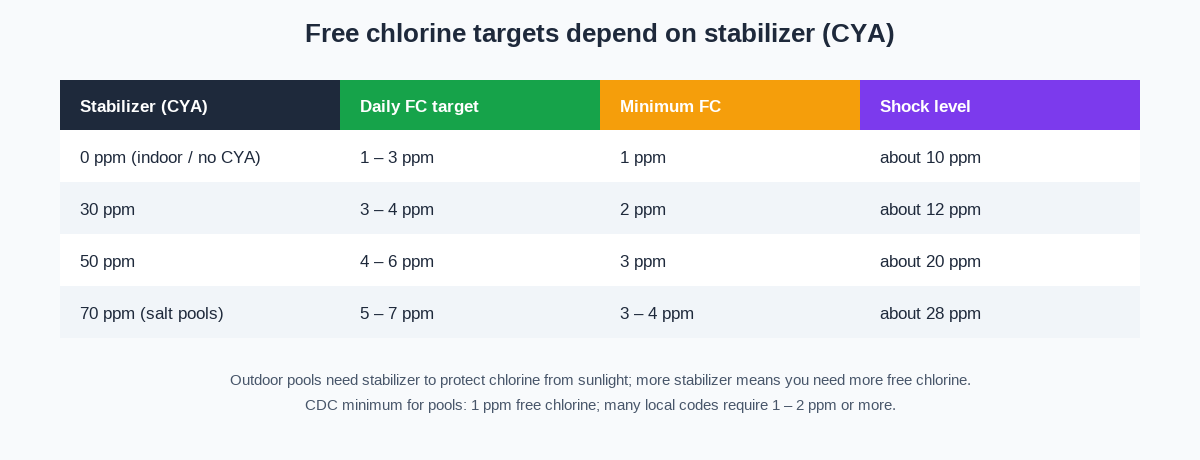
Chart: Asphapro.com
The CDC sets a minimum of 1 ppm free chlorine for pools, and many health codes require more. For residential outdoor pools, the right target depends on cyanuric acid (CYA, also called stabilizer or conditioner). CYA protects chlorine from sunlight, but it also makes chlorine weaker. The more stabilizer in the water, the more free chlorine you need. A useful rule many pool experts use is to keep free chlorine at about 7.5% of the CYA level, with a minimum of about 5% of CYA.
- Indoor pool, no CYA: 1 to 3 ppm.
- CYA 30 ppm: about 3 to 4 ppm.
- CYA 50 ppm: about 4 to 6 ppm.
- Salt pool with CYA 70 ppm: about 5 to 7 ppm.
How Much Liquid Chlorine to Add to Pool
Pool liquid chlorine, also called chlorine liquid pool treatment (sodium hypochlorite, sold as pool chlorine or chlorinating liquid at 10% to 12.5%) is the simplest way to chlorinate a pool. It dissolves instantly, adds no stabilizer or calcium, and raises pH only slightly. Here is how much liquid chlorine to add to pool water for common jobs:
| Job | 10,000 gal | 15,000 gal | 20,000 gal |
|---|---|---|---|
| Daily top-up (+2 ppm) | about 20 fl oz | about 31 fl oz | about 41 fl oz |
| Raise from 1 to 5 ppm (+4) | about 41 fl oz | about 61 fl oz | about 82 fl oz |
| Shock (+10 ppm) | about 102 fl oz (0.8 gal) | about 154 fl oz (1.2 gal) | about 205 fl oz (1.6 gal) |
| Algae shock (+20 ppm) | about 1.6 gal | about 2.4 gal | about 3.2 gal |
Amounts are for 12.5% chlorine. For 10% chlorine, use about 25% more. For 6% household bleach (plain, unscented, no additives), use about twice as much.
How to add liquid chlorine to a pool
- Test free chlorine, pH and CYA.
- Work out the dose with the calculator or table.
- With the pump running, pour the chlorine slowly into the pool in front of a return jet, or walk it around the deep end. Keep the jug low to avoid splashing.
- Add it in the evening if possible, so the sun does not burn it off right away.
- Brush the pool and run the pump for at least an hour.
- Retest after an hour or the next morning.
How Many Chlorine Tablets for Pool Sizes?
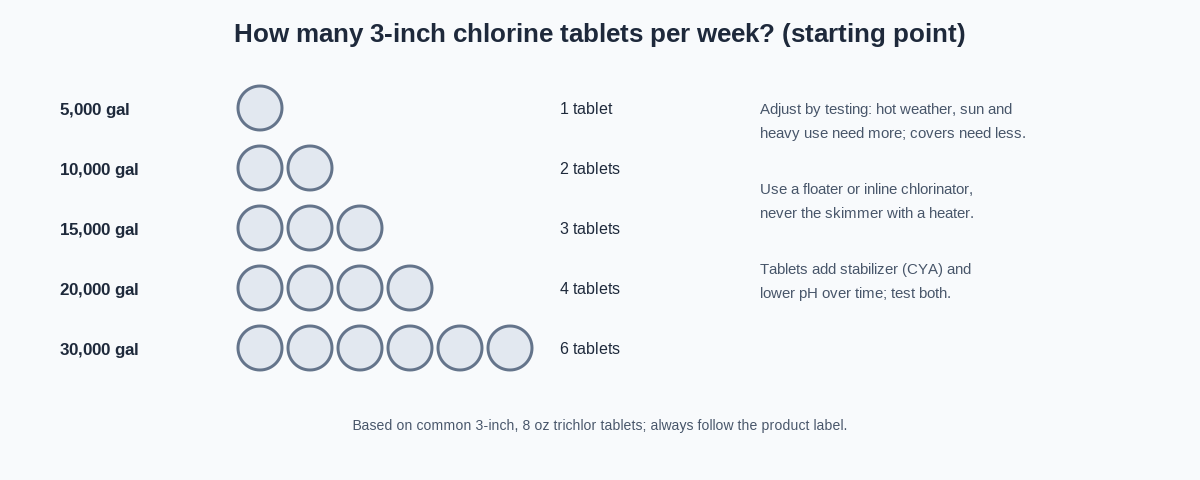
Chart: Asphapro.com
Pool chlorine tablets (usually 3-inch, 8 oz trichlor tablets) dissolve slowly in a floater, skimmer-free inline chlorinator or offline feeder to give steady chlorine. A common starting point is one 3-inch tablet per 5,000 gallons per week. That means about 2 tablets for 10,000 gallons, 3 for 15,000 and 4 for 20,000. Many owners use 1-inch tablets in small pools and spas.
The right number of chlorine tablets in pool feeders varies a lot with sun, heat, swimmers, rain and the feeder setting. Test at least twice a week and adjust the floater vents or chlorinator dial to keep free chlorine in range. Chlorine tablets for pool use are convenient, but they add stabilizer (CYA) every time they dissolve and lower pH and alkalinity over time. Over a season, CYA can rise past 80 to 100 ppm, which makes chlorine much less effective and calls for partial draining. Many owners use tablets for steady chlorine and liquid chlorine for shocking, and watch CYA closely.
Shocking a Pool With Liquid Chlorine
Shocking pool with liquid chlorine is the cleanest way to shock, and pool shock liquid chlorine dosing is easy to calculate. To shock swimming pool liquid chlorine levels must go well above normal.
Shocking means raising chlorine far above the daily level for a short time to destroy algae, bacteria and chloramines. Liquid chlorine is one of the best choices for shocking because it works fast, dissolves instantly and adds no stabilizer or calcium. Here is how to shock a pool with liquid chlorine:
- Test CYA and pH. Get pH to about 7.2 to 7.6, where chlorine works best.
- Pick a shock level. For routine shocking or cloudy water, raise free chlorine to about 40% of your CYA level (for example 20 ppm with CYA at 50). For a pool without stabilizer, about 10 ppm is enough. For a green pool, hold the shock level until the water clears.
- Work out how much liquid chlorine to shock pool water. Use the calculator above. For a 15,000 gallon pool with CYA at 40, raising FC from 2 to 16 ppm takes about 215 fl oz (about 1.7 gallons) of 12.5% chlorine.
- Add it at dusk with the pump running, pouring in front of the return jets.
- Brush the walls and floor to stir up algae and dirt.
- Run the pump overnight, then test in the morning. If chlorine dropped a lot overnight, there is still algae or organic waste; add more and keep shocking until it holds.
- Swim only when free chlorine is back below about 10 ppm, or as the label says.
When you shock pool with liquid chlorine instead of stabilized shock (dichlor) avoids raising CYA, which keeps your chlorine working well all season. For timing, see when to shock a pool, and for green water, how to clean a green pool.
How much chlorine to shock a pool by size
| Pool size | +10 ppm shock (12.5% liquid) | +20 ppm algae shock |
|---|---|---|
| 5,000 gal | about 0.4 gal | about 0.8 gal |
| 10,000 gal | about 0.8 gal | about 1.6 gal |
| 15,000 gal | about 1.2 gal | about 2.4 gal |
| 20,000 gal | about 1.6 gal | about 3.2 gal |
| 30,000 gal | about 2.4 gal | about 4.8 gal |
Types of Pool Chlorine Compared
Each type of chlorine adds something besides chlorine. That side effect matters as much as the dose.
- Liquid chlorine (sodium hypochlorite, 10% to 12.5%): adds only chlorine and a little salt. Slightly raises pH. Best all-round choice for daily dosing and shocking. Loses strength in storage, so buy fresh and keep it cool.
- Household bleach (6% to 8%): the same chemical as pool chlorine, just weaker. Use only plain, unscented bleach with no added thickeners.
- Trichlor tablets (about 90% available chlorine): slow-dissolving, convenient for steady dosing. Add CYA and lower pH.
- Dichlor granules (about 56% to 62%): fast-dissolving and pH-neutral, but add a lot of CYA. Good for spas and occasional use.
- Cal-hypo (calcium hypochlorite, 65% to 73%): strong granular shock. Adds calcium and raises pH. Dissolve in a bucket first. Not ideal for pools with hard water.
- Lithium hypochlorite: dissolves fast and adds no calcium or CYA, but it is expensive and less common.
- Salt chlorine generators: make chlorine from salt in the pool. See salt pool versus chlorine.
What Changes How Much Chlorine a Pool Needs
Two pools of the same size can need very different amounts of chlorine. The main factors:
- Sunlight: UV rays destroy unstabilized chlorine within hours. Stabilizer slows this.
- Water temperature: warm water uses chlorine faster and grows algae faster.
- Swimmers: sweat, oils, sunscreen and urine consume chlorine. A pool party can use a day's worth of chlorine in hours.
- Rain and debris: leaves, pollen and runoff add organic matter.
- pH: at high pH, chlorine is weaker, so you need more to get the same effect.
- Stabilizer level: more CYA means you need more free chlorine.
- Covers: a cover blocks sun and debris and can cut chlorine use sharply.
Because of these factors, testing is the only way to know exactly how much chlorine to add to pool water on a given day. Most owners test free chlorine and pH at least two or three times a week in summer.
Chlorine Tablets for Swimming Pool Feeders: Floater vs Chlorinator
Chlorine tablets for swimming pool use go in one of three places:
- Floater: a floating dispenser with adjustable vents. Cheap and simple, but it can drift to one spot and bleach a vinyl liner, and it is not ideal with children around.
- Inline or offline chlorinator: a canister plumbed after the filter and heater, with a dial to set the dose. More even and controllable, and keeps tablets out of reach.
- Skimmer basket: not recommended. Concentrated chlorinated water flows straight through the pump, filter and heater, which can corrode metal parts, especially copper heat exchangers.
Never put chlorine tablets pool-side in a feeder that has held other chemicals, and never mix tablet types in the same feeder; some combinations can react violently.
Common Mistakes When Adding Chlorine
- Guessing instead of testing. A good test kit pays for itself in saved chemicals.
- Adding chlorine in the midday sun, which burns much of it off.
- Relying only on tablets all season, letting CYA climb too high.
- Shocking with too little chlorine, which feeds algae instead of killing it.
- Pouring chlorine through the skimmer with the heater on.
- Mixing chlorine with acid or other chemicals, which can release toxic gas.
- Using old liquid chlorine, which may have lost much of its strength.
Chlorine Safety and Storage
- Store chlorine in a cool, dry, ventilated place out of direct sun, away from acids, fertilizers and fuels.
- Keep containers closed and in their original packaging, out of reach of children and pets.
- Wear gloves and eye protection when handling chlorine.
- Add chemicals to water, never water to chemicals.
- Never mix different types of chlorine, or chlorine with acid.
- Follow the product label; pool chemicals are regulated and labeled for safe use.
Free, Combined and Total Chlorine
Pool test kits often show three chlorine numbers. Knowing what they mean helps you decide how much chlorine to add to pool water:
- Free chlorine (FC): the active chlorine available to kill germs and algae. This is the number you dose to.
- Combined chlorine (CC): chlorine that has already reacted with sweat, urine and other waste (chloramines). It is weak and causes the "chlorine smell" and red eyes.
- Total chlorine (TC): free plus combined chlorine.
Combined chlorine should stay below about 0.5 ppm. If it is higher, shock the pool to break down the chloramines. A strong chlorine smell usually means too little free chlorine, not too much.
How to Test Chlorine Accurately
- Test strips: fast and easy, good for quick checks, but less precise.
- Drop test kits: more accurate. A FAS-DPD kit measures free and combined chlorine to 0.5 ppm or better and works even at shock levels.
- Digital testers: fast and precise when calibrated.
Take samples from elbow depth, away from return jets and the skimmer. Test in the evening before adding chlorine, and again the next morning; a drop of more than about 1 ppm overnight with no swimmers suggests algae or other contamination that needs shocking. Keep reagents out of the heat and replace them each season.
Chlorine for Above Ground Pools and Small Pools
Above ground pools follow the same chlorine targets, but their smaller volume means doses are smaller and easier to overshoot. A 24 ft round pool of about 13,000 gallons needs about 13 fl oz of 12.5% liquid chlorine for each 1 ppm, or about 2 to 3 three-inch tablets a week. Small inflatable and frame pools under 5,000 gallons often do better with 1-inch tablets or measured doses of liquid chlorine. Vinyl liners can bleach if a floater sits in one spot or if undissolved granules settle on the floor, so dissolve granular products in a bucket first.
How Much Does Pool Chlorine Cost a Year?
Chlorine is usually the largest chemical cost for a pool. Rough yearly costs for a 15,000 to 20,000 gallon outdoor pool in a warm climate:
| Chlorine method | Typical yearly cost |
|---|---|
| Liquid chlorine only | $250 – $600 |
| Trichlor tablets plus occasional shock | $300 – $700 |
| Salt chlorine generator (salt, acid, cell share) | $100 – $300 after setup |
A pool cover, good circulation, balanced pH and steady testing all cut chlorine use. For a full breakdown of yearly upkeep, see cost to maintain a pool.
A Simple Weekly Chlorine Routine
Once you know how much chlorine to add to pool water for your size, a steady routine keeps things easy:
- Twice or three times a week: test free chlorine and pH in the evening.
- Top up chlorine to your target using liquid chlorine, or check that the tablet feeder still has tablets and the dial is set right.
- Adjust pH to 7.4 to 7.6 if needed; see how to raise pH in pool.
- Once a week: brush the walls and floor, empty baskets and check the filter pressure.
- Once a month: test alkalinity, calcium hardness and CYA.
- After storms, parties or heat waves: test the next morning and shock if chlorine dropped sharply.
Keeping a simple log of readings and doses helps you learn your pool's daily chlorine use. After a few weeks, you will know roughly how much chlorine your pool needs in each kind of weather, and you will spend less on chemicals.
Chlorine Tips for Hot Weather
In heat waves, pools can lose 3 to 5 ppm of chlorine a day or more. Raise your daily dose, add chlorine at dusk so it lasts through the night, keep stabilizer in range, run the pump longer, and use a cover when the pool is not in use. Check chlorine every day during long hot spells, especially if children swim often, because algae can bloom in a single day when chlorine runs out.
Stabilizer: How Much Is Too Much?
Cyanuric acid protects chlorine from the sun, but it builds up when you use tablets or dichlor, because it does not break down or evaporate. Most outdoor pools do well at 30 to 50 ppm CYA; salt pools often run 60 to 80 ppm. Above about 80 to 100 ppm, you need very high free chlorine to keep algae away, and many owners struggle with cloudy or green water even though the test shows "some" chlorine. The only practical way to lower CYA is to drain part of the water and refill with fresh water. If your CYA is high, switch to liquid chlorine or cal-hypo for a while so it stops rising.
Is "Chlorine Lock" Real?
Many owners hear that a pool can become "chlorine locked," where adding chlorine does nothing. What is really happening is usually one of two things: CYA is so high that normal chlorine levels are too weak, or the pool has so much algae or waste that it uses up chlorine as fast as you add it. The fix is the same in both cases: test CYA, lower it if needed, and shock with enough liquid chlorine to hold a high free chlorine level until the water clears and the overnight loss is under 1 ppm.
Chlorine in Indoor Pools
Indoor pools follow different rules. They are not exposed to sunlight, so they usually run with little or no stabilizer and need lower free chlorine, about 1 to 3 ppm. Good ventilation is important to remove chloramines from the air. For more on indoor pools, see indoor pool cost.
How Much Chlorine to Add to Pool: Key Points
- About 10 fl oz of 12.5% liquid chlorine raises 10,000 gallons by 1 ppm.
- Start with one 3-inch tablet per 5,000 gallons per week and adjust by testing.
- Target free chlorine of about 7.5% of your CYA level; 3 to 5 ppm for most outdoor pools.
- Shock with liquid chlorine at about 10 to 20 ppm, more for algae.
- Never mix chlorine products, and add chemicals to water, not water to chemicals.
Frequently Asked Questions
How much chlorine do I add to my pool?
Test first. Then add about 10 fl oz of 12.5% liquid chlorine per 10,000 gallons for each 1 ppm you need to raise free chlorine.
How many chlorine tablets for a pool of 10,000 gallons?
About 2 three-inch tablets a week as a start, adjusted by testing.
How much chlorine add to pool water each day?
Enough to replace what was used, often 1 to 3 ppm in summer. For a 15,000 gallon pool, that is about 15 to 46 fl oz of 12.5% liquid chlorine a day.
How much liquid chlorine to shock pool water?
Raise free chlorine to about 40% of your CYA level. For most pools that means about 1 to 2 gallons of 12.5% liquid chlorine per 10,000 to 20,000 gallons.
Is pool liquid chlorine the same as bleach?
Yes, chemically. Pool chlorine is stronger (10% to 12.5%) than household bleach (6% to 8%), so you need less of it.
How many chlorine tablets in pool floaters at once?
Most floaters hold 3 to 5 three-inch tablets. Fill it and adjust the vents rather than adding more tablets than the pool needs.
How much chlorine to add to pool water after rain?
Test first. Heavy rain dilutes chlorine and adds debris, so many pools need 2 to 5 ppm extra. Shock if the water looks dull or green.
Should I add chlorine at night or during the day?
At night or in the evening. Sunlight breaks chlorine down quickly, so evening doses last longer.
Can I add too much chlorine?
Yes. Very high chlorine can irritate skin and eyes and bleach swimsuits and liners. Stop adding chlorine and let sunlight and time bring it down.
Does a pool need chlorine every day?
An outdoor pool uses some chlorine every day. A tablet feeder or salt cell adds it steadily; with liquid chlorine, most owners add it daily or every other day.
How long after adding chlorine can you swim?
Usually after 20 to 30 minutes for a normal dose, once it has mixed. After shocking, wait until free chlorine is back to normal levels.
Do chlorine tablets pool owners use work in salt pools?
They can be used as a backup, but they add stabilizer and lower pH. Liquid chlorine is a better boost for salt pools.
Sources
- CDC: Pool chemistry and testing
- Trouble Free Pool: Pool water chemistry
- Swim University: How much chlorine to add to a pool
- EPA: Pesticide product labels (pool chemicals)