
Pool Depth Guide: How Deep Should a Swimming Pool Be?
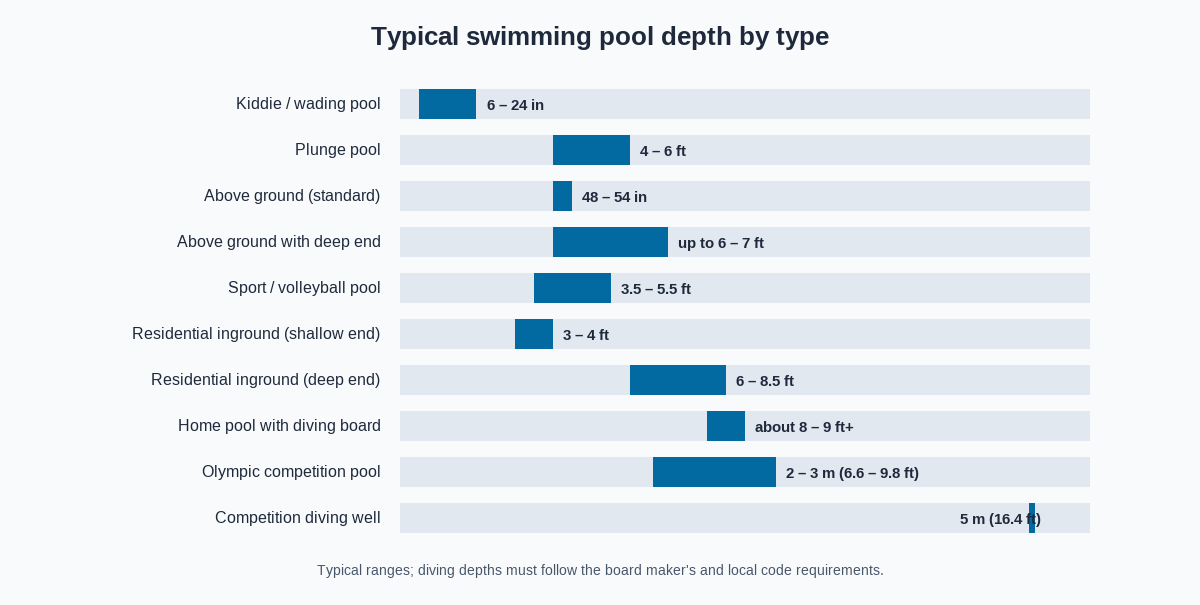
Chart: Asphapro.com
Quick Answer
The typical pool depth for a home inground pool is about 3.5 feet in the shallow end and 5 to 8 feet in the deep end. Many families now choose a sport pool that stays between 3.5 and 5.5 feet so everyone can stand. Standard above ground pools are 48 to 54 inches deep, and an above ground pool with a deep end can reach about 6 to 7 feet in the middle. An 8 foot deep pool is common when a diving board is planned, though boards need enough depth and length set by the maker and code. An Olympic pool must be at least 2 meters (6.6 feet) deep, with 3 meters (9.8 feet) recommended. Pools need clear depth markers on the deck and walls.
Depth shapes how a pool feels and how it is used. Shallow water suits young children, games and lounging; deeper water suits swimming, floating and, with the right design, diving. Depth also affects cost, water volume, heating, chemicals and safety. Choosing the right swimming pool depth is one of the first decisions in planning a pool, and one that is hard to change later.
This guide covers pool depth for every common type, from 48 inch pools to 8 ft pools and Olympic pools, plus pool depth markers and how to choose. For pool shapes and features, see inground pool ideas.
Typical Swimming Pool Depth for Homes
Most residential inground pools have a shallow end of about 3 to 4 feet, deep enough to swim but shallow enough for most adults and older children to stand. The deep end is usually 5 to 8 feet. Many builders slope the floor gently from the shallow end to a "break" point at about 4.5 to 5 feet, then more steeply into the deep end. A common layout is 3.5 feet at the shallow end and 6 to 8 feet at the deep end.
In recent years, many families have chosen not to have a deep end at all. A sport pool or volleyball pool has a consistent depth of about 3.5 to 5.5 feet, often deepest in the middle. Everyone can stand, games like volleyball and basketball work well, and the pool costs less to build, heat and treat. Since home diving boards are less common than they once were, a sport pool fits how most people actually use their pool.
Common Pool Depth Profiles
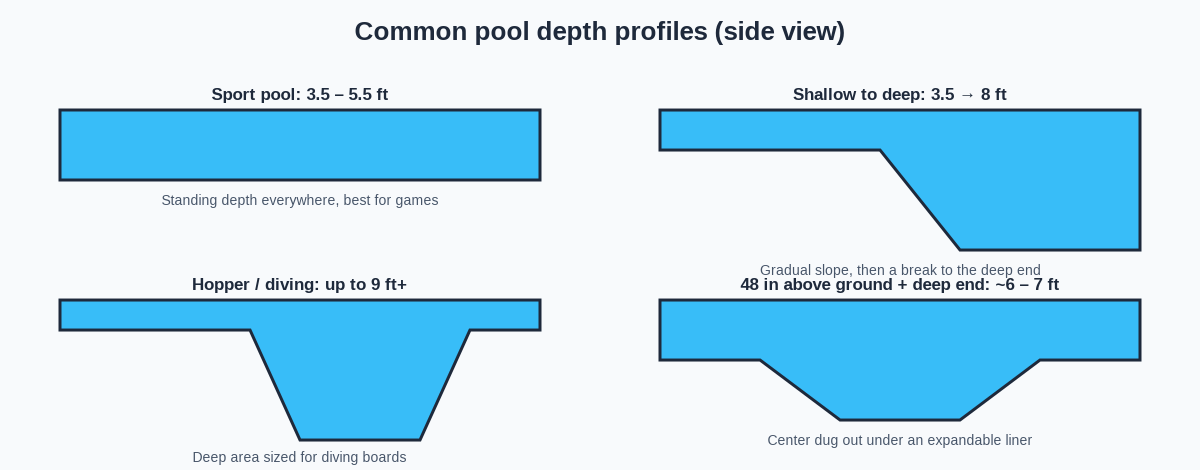
Diagram: Asphapro.com
Flat or sport bottom: one depth or a gentle slope, typically 3.5 to 5.5 feet. Best for play and families.
Shallow to deep: a shallow end that slopes to a deep end of 6 to 8 feet. A classic all-purpose design.
Hopper bottom: a deep area shaped like a funnel, designed for diving boards. Depths often reach 8.5 to 9 feet or more.
Lap pool: long and narrow with a steady depth of about 3.5 to 5 feet for swimming.
Plunge pool: small and usually 4 to 6 feet deep for cooling off and soaking. See what is a plunge pool.
48 Inch Deep Pool: The Standard Above Ground Depth
Most above ground pools have walls 48, 52 or 54 inches tall, and the water level sits a few inches below the top. A 48 inch pool usually holds about 42 to 44 inches of water. That is deep enough for adults to swim, float and play, and children can stand in the shallow parts with supervision. A 48 inch deep pool is the most common and affordable above ground size; 52 and 54 inch walls add a little more depth for taller swimmers. Soft-sided and frame pools come in many depths, from 30 inches for kids to 52 inches for adults. See above ground pool installation cost.
Above Ground Pool With Deep End
An above ground pool with deep end is made by digging a bowl or "hopper" into the ground under the center of the pool and using an expandable liner that stretches down into it. The walls stay fully above ground on a level base, while the center becomes deeper. Typical deep ends reach 6 to 7 feet in the middle of a 24 foot or larger pool, while the edges stay at the normal 48 to 54 inches. Oval pools can have a deep area toward one end.
A deep end adds room to swim and play but has limits. It is not safe for diving; there is not enough length or depth for a diving board, and most above ground pool makers forbid diving. The sides of the dug area must slope gently and sit far enough from the wall that the wall track stays on undisturbed soil. Digging a deep end adds a few hundred to over a thousand dollars and needs careful work. Expandable liners cost more than standard liners. See how to level an above ground pool for base preparation.
8 Foot Deep Pool and Diving Boards
An 8 foot deep pool, or 8 ft pool, was once the standard for homes with diving boards. Today, the rules are more detailed. Safe diving needs not only depth but also enough length of deep water in front of the board, because divers travel forward as they enter the water. Industry standards and diving board makers set minimum depths and envelope sizes for each board type, and many residential diving setups call for 8.5 feet or more at the deepest point. Some insurers and local codes have further rules. If you want a diving board, choose the board first and have your builder design the 8 foot swimming pool deep area to its specifications.
Without a diving board, 8 feet deep is more than most families need, and many owners regret the cost and the loss of usable standing space. Swimmers rarely use water deeper than 6 feet unless diving or doing deep-water exercise. An 8 feet deep pool also holds more water, which costs more to heat and treat.
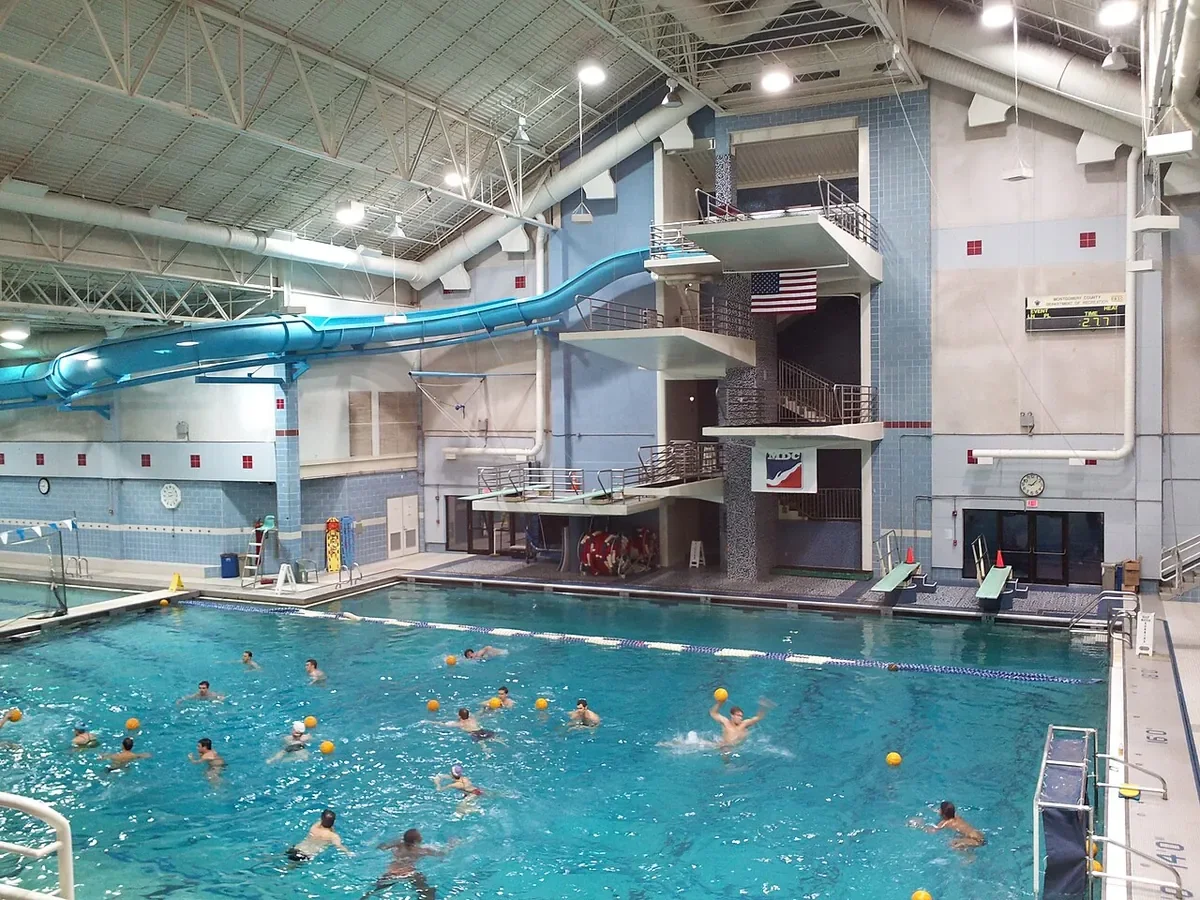
Photo: Ben Schumin, Wikimedia Commons, CC BY-SA 3.0
Depth of Olympic Pool
The depth of Olympic pool competition venues is set by World Aquatics (formerly FINA). An Olympic-size pool is 50 meters long and 25 meters wide. World Aquatics rules require a minimum depth of 2 meters (about 6.6 feet), and a depth of 3 meters (about 9.8 feet) is recommended for Olympic Games and World Championships, since deeper water reduces waves and helps swimmers go faster. Diving wells are much deeper, typically 5 meters (about 16.4 feet) for 10-meter platform diving. See how many gallons are in an Olympic size swimming pool.
Pool Depth Markers
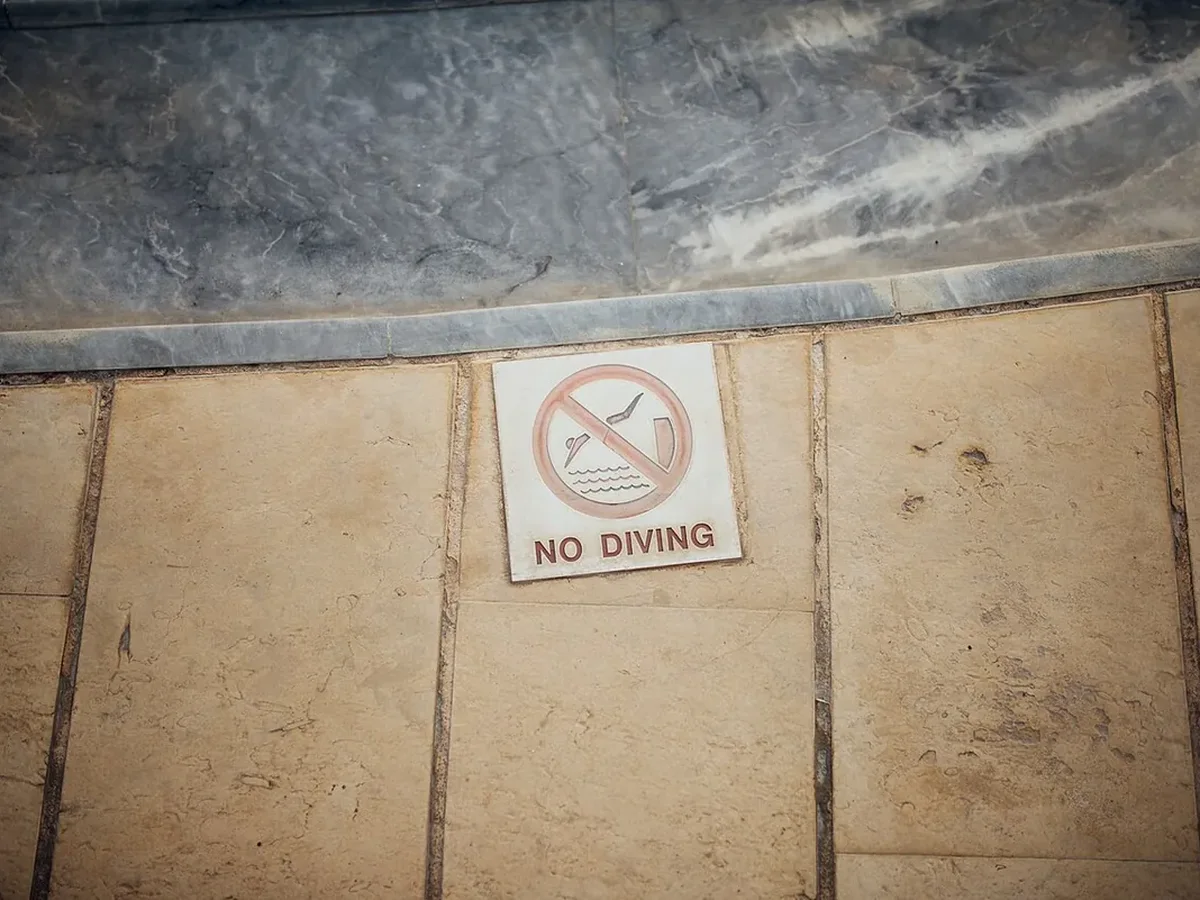
Photo: Shixart1985, Wikimedia Commons, CC BY 2.0
Pool depth markers tell swimmers how deep the water is before they enter. Public pools are required by health and building codes to have them, and many home owners add them for safety. Codes such as the CDC's Model Aquatic Health Code and the International Swimming Pool and Spa Code call for depth markings on the deck and the vertical pool wall at the shallow end, the deep end, the slope break and at set intervals, in numbers at least 4 inches tall with units (FT, IN or M) and in a contrasting color. Shallow areas, often 5 feet or less, must also be marked "NO DIVING" with a symbol. Deck markers should be slip-resistant tiles. Check your local code for exact rules.
How Pool Depth Affects Cost
Deeper pools cost more. A deep end adds excavation, more concrete or a larger fiberglass shell or liner, and more water. A 16 x 32 foot pool with an average depth of 4.5 feet holds about 17,000 gallons; the same pool averaging 5.5 feet holds about 21,000 gallons. That extra water costs more to fill, heat and treat every year. Deep ends also take up space that cannot be used for standing play. A sport pool can save several thousand dollars in construction and hundreds a year in running costs.
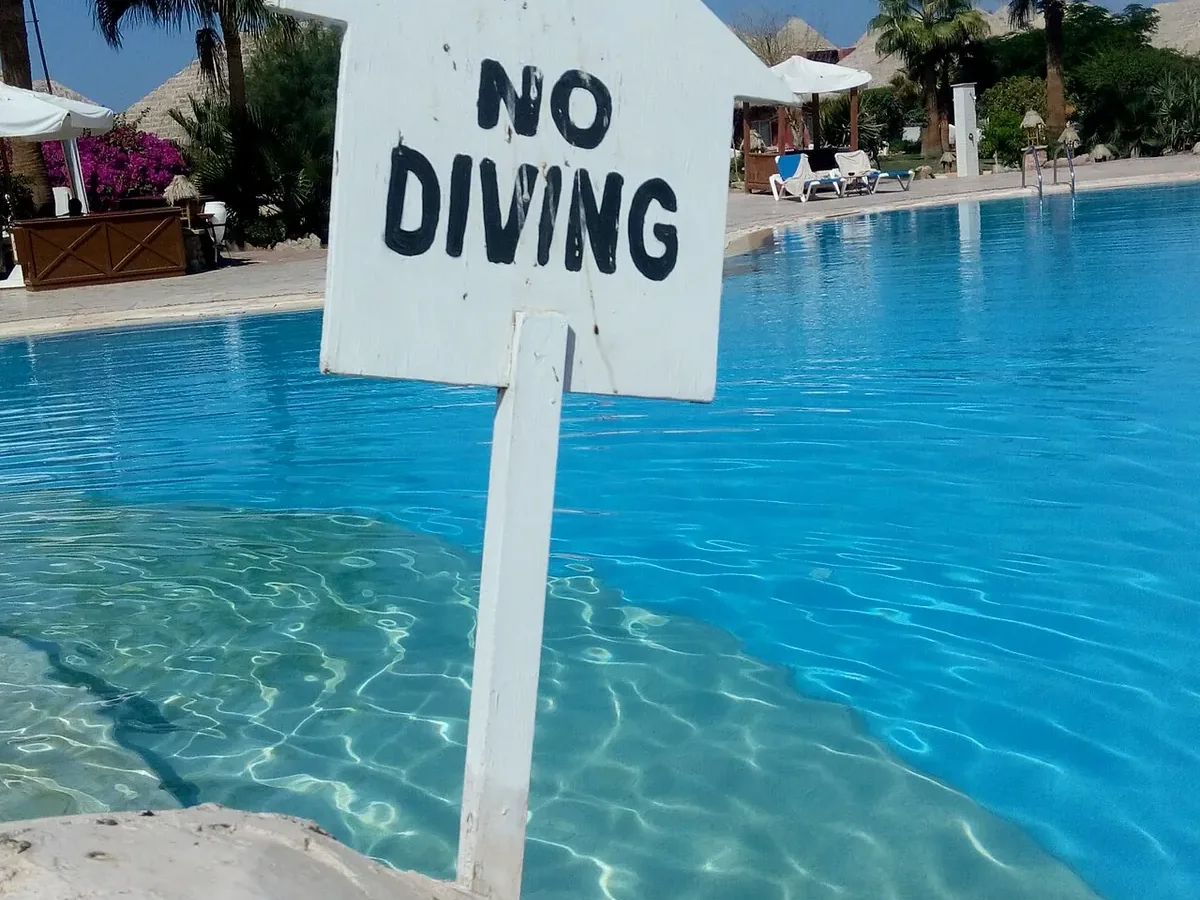
Photo: ديفيد عادل وهبة خليل 2, Wikimedia Commons, CC0
How to Choose the Right Pool Depth
Start with how people will use the pool. If young children will swim, a large area of 3 to 4 feet lets them stand with an adult close by, and a tanning ledge of 6 to 12 inches gives toddlers a supervised place to splash. If adults mainly lounge, play games and cool off, a sport pool depth of 3.5 to 5.5 feet works best. If someone swims laps, 3.5 to 5 feet is plenty, since lap swimming does not need deep water; competition flip turns are easier with at least 4 feet at the walls. If you want a diving board, you need a dedicated deep area designed for that board. For water exercise and deep-water running, an area of 5 to 6 feet is useful. Most families end up with a pool depth range of 3.5 to 6 feet, with a deeper section only if they plan to dive.
Think about the future too. Young children grow into teenagers who may want deeper water for jumping, and older owners may prefer shallow water and wide steps. A pool depth that works for the whole family over 20 years is the best choice.
Pool Depth by Construction Type
Concrete (gunite or shotcrete) pools can be built to almost any depth and profile, from flat sport pools to deep diving pools, and depths can vary across the pool in any pattern.
Fiberglass pools come in fixed shapes and depths set by each maker. Most have a shallow end of 3 to 4 feet and a deep end of 5 to 8 feet, and sport models are common. Because the shell must be shipped by road, very deep fiberglass pools are rare.
Vinyl liner pools offer many depth options, including sport bottoms, hopper bottoms and diving depths, since the floor is shaped on site and the liner is made to fit. See vinyl inground pool cost.
Above ground and semi inground pools are limited by wall height, usually 48 to 54 inches, with optional deep ends dug under the center. Semi inground pools may allow slightly deeper designs.
Average Pool Depth and Water Volume
To work out how many gallons a pool holds, you need its average depth. For a pool with a 3.5 foot shallow end and an 8 foot deep end, a rough average is (3.5 + 8) ÷ 2 = 5.75 feet, though the real average depends on how much of the floor is shallow. Multiply length × width × average depth × 7.5 for rectangular pools. A 16 x 32 foot pool averaging 5.5 feet holds about 21,100 gallons. Knowing the true average swimming pool depth helps you dose chemicals correctly and size pumps, heaters and filters. Many pools are mostly shallow with a smaller deep area, so measure depth at several points rather than just averaging the two ends.
Depth of Steps, Benches and Tanning Ledges
Not every part of a pool is a single depth. Entry steps usually rise about 10 to 12 inches each, with treads 12 inches or wider. Bench seats are often 18 to 24 inches below the water surface so a seated adult has water at chest level. Tanning ledges, or baja shelves, are usually 6 to 12 inches deep, enough to lie in the water on a lounger. Attached spas are usually 3 to 4 feet deep with seats. These shallow areas change how the pool feels, and planning them is part of choosing the overall pool depth. See inground pool steps.
Pool Depth and Safety
Drowning can happen in any depth of water, including just a few inches, so supervision matters at every pool depth. Deeper water adds risk for weak swimmers and for anyone who enters without knowing how deep it is. Clear pool depth markers, a visible slope break, a safety rope with floats at the point where the floor drops toward the deep end, and steps or ladders in both shallow and deep areas all help. Diving into shallow water is a leading cause of serious spinal injuries; never dive into water less than the depth set for diving, and never dive into an above ground pool. Fencing, alarms and covers help keep children away when no adult is present. See pool fence cost.
Swimming Pool Depth Rules for Public and Hotel Pools
Public pools, hotels, clubs and apartment pools must follow state and local health codes, which set requirements for swimming pool depth markings, maximum slopes in shallow areas, the depth at which a slope may change, and minimum depths for diving. Many codes limit the floor slope in water under 5 feet to about 1 foot of drop for every 12 feet of length, then allow steeper slopes beyond that point. Diving boards and starting blocks have their own minimum depths. Home pools usually face fewer rules, but following public pool depth guidelines is a good way to design a safe home pool.
Lap Pool Depth
Lap pools do not need to be deep. A depth of 3.5 to 4 feet is enough for freestyle and other strokes, and it lets swimmers stand to rest. Competitive swimmers who do flip turns prefer at least 4 feet at the walls, and pools with starting blocks need deeper water at that end. A consistent depth makes a lap pool cheaper to build and easier to heat. Many lap pools are 40 to 75 feet long and 8 to 10 feet wide, with a steady pool depth along their length.
Pool Depth and Running Costs
Water volume drives many running costs. Every extra foot of average depth in a 16 x 32 foot pool adds about 3,800 gallons. That means more chlorine, acid and other chemicals each week, a larger heater or longer heating times, and a larger pump and filter. Deeper water also takes longer to warm up in spring. A pool with a modest swimming pool depth and no deep end can cut chemical and heating costs noticeably over the years. See how much does it cost to heat a pool.
Can You Change Pool Depth Later?
Changing pool depth after construction is possible but expensive. Concrete pools can be made shallower by filling part of the deep end with compacted fill and new concrete, then resurfacing. This is sometimes done when owners remove a diving board or want more standing space. Making a pool deeper is much harder and rarely done. Vinyl pools can be reshaped during a liner replacement, with a new floor and liner made to fit, at extra cost. Fiberglass pools cannot be changed. Because changes are costly, it pays to get the pool depth right the first time, with input from everyone who will use the pool.
Worked Examples
Example 1: young family. A family with three young children chooses a 16 x 32 foot sport pool, 3.5 feet at each end and 5 feet in the middle, with a tanning ledge. Everyone can stand, and the average pool depth of about 4.3 feet keeps volume near 16,500 gallons.
Example 2: diving board. A couple who want a diving board choose a vinyl pool with a hopper deep area built to the board maker's dimensions, reaching about 8.5 feet deep, with a 3.5 foot shallow end.
Example 3: above ground pool with deep end. A family installs a 27 foot round 52 inch above ground pool with a dug center and an expandable liner, giving about 6.5 feet in the middle and 4 feet at the edges, with no diving allowed.
Pool Depth Markers at Home
Home owners are not always required to install pool depth markers, but they are a simple safety upgrade. Guests, especially children visiting for the first time, cannot judge swimming pool depth by looking, because clear water makes the bottom look closer than it is. Adding pool depth markers in the coping or deck tile at the shallow end, the slope break and the deep end tells everyone what to expect. Waterline tile with depth numbers is easy to add when tiling or resurfacing. Slip-resistant ceramic or porcelain markers cost about $10 to $40 each, plus installation. "No Diving" markers in shallow areas are a good idea even if no one in your family dives. If you have an 8 ft pool or deeper area, mark it clearly and consider a float rope at the break point.
Measuring Pool Depth
To measure pool depth, use a long pole with markings or a weighted tape measure. Measure from the water surface straight down to the floor at the shallow end, the deepest point and several spots in between. Note where the slope changes. For an above ground pool with deep end, measure at the wall and at the center. Write the numbers down; they help you calculate volume, choose a pool cover and safety rope, and size a heater or pump. If you are buying a home with a pool, measuring pool depth is also a quick way to see whether the pool suits your family before you commit.
Pool Depth for Hot Climates and Cool Climates
Climate can influence the best pool depth. In hot climates, a deeper pool stays cooler in summer, which many swimmers enjoy, and it holds its temperature more steadily. In cooler climates, a shallower swimming pool depth warms faster in the sun and costs less to heat, which helps extend a short season. A sport pool of 3.5 to 5 feet is often the best choice in cool regions, while hot regions may justify a slightly deeper design. Covers help in both cases by keeping heat in and debris out, whatever depth you choose.
Pool Depth Myths
"Deeper is safer." Not necessarily. Weak swimmers are safer in water they can stand in, and drowning can happen at any depth.
"You need a deep end to swim laps." Lap swimming works well in 3.5 to 4 feet of water.
"An 8 foot deep pool is always deep enough for a diving board." Diving safety depends on the board type and the shape and length of the deep area, not just maximum depth.
"Above ground pools with a deep end are fine for diving." They are not; never dive into an above ground pool, whatever the pool depth in the middle.
Questions to Ask Your Pool Builder About Depth
Before you sign a contract, ask your builder a few questions about pool depth. What are the shallow, break-point and deepest depths, and where does the slope change? How long is the shallow area compared with the deep area? If you want a diving board, which board will be used and does the deep area meet its requirements? How will the depth affect the total gallons, the heater size and the yearly chemical cost? Will depth markers and a float rope anchor be included? Ask to see a cross-section drawing of the pool floor, so you can picture exactly how deep each part will be and where people will be able to stand.
Pool Depth: Key Points
- Home inground pools are usually 3.5 ft shallow and 5 to 8 ft deep.
- Sport pools stay 3.5 to 5.5 ft deep for standing play.
- Above ground pools are 48 to 54 in; deep ends reach about 6 to 7 ft.
- Olympic pools are at least 2 m deep, with 3 m recommended.
Frequently Asked Questions
What is the best depth for a family pool?
A sport pool of 3.5 to 5.5 feet suits most families, since everyone can stand and play, and a tanning ledge adds a safe shallow area for toddlers.
How deep does a pool need to be for diving?
It depends on the board; many residential boards need 8.5 feet or more of depth plus enough length of deep water in front of the board. Follow the board maker's specifications and local code.
Can you dive into a 48 inch pool?
No. Never dive into an above ground pool, including one with a deep end. The water is too shallow and the area too small for safe diving.
How deep is an Olympic pool?
At least 2 meters (about 6.6 feet), and 3 meters (about 9.8 feet) is recommended for the Olympic Games and world championships.
Do home pools need depth markers?
Many codes require them for public pools; for home pools they are a good safety step, especially when guests and children visit.
How deep is the shallow end of a pool?
Usually 3 to 4 feet, with 3.5 feet the most common choice for home pools.
Sources
- CDC: Model Aquatic Health Code
- ICC: International Swimming Pool and Spa Code
- World Aquatics: Competition regulations
- CPSC: Pool and spa safety