
Concrete Pool Deck Repair: Cracks, Coping Joints, Spalls and Settled Slabs
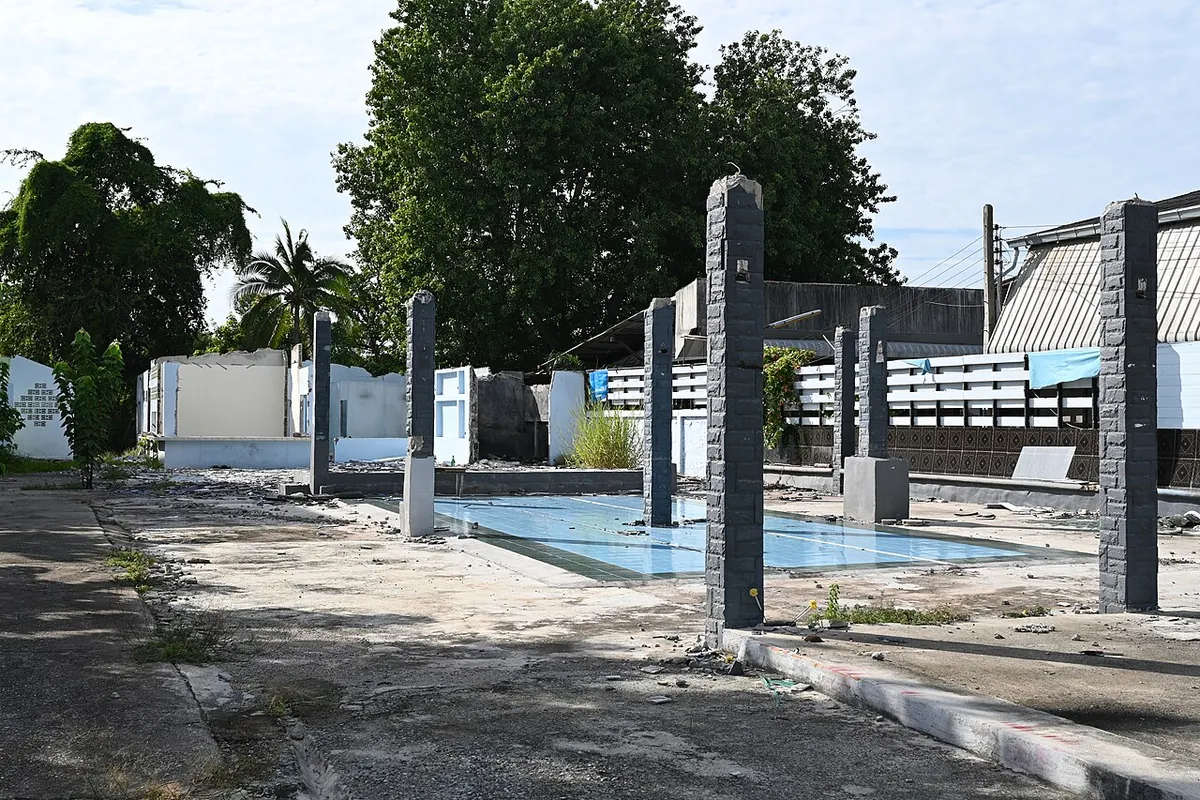
Photo: PattayaPatrol, Wikimedia Commons, CC BY-SA 4.0.
Quick Answer
Most concrete pool deck repair comes down to five jobs: sealing cracks with a flexible sealant, resealing the expansion joint between the pool coping and the deck, patching spalls and chips with a polymer repair mortar, lifting sunken slabs with mudjacking or foam, and resurfacing a worn or patched deck so it looks uniform. Concrete pool deck crack repair and joint sealing are often a few hundred dollars; lifting runs about $3 to $25 per square foot depending on the method; resurfacing about $3 to $5 per square foot for a basic coat and more for decorative overlays; and replacing a deck about $6 to $14 per square foot for plain concrete. Cracks in the pool shell itself are a separate pool concrete repair and usually need a pool contractor.
A pool deck lives a harder life than most concrete. It is splashed with chlorinated or salt water all summer, walked on barefoot, baked in the sun, and in many climates frozen in winter. It also sits right next to a heavy pool shell that moves differently from the deck. Cracks, hollow spots, chipped edges and settled slabs are common, especially once a deck is ten or fifteen years old.
This guide explains what causes pool deck damage, how to handle concrete pool deck crack repair, why the coping joint matters so much, how to patch, level and resurface, what pool deck concrete repair costs, and when to call concrete pool deck repair services.
Why Pool Decks Crack and Break
- Water under the deck. Splash-out, poor drainage and an open coping joint send water under the slab. It softens and washes out the base, and the deck settles and cracks.
- Backfill settlement. The soil around a new pool is backfill that was dug out and replaced. If it was not compacted well, the deck over it settles for years.
- Movement against the pool. Deck and pool expand and contract differently. If the joint between them is filled with rigid mortar or is missing, the deck pushes on the coping, cracking both.
- Freeze-thaw. In cold climates, water in cracks and under the deck freezes, lifting slabs and coping and widening cracks.
- Chemicals and salt. Salt-water pools and pool chemicals can attack the concrete surface over time, causing scaling, pitting and spalling, especially on decks that are not sealed.
- Shrinkage and poor joints. Like any slab, a pool deck needs control joints. Too few, and it cracks randomly.
- Roots. Trees near the deck can lift slabs.
The Coping Joint: Start Here
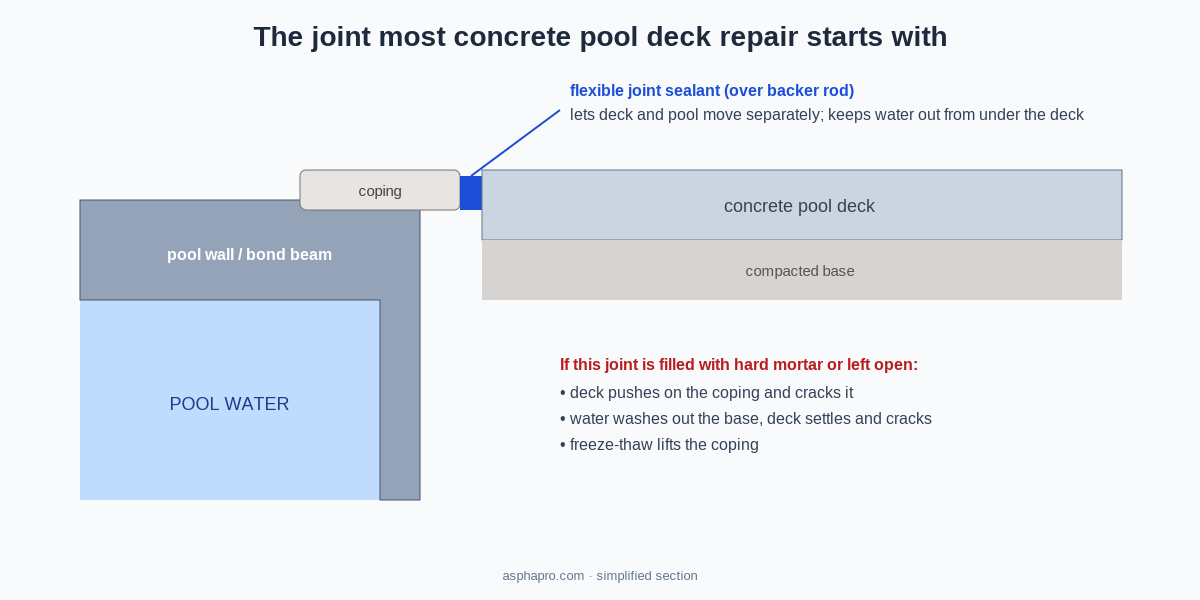
Between the pool coping and the deck there should be an expansion joint filled with a flexible sealant over a backer rod. This joint lets the deck and the pool move independently and keeps water out from under the deck. It is the single most important maintenance item on a concrete pool deck, and failed joint sealant is behind a lot of the cracks, lifted coping and settled decks people see.
If your joint sealant is cracked, pulled away, missing, or the joint has been filled with mortar or grout, fix it first:
- Cut out the old sealant with a utility knife or an oscillating tool. If the joint is full of mortar, it may need to be cut open with a saw by a pro.
- Clean the joint and let it dry.
- Insert closed-cell backer rod so the sealant has the right depth.
- Tape off the coping and deck edges if you want a neat line.
- Fill with a self-leveling sealant made for pool deck joints, such as a polyurethane or polysulfide product, finishing slightly below the surface.
- Let it cure fully before swimming or splashing.
Resealing this joint every several years, or whenever it cracks, prevents many larger repairs. It is also one of the cheapest jobs on the list: a few tubes of sealant and some backer rod cover the joint around a typical residential pool, and most homeowners can finish it in an afternoon.
Concrete Pool Deck Crack Repair
Concrete pool deck crack repair follows the same rules as other outdoor slabs, with a little extra attention to looks and barefoot comfort.
Hairline cracks
Fine shrinkage cracks are common and usually cosmetic. Clean them and seal with a penetrating sealer, or leave them for the next resurfacing coat if they are not growing.
Small and medium cracks
Clean out the crack, add backer rod if it is deep, and fill with a flexible, UV-stable sealant. Choose a color close to the deck, or sprinkle matching sand on the wet sealant so it blends in. Do not use rigid mortar or epoxy in cracks that move with the seasons; they will crack again.
Cracks with uneven edges
A crack with one side higher than the other is a trip hazard for wet, barefoot swimmers. Small lips can be ground flush; larger ones mean the slab has settled and needs lifting. Our guide to how to repair concrete cracks covers products and methods in more detail.
Cracks in textured or coated decks
Many pool decks have a spray texture or acrylic coating. Cracks in these decks are usually routed out, filled with a flexible filler, then the texture is patched or the whole deck is recoated so the repair does not show. This is a common reason homeowners hire concrete pool deck repair services.
Patching Spalls, Chips and Pop-Outs
Chipped edges at steps, spalled areas near the coping and pop-outs across the deck can be patched with a polymer-modified repair mortar:
- Chip out loose concrete back to sound material and square the edges.
- Clean, then dampen the area to saturated surface dry.
- Pack in the repair mortar and finish it to match the deck texture, such as a light broom or a knockdown texture.
- Keep the patch damp while it cures, and keep pool water and chemicals off it during curing.
For more on spalls, see our guide to spalling concrete. For pitting and flaking, see concrete pitting.
Fixing Settled or Sunken Pool Deck Slabs
Sunken slabs are common on pool decks because of backfill and water. Options:
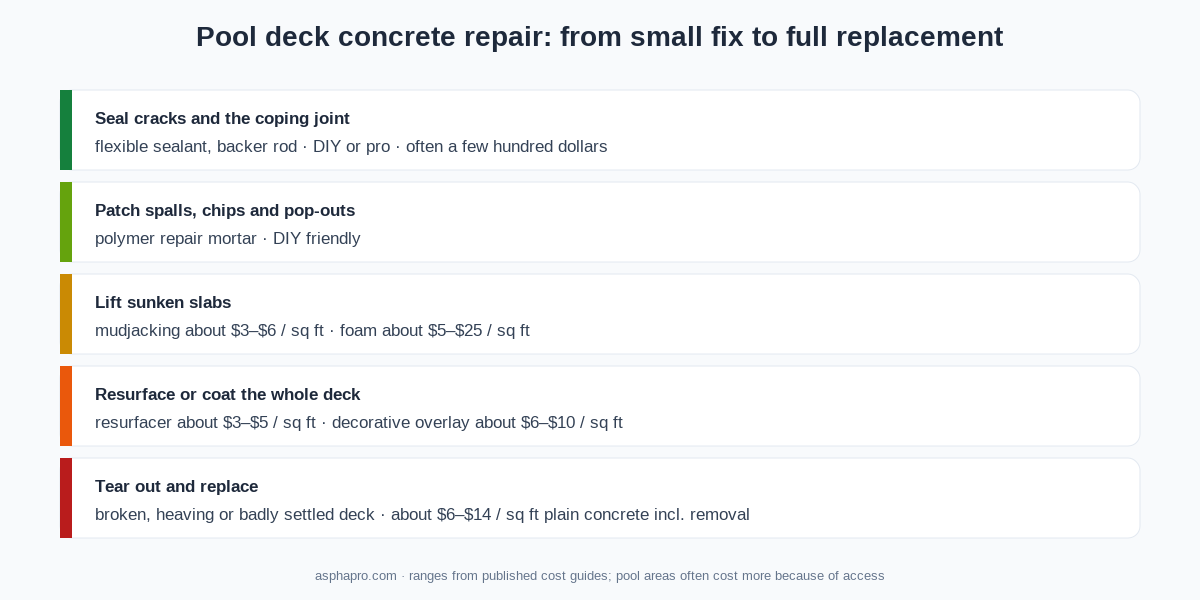
- Mudjacking lifts slabs by pumping a cement slurry underneath, typically about $3 to $6 per square foot.
- Polyurethane foam lifting uses smaller holes and a lightweight foam, about $5 to $25 per square foot. Its light weight is a plus over backfill.
- Replacing badly broken slabs is sometimes better than lifting.
Lifting near a pool needs care, because pumping material under a deck next to the pool wall can push on the wall or plumbing. Use an experienced contractor. See concrete leveling cost.
Resurfacing a Pool Deck
When a deck has many cracks, patches, stains and a worn surface, but the slabs are level and solid, resurfacing gives it a new look and a uniform, slip-resistant surface. Options include a plain cement resurfacer, a spray-applied knockdown texture, a stamped or stenciled overlay, or an acrylic coating. Our guide to concrete pool deck resurfacing compares them. Repair cracks, joints and spalls first, or they will show through the new surface within a season or two.
Pool Concrete Repair: The Pool Shell
Pool concrete repair can also mean repairing the pool itself. Concrete and gunite or shotcrete pools have a concrete shell covered with plaster, aggregate or tile. Common problems include:
- Surface cracks in the plaster (checking or crazing), which are usually cosmetic.
- Cracks through the shell, which can leak and may be structural.
- Delaminated or rough plaster, which is fixed by replastering.
- Cracked or loose coping and tile at the waterline.
Small plaster chips can be patched with underwater epoxy putty or pool patch products. Cracks that leak, cracks through the shell, and replastering are jobs for a pool contractor, because the pool may need draining, and draining a pool at the wrong time can damage it if groundwater is high. Pool cement repair at the waterline, such as resetting coping and tile, also usually needs a pool professional. This guide focuses on the deck; ask a pool builder about the shell.
Pool Deck Finishes and How They Fail
The type of finish on your deck changes what damage looks like and how a repair should be done:
- Broom-finished concrete: the simplest deck. Cracks and spalls are easy to patch, but patches show unless the whole deck is resurfaced.
- Exposed aggregate: stones at the surface hide small cracks well, but loose stones pop out over time. Repairs use a matching aggregate pressed into fresh mortar.
- Stamped concrete: pattern and color make patches hard to hide. Cracks are often sealed along grout lines, and the deck is recolored and resealed afterward.
- Spray knockdown texture (often called cool deck): a thin acrylic-cement texture over concrete that stays cooler underfoot. It cracks and peels with the slab beneath it, and is usually patched and recoated.
- Pavers over a concrete base: individual pavers can be lifted and reset; the concrete under them still needs drainage.
Slip Resistance and Safety
A pool deck is a wet, barefoot surface, so slip resistance matters as much as looks. After any concrete pool deck repair:
- Match the texture of patches to the rest of the deck; smooth troweled patches can be slippery.
- Choose a sealer meant for pool decks, and ask for a slip-resistant additive if it gives a sheen.
- Grind or lift any lips at cracks and joints; even a 1/4-inch lip catches toes.
- Keep algae and mildew off shaded areas, which become slick.
- Check steps and the edges of the coping, where most falls happen.
Pool Deck Drainage and Slope
Water should run away from the pool, either to deck drains or off the edge of the deck into the yard. A deck that slopes toward the pool sends dirt, fertilizer and debris into the water, and a deck with low spots holds water that grows algae and freezes in winter. Clogged deck drains are common: flush them with a hose and clear leaves regularly. If the deck has settled into the wrong slope, lifting slabs with foam or mudjacking can often correct it. Fixing drainage is part of any lasting pool deck concrete repair, because water under the deck is behind most settlement and cracking.
Salt-Water Pools and Concrete Decks
Salt-water pools are popular, but salt splash and spray can be hard on concrete and natural stone over time. Salt water that dries on the deck leaves salt in the surface pores; as it crystallizes and as the deck freezes and thaws, it can cause scaling and pitting. To protect the deck:
- Seal the deck with a penetrating sealer rated for salt exposure, and reseal on schedule.
- Rinse the deck with fresh water after heavy use or after draining or backwashing.
- Keep the coping joint and cracks sealed so salt water stays out of the slab.
- Ask your installer about salt-resistant finishes if you are building a new deck.
Pool Deck Repair in Freezing Climates
In regions with cold winters, freeze-thaw does more damage to a pool deck than anything else. Water that gets under the deck or into cracks freezes, expands and lifts slabs and coping, and every spring the gaps are a little wider. Before closing the pool, walk the deck and seal every open crack and the coping joint, clear deck drains, and make sure the cover and winterizing plan keep water from pooling on the deck. Avoid rock salt on pool decks in winter; it adds to freeze-thaw damage and gets into the pool water in spring. If the coping has started to lift, have a pool contractor look at it before the next winter, because lifted coping can damage the tile line and the pool finish.
Best Time of Year for Pool Deck Repairs
Most cement-based patches, resurfacers and sealants need dry weather and temperatures above about 50°F to cure. In cold climates, the best time for pool deck work is late spring before opening the pool or early fall after closing it, so you are not trying to keep swimmers and splashes off fresh repairs. In hot climates, avoid midday heat; work early in the morning or late in the afternoon and keep cement products damp while they cure. Never let pool water, chemicals or salt water splash onto a fresh repair until it has cured as long as the label requires.
Tools for DIY Pool Deck Concrete Repair
- Utility knife or oscillating tool to cut out old joint sealant
- Wire brush, shop vac and leaf blower
- Closed-cell backer rod in a few sizes
- Pool deck joint sealant and a caulk gun
- Angle grinder with a diamond blade for squaring patches and crack edges
- Polymer-modified repair mortar and a margin trowel
- Painter's tape for neat joint lines
- Pump sprayer for sealer
- Safety glasses, gloves and a dust mask
A Worked Example: Twenty-Year-Old Pool Deck
A 600 square foot broom-finished pool deck has a coping joint sealed with old, cracked caulk, five cracks of up to 1/4 inch, one slab near the steps that has dropped about 1/2 inch, and scattered pop-outs. The rest of the deck is solid.
- Cut out the old joint sealant, clean the joint, insert backer rod and reseal it.
- Have the dropped slab lifted with polyurethane foam, roughly 80 square feet at $5 to $25 per square foot.
- Clean and seal the cracks with a flexible sealant, and patch pop-outs with repair mortar.
- Pressure-wash and resurface the whole deck with a cement resurfacer and light broom finish, about $3 to $5 per square foot.
- Seal the deck with a slip-resistant pool deck sealer.
The lifting might cost roughly $400 to $2,000 depending on the method and minimum charges, and the resurfacing roughly $1,800 to $3,000, compared with something like $3,600 to $8,400 to replace the deck with plain concrete.
Concrete Pool Repair for Small Shell Problems
For small concrete pool repair jobs on the pool shell, such as a chip in the plaster at a step or a small hole, pool supply stores sell patch kits and underwater epoxy putties that can be applied without draining the pool. Rough spots on plaster can sometimes be smoothed with a pumice stone. Tile that has fallen off at the waterline can be reset with a pool-rated thinset or epoxy if the bond beam behind it is sound. Anything that involves leaks, cracks that run through the shell, hollow-sounding plaster over a large area, or coping that is loose all around the pool should be inspected by a pool contractor.
What Concrete Pool Deck Repair Costs
| Repair | Typical cost |
|---|---|
| DIY crack and joint sealing materials | About $30 to $150 |
| Professional crack repair and joint resealing | Often a few hundred dollars, more for long joints |
| Patching spalls and chips | DIY $20 to $100; pros often a few hundred dollars |
| Mudjacking settled slabs | About $3 to $6 per square foot |
| Polyurethane foam lifting | About $5 to $25 per square foot |
| Resurfacing with a cement resurfacer | About $3 to $5 per square foot |
| Decorative overlay (stamped, textured, colored) | About $6 to $10 per square foot |
| Replacing a plain concrete deck | About $6 to $14 per square foot including removal |
These ranges follow published cost guides such as HomeGuide and match our concrete repair cost and concrete overlay cost guides. Pool areas can cost more than open driveways because of access, protecting the pool, and careful work next to coping and plumbing.
Hiring Concrete Pool Deck Repair Services
Concrete pool deck repair services range from general concrete contractors to decorative concrete specialists and pool builders. For a good result:
- Ask how they will handle the coping joint, and what sealant they use.
- Ask whether they will fix settlement before resurfacing.
- For textured or coated decks, ask to see finished jobs that are at least a couple of years old.
- Confirm how they will protect the pool water and finish from dust and debris.
- Get the warranty in writing, and ask what it covers if cracks reappear.
- For shell, tile or coping work, use a pool contractor.
Cement Pool Deck Repair Mistakes to Avoid
- Filling the coping joint with mortar or grout.
- Coating over cracks and joints without repairing them.
- Using rigid fillers in moving cracks.
- Resurfacing over settled slabs instead of lifting them first.
- Ignoring drainage, so water keeps running under the deck.
- Using slippery, glossy sealers on a wet, barefoot surface; ask for a slip-resistant additive.
- Letting pool chemicals or salt water sit on fresh patches during curing.
Maintenance That Prevents Pool Deck Damage
- Inspect and reseal the coping joint every few years.
- Keep deck drains clear, and make sure the deck slopes away from the pool to drains or the yard.
- Seal the deck with a breathable, slip-resistant sealer suited to pool decks, and reseal as directed.
- Rinse salt-water splash off the deck regularly if you have a salt pool.
- Seal small cracks as they appear, before winter.
- Keep trees with aggressive roots away from the deck.
- In freezing climates, close the pool properly and keep water from pooling on the deck.
How Long Does Pool Deck Concrete Repair Last?
How long a repair lasts depends on what was fixed and how well the causes were handled. Joint sealant on a pool deck often needs replacing every several years because it works hard in sun and water. Crack sealant in a deck that moves seasonally lasts longer when backer rod is used and the crack was cleaned well. Mortar patches last as long as the concrete around them stays sound and dry. Resurfaced and coated decks commonly need resealing or a fresh topcoat every few years to keep their color and grip. The repairs that last longest are the ones that also fixed water: an open coping joint, clogged drains, or a deck sloping toward the pool. Without those fixes, cracks reopen and slabs settle again no matter how good the patch is.
Questions to Ask Before Cement Pool Deck Repair
- Is the damage only on the surface, or are slabs moving?
- Is the coping joint flexible and sealed, or filled with mortar?
- Does water drain away from the pool?
- Is the deck finish plain, stamped, exposed aggregate or textured, and how will repairs be matched?
- Will the repair be done in a season when the pool can be kept closed while it cures?
- Would resurfacing the whole deck now save money compared with many small patches over the next few years?
Answering these before calling contractors helps you compare quotes for the same scope of work, and keeps you from paying for a resurfacing job when the real problem is a settled slab or a failed joint.
Repair or Replace a Pool Deck?
Concrete pool deck repair is usually worth it when slabs are mostly level and in one piece. Replacement makes more sense when most slabs are cracked through, many have settled or heaved, the coping is being pushed or lifted, or you want a different material such as pavers. Replacing a deck around a pool needs care to protect the coping, plumbing and pool finish, and is a good time to fix drainage and add proper joints. See concrete removal cost and stamped concrete vs pavers.
Frequently Asked Questions
How do you repair a concrete pool deck?
Reseal the coping joint, clean and seal cracks with a flexible sealant, patch spalls with repair mortar, lift any settled slabs, then resurface or seal the deck so it looks uniform.
How much does concrete pool deck repair cost?
Crack and joint repairs often cost a few hundred dollars, lifting about $3 to $25 per square foot, resurfacing about $3 to $5 per square foot for a basic coat, and replacement about $6 to $14 per square foot.
What is the best way to do concrete pool deck crack repair?
Clean the crack, add backer rod if deep, and fill with a flexible UV-stable sealant. Grind or lift uneven edges. On textured decks, patch the texture or recoat after filling.
Should the joint between the pool and deck be caulked?
Yes. The expansion joint between coping and deck should be filled with a flexible sealant over backer rod, not mortar, so the deck and pool can move separately and water stays out.
Can you resurface a cracked pool deck?
Yes, if the slabs are level and sound. Repair cracks and joints first, then apply a resurfacer, overlay or coating.
Who does pool concrete repair on the pool shell?
Pool contractors handle shell cracks, leaks, replastering, tile and coping. Concrete contractors and decorative concrete companies usually handle the deck.
Sources
- HomeGuide: Concrete Resurfacing Cost
- HomeGuide: Mudjacking Cost
- HomeGuide: Polyjacking Cost
- Concrete Network: Concrete Overlay Cost
- U.S. General Services Administration: Types of Cracks in Concrete and Typical Causes
Related Guides
- Concrete pool deck resurfacing — coatings, spray textures and overlays
- Concrete expansion joint guide — filler, caulk and where joints go
- Shotcrete vs gunite — sprayed concrete for pools and walls
- Stamped concrete patios — designs, colors, cost and pool decks
- How to clean moss from concrete — removing moss and stopping regrowth
- How to kill roots under concrete — tree roots lifting slabs
- Concrete pool — construction, gunite and costs
- Concrete pool coping — poured and precast coping, joints and repair
- Concrete trench drain — channel drains, grates, install and cost
- Pool deck concrete — installation, finishes and cost
- Concrete restoration — repair process, methods and cost