
How Much Water Evaporates From a Pool? Rates, Calculator and Costs
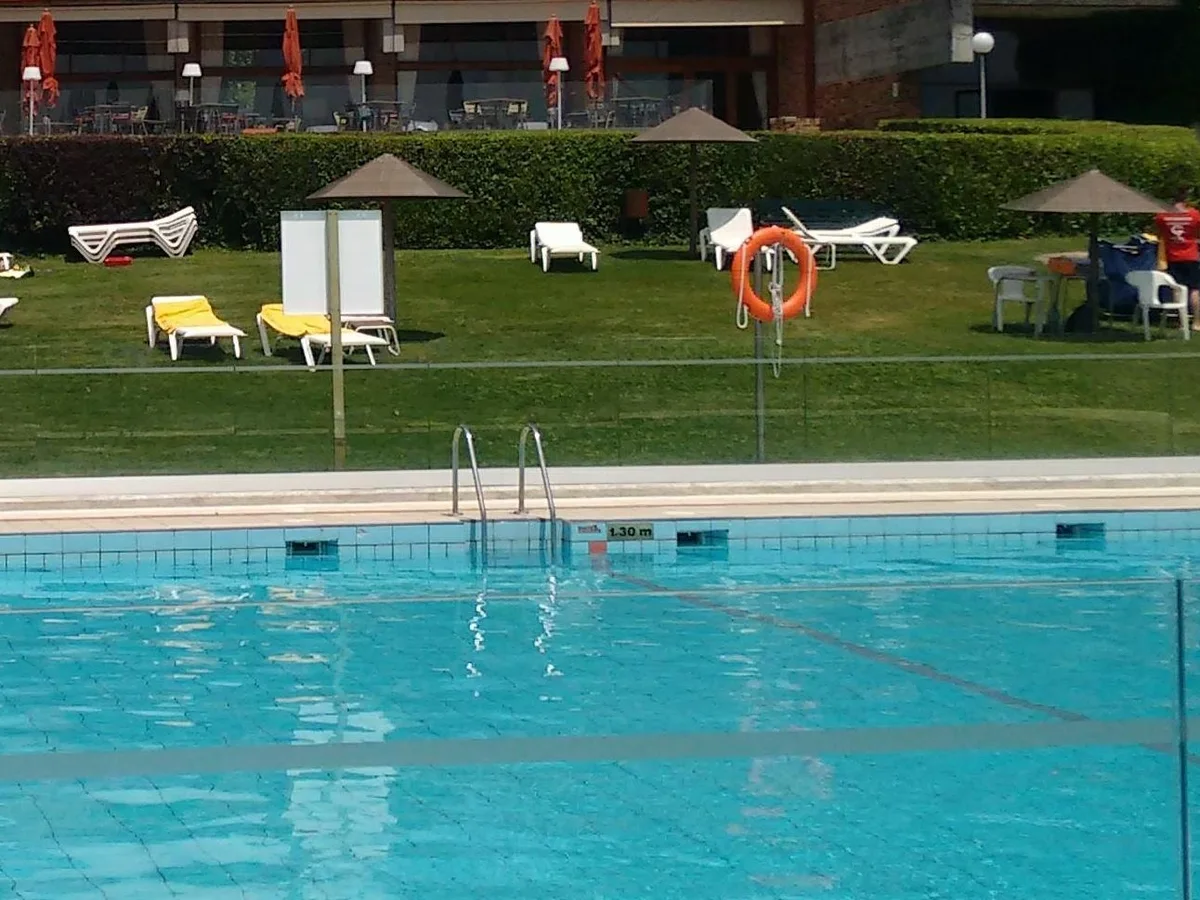
Photo: Egidio24, Wikimedia Commons, CC BY-SA 4.0
Quick Answer
An uncovered outdoor pool usually loses about 1/4 inch of water a day to evaporation in summer, with a normal range of 1/8 to 1/2 inch. Hot, dry, windy places and heated pools can lose 1/2 inch or more. For a 16 by 32 foot pool, 1/4 inch a day is about 80 gallons a day, roughly 2,400 gallons a month. Over a season, that can add up to 10,000 to 30,000 gallons. A pool cover cuts evaporation by up to 95%. If your pool drops more than about 1/2 inch a day without splashing, or the bucket test shows the pool losing more than the bucket, look for a leak.
Every pool owner sees the water level drop over a hot week and wonders whether it is normal or a leak. Knowing how much water evaporates from a pool helps you answer that question, plan your water bill and decide whether a cover or windbreak is worth buying. Evaporation is the single biggest source of water loss in most outdoor pools, often bigger than splash-out and backwashing combined.
This guide explains how much water evaporates from a pool in different climates, what drives evaporation, how to estimate your own pool's losses with a calculator, how to tell evaporation from a leak, and what you can do to cut water and heating costs. If you think you have a leak, also see how to find a leak in a pool.
Pool Evaporation Calculator
Enter your pool's size, climate and conditions to estimate how much water evaporates from a pool like yours each day and month, and what it costs to replace.
The calculator uses typical daily evaporation rates for each climate and adjusts them for wind, heating, water features and cover use. Real evaporation changes day to day with the weather, so treat the result as an average for the swimming season. For the exact physics, engineers use formulas based on water temperature, air temperature, humidity and wind speed; the simple rates here match those well for typical residential pools.
How Much Water Evaporates From a Pool by Climate
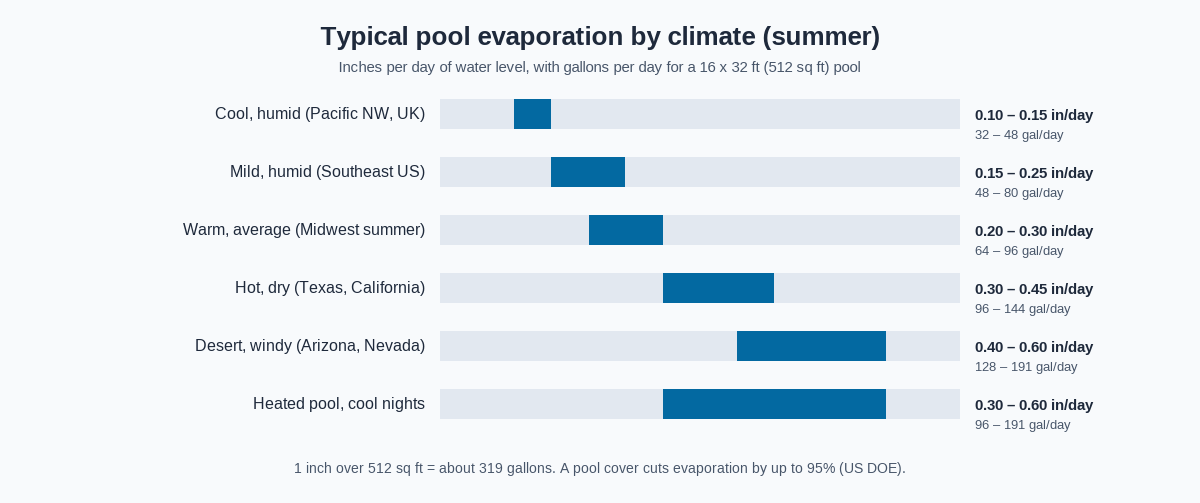
Chart: Asphapro.com
The chart shows how much water evaporates from a pool in different summer climates. In cool, humid places such as the Pacific Northwest or the UK, a pool may lose only 1/10 to 1/7 of an inch a day. In the humid Southeast, 1/6 to 1/4 inch is common. In hot, dry parts of Texas and California, 1/3 to nearly 1/2 inch a day is normal, and in the desert Southwest, pools can lose 1/2 inch or more on hot, windy days. Heated pools lose more than unheated pools in the same climate, especially on cool nights when warm water meets cold air.
To turn inches into gallons, multiply the pool's surface area in square feet by the inches lost, divide by 12 to get cubic feet, then multiply by 7.48 gallons per cubic foot. For a 16 by 32 foot pool with 512 square feet of surface, one inch of water is about 319 gallons. So a 1/4 inch daily drop is about 80 gallons, and a 1/2 inch drop is about 160 gallons. Note that depth does not matter: how much water evaporates from a pool depends on the surface area, not the total volume.
How Much Water Evaporates From a Swimming Pool per Week, Month and Year
Daily numbers add up fast. Here is how much water evaporates from a swimming pool of 512 square feet over longer periods at a typical rate of 1/4 inch a day:
- Per day: about 80 gallons
- Per week: about 1 3/4 inches, or 560 gallons
- Per month: about 7 1/2 inches, or 2,400 gallons
- Per 5-month season: about 3 feet of water, or 12,000 gallons
In a desert climate at 1/2 inch a day, the season total can reach 25,000 gallons or more, close to the full volume of many pools. In year-round climates like Arizona, Florida and Southern California, annual evaporation from an uncovered pool can be 40,000 to 60,000 gallons. That is why water agencies in dry regions often recommend pool covers and why some offer rebates for them.
What Controls How Much Water Evaporates From a Pool
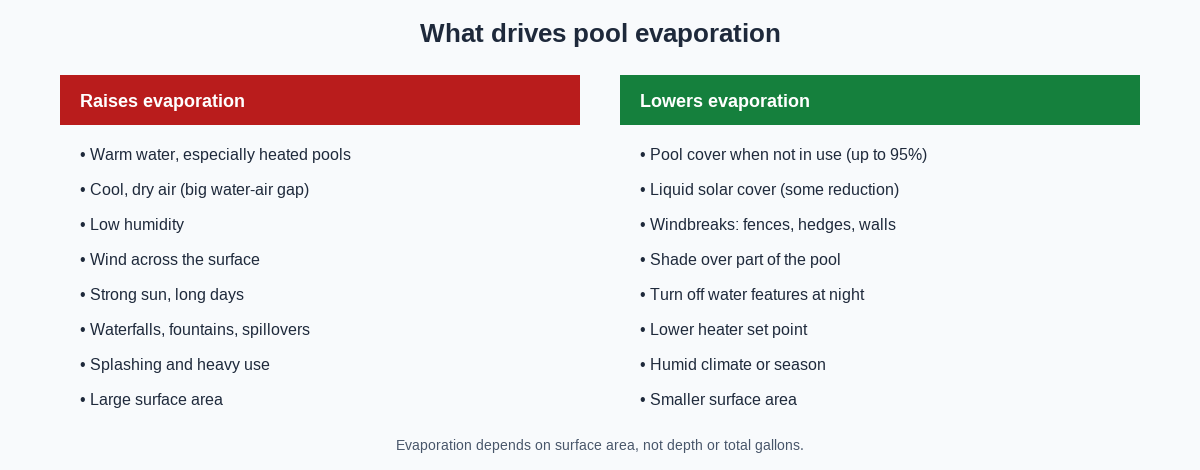
Chart: Asphapro.com
Water temperature and air temperature. Warm water evaporates faster. What really matters is the difference between the water's vapor pressure and the air's. When water is warmer than the air, as in heated pools on cool evenings, evaporation is high; you may even see steam rising.
Humidity. Dry air can take up more water. In humid climates, the air is already close to full, so evaporation slows. This is why pools in Arizona lose far more than pools in Florida even at similar temperatures.
Wind. Wind carries moist air away from the surface and replaces it with drier air. The US Department of Energy notes that a 7 mph wind at the pool surface can increase energy loss by as much as 300%, and most of that loss is evaporation. Windbreaks help a lot.
Sun. Direct sun warms the surface layer of the water, which speeds up evaporation. Long summer days add up.
Water features and splashing. Waterfalls, fountains, spillover spas and sheer descents spray water into the air and expose much more surface, greatly increasing losses. Splashing and heavy use also throw water out of the pool.
Surface area. The bigger the surface, the more water is lost. Depth does not change evaporation.
How Scientists Measure Evaporation
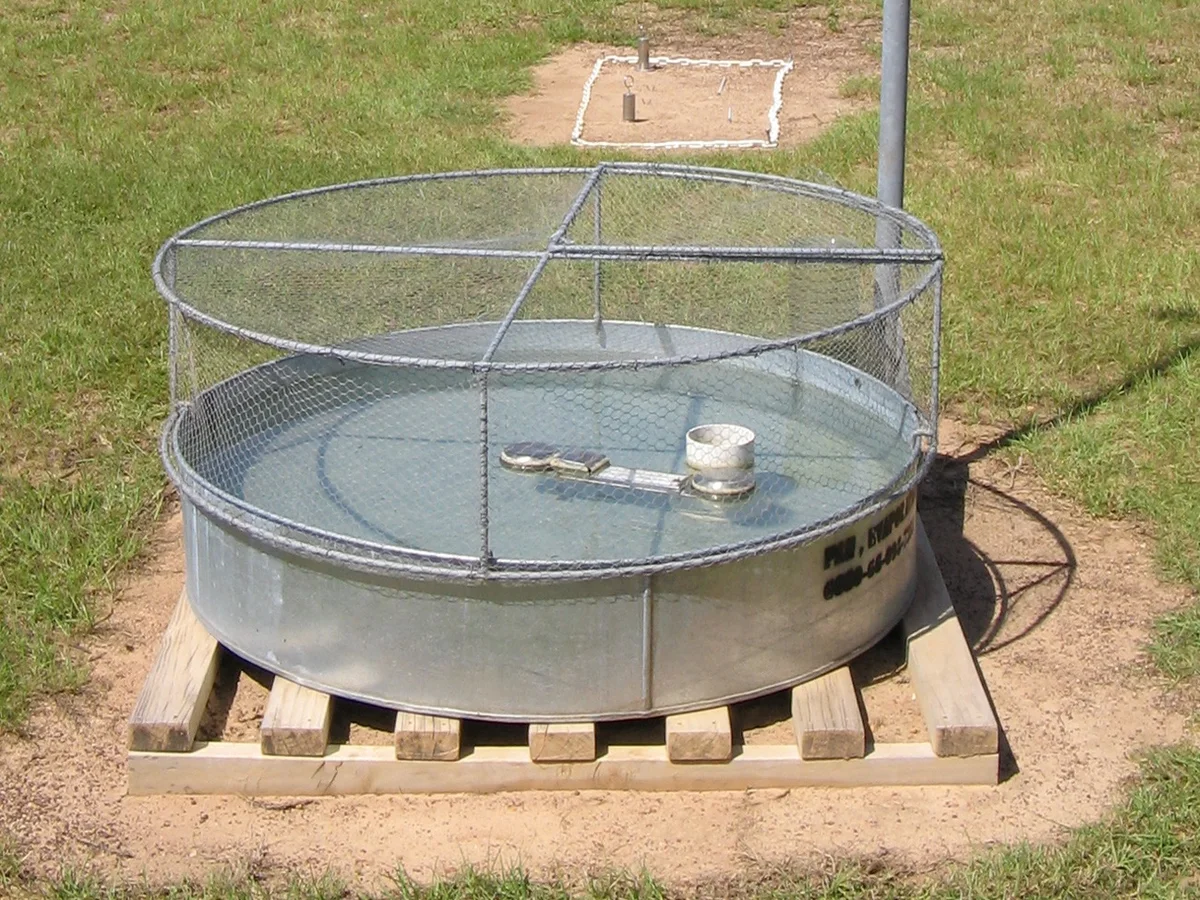
Photo: Bidgee, Wikimedia Commons, CC BY 3.0
Weather services measure evaporation with a Class A evaporation pan, like the one in the photo: a round metal pan about 4 feet across and 10 inches deep, filled with water and checked every day. Pan evaporation data is published for many locations and gives a good idea of how much water evaporates from a pool in your area. A pool usually evaporates a bit less than the pan, often around 70 to 80% of the pan rate, because the pool is deeper and its water warms more slowly. If your local weather service or university extension publishes pan evaporation figures, you can use them to estimate your pool's losses month by month.
Evaporation or a Leak? The Bucket Test
The easiest way to tell evaporation from a leak is the bucket test. Fill a bucket with pool water to about the same level as the pool, and set it on the second step so it sits in the pool water. Mark the water level inside the bucket and the pool level on the outside of the bucket. Turn off auto-fill and do not swim. After 24 to 48 hours, compare the drops. If the pool dropped about the same as the bucket, the loss is evaporation. If the pool dropped noticeably more, you likely have a leak. Run the test once with the pump running and once with it off; if the loss is greater with the pump on, the leak is likely on the pressure side of the plumbing.
As a rule of thumb, losing more than about 1/2 inch a day in a mild climate, or more than about 2 inches a week without heavy use, is worth checking. For costs if you find a leak, see pool leak repair cost.
Other Ways Pools Lose Water
Not every drop is evaporation or a leak. Splash-out from kids, dogs and cannonballs can remove several inches in a busy day. Backwashing a sand or DE filter uses 200 to 500 gallons each time. Vacuuming to waste removes water quickly. Rain can add water, and heavy rain may require you to lower the level. Water features and spillover spas lose extra water to both evaporation and splash. Keep these in mind when you try to work out how much water evaporates from a pool on its own.
How Much Water Evaporates From a Pool With a Cover
According to the US Department of Energy, pool covers can reduce evaporation by 90 to 95% when used whenever the pool is not in use. That makes a cover the single most effective way to cut how much water evaporates from a pool. A basic solar bubble cover costs a few hundred dollars and also holds in heat. Automatic covers cost more but are easy to use, so they get used more often. Liquid solar covers, thin chemical layers that float on the surface, reduce evaporation somewhat but much less than a physical cover, and wind and swimmers break up the layer. For prices, see pool cover cost and automatic pool cover cost.
How Much Water Evaporates From a Heated Pool
Heated pools lose more water and much more energy. Most of a pool's heat loss is through evaporation; the DOE notes that evaporation accounts for about 70% of heat loss in outdoor pools. Every gallon that evaporates takes about 8,700 BTUs of heat with it. So a heated pool losing 100 gallons a day is losing about 870,000 BTUs a day to evaporation alone, which a gas heater has to replace. Using a cover on a heated pool can cut heating costs by 50 to 70% and greatly reduce how much water evaporates from a pool. For heater sizing, see pool heater size calculator.
How to Reduce Pool Evaporation
Use a cover. The biggest saving by far, up to 95%.
Add windbreaks. Fences, hedges, walls and screens around the pool slow the wind across the surface. See pool privacy ideas for screens that also cut wind.
Turn off water features when not needed. Run waterfalls and fountains only when you are enjoying them, and never overnight.
Lower the heater set point. Every degree warmer increases evaporation and heat loss. Keep the water a few degrees lower and use a cover at night.
Add shade. A pergola, sail or trees over part of the pool reduce sun on the surface.
Keep the water level right. Keep the water at the middle of the skimmer opening, not overfilled, to reduce splash-out.
Backwash only when needed. Backwash when the pressure rises 8 to 10 psi, not on a fixed schedule. A cartridge filter avoids backwash water entirely.
How Much Water Evaporates From a Pool: Cost of Refilling
The cost of replacing evaporated water depends on local water prices, which commonly run $3 to $10 per 1,000 gallons in the US, plus sewer charges in some areas where the bill is based on water use. At $6 per 1,000 gallons, replacing 2,400 gallons a month costs about $14. Over a season of 12,000 gallons, about $72. In a desert climate losing 25,000 to 50,000 gallons a year, the water cost may be $150 to $300 a year or more, and heating costs on top. Some cities offer a sewer credit for pool filling; ask your utility. For the cost of filling a pool from scratch, see swimming pool filling cost.
How Much Water Evaporates From a Pool: Worked Examples
Phoenix, Arizona, 15 by 30 foot pool, unheated, no cover. Surface area 450 square feet. At about 1/2 inch a day in summer, the pool loses 450 × 0.5 / 12 × 7.48 = about 140 gallons a day, or 4,250 gallons a month. With a cover used whenever the pool is not in use, losses drop to roughly 640 gallons a month.
Atlanta, Georgia, 16 by 32 foot pool. At about 1/5 inch a day, the pool loses about 64 gallons a day, or 1,940 gallons a month. The owner fills it with a garden hose for a few minutes every few days.
Heated pool in Colorado with a waterfall. A 14 by 28 foot pool (392 square feet) heated to 84°F with a waterfall runs about 1/2 inch a day on cool nights: about 122 gallons a day. Turning off the waterfall at night and using a solar cover cuts this to around 30 gallons a day and saves a large share of the heating bill.
Suspected leak. An owner in Ohio sees the pool drop 1 inch a day in mild weather, far more than the expected 1/4 inch. The bucket test shows the bucket losing 1/4 inch while the pool loses 1 inch. A leak detection company finds a cracked return line.
How to Measure How Much Water Evaporates From Your Pool
You do not need special tools to find out how much water evaporates from a pool in your own yard. Turn off any auto-fill valve, and on a calm day with no swimming, mark the water level on the tile or skimmer with a piece of tape or a grease pencil. Measure again 24 hours later at the same time of day, using a ruler held against the tile. Repeat for three to five days and average the results, since a single hot, windy day can be far above normal. Write down the weather each day as well. After a week, you will have a good idea of your pool's normal evaporation in that season. Compare it with the climate chart above: if your numbers are close, your pool is behaving normally; if they are much higher, use the bucket test to rule out a leak.
Many owners keep a simple log through the season. A notebook with the date, the water level, the weather and any top-ups makes it easy to spot changes. A sudden jump in losses with no change in weather is one of the earliest signs of a leak, and catching it early can save thousands of gallons and prevent damage to the ground around the pool.
Evaporation and Pool Water Chemistry
When water evaporates, the minerals and chemicals stay behind. Calcium, salt, cyanuric acid (stabilizer) and other dissolved solids slowly build up as you top up the pool with fresh water that adds more minerals. In hot, dry areas where a lot of water evaporates from a pool each year, total dissolved solids and calcium hardness can climb high enough to cause scale on tile, cloudy water and scaling in heaters and salt cells. That is why pools in desert climates often need a partial drain and refill every few years, while pools in rainy climates rarely do. Test calcium hardness and cyanuric acid a few times a season, and if they climb too high, replace part of the water. Evaporation also concentrates salt in saltwater pools, though most of the salt stays in the pool, so salt levels change little unless you lose water through splash-out, backwash or leaks.
Topping Up: Hose or Auto-Fill?
Most owners top up evaporation with a garden hose every few days. A standard hose delivers about 5 to 10 gallons a minute, so replacing 80 gallons takes around 10 to 15 minutes. Use a timer on the spigot so you do not forget it running. An auto-fill valve keeps the level steady automatically, which is convenient during vacations and heat waves, but it can hide a leak because the pool never seems to drop. If you have an auto-fill, check your water meter or the fill line's own meter regularly, and do a bucket test with the auto-fill off at least once a season. Knowing how much water evaporates from a pool like yours lets you spot when the auto-fill is adding far more than evaporation alone would explain.
How Much Water Evaporates From an Indoor Pool
Indoor pools have no wind and no direct sun, so they usually lose less water than outdoor pools. But the water is often heated and the room air is kept fairly dry by a dehumidifier, so evaporation still happens all the time. Too much evaporation in an indoor pool room raises humidity, which can cause condensation, mold, rot and corrosion. Indoor pools therefore use special dehumidification systems sized for the expected evaporation. A cover on an indoor pool when not in use cuts evaporation, lowers the load on the dehumidifier and saves energy. Keeping the room air a degree or two warmer than the water also helps limit evaporation.
How Much Water Evaporates From a Swimming Pool With a Spa or Hot Tub
Spas lose water faster per square foot than pools because they run hotter, usually 100 to 104°F, and their jets and air blowers churn the surface. An attached spa with a spillover into the pool adds both extra surface and a sheet of falling water, which raises how much water evaporates from a swimming pool noticeably. A standalone hot tub with its cover on loses very little; with the cover off for hours, it can drop an inch or more in a day in dry weather. Keep spa covers on whenever the spa is not in use, run spillovers only when you enjoy them, and lower the spa temperature when you are away. These habits keep both water and heating costs down.
How Much Water Evaporates From a Pool: Myths
"A deeper pool loses more water." False. Evaporation depends on surface area, not depth. A deep pool and a shallow pool with the same surface lose the same amount.
"Chlorine makes water evaporate faster." Normal pool chemicals have no meaningful effect on evaporation. Temperature, humidity, wind and sun are what matter.
"Any drop over 1/4 inch is a leak." Not always. Hot, dry, windy days can easily take 1/2 inch or more. Use the bucket test before calling a leak detection company.
"Liquid covers work as well as solid covers." They help, but much less. A physical cover is far more effective at reducing how much water evaporates from a pool.
How Much Water Evaporates From a Pool in Winter
In winter, unheated pools in cold climates lose very little to evaporation, often only a fraction of the summer rate, since both the water and air are cold. Closed pools under winter covers lose almost nothing. Heated pools open in winter can lose more than in summer, because the difference between warm water and cold, dry air is large. Spas and hot tubs lose water quickly in winter for the same reason; keep the cover on.
How Much Water Evaporates From a Pool vs a Lawn
Pools are often blamed for wasting water, but comparisons can surprise. A pool loses water through evaporation, while a lawn of the same area also needs irrigation to replace water lost through evaporation and plant transpiration. In dry climates, an uncovered pool and a well-watered lawn of the same area can lose water at broadly similar rates, while a covered pool loses far less than either. The point is that covers make a big difference to how much water evaporates from a pool over a year.
How Much Water Evaporates From a Pool: Key Points
- Typical summer evaporation is about 1/4 inch a day, range 1/8 to 1/2 inch.
- A 16 by 32 foot pool loses about 80 gallons a day at 1/4 inch.
- Heat, dry air, wind, sun and water features increase losses.
- Covers cut evaporation by up to 95%.
- Use the bucket test to tell evaporation from a leak.
Frequently Asked Questions
How much water evaporates from a pool per day?
Usually about 1/4 inch in summer, ranging from 1/8 inch in cool, humid weather to 1/2 inch or more in hot, dry, windy weather.
Is losing 1 inch of water a day normal?
Only in extreme heat, wind and low humidity, or with heavy splashing or water features. Otherwise, do a bucket test to check for a leak.
Does a pool lose more water in summer or winter?
Unheated pools lose more in summer. Heated pools in winter can lose a lot because warm water evaporates quickly into cold, dry air.
How much water does a pool cover save?
Up to 90 to 95% of evaporation when used whenever the pool is not in use, according to the US Department of Energy.
Does pool depth affect evaporation?
No. Evaporation depends on surface area, water and air temperatures, humidity and wind, not depth.
How do I calculate how much water evaporates from my pool?
Multiply surface area in square feet by the inches lost, divide by 12 and multiply by 7.48 to get gallons. Use the calculator above for an estimate.
Sources
- US Department of Energy: Swimming pool covers
- USGS: Evaporation and the water cycle
- National Weather Service
- EPA WaterSense