
How to Remove Concrete: How to Break Up a Slab, Patio, Steps or Footing Yourself
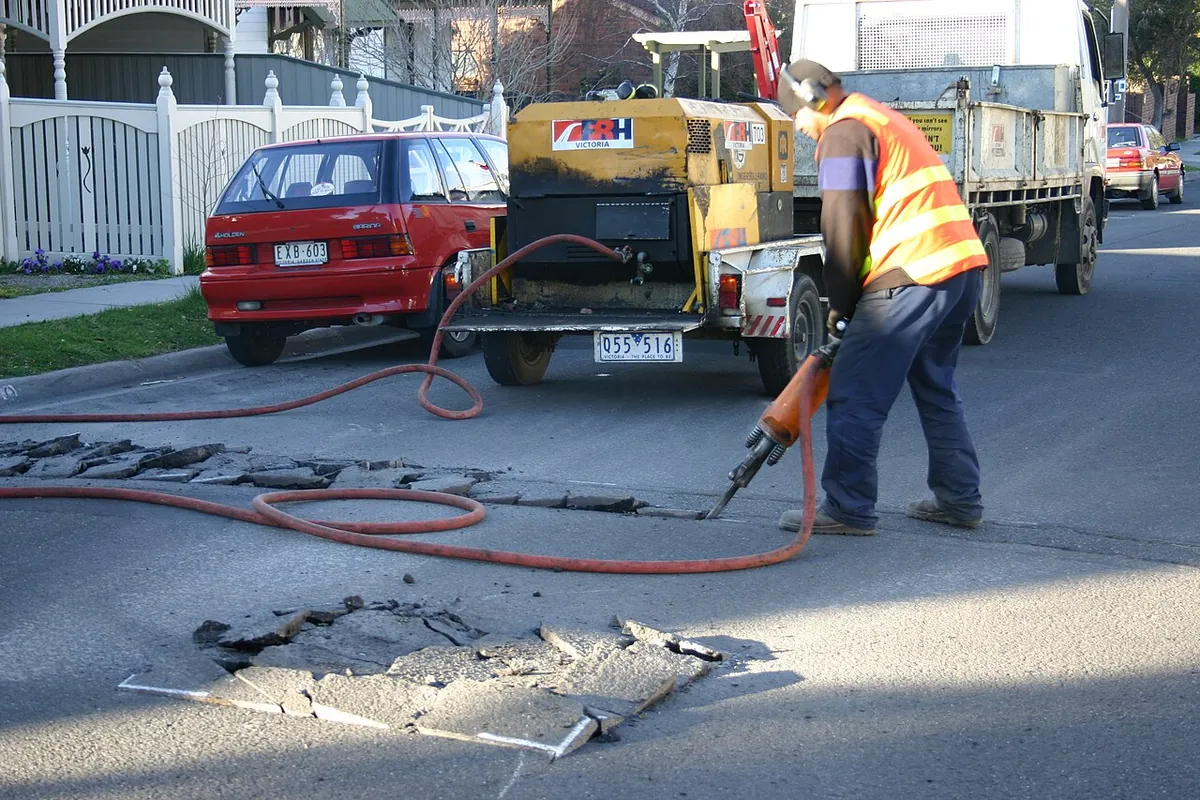
Photo: Josh Parris, Wikimedia Commons, public domain
Quick Answer
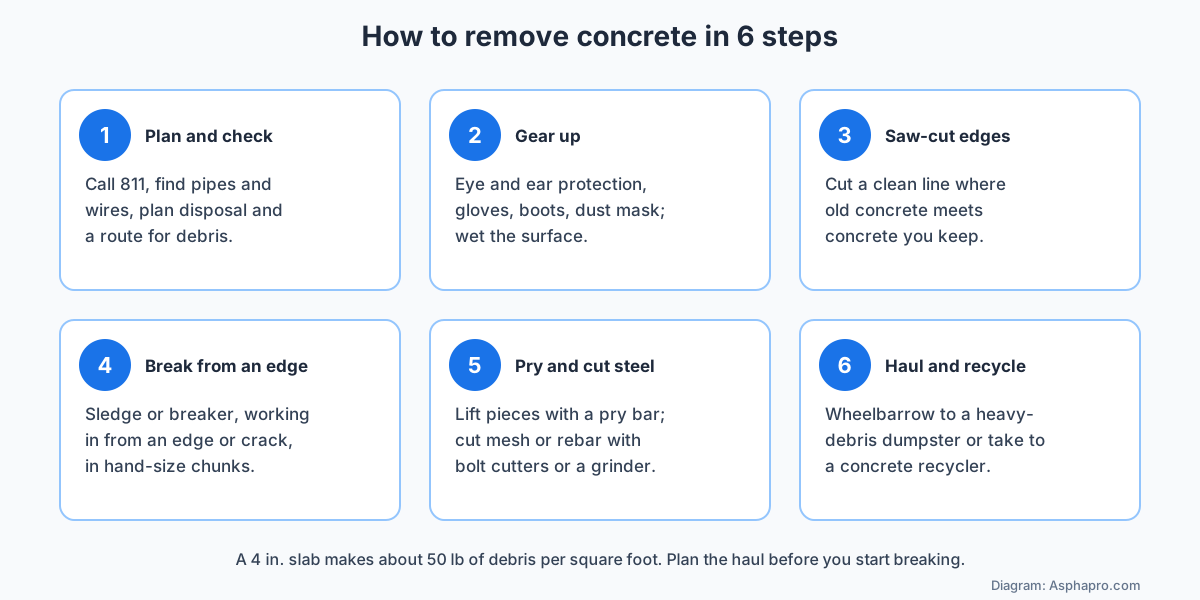
To remove concrete, first check for buried utilities (call 811) and plan where the debris will go. Wear eye and hearing protection, gloves, boots and a dust mask, and wet the surface to control silica dust. Saw-cut any edge that meets concrete you are keeping. Then break the slab from an edge or crack with a sledgehammer (thin slabs) or a rented electric demolition hammer or jackhammer (most slabs), pry the pieces up, cut any mesh or rebar, and haul the broken concrete to a heavy-debris dumpster or a concrete recycler. A 4 inch slab makes about 50 pounds of debris per square foot.
Removing concrete is hard work, but for small and medium jobs it is well within reach of a determined homeowner. A thin patio, an old walkway, a shed pad or a few fence post footings can often be removed in a weekend with rented tools. Larger and thicker slabs, especially driveways with rebar, are where hiring a contractor or renting a skid steer makes sense.
This guide explains how to remove concrete and how to break concrete efficiently: choosing the right tool, step-by-step methods for slabs, steps, footings and posts, dealing with rebar and mesh, staying safe, and getting rid of the debris. For prices if you hire it out, see concrete removal cost.
Choose the Right Tool to Break Concrete
| Tool | Best for | Notes |
|---|---|---|
| Sledgehammer (10 – 16 lb) | Thin, unreinforced slabs up to about 4 in., stepping pads, small pieces | Works best when the slab is undermined so it can flex |
| Pry bar and digging bar | Lifting and separating broken pieces | Essential for every method |
| Electric demolition hammer | Most patios, walkways and steps | Common rental; plugs into a standard outlet |
| Pneumatic jackhammer | Thick or reinforced slabs | Needs a towable air compressor; heavier and louder |
| Concrete saw | Clean edges where concrete stays | Use water to control dust; see how to cut concrete |
| Skid steer or mini excavator with breaker | Driveways and large slabs | Fastest, but requires experience and access |
| Bolt cutters, angle grinder | Cutting wire mesh and rebar | Grinder with a metal-cutting wheel |
For most homeowners, the electric demolition hammer is the sweet spot: powerful enough for a typical 4 inch slab, light enough to handle, and available at most rental shops.
How to Remove Concrete: Methods Compared
| Method | Speed | Effort | Best use |
|---|---|---|---|
| Sledgehammer and pry bar | Slow | Very high | Small, thin, unreinforced pads and walks |
| Electric demolition hammer | Moderate | Moderate | Most patios, walkways, steps |
| Pneumatic jackhammer | Fast | High (heavy tool) | Thick or reinforced slabs |
| Skid steer or excavator with breaker | Very fast | Low physical, high skill | Driveways, large slabs |
| Expansive demolition agent | Slow (hours) | Low physical | Large solid footings near structures |
The right way to remove concrete depends on its thickness, reinforcement, size and location. Most homeowners who want to break concrete for a patio or walkway get the best results with a rented demolition hammer and a good pry bar. For anything bigger, the time saved by machines usually outweighs the rental cost.
Before You Start
- Call 811 a few days ahead so utility lines are marked.
- Check for pipes and wires under the slab: gas, water, sprinkler lines, drains and electrical conduit.
- Measure the slab and estimate the debris weight (about 50 lb per square foot at 4 inches).
- Plan disposal: a heavy-debris dumpster, recycling yard or reuse on site.
- Plan the route from the slab to the dumpster or truck; lay plywood over lawns.
- Check thickness at an edge so you choose the right tool.
- Protect nearby surfaces: windows, siding, cars and plants.
Safety Gear and Dust Control
Breaking concrete throws sharp chips and creates fine dust that contains crystalline silica, which can harm the lungs if breathed regularly. Wear safety glasses or goggles, hearing protection, heavy gloves, long sleeves and pants, and steel-toe boots. Use a respirator or at least a well-fitted dust mask rated for fine dust. Keep the surface wet while breaking and cutting, and work with the wind at your back. OSHA rules for workers set specific controls for silica dust; homeowners should follow the same basic idea of wet methods and respiratory protection. Keep children and pets away from the work area.
How to Break Up a Concrete Slab Step by Step
How do I break up concrete without wearing myself out? Work from an edge, dig out the soil under it so the slab has room to drop, and break small pieces instead of trying to crack the whole slab at once. That is how to break up concrete with the least effort, whether you use a sledgehammer or a jackhammer.
- Saw-cut the boundary. If the slab meets concrete you are keeping, such as a garage floor or sidewalk, cut a straight line about a quarter to a third of the way through with a concrete saw first. This keeps the break from running into the good concrete.
- Start at an edge or crack. Concrete breaks far more easily where it has an open edge. Dig a little soil away from the edge so the slab has room to drop as it breaks.
- Break small sections. With a demolition hammer, angle the bit slightly and work about 6 to 12 inches in from the edge, breaking off manageable pieces rather than trying to shatter the middle. With a sledge, strike a few inches in from the edge and work along it.
- Pry and lift. Slide a pry bar under broken pieces and lever them up. Lifting a piece also exposes a new edge to work from.
- Cut the steel. Wire mesh and rebar will hold broken pieces together. Cut it with bolt cutters or an angle grinder as you go.
- Keep pieces carry-sized. Break chunks into pieces one person can lift safely, often about 30 to 50 pounds.
- Haul as you go. Load pieces into a wheelbarrow and move them to the dumpster or truck before the work area fills up.
- Clean up the base. Rake out loose chunks and gravel, then grade the area for its next use.
How to Break Concrete With a Sledgehammer
A sledgehammer works for thin slabs, typically up to about 4 inches with no reinforcement. The trick is to remove support from underneath: dig out soil along an edge so the slab is hanging over a gap, then strike a few inches in from the edge. Concrete is strong in compression but weak when it bends, so an undermined slab cracks with far fewer blows. Let the weight of the hammer do the work, keep your feet apart and your back straight, and stop before you are exhausted, since tired swings cause injuries. For thicker or reinforced slabs, a demolition hammer saves a lot of time and effort.
Using a Demolition Hammer or Jackhammer
- Use a chisel or point bit for breaking; a spade bit for cleaning up.
- Let the tool do the work. Guide it rather than pushing hard.
- Work in from an edge in small bites, angling the bit slightly toward the edge.
- Do not bury the bit. If it sinks too deep and sticks, rock it gently to free it.
- Take breaks. Vibration is tiring; rest your hands and arms often.
- Keep the cord clear of the bit and the broken concrete.
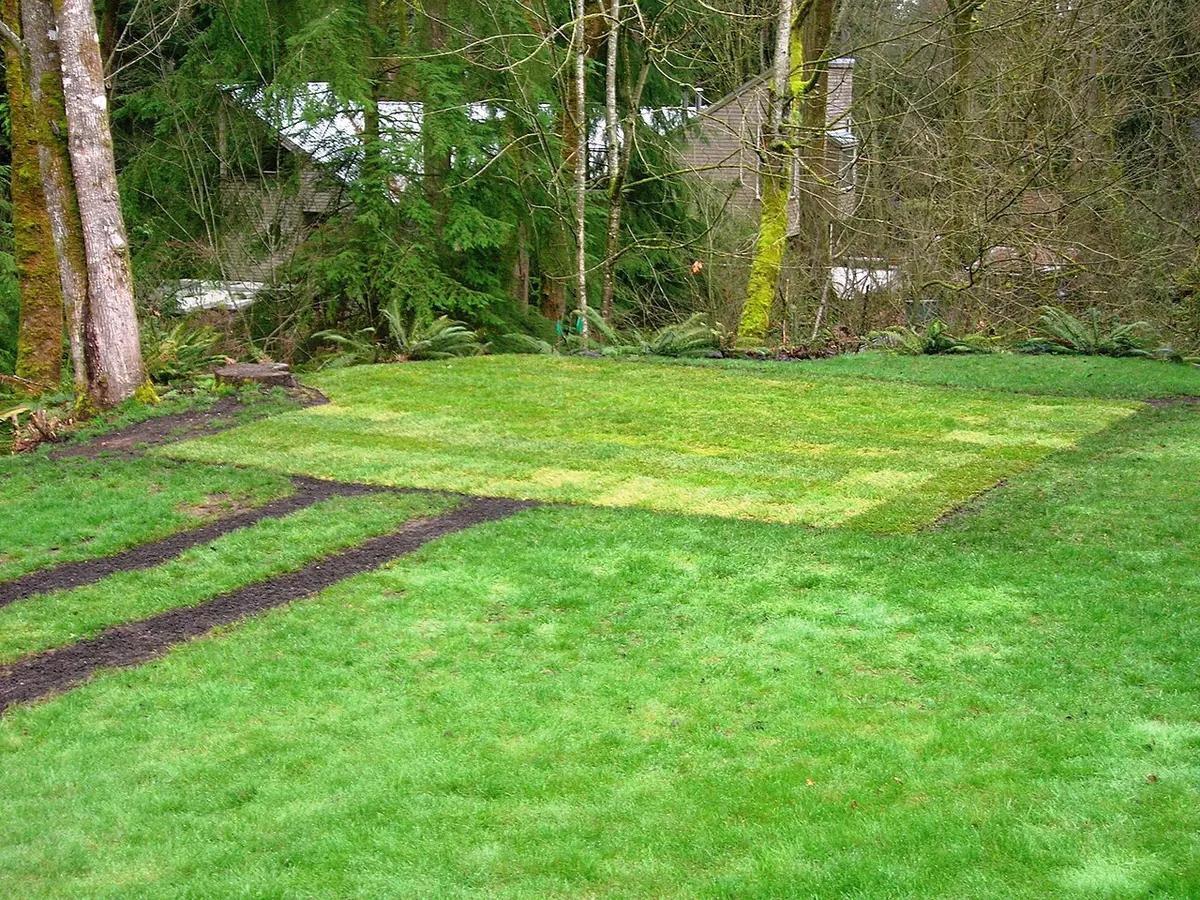
Photo: brewbooks, Wikimedia Commons, CC BY-SA 2.0
How to Remove Concrete Steps
Concrete steps are solid blocks, often with a fill of rubble or soil inside, and they can weigh thousands of pounds. Start at the top step and work down, breaking the concrete into chunks with a demolition hammer. Watch for rebar and for the connection to the house foundation; steps are sometimes tied to the foundation with steel. Saw-cut along the foundation first if needed, so you do not damage it. Once the shell is broken, the fill inside comes out more easily. If you are replacing the steps, see concrete steps cost and how to fix concrete steps.
How to Remove Concrete Footings and Fence Posts
How to remove fence post concrete depends on the size of the footing. A small footing around a 4 × 4 post can often be dug out whole and levered up with a long bar; a large footing is faster to break in place with a demolition hammer.
Post footings are usually easier to pull out whole than to break up. Dig around the footing to loosen it, then:
- Lever it out with a long bar, using a block of wood as a fulcrum.
- Use a post puller or farm jack with a chain wrapped around the post or footing.
- Break it in place with a demolition hammer if it is too large to lift.
- Leave it if allowed: if the new project does not need the space, some people cut the post at ground level and leave the footing.
Deck footings and pier blocks are handled the same way. Large footings for buildings need excavation equipment.
Dealing With Rebar and Wire Mesh
Reinforcement is what makes some slabs much harder to remove. Wire mesh holds broken pieces together like a net, so you need to cut it frequently. Rebar is stronger and must be cut with an angle grinder with a metal-cutting wheel or a reciprocating saw with a metal blade. Wear eye protection, as cutting throws sparks. Bend cut ends down or cover them so nobody trips on sharp steel. Some recycling yards take concrete with rebar; others want the steel separated, and scrap yards may take the steel.
How to Remove Concrete From Small Areas
Not every job is a whole slab. Here is how to remove concrete in a few common small situations:
- A single sidewalk panel: saw-cut the joints on both sides if the neighboring panels stay, then break the panel from the middle cut lines outward and pry it out.
- A mailbox or clothesline post: dig around the footing and lever it out whole with a long bar.
- An old AC pad: many are precast and can be pried up and moved in one piece with two people and a bar.
- Concrete around a buried pipe or utility box: work slowly with a small chisel and hammer, or call a pro, to avoid damaging the line.
- Spilled or hardened concrete on a driveway or tools: chip it off carefully with a chisel, or use a concrete dissolver made for the purpose; see how to remove concrete from brick for surface cleanup.
For small areas, breaking concrete by hand with a sledgehammer, chisel and pry bar is often faster than renting and setting up a power tool.
How to Dispose of Broken Concrete
- Concrete recycling yards: often the cheapest option for clean concrete.
- Heavy-debris dumpsters: concrete is so heavy that haulers use special containers with weight limits.
- Landfills: accept concrete as construction debris, usually charged by weight.
- Reuse: broken pieces can build garden walls, raised beds or paths.
- Give it away: some people need clean fill.
See concrete removal cost for disposal prices.
How to Remove a Concrete Driveway
To remove concrete from a driveway, expect a bigger job: driveways are thicker and more often reinforced than patios, and they cover a big area, so plan the job carefully. Saw-cut where the driveway meets the garage floor and the street apron or sidewalk if those will stay. For a DIY job, an electric demolition hammer will work but will take a long time on a full driveway; many homeowners rent a skid steer with a hydraulic breaker or hire a crew for the breaking and do the cleanup themselves. Break the driveway into strips from the street end or from an open edge, lift the pieces with a bucket or bars, and load them directly into a dump trailer or heavy-debris container. A 600 square foot, 4 inch driveway makes about 15 tons of debris, so expect several container loads or trips. If a new driveway is going in, keep the old gravel base if it is in good condition; see concrete driveway cost.
Removing a Patio Next to the House
When you remove concrete next to a house, take extra care. Patios often touch the house foundation, siding or a door threshold. Breaking concrete right against the house can chip the foundation or crack the siding. Start by saw-cutting a line a few inches out from the house, then break the patio from the outer edge toward the cut. Remove the strip next to the house last, carefully, with a smaller tool or by prying it away. Check for a dryer vent, hose bib line or downspout drain that may run under the patio. After removal, make sure the new grade slopes away from the house so water does not collect against the foundation.
Removing Concrete Inside a Garage or Basement
Indoor concrete removal is slower and dustier than breaking concrete outside. Use a demolition hammer rather than a sledgehammer, keep the surface wet, run fans to move dust outside, and wear a respirator. Protect walls, doors and stored items. Watch for plumbing, drains, radon pipes and electrical conduit under the slab; basements often have drain lines and sump pits. Because every piece must be carried out by hand, plan a clear path and use a sturdy cart or wheelbarrow. For large basement floors, many homeowners hire a crew.
Removing a Concrete Pool Deck
Pool decks sit next to coping, tile, plumbing and the pool shell, all of which are expensive to damage. Saw-cut the deck a few inches away from the coping, protect the pool with plywood and tarps so chips do not fall in, and remove the concrete from the outer edge inward. Check where skimmer and return lines run before breaking. If the pool shell or coping is part of the project, have a pool contractor plan the work.
Using Expansive Demolition Agents
Non-explosive expansive demolition agents are powders mixed with water and poured into holes drilled in the concrete. Over several hours, they expand and crack the concrete from the inside without noise or vibration. They can be useful for large footings, boulders or concrete near structures where hammering is risky. They require drilling many holes in a planned pattern, careful mixing, and following the product's temperature and safety instructions, since the material can blow out of holes if mixed or placed incorrectly. They work best on large solid masses rather than thin slabs.
Using a Skid Steer or Mini Excavator
For big jobs, a skid steer with a hydraulic breaker can break a driveway in hours instead of days, and the same machine can load the debris. A mini excavator with a breaker or a bucket is good for footings and thicker slabs. These machines are heavy and can crack nearby paving, rut lawns and damage underground lines, so they require care and experience. Many rental yards will deliver the machine on a trailer. If you have never run one, practice in an open area first, or hire an operator.
After Removal: Getting the Ground Ready
Once the concrete is gone, decide what comes next. For a new slab, the old gravel base may be reusable if it is clean and not mixed with soil; regrade and compact it, adding new crushed stone where needed. For lawn or garden, remove the old base and compacted soil, then add several inches of topsoil, since grass and plants struggle in compacted gravel. For pavers, build a fresh compacted base and sand bed. In every case, fix the drainage so water flows away from the house. See the cost to pour a concrete slab if you are replacing the slab.
How Long It Takes and What It Costs to DIY
Small jobs, such as a few fence post footings or a 50 square foot pad, can often be done in a day. A 200 square foot patio usually takes one or two people a weekend with a rented demolition hammer, including hauling. A full driveway is a multi-day job by hand, or a day or two with a skid steer. DIY costs include tool rental for the days you need it, a heavy-debris dumpster or trips to a recycling yard, and safety gear. Compare that with a contractor's price, often about $2 to $6 per square foot, before deciding; see concrete removal cost.
Common Mistakes When Removing Concrete
- Starting in the middle of a slab instead of at an edge or crack.
- Skipping the utility call and hitting a pipe or cable under the slab.
- Breaking without a saw cut next to concrete you want to keep.
- Overfilling a dumpster and paying overweight fees.
- Making chunks too heavy to lift safely.
- Working without dust control or hearing protection.
- Ignoring the base after removal and pouring a new slab on loose debris.
Tips to Break Concrete Faster
- Undermine the edges. Digging soil from under the slab lets it bend and crack with far less force.
- Use existing cracks. Start where the slab is already cracked or at control joints.
- Score a line. Shallow saw cuts in a grid make the slab break into neat, carry-sized pieces.
- Work in rows. Break a strip, remove it, then break the next strip from the new edge.
- Cut mesh early. Steel holding pieces together slows everything down.
- Keep the bit sharp. Ask the rental shop for a fresh chisel bit.
- Haul continuously. A cluttered work area slows the breaking.
With these tips, the slowest part of removing concrete is often hauling, not breaking. Line up a helper to move pieces while you run the hammer.
When to Hire a Pro Instead
- The slab is thicker than about 4 to 5 inches or heavily reinforced.
- The area is large, such as a full driveway.
- Concrete is next to a foundation, retaining wall or utilities you cannot risk damaging.
- You do not have a way to haul tons of debris.
- You have back, shoulder or joint problems that vibration and lifting will aggravate.
Working Safely Around Heavy Pieces
When you remove concrete, the broken pieces are heavy, sharp and unstable. Lift with your legs and keep your back straight, and do not try to carry pieces heavier than you can comfortably handle; break the concrete into smaller pieces instead. Use a wheelbarrow with a good tire, and lay plywood planks over soft ground and steps. Keep fingers clear when prying, since slabs can shift suddenly. Never work under a raised slab or reach under a piece being levered up. Stack debris low and stable near the dumpster, not in walkways. If you are working with helpers, agree on simple signals before lifting together, and take regular breaks.
Frequently Asked Questions
What is the easiest way to remove concrete?
For most slabs, rent an electric demolition hammer, break the concrete from an edge in small pieces, pry them up and haul them to a heavy-debris dumpster or recycler.
How do you break concrete by hand?
Dig soil out from under an edge so the slab is unsupported, then strike a few inches in from the edge with a 10 to 16 lb sledgehammer, working along the edge.
Can you break a 4 inch slab with a sledgehammer?
Often yes, if it is not reinforced and you undermine the edge first. Reinforced or thicker slabs are much easier with a demolition hammer.
How do I remove concrete without a jackhammer?
For thin slabs, use a sledgehammer and pry bar, undermining edges first. Some people also use expansive demolition agents in drilled holes, following the product directions carefully.
How long does it take to remove a concrete patio?
A 200 square foot patio often takes a weekend for one or two people with a rented demolition hammer, including hauling.
How do you break concrete without making a lot of dust?
Keep the surface wet with a hose or sprayer while you break concrete, use wet cutting for saw work, and wear a respirator. Dust control protects your lungs and keeps the mess down.
Is it worth renting a jackhammer to remove concrete?
For anything larger than a small pad, yes. A rented demolition hammer or jackhammer breaks concrete many times faster than a sledgehammer and with far less strain.
What is the best way to remove concrete steps?
Start at the top and work down with a demolition hammer, saw-cut along the house first if the steps touch the foundation, and watch for rebar tying the steps to the wall.
How do you break up a concrete slab with rebar?
Break the concrete with a demolition hammer or jackhammer, then cut the exposed rebar with an angle grinder or reciprocating saw as you go. Lift pieces with a pry bar once the steel is cut.
What size sledgehammer do I need to break concrete?
Many people use a 10 to 16 lb sledgehammer. Heavier hammers hit harder but tire you faster. Undermining the slab matters more than the hammer size.
How do I remove a concrete fence post footing?
Dig around the footing, then lever it out with a bar, pull it with a post puller or farm jack, or break it in place with a demolition hammer.
Do I need a permit to remove concrete?
Usually not for private patios and walkways, but often yes for public sidewalks, driveway aprons and structural concrete.
Sources
- OSHA, "Silica, Crystalline" (dust hazards and controls). osha.gov
- Call 811, "Know what's below" (utility locating before digging). call811.com
- HomeGuide and LawnStarter concrete removal cost guides. homeguide.com
- Image credits: jackhammer photo by Josh Parris (public domain) and broken pad photo by brewbooks (CC BY-SA 2.0), via Wikimedia Commons. Diagram by Asphapro.com.
Use rented tools according to their instructions. Checked November 2026.
Related Guides
- How to cut concrete — saws, blades and dust safety