
Pool Ideas With Waterfalls: Styles, Costs and Tips
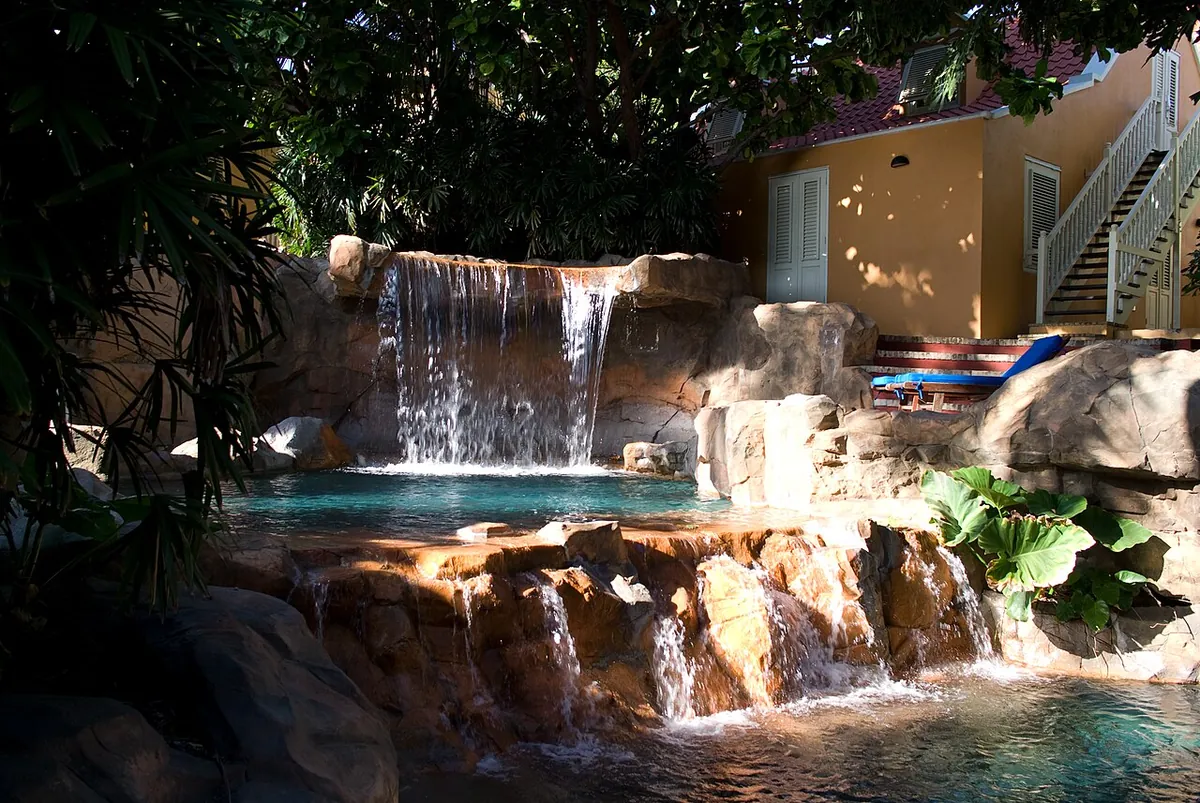
Photo: Charles Hoffman, Wikimedia Commons, CC BY-SA 2.0
Quick Answer
Popular pool ideas with waterfalls include a natural rock waterfall ($3,000 to $30,000+), a sheer descent sheet of water from a raised wall ($1,000 to $5,000), scuppers or spouts ($300 to $1,500 each), a rain curtain from an overhead beam ($2,000 to $8,000), a grotto with a cave behind the falls ($15,000 to $50,000+), a spa spillover into the pool, and low-cost deck jets and bubblers ($200 to $1,500). Most pool water features need their own pump or a variable-speed pump with a valve, add sound and movement, and increase evaporation and chemical use a little. Plan the waterfall with the pool design so plumbing, lighting and wiring are built in from the start.
A waterfall turns a pool into the focal point of the yard. The sound of falling water masks traffic and neighbors, moving water looks fresh and inviting, and lit at night, a pool waterfall becomes a feature you enjoy even when nobody swims. Waterfalls and other water features also give a place to sit under falling water, a spot for kids to play, and a way to tie the pool into landscaping and stonework.
This guide collects practical pool ideas with waterfalls and other water features, from natural rock falls to clean modern sheets of water, with typical costs, pump and plumbing needs, lighting ideas, small pool waterfall ideas and upkeep tips. For overall pool budgets, see how much does a pool cost.
Types of Pool Waterfalls and Water Features
Swimming pool waterfalls come in many forms, and swimming pool water features go beyond falls. Here are the main options for a pool with waterfall features or any water feature pool design.
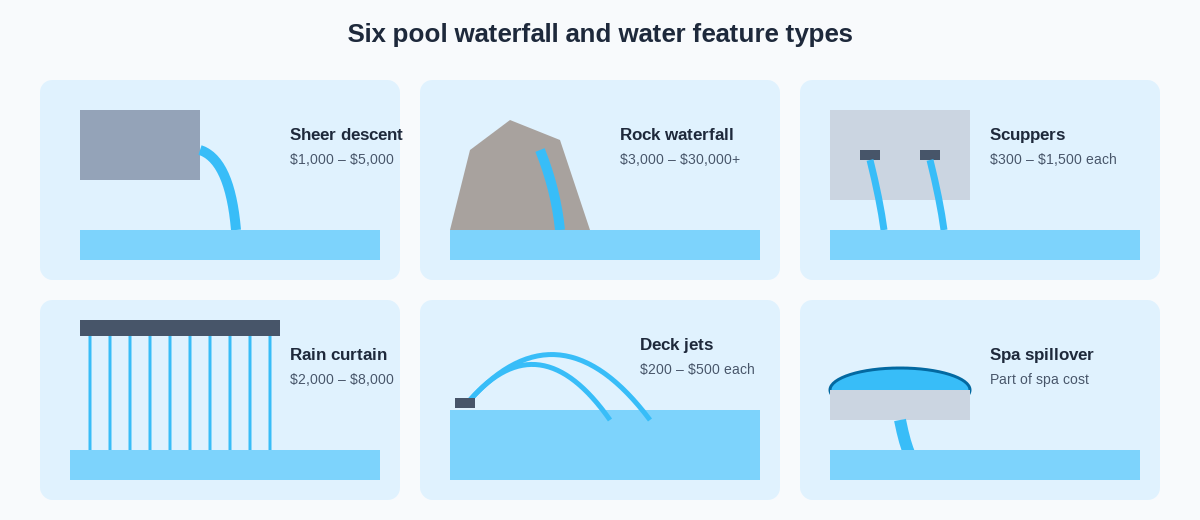
Diagram: Asphapro.com
1. Natural rock waterfall
A rock waterfall uses real boulders or cast faux rock stacked at the edge of the pool, with water spilling from one or more drops. Small rock waterfalls cost about $3,000 to $8,000; large natural stone falls with several tiers can cost $15,000 to $30,000 or more. Real stone looks the most natural but is heavy and needs a strong footing. Faux rock panels are lighter and can be shaped to hide plumbing.
2. Sheer descent
A sheer descent is a stainless steel or acrylic lip set into a raised wall that sends out a smooth, clear sheet of water. It is the most popular modern pool waterfall. Units cost about $200 to $1,500 each, and installed with the raised wall, plumbing and finish, about $1,000 to $5,000. Sheer descents come in widths from 1 to 8 feet. They need steady flow to look even, usually about 10 to 15 gallons per minute per foot of width.
3. Scuppers and spouts
Scuppers are open channels or bowls in a raised wall that pour water into the pool. Spouts are pipes or decorative nozzles. Copper, stainless or stone scuppers cost about $300 to $1,500 each installed. A row of three scuppers on a raised wall is a classic look for both traditional and modern pools.
4. Rain curtain
A rain curtain sends water down from an overhead beam or pergola in many small streams, like rain. Swimmers can stand under it. Costs run about $2,000 to $8,000 depending on the structure.
5. Grotto
A grotto is a rock waterfall with a cave or room behind it, often with a bench inside. Grottos are dramatic and popular in resort-style pools, but they are the most expensive water feature at about $15,000 to $50,000 or more, and they need careful engineering and safety design.
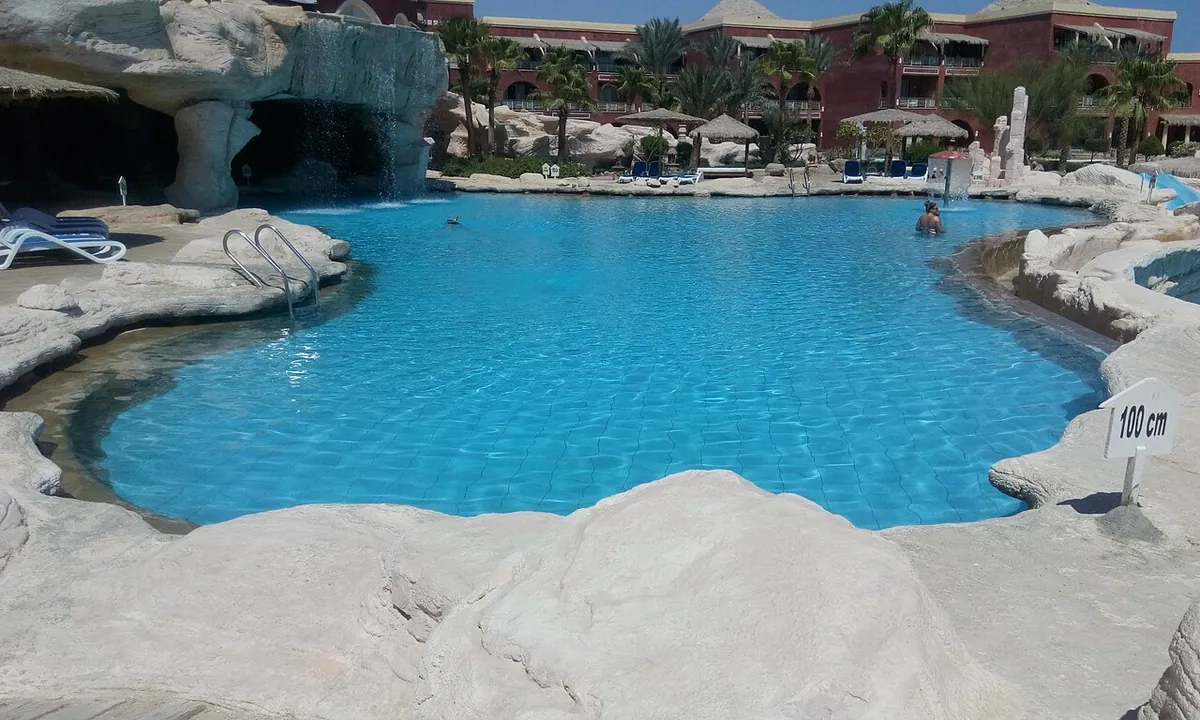
Photo: Wikimedia Commons, CC0
6. Spa spillover
A raised spa that overflows into the pool creates a built-in waterfall. The spillover edge can be a smooth sheet or a stone lip. It adds little extra cost if you are already building an attached spa.
7. Deck jets and laminar jets
Deck jets shoot arcs of water from the deck into the pool, a favorite with kids. Basic deck jets cost $200 to $500 each installed; laminar jets, which produce smooth, glass-like arcs that can be lit, cost $1,000 to $3,000 each.
8. Bubblers
Bubblers push water up through a tanning ledge to make a small fountain. They cost about $500 to $1,500 each and add sound and movement to shallow areas.
9. Fire and water bowls
Bowls on pillars that spill water into the pool and have a gas fire on top combine two features. Each costs about $1,500 to $6,000 installed, plus gas lines.
Pool Ideas With Waterfalls by Style
The right water feature for pool designs depends on the style of the house and yard. A waterfall pool should match its setting.
- Tropical: a rock waterfall with palms, ferns and a lagoon-shaped pool.
- Modern: a sheer descent from a smooth stucco or tile wall, or a row of stainless scuppers.
- Mediterranean: stone scuppers or lion-head spouts in a raised wall, with terracotta and olive trees.
- Desert: stacked flagstone falls with succulents and gravel.
- Resort: a grotto with a slide, sun ledge and bubblers.
- Natural or eco pool: a gentle stream-like cascade surrounded by planting.
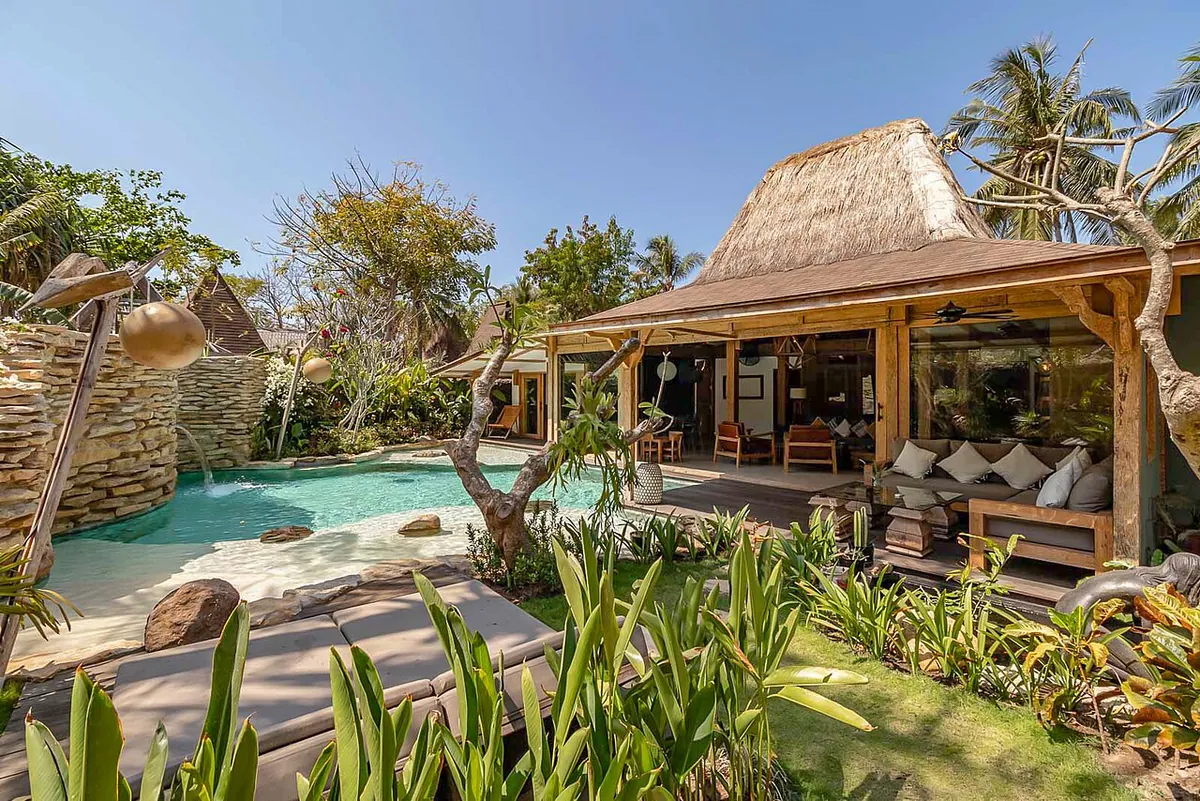
Photo: KunoGili, Wikimedia Commons, CC BY-SA 4.0
Small Pool Waterfall Ideas
These small pool ideas with waterfall features fit plunge pools and compact yards. They are some of the best pool waterfalls ideas for tight budgets too.
You do not need a big pool or a big budget for a waterfall. Small pool waterfall ideas that work in tight yards:
- One sheer descent 1 to 2 feet wide in a low raised wall behind a plunge pool.
- A single scupper or spout centered on the back wall.
- A small stacked-stone fall two or three rocks high in one corner.
- A spillover from a raised planter that doubles as a seat.
- Deck jets that arc into the pool from one side, with no wall needed.
- A bubbler on a sun ledge for sound and play.
Small features also need smaller pumps and add less evaporation, so running costs stay low. For more ideas for tight spaces, see swimming pool ideas for small backyard.
Pool Waterfall Cost Overview
| Water feature | Typical installed cost |
|---|---|
| Deck jet | $200 – $500 each |
| Bubbler | $500 – $1,500 each |
| Scupper or spout | $300 – $1,500 each |
| Sheer descent with raised wall | $1,000 – $5,000 |
| Laminar jet | $1,000 – $3,000 each |
| Fire and water bowl | $1,500 – $6,000 each |
| Rain curtain | $2,000 – $8,000 |
| Small rock waterfall | $3,000 – $8,000 |
| Large natural stone waterfall | $10,000 – $30,000+ |
| Grotto | $15,000 – $50,000+ |
Adding a waterfall to an existing pool usually costs more than including it in a new build, because the deck may need cutting and new plumbing must be run.
Pumps, Plumbing and Power for Pool Water Features
Every swimming pool water feature needs water flow. There are three common ways to supply it:
- Shared variable-speed pump with a valve: the main pump runs faster when the feature is on. Simple and low-cost for small features.
- Dedicated feature pump: a separate pump that runs only the waterfall. Best for large waterfalls and grottos, and it lets you run the feature without changing filtration.
- Automation: valve actuators and timers controlled from a panel or phone app, so you can turn the waterfall on for evenings and off overnight.
Plan the flow early. A 3 ft sheer descent may need 30 to 45 gallons per minute; a large rock waterfall can need 60 to 100 or more. Larger pipes reduce noise and energy use. For pump sizing, see how to prime a pool pump, which includes a flow calculator.
Lighting a Pool Waterfall
Light turns a pool waterfall into a nighttime feature. LED lights set behind or below a sheer descent glow through the water. Small lights in rock crevices highlight a rock waterfall. Color-changing LEDs let you change the mood, and laminar jets can carry light along their arc. Plan conduits and low-voltage transformers before the deck is poured.
Pros and Cons of a Swimming Pool With Waterfall
Pros
- Relaxing sound that masks noise.
- Moving water looks fresh and inviting.
- Creates a focal point and adds to the design.
- Places to play and sit under the water.
- Aeration can help raise pH naturally.
Cons
- Higher build cost.
- More evaporation and heat loss when running.
- Extra energy use for pumps.
- Calcium scale on rocks and lips in hard water.
- More cleaning around rocks and in grottos.
- Noise may bother neighbors if run late.
Caring for Pool Waterfalls
- Keep pH and calcium balanced to prevent white scale on rocks and sheer descent lips.
- Brush rock surfaces where algae can grow in shaded spots.
- Clean debris from scupper bowls and the top of rock falls.
- Run features on a timer to save energy and reduce evaporation.
- Turn waterfalls off when heating the pool or when the pool is covered.
- Drain feature lines before freezing weather, and blow them out with air if needed.
Safety Around Pool Waterfalls
Rock waterfalls and grottos tempt people to climb and jump. Design them so they cannot be used as diving platforms, keep water under rock edges deep enough or block access, and avoid sharp edges. Inside grottos, provide good lighting and air flow. Make sure every feature meets local pool codes and drain safety rules.
Planning a Swimming Pool Waterfall
- Choose the view. Place the swimming pool waterfall where you see it most: from the kitchen window, the back door or the main seating area.
- Pick a style that matches the house: rocks for natural and tropical yards, a sheer descent or scuppers for modern homes, stone spouts for traditional designs.
- Decide on size and height. A waterfall 2 to 4 feet high is enough for sound and looks in most yards. Taller falls cost more, use more water flow and can be loud.
- Check codes and safety. Some towns limit how close climbable features can be to fences and require designs that discourage diving from rocks.
- Plan the plumbing and pump with your builder: flow rate, pipe size, valves and whether a dedicated pump is needed.
- Plan lights and power so conduits go in before the deck.
- Think about upkeep: access to clean the top of the fall, drain lines for winter, and how leaves will be cleared.
- Get a drawing that shows the waterfall in relation to the pool, deck and planting, and confirm the price in writing.
A waterfall swimming pool design works best when it is part of the original plan. Retrofits are possible but cost more and may need deck repairs.
Materials for Pool Waterfalls
- Natural boulders: the most authentic look, very durable, but heavy and costly to move and set. Each large boulder can weigh over a ton.
- Flagstone and stacked stone: flat stones stacked into a ledge for a cleaner, more architectural fall.
- Faux rock (glass-fiber reinforced concrete or polyurethane): lighter, can be molded with hidden plumbing and caves, and usually costs less than real stone of the same size.
- Tile, stucco or stone veneer walls: for raised walls with sheer descents and scuppers.
- Stainless steel, copper or acrylic: for sheer descent lips, scuppers and spouts. Choose marine-grade stainless or copper that will develop a patina.
Real stone and faux rock each have a place. Many builders mix real boulders at the base with faux rock higher up to cut weight and cost.
Adding a Waterfall to an Existing Pool
Adding a waterfall for pool owners who already have a pool is a common upgrade. The work usually includes:
- Cutting a section of deck or coping to set the feature and run pipes.
- Running a new pipe from the equipment pad to the waterfall, or tapping into an existing return line with a valve.
- Adding a pump or upgrading to a variable-speed pump if flow is not enough.
- Building the raised wall or rock structure on a proper footing.
- Patching the deck and adding lighting.
Expect to pay about 20% to 50% more than the same feature in a new pool. Simple add-ons like deck jets or a small sheer descent on an existing raised wall cost the least. If you are remodeling the pool, add the waterfall then; see pool remodel cost.
Swimming Pool Water Features Ideas for Families
Families with kids get the most use out of interactive water features. Good swimming pool water features ideas for children include deck jets and laminar arcs they can swim through, bubblers on a shallow ledge, a rain curtain they can stand under, a short slide set into rocks, and a low sheer descent that splashes on shoulders. Keep features in shallow areas where children play, avoid climbable rocks over deep water, and add a timer so features run while the family is outside.
Landscaping Around a Pool and Waterfall
Planting makes a pool and waterfall look like they belong together. Set ferns, grasses and low shrubs around rock falls to soften edges and hide pipes. Use palms, bird of paradise and elephant ear for a tropical look, or agave and yucca in dry climates. Keep trees that drop leaves away from the top of the waterfall so debris does not wash into the pool. Uplights on plants and the waterfall tie the scene together at night. For deck surfaces that work with water features, see pool deck ideas.
DIY Pool Waterfall Kits
Prefabricated waterfall kits are available for above ground and inground pools. They include a molded faux rock or resin unit and fittings to connect to a return line or a small pump. Kits cost about $300 to $3,000 and can be installed by handy owners in a weekend. They work well for small features; larger rock falls and grottos should be built by experienced pros because of weight, footing and plumbing needs.
Waterfalls for Above Ground Pools
Above ground pools can have waterfalls too. The simplest option is a waterfall return fitting: it replaces the standard return and fans the water into a small sheet or arc as it enters the pool. These cost $30 to $150 and install in minutes. For a bigger effect, a freestanding resin or faux rock waterfall can sit beside the pool on the deck, fed by a hose from the pump. Make sure any feature does not create a step that children could use to climb into the pool, and that hoses and cords are safely routed.
How Much Sound Does a Pool Waterfall Make?
Sound depends on height, flow and what the water lands on. A sheer descent falling 1 to 2 feet into the pool gives a gentle rush. A tall rock waterfall landing on stone is much louder. If you want a calm sound, keep drops short, let water land in the pool rather than on rock, and use a variable-speed pump to turn the flow down at night. If you want to mask road noise, a wider or taller fall helps. Think about neighbors' bedrooms when choosing where to put a loud feature, and use timers so it shuts off late in the evening.
Best Pool Ideas With Waterfalls for Different Budgets
- Under $1,000: deck jets, a waterfall return fitting on an above ground pool, or a single small scupper on an existing wall.
- $1,000 to $5,000: a sheer descent in a new raised wall, a pair of bubblers, or a small faux rock kit.
- $5,000 to $15,000: a custom rock waterfall, a row of scuppers with lighting, or a rain curtain on a pergola.
- $15,000 and up: large natural stone falls, grottos, fire and water features and full automation.
Whatever the budget, the best pool ideas with waterfalls are the ones planned around how you use the pool: a calm sheet of water to relax by, a playful jet for kids, or a dramatic rock fall to anchor a tropical yard.
Choosing a Builder for a Pool Waterfall
Waterfalls look simple, but a poorly built one leaks, splashes water onto the deck, sounds wrong or looks fake. When hiring, ask to see photos of waterfalls the builder has made, not just pools. Ask what footing goes under the rocks or wall, how they waterproof the structure, how they hide pipes, and how they set the flow so the water falls evenly. For rock waterfalls, find out whether they use real stone, faux rock or both, and who sets the stones; skilled rock work makes the difference between a natural-looking swimming pool waterfall and a pile of rocks. Get the design, materials, pump and lighting written into the contract.
Common Pool Waterfall Problems
- Uneven sheet from a sheer descent: usually not enough flow or a lip that is not level. Increase flow or re-level the unit.
- Water splashing outside the pool: too much flow or a drop that lands on rock. Reduce flow or reshape the landing area.
- Leaks behind rocks: gaps in the waterproofing; must be sealed from behind.
- White scale: high calcium and pH. Balance the water and clean with a descaler.
- Algae on rocks: shaded, wet surfaces. Brush and keep chlorine in range.
- Noisy pump: undersized pipes or a pump running too fast. A variable-speed pump fixes most noise.
Most of these problems are avoided with good design, correct flow and regular care, so ask your builder how each one will be prevented before work starts.
Pool Ideas With Waterfalls for Night Use
Many owners use the pool most after work and after dark, so plan pool ideas with waterfalls around evening light and sound. A lit sheer descent behind the pool glows like a ribbon of light. Rock waterfalls lit from below cast moving shadows on the rocks and nearby plants. Laminar jets carry color in smooth arcs across the water, and fire and water bowls add warm flames above falling water. Use warm white light for a calm, natural feel, or color-changing LEDs for parties. Put features on a timer or app so you can turn on the waterfall for an hour in the evening, then let the yard go quiet for the night. Evening use is also when the sound of a pool waterfall is most relaxing, so a small, well-lit feature can give more enjoyment than a large one that runs all day.
Can I add lights to an existing pool waterfall?
Usually, yes. Low-voltage LED fixtures can often be fitted behind sheer descents and in rock gaps using new conduit, without rebuilding the feature.
Pool Ideas With Waterfalls: Key Points
- Rock waterfalls, sheer descents and scuppers are the most popular pool waterfalls.
- Costs range from $200 for a deck jet to $50,000+ for a grotto.
- Plan pumps, plumbing and lighting with the pool design.
- Water features increase evaporation and noise; use timers and covers.
Frequently Asked Questions
How much does a pool waterfall cost?
About $1,000 to $5,000 for a sheer descent, $3,000 to $30,000+ for a rock waterfall, and $15,000 to $50,000+ for a grotto.
How long does it take to build a pool waterfall?
A sheer descent or scuppers in a new wall take a few days. A custom rock waterfall takes 1 to 3 weeks, and a grotto can take a month or more.
Which pool waterfall looks most natural?
A well-set natural stone waterfall with planting around it. Ask to see examples of the builder's rock work before you choose.
Can you add a waterfall to an existing pool?
Yes. Many waterfalls can be added with a new return line, a pump or valve and a raised wall or rock structure.
Does a waterfall for the pool raise the energy bill?
Yes, some. A small feature on a shared variable-speed pump adds little; a large waterfall on a dedicated pump can add $20 to $80 a month if run many hours.
Do pool waterfalls cause evaporation?
Yes. Moving water evaporates faster and loses heat. Run features on a timer and turn them off when heating the pool.
What is the best waterfall for swimming pool designs on a budget?
A single sheer descent or a pair of deck jets. Both cost under a few thousand dollars and add sound and movement.
Can a pool waterfall raise pH?
Yes. Aeration releases carbon dioxide, which raises pH over time, so test more often when features run a lot.
Are rock waterfalls hard to maintain?
They need occasional brushing and scale control. Faux rock is easier to clean than rough natural stone.
What are good pool water feature ideas besides waterfalls?
Deck jets, laminar jets, bubblers, fire and water bowls, rain curtains and spa spillovers.
Sources
- HomeGuide: Pool waterfall cost
- Angi: Pool waterfall cost
- US Department of Energy: Pool pumps
- CPSC: Pool and spa safety