
What Is an Infinity Pool? Definition, Design and Cost
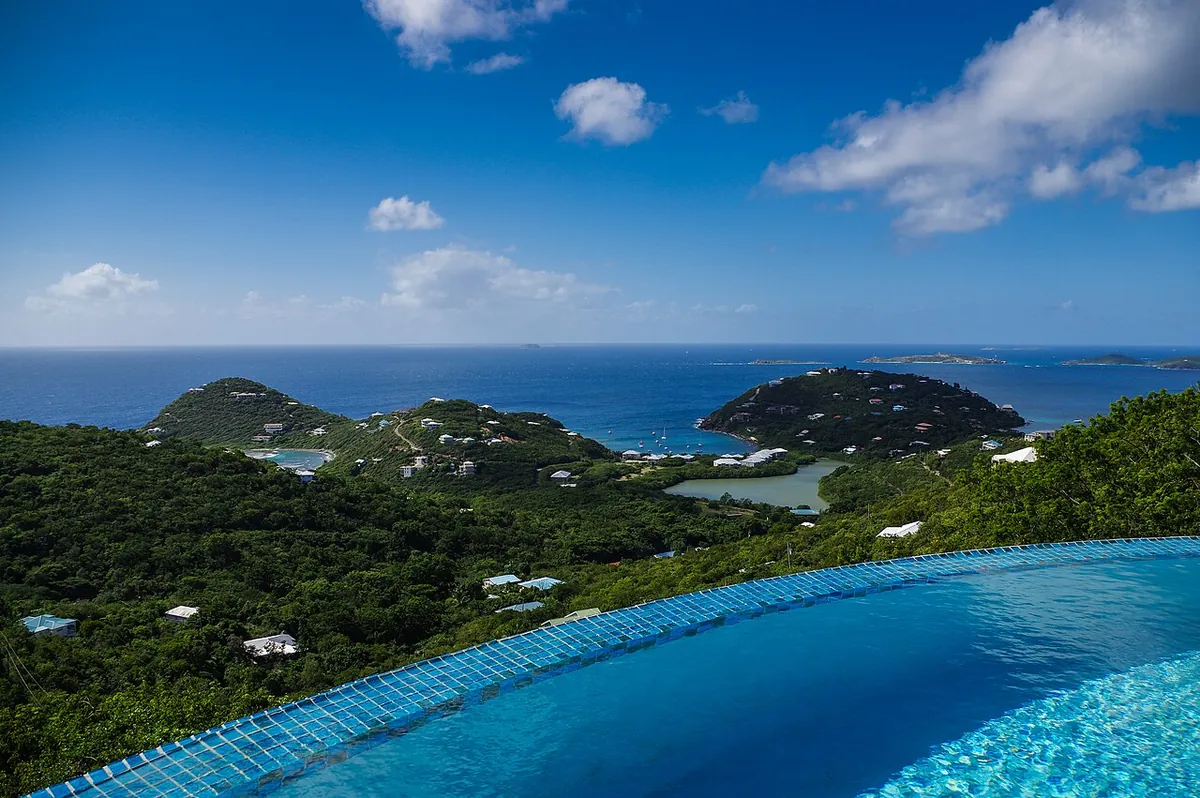
Photo: Cosmic Timetraveler, Wikimedia Commons, CC0
Quick Answer
What is an infinity pool? An infinity pool, also called an infinity edge pool, vanishing edge, negative edge or zero edge pool, is a pool where one or more sides end in a lowered wall (weir) instead of a raised edge. Water flows over that edge into a hidden catch basin below, and a pump sends it back to the main pool. Seen from the right angle, the water seems to stretch to the horizon with no visible border. Infinity pools work best on sloped lots with a view. A backyard infinity pool usually costs $80,000 to $200,000 or more, often 20% to 50% more than a standard concrete pool of the same size, because of the extra wall, basin, pump, engineering and site work.
Infinity pools are some of the most photographed pools in the world. Resorts in Bali, the Caribbean and the Mediterranean use them to blend a pool into the ocean or sky, and rooftop pools in cities like Singapore and Dubai use them to make swimmers feel like they are floating above the skyline. The same idea is used in backyards on hillsides and lakefronts, where an infinity edge pool turns a view into part of the pool.
This guide explains what an infinity pool is, how an infinity edge works, the main infinity pool design types, what it takes to build a backyard infinity pool, typical costs, upkeep, pros and cons, and ideas for different sites. For general pool prices, see how much does a pool cost.
Infinity Pool Definition
What is a infinity pool, exactly, and what is an infinity edge pool compared with a normal pool? A simple infinity pool definition: a swimming pool designed so that one or more edges are level with the water surface, and water continually overflows that edge into a lower trough, creating a visual effect of water extending to the horizon. The terms "what is an infinity swimming pool," "vanishing edge pool," "negative edge pool" and "disappearing edge pool" all describe the same idea. A related design, the "perimeter overflow" or "zero edge" pool, has water spilling over all four sides into a slot or gutter, so the water surface is flush with the deck.
How Does an Infinity Pool Work?
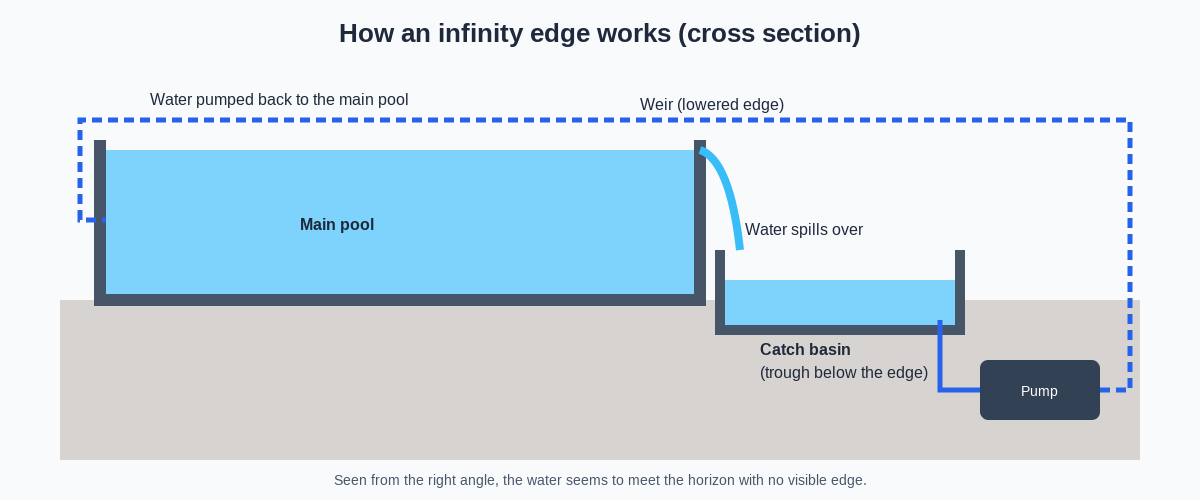
Diagram: Asphapro.com
An infinity edge pool has four main parts:
- The main pool, built like a normal concrete pool, filled to the top of the weir.
- The weir, a wall on the vanishing side built slightly lower than the other walls, usually with a smooth, precisely level top finished in tile or stone.
- The catch basin (or trough), a smaller tank below the weir that collects the water spilling over. It must hold enough water to refill the pool when swimmers splash or the pump turns off.
- A pump and plumbing that move water from the basin back into the main pool, keeping a steady sheet of water flowing over the edge.
When the pump runs, water rises to the weir height and spills evenly over it, forming a thin, continuous sheet. The weir must be level to within a fraction of an inch along its whole length; even small dips make the water spill unevenly. Viewed from the house or the far end of the pool, the eye cannot see the weir, so the water appears to merge with the view.
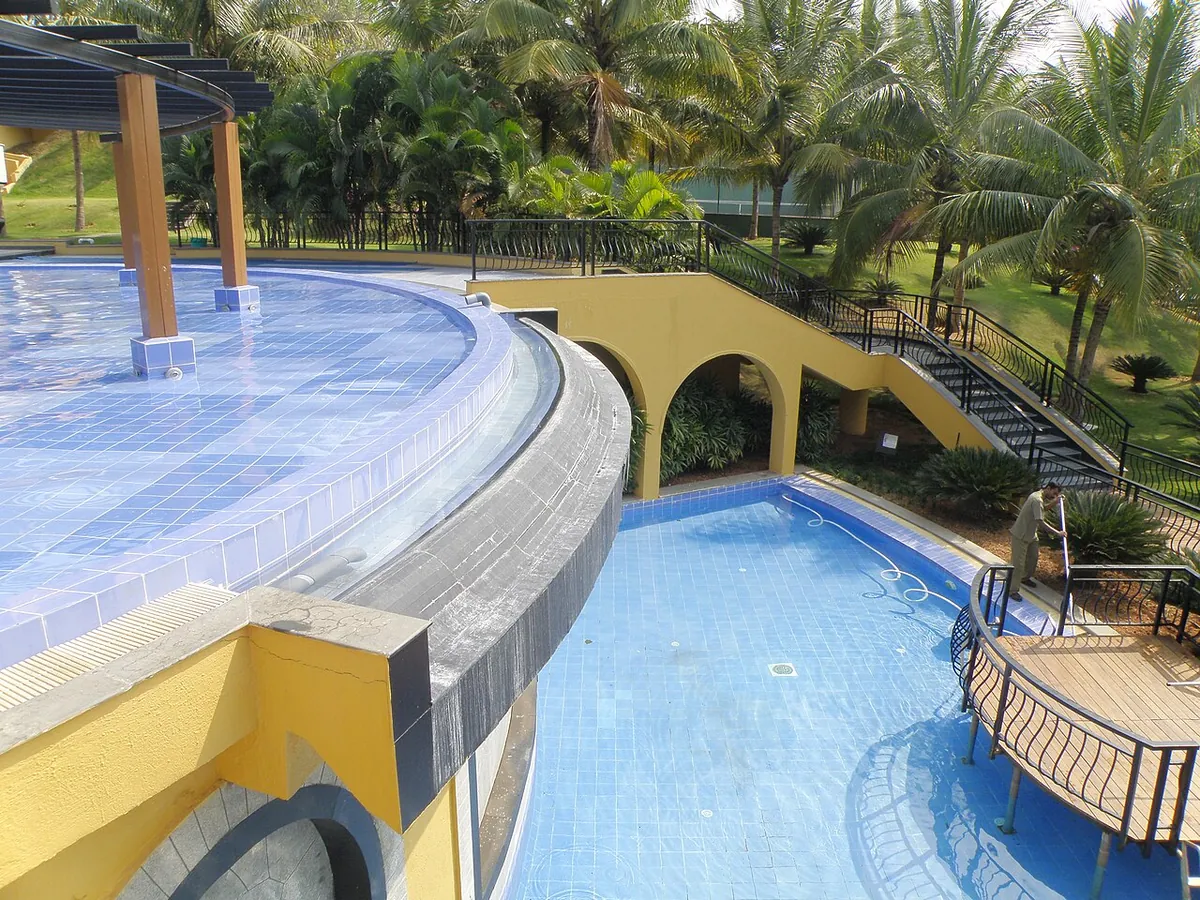
Photo: Prateek Karandikar, Wikimedia Commons, CC BY-SA 4.0
Infinity Pool Design Types
Infinity pool design comes in several forms. Each infinity edge pool type suits a different site.
Single vanishing edge
The most common infinity pool design: one long side is the vanishing edge, facing the best view. The other three sides have normal coping. It works well on a slope that falls away from the house.
Multiple vanishing edges
Two or three sides vanish, often on a corner of a hill or a rooftop. These need larger catch basins and more careful engineering, and cost more.
Perimeter overflow (zero edge)
Water spills over all four sides into a slot or grate around the pool. The water surface sits flush with the deck, like a sheet of glass. This style works on flat sites and creates a calm, mirror-like look rather than a horizon effect.
Rooftop and elevated infinity pools
Pools on roofs or cantilevered off buildings use the vanishing edge to frame city views. They need major structural engineering.
Infinity spa spillover
A raised spa with one vanishing edge spilling into the main pool gives some of the infinity effect at a lower cost.
How Much Does an Infinity Pool Cost?
| Infinity pool project | Typical cost |
|---|---|
| Small backyard infinity pool (12 x 24 ft, one edge) | $80,000 – $130,000 |
| Medium infinity pool (16 x 32 ft, one edge) | $100,000 – $180,000 |
| Large or multi-edge infinity pool | $150,000 – $300,000+ |
| Rooftop or cantilevered infinity pool | $250,000 – $1,000,000+ |
| Infinity spa spillover added to a pool | $15,000 – $40,000 extra |
The extra cost compared with a standard concrete pool comes from the weir wall and its precise leveling and finish, the catch basin and its plumbing, a larger pump or a second pump, structural engineering for walls that are exposed on the low side, retaining walls and foundations on slopes, and more complex automation to control water levels. Site access on steep hillsides can add a lot more.
What Site Does an Infinity Pool Need?
An infinity edge only creates the horizon effect when there is something to look at beyond it and the ground falls away below the edge. Good sites include hillsides overlooking a valley, lake or ocean; lots that slope away from the house; and rooftops with open views. On a flat suburban lot with a fence behind the pool, a vanishing edge has much less impact, and a perimeter overflow design or a raised spillover wall may be a better use of the budget.
Infinity pools on slopes also need careful geotechnical work. The low side of the pool and the catch basin wall are exposed, so they must be engineered to hold the water and resist soil movement. Expect soil testing, engineered foundations and sometimes caissons or piers.
How an Infinity Pool Is Built
Infinity pool construction follows the same basic steps as a concrete pool, with extra work for the weir and basin.
- Design and engineering: a pool designer and structural engineer plan the pool, weir, basin, sight lines and drainage.
- Permits: often more involved than for a standard pool because of slopes and retaining walls.
- Excavation and foundations: the pool and basin are dug and footings poured, sometimes with piers into the slope.
- Steel and plumbing: rebar for the shell and walls; plumbing for the main pool, basin, weir return lines and auto-fill.
- Shell: gunite or shotcrete forms the pool, weir wall and basin.
- Weir finishing: the top of the weir is set dead level, often with tile or stone, and the face of the wall is finished because it is visible from below.
- Equipment: a dedicated weir pump, filter, heater and automation to manage levels.
- Finish and fill: interior finish, coping, deck, fill and start-up.
Most infinity pools are concrete, because the weir and basin must be custom-shaped. A few fiberglass models include a vanishing edge, but site options are limited. Build time is usually 3 to 6 months.
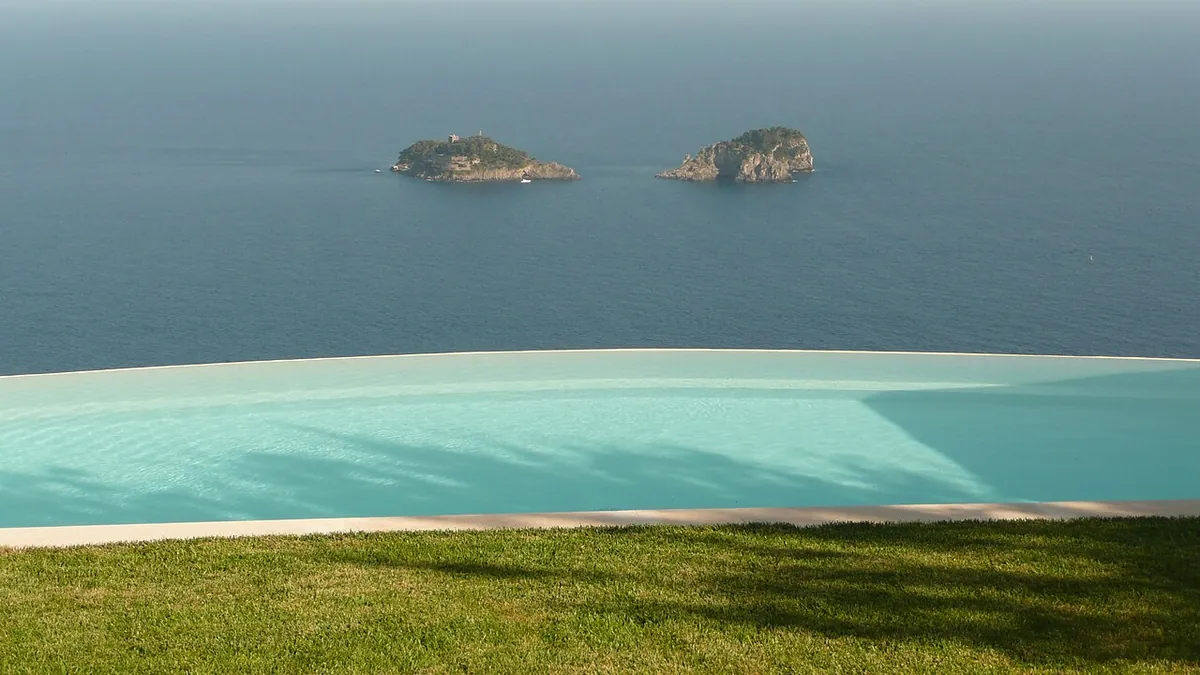
Photo: Bruno Acampora, Wikimedia Commons, CC BY-SA 3.0
Backyard Infinity Pool Ideas
An infinity pool backyard project works best when it is built around a view. Here are infinity pool designs for different settings.
- Lake view: a vanishing edge aligned with the water line of a lake so the pool appears to flow into it.
- Valley view: a long, narrow lap pool with an infinity edge along a hillside.
- Ocean view: dark interior finishes that match the color of the sea.
- Garden view: an edge facing a planted slope or meadow.
- Sunset alignment: orient the edge toward the west for evening views.
- Infinity spa: a raised spa with a vanishing edge into the pool for a more modest budget.
- Lighting: LED lights in the catch basin and under the weir make the edge glow at night.
Above Ground Infinity Pool Options
True infinity edges need a basin and pump, so above ground infinity pool options are limited. Some prefabricated pools and container pools include a vanishing edge with a built-in trough, set on a deck or slope. They are less common and still cost much more than a standard above ground pool, typically $40,000 to $100,000 installed. For a more budget-friendly water feature, consider a spillover or sheer descent instead; see pool ideas with waterfalls.
Infinity Pool Maintenance
- Keep the water level right: an auto-fill keeps the basin from running low as water evaporates.
- Clean the weir: algae and scale on the spill edge show clearly; brush it weekly.
- Watch evaporation: falling water loses more water and heat, so use a cover and run the weir pump on a schedule.
- Balance the water: the extra aeration tends to push pH up; test more often.
- Clean the catch basin of leaves and debris.
- Service the extra pump and controls once a year.
Running costs are typically 20% to 40% higher than a standard pool because of the extra pump, evaporation and heat loss. A variable-speed weir pump and a cover help a lot.
Pros and Cons of an Infinity Pool
Pros
- Striking, resort-style look that frames a view.
- Soothing sound of moving water.
- Can make the most of a sloped lot.
- May add appeal to high-end homes with views.
Cons
- High build cost and complex engineering.
- Higher running costs from evaporation and pumps.
- Needs a site with a view and a slope to make sense.
- Weir and basin need regular cleaning.
- Repairs to the weir or basin can be costly.
Infinity Swimming Pool Designs: Shapes, Finishes and Details
Infinity swimming pool designs succeed or fail on small details. These choices shape the final look:
- Shape: long rectangles with the vanishing edge on the long side give the strongest horizon effect. Curved edges suit natural hillsides; round infinity pools work on hilltops with views in several directions.
- Interior color: dark gray, black or deep blue finishes reflect the sky and make the edge disappear. Light finishes look bright and tropical but show the edge more.
- Weir finish: glass tile, stone or smooth plaster on the top of the weir; the face of the wall below is often tiled or clad in stone because people see it from the garden.
- Edge height: the drop from the weir to the basin affects sound. A short drop is quiet; a tall drop makes a waterfall sound.
- Sight lines: designers stand at the main viewing spots, such as the living room or terrace, to make sure the weir is hidden from those angles.
- Lighting: lights under the weir lip or in the basin make the edge glow at night.
Good infinity pool design starts from the view and the main viewing points, then work back to the pool shape and edge position.
What Infinity Pool Pictures Do Not Show
Infinity pool pictures and photos in magazines and resort ads are taken from carefully chosen angles, often at sunset, with calm water and no wind. Real infinity pools look just as good from the right spots, but from the side you will see the weir, the basin and the wall below. Wind can ripple the surface and break the illusion, and leaves or bugs collect along the edge. When you look at infinity pool images and pics for ideas, also look at photos from the side and below to understand the full structure, and ask builders for site visits to pools they have built.
Famous Infinity Pools and Resorts With Infinity Pool Views
Some of the best-known infinity pools are at resorts and hotels. The rooftop pool at Marina Bay Sands in Singapore, more than 50 stories up, made infinity pools famous worldwide. Hotels in Dubai, Bali, Santorini, the Amalfi Coast and the Caribbean use vanishing edges to blend pools with the sea. Many resorts with infinity pool designs place the edge so the water lines up with the ocean horizon from the lounge chairs. These pools show what is possible, but they are commercial projects with budgets and engineering far beyond a typical home. Backyard versions borrow the same ideas at a smaller scale.
Infinity Pool Installation: Choosing a Builder
Infinity pool construction is unforgiving. A weir that is off by a quarter inch can make water spill unevenly; a basin that is too small can run dry and starve the pump when swimmers splash. When choosing a builder for infinity pool installation:
- Ask to see several infinity pools they have built, in person if possible.
- Ask who does the structural engineering and how the slope will be stabilized.
- Ask how they size the catch basin and what controls they use for water level.
- Ask how they ensure the weir is level and what finish they use on it.
- Get a detailed contract that covers the weir, basin, pumps, automation and wall finishes.
- Confirm warranties on the structure, waterproofing and equipment.
Infinity Pool House Design Tips
For an infinity pool house, where the pool is a central feature of the home, plan the pool and the house together. Align the vanishing edge with the main living room window or terrace so the pool frames the view from inside. Keep the deck on the house side wide enough for loungers and dining, and keep the vanishing side clear of furniture and railings that would break the line. Use landscaping below the edge to hide the basin, and put the equipment room where its noise and access do not interfere with views. In many homes, a simple long rectangle with one infinity edge gives more impact than a complex shape.
Infinity Pool Description: How It Feels to Swim In
In use, an infinity pool feels like any good pool, with one difference: as you swim toward the vanishing edge, the water seems to end in the sky or the sea. You can rest your arms on the edge and look out at the view, with water flowing gently over the weir beneath you. The sound of water falling into the basin adds a quiet background. It is this experience, as much as the photos, that makes infinity pools so popular.
Infinity Pool vs Standard Pool
| Factor | Infinity edge pool | Standard concrete pool |
|---|---|---|
| Typical cost (16 x 32 ft) | $100,000 – $180,000 | $55,000 – $110,000 |
| Best site | Slope with a view | Any level yard |
| Equipment | Extra weir pump, basin, auto-fill | Standard pump and filter |
| Water and heat loss | Higher | Lower |
| Build time | 3 – 6 months | 2 – 3 months |
| Look | Blends into the view | Framed by coping |
Safety and Codes for Infinity Pools
Infinity pools must meet the same safety codes as any pool: a barrier around the pool area, anti-entrapment drain covers, proper electrical bonding and GFCI protection. The low side of an infinity edge is often several feet above the ground, so codes may require railings or barriers below the basin, and designs should discourage anyone from sitting on or climbing over the weir. The catch basin itself can be a drowning hazard for small children if it is deep and accessible, so it is often covered with a grate or placed out of reach. Discuss these details with your designer and local building department early.
Is an Infinity Pool Worth It?
An infinity edge pool is worth it if you have a sloped lot with a strong view and the budget to build it well. On the right site, it can become the defining feature of a home and is highly valued in luxury markets. On a flat lot without a view, the extra money usually brings little benefit; a perimeter overflow pool, a spillover spa or a well-designed water feature can give a high-end look for less. Weigh the higher build and running costs against how much you will enjoy the view every day.
A Short History of the Infinity Pool
The idea of water that seems to merge with the landscape is old. Some historians point to garden designs in 17th-century France and to reflecting pools that mirror the sky. The modern infinity pool became popular in the second half of the 20th century, when architects in California, Hawaii and the Mediterranean began building residential and hotel pools with vanishing edges on hillside sites. As concrete pool construction improved and resort travel grew, infinity edges spread worldwide, and social media made them one of the most recognizable pool designs today.
Planning Checklist for an Infinity Pool
- Confirm the view and the slope: stand where you will look at the pool most and check what lies beyond the edge.
- Order a soil and slope study before design.
- Set a realistic budget, including engineering, retaining walls and landscaping below the edge.
- Decide on one or more vanishing edges and the basin location.
- Choose interior and weir finishes that suit the view and light.
- Plan equipment, auto-fill and automation for water level control.
- Plan lighting, safety barriers and access for maintenance below the edge.
- Interview several builders with infinity pool experience and visit their work.
Careful planning is what turns an expensive infinity pool into a pool that looks as good in daily life as it does in photos.
What Is an Infinity Pool: Key Points
- An infinity pool has a lowered edge (weir) where water spills into a hidden catch basin.
- The effect works best on sloped sites with a view.
- Backyard infinity pools typically cost $80,000 to $200,000 or more.
- They need careful engineering, a precisely level weir and an extra pump and basin.
Frequently Asked Questions
Whats an infinity pool in simple terms?
A pool with one edge that water spills over into a hidden trough, so the water seems to meet the horizon.
Is an infinity pool the same as a negative edge pool?
Yes. Infinity, vanishing, negative and disappearing edge pools are names for the same design.
What is an infinity edge pool used for?
Mainly for its look: it frames a view and makes the water seem to blend with the horizon. It swims like any other pool.
How much does an infinity pool cost to run?
An infinity edge pool usually costs 20% to 40% more to run than a standard pool because of the extra pump, evaporation and heat loss.
Can an infinity edge pool be heated?
Yes. Heat the infinity pool as usual, but expect more heat loss when water is flowing over the edge. Run the weir pump only when you want the effect, and use a cover.
Does an infinity edge pool add value to a house?
On a view lot in a high-end market, an infinity pool can add appeal and value. On ordinary lots, it rarely returns its extra cost.
What is the difference between an infinity edge pool and an overflow pool?
An infinity pool spills over one or more edges into a basin below to create a horizon effect. An overflow or zero edge pool spills over all sides into a slot at deck level, creating a flat, mirror-like surface.
What makes good infinity pool design?
Good infinity pool design starts with the view, hides the weir from the main viewing spots, sizes the basin correctly and keeps the edge perfectly level.
Can an infinity edge pool be small?
Yes. A small infinity pool or infinity plunge pool works well on a terrace with a view, though costs stay high because of the weir and basin.
Are infinity pools safe?
Yes, when built to code. The vanishing edge is a wall with a drop on the outside, so designs keep swimmers from climbing onto it, and the area below is fenced or not accessible.
Can I add an infinity edge to an existing pool?
Sometimes, if the site slopes the right way, but it means rebuilding a wall, adding a basin and new plumbing. It often costs $30,000 to $80,000 or more.
Do infinity pools lose more water?
Yes. Falling water evaporates faster, so expect higher water use. Covers and pump scheduling help.
What is infinity pool design on a flat lot?
On flat lots, a perimeter overflow (zero edge) pool gives a similar sleek look without needing a view or slope.
Where can I see infinity pool pictures for ideas?
Builder portfolios, design magazines and resort websites show many infinity pool photos. Look at side views too, to see the weir and basin.
How long does it take to build an infinity pool?
Usually 3 to 6 months, including design, permits, engineering and construction.
Sources
- HomeGuide: Infinity pool cost
- Angi: Infinity pool cost
- CPSC: Pool and spa safety
- ICC: International Swimming Pool and Spa Code