
Pool Ladder Steps: Types, Replacement and Installation Guide
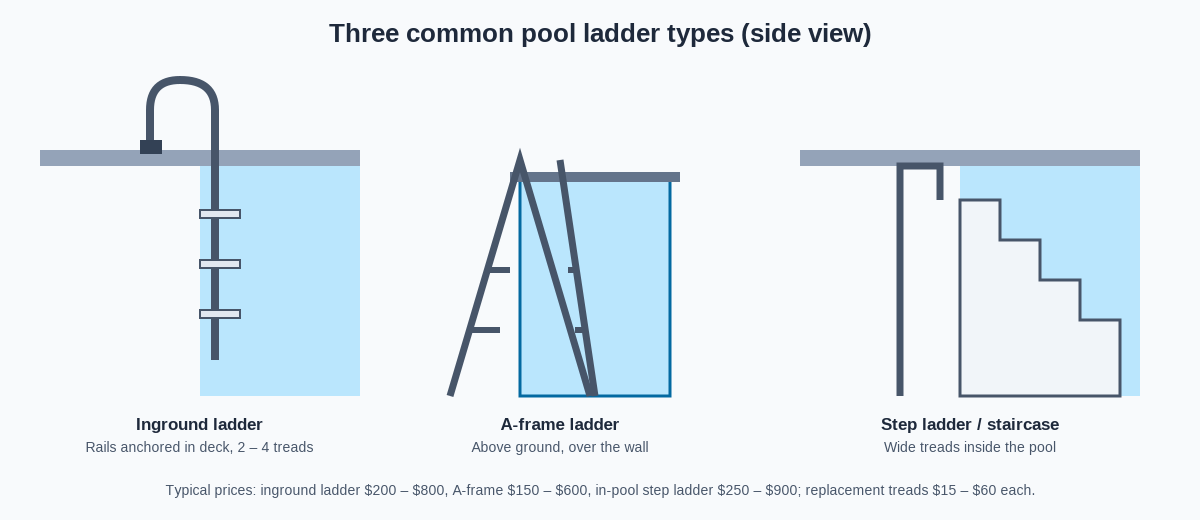
Diagram: Asphapro.com
Quick Answer
Pool ladder steps are the treads on a pool ladder, and the term also covers the ladders themselves. Inground pool ladders have two curved stainless steel handrails anchored in the deck and 2 to 4 treads, and cost about $200 to $800. Above ground pools use A-frame ladders that straddle the wall, or deck ladders, for $150 to $600. In-pool step ladders with wide treads cost $250 to $900 and are easier to climb. Worn or cracked treads can be replaced for about $15 to $60 each: remove the bolts, slide out the old tread, fit the new one and tighten. Choose wide, slip-resistant treads, keep bumpers on the rails to protect the pool wall, and make sure the ladder is firmly anchored.
A pool ladder is the simplest way into and out of a pool, especially at the deep end where built-in steps do not reach. Ladders take almost no swimming space, cost far less than steps, and are easy to add or replace. But a loose rail, a cracked tread or a slippery step can make a ladder unsafe. Knowing the types of pool ladders, how to replace pool ladder steps and how to install a ladder properly keeps every swimmer safe.
This guide covers every kind of swimming pool ladder, replacement treads, installation, safety and costs. If you want wider steps instead of a ladder, see our guides to inground pool steps and pool steps above ground.
Types of Pool Ladders
Inground pool ladders. The classic inground ladder has two curved handrails, usually made of stainless steel, that rise above the deck and curve down into the water. The rails sit in anchor sockets set into the concrete deck and are held by wedge anchors or bolts. Between the rails are 2 to 4 treads, the pool ladder steps, which are made of stainless steel, plastic or resin. Bumpers on the rail ends rest against the pool wall to keep the ladder from scratching the surface.
Above ground A-frame ladders. An A-frame ladder straddles the wall of an above ground pool, with steps on the outside and inside. Many have a removable or flip-up outer section so the ladder can be locked or taken away when the pool is not in use, which helps meet safety rules.
Deck ladders for above ground pools. When an above ground pool has a deck, a deck ladder bolts to the deck and drops into the pool, much like an inground ladder.
In-pool step ladders. A step ladder swimming pool design has wider, deeper treads set at a gentler angle than a vertical ladder, more like a small staircase with handrails. These pool step ladder units are easier for children, older adults and anyone who struggles with a steep ladder.
Cross-braced and three-tread ladders. Heavy-duty ladders have cross braces between the rails for extra strength, often used in commercial pools and busy family pools.
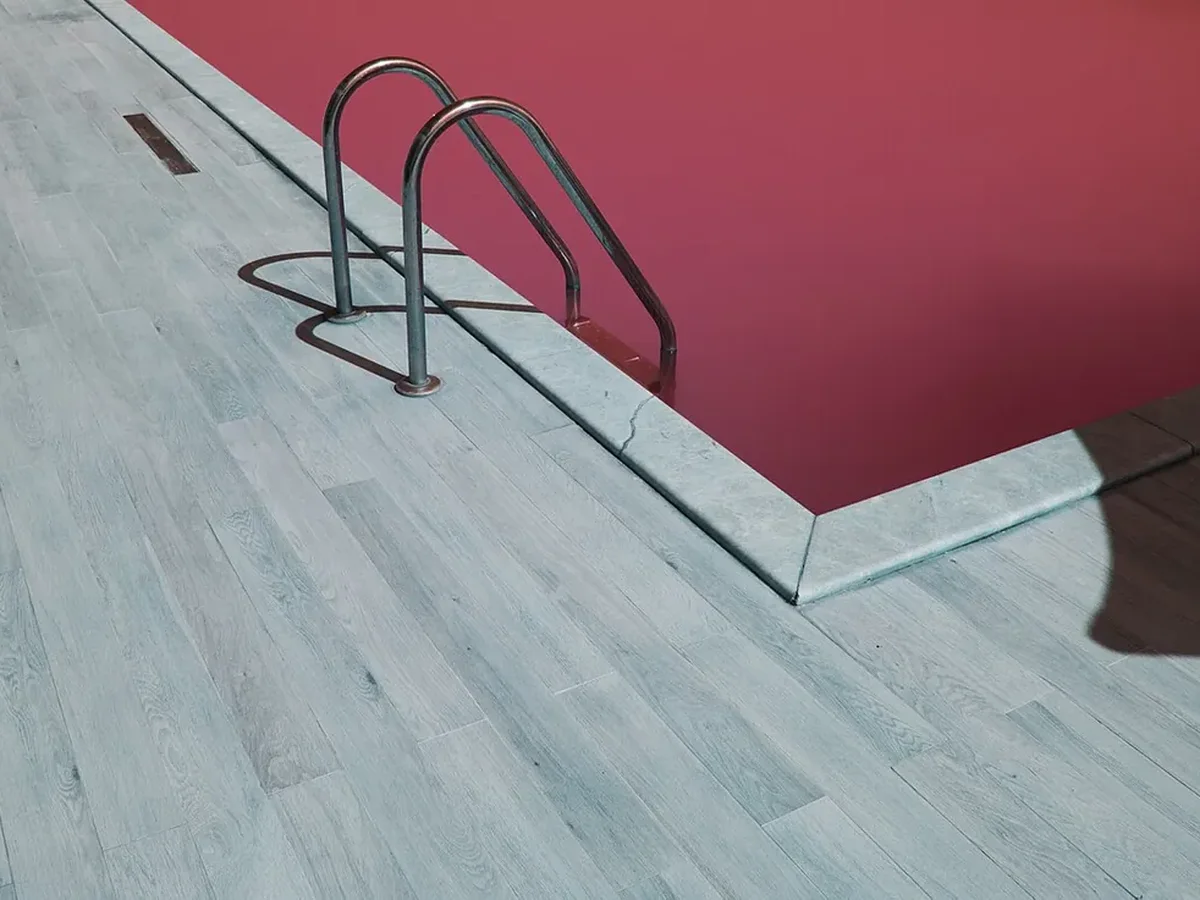
Photo: Caroline Bertolini, Wikimedia Commons, CC0
Parts of a Pool Ladder
Every inground ladder for pool use has the same basic parts. The handrails are the two curved tubes, usually 1.9 inches in outside diameter, made of 304 or 316 stainless steel. The treads are the steps between the rails. The anchor sockets are cups set in the deck concrete that hold the rail ends. Wedge anchors or escutcheon plates lock the rails in the sockets and cover the hole. Bumpers are rubber or vinyl caps on the bottom ends of the rails, which rest on the pool wall. Bolts hold each tread to the rails.
Pool Ladder Replacement Steps
Treads take the most wear on a pool ladder. Plastic treads crack, fade and lose their non-slip texture in the sun and chlorine. Stainless steel treads can get slippery or develop rust spots if they are low-grade steel. Pool ladder replacement steps are sold in kits that include the tread and the bolts. They come in standard sizes for most ladders, but always measure the distance between the rails and the bolt hole spacing before buying.
Replacement steps for swimming pool ladder units are made of plastic, resin, or stainless steel with a non-slip surface. Plastic treads cost about $15 to $40 each; stainless treads $40 to $60. Replacing all the treads on a ladder is a cheap way to make an old ladder safe and comfortable again.
How to Replace Pool Ladder Steps
1. Remove the ladder. Loosen the wedge anchors or anchor bolts at the deck and lift the ladder out of the sockets. Some ladders can be worked on in place, but removing it is easier and safer.
2. Remove the old treads. Undo the bolts that hold each tread to the rails. Old bolts may be corroded; use penetrating oil and the right wrench or socket. Slide or pull the tread out.
3. Clean the rails. Clean the rails where the treads attach, and check for cracks, bends or rust. Replace the rails if they are damaged.
4. Fit the new treads. Line up the new treads with the bolt holes and insert the new stainless bolts. Tighten them evenly but do not overtighten plastic treads, which can crack.
5. Replace bumpers. Fit new rubber bumpers on the rail ends while the ladder is out.
6. Reinstall the ladder. Set the rails back into the anchor sockets, tighten the wedge anchors, and check that the ladder does not wobble.
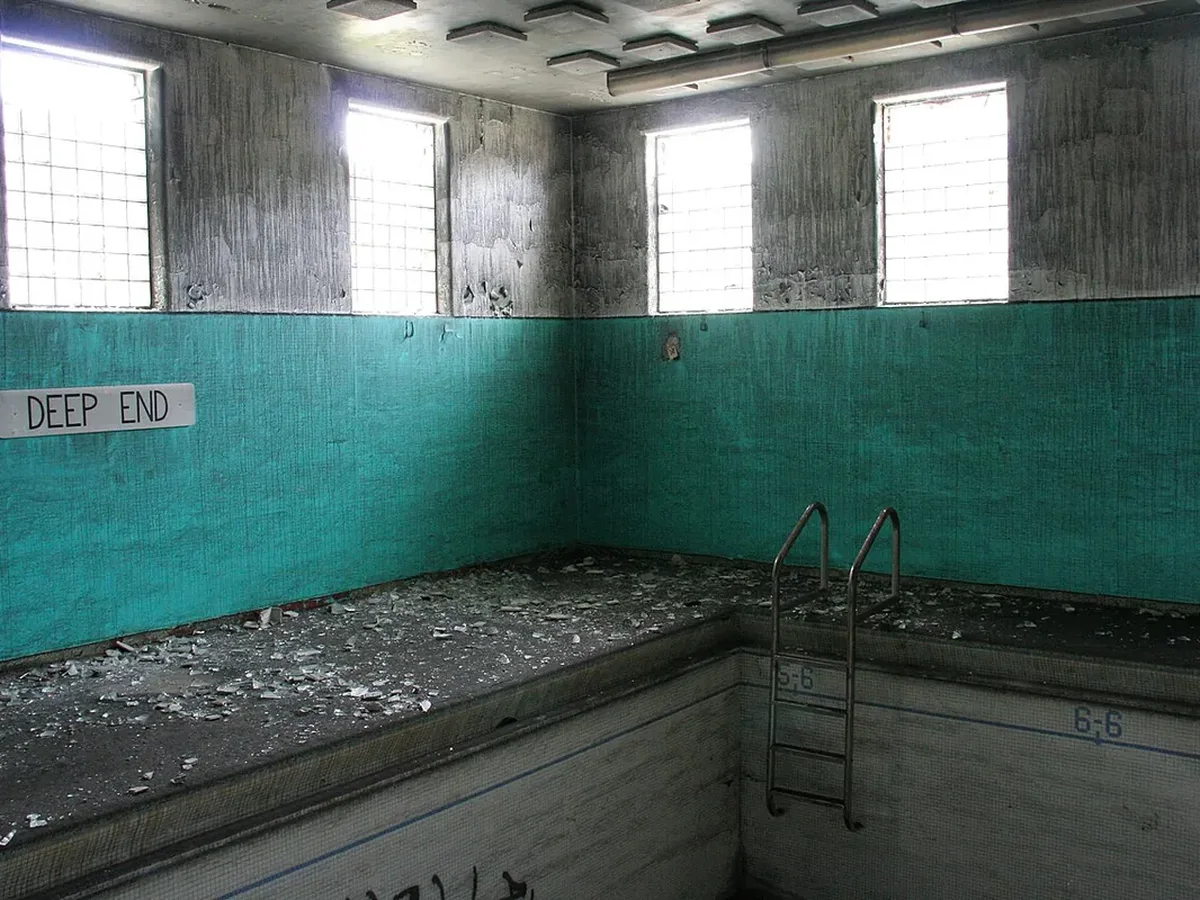
Photo: Colin Knowles, Wikimedia Commons, CC BY-SA 2.0
How to Install an Inground Pool Ladder
Most inground pools are built with anchor sockets already set in the deck where the ladder goes. If yours has sockets, installing a ladder for a swimming pool is simple. Clean out the sockets, which often fill with dirt and debris. Slide the wedge anchors onto the rail ends, if your ladder uses them. Lower the rails into the sockets so the bumpers rest against the pool wall at the right height. Tighten the wedge anchor bolts until the rails are firm. Fit the escutcheon plates over the sockets to cover the gaps.
If there are no sockets, you will need to core-drill holes in the deck, set new anchor sockets in quick-set hydraulic cement or epoxy, and bond the sockets to the pool's equipotential bonding grid. The rail spacing and distance from the pool edge must match the ladder exactly, so use a template from the ladder maker. Because bonding is an electrical safety requirement, many owners hire a pool contractor or electrician for this step.
How to Install an Above Ground Pool Ladder
Above ground ladders come in a few designs. A-frame ladders simply straddle the wall: assemble the ladder, set it over the wall, and make sure both feet sit flat on firm ground outside and on the pool floor inside. Place a ladder mat under the inside feet to protect the liner. Many swimming pool ladders for above ground pools fill with water or sand in the inside legs to keep them from floating.
Deck ladders bolt to the deck surface and hang into the pool. Install them so the top rail height and the treads match the maker's guide, and use stainless bolts through the deck boards into solid framing. Again, set a ladder mat under the feet inside the pool. For safety, choose a design with a lockable gate or a removable outer section, so children cannot climb into the pool when no adult is around.
Choosing Swimming Pool Ladder Steps
The best swimming pool ladder steps are wide, deep and textured. Wider treads, often 4 to 6 inches deep instead of the narrow 2- to 3-inch treads on older ladders, are far more comfortable and less likely to cause slips. Many replacement treads are designed as "comfort" or "wide" treads that fit standard rails. Plastic treads are warm to the touch and do not get hot in the sun, but can crack with age. Stainless steel treads last longer but can get hot and slippery unless they have a strong non-slip pattern.
Think about who uses the ladder. Children and older adults benefit from wide treads and a gentle angle, so a step ladder style may be better than a vertical ladder. Swimmers who use the deep end for laps or diving usually prefer a classic ladder that takes up little space.
Pool Ladders and Steps: Which Is Better?
Pool ladders and steps each have a role. Steps are easier and safer for most people, give a place to sit, and work well at the shallow end. Ladders take less space, cost less and suit the deep end, where steps would need to be very long. Most pools use both: steps at the shallow end and a ladder at the deep end, which also gives a second way out of the pool, required by many codes for larger pools.
If your pool has only a ladder and you want an easier entry, you can add drop-in steps at the shallow end, or swap a vertical ladder for an in-pool step ladder. A pool with steps with ladder support at the other end gives every swimmer a comfortable way in and a quick way out.
Materials: 304 vs 316 Stainless Steel
Most pool ladder rails are made of 304 stainless steel, which resists corrosion in normal chlorine pools. In salt water pools, coastal areas and pools with heavy chemical use, 316 stainless steel, which contains molybdenum, holds up much better. A cheaper ladder made of lower-grade steel may develop rust spots, called tea staining, within a few seasons. Powder-coated aluminum or steel ladders in colors like blue, black or white are also available, and resin ladders are common on above ground pools. Whatever the material, look for a ladder with a high weight rating, often 300 to 400 pounds.
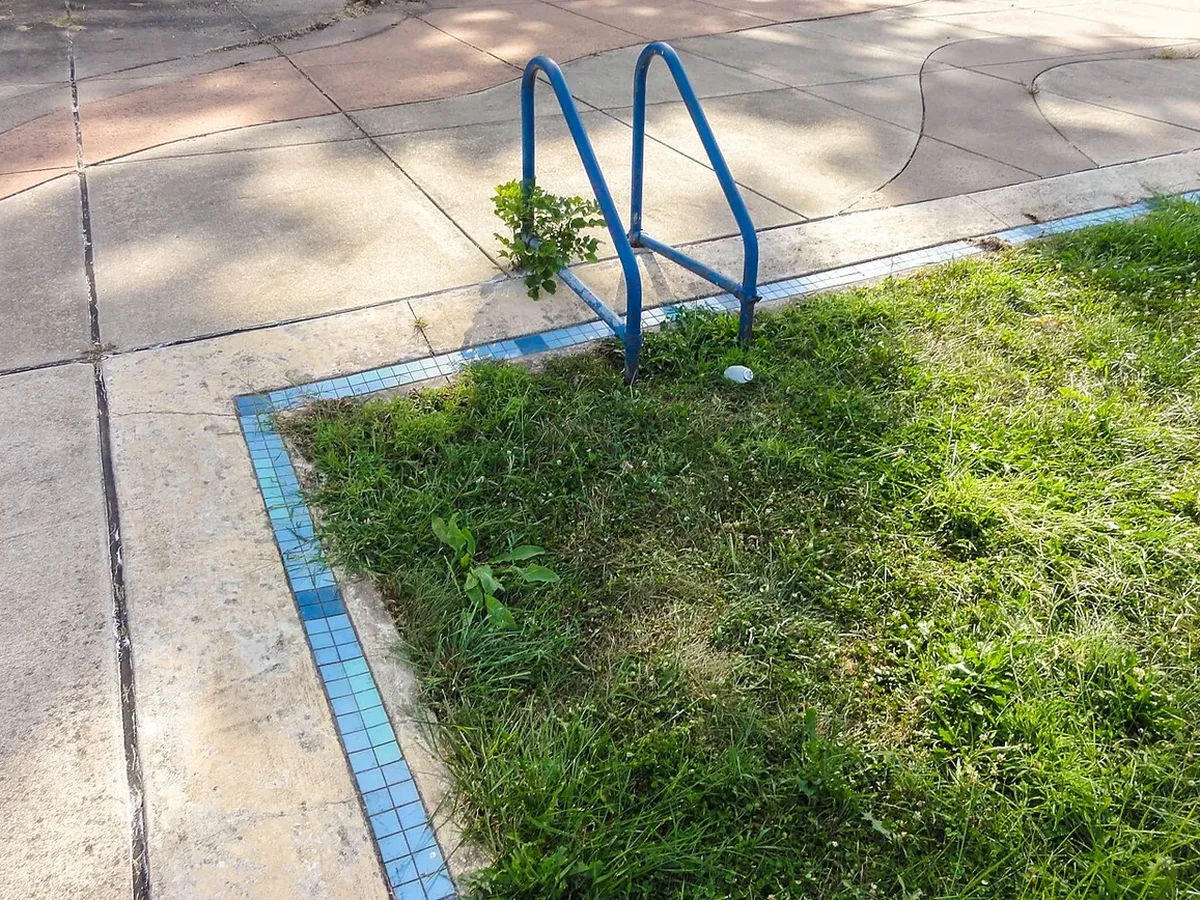
Photo: Graham Coreil-Allen, Wikimedia Commons, CC BY-SA 4.0
Swimming Pool Ladder Safety
A swimming pool ladder must be firmly anchored, with no wobble. Check the wedge anchors at the start of each season and tighten them if the ladder moves. Make sure the bumpers are in place, so the rails do not scratch the wall or leave a gap where fingers or toes could get caught. The space between the ladder and the pool wall should be small enough to avoid entrapment, and treads should be evenly spaced, usually 7 to 12 inches apart. Treads should be slip resistant and in good condition.
Never dive from or near a ladder, and teach children to face the ladder when climbing in or out. Above ground pool ladders should be removed, locked or blocked when no adult is present. For more on pool safety barriers, see our guide on pool fence cost.
Electrical Bonding and Pool Ladders
The National Electrical Code requires metal parts within a set distance of the pool, including ladder rails and their anchor sockets, to be bonded to the pool's equipotential bonding grid. Bonding keeps all metal parts at the same electrical potential, so stray current does not shock swimmers. If you replace a ladder in existing bonded sockets, the new rails are bonded through the sockets. If you add new sockets, they must be bonded. If swimmers ever feel a tingle when touching the ladder, stop using the pool and have an electrician check the bonding and wiring at once.
Common Pool Ladder Problems and Fixes
Wobbly ladder. Usually loose wedge anchors. Tighten the anchor bolts; if the socket itself is loose in the deck, reset it with hydraulic cement.
Rust spots. Low-grade steel or poor water chemistry. Clean with a stainless steel cleaner and polish, keep pH and chlorine in range, and consider 316 stainless when replacing.
Cracked or slippery treads. Replace them with new pool ladder replacement steps.
Missing bumpers. Replace them right away to protect the wall and prevent pinching.
Stuck rails. Rails can corrode into the sockets. Soak with penetrating oil, loosen the wedge anchors fully and work the rails back and forth. Coat the rail ends with anti-seize before reinstalling.
Pool Step Ladder Replacement Cost
The cost of a pool step ladder replacement depends on what you replace. New treads cost $15 to $60 each, so a full set for a 3-step ladder runs $45 to $180. Bumpers cost $5 to $20 a pair. A new inground ladder costs about $200 to $800, with 316 stainless and heavy-duty models at the top of the range. An in-pool step ladder with wide treads costs $250 to $900. Above ground A-frame ladders cost $150 to $600. Professional installation, if needed, costs about $100 to $300, or more if new anchor sockets must be drilled and bonded.
Caring for Pool Ladders
Simple care keeps pool ladders safe and shiny. Wipe stainless rails with a soft cloth and a stainless cleaner a few times a season to remove scale and chemical film. Rinse above ground ladders and check for cracks. Brush the treads when you brush the pool, since algae can grow on them. In cold climates, remove inground ladders when you close the pool, clean them, coat the rail ends with anti-seize, and store them indoors. Cover the anchor sockets so they do not fill with debris. Remove above ground ladders for winter too, so ice cannot damage them or the liner.
Ladder Pool Steps for Children and Older Swimmers
Climbing a vertical ladder is hard for small children and for anyone with weak knees, hips or arms. For these swimmers, ladder pool steps with wide treads and a gentle angle make a big difference. In-pool step ladders, steps with handrails on both sides, and drop-in staircase units all help. For dogs, special pet ramps and steps let them climb out safely, which also protects the liner from claws.
Above Ground Swim Pool Ladder Options
For an above ground swim pool ladder, the main choices are an A-frame ladder, a deck ladder or a staircase entry. A-frame ladders are the cheapest and most common. Look for a model with a locking or removable outer section. Deck ladders work if the pool has a deck. Staircase entry systems with wide steps outside and inside the pool are the easiest to use but cost more, usually $300 to $900.
How to Measure for a Replacement Pool Ladder
Before buying a new inground ladder, take three measurements. First, measure the distance between the centers of the two anchor sockets in the deck; most residential ladders use about 19 to 24 inches, but check yours. Second, measure from the top of the deck to the pool floor directly below the ladder, or at least the water depth where the ladder sits, to choose the right number of treads and rail length. Third, measure from the edge of the deck coping to the center of the sockets, since the rails must curve over the coping at the right distance. Ladder makers list these dimensions for each model, so you can match your pool. If the socket spacing does not match any ladder you like, you may need new sockets or adapter plates.
Where to Place a Pool Ladder
Most pools put the ladder at the deep end, often on a side wall a few feet from the end, so swimmers can get out quickly after a dive or a swim. Some larger pools have ladders on both sides of the deep end. Codes for many pools require a means of exit at both the shallow and deep ends, and a ladder is the most common deep-end exit. Keep ladders away from diving boards and slides, out of the path of returns that could push swimmers against the rails, and in a spot where people naturally finish swimming. A well-placed swimming pool ladder also makes it easy for adults to keep an eye on swimmers getting out.
Worked Example: Updating an Old Ladder
A family has a 25-year-old inground pool with a stainless ladder that wobbles, has two cracked plastic treads and is missing a bumper. Instead of buying a new ladder for $500, they remove the old one, clean the rails, and find the steel is still in good shape. They buy a set of three wide replacement treads for $90, a pair of bumpers for $12 and new stainless bolts for $10. They also clean out the anchor sockets, which were full of dirt, and fit new wedge anchors for $25. The total cost is about $137 and two hours of work, and the ladder is safer and more comfortable than when it was new.
Buying Guide for Pool Ladders
When shopping for pool ladders, check the rail material (316 stainless for salt pools), the tread width and texture, the number of treads for your water depth, the weight rating, the anchor spacing, and the warranty. Read whether the ladder includes anchors, escutcheons and bumpers or if they are sold separately. For above ground pools, check that the ladder fits your wall height and that it has a safety lock or removable section. Avoid very cheap ladders made of thin tubing, which can bend and rust quickly.
Pool Ladder Rules in Building Codes
Building codes and pool standards set a few rules for ladders. The ISPSC and ANSI standards generally require ladders to have handrails on both sides, treads that are slip resistant and at least a set width, uniform spacing between treads, and a small enough gap between the ladder and the pool wall to prevent entrapment. Larger residential pools often need a means of exit at the deep end, which a ladder can provide. Commercial pools have stricter rules, including the number and placement of ladders based on pool size. When you replace a ladder, choose a model that meets current standards, since older ladders may not.
Winterizing a Pool Ladder
In cold climates, ice can bend ladder rails, crack treads and damage the pool wall where the bumpers rest. When you close the pool, loosen the wedge anchors, lift out the ladder, rinse it, and let it dry. Coat the rail ends with anti-seize so they will slide out easily next year. Store the ladder indoors or in a shed. Put caps or covers on the anchor sockets so they do not fill with water and debris, which can freeze and crack the deck. For the full closing routine, see our guide on how to winterize a pool. In spring, clean the sockets, check the treads and bumpers, and reinstall the ladder before the first swim.
Lighting and Visibility for Pool Ladders
Swimmers need to find the ladder quickly, especially at night or when they are tired. A pool light placed near the deep end helps, and some owners add small LED lights on the deck beside the ladder or use rail covers in bright colors. Dark tile markers on the pool wall behind the ladder also help swimmers see it from across the pool. Keep the area around the top of the ladder clear of chairs, toys and hoses, so people climbing out have a clear, safe place to step onto the deck.
Pool Ladder Steps: Key Points
- Inground ladders cost $200 to $800; above ground ladders $150 to $600.
- Replacement treads cost $15 to $60 each and are easy to install.
- Keep anchors tight, bumpers in place and treads slip resistant.
- Step ladders with wider treads are easier for children and older adults.
Frequently Asked Questions
How many steps should a pool ladder have?
Most inground ladders have 2 to 4 treads, depending on water depth at the ladder. Deep-end ladders often have 3 or 4, with the bottom tread about 3 feet below the water.
Can I replace just one pool ladder step?
Yes. Treads are bolted on individually and can be replaced one at a time. If the others are worn too, replace them together so all the pool ladder steps feel the same underfoot.
Where can I buy pool replacement ladder steps?
Pool stores and online pool suppliers sell pool replacement ladder steps in standard sizes. Measure the rail spacing and bolt holes, or note the ladder model, before ordering.
Is swimming pool ladder step replacement a DIY job?
Yes. Swimming pool ladder step replacement needs only a wrench or socket set and about 30 minutes per ladder.
Should a pool have steps with ladder exits too?
Most pools work best with pool steps with ladder exits at the deep end. Steps give an easy entry, and the ladder gives a second way out.
Why is my pool ladder rusting?
Usually low-grade stainless steel, salt water or low pH. Clean it, balance the water, and choose 316 stainless when you replace it.
Sources
- ICC: International Swimming Pool and Spa Code
- CPSC: Pool and spa safety
- Pool and Hot Tub Alliance: Standards
- CDC: Preventing drowning