
Pool Steps Above Ground: How to Choose and Install the Right Steps
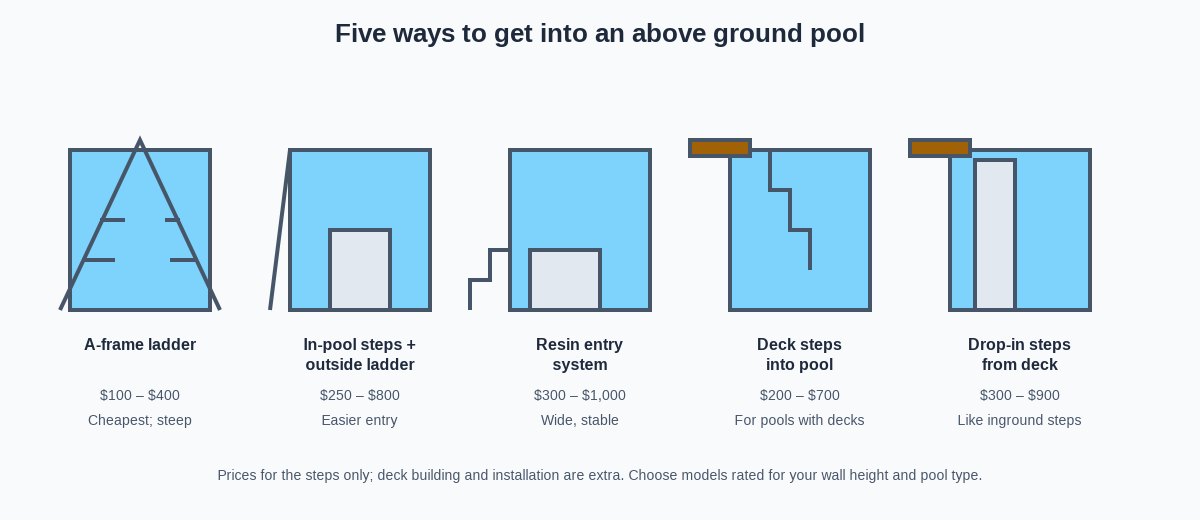
Diagram: Asphapro.com
Quick Answer
The main pool steps above ground options are an A-frame ladder ($100 to $400), an in-pool step unit with an outside ladder ($250 to $800), a resin entry system with wide steps inside and outside the pool ($300 to $1,000), deck steps that go from a deck into the pool ($200 to $700), and drop-in steps for pools with decks ($300 to $900). Choose steps rated for your wall height (usually 48 to 54 inches) and your heaviest swimmer (many are rated 300 to 400 lb), set them on level ground or a pad, weight them with sand or water so they do not float, and put a step pad under the inside steps to protect the liner. Steps are much easier and safer than a steep ladder for children, older adults and anyone with limited mobility.
The way you get in and out of an above ground pool makes a big difference in how often you use it. A steep, narrow ladder can be hard for children, older family members and anyone with knee or back problems, and it is easy to slip on. Wide steps with handrails make entering the water feel like walking into an inground pool. The right above ground pool steps also make the pool safer and can help protect the liner.
This guide compares the types of pool steps for above ground pool use, explains how to choose by wall height, pool type and swimmers, lists typical costs, and shows how to install above ground pool steps safely, with or without a deck. For pool installation costs, see above ground pool installation cost.
Types of Above Ground Pool Steps
Swimming pool steps for above ground pools come in five main styles. Above ground pool stairs steps and ladders each suit different pools and swimmers.
A-frame ladders
A-frame ladders straddle the pool wall, with steps on both sides and a platform or handrails at the top. They are the cheapest and most common way to get into an above ground pool, and many come with the pool. They take little space, but the rungs are narrow and steep, which makes them harder for small children and older adults. Many A-frame ladders have a swing-up or removable outside section that can be locked to keep children out when no adult is present.
In-pool steps with an outside ladder
These combine a wide step unit inside the pool with a simpler ladder outside. The inside steps make getting into and out of the water much easier, while the outside ladder keeps the footprint small. They are a popular upgrade from a basic A-frame ladder.
Resin entry systems
An entry system is a wide, molded resin staircase with steps on both the outside and inside of the pool, joined by a platform over the wall. They feel solid, have wide treads and sturdy handrails, and suit families with children and older swimmers. They take more space and cost more than ladders.
Deck steps into the pool
If your above ground pool has a deck, deck steps attach to or rest against the deck and lead down into the pool. They let you step off the deck into the water like an inground pool. Many are adjustable for different deck heights.
Drop-in steps
Drop-in steps are wide step units placed inside the pool next to a deck, often with molded seats. They give the most inground-like entry and can double as a place to sit in the water.
How to Choose Pool Steps for Above Ground Pools
- Wall height: most above ground pools have 48, 52 or 54 inch walls. Steps and ladders are made for specific height ranges; many are adjustable. Measure from the ground to the top rail.
- Weight rating: check the maximum load, often 250 to 400 lb. Choose a rating above your heaviest regular swimmer.
- Tread width and depth: wider, deeper treads are easier for children and older adults.
- Handrails: sturdy rails on both sides make entry much safer.
- Pool type: some steps are designed for steel-wall pools; others work with soft-sided or frame pools. Check compatibility.
- Liner type: steps inside the pool need a protective pad, and some are not suitable for expandable liners with deep ends near the wall.
- Deck or no deck: deck steps and drop-in steps need a deck; ladders and entry systems stand on the ground.
- Safety locking: look for ladders with removable or lockable outside sections, or plan a gate on the deck.
- Material: resin steps do not rust and resist chemicals; metal parts should be stainless or coated.
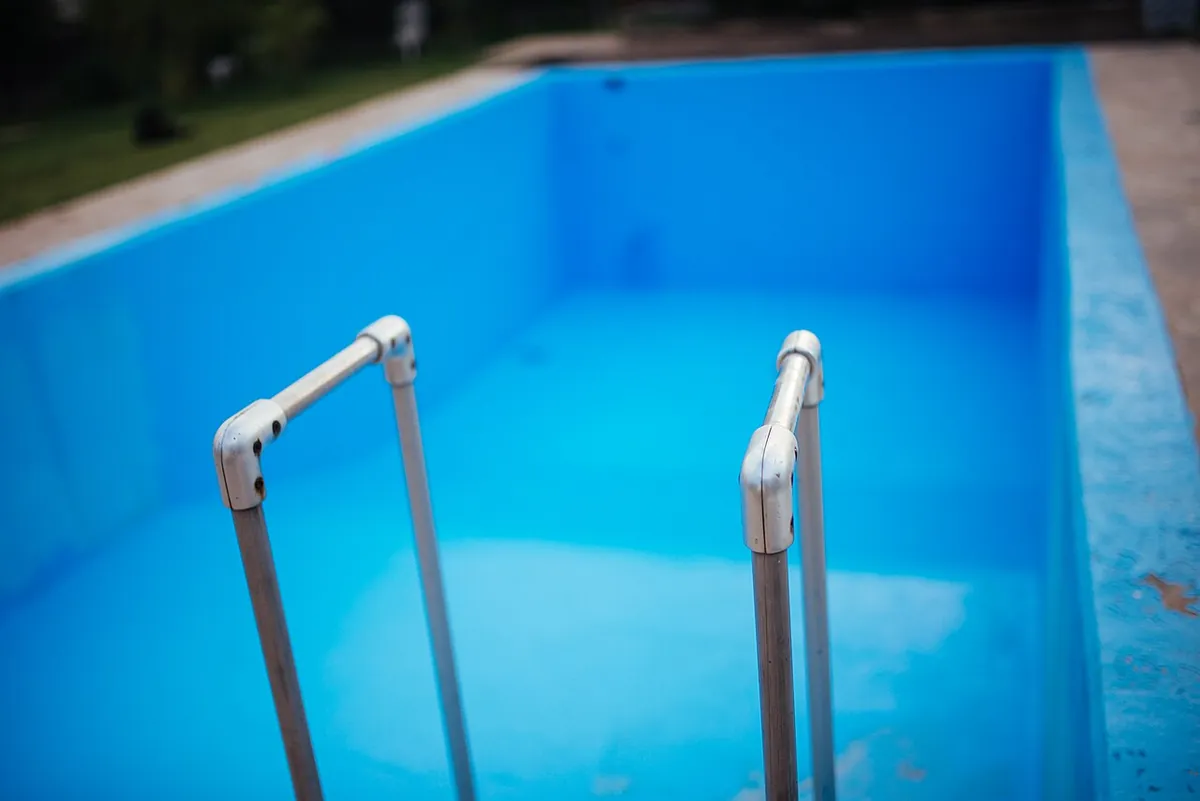
Photo: Shixart1985, Wikimedia Commons, CC BY 2.0
Steps for Inside Above Ground Pool Entry
Steps for inside above ground pool use are the part swimmers notice most. Inside steps let people walk down into the water instead of climbing down a vertical ladder. Look for at least three or four steps with treads 8 to 10 inches deep, a non-slip texture and a handrail that reaches the top. Inside steps sit on the pool floor, so they need a step pad or a piece of liner protection under them, and their hollow bodies must be filled with water or sand so they do not float. Many inside step units are white or light blue, which also makes them easy to see from the deck.
How to Install Above Ground Pool Steps
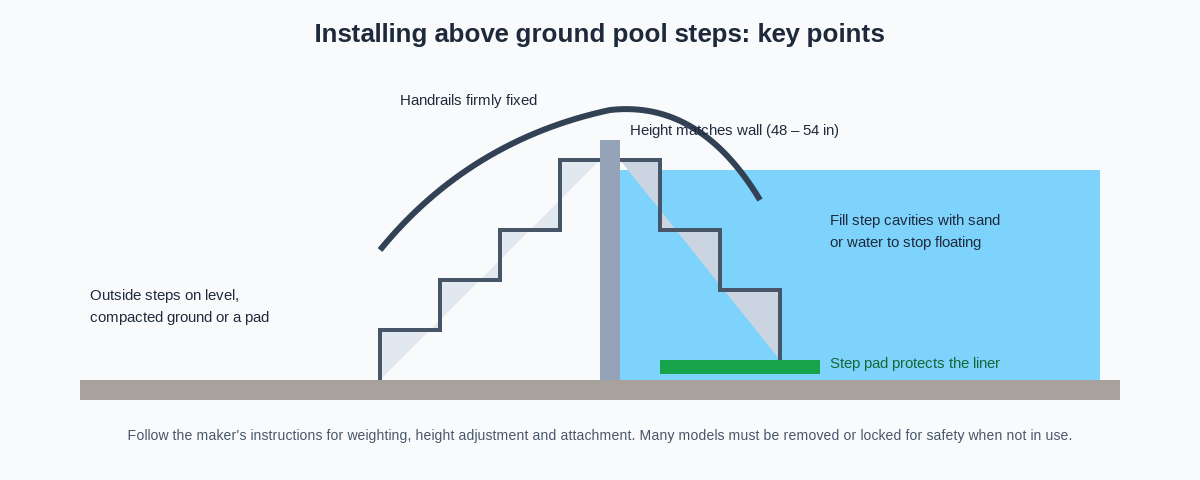
Diagram: Asphapro.com
- Read the manual for your steps and check the wall height setting.
- Choose the location: on a straight section of wall if possible, away from the skimmer and return, with level ground outside.
- Prepare the outside base: level and compact the ground, or set the outside steps on pavers or a small concrete pad so they do not sink.
- Protect the liner: place a step pad or liner protection mat on the pool floor where the inside steps will sit. Many owners put the pad in before filling a new pool; in a filled pool, slide it into place carefully.
- Assemble the steps and handrails as directed, using the supplied hardware.
- Lower the inside steps into the pool and position them against the wall.
- Weight the steps: fill the step cavities with sand or water through the fill ports, as the manual says, so they stay put and do not float.
- Adjust the height and level, then connect the platform or top section over the wall.
- Secure handrails and check that nothing presses on the top rail or wall in a way the maker does not allow.
- Test by walking up and down slowly before letting children use the steps.
Most above ground pool steps install in one to two hours. If you are adding steps during a liner change, it is the perfect time to put a step pad under the liner.
Above Ground Pool Steps With Deck
If you have or are building a deck, above ground pool steps with deck access feel the most natural. Common layouts include a deck at the height of the pool's top rail with deck steps going down into the water, drop-in steps that sit inside the pool against the deck edge, and a deck gate at the top of the outside stairs to keep children out. For above ground swimming pool step to deck connections, make sure the deck supports the step unit's handrails where the manual says, and that the gap between the deck and the pool wall is small and safe.
Above ground deck pool steps should be paired with a safety gate. Many codes treat the deck as part of the pool barrier, so the stairs from the yard to the deck often need a self-closing, self-latching gate. For deck design ideas, see above ground swimming pool deck ideas.
DIY Above Ground Pool Steps
Some owners build their own outside stairs from pressure-treated or composite lumber to reach a deck or the top of the pool, then add a manufactured step unit inside the pool. This is a reasonable DIY project if you follow deck and stair building rules: consistent riser heights (usually 7 to 7.75 inches), treads at least 10 inches deep, sturdy handrails and solid footings. Avoid building homemade steps that sit inside the pool; wood and nails can damage the liner, swell, rot and become slippery. A manufactured in-pool step unit is designed to be stable and safe in the water.
Above Ground Pool Steps Cost
| Option | Typical cost |
|---|---|
| A-frame ladder | $100 – $400 |
| In-pool steps with outside ladder | $250 – $800 |
| Resin entry system | $300 – $1,000 |
| Deck steps | $200 – $700 |
| Drop-in steps | $300 – $900 |
| Step pad / liner protector | $20 – $80 |
| DIY outside stairs (wood or composite) | $200 – $1,000 |
| Professional installation | $100 – $400 |
Safety Tips for Above Ground Pool Stairs and Steps
- Remove or lock the outside ladder or close the deck gate whenever the pool is not supervised.
- Keep treads clean and free of algae, which makes them slippery.
- Never dive from steps, ladders or the top rail of an above ground pool; the water is too shallow.
- Check bolts, handrails and treads each season.
- Keep the area around the outside steps clear of chairs and toys that children could climb.
- Teach children to face the steps or ladder when climbing down.
Caring for Above Ground Pool Steps
Brush inside steps weekly, since algae likes the corners and the area behind them. Keep water chemistry balanced to protect resin and metal parts. In cold climates, take steps out at closing, drain any water inside them, rinse and store them out of the sun; or follow the maker's guidance if they are designed to stay in. Replace cracked treads or worn non-slip surfaces promptly.
Wedding Cake Steps and Wide Above Ground Pool Steps
"Wedding cake" or "cake" pool steps are rounded, tiered steps that get smaller as they rise, like layers of a cake. Cake pool steps are common in inground pools, and some above ground swimming pool steps use the same idea: a wide, curved step unit inside the pool with three or four broad, semicircular treads. Cake steps for pool use are easy to walk on, give a place to sit in the water, and look attractive. They take more floor space than straight steps, so they suit larger round and oval pools. Wide above ground pool steps of any shape are a good choice when several people, small children or older swimmers use the pool, because each tread has room for both feet and a firm handhold.
Above Ground Pool Ladder Steps vs Full Steps
Many products are sold as above ground pool ladder steps: ladders with wider, flat treads instead of round rungs. They are a middle ground between a basic ladder and a full staircase. Here is how the options compare:
| Feature | Ladder | Ladder with wide steps | Full step unit |
|---|---|---|---|
| Footprint | Small | Small to medium | Large |
| Ease of use | Hardest | Easier | Easiest |
| Price | $100 – $400 | $200 – $600 | $300 – $1,000 |
| Best for | Small pools, adults | Families on a budget | Kids, seniors, frequent use |
Above ground swimming pool steps and ladders can also be combined: a full step unit inside the pool with a ladder outside, or a deck with stairs outside and a ladder inside. Think about who struggles most with your current entry and choose the option that helps them.
Above Ground Pool Deck Steps: Design Ideas
An above ground pool deck with steps turns the pool into a more inviting space. Popular designs for above ground pool steps for deck use:
- Wraparound deck with stairs at one corner: outside stairs lead up to the deck, and deck steps or drop-in steps lead into the pool on the opposite side.
- Half-deck platform: a deck on one side of the pool with wide steps from the yard and a pool-entry step unit at the deck edge.
- Multi-level deck: a lower level for seating and a higher level at pool height, connected by a few wide stairs.
- Gated deck stairs: a self-closing gate at the top of the stairs keeps the pool off limits when no adult is present.
Above ground pool to deck steps should line up with a straight wall section, sit away from the skimmer and return, and have a clear path on the deck. If you are building a new deck, plan the position of above ground pool steps to deck before framing so posts and joists do not get in the way.
Steps to Install Above Ground Pool Steps in a Filled Pool
You do not need to drain the pool to add steps. Here are the steps to install above ground pool steps when the pool is full:
- Lower the step pad into the water at the chosen spot and smooth it flat on the floor with your feet or a pool brush.
- Open the fill ports on the step unit and slowly lower it into the pool, letting it fill with water as it sinks.
- Position it on the pad, square to the wall, with the top at the height the manual shows.
- Add sand through the fill ports if the maker recommends it for extra stability.
- Attach the handrails and any connection over the top rail.
- Install or adjust the outside ladder or stairs.
Work slowly so the steps do not scrape or snag the liner, and have a helper hold the unit while it fills.
Drop In Steps for Above Ground Pool Decks
Above ground pool drop in steps are wide step units that sit fully inside the pool against the deck edge, with no outside section. They make the pool feel like an inground pool: you step from the deck onto the top tread and walk down. Above ground pool steps drop-in models usually have three or four treads, molded handrails or rail mounts, and a broad top step that can double as a seat. They need a deck at or near the height of the pool's top rail and a step pad under them. Drop in steps for above ground pool use are a top choice for families who want the easiest possible entry.
Pool Steps for Soft-Sided and Frame Pools
Inflatable and metal-frame pools have softer walls than steel-wall above ground pools, so not every step unit fits them. Look for ladders and steps labeled for frame or soft-sided pools; they rest on the ground and the pool floor without leaning on the wall. Wide A-frame ladders with a top platform are common for these pools. In-pool step units can work in larger frame pools if they are freestanding and do not press on the wall. Always use a protective mat under anything that sits on the pool floor, since the liners on these pools are thinner.
Accessibility: Steps for Older Swimmers and Limited Mobility
For older swimmers or anyone with limited mobility, the right pool steps above ground can be the difference between using the pool and not. Look for:
- Shallow, wide treads with a low rise between steps.
- Handrails on both sides that extend from the deck or ground into the water.
- A top platform or deck to rest on before stepping down.
- A non-slip surface on every tread.
- Good lighting for evening use.
Drop-in steps from a deck, or a full resin entry system with double handrails, are usually the most comfortable options. Some owners add a bench step inside the pool so swimmers can sit while getting in and out.
Winter Care for Above Ground Pool Steps
When closing the pool, remove inside steps if the maker recommends it, empty the water or sand from them, rinse them and store them out of the sun. Ice can crack resin steps left in a frozen pool and can damage the liner where the steps press on it. Outside ladders and stairs can be locked or removed for the season to keep the pool closed to children and pets.
Where to Place Above Ground Pool Steps
Placement affects safety, comfort and how long the steps and liner last. Good locations share a few traits. The outside base should be on level, firm ground or a pad, away from soft spots where the steps could sink. The inside steps should sit on a flat part of the pool floor, not on a slope toward a deep center, and not near the skimmer, return jet or a light where they could block circulation. Place steps where swimmers can enter without walking through a garden bed or across slippery grass, and where an adult can see them from the house or a lounge chair. On a pool with a deck, line the steps up with the main path from the house so swimmers do not walk around the whole deck to get in.
Common Mistakes With Above Ground Pool Steps
- No step pad: steps rub through the liner over time.
- Not weighting the steps: they shift or float, creating a hazard.
- Wrong height setting: steps that do not match the wall height can wobble or press on the top rail.
- Outside base on soft ground: one side sinks and the steps tilt.
- Leaving the outside ladder accessible when no one is watching the pool.
- Placing steps near the return, which blocks circulation and lets algae grow behind them.
- Diving from the platform, which is always unsafe in an above ground pool.
Avoiding these mistakes keeps your steps stable and your liner safe for years.
Pool Steps Above Ground: Key Points
- Options include A-frame ladders, in-pool steps, resin entry systems, deck steps and drop-in steps.
- Prices range from about $100 to $1,000 for the steps.
- Match the steps to your wall height and swimmer weight.
- Weight the steps, use a step pad, and secure handrails.
Frequently Asked Questions
What are the best above ground swimming pool steps?
For most families, a resin entry system or in-pool steps with handrails. They are wider, more stable and easier to use than a ladder.
How much do above ground pool steps cost?
About $100 to $400 for ladders, $250 to $1,000 for step units and entry systems, plus any deck work.
Do above ground pool steps damage the liner?
They can if used without a step pad or if they shift. Always put a step pad under inside steps and weight them so they stay in place.
Can I add steps to an above ground pool without a deck?
Yes. A resin entry system or in-pool steps with an outside ladder stand on the ground and the pool floor, with no deck needed.
What are above ground pool steps with platform?
They have a flat landing at the top, over the pool wall, so swimmers can steady themselves before stepping down into the water.
Do I need a permit to add pool steps?
Usually not for the steps themselves. A new deck or stairs may need a permit, and the deck may need a gate to meet barrier rules.
How wide should above ground pool steps be?
At least 24 inches is comfortable; family step units are often 30 to 36 inches wide, which leaves room to hold a child's hand while stepping down.
How do I keep pool steps from floating?
Fill the step cavities with sand or water as the maker directs. Sand is heavier and more stable; water is easier to drain when you remove them.
Can I use inground pool steps in an above ground pool?
No. Use steps designed for above ground pools; inground steps are built into the pool and will not fit or attach safely.
What height steps do I need for a 52 inch pool?
Choose steps or a ladder rated for a 52 inch wall, or an adjustable model that covers 48 to 54 inches.
Can I build homemade above ground pool steps?
You can build outside stairs to a deck from lumber or composite, following stair building rules. For inside the pool, use a manufactured step unit, since homemade wood steps can damage the liner and become unstable in water.
Do pool steps need handrails?
Handrails are strongly recommended and included with most step units. They make entry and exit much safer, especially when steps are wet.
Are steps safer than a ladder?
Usually, yes. Wide steps with handrails are easier to use and reduce slips, especially for children and older adults who find vertical ladders hard to climb.
How long do above ground pool steps last?
Good resin steps often last 10 years or more with care. Sun and harsh chemicals shorten their life, so balanced water and storing them out of the sun in winter both help them last.
Sources
- CPSC: Pool and spa safety
- CPSC: Safety barrier guidelines for residential pools
- ICC: International Swimming Pool and Spa Code
- Swim University: Above ground pool steps