
Inground Pool Steps: Types, Sizes, Replacement and Costs
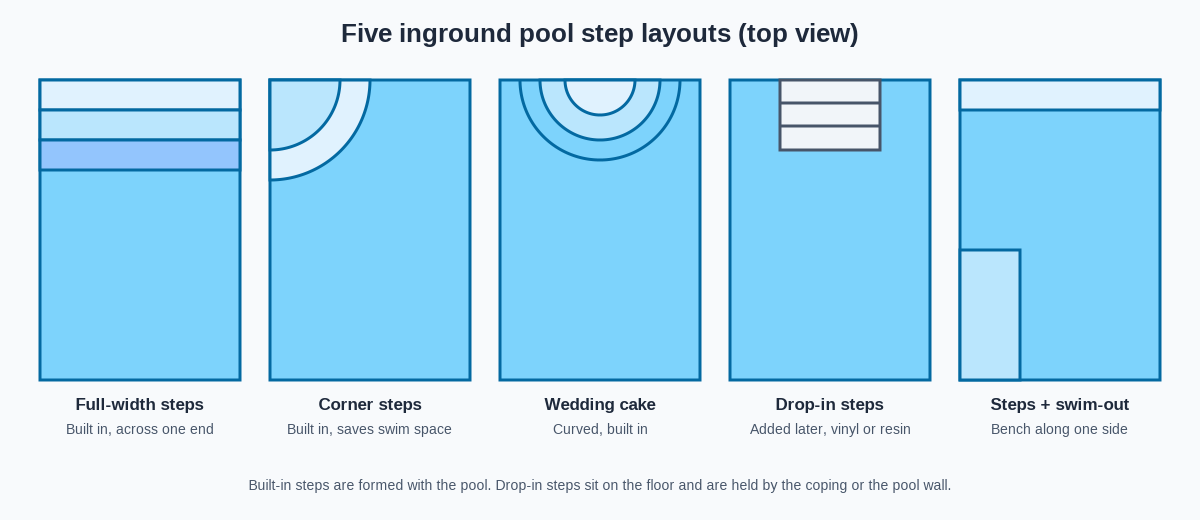
Diagram: Asphapro.com
Quick Answer
Inground pool steps come in two main kinds. Built-in steps are formed as part of the pool shell (concrete, fiberglass or vinyl) and come in layouts like full-width, corner, wedding cake and swim-out benches; they usually add $1,000 to $5,000 to a new pool. Drop-in pool steps are separate resin or fiberglass units that sit on the pool floor and are held at the coping or wall; they cost about $500 to $2,500 plus $200 to $800 to install, and are the common choice for replacement pool steps for inground pool owners who have only a ladder. Good steps have uniform risers of about 7 to 12 inches, treads at least 10 inches deep, a handrail and slip-resistant surfaces.
Steps are how most people get in and out of a pool. Ladders work, but they are steep, narrow and hard for children, older adults and anyone with limited mobility. Pool steps give a gentle, wide entry, a place to sit in shallow water, and a safer way out of the pool. They also change how a pool looks and how much open swimming space it has.
This guide covers every type of inground pool steps: built-in steps, drop-in steps, replacement steps, sizes and safety rules, materials, costs and how to choose. If you have an above ground pool, see our guide on pool steps above ground.
Built-In Inground Pool Steps
Built-in steps are part of the pool itself. In a concrete or gunite pool, the steps are formed with steel and sprayed concrete at the same time as the walls and floor, then finished with plaster, pebble or tile. In a fiberglass pool, the steps are molded into the one-piece shell at the factory. In a vinyl liner pool, the steps are usually a separate panel built into the wall, either covered by the liner or made of white thermoplastic.
Built-in steps look seamless and last as long as the pool. They can be designed in almost any shape, from a straight set across the shallow end to curved steps that flow into a bench. The trade-off is that they take up swimming space, and they are hard and expensive to change once the pool is built.
Common Layouts for Steps in a Pool
Full-width steps run across the whole shallow end. They are the easiest to use, give plenty of seating and work well for families. They take up the most space.
Corner steps sit in one corner of the shallow end, either square or curved. They save swimming space and are popular on rectangular pools. Roman or radius corner steps, with a curved outline, are a classic look.
Wedding cake steps are a stack of curved steps, wider at the bottom, usually set in the middle of one end or in a corner. They look elegant and make a gentle entry from several directions.
Steps with a swim-out bench combine a set of entry steps with a long underwater bench along one wall. The bench gives seating in deeper water and a place to rest.
Tanning ledges are wide, shallow shelves at the top of the steps, often 6 to 12 inches deep, where people can sit or lie in a few inches of water. They are very popular on new pools and add $2,000 to $8,000 to the cost.
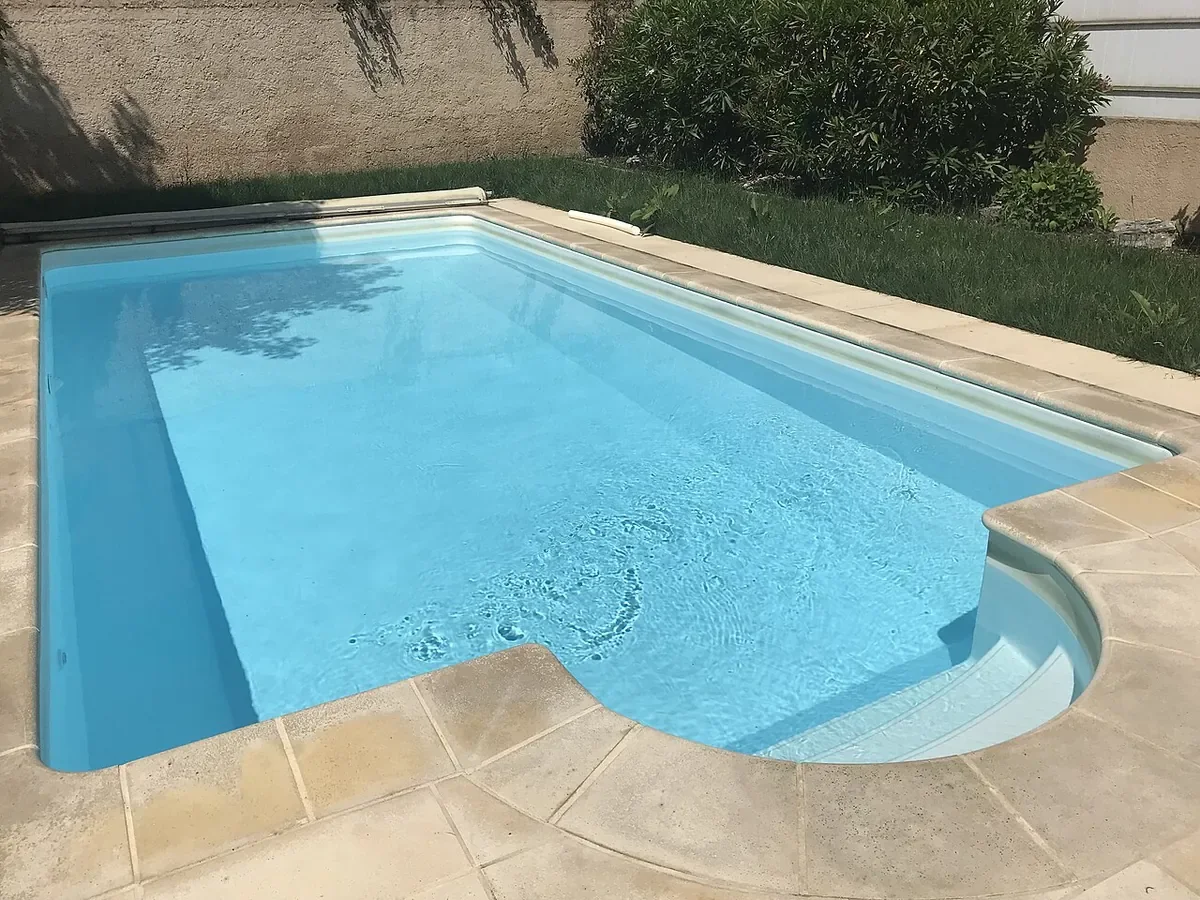
Photo: Benoît Prieur, Wikimedia Commons, CC0
Drop-In Pool Steps
Drop-in pool steps are separate step units made of resin, thermoplastic or fiberglass. They sit on the pool floor and hook over the coping or bolt to the pool wall, so they can be added to a pool that only has a ladder or replaced when they wear out. They are most common in vinyl liner pools but can be used in concrete and fiberglass pools too.
Drop-in steps come in many shapes: straight steps for walls, corner steps, and wedding cake designs. Some have built-in handrails. Most are made of UV-stabilized resin in white, gray or tan, and many fill with water or sand so they stay put. They usually have three or four steps and are about 3 to 8 feet wide.
The main advantage of drop-in steps for inground pool owners is that they are easy to add and replace. The downside is that they do not look as seamless as built-in steps, can trap debris behind them, and need a liner pad or protective mat under them in vinyl pools to prevent wear.
Inground Pool Steps Drop In vs Built In
When you compare inground pool steps drop in units with built-in steps, the choice usually comes down to whether you are building a new pool or updating an existing one. For a new pool, built-in steps nearly always make sense: they cost little extra compared with the pool, look better and last longer. For an existing pool that has only a ladder, or where old steps are damaged, drop-in steps are much cheaper and faster than cutting the pool to build new steps.
Drop-in steps cost about $500 to $2,500 for the unit plus $200 to $800 for installation. Adding new built-in steps to an existing concrete pool usually means cutting into the shell, forming new steps and refinishing, which can cost $3,000 to $10,000 or more and is often done during a remodel or replaster.
Replacement Pool Steps for Inground Pool
Steps wear out, especially in vinyl pools. Thermoplastic steps can crack, fade or become brittle after 15 to 25 years in sun and chlorine. Drop-in steps can crack or loosen. When you look for replacement pool steps for inground pool use, first measure the space carefully: the width, the depth of each tread, the height of each riser and the distance from the coping to the floor. Many vinyl pool makers sell exact replacement step panels for their wall systems.
For vinyl pools with steps under the liner, replacing the steps usually means draining the pool, removing the liner, swapping the step panel and installing a new liner, so it is often done at the same time as a liner change. For thermoplastic white steps in vinyl pools, the step unit itself can sometimes be replaced while the pool is partly drained. Replacement steps for inground pool use typically cost $800 to $3,000 for the unit, with total installed costs of $1,500 to $5,000 when draining and labor are included.
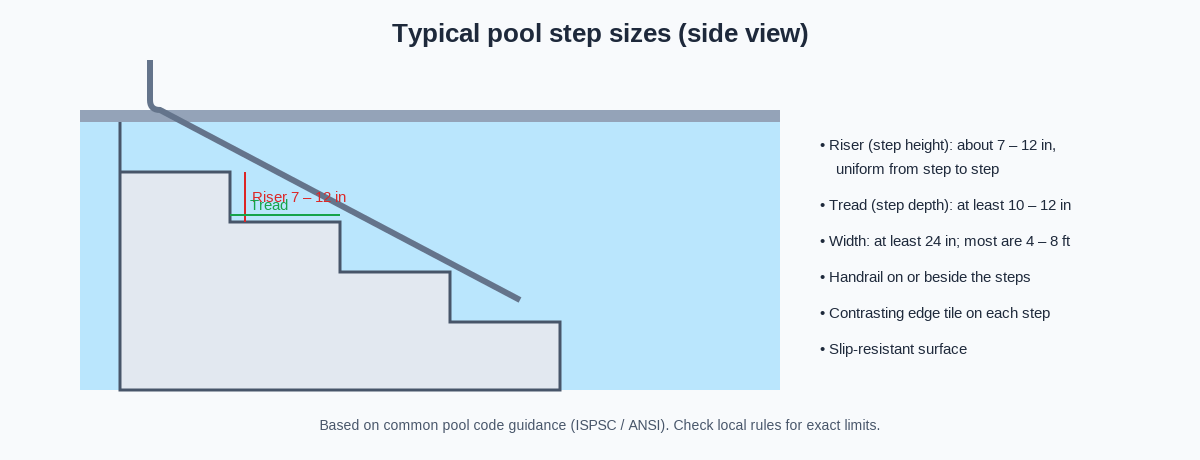
Diagram: Asphapro.com
Pool Step Sizes and Safety Rules
Codes based on the International Swimming Pool and Spa Code (ISPSC) and ANSI standards set rules for pool steps. Common requirements for residential pools include uniform riser heights no more than 12 inches, treads at least 10 inches deep and 24 inches wide, and a handrail on or near the steps when the pool requires one. Many builders make risers 7 to 10 inches for easier use. Step edges should be marked with a contrasting color tile or band so swimmers can see them under water. Surfaces should be slip resistant.
Steps must also be placed so people can get out of the pool quickly. Many codes require a means of exit, such as steps, a ladder or a swim-out, at both the shallow and deep ends of larger pools. Check your local code before you design or change your pool steps.
Materials for Steps for Pool Use
Steps in concrete pools are finished with the same plaster, pebble or quartz finish as the rest of the pool, often with tile on the step edges. Fiberglass pool steps are molded gel coat with a textured non-slip surface. Vinyl pools use thermoplastic steps or steps covered by the liner, sometimes with a separate liner pattern on the treads. Drop-in steps are made of resin, ABS or fiberglass. For all steps for pool use, a slip-resistant texture and a contrasting edge are the most important safety features.
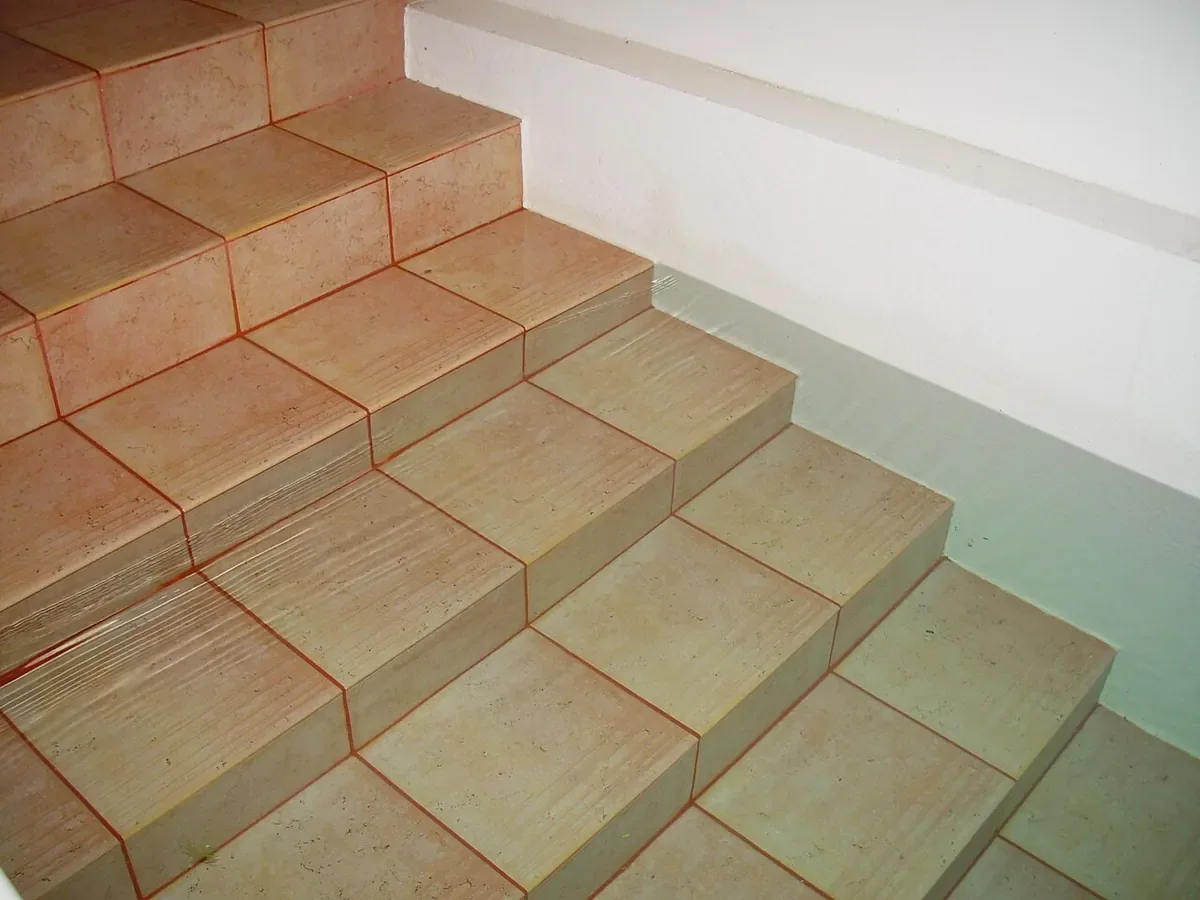
Photo: Leon Brooks, Wikimedia Commons, public domain
How to Install Drop-In Pool Steps
Installing drop in pool steps is a job many owners can do with a helper. Start by choosing steps that fit the depth from the coping to the floor where they will sit. Lower the water a little if the steps attach at the coping. In vinyl pools, place a protective step pad or mat on the floor where the steps will rest. Lower the steps into the water, fill any ballast chambers with water or sand, and attach the top of the steps to the coping or wall with the brackets supplied. Install the handrail into the deck anchor if one is included. Check that the steps sit level and do not rock, and that no sharp edges press on the liner.
Choosing a Swimming Pool Step Design
Picking the right swimming pool step design starts with how you use the pool. Families with young children usually want wide, shallow steps across the shallow end, because children like to sit and play on them. Owners who swim laps want steps tucked into a corner so the full length of the pool stays open. Older adults and anyone with mobility needs benefit from low risers, deep treads and a sturdy handrail on both sides. People who entertain often choose a tanning ledge with steps that lead off it, so guests can sit in shallow water with a drink.
The pool's shape also guides the design. Rectangular pools suit straight full-width or corner steps. Freeform pools suit curved, wedding cake or Roman steps that echo the curves. On a small pool, every square foot counts, so a compact corner step or a set of steps that doubles as a bench is often the best choice. A step swimming pool layout where the steps run into a swim-out bench gives seating along one side without taking extra space at the end.
In Ground Pool Steps for Concrete Pools
In ground pool steps in concrete pools are the most flexible, because the shell is shaped on site. The designer can make steps any width, curve or number of treads, and add benches, ledges and sun shelves. The steps are built with the same steel and shotcrete or gunite as the walls, then finished with plaster, quartz or pebble. Many owners add a row of tile along each step edge to mark it clearly under water.
Over time, step edges in concrete pools can chip, and the plaster on step treads can wear faster than the rest of the pool because of foot traffic. Small chips can be patched with underwater repair compound. Larger repairs are usually done during a replaster, when the pool is drained. Rebuilding steps in a concrete pool, or adding new ones, is a job for a pool builder with experience in remodels.
Fibreglass Pool Steps
Fibreglass pool steps, or fiberglass pool steps in US spelling, are molded into the pool shell at the factory. Because each shell comes from a mold, you choose the step layout when you choose the pool model. Many fiberglass pools have full-width entry steps, wedding cake steps or corner steps, often with a bench or tanning ledge. The steps have a textured, non-slip gel coat surface. Drop-in fiberglass step units are also sold for adding steps to vinyl or concrete pools; they are strong and long-lasting but cost more than resin steps.
Inground Swimming Pool Steps for Vinyl Liner Pools
Inground swimming pool steps in vinyl liner pools come in two styles. The first is a white thermoplastic or acrylic step unit that bolts into the steel or polymer wall panels; the liner is cut around it and sealed with gaskets and a faceplate. The second is a step built from the same wall and floor materials, with the liner covering it. Liner-covered steps blend in with the pool and can be any shape, but the liner on the treads wears faster from foot traffic and may need a special textured step liner.
Thermoplastic steps are tough but can crack or yellow with age. Gaskets around the steps can leak, so a slow leak in a vinyl pool is often traced to the step gaskets. If you plan a liner replacement, it is a good time to check and replace old step gaskets or the steps themselves.
Drop In Swimming Pool Steps: What to Look For
When shopping for drop in swimming pool steps, compare these points. First, size: measure the depth at the spot where the steps will sit and make sure the steps fit the depth. Most drop-in steps for an inground pool are made for depths of 36 to 48 inches. Second, mounting: some steps hook over the coping, some bolt to the wall, and some just sit on the floor with ballast. Third, the handrail: built-in rails are handy, but a separate deck-mounted handrail is often stronger. Fourth, the material: thicker resin and fiberglass last longer and feel more solid underfoot. Finally, check the weight rating, often 300 to 400 pounds, and the warranty.
In ground swimming pool drop in steps should also be easy to clean behind and around. Debris can collect behind the steps, and algae can grow in the gap between the steps and the wall if circulation is poor. Brush behind the steps weekly and aim a return toward that area if possible.
Drop In Pool Steps for Inground Pool Safety
Adding drop in pool steps for inground pool safety is one of the most useful upgrades for pools with only a ladder. Ladders require climbing with the hands, which is hard for many people, and their narrow rungs can be slippery. Steps let people walk in and out holding a rail, sit to rest, and help children enter more safely. For people with limited mobility, wide drop in inground pool steps with a handrail on each side can make the difference between using the pool and not using it. For full accessibility, pool lifts and sloped entries are other options, especially for commercial pools.
Inground Pool Steps Replacement: Signs It Is Time
Look for these signs when deciding on inground pool steps replacement: cracks in thermoplastic or resin steps, loose or rocking drop-in steps, leaks around step gaskets in vinyl pools, faded and brittle step surfaces, and step edges that are no longer easy to see under water. Worn non-slip texture is a safety issue as well. If you are replacing the liner, replastering or remodeling, that is usually the best time to replace steps, because the pool is already drained.
Steps for In Ground Pool Remodels
Many owners rethink their steps for in ground pool remodels. A remodel is a chance to change an awkward ladder entry into a set of wide steps, add a tanning ledge, or reshape steps to open up more swimming space. In concrete pools, the builder can cut and form new steps before the new finish goes on. In vinyl pools, new step panels can be installed when the liner is replaced. Talk with your builder about how step changes affect plumbing, lighting and the pool's volume. For finish costs, see our guide on replaster pool cost.
Lighting and Marking Steps in Pool
Steps in pool water can be hard to see at night or in bright sun. Contrasting tiles on each step edge make the edges clear in all light. LED step lights, small lights set into the riser of each step, add both safety and style at night. Many new pools also have a light aimed at the step area. If you add drop-in steps, choose a color that contrasts with the pool floor so swimmers can see them easily.
Pool Step Costs in Detail
The cost of pool steps depends on whether they are built with the pool or added later, the material, the size and the labor. For new concrete pools, a standard set of entry steps is usually included in the base price, while larger or custom steps, wedding cake designs, benches and tanning ledges add $1,000 to $8,000. Fiberglass pools include molded steps in the shell price, with models that have bigger step and ledge areas costing more. For vinyl pools, a white thermoplastic step unit adds about $800 to $2,500 to a new pool, and a liner-covered step section about $1,000 to $3,000.
For existing pools, drop-in resin steps cost about $500 to $1,500, fiberglass drop-in steps $1,200 to $2,500, and installation $200 to $800 depending on whether the pool needs draining. A deck-mounted handrail costs $150 to $500 plus $100 to $300 to install the deck anchor. Replacing built-in vinyl pool steps during a liner change adds about $800 to $2,500 to the liner project. Rebuilding or adding steps to a concrete pool during a remodel usually runs $3,000 to $10,000, plus refinishing.
Caring for Pool Steps
Steps collect dirt, leaves and algae because water moves slowly in the step area. Brush the steps every time you brush the pool, paying attention to the corners where treads meet risers. In vinyl and drop-in steps, brush gently with a soft brush to avoid scratching. Keep water chemistry balanced: high pH and calcium leave scale on step edges, and low pH etches plaster and fades vinyl. Check drop-in steps for loose brackets and cracks at the start of each season, and check step gaskets in vinyl pools for leaks. In winter, leave water in the pool as directed by your pool maker, and make sure freeze protection covers the step area.
Steps vs Ladders vs Beach Entries
Steps are not the only way into a pool. Ladders are the cheapest entry, usually $200 to $800 installed, and take almost no swimming space, which is why many deep-end exits use them. But they are harder to use for children, older adults and anyone with limited strength. Beach or zero-entry pools have a gently sloping floor that runs from the deck into the water, like walking into the sea. Zero entries are the easiest to use and great for small children and people with mobility needs, but they take a lot of space, add $5,000 to $15,000 or more to a concrete pool, and need more chemicals and heating because of the extra shallow water.
Most residential pools use steps at the shallow end and a ladder or swim-out at the deep end. This mix gives easy entry for everyone and a quick way out of deep water. When you plan a new pool, think about who will use it in ten or twenty years as well as today; wide, gentle steps with a rail are easy for all ages.
Step Design Tips From Pool Builders
Pool builders often suggest a few simple rules for steps. Keep every riser the same height, because a single uneven step is a common tripping point. Make the top tread a little deeper, so people have a place to stand and sit at the edge. Place the steps where people naturally walk from the house, so they do not cross the deck to reach them. Put a light near the steps, add contrasting edge tile, and plan a handrail from the start, with its deck anchors set when the deck is poured.
Inground Pool Steps: Key Points
- Built-in steps are part of the pool and add $1,000 to $5,000 to a new pool.
- Drop-in steps cost $500 to $2,500 and are easy to add or replace.
- Layouts include full-width, corner, wedding cake, swim-out benches and tanning ledges.
- Risers up to 12 inches, treads at least 10 inches, handrail and contrasting edges.
Frequently Asked Questions
Can you add steps to an inground pool?
Yes. Drop-in steps can be added to most pools. Built-in steps can be added to concrete pools during a remodel.
How much do inground pool steps cost?
About $500 to $2,500 for drop-in steps, and $1,000 to $5,000 for built-in steps on a new pool.
Are drop-in pool steps safe for vinyl liners?
Yes, when used with a protective step pad under the feet and installed so no sharp edges touch the liner. Check the pad and liner under the steps each season.
How deep should pool steps go?
Steps usually run from the coping down to the shallow end floor, about 3 to 4 feet, in three to five steps of even height.
Do pool steps need a handrail?
Many codes require a handrail for steps in pools, and it is always a good idea. Rails can be mounted in the deck or built into drop-in steps.
Sources
- ICC: International Swimming Pool and Spa Code
- Pool and Hot Tub Alliance: Standards
- CPSC: Pool and spa safety
- HomeGuide: Inground pool cost