
Automatic Pool Cover Cost: Prices by Type, Upkeep and Savings
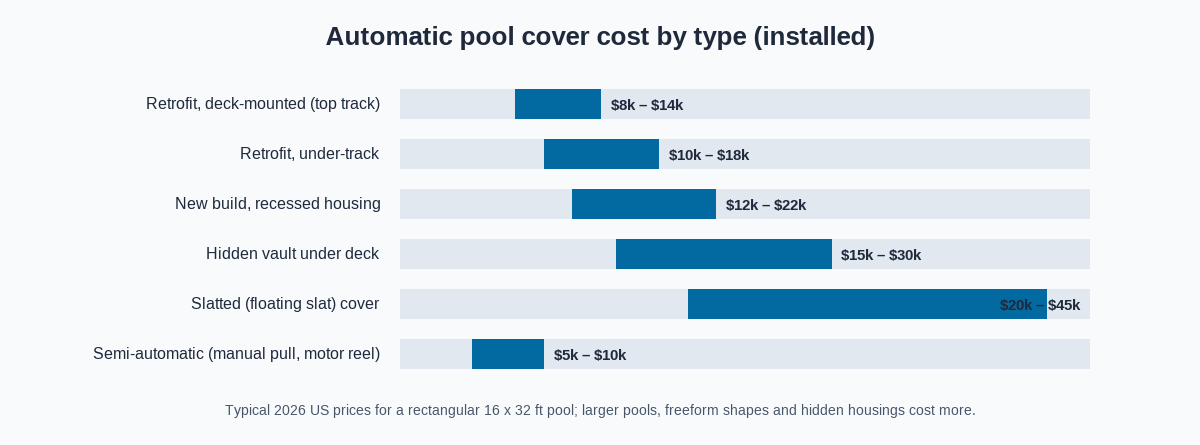
Chart: Asphapro.com
Quick Answer
The typical automatic pool cover cost is about $8,000 to $22,000 installed for a rectangular residential pool around 16 x 32 feet. Retrofit systems with tracks on the deck cost about $8,000 to $14,000; under-track and recessed systems on new pools cost $10,000 to $22,000; hidden under-deck vaults reach $15,000 to $30,000; and slatted covers cost $20,000 to $45,000. Plan on $2,000 to $4,500 for replacement fabric every 5 to 10 years. In return, an automatic cover can cut heating costs by 30 to 70%, evaporation by up to 90% and chemical use by a third or more, while adding a strong layer of safety.
An automatic pool cover is a motorized cover that runs along tracks on each side of the pool and rolls onto a drum at one end. With the turn of a key or the press of a button, it covers or uncovers the pool in under a minute. Well-built automatic covers that meet the ASTM F1346 safety standard can hold the weight of a person, which makes them one of the best safety features a pool can have. They also save energy, water and cleaning time every day.
This guide breaks down automatic pool cover cost by type and pool size, what goes into the price, ongoing costs, savings and whether the cost of automatic pool cover systems is worth it. For other cover options, see pool cover cost.
Automatic Pool Cover Cost by Type
Retrofit with deck-mounted (top) tracks: $8,000 to $14,000. The most common choice for existing pools. Aluminum tracks are fixed to the deck along the pool edge, and the motor and drum sit in a box at one end, usually with a bench-style lid.
Retrofit with under-track: $10,000 to $18,000. Tracks are mounted under the coping so they are hidden. This looks cleaner but may need coping work.
New build with recessed housing: $12,000 to $22,000. On a new pool, the drum sits in a recessed box at the end of the pool under a flush lid, and tracks are built into the coping.
Hidden vault under the deck: $15,000 to $30,000. The drum and motor sit in a concrete vault below the deck, out of sight. This needs more concrete work and drainage.
Slatted covers: $20,000 to $45,000. Rigid floating slats roll up onto a drum, sometimes hidden below the water at one end. Popular in Europe and for high-end pools.
Semi-automatic covers: $5,000 to $10,000. A motorized reel winds the cover in, but you pull it out by hand or with a rope. Cheaper, but less convenient and often not rated as a safety cover.
Automatic Pool Cover Cost Breakdown
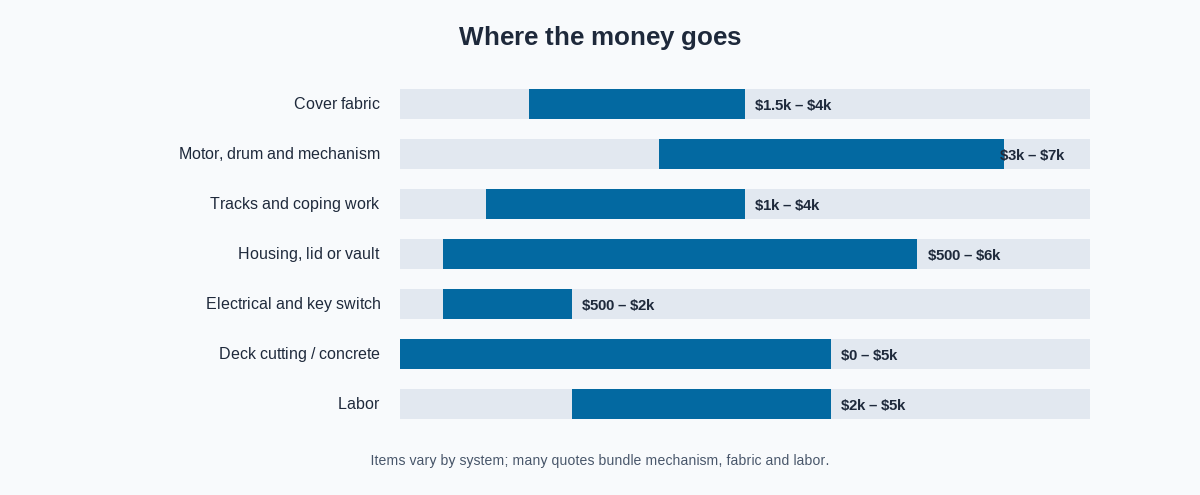
Chart: Asphapro.com
The total cost of automatic pool cover systems is made up of the cover fabric ($1,500 to $4,000), the motor, drum and mechanism ($3,000 to $7,000), tracks and any coping changes ($1,000 to $4,000), the housing, lid or vault ($500 to $6,000), electrical work and the key switch ($500 to $2,000), deck cutting or concrete work ($0 to $5,000), and labor ($2,000 to $5,000). Most companies quote one bundled price, but asking for a breakdown helps you compare quotes fairly and spot items, such as electrical work or coping changes, that one dealer includes and another leaves out.
What Affects Automatic Pool Cover Cost?
Pool size. Larger pools need more fabric, longer tracks, a bigger drum and a stronger motor.
Pool shape. Rectangles are easiest and cheapest. Freeform pools can sometimes take a cover with tracks that run straight beyond the curves or with a custom deck extension, at higher cost. Some shapes are not practical, and an installer should tell you so before you order.
New build or retrofit. Planning for a cover during construction is cheaper and gives a cleaner result. Retrofits may need deck and coping changes.
Housing style. Deck-mounted boxes cost least; flush recessed lids and hidden vaults cost more.
Hydraulic or electric drive. Most use electric motors; hydraulic drives are used for some larger or hidden systems and cost more.
Fabric grade and color. Heavier fabrics and darker colors cost a little more but may last longer and absorb more heat.
Steps, spas and obstacles. Raised spas, protruding steps, rails and water features complicate the installation and can add to the price or limit which systems will fit.
Ongoing Automatic Pool Cover Cost and Savings
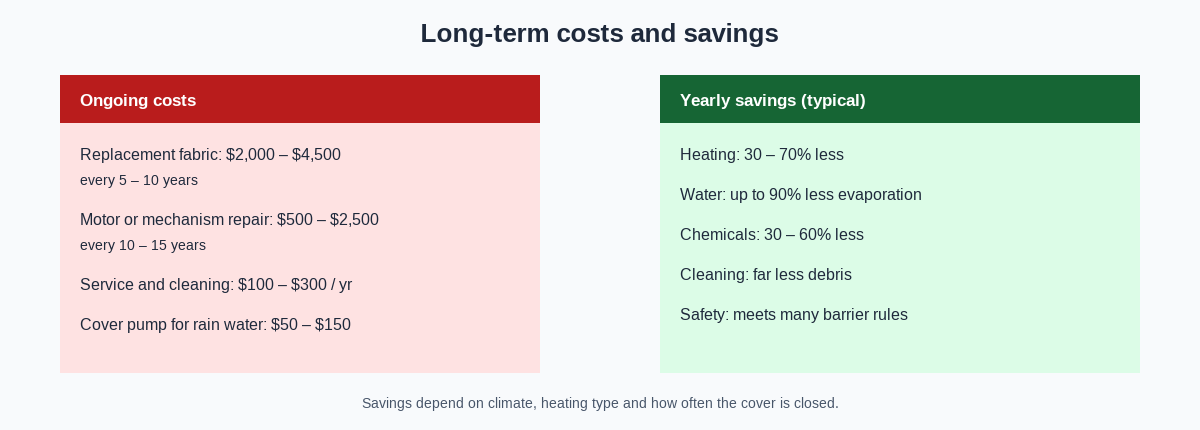
Chart: Asphapro.com
Cover fabric wears out from sun, chlorine and use, and usually needs replacing every 5 to 10 years at about $2,000 to $4,500. Motors, switches, ropes and pulleys need repair now and then; budget $500 to $2,500 every 10 to 15 years. An annual service and cleaning costs $100 to $300. A small cover pump to remove rain water costs $50 to $150.
On the savings side, the US Department of Energy notes that covers can cut pool heating costs by 50% to 70% and reduce water loss from evaporation by 30% to 50% or more, depending on use. Automatic covers are closed more often than manual covers because they are so easy to use, so they tend to deliver more of these savings. They also cut chemical use and keep out leaves, saving cleaning time and reducing wear on the pump, filter and cleaner.
Photo: Jpatokal, Wikimedia Commons, CC BY-SA 4.0
Automatic Pool Cover Cost by Pool Size
Pool size is one of the biggest drivers of automatic pool cover cost. Approximate installed prices for retrofit top-track systems on rectangular pools are:
12 x 24 feet: about $7,000 to $11,000. Small pools need less fabric and a smaller motor, so the automatic pool cover cost is at the low end.
15 x 30 feet: about $8,000 to $13,000.
16 x 32 feet: about $9,000 to $14,000, the most common residential size.
18 x 36 feet: about $11,000 to $17,000.
20 x 40 feet: about $13,000 to $20,000. Very large pools may need heavier motors or hydraulic drives.
Under-track and recessed systems usually add $2,000 to $8,000 to these figures, and hidden vaults more. Pools over about 20 x 45 feet may need special systems.
Swimming Pool Covers: Automatic Cost vs Other Types
Many owners comparing swimming pool covers automatic cost estimates with other cover types find a wide range. Here is how the main options compare:
Solar bubble covers cost $50 to $300 and save heat and water but offer no safety. See solar pool cover bubbles up or down.
Mesh safety covers, anchored to the deck with springs, cost $1,500 to $4,000 installed. They are mainly winter covers and are hard to put on and take off every day.
Solid safety covers cost $2,000 to $5,000 and block sunlight and debris but need a pump to remove rain water.
Automatic covers cost $8,000 to $22,000 or more but are the only option that is both a daily-use cover and a safety cover. Because the automatic pool cover cost includes motor, tracks and housing, it is several times the price of other covers, but it is also used far more often, which is where the savings come from.
Automatic Pool Cover Cost for New vs Existing Pools
The cost of automatic pool cover installation is usually lower and the result cleaner when it is planned during construction. The builder can design the coping to hold under-tracks, build a recessed box or vault for the drum, run electrical conduit, and add a drain for the housing. On an existing pool, the installer may need to cut the deck, replace coping along the sides, add a housing on the deck and run new wiring. For most rectangular pools, a retrofit still works well, but it may cost $1,000 to $5,000 more than the same system on a new pool, and the drum box will be visible unless you pay for a hidden vault.
How Installation Affects Automatic Pool Cover Cost
Installation usually takes one to three days. The crew measures the pool, sets the drum and motor housing at one end, and mounts tracks along both long sides, either on the deck or under the coping. They attach the fabric to sliders that run in the tracks and to the drum, then wire the motor to a dedicated GFCI circuit and a key switch, which is required so children cannot operate the cover. Finally, they adjust the fabric tension, test the cover several times and show you how to operate and care for it. More complex installs, such as vaults, add concrete and drainage work and can take a week or more.
Safety Standards and the Cost of Automatic Pool Cover Systems
Automatic covers sold as safety covers should meet ASTM F1346, which sets requirements for the weight a cover must hold and how securely it must close off the pool. In some areas, a compliant automatic cover can count toward pool barrier requirements, which may reduce the need for some fencing or door alarms, but rules vary widely, so check your local code. Even with a safety cover, keep it closed whenever the pool is not in use, never let children play on it, and remove standing water, since a child can drown in a few inches of water on top of a cover. Factoring safety into the automatic pool cover cost helps explain why many families choose one.
Maintenance and Long-Term Automatic Pool Cover Cost
Routine care keeps ongoing automatic pool cover cost down. Pump standing water off the cover after rain, using the built-in pump or a separate cover pump. Brush or hose off leaves and dirt. Keep pool chemistry balanced, since high chlorine and low pH shorten fabric life; open the cover for a while after shocking so chlorine gas can escape. Clean the tracks and housing a few times a year and remove debris that collects in the drum box. Have a technician inspect ropes, pulleys, the motor and limit switches every year or two. Fixing small problems early, such as a fraying rope, avoids larger repair bills.
Common Repairs and the Cost of Automatic Pool Cover Upkeep
Ropes that pull the cover out wear over time and cost about $300 to $800 to replace. Motors cost $800 to $2,500 to replace. Key switches and limit switches cost $100 to $400. Torn fabric can sometimes be patched for $100 to $300, but large tears or sun-rotted fabric need a full replacement at $2,000 to $4,500. Track repairs, especially after freeze damage or impact, can cost $500 to $2,000. Budgeting $200 to $500 a year for repairs and fabric replacement gives a realistic picture of the total cost of automatic pool cover ownership.
Is the Cost of an Automatic Pool Cover Worth It?
For many owners, yes. Consider a heated 16 x 32 foot pool where heating costs $2,000 a year. An automatic cover that cuts that by half saves $1,000 a year, plus savings on water and chemicals of $200 to $500. With an installed price of $12,000 and fabric replacement every 7 years, the cover can pay for itself in 8 to 12 years from savings alone, before counting the safety benefits and time saved cleaning. In unheated pools in mild climates, the payback is longer, and the main reasons to buy are safety and convenience. Families with young children often find the safety alone justifies the automatic pool cover cost.
Automatic Pool Cover Cost: Worked Examples
Example 1: retrofit on a standard pool. An owner adds a top-track automatic cover with a bench-style lid to a 16 x 32 foot concrete pool. The system costs $11,500 installed, plus $800 for a new GFCI circuit. Total: about $12,300.
Example 2: new pool with under-track cover. A family building an 18 x 36 foot vinyl pool includes an under-track automatic cover in a recessed housing. The cover adds $15,500 to the pool contract, including coping and conduit.
Example 3: hidden vault on a large pool. A homeowner with a 20 x 40 foot pool chooses a hidden vault system with a flush stone lid. Total cost of automatic pool cover installation, including concrete vault, drainage and electrical: about $27,000.
How to Save on Automatic Pool Cover Cost
Plan the cover when you build the pool, since that is the cheapest time to add it. Choose a rectangle or a shape that suits a cover. Pick a deck-mounted housing instead of a hidden vault. Get quotes from several dealers, ask for a cost breakdown, and compare warranties on the mechanism and the fabric. Ask about off-season pricing in fall and winter. Maintain the cover well so the fabric lasts longer. If budget is tight, a semi-automatic cover or a mesh safety cover can be a starting point, though neither gives the same daily convenience.
Fabric Options and Automatic Pool Cover Cost
Cover fabrics are vinyl-coated polyester in several colors, commonly blue, gray, tan, green and black. Darker colors absorb more heat and can warm the water a little more, while lighter colors stay cooler to the touch. Heavier fabrics resist wear and punctures better and tend to last longer, especially in sunny climates. Some fabrics have a printed pattern or a reflective underside. Ask the dealer how each fabric option affects the automatic pool cover cost and its expected life, since a slightly more expensive fabric that lasts two extra years can be the better value.
Automatic Pool Cover Cost by Region
Where you live affects automatic pool cover cost. In the Northeast, California and other high-cost areas, labor and electrical work push installed prices toward the top of the ranges in this guide. In much of the South and Midwest, prices are often closer to the middle. Colder regions see higher demand for covers because they extend the short swim season and protect the pool in spring and fall, which can mean longer wait times in spring. Remote areas may pay extra for travel. Getting two or three quotes from local dealers is the best way to see the real cost of automatic pool cover installation in your area.
Automatic Covers and Heating Costs
If you heat your pool, an automatic cover changes the math more than almost any other upgrade. Without a cover, a heated pool can lose much of its heat overnight through evaporation, and the heater has to make it all back the next day. With an automatic cover closed every evening and opened only to swim, many owners see heating bills fall by half or more. Heat pumps, which heat slowly, work far better on a covered pool. In cool climates, the savings on heating alone can cover a large share of the automatic pool cover cost over the life of the mechanism. See how much does it cost to heat a pool.
Questions to Ask Before You Buy
Before you sign, ask each dealer what is included in the automatic pool cover cost: the mechanism, fabric, tracks, housing or lid, electrical work, deck or coping changes, permits and a cover pump. Ask whether the cover meets ASTM F1346 and whether it will count toward local barrier rules. Ask about warranties: many mechanisms carry 5 to 10 years or longer, while fabric warranties are often prorated over 3 to 7 years. Ask how long installation takes, who services the cover, and what a typical annual service costs. Finally, ask to see an installed cover of the same type in person, so you can see how it looks and how quickly it opens and closes.
Living With an Automatic Cover
Day to day, an automatic cover is simple. Turn the key to open it before swimming and close it when everyone is out. Keep the key away from children. Pump off rain water and brush off leaves. Open the cover for a few hours after adding a lot of chlorine. In winter, many owners in mild climates keep the pool open and covered; in freezing climates, follow the maker's winterizing advice, which may include leaving the cover closed with the water level kept at the right height so the cover is supported. Owners often say the biggest change is how much cleaner and warmer the pool stays with so little effort, which makes the automatic pool cover cost feel worthwhile.
Automatic Covers on Vinyl, Fiberglass and Concrete Pools
Automatic covers can be fitted to vinyl, fiberglass and concrete pools, but each has details that affect price. On concrete pools, under-track systems are often built into new coping, and retrofits may involve cutting and replacing coping stones along the sides. On vinyl pools, tracks are often mounted on top of the coping or deck, and some vinyl pool coping systems have under-track versions designed for covers. On fiberglass pools, the shell shape matters; many fiberglass models are offered with cover-ready ledges and recessed areas, while curved shapes may need custom tracks. Ask your installer whether your pool type and coping work with the system you want, since changes to coping can add several thousand dollars.
Steps, Ledges and Spas
Features inside the pool affect how a cover fits. Steps that sit inside the rectangle of the pool are usually fine, since the cover passes over them. Steps or swim-outs that stick out beyond the main rectangle may need to be left uncovered, covered by a separate piece, or redesigned. Tanning ledges inside the rectangle are usually fine. Raised spas and walls along the sides can block the tracks. Water features that spill into the pool need to be turned off when the cover is closed. Discuss every feature with the installer before you order, so the design avoids gaps that would weaken safety and heat retention.
Warranties
Warranties are an important part of comparing automatic cover quotes. Mechanisms often carry warranties of 5 to 10 years or longer, sometimes with shorter coverage on motors and switches. Fabric warranties are commonly 3 to 7 years and often prorated, so the refund drops each year. Labor may be covered for only one or two years. Read what voids the warranty; high chlorine, unbalanced water and lack of service are common exclusions. Keep records of water tests and service visits in case you need to make a claim.
Financing an Automatic Cover
Because the automatic pool cover cost is significant, some owners finance it, often as part of a new pool loan or a remodel. Home equity loans and lines of credit usually carry the lowest rates. Some dealers offer financing or seasonal promotions. If you finance, compare the monthly payment with expected savings on heating, water and chemicals, which can offset part of it. See how to finance a pool for loan options.
Automatic Pool Cover Cost: Key Points
- Most automatic covers cost $8,000 to $22,000 installed.
- Hidden vaults and slatted covers cost $15,000 to $45,000.
- Replace fabric every 5 to 10 years for $2,000 to $4,500.
- Savings on heat, water and chemicals, plus safety, offset much of the cost.
Frequently Asked Questions
How much is an automatic pool cover?
About $8,000 to $22,000 installed for most pools. The automatic pool cover cost rises with pool size, hidden housings and slatted designs, which can reach $30,000 to $45,000.
Can you add an automatic cover to an existing pool?
Yes, most rectangular pools can take a retrofit system with deck-mounted or under-coping tracks. Expect the cost of automatic pool cover retrofits to run $1,000 to $5,000 more than the same cover on a new pool.
How long does an automatic pool cover last?
The mechanism often lasts 15 to 20 years with service; the fabric usually lasts 5 to 10 years, depending on sun, chemistry and care.
Are automatic pool covers safe to walk on?
Covers meeting ASTM F1346 can hold the weight of a person in an emergency, but they are not made to walk or play on, and standing water on top is a drowning risk.
Do automatic covers work on freeform pools?
Sometimes, with custom designs such as tracks that extend past curves or a deck built out to a rectangle, which raises the automatic pool cover cost.
Does an automatic cover keep the pool warm?
Yes, it greatly reduces heat loss and evaporation, so heated pools stay warmer and use far less energy.
Sources
- US Department of Energy: Swimming pool covers
- ASTM F1346: Safety covers for swimming pools
- CPSC: Pool and spa safety
- ICC: International Swimming Pool and Spa Code