
Pool Cover Cost: How Much Each Type of Cover Costs
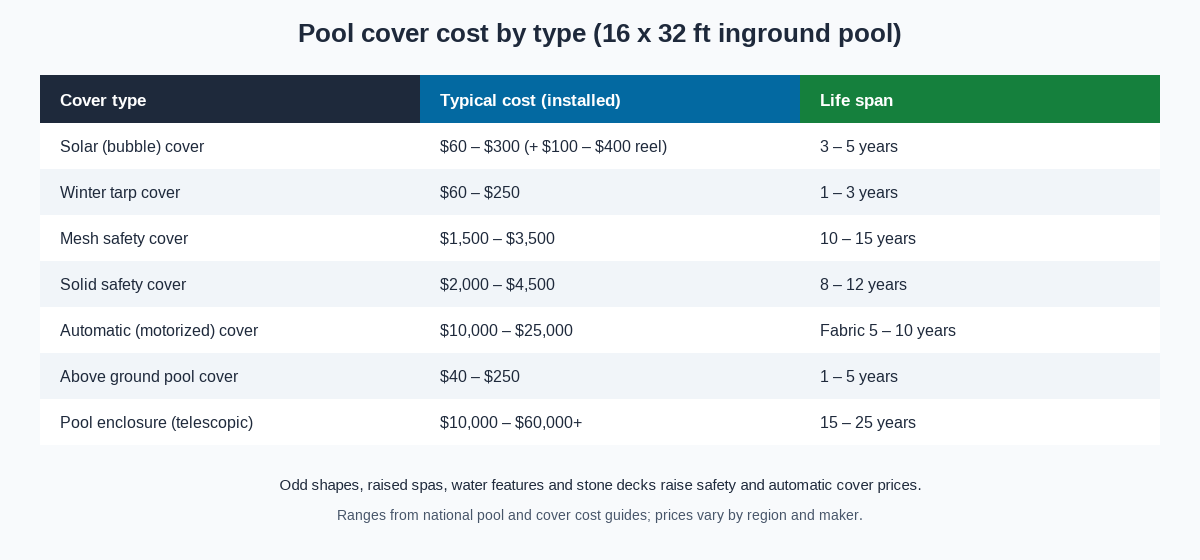
Chart: Asphapro.com
Quick Answer
The pool cover cost depends mostly on the type of cover. For a typical 16 x 32 foot inground pool, a solar (bubble) cover costs about $60 to $300, plus $100 to $400 for a reel. A winter tarp cover costs $60 to $250. A mesh safety cover costs about $1,500 to $3,500 installed, and a solid safety cover $2,000 to $4,500. An automatic (motorized) cover costs about $10,000 to $25,000 installed. Above ground pool covers cost $40 to $250. A good cover can cut heating costs by 50% to 70% and evaporation by up to 95%, so most covers pay for themselves over a few seasons.
A cover is one of the most useful things you can buy for a pool. It keeps out leaves and dirt, holds in heat, cuts evaporation and chemical use, and some types keep children and pets from falling in. A pool with cover in place during the off season also opens cleaner in spring, with less work and fewer chemicals.
This guide explains how much does a pool cover cost for each type, what drives the price, how covers save money, and how to choose the right cover for a pool. For heating options that pair well with covers, see our guide on how to heat a pool.
How Much Is a Pool Cover?
How much is a pool cover for your pool? It can range from under $100 to over $25,000. The big differences come from what the cover does. A thin solar cover that floats on the water to hold heat is cheap and easy to replace. A safety cover that is anchored into the deck and strong enough to hold the weight of a person is a custom product that must be measured and installed. An automatic cover runs on a motor and track system built into the pool or deck and is one of the most expensive pool features you can add.
Pool Cover Cost by Type
Solar covers
Solar covers, also called solar blankets or bubble covers, are sheets of plastic with air bubbles on one side. They float on the water, let sunlight warm the pool and trap heat at night. A solar cover for a typical inground pool costs about $60 to $300 depending on size and thickness, usually 8 to 16 mil. A reel to roll the cover on and off costs about $100 to $400 and makes daily use much easier. Solar covers usually last 3 to 5 years before sun and chlorine break them down.
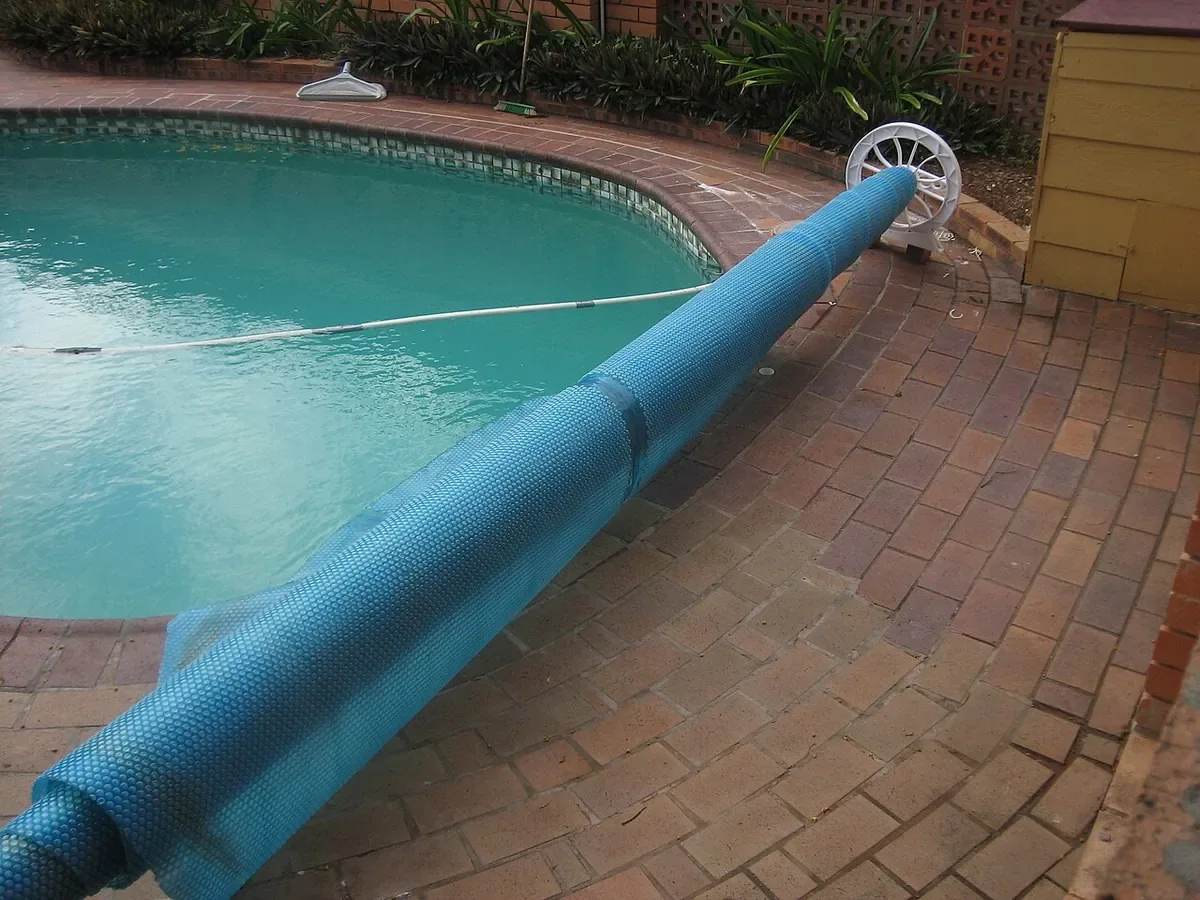
Photo: SMC, Wikimedia Commons, public domain
Winter covers
Winter covers are solid tarps that protect a closed pool from leaves, dirt and sunlight in the off season. On inground pools, they are held down with water bags around the edge; on above ground pools, a cable and winch secure them under the top rail. Winter covers cost about $60 to $250 and last 1 to 3 years. They are not safety covers: a child or pet can slip under them or fall in, and water collecting on top can be a drowning hazard.
Mesh safety covers
Mesh safety covers are made of strong woven fabric stretched tight across the pool and held by straps and springs to brass anchors set in the deck. They meet ASTM safety standards when installed correctly, meaning they can hold the weight of people and pets. Mesh lets rain and snowmelt drain through, so water does not collect on top, but fine dirt and some sunlight also pass through, which can lead to algae in spring. Mesh safety covers cost about $1,500 to $3,500 installed for a typical pool and last 10 to 15 years.
Solid safety covers
Solid safety covers use the same anchor system but have a solid vinyl fabric with a small mesh drain panel or need a pump to remove water from the top. They block all sunlight and debris, so the pool opens cleaner in spring. They cost about $2,000 to $4,500 installed and last 8 to 12 years.
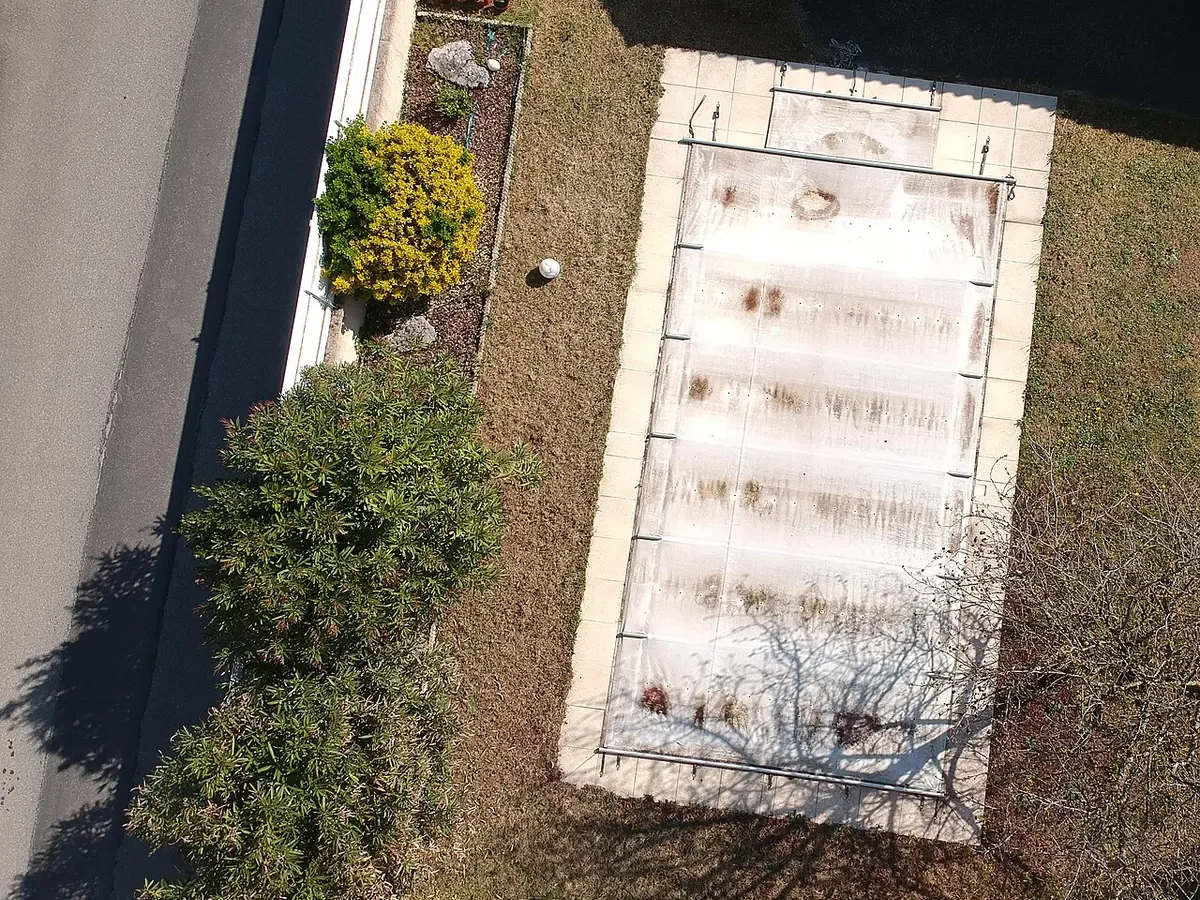
Photo: Benoît Prieur, Wikimedia Commons, CC0
Automatic covers
Automatic pool covers roll out and back on a motorized reel at the turn of a key or the push of a button. The cover runs in tracks along the pool's sides, either on the deck or hidden under the coping. Automatic covers are the most convenient choice and act as safety covers, heat savers and debris covers in one. They cost about $10,000 to $25,000 installed, and more for large or unusual pools. Building the track into a new pool is cheaper than adding it to an existing one. The fabric usually needs replacing every 5 to 10 years for $2,000 to $5,000, and motors and parts need occasional repair.
Pool enclosures
Pool enclosures are rigid structures of aluminum and polycarbonate or glass that cover the whole pool. Low telescopic enclosures slide open in sections, while tall enclosures let you swim inside. They keep out debris, add a lot of heat, extend the swim season and add safety. Low telescopic enclosures cost about $10,000 to $30,000, and tall enclosures $30,000 to $60,000 or more.
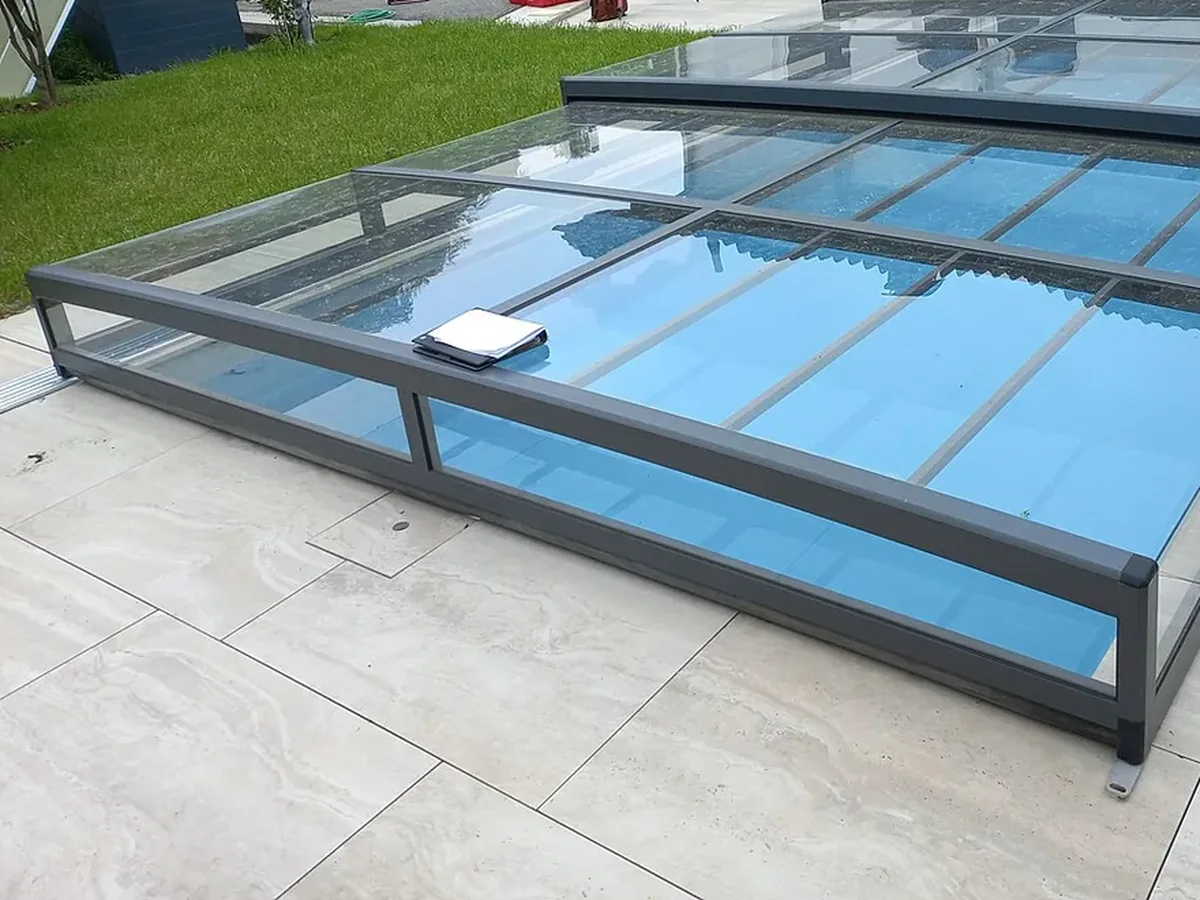
Photo: Asurnipal, Wikimedia Commons, CC BY-SA 4.0
Liquid solar covers
Liquid covers are a thin chemical layer that floats on the water and slows evaporation. They cost about $30 to $60 a month during the swim season. They save less heat than a physical cover and blow away in wind, but they need no handling.
Pool Cover Cost by Pool Size and Shape
Pool size has a big effect on pool cover cost, especially for safety and automatic covers. A small 12 x 24 foot pool might need a mesh safety cover costing $1,200 to $2,200, while a large 20 x 40 foot pool may need one at $2,500 to $4,500. Odd shapes, such as kidney, freeform or L-shaped pools, need custom patterns and more anchors, adding 10% to 30% to the price. Raised spas, waterfalls, rock features, diving boards and steps that stick out of the pool all add to the cost.
For automatic covers, rectangular pools are simplest and cheapest. Freeform pools need special tracks or a rectangular cover over the pool with decking cut around it, which raises costs considerably.
Above Ground Pool Cover Cost and Options
Covers for above ground pools are usually much cheaper. A winter cover for a round above ground pool costs about $40 to $150, and a solar cover $40 to $150. Air pillows, which sit under winter covers to handle ice, add $10 to $40. Above ground safety covers are rare and cost $600 to $1,500. Because above ground pools are often taken down or closed in winter, many owners simply replace their winter cover every couple of years.
How a Pool Cover Saves Money on Heat, Water and Chemicals
The US Department of Energy says covers are the most effective way to reduce pool heating costs, with savings of 50% to 70%. Most heat loss from a pool comes from evaporation, and a cover blocks most of it. A pool with cover on at night also loses less water, which the DOE says can be reduced by 30% to 50%, and less chlorine, because the sun does not break it down as fast.
For a heated pool that spends $1,500 a season on gas or electricity, a $200 solar cover could save $750 to $1,000 a year. Even for unheated pools, a cover can raise water temperature by several degrees, extend the swim season, and cut cleaning time and chemical costs. For a full look at yearly costs, see our guide on the cost to maintain a pool.
Pool Cover Cost for Installation
Solar and winter covers are DIY items with no installation cost, though you may need to trim a solar cover to fit. Safety covers need professional measuring and installation, which is usually included in the quoted price. The installer drills holes in the deck for anchors, sets brass anchors and fits the cover. On stone or paver decks, anchors may need special installation, adding to the cost. Automatic covers need a track system, a motor housing, electrical work and sometimes changes to the coping or deck, which is why installation is a large share of the price.
How to Choose a Cover for a Pool on Any Budget
- For heat and savings during the swim season: a solar cover with a reel.
- For winter protection on a budget: a winter tarp cover with water bags.
- For safety with children or pets: a mesh or solid safety cover, or an automatic cover.
- For the most convenience: an automatic cover.
- For a longer swim season: an enclosure.
Pool Cover Cost Examples
Real numbers make it easier to see how pool cover cost adds up. Here are four common cases for owners comparing covers for swimming pool use in different climates and budgets.
Example 1: heated pool in a mild climate. An owner with a 15 x 30 foot inground pool heated by a gas heater buys a 12-mil solar cover for $180 and a reel for $250. They put the cover on every night. Their heating bill drops from about $1,200 to $500 for the season, so the $430 setup pays for itself in less than one season. They replace the cover every four years.
Example 2: family pool in a cold climate. A family with young children closes their 18 x 36 foot pool every October. They choose a mesh safety cover for $2,600 installed, which keeps leaves out and children safe all winter. Over a 12-year life, the safety cover costs about $215 a year, and it saves them buying a winter tarp and water bags every couple of years.
Example 3: automatic cover on a new pool. A homeowner building a new 16 x 32 foot rectangular pool adds an automatic cover with a recessed track for $14,000. Because the track is built in during construction, the cost is several thousand dollars less than adding it later. The cover replaces both a solar cover and a safety cover and makes daily use effortless. They budget about $3,500 to replace the fabric after 7 to 8 years.
Example 4: above ground pool on a budget. An owner with a 24-foot round above ground pool buys a winter cover for $90, an air pillow for $25, and a solar cover for $80. Their total pool cover cost is under $200, and they replace the winter cover every two to three years.
Pool With Covers: Pros and Cons of Each Type
Every pool with covers in use benefits from cleaner water and lower costs, but each type has trade-offs. Solar covers are cheap and save the most heat for the money, but they are not safe to walk on, can be awkward to handle without a reel, and wear out every few years. Winter covers are cheap and keep out sunlight, but water and leaves collect on top and need pumping and cleaning, and they offer no real protection against falls.
Safety covers are strong, long-lasting and drain well (mesh) or keep the water very clean (solid), but they cost much more and are mainly used during the off season, because removing and installing them takes time. Automatic covers combine safety, heat retention and convenience, but they are expensive, need maintenance and can be damaged if water collects on top and is not pumped off. Enclosures add the most heat and season length but are the most costly and change the look of the yard.
Many owners use two covers: a solar cover in the swim season and a safety cover in winter. This combination gives most of the benefits of an automatic cover at a fraction of the price.
What Affects the Cost of a Cover for a Pool?
Beyond type and size, several details change the cost of a cover for a pool. Material grade is one: thicker solar covers and heavier mesh or solid fabrics cost more but last longer. Color matters for solar covers, since clear covers heat the water more while blue or silver ones may slow algae and last longer. Warranty length usually reflects quality, with good safety covers carrying 12 to 15 year warranties, often prorated.
Deck type affects safety cover installation, since anchors are easiest to set in concrete and harder in pavers, stone or wood decks. For automatic covers, the choice between a deck-mounted track and a hidden track under the coping, the motor type and the lid over the cover box all change the price. Location also matters: labor costs vary by region, and areas with long winters often have more cover companies and more competitive pricing.
Covers for Swimming Pool Safety
Only safety covers and automatic covers that meet the ASTM F1346 standard should be counted on to help prevent drowning. These covers must hold a set weight, have no gaps that a child could slip through and drain water so it does not pool on top. Solar covers and winter tarps are not safety covers, and children can become trapped under them. If safety is a main reason for buying a cover, choose a rated safety or automatic cover, keep it properly tensioned and anchored, pump off any standing water and never rely on a cover alone. A fence with self-closing gates is still the main barrier for most pools; see our guide to pool fence cost.
Caring for a Pool Cover to Lower Its Yearly Cost
The life of a cover, and so the real pool cover cost you pay each year, depends on care. Rinse solar covers with fresh water occasionally and keep them out of direct sun when off the pool, since a rolled-up cover in the sun can overheat and warp. Never leave a solar cover on during heavy shock treatments, because high chlorine breaks down the plastic. Clean safety covers with a soft brush and water before storing them, let them dry, and store them in a bag away from rodents. Check springs, straps and anchors at each opening and closing, and lower anchors flush with the deck in summer so no one trips. For automatic covers, keep the track clean, pump water off the top, and follow the maker's service schedule.
Pool Cover Cost vs Savings Over Ten Years
Looking at pool cover cost over ten years shows why covers are a good investment. A solar cover setup of about $400 with two replacement covers over ten years costs about $800 in total. If it saves $500 a year in heating and $100 a year in water and chemicals, the ten-year savings are around $6,000. A mesh safety cover at $2,500 that lasts the whole decade costs $250 a year and saves on spring cleanup, chemicals and the cost of replacing cheaper winter covers. An automatic cover at $15,000 plus one fabric replacement may cost $19,000 over ten years, but it delivers heating savings, safety and convenience every day of the year. For a pool with cover use every day, the yearly savings help balance that cost.
How Much Does a Pool Cover Cost to Replace?
How much does a pool cover cost when the old one wears out? Replacement prices are usually close to the original pool cover cost for solar and winter covers, since you simply buy a new one. For safety covers, you can often reuse the existing anchors if the new cover is made to the same pattern, which saves on installation. Many cover makers keep the measurements on file, so a replacement mesh safety cover may cost $1,200 to $3,000 rather than the full installed price. For automatic covers, replacing the fabric costs about $2,000 to $5,000, and a new motor or reel mechanism adds $1,000 to $3,000 if needed.
Signs that a cover needs replacing include tears, worn straps, faded or brittle fabric, sagging mesh that lets debris through, and on solar covers, bubbles that have flattened or flaked off into the water. Small tears in safety covers can often be patched by the maker or a cover repair service for $50 to $200, which extends the cover's life.
Pool Cover Cost by Season
Timing your purchase can lower pool cover cost. Solar covers and reels are often on sale late in the swim season or in early spring before stores stock up. Safety covers are custom made and need measuring, so order in late summer for fall closing; cover companies get very busy in September and October, and lead times can stretch to several weeks. Automatic covers are best planned during pool construction or a renovation, when the track can be built in. Some companies offer off-season discounts on automatic and safety covers in winter.
Is a Cheap Cover for a Pool Good Enough?
A cheap cover for a pool can be a good choice for some owners. If your pool is unheated, you live where winters are mild, and you have no young children, a solar cover in summer and a winter tarp in the off season may be all you need. If safety, long life or low maintenance matter more, a safety cover is a better long-term value even though the upfront pool cover cost is much higher. The cheapest cover is not always the lowest cost over time: a $100 winter tarp replaced every two years and the extra cleaning it needs can cost more over a decade than a $2,500 safety cover that lasts 12 years.
Getting Quotes on Pool Cover Cost
For solar and winter covers, you can compare pool cover cost online or at a pool store by size and thickness. For safety and automatic covers, get at least two or three quotes from local installers. Ask each one which brand and fabric they use, the warranty on the cover and on the installation, how they handle steps, spas and odd shapes, and whether the quote includes anchors, drilling and a storage bag. For automatic covers, ask about the track type, motor warranty, lid design and the expected cost of replacing the fabric later. Comparing the full pool cover cost over the cover's life, not just the upfront price, helps you choose the best value cover for a pool like yours.
When a cover company visits to measure, point out any planned changes to the deck, landscaping or pool features, since a cover made for today's layout may not fit after a remodel. A pool with covers made to the right pattern will fit tightly, last longer and give the most savings.
Pool Cover Cost: Key Points
- Solar covers: $60 to $300; winter covers: $60 to $250.
- Mesh safety covers: $1,500 to $3,500; solid: $2,000 to $4,500.
- Automatic covers: $10,000 to $25,000 installed.
- Covers can cut heating costs by 50% to 70% and evaporation by 30% to 50% or more.
Frequently Asked Questions
How much does a pool cover cost for an inground pool?
From about $60 for a solar cover to $1,500 to $4,500 for a safety cover and $10,000 to $25,000 for an automatic cover. Large or freeform pools, raised spas and stone decks push prices toward the top of each range.
Is a pool cover worth it?
For most pools, yes. The energy, water and chemical savings often cover the pool cover cost of a solar or winter cover within one or two seasons, and a pool with cover use every night stays warmer and cleaner all season.
How much is a pool cover for an above ground pool?
About $40 to $150 for a winter or solar cover, and $600 to $1,500 for the rare above ground safety cover.
Which pool cover cost is lowest per year?
A solar cover usually has the lowest pool cover cost per year when you count the energy it saves. For winter use, a mesh safety cover often has the lowest cost over its life.
Can I leave a solar cover on all the time?
Not when swimming, and not during heavy shock treatments. Leaving it on in very hot weather can also overheat the water. Remove it when swimming and when shocking the pool, and put it back on in the evening to hold the day's heat overnight.
Are covers for swimming pools required by law?
Usually not, but some codes accept a rated safety or automatic cover as part of the pool barrier. Fences are the main legal requirement in most places, so check with your local building department.
Sources
- US Department of Energy: Swimming pool covers
- ASTM F1346: Safety covers for swimming pools and spas
- HomeGuide: Pool cover cost
- CPSC: Safety barrier guidelines for residential pools