
Concrete Canoe: How a Concrete Boat Floats, and How Students Build and Race Them

Photo: Paul J. Morris, Flickr, CC BY-SA 2.0
Quick Answer
A concrete canoe is a racing canoe whose hull is made of reinforced concrete, built by civil engineering students for competitions such as the ASCE Concrete Canoe Competition, held nationally since 1988. Concrete canoes float for the same reason steel ships do: the hull's shape displaces more water than the canoe weighs. Many teams also use lightweight concrete made with glass microspheres, expanded glass or perlite, some lighter than water itself, so the canoe stays afloat even when swamped. Hulls are typically about 18 to 22 feet long, with walls often only about 1/2 inch thick, reinforced with fiberglass, carbon or basalt mesh, and modern canoes commonly weigh about 100 to 300 pounds. The first modern concrete canoe was built at the University of Illinois in 1970, and the first intercollegiate concrete canoe race followed in 1971.
A boat made of concrete sounds like a joke, and that is part of the appeal. Every spring, teams of civil engineering students launch concrete canoes onto lakes and race them, to the surprise of spectators who expect them to sink. The photo above shows a concrete canoe in a race: two paddlers driving a slim, painted hull across the water while crowds watch from the shore. Behind each concrete canoe is a year of mix design, structural analysis, mold building, casting, curing, sanding and testing.
This guide explains how a concrete canoe floats, what it is made of, how teams design and build one, the rules and history of the ASCE Concrete Canoe Competition, and the larger story of concrete boats and ships.
How Can a Concrete Canoe Float?
Floating depends on buoyancy, described by Archimedes' principle: an object floats when it displaces a weight of water equal to its own weight. A solid block of normal concrete, at about 145 to 150 pounds per cubic foot, sinks because it is more than twice as dense as water, which weighs about 62.4 pounds per cubic foot. But a concrete canoe is not a solid block. It is a thin, hollow shell. When it sits in the water, the hull pushes aside a large volume of water, and as long as that displaced water weighs as much as the canoe and its paddlers, the canoe floats. This is exactly how steel and concrete ships float.
There is a catch: if the canoe fills with water, it no longer displaces water with its hollow shape, and a canoe made of normal concrete would sink. That is why competition rules call for concrete canoes to stay afloat when swamped, and why teams develop concrete mixes with a density close to or below that of water, or add flotation. A concrete canoe made with lightweight concrete lighter than water will float even when full. See density of concrete.
What Is a Concrete Canoe Made Of?
Cementitious binders. Portland cement, often combined with fly ash, slag cement, silica fume or metakaolin, plus latex or polymer admixtures that improve bond, flexibility and finish.
Lightweight aggregates. The secret of most concrete canoe mixes. Instead of sand and gravel, teams use hollow glass microspheres, expanded glass beads, perlite, expanded shale or clay, cenospheres from fly ash, and similar materials. Combining them in carefully graded sizes produces concrete with densities often in the range of about 50 to 70 pounds per cubic foot, compared with about 145 for normal concrete. See lightweight concrete.
Fibers. Short polymer, glass, PVA or carbon fibers mixed into the concrete reduce cracking and improve toughness. See fiber-reinforced concrete.
Reinforcing mesh. Layers of fiberglass, carbon fiber, basalt or aramid mesh embedded in the thin hull carry tension, because concrete alone is weak in tension and would crack when the canoe flexes in the water or is carried.
Admixtures. Superplasticizers and viscosity modifiers keep the low-water mix workable enough to apply in thin layers. See concrete admixtures.
Finishes. Concrete stains and sealers color and protect the hull, often with elaborate artistic designs matching the team's theme. Competition rules generally limit what coatings may be used so the hull remains concrete.
Reinforcing a Concrete Canoe
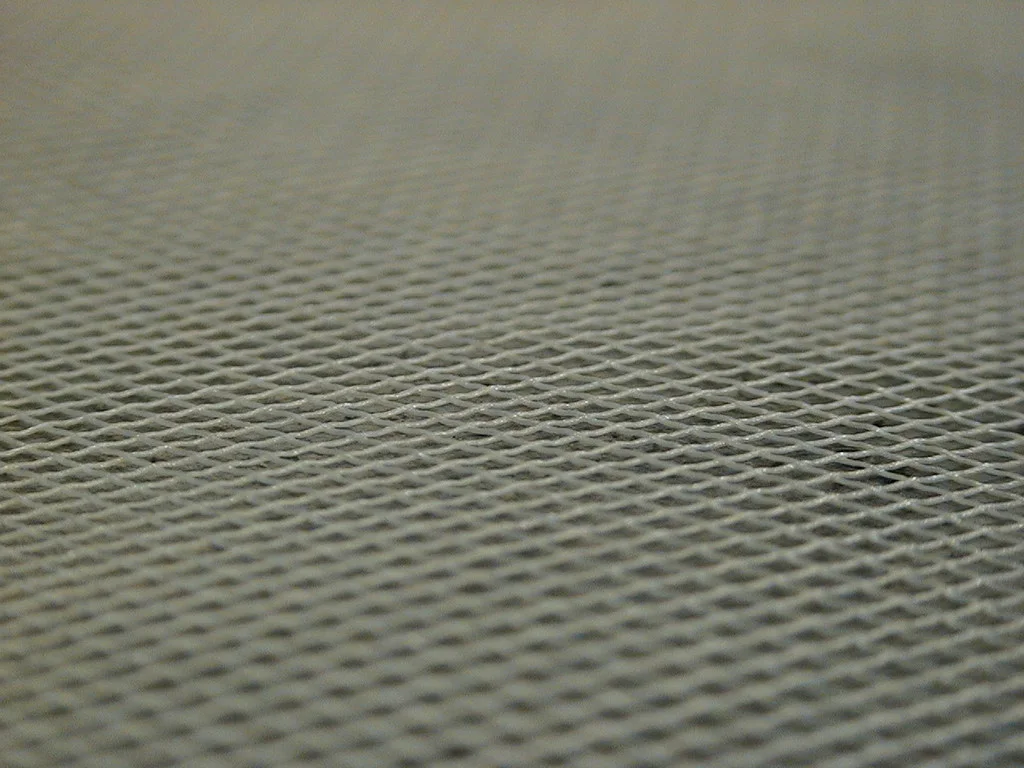
Photo: thisisbossi, Flickr, CC BY-SA 2.0
The close-up above shows the kind of fine mesh teams embed in the walls of a concrete canoe. Because the hull is so thin, the reinforcement must be thin, light and strong, and it must have enough open area for the concrete to pass through and bond. Teams typically place one or more layers of mesh between layers of concrete, run extra layers along the gunwales and at the ends where stresses concentrate, and sometimes add transverse ribs or bulkheads for stiffness. Structural analysis treats the concrete canoe as a beam supported by water pressure and loaded by paddlers, checking bending and shear in cases such as paddling, carrying and display stands. Concrete canoe design uses the same principles as reinforced concrete in buildings, at a much smaller scale. See glass fiber reinforced concrete.
How a Concrete Canoe Is Built
1. Hull design. Teams choose length, width, depth, rocker (the curve from bow to stern) and cross-section to balance speed, straight-line tracking and maneuverability for slalom turns, often using naval architecture software.
2. Mix design. The team tests many trial batches, measuring density, compressive and tensile strength and workability, to find a mix that is light and strong.
3. Mold. Most teams build a male mold, shaped like the inside or outside of the canoe, from layered foam cut by CNC machine or by hand, then sanded smooth and sealed. Some use female molds or reusable molds.
4. Casting. On casting day, the team applies thin layers of concrete by hand to the mold, embedding the reinforcing mesh between layers and controlling thickness with gauges, often to about 1/2 inch or less. The whole hull is placed in one day to avoid cold joints.
5. Curing. The concrete canoe is moist cured for about 28 days, often in a humid tent or under wet coverings, to develop strength and reduce cracking. See how long does concrete take to cure.
6. Demolding and finishing. The hull is removed from the mold, sanded, patched, stained and sealed, and graphics are added.
7. Testing and practice. Paddlers practice in the finished canoe, and the team tests flotation and handling before competition.
The ASCE Concrete Canoe Competition
Concrete canoe racing began on college campuses. At the University of Illinois, students built what is generally described as the first modern concrete canoe by the end of 1970: a 370 pound craft named Mis-Led. Purdue challenged Illinois, and the first intercollegiate concrete canoe race took place on May 16, 1971, at Kickapoo State Park in Illinois. Through the 1970s, other ASCE student chapters held regional races, and the American Society of Civil Engineers held the first national concrete canoe competition in 1988 at Michigan State University, with 18 teams.
Today, dozens of universities compete in regional ASCE student conferences, and top teams advance to the national finals. Teams are judged on several components, which in recent years have included:
Technical proposal or design report describing the hull design, mix design, structural analysis, construction and project management.
Presentation to judges, with questions on engineering decisions.
Final product evaluation of the canoe and display, including craftsmanship and aesthetics.
Races such as men's, women's and coed sprints and slaloms, where the canoe must perform on the water.
Rules change from year to year, often with a theme or a specific requirement such as a mandatory hull shape, aggregate or reinforcement percentage, to keep teams innovating. Check the current rules on ASCE's site.
Concrete Canoe Dimensions and Weight
Concrete canoes vary with rules and design, but typical competition hulls are about 18 to 22 feet long, roughly 2 to 3 feet wide, and around 12 to 16 inches deep. Wall thickness is often only about 3/8 to 3/4 inch. Early concrete canoes weighed 300 to 500 pounds or more; modern concrete canoes made with lightweight concrete and efficient reinforcement commonly weigh about 100 to 300 pounds, though some rules years have required heavier or specific designs.
Concrete Canoe Mix Design in Detail
Mix design is where many concrete canoe teams win or lose. The goal is a concrete that is light, strong enough in tension and compression, workable in thin layers, and durable. Teams usually start with the previous year's mix and test changes one at a time:
Density. Measured on fresh and hardened samples. Mixes below about 62.4 pounds per cubic foot float on their own, but very light mixes often lose strength, so teams balance density against strength.
Compressive strength. Tested on small cylinders or cubes at 7, 14 and 28 days. Concrete canoe mixes are generally much weaker than structural concrete, but strong enough for the stresses calculated in the hull.
Tensile and flexural strength. Tested with split-cylinder or beam tests, often with mesh, since bending of the thin hull governs design.
Workability. The mix must stay on curved, vertical mold surfaces without sagging, yet be easy to trowel through the mesh.
Aggregate grading. Teams blend several lightweight aggregates by size to pack them tightly, reducing the amount of heavy cement paste needed.
Durability. Some teams test absorption and freeze-thaw behavior, since a concrete canoe spends its life wet and outdoors.
The results are written up in the design report, and many concrete canoe mix designs are shared in technical papers and conference proceedings, which is one way the competition advances lightweight concrete technology.
Hull Design for Speed and Turning
A concrete canoe must perform in very different races. Long, narrow hulls with little rocker go fast in a straight line for sprints, while shorter hulls with more rocker turn more easily around slalom buoys. Teams use naval architecture software to compare hull shapes for resistance, stability and tracking, sometimes testing scale models in a flume, as in early hydrodynamics testing at many universities. The final concrete canoe hull is usually a compromise between sprint speed and slalom agility, with enough freeboard to keep water out when paddlers lean into turns, and enough stability for coed races with four paddlers.
Common Concrete Canoe Problems
Shrinkage cracking. Thin, cement-rich mixes shrink, and cracks can open during curing. Moist curing, fibers and shrinkage-reducing admixtures help.
Delamination. Layers of concrete placed at different times can separate if they dry too much between layers. Teams keep each layer moist and work quickly.
Thickness variation. Thick spots add weight; thin spots expose mesh and crack. Thickness gauges and careful troweling keep walls even.
Demolding damage. Pulling a fragile concrete canoe off a mold can crack it. Release agents, flexible molds and careful lifting are essential.
Leaks. Hairline cracks can let water in. Patching with the same mix and sealing are allowed within the rules in most years.
Starting a Concrete Canoe Team
Most concrete canoe teams are run through a university's ASCE student chapter, with a faculty advisor and student captains. New teams typically:
Recruit across years and majors. Civil engineering students lead, but mechanical engineers, artists and business students help with molds, aesthetics and fundraising.
Read the rules early. ASCE publishes the competition rules each year, often in the fall, with specific requirements for the concrete canoe and the report.
Find space and sponsors. A concrete canoe needs a workspace for mold building, casting and curing for months, plus materials, travel and paddling gear.
Plan the schedule. Mix testing in the fall, mold building and casting in winter, 28 days of curing, finishing and paddling practice in spring before the regional conference.
How Much Does a Concrete Canoe Cost?
A concrete canoe project's budget varies widely. Materials such as cement, lightweight aggregates, mesh, admixtures, stains and sealers may cost from a few hundred to a few thousand dollars, and mold materials, foam and CNC cutting can add similar amounts. Travel to regional and national competitions often costs more than the canoe itself. Teams fund their concrete canoe through university support, ASCE chapters, and sponsorships from concrete suppliers, admixture companies, contractors and engineering firms, which value the competition as a recruiting ground.
Paddling a Concrete Canoe
Racing a concrete canoe is surprisingly similar to racing a lightweight canoe, but heavier hulls carry more momentum and turn more slowly. Paddlers practice starts, turns and coordination, since races are short and decided by seconds. Wearing life jackets is required, and teams practice capsizes and swamping to be sure the concrete canoe behaves as designed. Many paddlers say the hardest part is getting used to how stable and solid a concrete canoe feels compared with a recreational canoe.
What Students Learn From the Concrete Canoe
The concrete canoe competition is valued by engineering schools and employers because it packs a full project into one academic year: materials research, structural analysis, design, scheduling, budgeting, quality control, construction, technical writing, presentations and teamwork under deadlines. Many professionals in concrete, structural engineering and construction management point to their concrete canoe team as the experience that prepared them most for real projects. Students learn firsthand how concrete behaves: how water content affects strength, why curing matters, how reinforcement controls cracking, and how small changes in a mix change density and workability.
Transporting and Displaying a Concrete Canoe
A finished concrete canoe is fragile in bending and must be supported along its length. Teams build custom cradles and trailers with padded supports at several points, strap the hull gently, and avoid sudden jolts. At competitions, concrete canoes are displayed on stands alongside cross-sections, material samples and posters explaining the design, and the display itself is often judged.
Building a Concrete Canoe as a Personal Project
Hobbyists and teachers sometimes build small concrete canoes or concrete boats as personal or classroom projects. A simple approach uses a foam or wood male mold, a lightweight mortar with perlite or expanded glass aggregate, and fiberglass mesh, applied in thin layers and moist cured for several weeks. Small concrete boats for ponds are a good way to learn the principles before attempting a full-size concrete canoe. Always test flotation in shallow water with life jackets, and add foam flotation if the concrete is denser than water.
Concrete Canoe vs Regular Canoe
Weight. A recreational aluminum or plastic canoe weighs about 50 to 90 pounds; a racing kevlar canoe may weigh under 40. A concrete canoe commonly weighs 100 to 300 pounds, so it takes several people to carry.
Durability. Concrete resists sun and abrasion but cracks under impact and bending. A concrete canoe should never be dragged over rocks or dropped.
Performance. Well-designed concrete canoes paddle surprisingly well, with hull shapes similar to racing canoes. Their weight gives momentum and stability but makes acceleration and turns slower.
Cost and purpose. A concrete canoe is an engineering showcase, not a practical boat for camping trips, though some retired competition hulls are paddled for fun for years.
Safety in Concrete Canoe Racing
Competition rules put safety first. Paddlers wear approved life jackets, safety boats and rescue swimmers patrol the course, and every concrete canoe must stay afloat when swamped, which is why flotation testing is part of the event. Teams also wear protective equipment in the lab and during casting, since wet concrete is caustic and some lightweight aggregates and fibers create dust. Lifting a heavy concrete canoe requires enough people and good lifting technique to avoid injuries and damage to the hull.
Concrete Canoe Competitions Around the World
The ASCE event is the best-known concrete canoe competition in North America, with regional conferences across the United States and participation by Canadian universities in some years. Concrete canoe racing has also spread abroad. Germany and the Netherlands hold well-known concrete canoe regattas with university and student teams, often with creative categories for unusual boat designs, and other countries host their own student concrete canoe events. The basic challenge is the same everywhere: build a boat from a material that seems destined to sink, and make it fast.
Innovations From Concrete Canoe Teams
Over the decades, concrete canoe teams have experimented with ideas later explored in the wider concrete industry: ultra-lightweight aggregates, high-performance fibers, carbon and basalt reinforcing meshes, polymer-modified mixes, recycled materials as aggregates, sustainable binders that reduce Portland cement, 3D printed and CNC-milled molds, and digital structural modeling of thin shells. Students who design a concrete canoe often go on to work with precast, architectural and thin-shell concrete, where the same goal applies: maximum strength with minimum material.
The Science Behind a Floating Concrete Canoe: A Worked Example
Consider a concrete canoe 20 feet long with a hull surface area of about 90 square feet and walls 1/2 inch thick. The concrete volume is about 90 x 0.042, or roughly 3.75 cubic feet. With a lightweight mix of 60 pounds per cubic foot, the concrete weighs about 225 pounds; with normal concrete at 145 pounds per cubic foot, it would weigh about 545 pounds. Add two paddlers at 350 pounds combined, and the lightweight concrete canoe must displace about 575 pounds of water, roughly 9.2 cubic feet. A canoe hull 20 feet long and 2.5 feet wide only needs to sink a few inches to displace that much, leaving plenty of freeboard. If the same lightweight canoe is swamped, the concrete itself, at 60 pounds per cubic foot, is slightly lighter than the water it displaces, so the hull still floats. The normal-weight version would sink when swamped. That simple calculation explains why lightweight mix design is at the heart of every concrete canoe.
Concrete Canoe Graphics and Aesthetics
Part of the fun of a concrete canoe is its look. Teams choose a theme each year and decorate the hull with concrete stains, colored concrete inlays and sealers, creating elaborate designs, logos of the team's choosing and artwork that reflects the theme. Because judges often score the final product and display, aesthetics matter. Inlays are typically placed by casting colored concrete in recessed areas of the mold, so the art becomes part of the concrete itself rather than a paint layer. The finished concrete canoe is often displayed in an engineering building lobby for years after its racing season, inspiring the next team.
Concrete Boats and Ships
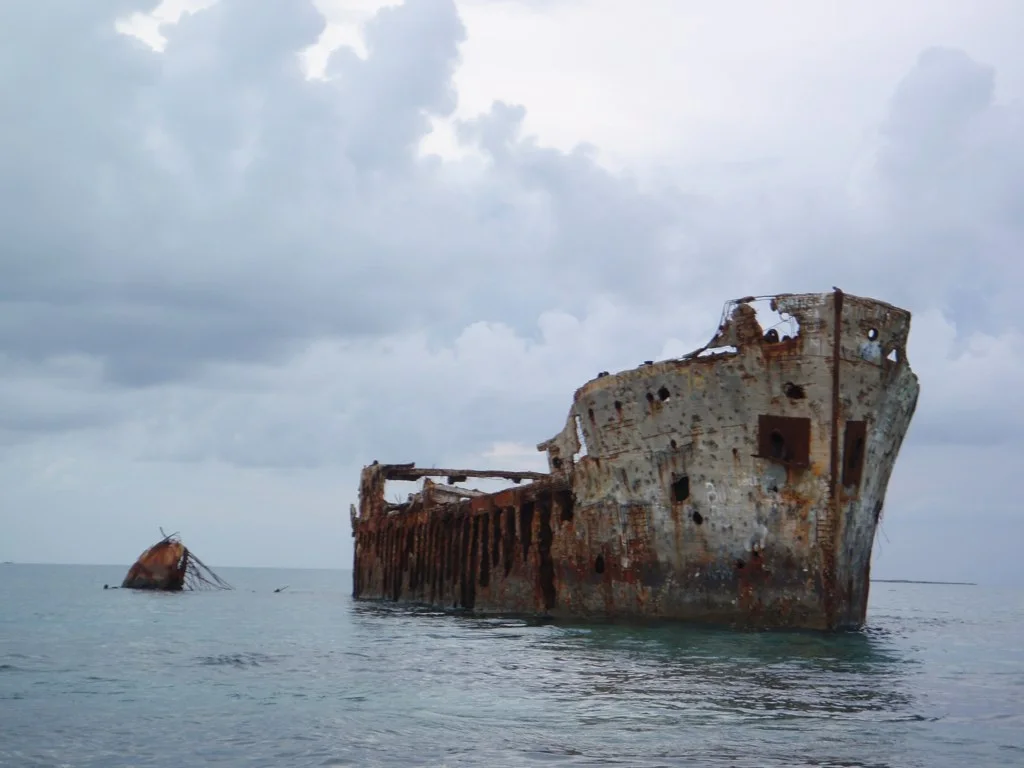
Photo: miamism, Flickr, CC BY 2.0
The concrete canoe is part of a long tradition of concrete boats. In 1848, Frenchman Joseph-Louis Lambot built a small rowboat of cement mortar over iron mesh, an early example of ferrocement and of reinforced concrete itself. During World War I and World War II, steel shortages led the United States and other countries to build concrete cargo ships and barges. Several survive as wrecks and breakwaters, such as the hulk shown above off Bimini in the Bahamas and the fleet of concrete ships forming a breakwater at Kiptopeke, Virginia. Ferrocement sailboats were popular with amateur builders in the 1960s and 1970s. Concrete floating docks, pontoons and even floating bridges are still built today.
Frequently Asked Questions
How thick are concrete canoe walls?
Often only about 3/8 to 3/4 inch, with one or more layers of reinforcing mesh inside.
What makes concrete canoe concrete light?
Lightweight aggregates such as glass microspheres, expanded glass, perlite and expanded shale replace sand and gravel, cutting density to roughly 50 to 70 pounds per cubic foot.
How long does it take to build a concrete canoe?
Most teams spend an academic year: a few months of mix testing and design, a few weeks building the mold, one day casting, 28 days curing, and several weeks finishing and practicing.
Can I paddle a concrete canoe for fun?
Yes, retired competition canoes are often paddled on calm water, but handle them gently, keep them supported when out of the water, and always wear a life jacket.
Does a concrete canoe really float?
Yes. Its hollow hull displaces enough water to float, and lightweight concrete keeps it afloat even when swamped.
How much does a concrete canoe weigh?
Modern competition concrete canoes commonly weigh about 100 to 300 pounds, far less than the 370 pound first canoe built in 1970.
When did concrete canoe racing start?
The first modern concrete canoe was built at the University of Illinois in 1970, and the first intercollegiate race was held in 1971. ASCE's national competition began in 1988.
Who can compete in the ASCE Concrete Canoe Competition?
Teams from ASCE student chapters at universities, competing first at regional conferences. The top concrete canoe teams from each region qualify for the national finals, usually held in early summer at a host university, where they race and present against the best teams in the country.
Sources
- American Society of Civil Engineers: ASCE Concrete Canoe Competition
- University of Illinois: Forty Years of Concrete Canoe
- ASCE: past concrete canoe winners
- American Concrete Institute: ACI 213 lightweight aggregate concrete and ACI 549 ferrocement
Related Guides
- Concrete slide — hillside and playground slides, plus concrete sliders (knee boards)