
Fiber Concrete: Types, Doses, Cost and When Fibers Replace Mesh
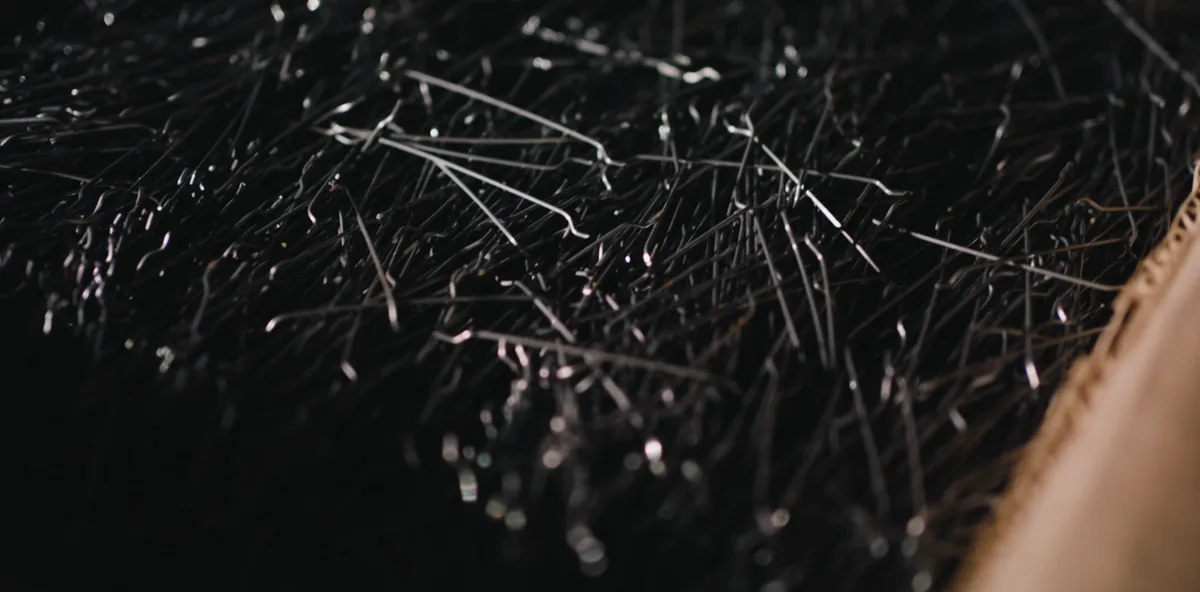
Photo: Primekss, Wikimedia Commons, CC0.
Quick Answer
Fiber concrete, or fiber reinforced concrete, is concrete with short fibers of plastic, steel or glass mixed in at the plant or in the mixer. Synthetic microfibers (about 1 to 1.5 pounds per cubic yard) reduce early plastic shrinkage cracks but add little strength. Macro synthetic fibers (about 3 to 8 pounds per yard) and steel fibers (about 25 to 60 pounds per yard) hold cracks together after they form and can replace light wire mesh in many slabs on the ground when the mix is designed for it. Fibers do not replace rebar in structural concrete or in heavily loaded slabs, and they do not replace control joints. Ready-mix plants typically charge about $5 to $15 per yard for microfibers and more for macro or steel fibers.
Ask for "fiber" when you order a load of ready-mix and the plant will add a bag of fibers to the drum, where they spread through the whole batch as it mixes. Fiber concrete has become one of the most common upgrades for driveways, patios, sidewalks and garage floors, because it costs little and needs no extra work on site. But "fiber" covers several very different products, and they do very different jobs. A bag of fine polypropylene fibers and a dose of steel fibers are not interchangeable.
This guide explains how fibers in concrete work, the main types of concrete fibers, dosage per yard, what fiber concrete costs, how it finishes, where fiberglass mesh for concrete fits in, and how fiber reinforcement for concrete compares with wire mesh and rebar.
What Is Fiber Reinforced Concrete?
Fiber reinforced concrete, or fiber concrete for short, is ordinary concrete with millions of short, discrete fibers spread evenly through it. Instead of a single layer of steel at one depth, like wire mesh or rebar, the fibers run in every direction through the whole thickness of the slab, from the bottom to the finished surface.
The idea is old. Builders added straw and horsehair to mud bricks and plaster for thousands of years. Modern concrete reinforcement fibers date from the 1960s and 1970s, when steel and then polypropylene fibers were developed for concrete. Today the American Concrete Institute's Committee 544 covers fiber reinforced concrete, and ASTM C1116 is the standard specification for fiber-reinforced concrete.
How Fibers in Concrete Work
Concrete cracks for two broad reasons. In the first hours, while it is still plastic, the surface can dry faster than water bleeds up to replace it, and it shrinks and cracks: plastic shrinkage cracks. Over the following weeks and months, the hardened concrete keeps shrinking as it dries, and temperature changes and loads add stress: drying shrinkage and structural cracks.
- Before it hardens, fibers in concrete act like a three-dimensional net that holds the fresh paste together, reduces bleeding and settlement, and resists the small tensile stresses that cause plastic shrinkage cracks.
- After it hardens, fine fibers have done most of their work. Larger macro and steel fibers keep working: when a crack opens, the fibers bridge it and pull the two sides together, so the concrete keeps carrying load after cracking. Engineers call that post-crack or residual strength, or toughness.
Concrete fibers do not make concrete stronger in compression in any meaningful way, and they do not stop a slab from cracking because of shrinkage, settlement or overload. Control joints still decide where a slab cracks. See why concrete cracks.
Types of Concrete Fibers
Synthetic microfibers
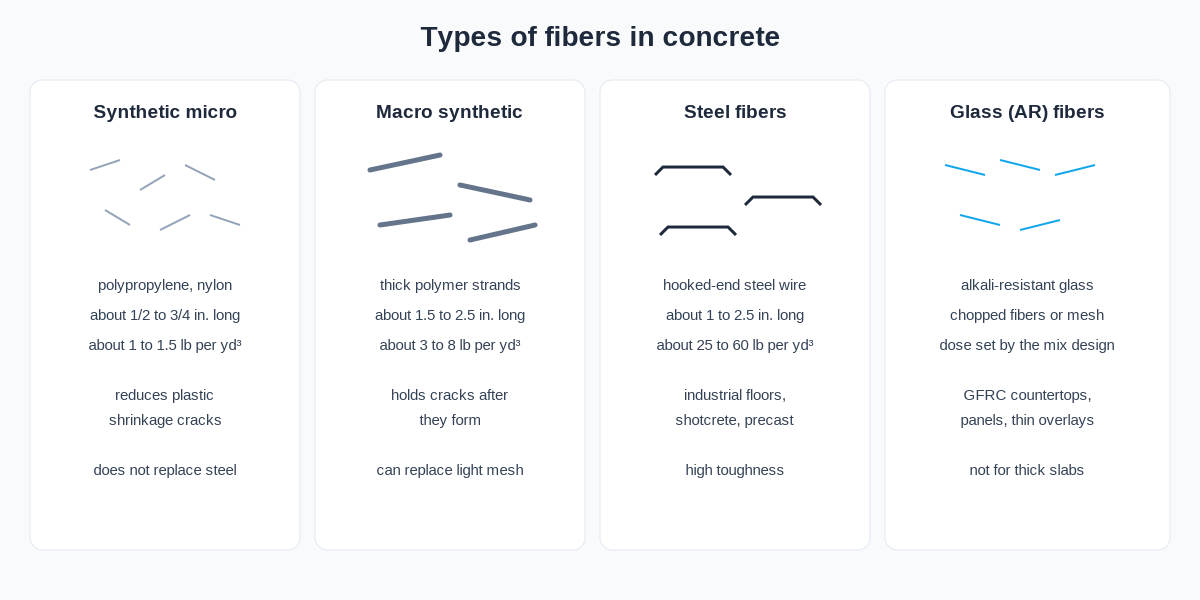
The most common fiber for concrete in homes is a fine polypropylene or nylon fiber, about 1/2 to 3/4 inch long, either single strands (monofilament) or a fibrillated net that opens up in the mixer. Typical dosage is about 1 to 1.5 pounds per cubic yard, or roughly 0.1 percent by volume. These concrete fibers reduce plastic shrinkage cracking, bleeding and surface crazing, and some improve impact and abrasion resistance. They do not carry meaningful load after the concrete cracks, so they are not a replacement for mesh or rebar in slabs that need steel.
Macro synthetic fibers
Macro synthetic fibers are much thicker and longer, about 1-1/2 to 2-1/2 inches, made from polypropylene or polyolefin blends. They are dosed at about 3 to 8 pounds per cubic yard, sometimes more. Because they are stiff and long, these concrete reinforcing fibers bridge cracks after the slab hardens, holding them tight much like light wire mesh. Many manufacturers and engineers use macro fibers as concrete reinforcement fibers in place of welded wire mesh for slabs on the ground, sidewalks, driveways and shotcrete, based on test results for residual strength. They do not rust.
Steel fibers
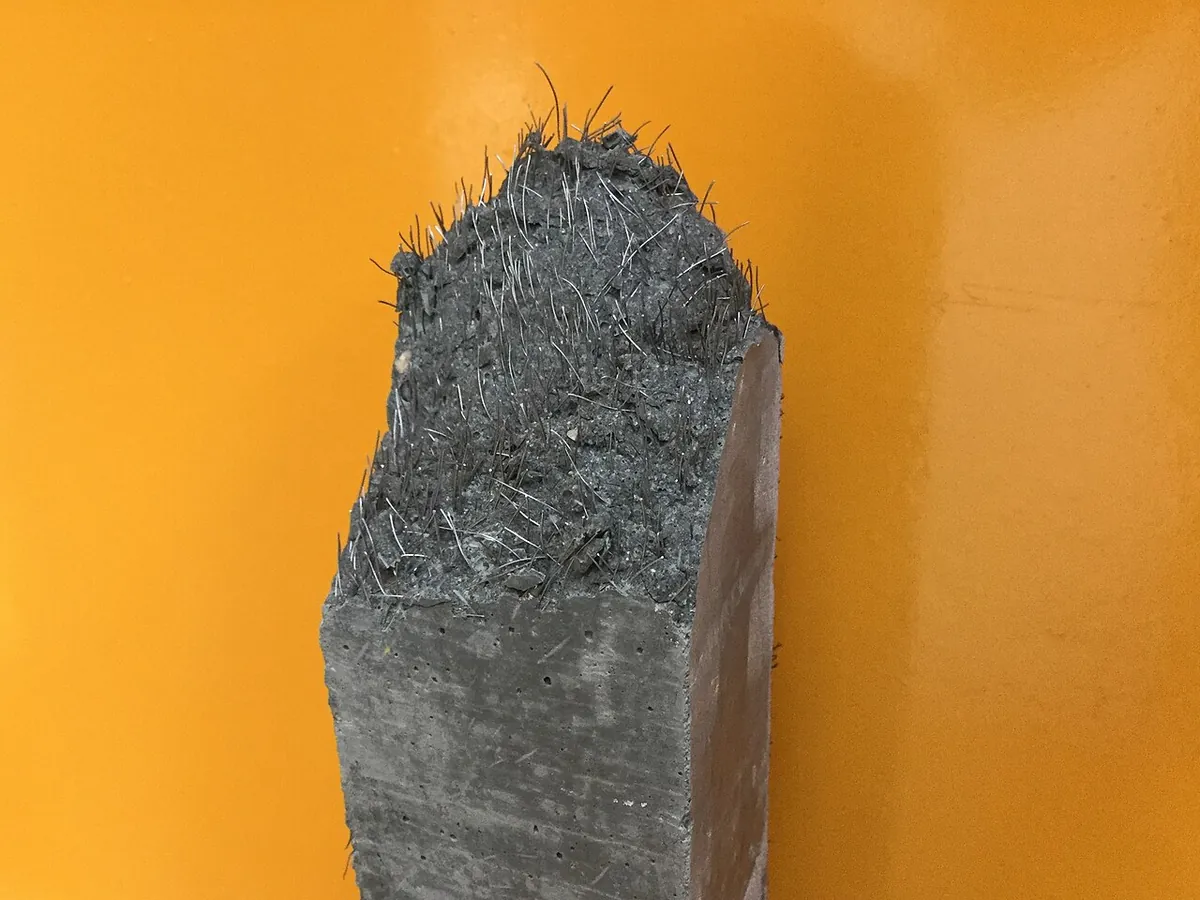
Photo: Bianca Paola Maffezzoli, Wikimedia Commons, CC BY-SA 4.0
Steel fibers for concrete are short pieces of steel wire, usually 1 to 2-1/2 inches long, with hooked or deformed ends that anchor them in the paste. Doses commonly run about 25 to 60 pounds per cubic yard. Steel fiber concrete has high toughness and impact resistance and is widely used in warehouse and industrial floors, tunnel linings, shotcrete, precast pieces and ultra-high performance concrete, like the broken sample above, where the fibers hold the pieces together long after the concrete fails. Fibers at the surface can rust and leave small stains, which matters on decorative work.
Glass fibers
Alkali-resistant (AR) glass fibers are used mainly in glass fiber reinforced concrete, or GFRC: thin precast panels, decorative facades, sinks and concrete countertops. Ordinary glass dissolves slowly in the alkaline cement paste, so only fibers made for concrete should be used. GFRC is typically sprayed or cast in layers about 1/2 to 3/4 inch thick, which is why it is popular for countertops that need to be light.
Other fibers
PVA (polyvinyl alcohol) fibers bond strongly to cement and are used in bendable concretes and thin products. Basalt fibers, cellulose fibers and natural fibers such as sisal show up in specialty work. For fiber concrete in a driveway or patio, the choice is almost always synthetic micro, macro synthetic or a blend of both.
Fiber Mesh Concrete: What the Term Means
When contractors talk about "fiber mesh concrete" or "concrete fiber mesh", they usually do not mean a sheet of mesh at all. The term comes from an early brand of polypropylene fiber, and it stuck. On a ready-mix ticket, fiber mesh for concrete normally means synthetic fibers mixed into the load, typically microfibers at about 1.5 pounds per yard, sometimes a micro and macro blend.
If a contractor quotes concrete with fiber "instead of mesh", ask which fiber and what dose. A light dose of microfibers does not replace the job that steel mesh or rebar does after a slab cracks. A macro fiber dose designed for the slab can.
Fiberglass Mesh for Concrete
Fiberglass mesh for concrete is a different product again: a woven or laid grid of alkali-resistant glass strands, sold in rolls, often coated to protect the glass. It is used where a slab or coating is too thin for steel:
- Thin concrete overlays and resurfacers, embedded in the base coat to reduce cracking. See how to resurface concrete.
- Stucco, plaster and exterior insulation systems.
- GFRC countertops and panels, as a layer of reinforcement between sprayed coats.
- Crack bridging in some patch and overlay systems.
Fiberglass mesh is not a substitute for welded wire mesh or rebar in a 4-inch slab. There is also fiberglass rebar (GFRP bars), a rust-proof alternative to steel bars used in marine work, bridge decks and some pools, which is designed like rebar, not like fibers.
Concrete Fiber Reinforcement Dosage Table
| Fiber | Length | Typical dose per cubic yard | Main job |
|---|---|---|---|
| Synthetic micro | 1/2–3/4 in. | 1–1.5 lb | Plastic shrinkage cracks, surface durability |
| Macro synthetic | 1-1/2–2-1/2 in. | 3–8 lb (sometimes more) | Hold cracks after hardening; can replace light mesh |
| Micro + macro blend | Mixed | Per manufacturer, often 4–6 lb total | Both early and later crack control |
| Steel | 1–2-1/2 in. | 25–60 lb | Toughness, impact, industrial floors |
| AR glass (GFRC) | Chopped | Set by GFRC mix design | Thin, light precast and countertops |
Always use the fiber in concrete dose on the manufacturer's data sheet for the job. Too little fiber does little; too much makes the concrete stiff and hard to place and finish, and the temptation is then to add water, which weakens the mix and increases shrinkage.
Fiber Reinforced Concrete vs Wire Mesh vs Rebar
| Reinforcement | Plastic shrinkage cracks | Holds cracks after hardening | Structural loads | Placement |
|---|---|---|---|---|
| Microfibers | Good | Little | No | Mixed in, none on site |
| Macro or steel fibers | Good | Good | Limited, by design | Mixed in, none on site |
| Welded wire mesh | Little | Good if placed right | Light | Must be held on chairs |
| Rebar | Little | Very good | Yes | Tied grid on chairs |
The big practical advantage of fiber reinforcement for concrete is placement. Mesh and rebar only work at the right depth, and on many home jobs they end up on the ground. Fibers are everywhere in the slab, including the top inch where cracks start, and no one can step on them or forget the chairs.
The big limitation is load. For footings, walls, beams, suspended slabs and anything on structural plans, fibers do not replace the steel the design calls for. For heavy driveways, RV pads and slabs on poor soil, most contractors still use rebar, often with fibers added. A common choice for home driveways is concrete with fiber plus rebar: the fibers fight early surface cracks and the bars hold the slab together over the long run.
Where Fiber Concrete Makes Sense
- Patios, sidewalks and walkways, where microfibers or a macro blend are often the only reinforcement.
- Driveways and garage floors, usually as an addition to rebar or mesh, or with macro fibers designed to replace light mesh.
- Hot, dry or windy pours, where plastic shrinkage cracking is the biggest risk.
- Stamped and decorative concrete, where microfibers reduce surface cracking (see note on finishing below).
- Pool decks, steps and thin sections, where it is hard to fit steel with enough cover.
- Countertops, panels and planters, using GFRC or fiberglass mesh.
- Shotcrete and industrial floors, using steel or macro fibers.
For thickness by slab type, see concrete slab thickness.
Fiber Concrete for Driveways, Patios and Garage Floors
Patios and walkways. For a 4-inch patio or sidewalk on firm, well-drained soil, fiber concrete is often the only reinforcement used. Microfibers handle plastic shrinkage cracks; a macro synthetic dose, or a micro and macro blend, also holds later shrinkage cracks tight the way light mesh would. With joints every 8 to 10 feet and good curing, that is a solid, low-cost slab.
Driveways. A driveway carries cars, delivery vans and sometimes heavier trucks, often near the edges. Most contractors pour driveways as concrete with fiber plus rebar or heavy mesh sheets, or with a macro fiber dose designed as the main reinforcement on good soil. If a quote just says "fiber", ask which fiber and dose. See how thick a concrete driveway should be.
Garage floors. Indoors, slabs are protected from weather, so fibers in concrete mostly help with early cracking, surface durability and impact. Garages that hold heavy vehicles, car lifts or workshop equipment still need rebar or a designed steel fiber floor. Fiber at the surface can also slightly improve resistance to chipping from dropped tools.
Pool decks and steps. Thin sections and tight shapes are hard to reinforce with bars. Fiber concrete fills every corner of the forms, which is one reason fibers are common in steps, curbs and pool deck overlays.
How Much Does Fiber Concrete Cost?
Fiber concrete is one of the cheapest upgrades you can order. Typical U.S. prices:
- Microfibers added at the plant: about $5 to $15 per cubic yard.
- Macro synthetic fibers: about $15 to $45 per cubic yard, depending on dose.
- Steel fibers: about $40 to $100 or more per cubic yard, depending on dose.
- Bags of microfiber for DIY mixing: about $8 to $20 for a 1 to 1.5 pound bag, enough for about one yard.
On a 20 by 20 foot, 4-inch slab, about 5 cubic yards, microfibers add roughly $25 to $75 to the order, far less than the cost of a single repair. See concrete slab cost, concrete driveway cost and concrete price per yard for full prices.
Concrete With Fiber: Placing and Finishing Tips
- Order it at the plant. Fibers in concrete spread most evenly when added with the other ingredients or into the truck with enough mixing time, usually at least 4 to 5 minutes at mixing speed.
- Do not add water because the mix looks stiffer. Fibers reduce slump a little. If you need more workability, ask for a water-reducing admixture.
- Finish with magnesium tools and float in the direction that pushes fibers down rather than pulling them up.
- Expect some "fuzz". A few microfibers can show on a broom finish. They wear off with traffic or can be removed by passing a propane torch flame quickly over the dry surface once the concrete is cured.
- Watch macro and steel fibers on decorative work. They are harder to hide in stamped or exposed finishes; ask the supplier about fibers made for finishing.
- Still cut control joints on time and at the right depth.
- Still cure the slab. Fibers are not a substitute for curing; see how long concrete takes to cure.
Adding Fiber to Bagged Concrete
Many bagged mixes are sold as fiber concrete, with fibers already in them, labeled crack-resistant or fiber-reinforced. You can also buy loose fiber for concrete and add it yourself. A cubic yard of concrete is about 45 bags of 80-pound mix, so a 1.5-pound bag of microfiber dosed per yard works out to about a third of an ounce, roughly 15 grams, per 80-pound bag. Add the fiber to the mixer with the water and part of the dry mix, then the rest of the bags, and mix a little longer than usual so the fibers separate. See how many bags of concrete in a yard and concrete cement mixers.
Fiber Concrete in Hot, Dry and Windy Weather
Plastic shrinkage cracks are the problem fiber concrete solves best, and they are a hot-weather problem. They show up as short, parallel or zigzag cracks a few inches to a few feet long, often within an hour or two of finishing, when sun, wind and low humidity pull water out of the surface faster than bleed water can rise to replace it. The American Concrete Institute's hot weather guide (ACI 305) treats an evaporation rate of about 0.2 pounds of water per square foot per hour as a level where precautions are needed, and lower for some mixes.
Concrete reinforcing fibers help by holding the fresh surface together while it is weakest. They work best alongside the usual hot-weather steps, not instead of them:
- Pour early in the morning, and schedule the truck so the crew is ready.
- Dampen the base and forms before the pour, without leaving puddles.
- Use sunshades or windbreaks on exposed sites.
- Spray an evaporation retarder on the surface between finishing passes if the surface is drying too fast.
- Start curing as soon as finishing is done, with curing compound, wet coverings or water.
How Fiber Reinforced Concrete Is Tested and Specified
For microfibers, the main test looks at plastic shrinkage cracking: panels of plain concrete and concrete with fiber are exposed to fans and heat, and the total crack area is compared (ASTM C1579). Fiber makers publish crack-reduction results from tests like these.
For macro synthetic and steel fibers, the important number is residual strength: how much load a cracked beam of fiber reinforced concrete can still carry. ASTM C1609 measures it by bending beams until they crack and then continuing to load them. Engineers use these results, and guides from ACI Committee 544 and ACI 360 for slabs on ground, to calculate a fiber dose that matches the crack control of a given wire mesh or light rebar grid. That is why manufacturers publish "equivalency" tables saying, for example, that a certain dose of their macro fiber replaces 6x6 W1.4xW1.4 mesh in a 4-inch slab. Those tables are product-specific; one brand's dose does not transfer to another.
On a written specification, you will typically see the fiber type, the material, the length, the dose in pounds per cubic yard, a reference to ASTM C1116, and for macro fibers a minimum residual strength. On a home job, it is enough to know the fiber type and dose, and to keep the delivery ticket that shows them.
Fibers in Concrete Repairs and Overlays
Concrete fibers also show up in many bagged repair products. Patching mortars, resurfacers, self-leveling underlayments and vertical repair mortars often contain fine synthetic fibers, which help thin layers resist cracking and curling. If you are choosing a patch for a broken edge or shallow spall, a fiber-reinforced repair mortar is a good sign. See concrete patching compound and concrete spalling for repair steps. For thicker repairs and new slabs poured next to old ones, fibers in the new concrete help with early cracks, while dowels or rebar tie the new slab to the old one.
Common Myths About Fiber Concrete
- "Fiber means no cracks." Fiber concrete still shrinks and still cracks; fibers just control the early cracks and keep later cracks tighter.
- "Fiber replaces rebar." Not in structural work or heavily loaded slabs. Macro fibers can replace light mesh in many slabs on ground, by design.
- "Fiber means no joints." Joint spacing stays the same. Some macro fiber designs allow slightly wider joint spacing, but only by engineering.
- "More fiber is always better." Overdosing makes the mix hard to place and finish, and adding water to fix it hurts the concrete.
- "Fiber is a gimmick." For plastic shrinkage cracking, fibers have decades of test data and field use behind them; they just have to be used for the right job.
Questions to Ask Before You Order Fiber Concrete
- Which fiber is it: micro, macro, blend or steel?
- What dose per cubic yard, and is that the manufacturer's dose for this use?
- Is the fiber replacing mesh or rebar, or added to it?
- How will the crew finish it, and will fibers show on a broom or stamped finish?
- What is the slump, and will water be added on site?
- How far apart will control joints be, and when will they be cut?
Fiber in Concrete: Pros and Cons
Pros
- Fiber concrete reduces plastic shrinkage cracks and surface crazing.
- Reinforcement throughout the full depth, including the surface.
- No placement labor and no risk of steel ending up on the ground.
- Synthetic fibers do not rust.
- Macro and steel fibers add toughness and impact resistance.
- Cheap, especially microfibers.
Cons
- Microfibers add little fiber reinforcement for concrete after it cracks.
- Does not replace structural rebar.
- Can show on the surface and make finishing a little harder.
- High doses reduce workability.
- Steel fibers at the surface can leave rust spots.
Frequently Asked Questions
Is fiber concrete as strong as rebar?
No. Concrete fibers reduce early cracking and macro or steel fibers hold cracks together, but rebar carries much more load. Structural concrete still needs the steel the design calls for.
Can fiber replace wire mesh in concrete?
Macro synthetic or steel fibers at a designed dose can replace light wire mesh in many slabs on the ground. A light dose of microfibers cannot.
How much fiber per yard of concrete?
About 1 to 1.5 pounds for synthetic microfibers, about 3 to 8 pounds for macro synthetic fibers and about 25 to 60 pounds for steel fibers. Follow the manufacturer's dose.
Does fiber reinforced concrete still crack?
Yes. Fibers reduce early cracks and keep later cracks tight, but slabs still need control joints, a good base and curing.
What is fiber mesh concrete?
On most ready-mix orders, it means synthetic fibers mixed into the concrete, not a sheet of mesh. The name comes from an early fiber brand.
Is fiberglass mesh for concrete slabs?
No. Fiberglass mesh is for thin overlays, stucco and countertops. A 4-inch slab uses fibers, welded wire mesh or rebar.
How much does fiber add to the cost of concrete?
About $5 to $15 per yard for microfibers, more for macro or steel fibers.
Can I add fiber to concrete myself?
Yes. Buy loose fiber for concrete made for mixer use, add about the dose per yard on the bag, and mix a little longer than usual so the fibers separate evenly.
Do fibers show on the finished surface?
Sometimes a few microfibers show on broomed concrete. They wear off with traffic or can be singed off with a quick pass of a propane torch after curing.
Sources
- American Concrete Institute: Committee 544, Fiber-Reinforced Concrete
- ASTM C1116: Standard Specification for Fiber-Reinforced Concrete
- Portland Cement Association: fiber reinforced concrete and slabs on ground
- Federal Highway Administration: concrete pavement technology
Related Guides
- GFRC concrete guide — glass fiber reinforced concrete for countertops and panels
- Concrete admixture guide — air entrained concrete, water reducers and more
- Shotcrete vs gunite — sprayed concrete for pools and walls
- Concrete bird bath — making, sealing and caring for one
- Concrete cloth — rolled concrete for ditches and slopes
- Concrete canoe — how a concrete boat floats and the ASCE competition